

A systematic review of help-seeking interventions for depression, anxiety and general psychological distress
Open accessThe DOI matches its Crossref record; 58 of the 59 references it cites were found in a registry or an index; 64 of the 177 sources its claims cite were checked for support.
Abstract
BACKGROUND: Depression and anxiety are treatable disorders, yet many people do not seek professional help. Interventions designed to improve help-seeking attitudes and increase help-seeking intentions and behaviour have been evaluated in recent times. However, there have been no systematic reviews of the efficacy or effectiveness of these interventions in promoting help-seeking. Therefore, this paper reports a systematic review of published randomised controlled trials targeting help-seeking attitudes, intentions or behaviours for depression, anxiety, and general psychological distress. METHODS: Studies were identified through searches of PubMed, PsycInfo, and the Cochrane database in November 2011. Studies were included if they included a randomised controlled trial of at least one intervention targeting help-seeking for depression or anxiety or general psychological distress, and contained extractable data on help-seeking attitudes or intentions or behaviour. Studies were excluded if they focused on problems or conditions other than the target (e.g., substance use, eating disorder). RESULTS: Six published studies of randomised controlled trials investigating eight different interventions for help-seeking were identified. The majority of trials targeted young adults. Mental health literacy content was effective (d = .12 to .53) in improving help-seeking attitudes in the majority of studies at post-intervention, but had no effect on help-seeking behaviour (d = -.01, .02). The…
Overview
CoChat Summary
## TL;DR
This systematic review found 6 randomized controlled trials of help-seeking interventions for depression, anxiety, and general psychological distress, covering 8 intervention conditions. Mental health literacy interventions improved help-seeking attitudes (effect sizes d = .12 to .53), but there was no evidence that they improved help-seeking behavior.
## Key findings
- The review identified 6 published studies of randomized controlled trials, published between 2004 and 2009, with sample sizes from 80 to 525 and participant ages ranging from 17 to 79 years.
- In all 6 trials, at least one intervention improved at least one help-seeking outcome at post-test; for the 5 studies that measured attitudes, willingness, or beliefs, at least one intervention improved help-seeking attitudes, with effect sizes from d = .12 to .53.
- Help-seeking behavior was harder to change: only 1 of 3 studies measuring behavior found a significant post-test effect, with a small effect size of d = .24; the review reports no significant intervention effect in the only study measuring intentions.
- Mental health literacy was the most common content type (6 of 8 interventions) and was associated with better attitudes in 5 studies, but none of the 3 studies measuring behavior found an effect from mental health literacy content.
## Methods
- Systematic review of randomized controlled trials targeting help-seeking for depression, anxiety, or general psychological distress, reported according to PRISMA.
- Searches were run in PubMed, PsycINFO, and the Cochrane Library in November 2011; after screening and hand-searching, 6 studies met inclusion criteria.
- Data extraction was done independently by 2 authors, with Cohen’s d calculated for post-test and follow-up comparisons; study quality was rated with the 9-item EPOC risk of bias tool.
## Limitations
- The paper states that help-seeking measures varied across studies, making comparison difficult, and that only one study examined actual help-seeking behavior.
- It also states that searching only 3 databases, restricting inclusion to English-language published journal papers, and relying on published studies only may have introduced bias.
- Evident from the text: the evidence base was small (6 studies), outcomes were heterogeneous, and the authors note that many interventions combined multiple components, making it difficult to isolate which component caused the effects.
Model-written summary. Check it against the paper before relying on it.
Integrity signals
Registry
Cites
Statistics
Figures
Verification
Claims the paper makes
40 Valid · 9 Not valid · 25 Not checked · 45 Own results and interpretations
At least one cited source doesn’t support this claim or points to a different paper, and none confirmed it — see the verdicts below.
In the paper
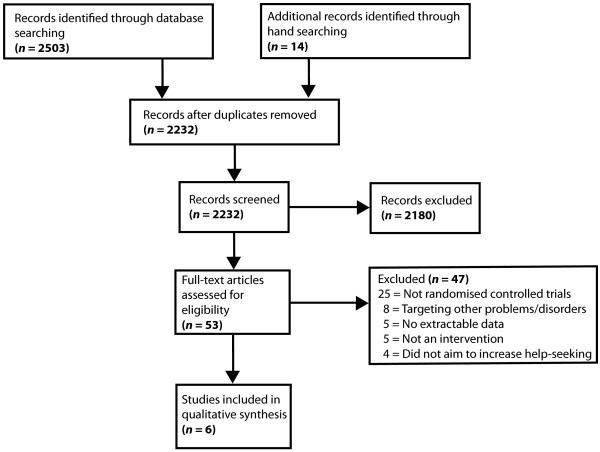
“Six published studies of randomised controlled trials investigating eight different interventions for help-seeking were identified.”
- Also stated in: § Search methodology and inclusion criteria · plain
“This left a total of six relevant studies [37,40-44].”
§ A systematic review of help-seeking interventions for depression, anxiety and general psychological distress > Abstract > Results
What the sources say
- Disputedcites [37] Christensen H Leach LS Barney L Mackinnon AJ Griffiths KM The effect of web based depression interventions on self reported help seeking: randomised controlled trial BMC psychiatry 2006 6 13 16595018 PMC1501008 sourceExperimental — accuracy not yet measured
The Background (page unavailable) says there had been very little research on interventions to increase help-seeking and identifies one randomised controlled study, not six published randomised trials investigating eight interventions. The eight treatments listed in Methods > Measures are items participants could report using, not eight help-seeking interventions tested across trials. (LLM, conf=0.82)
Checked by a reasoning model — may be wrong.
- Could not verifycites [40] Costin DL Mackinnon AJ Griffiths KM Batterham PJ Bennett AJ Bennett K Christensen H Health e-cards as a means of encouraging help seeking for depression among young adults: randomized controlled trial Journal of medical Internet research 2009 11 4 e42 19850549 PMC2802564 sourceExperimental — accuracy not yet measured
The Introduction (page not available) says that three randomized studies had investigated depression information interventions and their effects on help-seeking. The Results report this paper’s own trial. Neither passage establishes the claimed count of six published trials investigating eight help-seeking interventions; searches for those counts found no supporting passage. The narrower count of three does not rule out six trials across a broader range of interventions. (LLM, conf=0.72)
- Not checked — no full text of the sourcecites [41] Donohue B Dickens Y Lancer K Covassin T Hash A Miller A Genet J Improving athletes’ perspectives of sport psychology consultation: a controlled evaluation of two interview methods Behav Modif 2004 28 2 182 193 14997947 source
- Not checked — no full text of the sourcecites [42] Han DY Chen SH Hwang KK Wei HL Effects of psychoeducation for depression on help-seeking willingness: biological attribution versus destigmatization Psychiatry and clinical neurosciences 2006 60 6 662 668 17109699 source
- Not checked — no full text of the sourcecites [43] Sharp W Hargrove D Johnson L Deal W Mental health education: An evaluation of a classroom-based strategy to modify help-seeking for mental health problems J Coll Stud Dev 2006 47 4 419 438 source
- Not checked — no full text of the sourcecites [44] Buckley GI Malouff JM Using modeling and vicarious reinforcement to produce more positive attitudes toward mental health treatment J Psychol 2005 139 3 197 209 15945515 source
plain- Asserted: passes — The authors put it forward as true.
- Checkable: passes — It can be checked against evidence.
- Load-bearing: passes — The paper’s conclusions depend on it.
- Based: passes — The paper gives a reason why it holds.
- Also stated in: § Search methodology and inclusion criteria · plain
Some cited sources support this claim and some don’t — read each source’s verdict below.
In the paper
“Help-seeking behaviour was measured for three interventions [37,40,43], but no differences between the control and experimental condition were found for help-seeking behaviour at post-test for the interventions delivering information targeting mental health literacy.”
§ A systematic review of help-seeking interventions for depression, anxiety and general psychological distress > Results > Trial outcomes
What the sources say
- Disputedcites [37] Christensen H Leach LS Barney L Mackinnon AJ Griffiths KM The effect of web based depression interventions on self reported help seeking: randomised controlled trial BMC psychiatry 2006 6 13 16595018 PMC1501008 sourceExperimental — accuracy not yet measured
The Results and Discussion (page not provided) report differences in help-seeking behaviour between BluePages, the information intervention, and the control condition at post-test. BluePages participants reported less use of music, less help-seeking from family and friends, and fewer everyday treatments. The paper found no increase in seeking specific evidence-based treatments, but that narrower finding does not support the claim of no help-seeking differences. (LLM, conf=0.90)
Checked by a reasoning model — may be wrong.
- Supportedcites [40] Costin DL Mackinnon AJ Griffiths KM Batterham PJ Bennett AJ Bennett K Christensen H Health e-cards as a means of encouraging help seeking for depression among young adults: randomized controlled trial Journal of medical Internet research 2009 11 4 e42 19850549 PMC2802564 source
The Results section (Primary Outcome: Help-Seeking Behavior; page not provided) reports no significant intervention effect on formal or informal help seeking up to six weeks after the intervention. This supports the claim for the intervention studied in this paper; the other two interventions are attributed to separate citations. (LLM, conf=0.94)
- Not checked — no full text of the sourcecites [43] Sharp W Hargrove D Johnson L Deal W Mental health education: An evaluation of a classroom-based strategy to modify help-seeking for mental health problems J Coll Stud Dev 2006 47 4 419 438 source
plain- Asserted: passes — The authors put it forward as true.
- Checkable: passes — It can be checked against evidence.
- Load-bearing: passes — The paper’s conclusions depend on it.
- Based: passes — The paper gives a reason why it holds.
- Disputed
Every source the paper cites for this claim was checked and supports it.
In the paper
“One trial involved an indicated intervention [37] and included participants with high levels of psychological distress only (K-10 scores above or equal to 12).”
§ A systematic review of help-seeking interventions for depression, anxiety and general psychological distress > Results > Sample and participant characteristics
What the sources say
- Supportedcites [37] Christensen H Leach LS Barney L Mackinnon AJ Griffiths KM The effect of web based depression interventions on self reported help seeking: randomised controlled trial BMC psychiatry 2006 6 13 16595018 PMC1501008 source
The Methods > Participants passage says people scoring below 12 on the Kessler Psychological Distress Scale were ineligible. The Methods > Design passage describes the web-based interventions to which eligible participants were randomized. Together, these support describing the trial as an indicated intervention involving participants with K10 scores of at least 12. (LLM, conf=0.91)
plain- Asserted: passes — The authors put it forward as true.
- Checkable: passes — It can be checked against evidence.
- Load-bearing: unclear — It is unclear whether the paper’s conclusions depend on it.
- Based: passes — The paper gives a reason why it holds.
- Supported
The sources with a verdict support this claim; the rest weren’t checked yet, have no full text we could read, or their verdicts aren’t rated yet.
In the paper
“Five out of the six trials involved universal interventions [40-44].”
§ A systematic review of help-seeking interventions for depression, anxiety and general psychological distress > Results > Sample and participant characteristics
What the sources say
- Supportedcites [40] Costin DL Mackinnon AJ Griffiths KM Batterham PJ Bennett AJ Bennett K Christensen H Health e-cards as a means of encouraging help seeking for depression among young adults: randomized controlled trial Journal of medical Internet research 2009 11 4 e42 19850549 PMC2802564 sourceExperimental — accuracy not yet measured
The Methods (Participants and Flow; page not provided) describe a trial recruiting young adults from the community without requiring depression or elevated distress. Both high-distress and low- or no-distress participants were included, supporting this paper’s identification as a trial involving a universal intervention among those cited collectively. (LLM, conf=0.88)
- Not checked — no full text of the sourcecites [41] Donohue B Dickens Y Lancer K Covassin T Hash A Miller A Genet J Improving athletes’ perspectives of sport psychology consultation: a controlled evaluation of two interview methods Behav Modif 2004 28 2 182 193 14997947 source
- Not checked — no full text of the sourcecites [42] Han DY Chen SH Hwang KK Wei HL Effects of psychoeducation for depression on help-seeking willingness: biological attribution versus destigmatization Psychiatry and clinical neurosciences 2006 60 6 662 668 17109699 source
- Not checked — no full text of the sourcecites [43] Sharp W Hargrove D Johnson L Deal W Mental health education: An evaluation of a classroom-based strategy to modify help-seeking for mental health problems J Coll Stud Dev 2006 47 4 419 438 source
- Not checked — no full text of the sourcecites [44] Buckley GI Malouff JM Using modeling and vicarious reinforcement to produce more positive attitudes toward mental health treatment J Psychol 2005 139 3 197 209 15945515 source
plain- Asserted: passes — The authors put it forward as true.
- Checkable: passes — It can be checked against evidence.
- Load-bearing: unclear — It is unclear whether the paper’s conclusions depend on it.
- Based: passes — The paper gives a reason why it holds.
- Supported
The cited sources support only part of this claim — read each source’s verdict below.
In the paper
“Despite the severity of these consequences, it is estimated that up to one-half of those with depression [16-18] and only one third to one-half of those affected by anxiety disorders [8,16] seek professional help.”
§ A systematic review of help-seeking interventions for depression, anxiety and general psychological distress > Background > Help-seeking for anxiety and depression
What the sources say
- Not checked — no full text of the sourcecites [16] Andrews G Hall W Teesson M Henderson S The mental health of Australians 1999 Commonwealth Department of Health and Aged Care, Mental Health Branch, Canberra source
- Not checked — no full text of the sourcecites [17] Bland RC Newman SC Orn H Help-seeking for psychiatric disorders Can J Psychiatry 1997 42 9 935 942 9429063 source
- Partly supportedcites [18] Roy-Byrne PP Stang P Wittchen HU Ustun B Walters EE Kessler RC Lifetime panic-depression comorbidity in the National Comorbidity Survey. Association with symptoms, impairment, course and help-seeking Br J Psychiatry 2000 176 229 235 10755069 sourceExperimental — accuracy not yet measured
Table 3 (Discussion; page not given in our copy) reports past-year service use of 35.5% for major depression alone and 34.4% for panic disorder alone, supporting the point that many people in those groups did not seek help. The paper examines panic disorder, not anxiety disorders generally, and reports 55.2% service use among people with both conditions. (LLM, conf=0.85)
- Supportedcites [8] Andrews G Issakidis C Carter G Shortfall in mental health service utilisation Br J Psychiatry 2001 179 417 425 11689399 source
The Mental disorders section reports that 66.8% of people with a current principal affective disorder consulted, meaning about one-third did not. It also says people with anxiety disorders were less likely to consult than those with affective disorders. This supports the attributed point that many people with depression or anxiety disorders do not seek professional help. (LLM, conf=0.90)
hedged- Asserted: passes — The authors put it forward as true.
- Checkable: passes — It can be checked against evidence.
- Load-bearing: passes — The paper’s conclusions depend on it.
- Based: passes — The paper gives a reason why it holds.
42 more claims · 9 with their cited sources checked
Create a free account to see all 119 claims and to verify the 1 reference still open.
- Probably not a substantial claim. 43
- It may state two separate claims as one. 38
Claims other papers make about this one
Each is checked against this paper’s own text: does it say what the citing paper says it does?
The cited source doesn’t support the claim as written.
In the citing paper
“This is in line with previous studies suggesting that teens who are most in need are less likely to seek help [1, 11, 15].”
From What are the barriers, facilitators and interventions targeting help-seeking behaviours for common mental health problems in adolescents? A systematic review (2020) · cites this paper as [1]
Checked by a reasoning model — may be wrong.
Experimental — accuracy not yet measuredThe cited source doesn’t support the claim as written.
In the citing paper
“However, most interventions that have previously attempted to increase treatment receipt have only increased people's intention to seek treatment, rather than their behaviour (Gulliver et al., 2012).”
From Translating the Intention to Seek Treatment into Action: Does Symptom Monitoring Make a Difference? Results from a Randomized Controlled Trial (2019) · cites this paper as Gulliver et al., 2012
Checked by a reasoning model — may be wrong.
Experimental — accuracy not yet measuredThe cited source doesn’t support the claim as written.
In the citing paper
“The review concluded that these interventions had a positive impact on intention to seek treatment but little effect on actual treatment seeking, with the exception of the computerized CBT intervention (Christensen et al., 2006), which could arguably be considered treatment in and of itself.”
From Translating the Intention to Seek Treatment into Action: Does Symptom Monitoring Make a Difference? Results from a Randomized Controlled Trial (2019) · cites this paper as Gulliver et al., 2012
Checked by a reasoning model — may be wrong.
Experimental — accuracy not yet measuredThe source backs part of the claim, not all of it — or backs it for a different population, condition or comparison.
In the citing paper
“Teens who are most in need of mental health attention are reluctant to seek help.”
From What are the barriers, facilitators and interventions targeting help-seeking behaviours for common mental health problems in adolescents? A systematic review (2020) · cites this paper as [1]
Experimental — accuracy not yet measuredThe source backs part of the claim, not all of it — or backs it for a different population, condition or comparison.
In the citing paper
“However, none of the studies identified in this review analysed results according to gender and none were tailored to address the gender-based attitudes and perceived norms thought to drive male help-seeking behaviour.”
From Silence is deadly: a cluster-randomised controlled trial of a mental health help-seeking intervention for young men (2017) · cites this paper as [10]
Experimental — accuracy not yet measured
12 more claims about this paper
Create a free account to see every claim other papers make about this one.
Citations
Cites
The theory of planned behavior
Ajzen, I. (1991) · Organizational Behavior and Human Decision Processes · doi:10.1016/0749-5978(91)90020-t · Cited by 134,657
Statistical Power Analysis for the Behavioral Sciences
Muller, K. (1989) · Technometrics · doi:10.1080/00401706.1989.10488618 · Cited by 99,167
Preferred Reporting Items for Systematic Reviews and Meta-Analyses: the PRISMA statement
Moher, D., Liberati, A., Tetzlaff, J., Altman, D. G., & for the PRISMA Group (2009) · BMJ · doi:10.1136/bmj.b2535 · Cited by 83,823
Statistical power analysis for the behavioral sciences
(1990) · Computers, Environment and Urban Systems · doi:10.1016/0198-9715(90)90050-4 · Cited by 65,269
Preferred reporting items for systematic reviews and meta-analyses: the PRISMA Statement.
(2009) · PubMed Central · Cited by 44,859
Kessler, R. C., Chiu, W. T., Demler, O., & Walters, E. E. (2005) · Archives of General Psychiatry · doi:10.1001/archpsyc.62.6.617 · Cited by 12,052 · cited 1×
“Depression and anxiety are highly prevalent mental disorders with an estimated 12-month prevalence of 14-18% for anxiety disorders, and 4-7% for depressive disorders in high income countries worldwide [9-11].”
BackgroundRevisiting the Behavioral Model and Access to Medical Care: Does it Matter?
Andersen, R. M. (1995) · Journal of Health and Social Behavior · doi:10.2307/2137284 · Cited by 9,831 · cited 3×
“Theories of help-seeking predict that attitudes and beliefs influence behaviour [22,24,26,27,31].”
BackgroundMethodLopez, A. D., Mathers, C. D., Ezzati, M., Jamison, D. T., & Murray, C. J. (2006) · The Lancet · doi:10.1016/s0140-6736(06)68770-9 · Cited by 5,630
The size and burden of mental disorders and other disorders of the brain in Europe 2010
Wittchen, H. U., Jacobi, F., Rehm, J., Gustavsson, A., Svensson, M., Jönsson, B., Olesen, J., Allgulander, C., Alonso, J., Faravelli, C., et al. (2011) · European Neuropsychopharmacology · doi:10.1016/j.euroneuro.2011.07.018 · Cited by 3,754
Societal and Individual Determinants of Medical Care Utilization in the United States
ANDERSEN, R., & NEWMAN, J. F. (2005) · The Milbank Quarterly · doi:10.1111/j.1468-0009.2005.00428.x · Cited by 3,611 · cited 3×
“Theories of help-seeking predict that attitudes and beliefs influence behaviour [22,24,26,27,31].”
BackgroundMethodGulliver, A., Griffiths, K. M., & Christensen, H. (2010) · BMC Psychiatry · doi:10.1186/1471-244x-10-113 · Cited by 3,292 · cited 1×
“In the case of help-seeking for mental illness, behaviour may be more difficult to change than beliefs as it is external and thus potentially more vulnerable to the stigmatising of others, which in turn has been linked to help-seeking avoidance [49].”
BackgroundSelf-citationSocietal and Individual Determinants of Medical Care Utilization in the United States
Andersen, R., & Newman, J. F. (1973) · The Milbank Memorial Fund Quarterly. Health and Society · doi:10.2307/3349613 · Cited by 2,838
Jorm, A. F., Korten, A. E., Jacomb, P. A., Christensen, H., Rodgers, B., & Pollitt, P. (1997) · Medical Journal of Australia · doi:10.5694/j.1326-5377.1997.tb140071.x · Cited by 2,585 · cited 1×
“These include mental health literacy defined as “knowledge and beliefs about mental disorders which aid their recognition, management or prevention” [33], destigmatisation, which refers to the reduction of stigma surrounding mental disorders [34] often involving personal contact with consumers of mental health service…”
BackgroundSelf-citationWhy People Use Health Services
ROSENSTOCK, I. M. (2005) · The Milbank Quarterly · doi:10.1111/j.1468-0009.2005.00425.x · Cited by 2,325 · cited 2×
“Theories of help-seeking predict that attitudes and beliefs influence behaviour [22,24,26,27,31].”
BackgroundWhy People Use Health Services
Rosenstock, I. M. (1966) · The Milbank Memorial Fund Quarterly · doi:10.2307/3348967 · Cited by 2,305
Mental health literacy: Public knowledge and beliefs about mental disorders
Jorm, A. F. (2000) · British Journal of Psychiatry · doi:10.1192/bjp.177.5.396 · Cited by 2,114
Prevalence and Treatment of Mental Disorders, 1990 to 2003
Kessler, R. C., Demler, O., Frank, R. G., Olfson, M., Pincus, H. A., Walters, E. E., Wang, P., Wells, K. B., & Zaslavsky, A. M. (2005) · New England Journal of Medicine · doi:10.1056/nejmsa043266 · Cited by 1,910
Understanding the impact of stigma on people with mental illness.
(2002) · Europe PMC (PubMed Central) · Cited by 1,786
Hawton, K., & van Heeringen, K. (2009) · The Lancet · doi:10.1016/s0140-6736(09)60372-x · Cited by 1,671
Young People’s Help-Seeking for Mental Health Problems
Rickwood, D., Deane, F. P., Wilson, C. J., & Ciarrochi, J. (2005) · Australian e-Journal for the Advancement of Mental Health · doi:10.5172/jamh.4.3.218 · Cited by 1,619
When and how do young people seek professional help for mental health problems?
Rickwood, D. J., Deane, F. P., & Wilson, C. J. (2007) · Medical Journal of Australia · doi:10.5694/j.1326-5377.2007.tb01334.x · Cited by 1,195
Wantland, D. J., Portillo, C. J., Holzemer, W. L., Slaughter, R., & McGhee, E. M. (2004) · Journal of Medical Internet Research · doi:10.2196/jmir.6.4.e40 · Cited by 966
An Operational Classification of Disease Prevention
Gordon, R. (1987) · PsycEXTRA Dataset · doi:10.1037/e659532007-006 · Cited by 860 · cited 1×
“Help-seeking intervention research has also used two main approaches; universal interventions aimed at the general population, and indicated interventions targeted at those who have mild or early symptoms of a disorder [38].”
BackgroundGeneralized anxiety disorder: prevalence, burden, and cost to society
Wittchen, H.-U. (2002) · Depression and Anxiety · doi:10.1002/da.10065 · Cited by 733 · cited 1×
“use of medical services [8,12].”
Prevalence and Treatment of Mental Disorders
(2005) · New England Journal of Medicine · doi:10.1056/nejmc051936 · Cited by 650
Social-psychological factors affecting help-seeking for emotional problems
Rickwood, D. J., & Braithwaite, V. A. (1994) · Social Science & Medicine · doi:10.1016/0277-9536(94)90099-x · Cited by 583
Help-seeking behaviour in men and women with common mental health problems: cross-sectional study
Oliver, M. I., Pearson, N., Coe, N., & Gunnell, D. (2005) · British Journal of Psychiatry · doi:10.1192/bjp.186.4.297 · Cited by 558 · cited 1×
“Despite this, it is estimated that only one quarter of adults with high levels of mental distress [7] and one third of adults with diagnosable mental disorders seek professional help”
BackgroundRoy-Byrne, P. P., Stang, P., Wittchen, H.-U., Ustun, B., Walters, E. E., & Kessler, R. C. (2000) · British Journal of Psychiatry · doi:10.1192/bjp.176.3.229 · Cited by 446
The mental health of Australians: (676572010-001)
Andrews, G., Hall, W., Teesson, M., & Henderson, S. (2000) · PsycEXTRA Dataset · doi:10.1037/e676572010-001 · Cited by 423 · cited 1×
“that up to one-half of those with depression [16-18] and only one third to one-half of those affected by anxiety disorders [8,16] seek professional help.”
BackgroundShortfall in mental health service utilisation
Andrews, G., Issakidis, C., & Carter, G. (2001) · British Journal of Psychiatry · doi:10.1192/bjp.179.5.417 · Cited by 420 · cited 3×
“untreated including disability [8,13], suicide [14], lowered”
BackgroundInternet-based mental health programs: A powerful tool in the rural medical kit
Griffiths, K. M., & Christensen, H. (2007) · Australian Journal of Rural Health · doi:10.1111/j.1440-1584.2007.00859.x · Cited by 270 · cited 1×
“may be a relatively inexpensive means of delivering treatments to a wide range of people [53], particularly for rural residents [54] whose access to in-person interventions may be limited.”
BackgroundSelf-citationthe ESEMeD/MHEDEA 2000 Investigators, ten Have, M., de Graaf, R., Ormel, J., Vilagut, G., Kovess, V., & Alonso, J. (2010) · Social Psychiatry and Psychiatric Epidemiology · doi:10.1007/s00127-009-0050-4 · Cited by 266
Biddle, L., Donovan, J., Sharp, D., & Gunnell, D. (2007) · Sociology of Health & Illness · doi:10.1111/j.1467-9566.2007.01030.x · Cited by 261 · cited 1×
“The first approach conceptualising help-seeking involves a dynamic model that focuses on why young people do not seek help [30].”
BackgroundParslow, R. A., & Jorm, A. F. (2000) · Australian & New Zealand Journal of Psychiatry · doi:10.1080/000486700276 · Cited by 253
Handsearching versus electronic searching to identify reports of randomized trials
Hopewell, S., Clarke, M. J., Lefebvre, C., & Scherer, R. W. (2007) · Cochrane Database of Systematic Reviews · doi:10.1002/14651858.mr000001.pub2 · Cited by 247
Anxiety, Depression, and Quality of Life in Primary Care Patients
Brenes, G. A. (2007) · The Primary Care Companion to The Journal of Clinical Psychiatry · doi:10.4088/pcc.v09n0606 · Cited by 243 · cited 1×
“depression or anxiety [15].”
Help-Seeking for Psychiatric Disorders
Bland, R. C., Newman, S. C., & Orn, H. (1997) · The Canadian Journal of Psychiatry · doi:10.1177/070674379704200904 · Cited by 227 · cited 1×
“that up to one-half of those with depression [16-18] and only one third to one-half of those affected by anxiety disorders [8,16] seek professional help.”
BackgroundMental Illness and Help-seeking Behavior Among Mariel Cuban and Haitian Refugees in South Florida
Portes, A., Kyle, D., & Eaton, W. W. (1992) · Journal of Health and Social Behavior · doi:10.2307/2137309 · Cited by 204 · cited 1×
“This model has been applied to treatment-seeking for panic attacks in community-based adults [28] and help-seeking for mental health problems in refugees [29].”
MethodEstimating the effect of help‐seeking on achieving recovery from alcohol dependence
Dawson, D. A., Grant, B. F., Stinson, F. S., & Chou, P. S. (2006) · Addiction · doi:10.1111/j.1360-0443.2006.01433.x · Cited by 197
Conceptualizing mental health care utilization using the health belief model.
Henshaw, E. J., & Freedman-Doan, C. R. (2009) · Clinical Psychology: Science and Practice · doi:10.1111/j.1468-2850.2009.01181.x · Cited by 177
Smith, J. P., Tran, G. Q., & Thompson, R. D. (2008) · Psychology of Men & Masculinity · doi:10.1037/a0012158 · Cited by 117 · cited 1×
“Recently, this theory has been used to demonstrate the mediating effect of attitudes on men’s psychological help-seeking intentions [23].”
Preventing Mental Disorders in Children: A Systematic Review to Inform Policy-Making
Waddell, C., Hua, J. M., Garland, O. M., Peters, R. D., & McEwan, K. (2007) · Canadian Journal of Public Health · doi:10.1007/bf03403706 · Cited by 112
Educating Young People about Mental Health and Mental Illness: Evaluating a School - Based Programme
Rickwood, D., Cavanagh, S., Curtis, L., & Sakrouge, R. (2004) · International Journal of Mental Health Promotion · doi:10.1080/14623730.2004.9721941 · Cited by 111 · cited 1×
“These include mental health literacy defined as “knowledge and beliefs about mental disorders which aid their recognition, management or prevention” [33], destigmatisation, which refers to the reduction of stigma surrounding mental disorders [34] often involving personal contact with consumers of mental health service…”
BackgroundThe prevention of schizophrenia
Yung, A. R., Killackey, E., Hetrick, S. E., Parker, A. G., Schultze-Lutter, F., Klosterkoetter, J., Purcell, R., & Mcgorry, P. D. (2007) · International Review of Psychiatry · doi:10.1080/09540260701797803 · Cited by 104
Online Health Promotion, Early Identification of Difficulties, and Help Seeking in Young People
SANTOR, D. A., POULIN, C., LeBLANC, J. C., & KUSUMAKAR, V. (2007) · Journal of the American Academy of Child & Adolescent Psychiatry · doi:10.1097/01.chi.0000242247.45915.ee · Cited by 93 · cited 1×
“net, with research indicating that online services are highly acceptable to young people [50].”
BackgroundPrevention of anxiety disorders
Bienvenu, O. J., & Ginsburg, G. S. (2007) · International Review of Psychiatry · doi:10.1080/09540260701797837 · Cited by 93 · cited 1×
“Common mental disorders such as depression and anxiety disorders are treatable, and potentially preventable [2-4].”
BackgroundSharp, W., Hargrove, D. S., Johnson, L., & Deal, W. P. (2006) · Journal of College Student Development · doi:10.1353/csd.2006.0051 · Cited by 92 · cited 9×
“In three studies the intervention was delivered by the researchers themselves or a research assistant [40-42], two studies used an interviewer or an assistant [37,44], and one study employed a clinical psychology graduate with a master’s degree [43].”
BackgroundResultInfluentialChristensen, H., Leach, L. S., Barney, L., Mackinnon, A. J., & Griffiths, K. M. (2006) · BMC Psychiatry · doi:10.1186/1471-244x-6-13 · Cited by 85
Self-citationCostin, D. L., Mackinnon, A. J., Griffiths, K. M., Batterham, P. J., Bennett, A. J., Bennett, K., & Christensen, H. (2009) · Journal of Medical Internet Research · doi:10.2196/jmir.1294 · Cited by 79
Self-citationHAN, D., CHEN, S., HWANG, K., & WEI, H. (2006) · Psychiatry and Clinical Neurosciences · doi:10.1111/j.1440-1819.2006.01580.x · Cited by 76 · cited 10×
“In three studies the intervention was delivered by the researchers themselves or a research assistant [40-42], two studies used an interviewer or an assistant [37,44], and one study employed a clinical psychology graduate with a master’s degree [43].”
BackgroundResultInfluentialGoodwin, R., & Andersen, R. M. (2002) · Social Psychiatry and Psychiatric Epidemiology · doi:10.1007/s00127-002-0543-x · Cited by 71 · cited 1×
“This model has been applied to treatment-seeking for panic attacks in community-based adults [28] and help-seeking for mental health problems in refugees [29].”
MethodChristensen, H., Griffiths, K. M., & Evans, K. (2002) · PsycEXTRA Dataset · doi:10.1037/e677122010-001 · Cited by 67
Self-citationPrevention of depression: The state of the science at the beginning of the 21st Century
Barrera, A. Z., Torres, L. D., & Muñoz, R. F. (2007) · International Review of Psychiatry · doi:10.1080/09540260701797894 · Cited by 65
Andrews, G., & Titov, N. (2007) · The Lancet · doi:10.1016/s0140-6736(07)61393-2 · Cited by 51 · cited 1×
“untreated including disability [8,13], suicide [14], lowered”
Donohue, B., Dickens, Y., Lancer, K., Covassin, T., Hash, A., Miller, A., & Genet, J. (2004) · Behavior Modification · doi:10.1177/0145445503259399 · Cited by 42 · cited 10×
“In three studies the intervention was delivered by the researchers themselves or a research assistant [40-42], two studies used an interviewer or an assistant [37,44], and one study employed a clinical psychology graduate with a master’s degree [43].”
BackgroundResultInfluentialGillham, J. E., Shatté, A. J., & Reivich, K. (2001) · Prevention & Treatment · doi:10.1037//1522-3736.4.1.49c · Cited by 39 · cited 2×
“Thus, it is unlikely that the positive effects that were observed on help-seeking attitudes and behaviour were the consequence of nonspecific factors such as social support or attention [48].”
BackgroundMissing clinical trial data: setting the record straight
Godlee, F., & Loder, E. (2010) · BMJ · doi:10.1136/bmj.c5641 · Cited by 34 · cited 1×
“In addition, the restriction of the inclusion criteria to English-language journal papers may have introduced a level of bias into the present review, as may the incorporation of published papers only given that publication may be biased towards papers with positive outcomes [58].”
Buckley, G. I., & Malouff, J. M. (2005) · The Journal of Psychology · doi:10.1080/00223980.2019.12049782 · Cited by 30 · cited 12×
“In three studies the intervention was delivered by the researchers themselves or a research assistant [40-42], two studies used an interviewer or an assistant [37,44], and one study employed a clinical psychology graduate with a master’s degree [43].”
BackgroundResultInfluentialDo mail-shots improve access to primary care for young men with depression?
Walters, P. A., Fellow, M., Fisher, J., et al. (2007) · The European Journal of Psychiatry · doi:10.4321/s0213-61632007000100006 · Cited by 1
Research works printed but not linked: 3
- Andrews G Hall W Teesson M Henderson S The mental health of Australians 1999 Commonwealth Department of Health and Aged Care, Mental Health Branch, Canberra
- Deane FP Ciarrochi J Wilson C Rickwood D Anderson S Do high school students’ intentions predict actual help seeking from school counselors? In 8th Annual Conference of Suicide Prevention 2001 Sydney, Australia
- EPOC resources for review authors [ http://epoc.cochrane.org/epoc-resources-review-authors Archived by WebCite® at http://www.webcitation.org/5uxiODnqX]
Cited by
Clement, S., Schauman, O., Graham, T., Maggioni, F., Evans-Lacko, S., Bezborodovs, N., Morgan, C., Rüsch, N., Brown, J. S. L., & Thornicroft, G. (2015) · Psychological Medicine · doi:10.1017/s0033291714000129 · Cited by 3,152
“A systematic review of randomized controlled trials (RCTs) of interventions aiming to increase help-seeking reported that of two out of three anti-stigma interventions improved help-seeking attitudes (Gulliver et al. 2012).”
The Impact of Mental Illness Stigma on Seeking and Participating in Mental Health Care
Corrigan, P. W., Druss, B. G., & Perlick, D. A. (2014) · Psychological Science in the Public Interest · doi:10.1177/1529100614531398 · Cited by 1,642
Werner-Seidler, A., Perry, Y., Calear, A. L., Newby, J. M., & Christensen, H. (2017) · Clinical Psychology Review · doi:10.1016/j.cpr.2016.10.005 · Cited by 773
Self-citationAguirre Velasco, A., Cruz, I. S. S., Billings, J., Jimenez, M., & Rowe, S. (2020) · BMC Psychiatry · doi:10.1186/s12888-020-02659-0 · Cited by 736
“Previous systematic reviews on interventions targeting help-seeking reveal some promising results in regard to enhancing mental health literacy [16] and a significant positive overall effect of these interventions in improving help-seeking for mental health problems [17].”
Davies, E. B., Morriss, R., & Glazebrook, C. (2014) · Journal of Medical Internet Research · doi:10.2196/jmir.3142 · Cited by 499
“Measurements of help-seeking intentions and behavior, as well as aspects of mental health literacy, would be highly useful in future research as online interventions are often promoted as an alternative to seeking face-to-face help or preventing onset of ill mental health [23].”
BackgroundMethodInfluential
Metadata
- Authors
- Gulliver, A., Griffiths, K. M., Christensen, H., & Brewer, J. L.
- Affiliations
- Australian National University (AU)
- Corresponding author
- Gulliver, Amelia
- Venue
- BMC Psychiatry
- Published
- 2012-07-16
- Volume
- 12
- Issue
- 1
- Pages
- 81-81
- ISSN
- 1471-244X (ISSN-L)
- PMC
- PMC3464688
- OpenAlex
- W2115880456
- Semantic Scholar
- 1f00fcaac175d71835b436db06f3d36ce1cfdec4
- Cited by
- 342
- References
- 58
- Citations by year
- 2026: 22 · 2025: 37 · 2024: 23 · 2023: 30 · 2022: 36 · 2021: 41 · 2020: 24 · 2019: 21 · 2018: 31 · 2017: 21 · 2016: 18 · 2015: 13 · 2014: 18 · 2013: 4 · 2012: 3
- FWCI
- 1.70
- Type
- journal article
- Language
- en
- Open access
- gold
- doi.org
- Licence
- Locations
- BMC Psychiatry (publishedVersion, cc-by)
- Europe PMC (PubMed Central) (publishedVersion, cc-by)
- PubMed Central (publishedVersion, cc-by)
- PubMed (publishedVersion)
- DOAJ (DOAJ: Directory of Open Access Journals) (submittedVersion)
- ANU Open Research (Australian National University) (submittedVersion, cc-by)
- Funders
- Australian National University
- Australian Institute of Sport
- National Health and Medical Research Council (525413, 525411)
- Topics
- Health Sciences › Medicine › Psychiatry and Mental health › Mental Health Treatment and Access
- Social Sciences › Psychology › Clinical Psychology › Suicide and Self-Harm Studies
- Social Sciences › Psychology › Experimental and Cognitive Psychology › Anxiety, Depression, Psychometrics, Treatment, Cognitive Processes
- Keywords
- help-seeking, help-seeking attitudes, help-seeking intentions, depression, anxiety, psychological distress, stigma reduction, young adults
- MeSH terms
- Anxiety Disorders, Depressive Disorder, Humans, Mental Health, Patient Acceptance of Health Care, Psychotherapy, Stress, Psychological, Health Literacy
About these checks
Registry, retraction, Cites and statistics results are computed, not judged, with one exception: a printed reference that no index lists is read once by a model before it counts as a citation error. Claims are extracted by a model and kept only when their quote appears verbatim in the text; each cited source is then checked, with a model’s help, for whether it says what the claim relies on. Those verdicts can be wrong — read the claim’s quote and the cited source before relying on one.
The claim verdicts this report counts are experimental: their accuracy is not yet measured.
A language model drew the claims from the paper on 2026-09-29, under version 3 of the claim definition (model deepseek-v4.1-flash, prompt extract-v3).
A second model labelled each claim on 2026-09-29 (model jev-1.13-20260917, definition revision gold-guideline-v0.2).
Cited sources are checked with a language model’s help (gpt-6-sol).
Statistics and arithmetic are recomputed, not judged.
Confidence bands are shown only for fields calibrated on our annotated test set. None is calibrated yet, so no band is shown.
What counts as a claim ›How we measure confidence ›How we check this ›
Are you an author, or do you see a problem with this page? Request a review
Data sources
Bibliographic data: Semantic Scholar, OpenAlex, Crossref.
Contains information from the Semantic Scholar Academic Graph Datasets, made available under the ODC Attribution License (ODC-BY 1.0).
Semantic Scholar’s data is described in: Kinney, R., et al. (2023). The Semantic Scholar Open Data Platform. arXiv:2301.10140.
