

Preceding diagnoses to young adult bipolar disorder and schizophrenia in a nationwide study
Open accessThe DOI matches its Crossref record; 38 of the 38 references it cites were found in a registry or an index.
Abstract
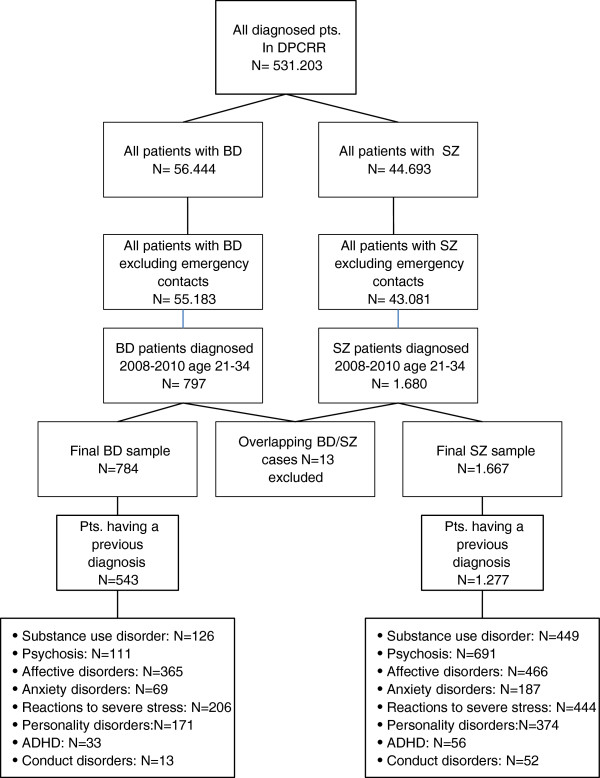
BACKGROUND: The aim of this comparative study was to investigate the type and frequency of diagnoses preceding adult bipolar disorder (BD) and schizophrenia (SZ). METHODS: A follow-back study of all preceding diagnoses in all patients aged 21-34 years with a primary, first time diagnosis of BD (N = 784) or SZ (N = 1667) in 2008 to 2010. Data were taken from the Danish Psychiatric Central Research Register (DPCRR) including ICD-10 and ICD-8 diagnoses. RESULTS: The numbers of patients with any preceding diagnoses amounted to 69.3% in BD and 76.6% in SZ with affective disorders (excluding BD) being the most frequent preceding diagnosis (46.6 vs. 28.0%), followed by psychoses (PSY) other than SZ (14.2 vs. 41.5%, p < .001), and substance use disorders (SUD) (16.1 vs. 26.9%, p < .001). Reactions to severe stress were equally frequent in both samples (26.3 vs. 26.6%) as were personality disorders (21.8 vs. 22.4%) and ADHD (4.2 vs. 3.5%), whereas rates of conduct disorders (1.7 vs. 3.1%) were rather low in both samples. Very few of the preceding diagnoses had their onset in childhood and adolescence. Overall patients with SZ had a minor but statistically significant earlier onset of any psychiatric disorder compared to BD (mean age: 23.3 vs. 22.5, p < .001). Regression analyses indicated that BD was associated with an increased risk of having experienced preceding affective disorders and ADHD, while SZ was associated with an increased risk of preceding substance use disorders, psychosis, anxiety disorders, and personality disorders. CONCLUSIONS: Specific developmental trajectories of preceding disorders were delineated for BD and SZ with affective disorders being more specific for BD and both SUD and PSY more specific to SZ. There are different patterns of vulnerability in terms of preceding diagnosis in young adults with BD and SZ.
Overview
The claims and statistics of this paper haven’t been checked yet.
Free: it reads the open-access text and checks the first 5 claims that cite a source we can check. Create a free account to check every claim.
Integrity signals
Registry
Cites
Statistics
Figures
Verification
Claims the paper makes
The claims and statistics of this paper haven’t been checked yet.
Free: it reads the open-access text and checks the first 5 claims that cite a source we can check. Create a free account to check every claim.
Claims other papers make about this one
Each is checked against this paper’s own text: does it say what the citing paper says it does?
The cited source doesn’t support the claim as written.
In the citing paper
“Only 1.1% and 0.7% of patients with SZ and BD, respectively, had a diagnosis of ADHD before age 18, and only 1.1% and 2% had a diagnosis of conduct disorder before age 18.”
From Developmental Differences Between Schizophrenia and Bipolar Disorder (2017) · cites this paper as [27]
Checked by a reasoning model — may be wrong.
Experimental — accuracy not yet measuredThe cited source says what the claim attributes to it.
In the citing paper
“There was a birth cohort effect, and patients born after 1980 were more likely to have any psychiatric diagnosis.”
From Developmental Differences Between Schizophrenia and Bipolar Disorder (2017) · cites this paper as [27]
Self-check
Percentages, sums and reported differences re-computed from the paper’s own numbers.
The self-check needs the paper’s full text.
Citations
Cites
Kessler, R. C., Adler, L., Barkley, R., Biederman, J., Conners, C. K., Demler, O., Faraone, S. V., Greenhill, L. L., Howes, M. J., Secnik, K., et al. (2006) · American Journal of Psychiatry · doi:10.1176/ajp.2006.163.4.716 · Cited by 3,886 · cited 3×
“However, conflicting comorbidity rates were found in various cross-sectional community studies [4-8] and due to low rates of BD in these studies, the lack of a correlation between ADHD and BD should be interpreted with caution [9].”
BackgroundResultKim-Cohen, J., Caspi, A., Moffitt, T. E., Harrington, H., Milne, B. J., & Poulton, R. (2003) · Archives of General Psychiatry · doi:10.1001/archpsyc.60.7.709 · Cited by 2,025 · cited 8×
“When comparing the present findings to previous studies in terms of its differential impact of predicting SZ but not BD, there is some similarity to the findings from the Dunedin studies, which found that anxiety disorders were more frequent among patients who developed schizofreniform disorders whereas anxiety disord…”
BackgroundResultInfluentialAngold, A., Costello, E. J., & Erkanli, A. (1999) · Journal of Child Psychology and Psychiatry · doi:10.1111/1469-7610.00424 · Cited by 1,872
The Danish Psychiatric Central Research Register
Mors, O., Perto, G. P., & Mortensen, P. B. (2011) · Scandinavian Journal of Public Health · doi:10.1177/1403494810395825 · Cited by 1,589 · cited 1×
“The DPCRR covers all contacts with the mental health care system along with all psychiatric diagnoses, the date, and the place of the diagnosis [30].”
BackgroundCostello, E. J. (1996) · Archives of General Psychiatry · doi:10.1001/archpsyc.1996.01830120067012 · Cited by 1,083 · cited 3×
“7% for adolescents [4,8] and amounting to 4.”
BackgroundResultAngold, A. C., Costello, E. J., & Erkanli, A. (1999) · PubMed · Cited by 785
LEWINSOHN, P. M., KLEIN, D. N., & SEELEY, J. R. (1995) · Journal of the American Academy of Child & Adolescent Psychiatry · doi:10.1097/00004583-199504000-00012 · Cited by 772 · cited 3×
“7% for adolescents [4,8] and amounting to 4.”
BackgroundAchim, A. M., Maziade, M., Raymond, E., Olivier, D., Merette, C., & Roy, M.-A. (2011) · Schizophrenia Bulletin · doi:10.1093/schbul/sbp148 · Cited by 526 · cited 2×
“3% of patients with SZ fulfilled criteria for at least one co-morbid anxiety disorder [18].”
BackgroundNeurodevelopmental hypothesis of schizophrenia
Owen, M. J., O'Donovan, M. C., Thapar, A., & Craddock, N. (2011) · British Journal of Psychiatry · doi:10.1192/bjp.bp.110.084384 · Cited by 500
Robins, L. N., & Price, R. K. (1991) · Psychiatry · doi:10.1080/00332747.1991.11024540 · Cited by 425 · cited 4×
“Although the literature documents an increased occurrence of CD in patients developing either BD or SZ as compared to the general population [14,17], the present study found no increase in risk for patients who developed BD in adulthood compared to those who developed SZ.”
BackgroundResultInfluentialPredicting schizophrenia: findings from the Edinburgh High-Risk Study
Johnstone, E. C., Ebmeier, K. P., Miller, P., Owens, D. G. C., & Lawrie, S. M. (2005) · British Journal of Psychiatry · doi:10.1192/bjp.186.1.18 · Cited by 326 · cited 1×
“Finally, data from a high-risk study indicated that social anxiety was one of the factors associated with conversion to SZ [19].”
BackgroundResolved: Mania Is Mistaken for ADHD in Prepubertal Children
BIEDERMAN, J., & Jellinek, M. S. (1998) · Journal of the American Academy of Child & Adolescent Psychiatry · doi:10.1097/00004583-199810000-00020 · Cited by 294 · cited 2×
“Considering the recent debate in the research literature about whether BD in childhood might often be mistaken for ADHD [3], the rather low prevalence of 4.”
BackgroundStahlberg, O., Soderstrom, H., Rastam, M., & Gillberg, C. (2004) · Journal of Neural Transmission · doi:10.1007/s00702-004-0115-1 · Cited by 273 · cited 1×
“Compared to BD, the debate on an association of ADHD with SZ has been less intensive, but some studies indicate that children and adolescents with ADHD are also at increased risk of developing SZ compared to the general population [12,13].”
Substance abuse in schizophrenia: a review of the literature and a study of correlates in Sweden
Cantor-Graae, E., Nordström, L. G., & McNeil, T. F. (2001) · Schizophrenia Research · doi:10.1016/s0920-9964(00)00114-6 · Cited by 261 · cited 2×
“Therefore they are inherently also a risk factor for SZ [23,24,31].”
BackgroundDiagnostic Shifts During the Decade Following First Admission for Psychosis
Bromet, E. J., Kotov, R., Fochtmann, L. J., Carlson, G. A., Tanenberg-Karant, M., Ruggero, C., & Chang, S.-W. (2011) · American Journal of Psychiatry · doi:10.1176/appi.ajp.2011.11010048 · Cited by 258 · cited 2×
“Another prospective follow-up study of patients presenting with first-episode psychosis found that after a follow-up period of 10 years, 50% had developed SZ and 16% had developed BD [29].”
BackgroundResultLauritsen, M. B., Jørgensen, M., Madsen, K. M., Lemcke, S., Toft, S., Grove, J., Schendel, D. E., & Thorsen, P. (2010) · Journal of Autism and Developmental Disorders · doi:10.1007/s10803-009-0818-0 · Cited by 239 · cited 1×
“This is documented for childhood autism [34], schizophrenia [35], and adult affective disorders [36].”
BackgroundValidity of diagnoses and other clinical register data in patients with affective disorder
Kessing, L. (1998) · European Psychiatry · doi:10.1016/s0924-9338(99)80685-3 · Cited by 210 · cited 1×
“This is documented for childhood autism [34], schizophrenia [35], and adult affective disorders [36].”
BackgroundCannabis use and expression of mania in the general population
Henquet, C., Krabbendam, L., de Graaf, R., ten Have, M., & van Os, J. (2006) · Journal of Affective Disorders · doi:10.1016/j.jad.2006.05.002 · Cited by 176 · cited 4×
“Although psychoses and SUD have been documented as frequently occurring disorders in patients developing BD or SZ [21,22,26,27,29] in the present study the association was stronger for SZ and thus, may serve as evidence for differentiating preceding psychiatric histories of patients with BD or SZ.”
BackgroundResultInfluentialReliability of clinical ICD-10 schizophrenia diagnoses
Jakobsen, K. D., Frederiksen, J. N., Hansen, T., Jansson, L. B., Parnas, J., & Werge, T. (2005) · Nordic Journal of Psychiatry · doi:10.1080/08039480510027698 · Cited by 170 · cited 1×
“This is documented for childhood autism [34], schizophrenia [35], and adult affective disorders [36].”
BackgroundPredominant recurrence polarity among 928 adult international bipolar I disorder patients
Baldessarini, R. J., Undurraga, J., Vázquez, G. H., Tondo, L., Salvatore, P., Ha, K., Khalsa, H. ‐. K., Lepri, B., Ha, T. H., Chang, J. S., et al. (2012) · Acta Psychiatrica Scandinavica · doi:10.1111/j.1600-0447.2011.01818.x · Cited by 162
Hodgins, S., Tiihonen, J., & Ross, D. (2005) · Schizophrenia Research · doi:10.1016/j.schres.2005.05.021 · Cited by 160 · cited 2×
“Furthermore, in this study CD was associated with an earlier onset of SZ and overall a more severe course [16].”
BackgroundADHD and comorbid disorders in relation to family environment and symptom severity
Hurtig, T. M., Ebeling, H. E., Taanila, A. M., Miettunen, J., Smalley, S. L., McGough, J. J., Loo, S. K., Järvelin, M., & Moilanen, I. K. (2007) · European Child & Adolescent Psychiatry · doi:10.1007/s00787-007-0607-2 · Cited by 144 · cited 2×
“However, conflicting comorbidity rates were found in various cross-sectional community studies [4-8] and due to low rates of BD in these studies, the lack of a correlation between ADHD and BD should be interpreted with caution [9].”
BackgroundResultOnset-age of bipolar disorders at six international sites☆
Baldessarini, R. J., Bolzani, L., Cruz, N., Jones, P. B., Lai, M., Lepri, B., Pérez, J., Salvatore, P., Tohen, M. F., & Tondo, L. (2009) · Journal of Affective Disorders · doi:10.1016/j.jad.2009.05.030 · Cited by 123 · cited 1×
“Although psychoses and SUD have been documented as frequently occurring disorders in patients developing BD or SZ [21,22,26,27,29] in the present study the association was stronger for SZ and thus, may serve as evidence for differentiating preceding psychiatric histories of patients with BD or SZ.”
ResultSubstance use in clinical high risk for psychosis: a review of the literature
Addington, J., Case, N., Saleem, M. M., Auther, A. M., Cornblatt, B. A., & Cadenhead, K. S. (2014) · Early Intervention in Psychiatry · doi:10.1111/eip.12100 · Cited by 122 · cited 1×
“Therefore they are inherently also a risk factor for SZ [23,24,31].”
BackgroundDalsgaard, S., Mortensen, P. B., Frydenberg, M., Maibing, C. M., Nordentoft, M., & Thomsen, P. H. (2014) · European Psychiatry · doi:10.1016/j.eurpsy.2013.06.004 · Cited by 121 · cited 1×
“Compared to BD, the debate on an association of ADHD with SZ has been less intensive, but some studies indicate that children and adolescents with ADHD are also at increased risk of developing SZ compared to the general population [12,13].”
Frontiers Between Attention Deficit Hyperactivity Disorder and Bipolar Disorder
Galanter, C. A., & Leibenluft, E. (2008) · Child and Adolescent Psychiatric Clinics of North America · doi:10.1016/j.chc.2007.11.001 · Cited by 120 · cited 2×
“Thus, the present finding is not in accordance with a review concluding that individuals with BD also seem to have high rates of ADHD [9], and a recent study finding high rates of concurrent and lifetime ADHD in a sample of BD patients using retrospective assessments, whereby 19% of the subjects screened positively fo…”
BackgroundResultJohnson, J. G., Cohen, P., & Brook, J. S. (2000) · American Journal of Psychiatry · doi:10.1176/appi.ajp.157.10.1679 · Cited by 120 · cited 3×
“The prevalence rates for anxiety disorders in patients with BD were also lower in the present study than the findings from other studies [14,15].”
BackgroundResultEffects of cannabis use on age at onset in schizophrenia and bipolar disorder
Binder, M. D., Wampers, M., Jendričko, T., Franić, T., Vidovic, D., Vriendt, N. D., Sweers, K., Peuskens, J., & van Winkel, R. (2010) · Schizophrenia Research · doi:10.1016/j.schres.2010.07.003 · Cited by 109 · cited 2×
“Therefore they are inherently also a risk factor for SZ [23,24,31].”
BackgroundDuffy, A. (2012) · American Journal of Psychiatry · doi:10.1176/appi.ajp.2012.11111725 · Cited by 103 · cited 1×
“In contrast, a recent review of all prospective longitudinal studies on the offspring of parents with BD showed that childhood ADHD was not a reliable predictor of the development of BD [11].”
ResultFaraone, S. V., Biederman, J., & Wozniak, J. (2012) · American Journal of Psychiatry · doi:10.1176/appi.ajp.2012.12010087 · Cited by 92 · cited 1×
“Furthermore, multiple studies have documented a high familial load of BD in families with ADHD and vice versa [10].”
BackgroundChildhood antecedent disorders to bipolar disorder in adults: A controlled study
Henin, A., Biederman, J., Mick, E. O., Hirshfeld‐Becker, D. R., Sachs, G. S., Wu, Y. P., Yan, L. J., Ogutha, J. O., & Nierenberg, A. A. (2006) · Journal of Affective Disorders · doi:10.1016/j.jad.2006.09.001 · Cited by 82 · cited 3×
“The prevalence rates for anxiety disorders in patients with BD were also lower in the present study than the findings from other studies [14,15].”
BackgroundResultGage, S. H., Zammit, S., & Hickman, M. (2013) · F1000 Medicine Reports · doi:10.3410/m5-2 · Cited by 78 · cited 1×
“Studies have pointed to an association of preceding SUD and SZ with a predominance of alcohol and cannabis use before the onset of SZ [23,24] but the role of cannabis use in the aetiology of SZ is still unclear [25].”
BackgroundKim, J. S., Baek, J. H., Choi, J. S., Lee, D., Kwon, J. S., & Hong, K. S. (2010) · Psychiatry Research · doi:10.1016/j.psychres.2010.09.017 · Cited by 74 · cited 2×
“One study following-up patients with first-episode psychosis found that up to 12% of cases with non-affective psychosis later developed BD [26].”
BackgroundResultPerugi, G., Ceraudo, G., Vannucchi, G., Rizzato, S., Toni, C., & Dell’Osso, L. (2012) · Journal of Affective Disorders · doi:10.1016/j.jad.2012.12.010 · Cited by 59 · cited 1×
“Thus, the present finding is not in accordance with a review concluding that individuals with BD also seem to have high rates of ADHD [9], and a recent study finding high rates of concurrent and lifetime ADHD in a sample of BD patients using retrospective assessments, whereby 19% of the subjects screened positively fo…”
ResultReich, W., Neuman, R. J., Volk, H. E., Joyner, C. A., & Todd, R. D. (2005) · Twin Research and Human Genetics · doi:10.1375/183242705774310105 · Cited by 34 · cited 2×
“However, conflicting comorbidity rates were found in various cross-sectional community studies [4-8] and due to low rates of BD in these studies, the lack of a correlation between ADHD and BD should be interpreted with caution [9].”
BackgroundResultBjörkenstam, E., Björkenstam, C., Hjern, A., Reutfors, J., & Bodén, R. (2013) · Schizophrenia Research · doi:10.1016/j.schres.2013.07.011 · Cited by 21 · cited 1×
“In a large register-based study from Sweden, the authors found that among patients presenting in psychiatry with a first-episode of psychosis, 5% were diagnosed with BD during a 5-year follow-up and 18% were diagnosed with SZ [28].”
BackgroundBuckley, P. F., Buchanan, R. W., Tamminga, C. A., & Schulz, S. (2000) · Schizophrenia Bulletin · doi:10.1093/oxfordjournals.schbul.a033462 · Cited by 2 · cited 2×
“Although affective disorders have frequently been documented in patients with SZ [20], they were a stronger”
BackgroundImportant achievements in the search for psychopathological predictors, but still a long road ahead
Baethge, C. (2012) · Acta Psychiatrica Scandinavica · doi:10.1111/j.1600-0447.2011.01824.x · Cited by 2
Cited by
Starzer, M. S. K., Nordentoft, M., & Hjorthøj, C. (2018) · American Journal of Psychiatry · doi:10.1176/appi.ajp.2017.17020223 · Cited by 258
Comorbidity of ADHD and adult bipolar disorder: A systematic review and meta-analysis
Schiweck, C., Arteaga-Henriquez, G., Aichholzer, M., Edwin Thanarajah, S., Vargas-Cáceres, S., Matura, S., Grimm, O., Haavik, J., Kittel-Schneider, S., Ramos-Quiroga, J. A., et al. (2021) · Neuroscience & Biobehavioral Reviews · doi:10.1016/j.neubiorev.2021.01.017 · Cited by 167
Developmental Differences Between Schizophrenia and Bipolar Disorder
Parellada, M., Gomez-Vallejo, S., Burdeus, M., & Arango, C. (2017) · Schizophrenia Bulletin · doi:10.1093/schbul/sbx126 · Cited by 114
Shyu, Y., Yuan, S.-S., Lee, S.-Y., Yang, C.-J., Yang, K., Lee, T., & Wang, L. (2015) · Schizophrenia Research · doi:10.1016/j.schres.2015.08.033 · Cited by 74
“In contrast, Andersen et al. (2013) failed to confirm a significant association between schizophrenia and”
Wang, L., Shyu, Y., Yuan, S.-S., Yang, C.-J., Yang, K., Lee, T., & Lee, S.-Y. (2015) · Journal of Psychiatric Research · doi:10.1016/j.jpsychires.2015.10.014 · Cited by 47
“Convincing retrospective studies have indicated a high prevalence of ADHD comorbidity among the BD population, ranging from 4% to 94% (Andersen et al., 2013; Asherson et al., 2014; Frias et al., 2014a).”
Metadata
- Authors
- Andersen, S. M., Randers, A., Jensen, C. M., Bisgaard, C., & Steinhausen, H.-C.
- Affiliations
- Aalborg University Hospital (DK)
- University of Basel (CH)
- Corresponding author
- Andersen, Søren Martin
- Venue
- BMC Psychiatry
- Published
- 2013-12
- Volume
- 13
- Issue
- 1
- Pages
- 343-343
- ISSN
- 1471-244X (ISSN-L)
- PMC
- PMC3898215
- OpenAlex
- W2110874901
- Cited by
- 23
- References
- 38
- Citations by year
- 2025: 1 · 2024: 4 · 2023: 2 · 2022: 1 · 2021: 2 · 2020: 2 · 2019: 1 · 2018: 1 · 2017: 3 · 2016: 3 · 2015: 2 · 2014: 1
- FWCI
- 1.42
- Type
- journal article
- Language
- en
- Open access
- gold
- doi.org
- Licence
- Locations
- BMC Psychiatry (publishedVersion, cc-by)
- Europe PMC (PubMed Central) (publishedVersion, cc-by)
- PubMed Central (publishedVersion, cc-by)
- PubMed (publishedVersion)
- Zurich Open Repository and Archive (University of Zurich) (acceptedVersion, cc-by)
- VBN Forskningsportal (Aalborg Universitet) (submittedVersion)
- Zurich Open Repository and Archive (University of Zurich) (submittedVersion, cc-by)
- Zurich Open Repository and Archive (University of Zurich)
- Topics
- Health Sciences › Medicine › Psychiatry and Mental health › Bipolar Disorder and Treatment
- Health Sciences › Medicine › Psychiatry and Mental health › Schizophrenia research and treatment
- Social Sciences › Psychology › Clinical Psychology › Personality Disorders and Psychopathology
- Keywords
- bipolar disorder, schizophrenia, young adults, mood disorders, substance use disorders, psychosis, personality disorders, attention deficit hyperactivity disorder, conduct disorder, anxiety disorders, psychiatric comorbidity, developmental trajectories, age of onset, stress reactions
- MeSH terms
- Adult, Bipolar Disorder, Denmark, Female, Follow-Up Studies, Humans, Male, Phobic Disorders, Risk Factors, Schizophrenia, Schizophrenic Psychology, Comorbidity, Causality, Panic Disorder, Age of Onset, Disease Progression, Young Adult
About these checks
Registry, retraction, Cites and statistics results are computed, not judged, with one exception: a printed reference that no index lists is read once by a model before it counts as a citation error. Claims are extracted by a model and kept only when their quote appears verbatim in the text; each cited source is then checked, with a model’s help, for whether it says what the claim relies on. Those verdicts can be wrong — read the claim’s quote and the cited source before relying on one.
Statistics and arithmetic are recomputed, not judged.
Confidence bands are shown only for fields calibrated on our annotated test set. None is calibrated yet, so no band is shown.
What counts as a claim ›How we measure confidence ›How we check this ›
Are you an author, or do you see a problem with this page? Request a review
Data sources
Bibliographic data: Semantic Scholar, OpenAlex, Crossref.
Contains information from the Semantic Scholar Academic Graph Datasets, made available under the ODC Attribution License (ODC-BY 1.0).
Semantic Scholar’s data is described in: Kinney, R., et al. (2023). The Semantic Scholar Open Data Platform. arXiv:2301.10140.
