

Internet-based treatment for PTSD reduces distress and facilitates the development of a strong therapeutic alliance: a randomized controlled clinical trial
Open accessThe DOI matches its Crossref record; 39 of the 41 references it cites were found in a registry or an index.
Abstract
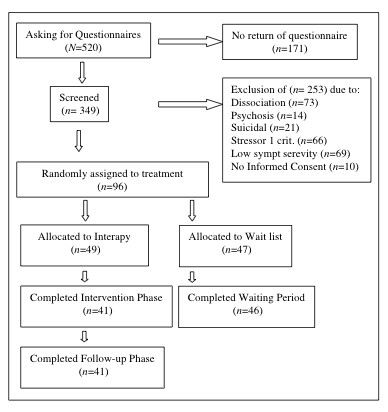
BACKGROUND: The present study was designed to evaluate the efficacy of an internet-based therapy (Interapy) for Posttraumatic Stress Disorder (PTSD) in a German speaking population. Also, the quality of the online therapeutic relationship, its development and its relevance as potential moderator of the treatment effects was investigated. METHOD: Ninety-six patients with posttraumatic stress reactions were allocated at random to ten sessions of Internet-based cognitive behavioural therapy (CBT) conducted over a 5-week period or a waiting list control group. Severity of PTSD was the primary outcome. Secondary outcome variables were depression, anxiety, dissociation and physical health. Follow-up assessments were conducted at the end of treatment and 3 months after treatment. RESULTS: From baseline to post-treatment assessment, PTSD severity and other psychopathological symptoms were significantly improved for the treatment group (intent-to-treat group x time interaction effect size d = 1.40). Additionally, patients of the treatment condition showed significantly greater reduction of co-morbid depression and anxiety as compared to the waiting list condition. These effects were sustained during the 3-months follow-up period. High ratings of the therapeutic alliance and low drop-out rates indicated that a positive and stable therapeutic relationship could be established online. Significant improvement of the online working alliance in the course of treatment and a substantial correlation between the quality of the online relationship at the end of treatment and treatment outcome emerged. CONCLUSION: Interapy proved to be a viable treatment alternative for PTSD with large effect sizes and sustained treatment effects. A stable and positive online therapeutic relationship can be established through the Internet which improved during the treatment process. TRIAL REGISTRATION: Australian Clinical Trials Registry ACTRN012606000401550.
Overview
The claims and statistics of this paper haven’t been checked yet.
Free: it reads the open-access text and checks the first 5 claims that cite a source we can check. Create a free account to check every claim.
Integrity signals
Registry
Cites
Statistics
Figures
Verification
Claims the paper makes
The claims and statistics of this paper haven’t been checked yet.
Free: it reads the open-access text and checks the first 5 claims that cite a source we can check. Create a free account to check every claim.
Claims other papers make about this one
Each is checked against this paper’s own text: does it say what the citing paper says it does?
The source backs part of the claim, not all of it — or backs it for a different population, condition or comparison.
In the citing paper
“The majority of evidence relating to the therapeutic alliance in Internet-delivered interventions derives from studies of interventions that are therapist-assisted to some extent.”
From Therapeutic alliance with a fully automated mobile phone and web-based intervention: secondary analysis of a randomized controlled trial (2016) · cites this paper as [25]
Experimental — accuracy not yet measuredThe cited source says what the claim attributes to it.
In the citing paper
“similar TA scores have been found for face-to-face therapy and IBIs [3,14,18,19,20]”
The cited source says what the claim attributes to it.
In the citing paper
“Our findings suggest that the guided self-help program can establish high patient satisfaction and a strong therapeutic alliance (Knaevelsrud and Maercker, 2007).”
From Feasibility of guided internet-based cognitive behavioral therapy for patients with anorexia nervosa (2022) · cites this paper as Knaevelsrud and Maercker, 2007
The cited source says what the claim attributes to it.
In the citing paper
“Currently, data on the efficacy of ICBT are available for a wide range of psychological disorders, including stress-related disorders [19–23].”
From An internet-based intervention for adjustment disorder (TAO): Study protocol for a randomized controlled trial (2018) · cites this paper as [20]
In the citing paper
“Two further studies demonstrated that, following small trials of a supported digital intervention for posttraumatic stress disorder (PTSD), ratings on the WAI were associated with reductions in PTSD symptoms [72,74].”
From The therapeutic alliance in digital mental health interventions for serious mental illnesses: narrative review (2020) · cites this paper as [72]
Self-check
Percentages, sums and reported differences re-computed from the paper’s own numbers.
The self-check needs the paper’s full text.
Citations
Cites
Diagnostic and Statistical Manual of Mental Disorders
Williams, J. B. W., & First, M. (2013) · Encyclopedia of Social Work · doi:10.1093/acrefore/9780199975839.013.104 · Cited by 109,519
WARE, J. E., KOSINSKI, M., & KELLER, S. D. (1996) · Medical Care · doi:10.1097/00005650-199603000-00003 · Cited by 17,392
Cohen, J. (1992) · Psychological Bulletin · doi:10.1037//0033-2909.112.1.155 · Cited by 8,771
The generalizability of the psychoanalytic concept of the working alliance.
Bordin, E. S. (1979) · Psychotherapy: Theory, Research & Practice · doi:10.1037/h0085885 · Cited by 5,238
Computer-Mediated Communication: Impersonal, Interpersonal, and Hyperpersonal Interaction
WALTHER, J. B. (1996) · Communication Research · doi:10.1177/009365096023001001 · Cited by 4,798
The online disinhibition effect
Suler, J. (2004) · CyberPsychology & Behavior · doi:10.1089/1094931041291295 · Cited by 4,375
Development and validation of the working alliance inventory
Horvath, A. O., & Greenberg, L. S. (1989) · Journal of Counseling Psychology · doi:10.1037//0022-0167.36.2.223 · Cited by 3,520
Relation of the therapeutic alliance with outcome and other variables: a meta-analytic review
Martin, D. J., Garske, J. P., & Davis, M. K. (2000) · Journal of Consulting and Clinical Psychology · doi:10.1037//0022-006x.68.3.438 · Cited by 3,355
The Impact of Event Scale: Revised
Weiss, D. S. (2007) · International and Cultural Psychology Series · doi:10.1007/978-0-387-70990-1_10 · Cited by 2,996
Relation between working alliance and outcome in psychotherapy: A meta-analysis
Horvath, A. O., & Symonds, B. D. (1991) · Journal of Counseling Psychology · doi:10.1037/0022-0167.38.2.139 · Cited by 2,673
Assessing psychological trauma and PTSD
(1997) · Choice Reviews Online · doi:10.5860/choice.34-5966 · Cited by 2,330
A Multidimensional Meta-Analysis of Psychotherapy for PTSD
Bradley, R., Greene, J., Russ, E., Dutra, L., & Westen, D. (2005) · American Journal of Psychiatry · doi:10.1176/appi.ajp.162.2.214 · Cited by 1,938
Assessing Psychological Trauma and PTSD
Allden, K. (1998) · The Journal of Nervous & Mental Disease · doi:10.1097/00005053-199807000-00018 · Cited by 1,709
Factor structure of the working alliance inventory
Tracey, T. J., & Kokotovic, A. M. (1989) · Psychological Assessment: A Journal of Consulting and Clinical Psychology · doi:10.1037/1040-3590.1.3.207 · Cited by 1,501
Working Alliance in Online Therapy as Compared to Face-to-Face Therapy: Preliminary Results
Cook, J. E., & Doyle, C. (2002) · CyberPsychology & Behavior · doi:10.1089/109493102753770480 · Cited by 503
The writing cure: How expressive writing promotes health and emotional well-being.
(2002) · American Psychological Association eBooks · doi:10.1037/10451-000 · Cited by 500
Lange, A., Rietdijk, D., Hudcovicova, M., van de Ven, J.-P., Schrieken, B., & Emmelkamp, P. M. G. (2003) · Journal of Consulting and Clinical Psychology · doi:10.1037/0022-006x.71.5.901 · Cited by 495
Development and validation of the Trauma-Related Guilt Inventory (TRGI).
Kubany, E. S., Haynes, S. N., Abueg, F. R., & Manke, F. P. (1996) · Psychological Assessment · doi:10.1037//1040-3590.8.4.428 · Cited by 376
Internet-Based Cognitive-Behavioral Therapy for Complicated Grief: A Randomized Controlled Trial
Wagner, B., Knaevelsrud, C., & Maercker, A. (2006) · Death Studies · doi:10.1080/07481180600614385 · Cited by 376
Self-citationHatcher, R. L., & Barends, A. W. (1996) · Journal of Consulting and Clinical Psychology · doi:10.1037//0022-006x.64.6.1326 · Cited by 361
Interchangeability of the Working Alliance Inventory and Working Alliance Inventory, Short Form.
Busseri, M. A., & Tyler, J. D. (2003) · Psychological Assessment · doi:10.1037/1040-3590.15.2.193 · Cited by 337
Assessing Psychological Trauma and PTSD
Serban, G. (1999) · American Journal of Psychotherapy · doi:10.1176/appi.psychotherapy.1999.53.2.273 · Cited by 253
Social acknowledgment as a victim or survivor: A scale to measure a recovery factor of PTSD
Maercker, A., & Müller, J. (2004) · Journal of Traumatic Stress · doi:10.1023/b:jots.0000038484.15488.3d · Cited by 217
Self-citationNeal, L. A., Busuttil, W., Rollins, J., Herepath, R., Turnbull, G., & Strike, P. (1994) · Journal of Traumatic Stress · doi:10.1002/jts.2490070310 · Cited by 209
Patterns of working alliance development: A typology of client's working alliance ratings.
Kivlighan, D. M., & Shaughnessy, P. (2000) · Journal of Counseling Psychology · doi:10.1037/0022-0167.47.3.362 · Cited by 201
Knaevelsrud, C., & Maercker, A. (2006) · Journal of Medical Internet Research · doi:10.2196/jmir.8.4.e31 · Cited by 184
Self-citationAlliance Prediction of Outcome Beyond in-Treatment Symptomatic Change as Psychotherapy Processes
Gaston, L., Marmar, C., Gallagher, D., & Thompson, L. (1991) · Psychotherapy Research · doi:10.1080/10503309112331335531 · Cited by 167
Nijenhuis, E. R. S., Spinhoven, P., van Dyck, R., van der Hart, O., & Vanderlinden, J. (1997) · Acta Psychiatrica Scandinavica · doi:10.1111/j.1600-0447.1997.tb09922.x · Cited by 147
SOCIAL SUPPORT AND TECHNOLOGICAL CONNECTEDNESS AS PROTECTIVE FACTORS IN BEREAVEMENT
VANDERWERKER, L. C., & PRIGERSON, H. G. (2004) · Journal of Loss and Trauma · doi:10.1080/15325020490255304 · Cited by 128
Therapie der posttraumatischen Belastungsstörungen
Maercker, A. (2003) · Springer eBooks · doi:10.1007/978-3-662-09391-7 · Cited by 107
Self-citationHopps, S. L., Pépin, M., & Boisvert, J.-M. (2003) · Psychotherapy · doi:10.1037/0033-3204.40.1-2.136 · Cited by 69
Callahan, K. L., Price, J. L., & Hilsenroth, M. J. (2003) · Journal of Personality Assessment · doi:10.1207/s15327752jpa8002_06 · Cited by 59
Dresden PTSD treatment study: randomized controlled trial of motor vehicle accident survivors
Maercker, A., Zöllner, T., Menning, H., Rabe, S., & Karl, A. (2006) · BMC Psychiatry · doi:10.1186/1471-244x-6-29 · Cited by 49
Self-citationInternet-Psychotherapie: Wirksamkeit und Besonderheiten der therapeutischen Beziehung
Knaevelsrud, C., Jager, J., & Maercker, A. (2004) · Verhaltenstherapie · doi:10.1159/000080913 · Cited by 46
Self-citationInterapy: A model for therapeutic writing through the Internet.
Lange, A., Schoutrop, M., Schrieken, B., & van de Ven, J.-P. (2004) · American Psychological Association eBooks · doi:10.1037/10451-011 · Cited by 38
Lange, A., Schrieken, B., Blankers, M., van de Ven, J.-P., & Slot, M. (2000) · Directieve therapie · doi:10.1007/bf03060234 · Cited by 38
Traumatische ervaringen, gevolgen en verwerking.
Kleber, R. J., Brom, D., & Defares, P. B. (1986) · Socio-Environmental Systems Modeling · Cited by 21
Treatment and Prevention of Posttraumatic Stress Disorder
Rauch, S. A. M., & Cahill, S. P. (2003) · Cited by 14
A telecommunication monitoring system for clinical and research practice.
Ritterband, L. M., Cox, D. J., Kovatchev, B. P., Borowitz, S. M., Ling, W. D., & Marshall, B. J. (2001) · Professional Psychology Research and Practice · doi:10.1037/0735-7028.32.6.636 · Cited by 4
Research works printed but not linked: 2
- Derogatis LR BSI: Administration, scoring, and procedures manual-II 1992 2 Baltimore, MD: Clinical Psychometric Research, Inc
- Kendall PC Grove WM Normative comparisons in therapy outcome Behav Assess 1988 10 147 158
Cited by
Adherence in Internet Interventions for Anxiety and Depression
Christensen, H., Griffiths, K. M., & Farrer, L. (2009) · Journal of Medical Internet Research · doi:10.2196/jmir.1194 · Cited by 1,133
Mohr, D. C., Cuijpers, P., & Lehman, K. (2011) · Journal of Medical Internet Research · doi:10.2196/jmir.1602 · Cited by 1,097
Katzman, M. A., Bleau, P., Blier, P., Chokka, P., Kjernisted, K., Van Ameringen, M., & the Canadian Anxiety Guidelines Initiative Group on behalf of the Anxiety Disorders Association of Canada/Association Canadienne des troubles anxieux and McGill University (2014) · BMC Psychiatry · doi:10.1186/1471-244x-14-s1-s1 · Cited by 1,090
The Delivery of Public Health Interventions via the Internet: Actualizing Their Potential
Bennett, G. G., & Glasgow, R. E. (2009) · Annual Review of Public Health · doi:10.1146/annurev.publhealth.031308.100235 · Cited by 800
Cuijpers, P., Donker, T., van Straten, A., Li, J., & Andersson, G. (2010) · Psychological Medicine · doi:10.1017/s0033291710000772 · Cited by 832
Metadata
- Authors
- Knaevelsrud, C., & Maercker, A.
- Affiliations
- Zentrum Überleben (DE)
- Corresponding author
- Knaevelsrud, Christine
- Venue
- BMC Psychiatry
- Published
- 2007-04-19
- Volume
- 7
- Issue
- 1
- Pages
- 13-13
- ISSN
- 1471-244X (ISSN-L)
- PMC
- PMC1885249
- OpenAlex
- W2104966869
- Cited by
- 398
- References
- 41
- Citations by year
- 2026: 5 · 2025: 5 · 2024: 11 · 2023: 5 · 2022: 16 · 2021: 26 · 2020: 32 · 2019: 20 · 2018: 23 · 2017: 20 · 2016: 32 · 2015: 26 · 2014: 39 · 2013: 30 · 2012: 32
- FWCI
- 23.51
- Type
- journal article
- Language
- en
- Open access
- gold
- doi.org
- Licence
- cc-by
- creativecommons.org/licenses/by/2.0 (tdm)
- Locations
- BMC Psychiatry (publishedVersion, cc-by)
- Europe PMC (PubMed Central) (publishedVersion, cc-by)
- PubMed Central (publishedVersion, cc-by)
- PubMed (publishedVersion)
- Zurich Open Repository and Archive (University of Zurich) (acceptedVersion, cc-by)
- DOAJ (DOAJ: Directory of Open Access Journals) (submittedVersion)
- Zurich Open Repository and Archive (University of Zurich)
- Funders
- Universiteit van Amsterdam
- Universität Zürich
- Topics
- Social Sciences › Psychology › Applied Psychology › Digital Mental Health Interventions
- Social Sciences › Psychology › Clinical Psychology › Posttraumatic Stress Disorder Research
- Social Sciences › Psychology › Clinical Psychology › Psychotherapy Techniques and Applications
- Keywords
- post-traumatic stress disorder, internet-based cognitive behavioral therapy, therapeutic relationship, treatment efficacy, depression, anxiety, dissociation, treatment discontinuation, German-speaking patients
- MeSH terms
- Adolescent, Adult, Aged, Anxiety, Depression, Dissociative Disorders, Female, Follow-Up Studies, Health Status, Humans, Male, Middle Aged, Physician-Patient Relations, Severity of Illness Index, Stress Disorders, Post-Traumatic, Stress, Psychological, Cognitive Behavioral Therapy, Treatment Outcome, Internet
About these checks
Registry, retraction, Cites and statistics results are computed, not judged, with one exception: a printed reference that no index lists is read once by a model before it counts as a citation error. Claims are extracted by a model and kept only when their quote appears verbatim in the text; each cited source is then checked, with a model’s help, for whether it says what the claim relies on. Those verdicts can be wrong — read the claim’s quote and the cited source before relying on one.
Statistics and arithmetic are recomputed, not judged.
Confidence bands are shown only for fields calibrated on our annotated test set. None is calibrated yet, so no band is shown.
What counts as a claim ›How we measure confidence ›How we check this ›
Are you an author, or do you see a problem with this page? Request a review
Data sources
Bibliographic data: Semantic Scholar, OpenAlex, Crossref.
Contains information from the Semantic Scholar Academic Graph Datasets, made available under the ODC Attribution License (ODC-BY 1.0).
Semantic Scholar’s data is described in: Kinney, R., et al. (2023). The Semantic Scholar Open Data Platform. arXiv:2301.10140.
