

The DOI matches its Crossref record; 20 of the 20 references it cites were found in a registry or an index.
Early trauma-focused cognitive-behavioural therapy to prevent chronic post-traumatic stress disorder and related symptoms: A systematic review and meta-analysis
Open accessAbstract
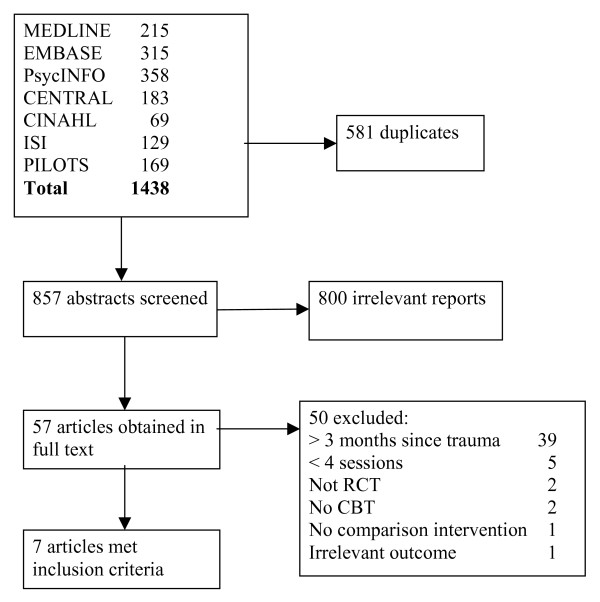
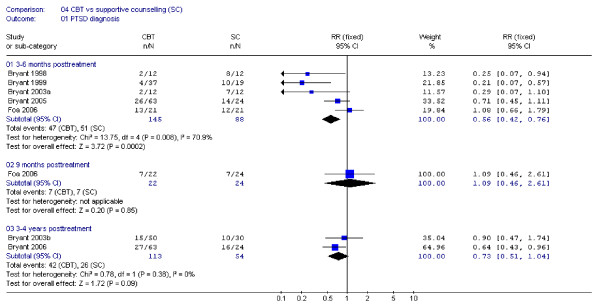
BACKGROUND: Early trauma-focused cognitive-behavioural therapy (TFCBT) holds promise as a preventive intervention for people at risk of developing chronic post-traumatic stress disorder (PTSD). The aim of this review was to provide an updated evaluation of the effectiveness of early TFCBT on the prevention of PTSD in high risk populations. METHODS: We performed a systematic literature search in international electronic databases (MEDLINE, EMBASE, PsycINFO, CENTRAL, CINAHL, ISI and PILOTS) and included randomised controlled trials comparing TFCBT delivered within 3 months of trauma, to alternative interventions. All included studies were critically appraised using a standardised checklist. Two independent reviewers selected studies for inclusion and assessed study quality. Data extraction was performed by one reviewer and controlled by another. Where appropriate, we entered study results into meta-analyses. RESULTS: Seven articles reporting the results of five RCTs were included. All compared TFCBT to supportive counselling (SC). The study population was patients with acute stress disorder (ASD) in four trials, and with a PTSD diagnosis disregarding the duration criterion in the fifth trial. The overall relative risk (RR) for a PTSD diagnosis was 0.56 (95% CI 0.42 to 0.76), 1.09 (95% CI 0.46 to 2.61) and 0.73 (95% CI 0.51 to 1.04) at 3-6 months, 9 months and 3-4 years post treatment, respectively. A subgroup analysis of the four ASD studies only resulted in RR = 0.36 (95% CI 0.17 to 0.78) for PTSD at 3-6 months. Anxiety and depression scores were generally lower in the TFCBT groups than in the SC groups. CONCLUSION: There is evidence for the effectiveness of TFCBT compared to SC in preventing chronic PTSD in patients with an initial ASD diagnosis. As this evidence originates from one research team replications are necessary to assess generalisability. The evidence about the effectiveness of TFCBT in traumatised populations without an ASD diagnosis is insufficient.
Overview
The claims and statistics of this paper haven’t been checked yet.
Run the check — free, no account needed. It reads the open-access text and checks the sources it cites.
Integrity signals
Registry
Cites
Statistics
Figures
Verification
Claims the paper makes
The claims and statistics of this paper haven’t been checked yet.
Run the check — free, no account needed. It reads the open-access text and checks the sources it cites.
Claims other papers make about this one
Each is checked against this paper’s own text: does it say what the citing paper says it does?
The source backs part of the claim, not all of it — or backs it for a different population, condition or comparison.
In the citing paper
“Three of these reviews synthesised and compared results from studies that had used risk screening tools and studies that had not used risk screening tools to identify participants for inclusion.42 73 77”
From Impact of healthcare interventions on distress following acute musculoskeletal/orthopaedic injury: A scoping review of systematic reviews (2024) · cites this paper as [42]
Experimental — accuracy not yet measuredThe cited source says what the claim attributes to it.
In the citing paper
“Five reviews had inclusion criteria requiring studies to have included participants on the basis of identified risk or analysed these studies separately from studies that did not have such inclusion criteria.41 42 73 77 78”
From Impact of healthcare interventions on distress following acute musculoskeletal/orthopaedic injury: A scoping review of systematic reviews (2024) · cites this paper as [42]
The cited source says what the claim attributes to it.
In the citing paper
“In five reviews of psychological interventions, higher levels of risk were a criterion for study inclusion.41 42 73 77 78”
From Impact of healthcare interventions on distress following acute musculoskeletal/orthopaedic injury: A scoping review of systematic reviews (2024) · cites this paper as [42]
In the citing paper
“Meta-analytic studies have supported the utility of early targeted intervention to limit later PTSD 133,134 .”
From Post‐traumatic stress disorder: a state‐of‐the‐art review of evidence and challenges (2019) · cites this paper as [133]
Self-check
Percentages, sums and reported differences re-computed from the paper’s own numbers.
The self-check needs the paper’s full text.
Citations
Cites
Diagnostic and Statistical Manual of Mental Disorders (DSM-IV)
Hu, R. J. (2003) · Elsevier eBooks · doi:10.1016/b0-12-226870-9/01070-4 · Cited by 9,168
Psychological debriefing for preventing post traumatic stress disorder (PTSD)
Rose, S. C., Bisson, J., Churchill, R., & Wessely, S. (2002) · Cochrane Database of Systematic Reviews · doi:10.1002/14651858.cd000560 · Cited by 1,250
Handbook of Stress: Theoretical and Clinical Aspects
Tyrer, P. J. (1983) · Journal of Neurology Neurosurgery & Psychiatry · doi:10.1136/jnnp.46.10.970-a · Cited by 1,217
Bisson, J. I., Ehlers, A., Matthews, R., Pilling, S., Richards, D., & Turner, S. (2007) · British Journal of Psychiatry · doi:10.1192/bjp.bp.106.021402 · Cited by 900
Single session debriefing after psychological trauma: a meta-analysis
van Emmerik, A. A., Kamphuis, J. H., Hulsbosch, A. M., & Emmelkamp, P. M. (2002) · The Lancet · doi:10.1016/s0140-6736(02)09897-5 · Cited by 644
Bryant, R. A., Harvey, A. G., Dang, S. T., Sackville, T., & Basten, C. (1998) · Journal of Consulting and Clinical Psychology · doi:10.1037/0022-006x.66.5.862 · Cited by 471 · cited 4×
“Four of the included studies [11-15,18] had been carried out with very similar research protocols in Australia by Richard Bryant and his research team, while Edna Foa and her team in the USA were responsible for the fifth study [17].”
BackgroundResultInfluentialBryant, R. A., Sackville, T., Dang, S. T., Moulds, M. L., & Guthrie, R. M. (1999) · American Journal of Psychiatry · doi:10.1176/ajp.156.11.1780 · Cited by 389
Gene‐Cos, N. (2006) · Psychiatric Bulletin · doi:10.1192/pb.30.9.357-a · Cited by 281
Wessely, S. C., Rose, S. K., & Bisson, J. I. (2000) · Research Portal (King's College London) · Cited by 264
The Additive Benefit of Hypnosis and Cognitive-Behavioral Therapy in Treating Acute Stress Disorder.
Bryant, R. A., Moulds, M. L., Guthrie, R. M., & Nixon, R. D. V. (2005) · Journal of Consulting and Clinical Psychology · doi:10.1037/0022-006x.73.2.334 · Cited by 215
Research works printed but not linked: 1
- National Collaborating Centre for Mental Health: Post-traumatic stress disorder. The management of PTSD in adults and children in primary and secondary care. London. 2005
Cited by
Sorted by citations
Katzman, M. A., Bleau, P., Blier, P., Chokka, P., Kjernisted, K., Van Ameringen, M., & the Canadian Anxiety Guidelines Initiative Group on behalf of the Anxiety Disorders Association of Canada/Association Canadienne des troubles anxieux and McGill University (2014) · BMC Psychiatry · doi:10.1186/1471-244x-14-s1-s1 · Cited by 1,090
Post‐traumatic stress disorder: a state‐of‐the‐art review of evidence and challenges
Bryant, R. A. (2019) · World Psychiatry · doi:10.1002/wps.20656 · Cited by 528
Efficacy of Cognitive Behavioral Therapy for Anxiety Disorders: A Review of Meta-Analytic Findings
Olatunji, B. O., Cisler, J. M., & Deacon, B. J. (2010) · Psychiatric Clinics of North America · doi:10.1016/j.psc.2010.04.002 · Cited by 483
Risk for mental disorders associated with sexual assault: a meta-analysis
Dworkin, E. R. (2020) · Trauma, Violence, & Abuse · doi:10.1177/1524838018813198 · Cited by 347
Iyadurai, L., Blackwell, S. E., Meiser-Stedman, R., Watson, P. C., Bonsall, M. B., Geddes, J. R., Nobre, A. C., & Holmes, E. A. (2018) · Molecular Psychiatry · doi:10.1038/mp.2017.23 · Cited by 266
Cognitive behavioral therapy for the treatment of post-traumatic stress disorder: A review
Kar, N. (2011) · Neuropsychiatric Disease and Treatment · doi:10.2147/ndt.s10389 · Cited by 266
Evans, S., Mikocka‐Walus, A. A., Klas, A., OLIVE, L. S., Sciberras, E., Karantzas, G. C., & Westrupp, E. M. (2020) · Frontiers in Psychology · doi:10.3389/fpsyg.2020.588667 · Cited by 273
Disaster Management: Mental Health Perspective
Math, S. B., Nirmala, M. C., Moirangthem, S., & Kumar, N. (2015) · Indian Journal of Psychological Medicine · doi:10.4103/0253-7176.162915 · Cited by 247
The neural basis of flashback formation: the impact of viewing trauma
Bourne, C., Mackay, C. E., & Holmes, E. A. (2013) · Psychological Medicine · doi:10.1017/s0033291712002358 · Cited by 218
Salivary cortisol in post-traumatic stress disorder: a systematic review and meta-analysis
Pan, X., Wang, Z., Wu, X., Wen, S. W., & Liu, A. (2018) · BMC Psychiatry · doi:10.1186/s12888-018-1910-9 · Cited by 198
Posttraumatic Stress Disorder in Maltreated Youth: A Review of Contemporary Research and Thought
Kearney, C. A., Wechsler, A., Kaur, H., & Lemos-Miller, A. (2010) · Clinical Child and Family Psychology Review · doi:10.1007/s10567-009-0061-4 · Cited by 169
Prevention of Traumatic Stress in Mothers of Preterms: 6-Month Outcomes
Shaw, R. J., John, N. S., Lilo, E. A., Jo, B., Benitz, W. E., Stevenson, D. K., & Horwitz, S. M. (2014) · PEDIATRICS · doi:10.1542/peds.2014-0529 · Cited by 108
Interpersonal Violence: Global Impact and Paths to Prevention
Mercy, J. A., Hillis, S. D., Butchart, A., Bellis, M. A., Ward, C. L., Fang, X., & Rosenberg, M. L. (2017) · World Bank, Washington, DC eBooks · doi:10.1596/978-1-4648-0522-6_ch5 · Cited by 110
Traumatic stress in acute leukemia
Rodin, G., Yuen, D., Mischitelle, A., Minden, M. D., Brandwein, J. M., Schimmer, A. D., Marmar, C. R., Gagliese, L., Lo, C., Rydall, A. C., et al. (2011) · Psycho-Oncology · doi:10.1002/pon.2092 · Cited by 113
EMDR and early psychological intervention following trauma
Shapiro, E. (2012) · European Review of Applied Psychology · doi:10.1016/j.erap.2012.09.003 · Cited by 93
Bryant, R. A. (2017) · Current Opinion in Psychology · doi:10.1016/j.copsyc.2017.01.005 · Cited by 88
Latest developments in post-traumatic stress disorder: diagnosis and treatment: Table 1
Greenberg, N. L., Brooks, S. K., & Dunn, R. (2015) · British Medical Bulletin · doi:10.1093/bmb/ldv014 · Cited by 75
An Evidence-Based Review of Early Intervention and Prevention of Posttraumatic Stress Disorder
Birur, B., Moore, N. C., & Davis, L. L. (2016) · Community Mental Health Journal · doi:10.1007/s10597-016-0047-x · Cited by 69
Figueroa, R. A., Marín, H., & González, M. (2010) · Revista médica de Chile · doi:10.4067/s0034-98872010000200001 · Cited by 63
Kliem, S., & Kröger, C. (2013) · Behaviour Research and Therapy · doi:10.1016/j.brat.2013.08.005 · Cited by 62
Ellison, L. E., & Munro, V. E. (2016) · The International Journal of Evidence & Proof · doi:10.1177/1365712716655168 · Cited by 58
Birk, J. L., Sumner, J. A., Haerizadeh, M., Heyman-Kantor, R., Falzon, L., Gonzalez, C. J., Gershengoren, L., Shapiro, P. A., Edmondson, D. E., & Kronish, I. M. (2019) · Journal of Anxiety Disorders · doi:10.1016/j.janxdis.2019.03.003 · Cited by 61
Damra, J. K. M., Nassar, Y. H., & Ghabri, T. M. F. (2014) · Counselling Psychology Quarterly · doi:10.1080/09515070.2014.918534 · Cited by 54
Salazar de Pablo, G., De Micheli, A., Solmi, M., Oliver, D., Catalan, A., Verdino, V., Di Maggio, L., Bonoldi, I., Radua, J., Baccaredda Boy, O., et al. (2021) · Harvard Review of Psychiatry · doi:10.1097/hrp.0000000000000294 · Cited by 51
Bryant, R. A. (2021) · Clinical Psychology Review · doi:10.1016/j.cpr.2021.101981 · Cited by 65
Psychosocial Recovery from Disasters: A Framework Informed by Evidence
Mf, M., Paton, D., de Terte, I., Johal, S., Karanci, A. N., Gardner, D. H., Collins, S., Glavovic, B., Huggins, T. J., Johnston, L. C., et al. (2011) · Massey Research Online (Massey University) · Cited by 49
Bianchi, M. L., Cornejo, F. A., Fresno, A., Rojas, C., & Serrano, C. (2017) · Gaceta Sanitaria · doi:10.1016/j.gaceta.2017.07.018 · Cited by 50
Childhood maltreatment and adult mental health
Dovran, A., Winje, D., Øverland, S. N., Arefjord, K., Hansen, A. L., & Waage, L. (2015) · Nordic Journal of Psychiatry · doi:10.3109/08039488.2015.1062142 · Cited by 44
Self-citationMinelli, A., Zampieri, E., Sacco, C., Bazzanella, R., Mezzetti, N., Tessari, E., Barlati, S., & Bortolomasi, M. (2019) · Psychiatry Research · doi:10.1016/j.psychres.2019.01.070 · Cited by 44
Bombardier, C. H., Azuero, C. B., Fann, J. R., Kautz, D. D., Richards, J. S., & Sabharwal, S. (2021) · Topics in Spinal Cord Injury Rehabilitation · doi:10.46292/sci2702-152 · Cited by 44
Psychosocial interventions for the prevention of disability following traumatic physical injury
Silva, M. J. D., MacLachlan, M., Devane, D., Desmond, D. M., Gallagher, P., Schnyder, U., Brennan, M., & Patel, V. (2009) · Cochrane Database of Systematic Reviews · doi:10.1002/14651858.cd006422.pub3 · Cited by 41
Brunet, A., Groseilliers, I. B. D., Cordova, M. J., & Ruzek, J. I. (2013) · European Journal of Psychotraumatology · doi:10.3402/ejpt.v4i0.21572 · Cited by 40
Rubin, A., Washburn, M., & Schieszler-Ockrassa, C. (2016) · Research on Social Work Practice · doi:10.1177/1049731515620016 · Cited by 33
Prevention of Posttraumatic Stress Disorder
Sones, H. M., Thorp, S. R., & Raskind, M. A. (2011) · Psychiatric Clinics of North America · doi:10.1016/j.psc.2010.11.001 · Cited by 31
New approaches to combining pharmacotherapy and psychotherapy for posttraumatic stress disorder
Pratchett, L. C., Daly, K. A., Bierer, L. M., & Yehuda, R. (2011) · Expert Opinion on Pharmacotherapy · doi:10.1517/14656566.2011.604030 · Cited by 31
Cognitive-Behavioral Therapy for Anxiety Disorders with Comorbid Depression: A Review
Bauer, I., Wilansky-Traynor, P., & Rector, N. A. (2012) · International Journal of Cognitive Therapy · doi:10.1521/ijct.2012.5.2.118 · Cited by 32
Growth Curve Trajectories of Distress in Burn Patients
Mason, S. T., Corry, N. H., Gould, N. F., Amoyal, N. R., Gabriel, V., Wiechman, S. A., Holavanahalli, R. K., Banks, S., Tropez-Arceneaux, L. L., & Fauerbach, J. A. (2010) · Journal of Burn Care & Research · doi:10.1097/bcr.0b013e3181cb8ee6 · Cited by 25
A Review of Trauma Specific Treatments (TSTs) for Post-Traumatic Stress Disorder (PTSD)
Lee, E., Faber, J., & Bowles, K. H. (2021) · Clinical Social Work Journal · doi:10.1007/s10615-021-00816-w · Cited by 33
A systematic literature review of early posttraumatic interventions for victims of violent crime
Guay, S., Beaulieu‐Prévost, D., Sader, J., & Marchand, A. (2019) · Aggression and Violent Behavior · doi:10.1016/j.avb.2019.01.004 · Cited by 29
Meta‐Analysis of Counseling Outcomes for the Treatment of Posttraumatic Stress Disorder
Erford, B. T., Gunther, C., Duncan, K., Bardhoshi, G., Dummett, B., Kraft, J., Deferio, K., Falco, M., & Ross, M. (2016) · Journal of Counseling & Development · doi:10.1002/jcad.12058 · Cited by 26
Effects of additional prolonged exposure to psychoeducation and relaxation in acute stress disorder
Freyth, C., Elsesser, K., Lohrmann, T., & Sartory, G. (2010) · Journal of Anxiety Disorders · doi:10.1016/j.janxdis.2010.06.016 · Cited by 20
The state of psychotherapy supervision: Recommendations for future training
Weerasekera, P. (2013) · International Review of Psychiatry · doi:10.3109/09540261.2013.769431 · Cited by 21
Pham, C. H., Fang, M., Nager, J., Matsushima, K., Inaba, K., & Kuza, C. M. (2019) · Journal of Trauma and Acute Care Surgery · doi:10.1097/ta.0000000000002371 · Cited by 18
Vignaud, P., Lavallé, L., Brunelin, J., & Prieto, N. (2022) · Psychiatry Research · doi:10.1016/j.psychres.2022.114503 · Cited by 19
A Review of Psychopharmacological Interventions Post-Disaster to Prevent Psychiatric Sequelae
Birur, B., Math, S. B., & Fargason, R. E. (2025) · Psychopharmacology Bulletin · doi:10.64719/pb.4352 · Cited by 17
Bryant, R. A. (2017) · Elsevier eBooks · doi:10.1016/b978-0-12-803457-6.00013-1 · Cited by 18
van der Mei, W. F., Barbano, A. C., Ratanatharathorn, A. D., Bryant, R. A., Delahanty, D. L., deRoon‐Cassini, T. A., Lai, B. S., Lowe, S. R., Matsuoka, Y., Olff, M., et al. (2020) · BMC Emergency Medicine · doi:10.1186/s12873-020-00308-z · Cited by 16
Candida, M., Campos, C., Monteiro, B., Rocha, N., Paes, F., Nardi, A. E., & Machado, S. E. D. C. (2016) · Medical Express · doi:10.5935/medicalexpress.2016.05.01 · Cited by 15
Dworkin, E. R., Schallert, M., Lee, C. M., & Kaysen, D. L. (2023) · Psychological Trauma Theory Research Practice and Policy · doi:10.1037/tra0001460 · Cited by 13
Katzman, M. A., Bleau, P., Blier, P., Chokka, P. R., Kjernisted, K. D., & Ameringen, M. V. (2021) · doi:10.32920/14638581 · Cited by 13
PTSD personality subtypes in women exposed to intimate-partner violence.
Carleton, R. N., Mulvogue, M. K., & Duranceau, S. (2014) · Psychological Trauma Theory Research Practice and Policy · doi:10.1037/tra0000003 · Cited by 12
Psychological Interventions for Trauma Exposure and PTSD
Bryant, R. A. (2011) · Wiley eBooks · doi:10.1002/9781119998471.ch5 · Cited by 13
Benzakour, L., Braillard, O., Mazzola, V., Gex, D., Nehme, M., Perone, S. A., Agoritsas, T., Kopp, G., Cereghetti, S., Bondolfi, G., et al. (2021) · Journal of Psychiatric Research · doi:10.1016/j.jpsychires.2021.05.031 · Cited by 13
Grant, E., Bowman, A. R., & Johnson, L. (2024) · Injury · doi:10.1016/j.injury.2024.112090 · Cited by 11
Psychotherapy Update for the Practicing Psychiatrist: Promoting Evidence-Based Practice
Weerasekera, P. (2010) · FOCUS The Journal of Lifelong Learning in Psychiatry · doi:10.1176/foc.8.1.foc3 · Cited by 10
Evans, S., Mikocka‐Walus, A. A., Klas, A., OLIVE, L. S., Sciberras, E., Karantzas, G. C., & Westrupp, E. M. (2020) · doi:10.31234/osf.io/a9jhe · Cited by 12
(2021) · The Journal of Spinal Cord Medicine · doi:10.1080/10790268.2021.1863738 · Cited by 9
Psychologische Frühinterventionen
Bengel, J., Becker-Nehring, K., & Hillebrecht, J. (2019) · Springer eBooks · doi:10.1007/978-3-662-58470-5_10 · Cited by 9
Attention control therapy for acute stress disorder: A randomized controlled trial
Segal, A., Wald, I., Pine, D. S., Halpern, P., & Bar‐Haim, Y. (2020) · Depression and Anxiety · doi:10.1002/da.23040 · Cited by 9
Sim, A., McNeilage, A. G., Gholamrezaei, A., Rebbeck, T., & Ashton-James, C. (2024) · BMJ Open · doi:10.1136/bmjopen-2024-085778 · Cited by 8
The influence of trauma on musicians
Swart, I. (2010) · UpSpace Institutional Repository (University of Pretoria) · Cited by 8
Guck, A., Buck, K. S., & Lehockey, K. A. (2021) · Professional Psychology Research and Practice · doi:10.1037/pro0000402 · Cited by 8
South African music learners and psychological trauma: educational solutions to a societal dilemma
Swart, I. (2013) · The Journal for Transdisciplinary Research in Southern Africa · doi:10.4102/td.v9i1.221 · Cited by 6
A guide to what works for anxiety disorders.
Reavley, N. J., Allen, N. B., Jorm, A. F., Morgan, A. J., Purcell, R., & Beyondblue (2010) · Swinburne figshare (Swinburne University of Technology) · Cited by 6
Crisis Intervention in the Acute Stage after Trauma
Zhang, L., & Zhou, J. (2015) · International Journal of Emergency Mental Health and Human Resilience · doi:10.4172/1522-4821.1000299 · Cited by 6
Preventing and Treating Trauma-Related Mental Health Problems
Brooks, S. K., & Greenberg, N. L. (2022) · Springer eBooks · doi:10.1007/978-3-030-83628-3_44 · Cited by 6
Evidence-Based Practice Problems: Form and Focus
Rice, M. J. (2010) · Journal of the American Psychiatric Nurses Association · doi:10.1177/1078390310374990 · Cited by 6
Takazawa, T. (2015) · SOPHIA (St. Catherine University) · Cited by 5
Surviving posttraumatic stress disorder
Lavin, J. (2011) · Nursing · doi:10.1097/01.nurse.0000403726.45691.b8 · Cited by 5
Epple, F., Glathe, C., & Schellong, J. (2019) · Trauma und Gewalt · doi:10.21706/tg-13-3-262 · Cited by 5
Psychologische Frühinterventionen
Bengel, J., & Becker-Nehring, K. (2013) · Springer eBooks · doi:10.1007/978-3-642-35068-9_10 · Cited by 5
Acute stress disorder and post traumatic stress disorder in individuals suffering from burn injury
Sharp, S., & Meyer, W. J. (2012) · Springer eBooks · doi:10.1007/978-3-7091-0315-9_1 · Cited by 4
Treatment Use Among College Women Following a Campus Shooting
Boykin, D. M., & Orcutt, H. K. (2018) · Journal of Aggression Maltreatment & Trauma · doi:10.1080/10926771.2018.1480548 · Cited by 4
Treatment Response of Affect Regulation Group Therapy for Recently Traumatized School Children
Chung, C. Y., Kim, D., Kim, S. H., Bae, H., Lee, K., & Go, B. (2014) · 신경정신의학 · doi:10.4306/jknpa.2014.53.3.171 · Cited by 4
Evaluating and Managing Adult PTSD in Primary Care
Valente, S. M. (2010) · The Nurse Practitioner · doi:10.1097/01.npr.0000388940.54617.99 · Cited by 3
Jacobs, N., & Reupert, A. E. (2015) · Psychotherapy and Counselling Journal of Australia · doi:10.59158/001c.71152 · Cited by 3
A guide to what works for anxiety
Reavley, N. J., Allen, N., Jorm, A. F., Morgan, A. J., Ryan, S., & Purcell, R. (2013) · Cited by 3
Akute Belastungsstörung. Ein Therapiemanual
Dittmann, C., & Steil, R. (2015) · Zeitschrift für Klinische Psychologie und Psychotherapie · doi:10.1026/1616-3443/a000323 · Cited by 3
Chazan, R. (1989) · University of California Press eBooks · doi:10.1525/9780520407022-011 · Cited by 3
Surviving posttraumatic stress disorder
Lavin, J. (2012) · Nursing Management · doi:10.1097/01.numa.0000413640.75644.c1 · Cited by 2
Hassanmirzaei, B., Soltani, S. K., Haratian, Z., & Moghadam, N. (2017) · Asian Journal of Sports Medicine · doi:10.5812/asjsm.13778 · Cited by 2
Early Psychological Interventions
Bengel, J., Becker-Nehring, K., & Hillebrecht, J. (2022) · Springer eBooks · doi:10.1007/978-3-662-64057-9_10 · Cited by 2
Augmented Cognition Design Approaches for Treating Mild Traumatic Brain Injuries
Stanney, K. M., Hale, K. S., & Jones, D. (2009) · Lecture notes in computer science · doi:10.1007/978-3-642-02812-0_90 · Cited by 2
Preventative Psychosocial Interventions Following Traumatic Physical Injury: Who, What, When?
MacLachlan, M., Silva, M. J. D., Devane, D., & Patel, V. (2009) · The Open Rehabilitation Journal · doi:10.2174/1874943700902010086 · Cited by 2
Trauma‐Related Problems and Disorders
Fisak, B. J. (2014) · doi:10.1002/9781394259359.ch19 · Cited by 2
Silva, R. C., Maffioletti, E., Magri, C., Cattaneo, A., Mazzelli, M., Meattini, M., Bortolomasi, M., Bazzanella, R., Perusi, G., Gennarelli, M., et al. (2025) · Biological Psychology · doi:10.1016/j.biopsycho.2025.109039 · Cited by 1
Davidson, T. M., Skojec, T., Li, P., Ridings, L. E., Espeleta, H. C., German, S., Mueller, M., Gates, R., Mooney, D., Russell, R., et al. (2026) · Contemporary Clinical Trials Communications · doi:10.1016/j.conctc.2026.101622 · Cited by 1
Management of adults with PTSD Part I: background, diagnosis and psychological therapies
(2014) · Drug and Therapeutics Bulletin · doi:10.1136/dtb.2014.3.0243 · Cited by 1
Holistische zorg voor slachtoffers van seksueel geweld
Keygnaert, I., van der Gucht, B., Schrijver, L. D., Braeckel, D. V., & Roelens, K. (2018) · Bohn Stafleu van Loghum eBooks · doi:10.1007/978-90-368-1111-8_20 · Cited by 1
Prevention of Traumatic Stress in Mothers of Preterms: 6-Month Outcomes
(2014) · PEDIATRICS · doi:10.1542/peds.2014-0529d · Cited by 1
Katzman, M. A., Bleau, P., Blier, P., Chokka, P. R., Kjernisted, K. D., & Ameringen, M. V. (2021) · doi:10.32920/14638581.v1 · Cited by 1
Posttraumatic Stress and Acute Stress Disorders
Powers, M. B., Nayak, N., Cahill, S. P., & Foa, E. B. (2012) · Wiley eBooks · doi:10.1002/9781118156391.ebcp002014
Psychological consequences of intraoperative awareness
Lennmarken, C., & Sydsjö, G. (2010) · Cambridge University Press eBooks · doi:10.1017/cbo9780511676291.011
Silva, M. J. D., Sydenham, E., MacLachlan, M., & Patel, V. (2009) · Cochrane Database of Systematic Reviews · doi:10.1002/14651858.cd007528.pub2
Superación del trastorno por estrés postraumático
Lavin, J. (2012) · Nursing (Ed española) · doi:10.1016/s0212-5382(12)70004-3
Role of hospitals of Korea Workers’ Compensation and Welfare Service as public hospitals
Kim, R. (2017) · Public Health Affairs · doi:10.29339/pha.1.1.195
Arolt, V., Behnken, A., & Jörgens, S. (2016) · Elsevier eBooks · doi:10.1016/b978-3-437-23731-7.00036-3
Metadata
- Authors
- Kornør, H., Winje, D., Ekeberg, Ø., Weisæth, L., Kirkehei, I., Johansen, K., & Steiro, A.
- Affiliations
- Nasjonalt Kunnskapssenter for Helsetjenesten (NO)
- University of Bergen (NO)
- University of Oslo (NO)
- Norwegian Centre for Violence and Traumatic Stress Studies (NO)
- Corresponding author
- Kornør, Hege
- Venue
- BMC Psychiatry
- Published
- 2008-09-19
- Volume
- 8
- Issue
- 1
- Pages
- 81-81
- ISSN
- 1471-244X (ISSN-L)
- PMC
- PMC2559832
- OpenAlex
- W2153338539
- Cited by
- 106
- References
- 20
- Citations by year
- 2026: 4 · 2025: 2 · 2024: 2 · 2023: 2 · 2022: 3 · 2021: 9 · 2020: 5 · 2019: 7 · 2018: 4 · 2017: 7 · 2016: 6 · 2015: 7 · 2014: 8 · 2013: 7 · 2012: 10
- FWCI
- 1.26
- Type
- journal article
- Language
- en
- Open access
- gold
- doi.org
- Licence
- Locations
- BMC Psychiatry (publishedVersion, cc-by)
- PubMed Central (publishedVersion, cc-by)
- PubMed (publishedVersion)
- BIBSYS Brage (BIBSYS (Norway)) (submittedVersion)
- DOAJ (DOAJ: Directory of Open Access Journals) (submittedVersion, cc-by-sa)
- NORA - Norwegian Open Research Archives (submittedVersion, other-oa)
- NORA - Norwegian Open Research Archives (submittedVersion, cc-by)
- Topics
- Social Sciences › Psychology › Clinical Psychology › Posttraumatic Stress Disorder Research
- Social Sciences › Psychology › Clinical Psychology › Psychoanalysis and Psychopathology Research
- Social Sciences › Psychology › Clinical Psychology › Psychotherapy Techniques and Applications
- Keywords
- trauma-focused cognitive behavioral therapy, post-traumatic stress disorder prevention, acute stress disorder, supportive counseling, chronic PTSD, anxiety, depression, vulnerable populations
- MeSH terms
- Anxiety Disorders, Chronic Disease, Depressive Disorder, Humans, Stress Disorders, Post-Traumatic, Time Factors, Cognitive Behavioral Therapy
About these checks
Registry, retraction, Cites and statistics results are computed, not judged, with one exception: a printed reference that no index lists is read once by a model before it counts as a citation error. Claims are extracted by a model and kept only when their quote appears verbatim in the text; each cited source is then checked, with a model’s help, for whether it says what the claim relies on. Those verdicts can be wrong — read the claim’s quote and the cited source before relying on one.
Statistics and arithmetic are recomputed, not judged.
Confidence bands are shown only for fields calibrated on our annotated test set. None is calibrated yet, so no band is shown.
What counts as a claim ›How we measure confidence ›How we check this ›
Are you an author, or do you see a problem with this page? Request a review
