

A novel school-based intervention to improve nutrition knowledge in children: cluster randomised controlled trial
Open accessThe DOI matches its Crossref record; 46 of the 48 references it cites were found in a registry or an index.
Abstract
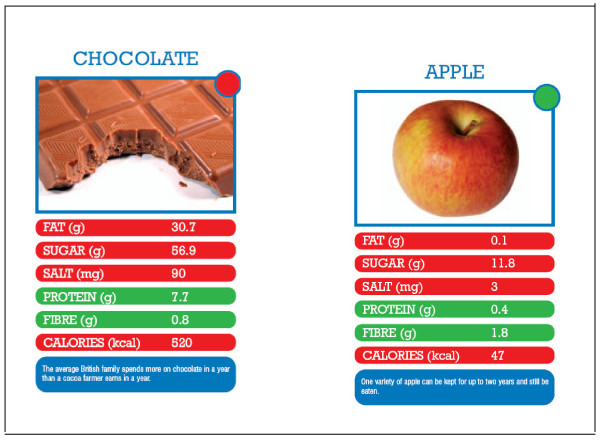
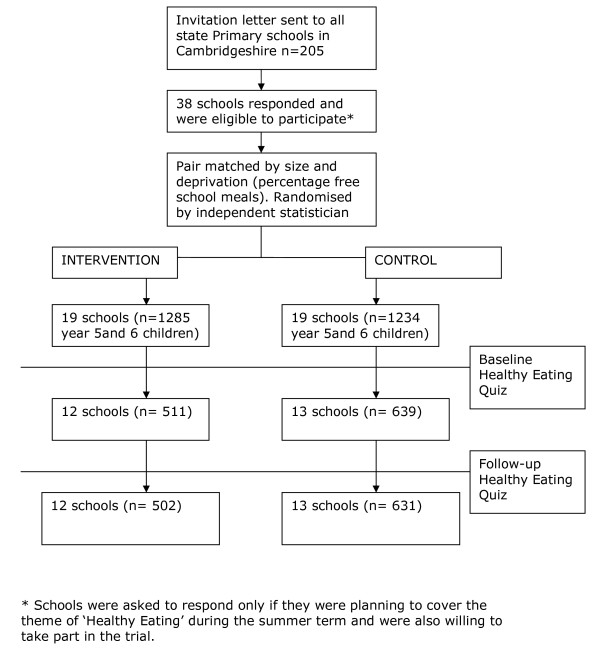
BACKGROUND: Improving nutrition knowledge among children may help them to make healthier food choices. The aim of this study was to assess the effectiveness and acceptability of a novel educational intervention to increase nutrition knowledge among primary school children. METHODS: We developed a card game 'Top Grub' and a 'healthy eating' curriculum for use in primary schools. Thirty-eight state primary schools comprising 2519 children in years 5 and 6 (aged 9-11 years) were recruited in a pragmatic cluster randomised controlled trial. The main outcome measures were change in nutrition knowledge scores, attitudes to healthy eating and acceptability of the intervention by children and teachers. RESULTS: Twelve intervention and 13 control schools (comprising 1133 children) completed the trial. The main reason for non-completion was time pressure of the school curriculum. Mean total nutrition knowledge score increased by 1.1 in intervention (baseline to follow-up: 28.3 to 29.2) and 0.3 in control schools (27.3 to 27.6). Total nutrition knowledge score at follow-up, adjusted for baseline score, deprivation, and school size, was higher in intervention than in control schools (mean difference = 1.1; 95% CI: 0.05 to 2.16; p = 0.042). At follow-up, more children in the intervention schools said they 'are currently eating a healthy diet' (39.6%) or 'would try to eat a healthy diet' (35.7%) than in control schools (34.4% and 31.7% respectively; chi-square test p < 0.001). Most children (75.5%) enjoyed playing the game and teachers considered it a useful resource. CONCLUSIONS: The 'Top Grub' card game facilitated the enjoyable delivery of nutrition education in a sample of UK primary school age children. Further studies should determine whether improvements in nutrition knowledge are sustained and lead to changes in dietary behaviour.
Overview
The claims and statistics of this paper haven’t been checked yet.
Free: it reads the open-access text and checks the first 5 claims that cite a source we can check. Create a free account to check every claim.
Integrity signals
Registry
Cites
Statistics
Figures
Verification
Claims the paper makes
The claims and statistics of this paper haven’t been checked yet.
Free: it reads the open-access text and checks the first 5 claims that cite a source we can check. Create a free account to check every claim.
Claims other papers make about this one
Each is checked against this paper’s own text: does it say what the citing paper says it does?
The source backs part of the claim, not all of it — or backs it for a different population, condition or comparison.
In the citing paper
“Modest improvements were also found in knowledge related to tasting and healthy-eating concepts, as well as in the number of foods recognized [49].”
From Effects of school-based nutrition literacy Intervention on obesity prevention in school-age students: a systematic review and meta-analysis (2026) · cites this paper as [49]
Experimental — accuracy not yet measuredThe source backs part of the claim, not all of it — or backs it for a different population, condition or comparison.
In the citing paper
“Including food and nutrition literacy, general nutrition knowledge, and obesity-related knowledge, generally improved following intervention, although the magnitude and consistency of effects varied across studies [43–55].”
From Effects of school-based nutrition literacy Intervention on obesity prevention in school-age students: a systematic review and meta-analysis (2026) · cites this paper as [49]
Experimental — accuracy not yet measuredThe source backs part of the claim, not all of it — or backs it for a different population, condition or comparison.
In the citing paper
“improved tasting-related behavioral determinants and intention to taste or eat healthily [49]”
From Effects of school-based nutrition literacy Intervention on obesity prevention in school-age students: a systematic review and meta-analysis (2026) · cites this paper as [49]
Experimental — accuracy not yet measuredThe source backs part of the claim, not all of it — or backs it for a different population, condition or comparison.
In the citing paper
“Across studies, curriculum content consistently addressed foundational nutrition knowledge, including food and nutrient concepts, healthy eating, food groups, daily caloric intake, hydration, obesity-related knowledge, and balanced diet principles [43, 49, 51, 53–55, 62, 63].”
From Effects of school-based nutrition literacy Intervention on obesity prevention in school-age students: a systematic review and meta-analysis (2026) · cites this paper as [49]
Experimental — accuracy not yet measuredThe source backs part of the claim, not all of it — or backs it for a different population, condition or comparison.
In the citing paper
“Modest improvements in affect-related behavioral determinants, such as intentions to try new foods and perceived social influences, were additionally reported [49].”
From Effects of school-based nutrition literacy Intervention on obesity prevention in school-age students: a systematic review and meta-analysis (2026) · cites this paper as [49]
Experimental — accuracy not yet measured
10 more claims about this paper
Create a free account to see every claim other papers make about this one.
Self-check
Percentages, sums and reported differences re-computed from the paper’s own numbers.
The self-check needs the paper’s full text.
Citations
Cites
Genetics of Food Intake Self-Regulation in Childhood: Literature Review and Research Opportunities
Faith, M. S., Carnell, S., & Kral, T. V. E. (2013) · Human Heredity · doi:10.1159/000353879 · Cited by 7,601
Diet, nutrition and the prevention of chronic diseases
Joint, W. (2002) · Medical Entomology and Zoology · Cited by 4,916
Obesity in children and young people: a crisis in public health
Lobstein, T., Baur, L., & Uauy, R. (2004) · Obesity Reviews · doi:10.1111/j.1467-789x.2004.00133.x · Cited by 3,801 · cited 1×
“Establishing healthy eating habits in young children may prevent various chronic health disorders in childhood and adult life, including obesity, diabetes, hypertension, cardiovascular disease, cancer and dental caries [6-8].”
BackgroundInterventions for preventing obesity in children
Brown, T., Moore, T. H., Hooper, L., Gao, Y., Zayegh, A., Ijaz, S., Elwenspoek, M., Foxen, S. C., Magee, L., O'Malley, C., et al. (2019) · Cochrane Database of Systematic Reviews · doi:10.1002/14651858.cd001871.pub4 · Cited by 2,982
McCance and Widdowson's The Composition of Foods
England, P. H. (2002) · Royal Society of Chemistry eBooks · doi:10.1039/9781849735551 · Cited by 2,209
Reducing Children's Television Viewing to Prevent Obesity: A Randomized Controlled Trial
Robinson, T. N. (1999) · JAMA · doi:10.1001/jama.282.16.1561 · Cited by 1,838 · cited 1×
“physical activity and nutrition behaviours [27-29] or focussed on only one dimension such as TV watching [32] or restricting drinking of carbonated drinks [33].”
BackgroundDiet, Nutrition, and the Prevention of Chronic Diseases
Leong, A. S.-Y. (1992) · Pathology · doi:10.1016/s0031-3025(16)36541-2 · Cited by 1,628
Designing and evaluating complex interventions to improve health care
Campbell, N. C., Murray, E., Darbyshire, J., Emery, J., Farmer, A., Griffiths, F., Guthrie, B., Lester, H., Wilson, P., & Kinmonth, A. L. (2007) · BMJ · doi:10.1136/bmj.39108.379965.be · Cited by 1,331 · cited 1×
“While increasing nutrition knowledge may be an important initial step, ensuring translation to behaviour change will likely require a more intensive intervention and more complex evaluation [40].”
BackgroundJanssen, I., Katzmarzyk, P. T., Boyce, W. F., Vereecken, C., Mulvihill, C., Roberts, C., Currie, C., Pickett, W., & The Health Behaviour in School‐Aged Children Obesity Working Group (2005) · Obesity Reviews · doi:10.1111/j.1467-789x.2005.00176.x · Cited by 1,169
McCance, R. A., & Widdowson, E. M. (1960) · Biblioteca Digital (Real Academia Nacional de Medicina) · Cited by 971
James, J., Thomas, P., Cavan, D., & Kerr, D. (2004) · BMJ · doi:10.1136/bmj.38077.458438.ee · Cited by 827
Simple sample size calculation for cluster-randomized trials
Hayes, R. J., & Bennett, S. (1999) · International Journal of Epidemiology · doi:10.1093/ije/28.2.319 · Cited by 822 · cited 1×
“Power calculations were based on the method described by Hayes and Bennett [ 16 ].”
MethodInterventions for preventing obesity in children
Summerbell, C. D., Waters, E., Edmunds, L., Kelly, S. A., Brown, T., & Campbell, K. J. (2005) · Cochrane Database of Systematic Reviews · doi:10.1002/14651858.cd001871.pub2 · Cited by 763 · cited 2×
“There have been two recent systematic reviews on school-based interventions to promote healthier lifestyles and prevent obesity in children [30,31].”
BackgroundNutrition knowledge and food consumption: can nutrition knowledge change food behaviour?
Worsley, A. (2002) · Asia Pacific Journal of Clinical Nutrition · doi:10.1046/j.1440-6047.11.supp3.7.x · Cited by 649 · cited 1×
“In order to achieve this it may be useful to increase knowledge of the nutritional content of commonly consumed foods [ 11 ].”
BackgroundDevelopment of a general nutrition knowledge Questionnaire for adults
Parmenter, K., & Wardle, J. (1999) · European Journal of Clinical Nutrition · doi:10.1038/sj.ejcn.1600726 · Cited by 633 · cited 1×
“We performed a literature review for questionnaires on nutrition knowledge, attitudes and behaviour, but we found few that had been developed to evaluate specific school-based interventions to prevent obesity or to increase fruit and vegetable intake [17-29].”
MethodCaballero, B., Clay, T., Davis, S. M., Ethelbah, B., Rock, B. H., Lohman, T., Norman, J., Story, M., Stone, E. J., Stephenson, L., et al. (2003) · The American Journal of Clinical Nutrition · doi:10.1093/ajcn/78.5.1030 · Cited by 627 · cited 2×
“We performed a literature review for questionnaires on nutrition knowledge, attitudes and behaviour, but we found few that had been developed to evaluate specific school-based interventions to prevent obesity or to increase fruit and vegetable intake [17-29].”
BackgroundMethodWHO Technical Report Series No. 72
&NA; (1954) · The American Journal of the Medical Sciences · doi:10.1097/00000441-195408000-00072 · Cited by 432
Randomised controlled trial of primary school based intervention to reduce risk factors for obesity
Sahota, P., Rudolf, M. C. J., Dixey, R., Hill, A. J., Barth, J. H., & Cade, J. (2001) · BMJ · doi:10.1136/bmj.323.7320.1029 · Cited by 379 · cited 1×
“On the other hand school programmes with shorter durations of around one year, such as the Christchurch Obesity Prevention Programme in Schools (CHOPPS) [38] and the Active Programme Promoting Lifestyles in Schools (APPLES), have not been successful [33,39].”
BackgroundArchivos Latinoamericanos de Nutrición
(2021) · Archivos Latinoamericanos de Nutrición · doi:10.37527/alanrev · Cited by 375
Interventions to prevent obesity in children and adolescents: a systematic literature review
Flodmark, C.-E., Marcus, C., & Britton, M. (2006) · International Journal of Obesity · doi:10.1038/sj.ijo.0803290 · Cited by 273 · cited 2×
“There have been two recent systematic reviews on school-based interventions to promote healthier lifestyles and prevent obesity in children [30,31].”
BackgroundReducing Obesity via a School-Based Interdisciplinary Intervention Among Youth: Planet Health
Gortmaker, S. L., Peterson, K., Wiecha, J., Sobol, A. M., Dixit, S., Fox, M. K., & Laird, N. (1999) · Archives of Pediatrics & Adolescent Medicine · doi:10.1001/archpedi.153.4.409 · Cited by 252 · cited 2×
“We performed a literature review for questionnaires on nutrition knowledge, attitudes and behaviour, but we found few that had been developed to evaluate specific school-based interventions to prevent obesity or to increase fruit and vegetable intake [17-29].”
BackgroundMethodEvaluation of a pilot school programme aimed at the prevention of obesity in children
Warren, J. M. (2003) · Health Promotion International · doi:10.1093/heapro/dag402 · Cited by 222 · cited 1×
“[29,48].”
Sahota, P., Rudolf, M. C. J., Dixey, R., Hill, A. J., Barth, J. H., & Cade, J. (2001) · BMJ · doi:10.1136/bmj.323.7320.1027 · Cited by 211
Obesity prevention programs for children and youth: why are their results so modest?
Thomas, H. (2006) · Health Education Research · doi:10.1093/her/cyl143 · Cited by 185 · cited 1×
“There is still uncertainty as to the components of an effective intervention [34].”
BackgroundFAHLMAN, M. M., Dake, J. A., McCaughtry, N., & Martin, J. J. (2008) · Journal of School Health · doi:10.1111/j.1746-1561.2008.00289.x · Cited by 183 · cited 1×
“The study showed that nutrition knowledge improved in the intervention group and students in the intervention group were more likely to eat fruits and vegetables and less likely to eat junk food than the control group [42].”
BackgroundSchool-based programs: lessons learned from CATCH, Planet Health, and Not-On-Tobacco.
Franks, A. L., Kelder, S. H., Dino, G., Horn, K. A., Gortmaker, S. L., Wiecha, J. L., & Simões, E. J. (2007) · Preventing Chronic Disease · Cited by 171
Stevens, J., Cornell, C. E., Story, M. T., French, S. A., Levin, S., Becenti, A., Gittelsohn, J., Going, S. B., & Reid, R. (1999) · American Journal of Clinical Nutrition · doi:10.1093/ajcn/69.4.773s · Cited by 145
James, J., Thomas, P., & Kerr, D. (2007) · BMJ · doi:10.1136/bmj.39342.571806.55 · Cited by 142 · cited 2×
“On the other hand school programmes with shorter durations of around one year, such as the Christchurch Obesity Prevention Programme in Schools (CHOPPS) [38] and the Active Programme Promoting Lifestyles in Schools (APPLES), have not been successful [33,39].”
BackgroundFORESIGHT TACKLING OBESITIES: FUTURE CHOICES
McPherson, K. (2011) · Journal of Epidemiology & Community Health · Cited by 136
Testing nutrient profile models using data from a survey of nutrition professionals
Scarborough, P., Boxer, A., Rayner, M., & Stockley, L. (2007) · Public Health Nutrition · doi:10.1017/s1368980007666671 · Cited by 128
Austin, S. B., Kim, J., Wiecha, J., Troped, P. J., Feldman, H. A., & Peterson, K. E. (2007) · Archives of Pediatrics & Adolescent Medicine · doi:10.1001/archpedi.161.9.865 · Cited by 72 · cited 1×
“Similarly the Harvard School of Public Health 5-2-1-Go! Program (eat 5 servings of fruit and vegetables daily, limit screen time to no more than 2 hours a day, and get at least 1 hour of physical activity daily) that includes the ‘Planet Health’ curriculum has shown promising results over many years [9, 37 ].”
BackgroundWhati, L., Senekal, M., Steyn, N. P., Nel, J. H., Lombard, C. J., & Norris, S. A. (2005) · Nutrition · doi:10.1016/j.nut.2004.09.011 · Cited by 64 · cited 1×
“We performed a literature review for questionnaires on nutrition knowledge, attitudes and behaviour, but we found few that had been developed to evaluate specific school-based interventions to prevent obesity or to increase fruit and vegetable intake [17-29].”
MethodA questionnaire assessment of nutrition knowledge – validity and reliability issues
A.*, A., Bell, A., Adamson, A., & Moynihan, P. (2002) · Public Health Nutrition · doi:10.1079/phnphn2001307 · Cited by 64 · cited 1×
“We performed a literature review for questionnaires on nutrition knowledge, attitudes and behaviour, but we found few that had been developed to evaluate specific school-based interventions to prevent obesity or to increase fruit and vegetable intake [17-29].”
MethodRobitaille, J., Gaudet, D., Përusse, L., & Vohl, M. (2006) · International Journal of Obesity · doi:10.1038/sj.ijo.0803450 · Cited by 58
Moore, J. B., Pawloski, L. R., Goldberg, P., Kyeung, M. O., Stoehr, A., & Baghi, H. (2009) · The Journal of School Nursing · doi:10.1177/1059840509333325 · Cited by 39 · cited 1×
“gov consisting of six classes taught over a 3-month period, showed that nutrition knowledge only increased in the control group, and there were no significant differences in BMI percentiles [43].”
BackgroundEvaluation of a computer-based nutrition education tool
Kreisel, K. (2004) · Public Health Nutrition · doi:10.1079/phn2003525 · Cited by 38 · cited 1×
“We performed a literature review for questionnaires on nutrition knowledge, attitudes and behaviour, but we found few that had been developed to evaluate specific school-based interventions to prevent obesity or to increase fruit and vegetable intake [17-29].”
MethodMalnutrition and high childhood mortality among the Onge tribe of the Andaman and Nicobar Islands
Rao, V., Sugunan, A., Murhekar, M. V., & SEHGAL, S. C. (2006) · Public Health Nutrition · doi:10.1079/phn2005761 · Cited by 37
Impact of a traffic light nutrition tool in a primary school
Ellis, R., & Ellis, R. C. T. (2007) · The Journal of the Royal Society for the Promotion of Health · doi:10.1177/1466424007073202 · Cited by 35 · cited 1×
“Positive attitude scores and asking behaviour for both red and green food items decreased [44].”
BackgroundRäsänen, M., Keskinen, S., Niinikoski, H., Heino, T., Simell, O., Rönnemaa, T., Helenius, H. Y. M., & Viikari, J. S. A. (2003) · European Journal of Clinical Nutrition · doi:10.1038/sj.ejcn.1601763 · Cited by 30 · cited 1×
“We performed a literature review for questionnaires on nutrition knowledge, attitudes and behaviour, but we found few that had been developed to evaluate specific school-based interventions to prevent obesity or to increase fruit and vegetable intake [17-29].”
MethodRao, G. S., Rao, D. R., Venkaiah, K., Dube, A. K., & Sarma, K. R. (2006) · Public Health Nutrition · doi:10.1017/s1368980006009748 · Cited by 25
The Quebec Overfeeding Study: a catalyst for new hypothesis generation
Redden, D. T., & Allison, D. B. (2004) · Obesity Reviews · doi:10.1111/j.1467-789x.2004.00128.x · Cited by 22
Impact of the Nutrition for Life Program on Junior High Students in New York State
Devine, C. M., Olson, C. M., & Frongillo, E. A. (1992) · Journal of School Health · doi:10.1111/j.1746-1561.1992.tb02328.x · Cited by 20
Garcia-Lascurain, M. C., Kicklighter, J. R., Jonnalagadda, S. S., Boudolf, E. A., & Duchon, D. (2005) · Journal of Immigrant and Minority Health · doi:10.1007/s10903-006-6342-9 · Cited by 20 · cited 1×
“A 12-item knowledge questionnaire was used and mean knowledge scores did not increase significantly from pre-to post-test, however, scores that measured ability to identify food groups and the number of servings for food groups increased, while scores on the ability to identify the importance of each food group for he…”
MethodThe Impact of a Computerized Dietary Assessment on Nutrition Knowledge.
Hensleigh, K. E., Eddy, J. M., Wang, M. Q., Dennison, D., & Chaney, J. D. (2004) · The international electronic journal of health education · Cited by 8
[A test to measure the degree of knowledge on food and nutrition at the onset of elementary school].
Ivanovic Marincovich, D., Gómez, C. G. C., & Marincovich, R. I. (1997) · PubMed · Cited by 2
Räsänen, M., Keskinen, S., Niinikoski, H., Heino, T., Simell, O., Rönnemaa, T., Helenius, H. Y. M., & Viikari, J. (2004) · European Journal of Clinical Nutrition · doi:10.1038/sj.ejcn.1601951 · Cited by 1
Research works printed but not linked: 5
- 11. National Social Marketing Centre for Excellence: Social Marketing Pocket Guide., 1 2005 [http://www.nsmcentre.org.uk/component/remository/ NSMC-Publications/Social-Marketing-Big-Pocket-guide/], (accessed Jan 2010).
- 20. Kjolhede C, Burrington C, Mitchell N, Quinn S, Kosinski S, Green A: Effect of an educational program on nutrition knowledge and awareness of the obesity epidemic among third grade children in rural schools. Obesity Research 2004, 12:A156.
- 25. Henry CJ, Warren JM: Family-centered, school-based intervention for the prevention of obesity in primary school aged children. Food Standards Agency 2001.
- 34. Bostrom M, Garbuck A, Nyberg G, Wikzen M, Karpmyr M, Marcus C: STOPP: Stockholm Obesity Prevention Project; a school-based obesity prevention among 6-10 year old children. Int J Obes Relat Metab Disord 2004, 28:S189.
- 46. Department for Education and Skills DfES: Maintained nursery and primary schools: school meal arrangements. 2005 [http://www.erpho.org.uk/ viewResource.aspx?id=9824], (accessed Jan 2010).
Cited by
Can games change children’s eating behaviour? A review of gamification and serious games
Chow, C. Y., Riantiningtyas, R. R., Kanstrup, M. B., Papavasileiou, M., Liem, D. G., & Olsen, A. (2019) · Food Quality and Preference · doi:10.1016/j.foodqual.2019.103823 · Cited by 194
Using a robot to personalise health education for children with diabetes type 1: A pilot study
Henkemans, O. B., Bierman, B. P. B., Janssen, J. B., Neerincx, M. A., Looije, R., van der Bosch, H., & van der Giessen, J. A. M. (2013) · Patient Education and Counseling · doi:10.1016/j.pec.2013.04.012 · Cited by 171
“Playing a game like the diabetes quiz allows the child to enhance their knowledge about health [17].”
BackgroundSuleiman-Martos, N., García-Lara, R. A., Martos-Cabrera, M. B., Albendín-García, L., Romero-Béjar, J. L., Cañadas-De la Fuente, G. A., & Gómez-Urquiza, J. L. (2021) · Nutrients · doi:10.3390/nu13072478 · Cited by 108
“[38] (2010), UK RCT N = 1133 children Age 9–11 years n CG = 631 n IG = 502 To increase nutrition knowledge CG: traditional healthy eating curriculum IG: “Top Grub”: card nutrition game 9 weeks Nutrition knowledge questionnaire Attitudes to healthy eating Baseline Nutrition knowledge Total score CG: 27.”
BackgroundViggiano, A., Viggiano, E., Costanzo, A. D., Viggiano, A., Andreozzi, E., Romano, V., Rianna, I., Vicidomini, C., Gargano, G., Incarnato, L., et al. (2014) · European Journal of Pediatrics · doi:10.1007/s00431-014-2381-8 · Cited by 150
Cotton, W., Dudley, D., Peralta, L., & Werkhoven, T. (2020) · Preventive Medicine Reports · doi:10.1016/j.pmedr.2020.101178 · Cited by 75
“…al., 2010; Amaro et al., 2006; Auld et al., 1998; Baranowski et al., 2000) and seven studies met between two and four of the assessment criteria (Anderson et al., 2005; Liquori et al., 1998; Fahlman et al., 2008; Govula et al., 2007; Prelip et al., 2012; Campbell et al., 2012; Friel et al., 1999).”
BackgroundInfluential
Metadata
- Authors
- Lakshman, R. R., Sharp, S. J., Ong, K. K., & Forouhi, N. G.
- Affiliations
- University of Cambridge (GB)
- Wellcome/MRC Institute of Metabolic Science (GB)
- Corresponding author
- Lakshman, Rajalakshmi R
- Venue
- BMC Public Health
- Published
- 2010-03-10
- Volume
- 10
- Issue
- 1
- Pages
- 123-123
- ISSN
- 1471-2458 (ISSN-L)
- PMC
- PMC2847978
- OpenAlex
- W2134997326
- Semantic Scholar
- 2c4b222f0bc500e56d9602bef636e02d7734375a
- Cited by
- 108
- References
- 48
- Citations by year
- 2026: 5 · 2025: 6 · 2024: 5 · 2023: 8 · 2022: 4 · 2021: 8 · 2020: 14 · 2019: 9 · 2018: 5 · 2017: 3 · 2016: 7 · 2015: 10 · 2014: 7 · 2013: 7 · 2012: 7
- FWCI
- 5.16
- Type
- journal article
- Language
- en
- Open access
- gold
- doi.org
- Licence
- cc-by
- creativecommons.org/licenses/by/2.0 (tdm)
- Locations
- BMC Public Health (publishedVersion, cc-by)
- PubMed Central (publishedVersion, cc-by)
- PubMed (publishedVersion)
- DOAJ (DOAJ: Directory of Open Access Journals) (submittedVersion)
- Apollo (University of Cambridge) (submittedVersion, cc-by)
- Funders
- Medical Research Council (MC_EX_G0701655)
- Economic and Social Research Council (ES/G007462/1)
- Topics
- Health Sciences › Nursing › Nutrition and Dietetics › Nutrition, Health and Food Behavior
- Health Sciences › Medicine › Public Health, Environmental and Occupational Health › School Health and Nursing Education
- Health Sciences › Medicine › Public Health, Environmental and Occupational Health › Obesity, Physical Activity, Diet
- Keywords
- nutrition knowledge, school-based intervention, elementary school students, card games, nutrition education, treatment acceptability, dietary behaviour
- MeSH terms
- Child, Diet, Female, Follow-Up Studies, United Kingdom, Health Education, Humans, Health Knowledge, Attitudes, Practice, Male, Play and Playthings, Surveys and Questionnaires, School Health Services, Nutrition Policy, Child Nutrition Sciences
About these checks
Registry, retraction, Cites and statistics results are computed, not judged, with one exception: a printed reference that no index lists is read once by a model before it counts as a citation error. Claims are extracted by a model and kept only when their quote appears verbatim in the text; each cited source is then checked, with a model’s help, for whether it says what the claim relies on. Those verdicts can be wrong — read the claim’s quote and the cited source before relying on one.
Statistics and arithmetic are recomputed, not judged.
Confidence bands are shown only for fields calibrated on our annotated test set. None is calibrated yet, so no band is shown.
What counts as a claim ›How we measure confidence ›How we check this ›
Are you an author, or do you see a problem with this page? Request a review
Data sources
Bibliographic data: Semantic Scholar, OpenAlex, Crossref.
Contains information from the Semantic Scholar Academic Graph Datasets, made available under the ODC Attribution License (ODC-BY 1.0).
Semantic Scholar’s data is described in: Kinney, R., et al. (2023). The Semantic Scholar Open Data Platform. arXiv:2301.10140.
