

Violence against female sex workers in Karnataka state, south India: impact on health, and reductions in violence following an intervention program
Open accessThe DOI matches its Crossref record; 32 of the 33 references it cites were found in a registry or an index.
Abstract
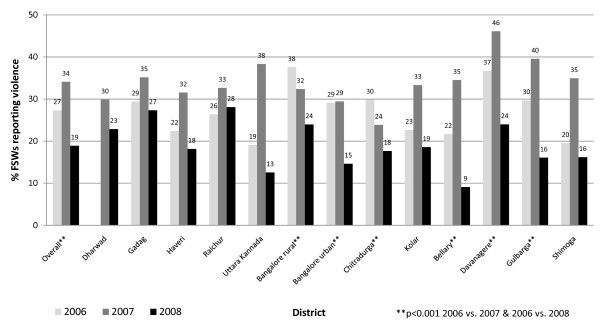
BACKGROUND: Violence against female sex workers (FSWs) can impede HIV prevention efforts and contravenes their human rights. We developed a multi-layered violence intervention targeting policy makers, secondary stakeholders (police, lawyers, media), and primary stakeholders (FSWs), as part of wider HIV prevention programming involving >60,000 FSWs in Karnataka state. This study examined if violence against FSWs is associated with reduced condom use and increased STI/HIV risk, and if addressing violence against FSWs within a large-scale HIV prevention program can reduce levels of violence against them. METHODS: FSWs were randomly selected to participate in polling booth surveys (PBS 2006-2008; short behavioural questionnaires administered anonymously) and integrated behavioural-biological assessments (IBBAs 2005-2009; administered face-to-face). RESULTS: 3,852 FSWs participated in the IBBAs and 7,638 FSWs participated in the PBS. Overall, 11.0% of FSWs in the IBBAs and 26.4% of FSWs in the PBS reported being beaten or raped in the past year. FSWs who reported violence in the past year were significantly less likely to report condom use with clients (zero unprotected sex acts in previous month, 55.4% vs. 75.5%, adjusted odds ratio (AOR) 0.4, 95% confidence interval (CI) 0.3 to 0.5, p < 0.001); to have accessed the HIV intervention program (ever contacted by peer educator, 84.9% vs. 89.6%, AOR 0.7, 95% CI 0.4 to 1.0, p = 0.04); or to have ever visited the project sexual health clinic (59.0% vs. 68.1%, AOR 0.7, 95% CI 0.6 to 1.0, p = 0.02); and were significantly more likely to be infected with gonorrhea (5.0% vs. 2.6%, AOR 1.9, 95% CI 1.1 to 3.3, p = 0.02). By the follow-up surveys, significant reductions were seen in the proportions of FSWs reporting violence compared with baseline (IBBA 13.0% vs. 9.0%, AOR 0.7, 95% CI 0.5 to 0.9 p = 0.01; PBS 27.3% vs. 18.9%, crude OR 0.5, 95% CI 0.4 to 0.5, p < 0.001). CONCLUSIONS: This program demonstrates that a structural approach to addressing violence can be effectively delivered at scale. Addressing violence against FSWs is important for the success of HIV prevention programs, and for protecting their basic human rights.
Overview
The claims and statistics of this paper haven’t been checked yet.
Free: it reads the open-access text and checks the first 5 claims that cite a source we can check. Create a free account to check every claim.
Integrity signals
Registry
Cites
Statistics
Figures
Verification
Claims the paper makes
The claims and statistics of this paper haven’t been checked yet.
Free: it reads the open-access text and checks the first 5 claims that cite a source we can check. Create a free account to check every claim.
Claims other papers make about this one
Each is checked against this paper’s own text: does it say what the citing paper says it does?
The source backs part of the claim, not all of it — or backs it for a different population, condition or comparison.
In the citing paper
“Globally, sex workers experience a disproportionate burden of violence compared to the general population [1–6].”
From Comparing typologies of violence exposure and associations with syndemic health outcomes among cisgender and transgender female sex workers living with HIV in the Dominican Republic (2023) · cites this paper as [1]
Experimental — accuracy not yet measuredThe source backs part of the claim, not all of it — or backs it for a different population, condition or comparison.
In the citing paper
“FSW face high rates of verbal, physical, and sexual abuse from a variety of perpetrators,5,36,45–47 which can harm their mental health.23,45”
From Mindfulness, Mental Health, and Violence Exposure Among Transgender Female Sex Workers Living with HIV in the Dominican Republic. (2026) · cites this paper as [46]
Experimental — accuracy not yet measured
Self-check
Percentages, sums and reported differences re-computed from the paper’s own numbers.
The self-check needs the paper’s full text.
Citations
Cites
Ellsberg, M., Jansen, H. A., Heise, L., Watts, C. H., & Garcia-Moreno, C. (2008) · The Lancet · doi:10.1016/s0140-6736(08)60522-x · Cited by 1,820 · cited 2×
“Rates of reported violence were very high, and were much higher in the PBS compared with the IBBA, likely reflecting social desirability bias in the face-to-face interviews, and highlighting the importance of using alternative survey methods when collecting information on sensitive behaviours [6,29-31].”
BackgroundDunkle, K. L., Jewkes, R. K., Brown, H. C., Gray, G. E., McIntryre, J. A., & Harlow, S. D. (2004) · The Lancet · doi:10.1016/s0140-6736(04)16098-4 · Cited by 1,323 · cited 2×
“Research on domestic violence from developing countries suggests that anywhere from 10-60% of married women of reproductive age report experiencing some form of domestic violence [2], and that domestic violence is strongly associated with physical and mental health morbidity, including homicide, suicide, physical inju…”
BackgroundViolence against women: global scope and magnitude
Watts, C., & Zimmerman, C. (2002) · The Lancet · doi:10.1016/s0140-6736(02)08221-1 · Cited by 1,190 · cited 4×
“Research on domestic violence from developing countries suggests that anywhere from 10-60% of married women of reproductive age report experiencing some form of domestic violence [2], and that domestic violence is strongly associated with physical and mental health morbidity, including homicide, suicide, physical inju…”
BackgroundInfluentialPronyk, P. M., Hargreaves, J. R., Kim, J. C., Morison, L. A., Phetla, G., Watts, C., Busza, J., & Porter, J. D. (2006) · The Lancet · doi:10.1016/s0140-6736(06)69744-4 · Cited by 919 · cited 1×
“There is growing recognition of the impact of physical and sexual violence on the mental and physical health of women, including HIV infection [3,13,33], and studies with non-sex workers have reported reductions in violence within intimate partnerships as part of broader HIV intervention programs [34-36].”
BackgroundJewkes, R., Nduna, M., Levin, J., Jama, N., Dunkle, K., Puren, A., & Duvvury, N. (2008) · BMJ · doi:10.1136/bmj.a506 · Cited by 757 · cited 1×
“There is growing recognition of the impact of physical and sexual violence on the mental and physical health of women, including HIV infection [3,13,33], and studies with non-sex workers have reported reductions in violence within intimate partnerships as part of broader HIV intervention programs [34-36].”
BackgroundKim, J. C., Watts, C. H., Hargreaves, J. R., Ndhlovu, L. X., Phetla, G., Morison, L. A., Busza, J., Porter, J. D. H., & Pronyk, P. (2007) · American Journal of Public Health · doi:10.2105/ajph.2006.095521 · Cited by 619 · cited 1×
“There is growing recognition of the impact of physical and sexual violence on the mental and physical health of women, including HIV infection [3,13,33], and studies with non-sex workers have reported reductions in violence within intimate partnerships as part of broader HIV intervention programs [34-36].”
BackgroundMaman, S., Mbwambo, J. K., Hogan, N. M., Kilonzo, G. P., Campbell, J. C., Weiss, E., & Sweat, M. D. (2002) · American Journal of Public Health · doi:10.2105/ajph.92.8.1331 · Cited by 406 · cited 1×
“Research on domestic violence from developing countries suggests that anywhere from 10-60% of married women of reproductive age report experiencing some form of domestic violence [2], and that domestic violence is strongly associated with physical and mental health morbidity, including homicide, suicide, physical inju…”
BackgroundThe Sonagachi Project: A Sustainable Community Intervention Program
Jana, S., Basu, I., Rotheram-Borus, M. J., & Newman, P. A. (2004) · AIDS Education and Prevention · doi:10.1521/aeap.16.5.405.48734 · Cited by 371 · cited 1×
“In addition to increased knowledge and awareness of sexual risk leading to increase condom use following participation in an HIV prevention program, the conversion of a hostile environment to a more facilitative enabling environment for sex work has been reported elsewhere as a contributing factor to improved condom u…”
BackgroundDunkle, K. L., Jewkes, R. K., Nduna, M., Levin, J., Jama, N., Khuzwayo, N., Koss, M. P., & Duvvury, N. (2006) · AIDS · doi:10.1097/01.aids.0000247582.00826.52 · Cited by 324
Target cells in vaginal HIV transmission
Miller, C. J., & Shattock, R. J. (2003) · Microbes and Infection · doi:10.1016/s1286-4579(02)00056-4 · Cited by 220 · cited 1×
“As well as negatively impacting on their mental health and emotional wellbeing [11,13], violence against sex workers can heighten their vulnerability to HIV and other sexually transmitted infections (STIs) through multiple mechanisms: (i) coerced sex is rarely protected; (ii) coerced sex can result in injuries that ca…”
Background
Research works printed but not linked: 6
- Wolffers I van Beelen N Brussa L Violence, repression and other health threats. Sex workers at risk Research for Sex Work 2001 4 1 32 http://iac.nswp.org/research-for-sex-work/editions/research-for-sex-work-4-risk-and-violence/ Accessed 10th February 2010
- Beattie T Shetty A Devi Vanta U Lowndes CM Alary M Bradley JE The evolution of female sex work in Guntur, Andhra Pradesh: a qualitative study of HIV-related issues Volume CHARME Working Paper No. 5. Bangalore, India: Charme Working Paper No. 5 2009 http://khpt.org/CHARME%20WP%205.pdf Accessed 10th February 2010
- National AIDS Control Organisation (NACO) HIV Sentinel Surveillance and HIV Estimation, 2006 NACO 2007 https://www.nacoonline.org/upload/NACO%20PDF/Note%20on%20HIV%20Sentinel%20Surveillance%20and%20HIV%20Estimation_01%20Feb%2008.pdf New Delhi: accessed 4th January 2010
- International Institute for Population Sciences (IIPS) and Macro International National Family Health Survey (NFHS-3): India, Volume I 2005 I
- Lowndes CM Jayachandran AA Pradeep BS Ramesh BM Washington R Mahapatra B Blanchard J Moses S Alary M High levels of HIV-related risky behaviour reported through polling booth surveys in comparison to face-to-face interviews in a general population survey in Mysore district, Karnataka state, southern India [Abstract P-339] XVII Biennial Meeting of the International Society for STD Research (ISSTDR), Seattle, Washington, USA, July 29 - August 1 2007
- World Health Organisation Violence against women and HIV/AIDS: Critical Intersections. Violence against sex workers and HIV prevention Volume Information Bulletin Series, Number 3 2005 The department of gender women and health
Cited by
Global epidemiology of HIV among female sex workers: influence of structural determinants
Shannon, K., Strathdee, S. A., Goldenberg, S. M., Duff, P., Mwangi, P., Rusakova, M., Reza-Paul, S., Lau, J., Deering, K., Pickles, M. R., et al. (2015) · The Lancet · doi:10.1016/s0140-6736(14)60931-4 · Cited by 887
A systematic review of the correlates of violence against sex workers
Deering, K. N., Amin, A., Shoveller, J., Nesbitt, A., Garcia-Moreno, C., Duff, P., Argento, E., & Shannon, K. (2014) · American Journal of Public Health · doi:10.2105/ajph.2014.301909 · Cited by 611
Kerrigan, D., Kennedy, C. E., Morgan-Thomas, R., Reza-Paul, S., Mwangi, P., Win, K. T., McFall, A., Fonner, V. A., & Butler, J. (2015) · The Lancet · doi:10.1016/s0140-6736(14)60973-9 · Cited by 375
Human rights violations against sex workers: burden and effect on HIV
Decker, M. R., Crago, A.-L., Chu, S. K. H., Sherman, S. G., Seshu, M. S., Buthelezi, K., Dhaliwal, M., & Beyrer, C. (2015) · The Lancet · doi:10.1016/s0140-6736(14)60800-x · Cited by 368
An action agenda for HIV and sex workers
Beyrer, C., Crago, A.-L., Bekker, L.-G., Butler, J., Shannon, K., Kerrigan, D., Decker, M. R., Baral, S. D., Poteat, T., Wirtz, A. L., et al. (2015) · The Lancet · doi:10.1016/s0140-6736(14)60933-8 · Cited by 230
Dunkle, K. L., & Decker, M. R. (2013) · American Journal of Reproductive Immunology · doi:10.1111/aji.12039 · Cited by 226
Stigma, violence and HIV vulnerability among transgender persons in sex work in Maharashtra, India
Ganju, D., & Saggurti, N. (2017) · Culture, Health & Sexuality · doi:10.1080/13691058.2016.1271141 · Cited by 194
The Global HIV Epidemics among Sex Workers
Kerrigan, D., Wirtz, A., Baral, S., Decker, M., Murray, L., Poteat, T., Pretorius, C., Sherman, S., Sweat, M., Semini, I., et al. (2013) · doi:10.1596/978-0-8213-9774-9 · Cited by 175
Beattie, T. S. H., Bhattacharjee, P., Suresh, M., Isac, S., Ramesh, B. M., & Moses, S. (2012) · Journal of Epidemiology and Community Health · doi:10.1136/jech-2011-200475 · Cited by 162
Self-citationThe role of sex work laws and stigmas in increasing HIV risks among sex workers
Lyons, C. E., Schwartz, S., Murray, S. M., Shannon, K., Diouf, D., Mothopeng, T., Kouanda, S., Anato, S., Kouamé, A., Mnisi, Z., et al. (2020) · Nature Communications · doi:10.1038/s41467-020-14593-6 · Cited by 168
Gibbs, A., Jacobson, J., & Wilson, A. K. (2017) · Global Health Action · doi:10.1080/16549716.2017.1290427 · Cited by 161
“Only three interventions specifically focused on female sex workers, despite global evidence on the overwhelming burden of HIV and violence in this population [84,85].”
Injection drug use, sexual risk, violence and STI/HIV among Moscow female sex workers
Decker, M. R., Wirtz, A. L., Baral, S. D., Peryshkina, A., Mogilnyi, V., Weber, R. A., Stachowiak, J., Go, V., & Beyrer, C. (2012) · Sexually Transmitted Infections · doi:10.1136/sextrans-2011-050171 · Cited by 139
Adolescent female sex workers: invisibility, violence and HIV
Silverman, J. G. (2011) · Archives of Disease in Childhood · doi:10.1136/adc.2009.178715 · Cited by 133
Reza-Paul, S., Lorway, R., O’Brien, N., Lazarus, L., Jain, J., Bhagya, M., Fathima, M. P., Venukumar, K., Raviprakash, K. N., Baer, J., et al. (2012) · Indian Journal of Medical Research · doi:10.4103/0971-5916.93431 · Cited by 124
“Violence faced by sex workers has been identified as a major contributor to HIV vulnerability 14,15 .”
Law enforcement and public health: recognition and enhancement of joined-up solutions
van Dijk, A., Herrington, V., Crofts, N., Breunig, R. V., Burris, S. C., Sullivan, H. T., Middleton, J., Sherman, S. G., & Thomson, N. M. (2019) · The Lancet · doi:10.1016/s0140-6736(18)32839-3 · Cited by 145
Dhana, A. V., Luchters, S. M. F., Moore, L., Lafort, Y., Roy, A., Scorgie, F., & Chersich, M. (2014) · Globalization and Health · doi:10.1186/1744-8603-10-46 · Cited by 121
Quaife, M., Eakle, R., Cabrera Escobar, M. A., Vickerman, P., Kilbourne-Brook, M., Mvundura, M., Delany-Moretlwe, S., & Terris-Prestholt, F. (2018) · Medical Decision Making · doi:10.1177/0272989x17729376 · Cited by 112
Tailored combination prevention packages and PrEP for young key populations
Pettifor, A. E., Nguyen, N., Celum, C., Cowan, F. M., Go, V. F.-L., & Hightow‐Weidman, L. (2015) · Journal of the International AIDS Society · doi:10.7448/ias.18.2.19434 · Cited by 122
“These include a heightened risk of physical and sexual violence by clients and law enforcement agents [60 63].”
BackgroundPolice-Related Experiences and HIV Risk Among Female Sex Workers in Andhra Pradesh, India
Erausquin, J. T., Reed, E., & Blankenship, K. M. (2011) · Journal of Infectious Diseases · doi:10.1093/infdis/jir539 · Cited by 105
“Beattie et al [17] found that as many as 26% of FSWs in Karnataka state, India, reported violence in the preceding year, and those reporting violence were more likely to report a range of HIV-related risks.”
BackgroundTransactional Sex and HIV Incidence in a Cohort of Young Women in the Stepping Stones Trial
Jewkes, R. K., & Dunkle, K. (2012) · Journal of AIDS & Clinical Research · doi:10.4172/2155-6113.1000158 · Cited by 125
“Women who engage in sex motivated by economic gain, whether in prostitution or more informal transactional sex, are very vulnerable to sexually transmitted infections, including HIV, as well as rape and intimate partner violence (IPV) [1-7].”
BackgroundJewkes, R. K., Morrell, R. G., Sikweyiya, Y. M., Dunkle, K., & Penn‐Kekana, L. (2012) · BMC Public Health · doi:10.1186/1471-2458-12-325 · Cited by 121
“Women and men in prostitution are vulnerable to HIV and other sexually transmitted infections, as well as acts of violence from clients, pimps, police and other parties [1-5].”
BackgroundViolence against women in sex work and HIV risk implications differ qualitatively by perpetrator
Decker, M. R., Pearson, E., Illangasekare, S. L., Clark, E., & Sherman, S. G. (2013) · BMC Public Health · doi:10.1186/1471-2458-13-876 · Cited by 94
“Reed E, Gupta J, Biradavolu M, Devireddy V, Blankenship KM: The context of economic insecurity and its relation to violence and risk factors for HIV among female sex workers in Andhra Pradesh, India.”
BackgroundResultInfluentialLyons, T., Krüsi, A., Pierre, L., Kerr, T., Small, W., & Shannon, K. (2017) · Qualitative Health Research · doi:10.1177/1049732315613311 · Cited by 96
“…suggests that sex workers face a disproportionate burden of violence compared with the general population, with significant variations occurring across social, legal, cultural, and economic contexts (Beattie et al., 2010; Deering et al., 2014; Kurtz, Surratt, Inciardi, & Kiley, 2004; Lowman, 2000).”
BackgroundDeering, K. N., Boily, M.-C., Lowndes, C. M., Shoveller, J., Tyndall, M. W., Vickerman, P., Bradley, J., Gurav, K., Pickles, M., Moses, S., et al. (2011) · BMC Public Health · doi:10.1186/1471-2458-11-s6-s8 · Cited by 94
“Legal empowerment training has also been offered to 25,000 FSWs across Karnataka state, to improve legal literacy and inform FSWs about their legal rights [19].”
BackgroundHIV and adolescents: focus on young key populations
Bekker, L., & Hosek, S. (2015) · Journal of the International AIDS Society · doi:10.7448/ias.18.2.20076 · Cited by 114
Gurnani, V., Beattie, T. S., Bhattacharjee, P., CFAR Team, Mohan, H., Maddur, S., Washington, R., Isac, S., Ramesh, B., Moses, S., et al. (2011) · BMC Public Health · doi:10.1186/1471-2458-11-755 · Cited by 93
“Emergency mobile phone numbers were widely distributed among the FSW community, providing sex workers with an immediate response in times of crisis, as well as advocating on the victim’s behalf to pursue justice against perpetrators of violence [25].”
InfluentialSelf-citationWariki, W. M., Ota, E., Mori, R., Koyanagi, A., Hori, N., & Shibuya, K. (2012) · Cochrane Database of Systematic Reviews · doi:10.1002/14651858.cd005272.pub3 · Cited by 91
Swain, S. N., Saggurti, N., Battala, M., Verma, R. K., & Jain, A. K. (2011) · BMC Public Health · doi:10.1186/1471-2458-11-357 · Cited by 91
“As a marginalized population group due to sex work lacking social and moral approval [11], FSWs are highly vulnerable to various forms of violence, perpetrated by the police, clients, pimps, agents and fellow sex workers.”
BackgroundResultInfluentialLyons, C. E., Ketende, S. C., Diouf, D., Drame, F., Liestman, B., Coly, K., Ndour, C. T., Turpin, G., Mboup, S., Diop, K., et al. (2016) · JAIDS Journal of Acquired Immune Deficiency Syndromes · doi:10.1097/qai.0000000000001209 · Cited by 83
Footer, K. H. A., Park, J. N., Allen, S. T., Decker, M. R., Silberzahn, B. E., Huettner, S., Galai, N., & Sherman, S. G. (2019) · American Journal of Public Health · doi:10.2105/ajph.2018.304809 · Cited by 82
Wirtz, A. L., Schwartz, S., Ketende, S., Anato, S., Nadedjo, F. D., Ouedraogo, H. G., Ky-Zerbo, O., Pitche, V., Grosso, A., Papworth, E., et al. (2015) · JAIDS Journal of Acquired Immune Deficiency Syndromes · doi:10.1097/qai.0000000000000451 · Cited by 79
“New WHO guidelines for comprehensive HIV programs for FSWs support the decriminalization of sex work and encouraging safe work environments as well as encourage reduction of violence against FSWs as a core focus of HIV prevention programs.25,44 Emerging innovative research has begun to assess the impact of structural…”
BackgroundInfluentialBeattie, T., Mohan, H. L., Bhattacharjee, P., Chandrashekar, S., Isac, S. K., Wheeler, T., Prakash, R., Ramesh, B. M., Blanchard, J., Heise, L., et al. (2014) · American Journal of Public Health · doi:10.2105/ajph.2014.301911 · Cited by 87
“In the intensive phases of the program (2006---2008), FSWs built on their sense of solidarity and started to undertake collective action, working with policymakers, the police, government officials, human rights lawyers, and the media to address issues of stigma, discrimination, violence, and social inequity.(21,31) T…”
Self-citationViolence as a Barrier for HIV Prevention among Female Sex Workers in Argentina
Pando, M. A., Coloccini, R. S., Reynaga, E., Rodriguez Fermepin, M., Gallo Vaulet, L., Kochel, T. J., Montano, S. M., & Avila, M. M. (2013) · PLoS ONE · doi:10.1371/journal.pone.0054147 · Cited by 77
“Previous studies have shown that reducing violence against FSWs can facilitate condom use and thus possibly reduce STI transmission among sex workers [17,32].”
BackgroundDecker, M. R., Wirtz, A. L., Pretorius, C., Sherman, S. G., Sweat, M. D., Baral, S. D., Beyrer, C., & Kerrigan, D. L. (2013) · American Journal of Reproductive Immunology · doi:10.1111/aji.12063 · Cited by 76
Sherwood, J. A., Grosso, A., Decker, M. R., Peitzmeier, S., Papworth, E., Diouf, D., Drame, F. M., Ceesay, N., & Baral, S. (2015) · BMC Public Health · doi:10.1186/s12889-015-1583-y · Cited by 77
“The primary exposure for this analysis is consistent with best practices when measuring sexual violence, which do not require that participants self-identify as being “raped” when measuring the prevalence of forced sex [47], as well as data showing that the primary perpetrators of sexual violence against FSW are clien…”
BackgroundResultInfluentialSchwitters, A., Swaminathan, M., Serwadda, D., Muyonga, M., Shiraishi, R. W., Benech, I., Mital, S., Bosa, R., Lubwama, G., & Hladik, W. (2015) · AIDS and Behavior · doi:10.1007/s10461-014-0957-y · Cited by 77
“The illegal nature of sex work increases stigma and the marginalization of sex workers, leaving women at higher risk of experiencing GBV while making reporting of GBV to authorities more difficult [24–26].”
BackgroundShaw, S. Y., Lorway, R. R., Deering, K. N., Avery, L., Mohan, H. L., Bhattacharjee, P., Reza-Paul, S., Isac, S., Ramesh, B. M., Washington, R., et al. (2012) · PLoS ONE · doi:10.1371/journal.pone.0031705 · Cited by 76
“Notably, the prevalence of sexual violence reported in our study is higher than the reported prevalence among FSWs in southern India, which has been estimated at 10–15% [48].”
BackgroundSelf-citationGoldenberg, S. M., Chettiar, J., Nguyen, P., Dobrer, S., Montaner, J., & Shannon, K. (2014) · Journal of Urban Health · doi:10.1007/s11524-014-9888-1 · Cited by 65
“029 Client volume per month (median, IQR) 48 (31-82) 48 (20-84) 48 (20-84) 0.”
Ramesh, S., Ganju, D., Mahapatra, B., Mishra, R. M., & Saggurti, N. (2012) · BMC Public Health · doi:10.1186/1471-2458-12-764 · Cited by 69
“Forced unprotected sexual encounters were described as the most likely cause for their heightened vulnerability to HIV [12,14,17].”
BackgroundResultInfluentialRoberts, S. T., Flaherty, B. P., Deya, R., Masese, L., Ngina, J., McClelland, R. S., Simoni, J., & Graham, S. M. (2018) · AIDS and Behavior · doi:10.1007/s10461-018-2107-4 · Cited by 68
Mooney, A. C., Kidanu, A., Bradley, H. M., Kumoji, E. K., Kennedy, C. E., & Kerrigan, D. L. (2013) · BMC Public Health · doi:10.1186/1471-2458-13-771 · Cited by 75
“However, structural interventions to reduce violence against FSWs for HIV prevention have been rare, despite the high prevalence of violence in this population [15].”
BackgroundGoldsmith, R. E., Martin, C. G., & Smith, C. P. (2014) · Journal of Trauma & Dissociation · doi:10.1080/15299732.2014.871666 · Cited by 95
“Multilevel systemic interventions have reduced violence against female sex workers in India (Beattie et al., 2010) as well as child abuse and neglect (McCroskey, Pecora, Franke, Christie, & Lorthridge, 2012).”
BackgroundFulu, E., Kerr-Wilson, A., & Lang, J. (2014) · Cited by 111
Violence and HIV Risk Among Female Sex Workers in Southern India
Deering, K. N., Bhattacharjee, P., Mohan, H. L., Bradley, J., Shannon, K., Boily, M.-C., Ramesh, B. M., Isac, S., Moses, S., & Blanchard, J. (2013) · Sexually Transmitted Diseases · doi:10.1097/olq.0b013e31827df174 · Cited by 64
“Dichotomizing the variable in this way also allows the results from this study to be comparable with other studies, providing a richer understanding of the association between violence and HIV risk among FSWs.15 Explanatory Variables Physical violence by different perpetrators (i.e., clients and NPP) was collected in…”
BackgroundInfluentialDecker, M. R., Park, J. N., Allen, S. T., Silberzahn, B. E., Footer, K. H. A., Huettner, S., Galai, N., & Sherman, S. G. (2019) · AIDS and Behavior · doi:10.1007/s10461-019-02569-7 · Cited by 70
El-Bassel, N., Mukherjee, T. I., Stoicescu, C., Starbird, L. E., Stockman, J. K., Frye, V., & Gilbert, L. (2022) · The Lancet HIV · doi:10.1016/s2352-3018(21)00325-8 · Cited by 74
Decker, M. R., Wirtz, A. L., Moguilny, V., Peryshkina, A., Ostrovskaya, M., Nikita, M., Kuznetsova, J. E., & Beyrer, C. (2013) · AIDS and Behavior · doi:10.1007/s10461-013-0577-y · Cited by 65
“Current evidence linking client-perpetrated physical and sexual violence with prevalent HIV echoes findings from Moscow [11] as well as other settings [28–30].”
BackgroundBharat, S., Mahapatra, B., Roy, S., & Saggurti, N. (2013) · PLoS ONE · doi:10.1371/journal.pone.0068043 · Cited by 74
“Violence and abuse by intimate partners, brothel owners, pimps and middle-men, and the police, are frequent occurrences in the lives of FSWs accentuating their overall vulnerability, particularly to sexual infections including HIV [12].”
BackgroundStructural Interventions for HIV Prevention Among Women Who Use Drugs: A Global Perspective
Blankenship, K. M., Reinhard, E., Sherman, S. G., & El‐Bassel, N. (2015) · JAIDS Journal of Acquired Immune Deficiency Syndromes · doi:10.1097/qai.0000000000000638 · Cited by 65
Heterosexual Anal Intercourse: A Neglected Risk Factor for HIV ?
Baggaley, R. F., Dimitrov, D., Owen, B. N., Pickles, M., Butler, A. R., Mâsse, B. R., & Boily, M. (2012) · American Journal of Reproductive Immunology · doi:10.1111/aji.12064 · Cited by 77
Argento, E., Muldoon, K. A., Duff, P., Simo, A., Deering, K., & Shannon, K. (2014) · PLoS ONE · doi:10.1371/journal.pone.0102129 · Cited by 65
“, by clients, police, community members) against SWs [42–44], there are very few populationbased studies that investigate the factors influencing violence within SWs’ intimate partner relationships.”
BackgroundBeattie, T., Bhattacharjee, P., Isac, S. K., Mohan, H., Simic‐Lawson, M., Ramesh, B., Blanchard, J., Moses, S., Watts, C. H., & Heise, L. (2015) · Journal of the International AIDS Society · doi:10.7448/ias.18.1.20079 · Cited by 69
“We have previously reported reductions in overall violence against FSWs (by any perpetrator) in Karnataka between 2005 and 2008, and associations between violence exposure (any perpetrator) and increased gonorrhoea prevalence [33].”
InfluentialSelf-citationLyons, C. E., Grosso, A., Drame, F., Ketende, S. C., Diouf, D., Ba, I. O., Shannon, K., Ezouatchi, R., Bamba, A., Kouamé, A., et al. (2017) · JAIDS Journal of Acquired Immune Deficiency Syndromes · doi:10.1097/qai.0000000000001310 · Cited by 72
Ippoliti, N. B., Nanda, G., & Wilcher, R. (2017) · Studies in Family Planning · doi:10.1111/sifp.12020 · Cited by 65
Parcesepe, A. M., L′Engle, K. L., Martin, S. L., Green, S., Sinkele, W., Suchindran, C., Speizer, I. S., Mwarogo, P., & Kingola, N. (2016) · Drug and Alcohol Dependence · doi:10.1016/j.drugalcdep.2015.12.037 · Cited by 56
“FSWs are at high risk of multiple forms of interpersonal violence orldwide (Beattie et al., 2010; Decker et al., 2012; Karandikar and rospero, 2010; Reed et al., 2010; Simic and Rhodes, 2009; Swain t al., 2011).”
BackgroundMoreno, R., Nababan, H. Y., Ota, E., Wariki, W. M. V., Ezoe, S., Gilmour, S., & Shibuya, K. (2014) · Cochrane Database of Systematic Reviews · doi:10.1002/14651858.cd003363.pub3 · Cited by 65
Lang, D. L., Salazar, L. F., DiClemente, R. J., & Markosyan, K. M. (2012) · AIDS and Behavior · doi:10.1007/s10461-012-0245-7 · Cited by 59
Winter, S. C., Obara, L. M., & McMahon, S. (2020) · PLoS ONE · doi:10.1371/journal.pone.0230894 · Cited by 79
Semple, S. J., Stockman, J. K., Pitpitan, E. V., Strathdee, S. A., Chavarin, C. V., Mendoza, D. V., Aarons, G. A., & Patterson, T. L. (2015) · PLoS ONE · doi:10.1371/journal.pone.0143317 · Cited by 51
“This association has significant implications for increasing FSWs’ risk for HIV infection and other STIs.”
BackgroundInfluentialOnyango, M. A., Adu-Sarkodie, Y., Agyarko-Poku, T., Asafo, M. K., Sylvester, J., Wondergem, P., Green, K., Wambugu, S., Brennan, A. T., & Beard, J. (2015) · JAIDS Journal of Acquired Immune Deficiency Syndromes · doi:10.1097/qai.0000000000000455 · Cited by 51
Draughon Moret, J. E., Carrico, A. W., Evans, J. L., Stein, E. S., Couture, M.-C., Maher, L., & Page, K. (2016) · Drug and Alcohol Dependence · doi:10.1016/j.drugalcdep.2016.01.028 · Cited by 48
The cost and cost‐effectiveness of gender‐responsive interventions for HIV: a systematic review
Remme, M., Siapka, M., Vassall, A., Heise, L., Jacobi, J., Ahumada, C., Gay, J., & Watts, C. H. (2014) · Journal of the International AIDS Society · doi:10.7448/ias.17.1.19228 · Cited by 55
“…description and study design (Grey scalea) HIV-related outcome(s)b Size and period of effect Incremental interpretation Beattie et al., 2010 India (urban) 4 NGOs Over 60,000 FSWs; 3852 participated in IBBA surveys in 4 districts; and 7638 FSWs participated in 691…”
BackgroundVassall, A., Chandrashekar, S., Pickles, M., Beattie, T., Shetty, G., Bhattacharjee, P., Boily, M., Vickerman, P. T., Bradley, J., Alary, M., et al. (2014) · PLoS ONE · doi:10.1371/journal.pone.0110562 · Cited by 56
“There were also sensitization sessions for local leaders, youth organizations and secondary stakeholders like pimps, brothel owners, police and others – particularly focused on violence reduction [11].”
BackgroundSelf-citationWirtz, A. L., Peryshkina, A., Mogilniy, V., Beyrer, C., & Decker, M. R. (2015) · International Journal of Drug Policy · doi:10.1016/j.drugpo.2015.04.017 · Cited by 51
“, 2013) Mathematical models as well as prospective studies of community-based empowerment programs and safer work environments have also demonstrated reductions in violence and HIV incidence.(Beattie et al., 2010; Bekker et al., 2014; Jana, Basu, Rotheram-Borus, & Newman, 2004; Reza-Paul et al., 2008; Shannon, Strathd…”
BackgroundEarly Sex Work Initiation and Violence against Female Sex Workers in Mombasa, Kenya
Parcesepe, A. M., L’Engle, K. L., Martin, S. L., Green, S. L., Suchindran, C., & Mwarogo, P. (2016) · Journal of Urban Health · doi:10.1007/s11524-016-0073-6 · Cited by 48
“These findings are consistent with previous research with FSWs in India that found that those who started sex work at younger ages were significantly more likely to have experienced physical or sexual violence in the past year.(10) In adjusted analyses, early initiation was significantly associated with all forms of v…”
BackgroundResultGoldenberg, S. M., Montaner, J. S. G., Duff, P., Nguyen, P., Dobrer, S., Guillemi, S. A., & Shannon, K. (2015) · AIDS and Behavior · doi:10.1007/s10461-015-1102-2 · Cited by 51
George, A. K., & Sabarwal, S. (2012) · International Journal of Gynecology & Obstetrics · doi:10.1016/j.ijgo.2012.08.019 · Cited by 46
“Younger FSWs were also found to be at higher risk of recent violence victimization and sexually transmitted infections (STIs) [2,12,13,15].”
BackgroundWheeler, T., Kiran, U., Dallabetta, G., Jayaram, M., Chandrasekaran, P., Tangri, A., Menon, H., Kumta, S., Sgaier, S. K., Ramakrishnan, A., et al. (2012) · Journal of Epidemiology & Community Health · doi:10.1136/jech-2012-201081 · Cited by 46
Intimate partner violence against female sex workers in Mombasa, Kenya
Pack, A. P., L’Engle, K., Mwarogo, P., & Kingola, N. (2014) · Culture, Health & Sexuality · doi:10.1080/13691058.2013.857046 · Cited by 44
“Moreover, inequitable gender norms, criminalisation and stigmatisation of sex work contribute not only to their increased risk of IPV, but also to the challenges female sex workers encounter for harm reduction, as they are less likely to seek or receive assistance from violent situations (Ratinthorn et al. 2009; Beatt…”
BackgroundWirth, K. E., Tchetgen, E. J. T., Silverman, J. G., & Murray, M. B. (2013) · American Journal of Epidemiology · doi:10.1093/aje/kws338 · Cited by 47
Bhattacharjee, P., Ma, H., Musyoki, H., Cheuk, E., Isac, S. K., Njiraini, M., Gichangi, P., Mishra, S., Becker, M., & Pickles, M. (2020) · BMC Women s Health · doi:10.1186/s12905-020-01081-8 · Cited by 54
Leddy, A. M., Underwood, C., Decker, M. R., Mbwambo, J., Likindikoki, S., Galai, N., & Kerrigan, D. (2018) · AIDS and Behavior · doi:10.1007/s10461-018-2156-8 · Cited by 40
Erausquin, J. T., Reed, E., & Blankenship, K. M. (2014) · AIDS and Behavior · doi:10.1007/s10461-014-0926-5 · Cited by 40
“Recent research has begun to examine the different types of interactions between FSWs and police [1], but few published studies [3, 13] have discussed the effectiveness of intervening to change these interactions to reduce HIV risk.”
Bhattacharjee, P., Prakash, R., Pillai, P., Isac, S. K., Mohan, H. L., Blanchard, A. K., Shahmanesh, M., Blanchard, J., & Moses, S. (2013) · AIDS Care · doi:10.1080/09540121.2012.736607 · Cited by 40
“The processes and organizational structures adopted in facilitating community mobilization may differ across contexts and districts, but follow a common set of principles and approaches that include engagement with policy makers, and addressing stigma and discrimination, violence and harassment, and social inequity (B…”
BackgroundPatel, S. K., Ganju, D., Prabhakar, P., & Adhikary, R. (2016) · BMJ Open · doi:10.1136/bmjopen-2016-011439 · Cited by 39
Abelson, A., Lyons, C. E., Decker, M. R., Ketende, S. C., Njindam, I. M., Fouda, G., Ndonko, F. T., Levitt, D., Tamoufé, U., Billong, S. C., et al. (2019) · International Journal of Social Psychiatry · doi:10.1177/0020764019858646 · Cited by 44
Decker, M. R., Lyons, C. E., Guan, K., Mosenge, V., Fouda, G., Levitt, D., Abelson, A., Turpin, G., Njindam, I. M., Kurani, S. S., et al. (2022) · Trauma Violence & Abuse · doi:10.1177/15248380211029405 · Cited by 42
“In Karnataka, India, a quasi-experimental trial found this approach effective in reducing violence against FSW (Beattie et al., 2010).”
BackgroundInfluentialLim, S., Peitzmeier, S. M., Cange, C. W., Papworth, E., LeBreton, M., Tamoufé, U., Kamla, A., Billong, S. C., Fokam, P., Njindam, I. M., et al. (2015) · JAIDS Journal of Acquired Immune Deficiency Syndromes · doi:10.1097/qai.0000000000000440 · Cited by 46
“Community-led interventions involving safe spaces for FSWs, crisis-response teams comprised of FSWs, and group sessions that strengthen women’s peer networks have been shown to be effective in empowering FSWs while mitigating violence exposure in other contexts.(3,28,30) Future interventions should tailor such interve…”
BackgroundMutumba, M., & Harper, G. W. (2015) · Journal of the International AIDS Society · doi:10.7448/ias.18.2.19429 · Cited by 47
“Rates of physical and sexual violence among youth involved in sex work are high, ranging between 18 and 67% [54,55].”
BackgroundJain, A. K., & Saggurti, N. (2012) · Journal of HIV/AIDS & Social Services · doi:10.1080/15381501.2012.678136 · Cited by 37
Peitzmeier, S. M., Yasin, F., Stephenson, R. B., Wirtz, A. L., Delegchoimbol, A., Dorjgotov, M., & Baral, S. (2015) · PLoS ONE · doi:10.1371/journal.pone.0139320 · Cited by 40
“For female sex workers, integrated, structural approaches to preventing violence that combined advocacy with policy makers, trainings with police officers, education and mobilization of sex workers, and creation of peerled crisis-response teams were effective in significantly reducing violence against sex workers in K…”
BackgroundInfluentialKnowing your HIV/AIDS epidemic and tailoring an effective response: how did India do it?
Sgaier, S. K., Claeson, M., Gilks, C. F., Ramesh, B. M., Ghys, P. D., Wadhwani, A., Ramakrishnan, A., Tangri, A., & Chandramouli, K. (2012) · Sexually Transmitted Infections · doi:10.1136/sextrans-2011-050382 · Cited by 44
“It also showed that HRGs who faced violence were less likely to use condoms with their clients, stressing the importance of having crisis response systems as an integral component of targeted interventions.(21) Furthermore, methods such as Polling-Booth Surveys and Informal Confidential Voting Interviews were used to…”
MethodPrabhakar, P., Mishra, R. M., Tucker, S., & Saggurti, N. (2012) · Journal of Epidemiology & Community Health · doi:10.1136/jech-2011-200832 · Cited by 38
Decker, M. R., Tomko, C. A., Wingo, E. E., Sawyer, A. L., Peitzmeier, S. M., Glass, N. E., & Sherman, S. G. (2017) · BMC Public Health · doi:10.1186/s12889-017-4624-x · Cited by 39
“To date, integrated, structural approaches show promise in reducing violence and HIV risk for FSWs in India [23].”
BackgroundPunyam, S., Pullikalu, R. S., Mishra, R. M., Sandri, P., Mutupuru, B. P., Kokku, S. B., & Prabhakar, P. (2012) · Journal of Epidemiology & Community Health · doi:10.1136/jech-2011-200478 · Cited by 35
Mendoza, C., Barrington, C., Donastorg, Y., Perez, M., Fleming, P. J., Decker, M. R., & Kerrigan, D. (2017) · JAIDS Journal of Acquired Immune Deficiency Syndromes · doi:10.1097/qai.0000000000001250 · Cited by 34
Jewkes, R. K., Milovanovic, M., Otwombe, K. N., Chirwa, E. D., Hlongwane, K. E., Hill, N., Mbowane, V., Matuludi, M., Hopkins, K. L., Gray, G., et al. (2021) · International Journal of Environmental Research and Public Health · doi:10.3390/ijerph182211971 · Cited by 41
Violence in Contract Work Among Female Sex Workers in Andhra Pradesh, India
George, A. K., Sabarwal, S., & Martin, P. E. (2011) · The Journal of Infectious Diseases · doi:10.1093/infdis/jir542 · Cited by 33
Berger, B. O., Grosso, A., Adams, D. A., Ketende, S. C., Sithole, B., Mabuza, X., Mavimbela, M., & Baral, S. (2016) · Journal of Interpersonal Violence · doi:10.1177/0886260516629385 · Cited by 37
“Heightened vulnerability to violence among FSW is driven by multi-level, interrelated factors related to the nature of sex work and the sociocultural environments in which it is embedded (Baral et al., 2012; Beattie et al., 2010; Decker et al., 2013; Okal et al., 2011).”
BackgroundResultInfluentialJavalkar, P., Platt, L., Prakash, R., Beattie, T., Bhattacharjee, P., Thalinja, R., L., K. D., Sangha, C. A. T. M., Ramanaik, S., Collumbien, M., et al. (2019) · BMC Public Health · doi:10.1186/s12889-019-6673-9 · Cited by 40
“Our findings build on other evidence that shows that female sex workers are highly vulnerable to sexual and physical violence from intimate partners as well as clients [5, 31].”
ResultSelf-citationHail-Jares, K., Chang, R. C. F., Choi, S., Zheng, H., He, N., & Huang, Z. J. (2015) · PLoS ONE · doi:10.1371/journal.pone.0139161 · Cited by 38
Beattie, T., Isac, S. K., Bhattacharjee, P., Javalkar, P., Davey, C., Raghavendra, T., Nair, S. G., Ramanaik, S., Kavitha, D. L., Blanchard, J., et al. (2016) · BMC Public Health · doi:10.1186/s12889-016-3356-7 · Cited by 33
“vention components, can successfully reduce violence by ‘non-partners’ such as clients and the police [24, 29, 65].”
BackgroundSelf-citationDuff, P., Birungi, J., Dobrer, S., Akello, M., Muzaaya, G., & Shannon, K. (2017) · AIDS Care · doi:10.1080/09540121.2017.1394966 · Cited by 32
“workplace violence and fear of violence on condom non-use (Beattie et al., 2010; Pando et al., 2013), including through client condom refusal (Decker et al.”
BackgroundAmogne, M. D., Balcha, T. T., & Agardh, A. (2019) · BMJ Open · doi:10.1136/bmjopen-2018-028247 · Cited by 32
“In another study conducted in Hunan, China and Karnataka, India, 16% and 9% of FSWs, respectively, reported work-related violence.(13) 14 Several risk factors have been found to have an association with physical and sexual violence against FSWs.”
BackgroundSexual Violence and HIV Transmission: Summary Proceedings of a Scientific Research Planning Meeting
Klot, J. F., Auerbach, J. D., & Berry, M. R. (2012) · American Journal of Reproductive Immunology · doi:10.1111/aji.12033 · Cited by 40
Goldenberg, S. M., Deering, K., Amram, O., Guillemi, S. A., Nguyen, P., Montaner, J. S. G., & Shannon, K. (2017) · International Journal of STD & AIDS · doi:10.1177/0956462416685683 · Cited by 37
Hendrickson, Z. M., Leddy, A. M., Galai, N., Mbwambo, J., Likindikoki, S. L., & Kerrigan, D. L. (2018) · BMJ Open · doi:10.1136/bmjopen-2018-022621 · Cited by 33
Impact of the RHANI Wives intervention on marital conflict and sexual coercion
Saggurti, N., Nair, S., Silverman, J. G., Naik, D. D., Battala, M., Dasgupta, A., Balaiah, D., & Raj, A. (2014) · International Journal of Gynecology & Obstetrics · doi:10.1016/j.ijgo.2014.01.015 · Cited by 32
“Previous studies indicate reductions in violence among female sex workers as a result of crisis response interventions within HIV prevention programs [13,14].”
BackgroundLandsberg, A., Shannon, K., Krüsi, A., DeBeck, K., Milloy, M., Nosova, E., Kerr, T. H., & Hayashi, K. (2017) · Journal of Urban Health · doi:10.1007/s11524-017-0155-0 · Cited by 43
“Violence or the threat of violence by clients has been shown to reduce sex worker harm reduction practices such as safely negotiating male condom use, thereby increasing risk for HIV infection [11, 35-39].”
BackgroundBhattacharjee, P., McClarty, L. M., Musyoki, H., Anthony, J., Kioko, J., Kaosa, S., Ogwang, B. E., Githuka, G. N., Sirengo, M., Birir, S., et al. (2015) · PLoS ONE · doi:10.1371/journal.pone.0137007 · Cited by 30
“Whether these two parameters are associated should be studied further among KPs in Kenya, as previous research has identified significant relationships between sexual violence and unprotected sex, specifically in the context of sex work [22,23].”
Background
Metadata
- Authors
- Beattie, T. S., Bhattacharjee, P., Ramesh, B., Gurnani, V., Anthony, J., Isac, S., Mohan, H., Ramakrishnan, A., Wheeler, T., Bradley, J., Blanchard, J. F., & Moses, S.
- Affiliations
- London School of Hygiene & Tropical Medicine (GB)
- Karnataka Health Promotion Trust (IN)
- India Health Action Trust (IN)
- Gates Foundation (US)
- Hôpital du Saint-Sacrement (CA)
- University of Manitoba (CA)
- Corresponding author
- Beattie, Tara SH
- ORCID
- Venue
- BMC Public Health
- Published
- 2010-08-11
- Volume
- 10
- Issue
- 1
- Pages
- 476-476
- ISSN
- 1471-2458 (ISSN-L)
- PMC
- PMC2931467
- OpenAlex
- W2164369667
- Cited by
- 260
- References
- 33
- Citations by year
- 2026: 10 · 2025: 4 · 2024: 10 · 2023: 9 · 2022: 13 · 2021: 19 · 2020: 16 · 2019: 17 · 2018: 17 · 2017: 15 · 2016: 21 · 2015: 25 · 2014: 27 · 2013: 16 · 2012: 33
- FWCI
- 58.87
- Type
- journal article
- Language
- en
- Open access
- gold
- doi.org
- Licence
- cc-by
- creativecommons.org/licenses/by/2.0 (tdm)
- Locations
- BMC Public Health (publishedVersion, cc-by)
- PubMed Central (publishedVersion, cc-by)
- PubMed (publishedVersion)
- LSHTM Research Online (London School of Hygiene and Tropical Medicine) (acceptedVersion)
- LSHTM Research Online (London School of Hygiene and Tropical Medicine) (submittedVersion, cc-by)
- DOAJ (DOAJ: Directory of Open Access Journals) (submittedVersion, cc-by-sa)
- Mspace (University of Manitoba) (submittedVersion)
- Funders
- Bill and Melinda Gates Foundation
- Topics
- Social Sciences › Sociology and Political Science › Sex work and related issues
- Health Sciences › Medicine › Epidemiology › HIV, Drug Use, Sexual Risk
- Health Sciences › Medicine › Infectious Diseases › HIV/AIDS Research and Interventions
- Keywords
- HIV prevention, violence intervention programs, condom use, sexually transmitted infections, gonorrhea, HIV risk, sexual health services access, peer educators, Karnataka, human rights, violence reduction, sexual health clinics, HIV counseling and testing, stigma and discrimination
- MeSH terms
- Adult, Coitus, Female, Health Policy, Health Promotion, Humans, India, Health Knowledge, Attitudes, Practice, Sex Work, Surveys and Questionnaires, Residence Characteristics, Risk-Taking, Sexually Transmitted Diseases, Socioeconomic Factors, Violence, HIV Infections, Condoms, Risk Assessment
About these checks
Registry, retraction, Cites and statistics results are computed, not judged, with one exception: a printed reference that no index lists is read once by a model before it counts as a citation error. Claims are extracted by a model and kept only when their quote appears verbatim in the text; each cited source is then checked, with a model’s help, for whether it says what the claim relies on. Those verdicts can be wrong — read the claim’s quote and the cited source before relying on one.
Statistics and arithmetic are recomputed, not judged.
Confidence bands are shown only for fields calibrated on our annotated test set. None is calibrated yet, so no band is shown.
What counts as a claim ›How we measure confidence ›How we check this ›
Are you an author, or do you see a problem with this page? Request a review
Data sources
Bibliographic data: Semantic Scholar, OpenAlex, Crossref.
Contains information from the Semantic Scholar Academic Graph Datasets, made available under the ODC Attribution License (ODC-BY 1.0).
Semantic Scholar’s data is described in: Kinney, R., et al. (2023). The Semantic Scholar Open Data Platform. arXiv:2301.10140.
