

Violence against female sex workers in Karnataka state, south India: impact on health, and reductions in violence following an intervention program
Open accessThe DOI matches its Crossref record; 32 of the 33 references it cites were found in a registry or an index.
Abstract
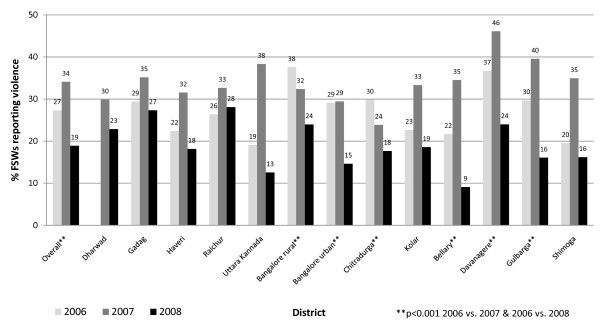
BACKGROUND: Violence against female sex workers (FSWs) can impede HIV prevention efforts and contravenes their human rights. We developed a multi-layered violence intervention targeting policy makers, secondary stakeholders (police, lawyers, media), and primary stakeholders (FSWs), as part of wider HIV prevention programming involving >60,000 FSWs in Karnataka state. This study examined if violence against FSWs is associated with reduced condom use and increased STI/HIV risk, and if addressing violence against FSWs within a large-scale HIV prevention program can reduce levels of violence against them. METHODS: FSWs were randomly selected to participate in polling booth surveys (PBS 2006-2008; short behavioural questionnaires administered anonymously) and integrated behavioural-biological assessments (IBBAs 2005-2009; administered face-to-face). RESULTS: 3,852 FSWs participated in the IBBAs and 7,638 FSWs participated in the PBS. Overall, 11.0% of FSWs in the IBBAs and 26.4% of FSWs in the PBS reported being beaten or raped in the past year. FSWs who reported violence in the past year were significantly less likely to report condom use with clients (zero unprotected sex acts in previous month, 55.4% vs. 75.5%, adjusted odds ratio (AOR) 0.4, 95% confidence interval (CI) 0.3 to 0.5, p < 0.001); to have accessed the HIV intervention program (ever contacted by peer educator, 84.9% vs. 89.6%, AOR 0.7, 95% CI 0.4 to 1.0, p = 0.04); or to have ever visited the project sexual health clinic (59.0% vs. 68.1%, AOR 0.7, 95% CI 0.6 to 1.0, p = 0.02); and were significantly more likely to be infected with gonorrhea (5.0% vs. 2.6%, AOR 1.9, 95% CI 1.1 to 3.3, p = 0.02). By the follow-up surveys, significant reductions were seen in the proportions of FSWs reporting violence compared with baseline (IBBA 13.0% vs. 9.0%, AOR 0.7, 95% CI 0.5 to 0.9 p = 0.01; PBS 27.3% vs. 18.9%, crude OR 0.5, 95% CI 0.4 to 0.5, p < 0.001). CONCLUSIONS: This program demonstrates that a structural approach to addressing violence can be effectively delivered at scale. Addressing violence against FSWs is important for the success of HIV prevention programs, and for protecting their basic human rights.
Overview
The claims and statistics of this paper haven’t been checked yet.
Free: it reads the open-access text and checks the first 5 claims that cite a source we can check. Create a free account to check every claim.
Integrity signals
Registry
Cites
Statistics
Figures
Verification
Claims the paper makes
The claims and statistics of this paper haven’t been checked yet.
Free: it reads the open-access text and checks the first 5 claims that cite a source we can check. Create a free account to check every claim.
Claims other papers make about this one
Each is checked against this paper’s own text: does it say what the citing paper says it does?
The source backs part of the claim, not all of it — or backs it for a different population, condition or comparison.
In the citing paper
“Globally, sex workers experience a disproportionate burden of violence compared to the general population [1–6].”
From Comparing typologies of violence exposure and associations with syndemic health outcomes among cisgender and transgender female sex workers living with HIV in the Dominican Republic (2023) · cites this paper as [1]
Experimental — accuracy not yet measuredThe source backs part of the claim, not all of it — or backs it for a different population, condition or comparison.
In the citing paper
“FSW face high rates of verbal, physical, and sexual abuse from a variety of perpetrators,5,36,45–47 which can harm their mental health.23,45”
From Mindfulness, Mental Health, and Violence Exposure Among Transgender Female Sex Workers Living with HIV in the Dominican Republic. (2026) · cites this paper as [46]
Experimental — accuracy not yet measured
Self-check
Percentages, sums and reported differences re-computed from the paper’s own numbers.
The self-check needs the paper’s full text.
Citations
Cites
Ellsberg, M., Jansen, H. A., Heise, L., Watts, C. H., & Garcia-Moreno, C. (2008) · The Lancet · doi:10.1016/s0140-6736(08)60522-x · Cited by 1,820 · cited 2×
“Rates of reported violence were very high, and were much higher in the PBS compared with the IBBA, likely reflecting social desirability bias in the face-to-face interviews, and highlighting the importance of using alternative survey methods when collecting information on sensitive behaviours [6,29-31].”
BackgroundDunkle, K. L., Jewkes, R. K., Brown, H. C., Gray, G. E., McIntryre, J. A., & Harlow, S. D. (2004) · The Lancet · doi:10.1016/s0140-6736(04)16098-4 · Cited by 1,323 · cited 2×
“Research on domestic violence from developing countries suggests that anywhere from 10-60% of married women of reproductive age report experiencing some form of domestic violence [2], and that domestic violence is strongly associated with physical and mental health morbidity, including homicide, suicide, physical inju…”
BackgroundViolence against women: global scope and magnitude
Watts, C., & Zimmerman, C. (2002) · The Lancet · doi:10.1016/s0140-6736(02)08221-1 · Cited by 1,190 · cited 4×
“Research on domestic violence from developing countries suggests that anywhere from 10-60% of married women of reproductive age report experiencing some form of domestic violence [2], and that domestic violence is strongly associated with physical and mental health morbidity, including homicide, suicide, physical inju…”
BackgroundInfluentialPronyk, P. M., Hargreaves, J. R., Kim, J. C., Morison, L. A., Phetla, G., Watts, C., Busza, J., & Porter, J. D. (2006) · The Lancet · doi:10.1016/s0140-6736(06)69744-4 · Cited by 919 · cited 1×
“There is growing recognition of the impact of physical and sexual violence on the mental and physical health of women, including HIV infection [3,13,33], and studies with non-sex workers have reported reductions in violence within intimate partnerships as part of broader HIV intervention programs [34-36].”
BackgroundJewkes, R., Nduna, M., Levin, J., Jama, N., Dunkle, K., Puren, A., & Duvvury, N. (2008) · BMJ · doi:10.1136/bmj.a506 · Cited by 757 · cited 1×
“There is growing recognition of the impact of physical and sexual violence on the mental and physical health of women, including HIV infection [3,13,33], and studies with non-sex workers have reported reductions in violence within intimate partnerships as part of broader HIV intervention programs [34-36].”
BackgroundKim, J. C., Watts, C. H., Hargreaves, J. R., Ndhlovu, L. X., Phetla, G., Morison, L. A., Busza, J., Porter, J. D. H., & Pronyk, P. (2007) · American Journal of Public Health · doi:10.2105/ajph.2006.095521 · Cited by 619 · cited 1×
“There is growing recognition of the impact of physical and sexual violence on the mental and physical health of women, including HIV infection [3,13,33], and studies with non-sex workers have reported reductions in violence within intimate partnerships as part of broader HIV intervention programs [34-36].”
BackgroundMaman, S., Mbwambo, J. K., Hogan, N. M., Kilonzo, G. P., Campbell, J. C., Weiss, E., & Sweat, M. D. (2002) · American Journal of Public Health · doi:10.2105/ajph.92.8.1331 · Cited by 406 · cited 1×
“Research on domestic violence from developing countries suggests that anywhere from 10-60% of married women of reproductive age report experiencing some form of domestic violence [2], and that domestic violence is strongly associated with physical and mental health morbidity, including homicide, suicide, physical inju…”
BackgroundThe Sonagachi Project: A Sustainable Community Intervention Program
Jana, S., Basu, I., Rotheram-Borus, M. J., & Newman, P. A. (2004) · AIDS Education and Prevention · doi:10.1521/aeap.16.5.405.48734 · Cited by 371 · cited 1×
“In addition to increased knowledge and awareness of sexual risk leading to increase condom use following participation in an HIV prevention program, the conversion of a hostile environment to a more facilitative enabling environment for sex work has been reported elsewhere as a contributing factor to improved condom u…”
BackgroundDunkle, K. L., Jewkes, R. K., Nduna, M., Levin, J., Jama, N., Khuzwayo, N., Koss, M. P., & Duvvury, N. (2006) · AIDS · doi:10.1097/01.aids.0000247582.00826.52 · Cited by 324
Target cells in vaginal HIV transmission
Miller, C. J., & Shattock, R. J. (2003) · Microbes and Infection · doi:10.1016/s1286-4579(02)00056-4 · Cited by 220 · cited 1×
“As well as negatively impacting on their mental health and emotional wellbeing [11,13], violence against sex workers can heighten their vulnerability to HIV and other sexually transmitted infections (STIs) through multiple mechanisms: (i) coerced sex is rarely protected; (ii) coerced sex can result in injuries that ca…”
Background
Research works printed but not linked: 6
- Wolffers I van Beelen N Brussa L Violence, repression and other health threats. Sex workers at risk Research for Sex Work 2001 4 1 32 http://iac.nswp.org/research-for-sex-work/editions/research-for-sex-work-4-risk-and-violence/ Accessed 10th February 2010
- Beattie T Shetty A Devi Vanta U Lowndes CM Alary M Bradley JE The evolution of female sex work in Guntur, Andhra Pradesh: a qualitative study of HIV-related issues Volume CHARME Working Paper No. 5. Bangalore, India: Charme Working Paper No. 5 2009 http://khpt.org/CHARME%20WP%205.pdf Accessed 10th February 2010
- National AIDS Control Organisation (NACO) HIV Sentinel Surveillance and HIV Estimation, 2006 NACO 2007 https://www.nacoonline.org/upload/NACO%20PDF/Note%20on%20HIV%20Sentinel%20Surveillance%20and%20HIV%20Estimation_01%20Feb%2008.pdf New Delhi: accessed 4th January 2010
- International Institute for Population Sciences (IIPS) and Macro International National Family Health Survey (NFHS-3): India, Volume I 2005 I
- Lowndes CM Jayachandran AA Pradeep BS Ramesh BM Washington R Mahapatra B Blanchard J Moses S Alary M High levels of HIV-related risky behaviour reported through polling booth surveys in comparison to face-to-face interviews in a general population survey in Mysore district, Karnataka state, southern India [Abstract P-339] XVII Biennial Meeting of the International Society for STD Research (ISSTDR), Seattle, Washington, USA, July 29 - August 1 2007
- World Health Organisation Violence against women and HIV/AIDS: Critical Intersections. Violence against sex workers and HIV prevention Volume Information Bulletin Series, Number 3 2005 The department of gender women and health
Cited by
Items 101–200 of 260
Beksinska, A., Prakash, R., Isac, S. K., Mohan, H. L., Platt, L., Blanchard, J., Moses, S., & Beattie, T. (2018) · BMJ Open · doi:10.1136/bmjopen-2017-021389 · Cited by 38
“To represent the greater number of FSWs in Bangalore and the variation in sex work typology, a sample size of 800 was used.(8) 26 Following mapping of FSWs across the two districts, two sampling methods were used.”
BackgroundMethodInfluentialSelf-citationFoláyan, M. O., Harrison, A. D., Brown, B. J., Odetoyinbo, M., Stockman, J. K., Ajuwon, A. J., & Cáceres, C. F. (2016) · PLoS ONE · doi:10.1371/journal.pone.0155210 · Cited by 36
“Similarly, although we may be among the first to report forced sexual initiation in association with anal sex in adolescents, a prior report from India has identified an association between sexual violence and anal sex in adult female sex workers [44].”
BackgroundWhy do condoms break? A study of female sex workers in Bangalore, south India
Bradley, J., Rajaram, S., Moses, S., Boily, M., Ramesh, B. M., Isac, S. K., Lobo, A. M., Gowda, G. C., Pushpalatha, R., Gurav, K., et al. (2012) · Sexually Transmitted Infections · doi:10.1136/sextrans-2011-050283 · Cited by 28
Maheu‐Giroux, M., Baral, S., Vesga, J. F., Diouf, D., Diabaté, S., Alary, M., Kouamé, A., & Boily, M. (2017) · American Journal of Epidemiology · doi:10.1093/aje/kwx244 · Cited by 33
“Sexual violence and coercion have often been associated with AI (10, 15, 17, 38) and FSWs reporting sexual violence by clients in Abidjan were 75%more likely to have engaged in AI.”
BackgroundDasgupta, S. (2020) · Violence Against Women · doi:10.1177/1077801220969881 · Cited by 30
“Working in geographically isolated spots such as dark alleys, deserted highways, or random hotels, sex workers are at an increased risk for suffering violence (Beattie et al., 2010; Wojcicki & Malala, 2001).”
BackgroundInfluentialStangl, A. L., Pliakas, T., Izazola-Licea, J. A., Ayala, G., Beattie, T., Ferguson, L., Orza, L., Mathur, S., Pulerwitz, J., Iovita, A., et al. (2022) · PLoS ONE · doi:10.1371/journal.pone.0264249 · Cited by 34
“Violence in the past year was not significantly associated with HIV infection but strongly associated with reduced condom use with clients HIV-1 infection OR: 1.10 (0.80–1.49), p = 0.60 aOR: 0.96 (0.70–1.32), p = 0.80 Condom use last sex act occasional clients OR: 0.75 (0.53,1.07), p = 0.10 aOR: 0.58 (0.40–0.85), p =…”
BackgroundInfluentialSelf-citationBhattacharjee, P., Campbell, L., Thalinja, R., Nair, S. G., Doddamane, M., Ramanaik, S., Isac, S. K., & Beattie, T. (2018) · Health Education & Behavior · doi:10.1177/1090198118763934 · Cited by 30
“Studies have shown that sex workers who experienced violence visited clinics less often, had lower condom use, and experienced more condom breakage, increasing the risk of HIV (Beattie et al., 2010).”
BackgroundSelf-citationReed, E., West, B. S., Frost, E., Salazar, M. M., Silverman, J. G., McIntosh, C., Gómez, M. G. R., Urada, L. A., & Brouwer, K. C. (2022) · AIDS and Behavior · doi:10.1007/s10461-022-03670-0 · Cited by 27
El‐Bassel, N., Pala, A. N., Mukherjee, T. I., McCrimmon, T., Mergenova, G., Terlikbayeva, A., Primbetova, S., & Witte, S. S. (2020) · JAMA Network Open · doi:10.1001/jamanetworkopen.2020.20802 · Cited by 30
Conners, E. E., Silverman, J. G., Ulibarri, M. D., Magis-Rodríguez, C. L., Strathdee, S. A., Staines‐Orozco, H., Patterson, T. L., & Brouwer, K. C. (2015) · AIDS and Behavior · doi:10.1007/s10461-015-1111-1 · Cited by 29
“and the community mobilization of FSWs has shown to be effective in reducing violence [35, 37] and may be one strategy to assist women who lack the security a venue may provide.”
Isac, S. K., Ramesh, B. M., Rajaram, S., Washington, R., Bradley, J., Reza‐Paul, S., Beattie, T., Alary, M., Blanchard, J., & Moses, S. (2015) · BMJ Open · doi:10.1136/bmjopen-2014-007106 · Cited by 27
Self-citationUrada, L. A., Malow, R. M., Santos, N. C., & Morisky, D. E. (2012) · AIDS Research and Treatment · doi:10.1155/2012/812635 · Cited by 29
“For example, in a cross-sectional study in Karnataka, India, the greatest percentage of FSW beaten or raped in the past year were among those under the age of 29 [31].”
BackgroundAmeyan, W., Jeffery, C., Negash, K., Biruk, E., & Taegtmeyer, M. (2015) · African Journal of AIDS Research · doi:10.2989/16085906.2015.1040809 · Cited by 30
“Inconsistent condom use by FSWs has been identified in numerous studies worldwide (Beattie et al., 2010; Godin et al., 2008) as a factor hampering efforts to address HIV transmission in sex work settings.”
BackgroundMultiple Victimizations and Overdose Among Women With a History of Illicit Drug Use
Ataiants, J., Mazzella, S., Roth, A. M., Robinson, L., Sell, R. L., & Lankenau, S. E. (2020) · Journal of Interpersonal Violence · doi:10.1177/0886260520927501 · Cited by 33
“…relationship between multiple victimizations and overdose rates did not disappear in the final models point to violence as an overdose risk factor, which can work through many mechanisms, but is also modifiable through direct public health interventions (Beattie et al., 2010; Gilbert et al., 2001).”
BackgroundVulnerability re-assessed: The changing face of sex work in Guntur district, Andhra Pradesh
Beattie, T., Bradley, J., Vanta, U. D., Lowndes, C. M., & Alary, M. (2012) · AIDS Care · doi:10.1080/09540121.2012.701726 · Cited by 31
“FSWs frequently experience violence from their intimate partners as well as others in their personal and working lives (Beattie et al, 2010 ; Panchanadeswaran et al, 2008 ).”
BackgroundSelf-citationWahed, T., Zaman, S., Huda, F. A., Li, J., Sultana, S., Alam, A., Panza, A., & Somrongthong, R. (2019) · Bangladesh Journal of Medical Science · doi:10.3329/bjms.v19i1.43870 · Cited by 25
“(23) Q1 24 2010 India Integrated behaviouralbiological assessments Surveys, face to face interviews Simple random sampling 3,852 × √ Violence”
BackgroundMatthen, P., Lyons, T., Taylor, M., Jennex, J., Anderson, S., Jollimore, J., & Shannon, K. (2016) · Men and Masculinities · doi:10.1177/1097184x16664951 · Cited by 34
“…(Krüsi et al. 2014; Jayasree 2004; Rekart 2005; Lutnick and Cohan 2009), incidents/experiences of violence (Wechsberg, Luseno, and Lam 2005; Beattie et al. 2010; Krüsi 2014), HIV prevention (Shannon et al. 2009; Asthana and Oostvogels 1996; Basu et al. 2004; Campbell and Mzaidume 2001),…”
BackgroundFulu, E., Kerr-Wilson, A., Gibbs, A., Jacobson, J., Jewkes, R. K., Lang, J., Mazars, C., Schauerhammer, V., & Watts, C. H. (2015) · Cited by 27
Park, J. N., Gaydos, C. A., White, R. H., Decker, M. R., Footer, K. H. A., Galai, N., Silberzahn, B. E., Riegger, K. E., Morris, M., Huettner, S. S., et al. (2019) · Sexually Transmitted Diseases · doi:10.1097/olq.0000000000001085 · Cited by 25
“Accordingly, this study examines the individual, interpersonal, and structural predictors of CT, NG, and TV infection among urban street-based CFSW.”
ResultInfluentialStigma, Social Support, and Sexual Behavior Among Female Sex Workers at Risk for HIV in Malawi
Ruegsegger, L. M., Stockton, M. A., Go, V. F.-L., Piscalko, H. M., Davis, D., Hoffman, I., Hosseinipour, M. C., Zalira, E., Lungu, T., Bula, A. K., et al. (2021) · AIDS Education and Prevention · doi:10.1521/aeap.2021.33.4.290 · Cited by 26
“Clients may have stigmatizing views of sex workers that can dehumanize them, lead to violence and affect their ability to negotiate condom use (Beattie et al., 2010; Huschke, 2019).”
BackgroundA Border Context of Violence: Mexican Female Sex Workers on the U.S.–Mexico Border
Cepeda, A., & Nowotny, K. M. (2014) · Violence Against Women · doi:10.1177/1077801214557955 · Cited by 34
“In particular, high rates of physical and sexual violence are reported among FSWs (Beattie et al., 2010; Church, Henderson, Barnard, & Hart, 2001; El-Bassel, White, Wada, Gilbert, & Wallace, 2001; Miller, 2002; Shannon, Kerr, et al., 2009; Watts & Zimmerman, 2002).”
ResultReed, E., Erausquin, J. T., Groves, A. K., Salazar, M. M., Biradavolu, M. R., & Blankenship, K. M. (2016) · Sexually Transmitted Infections · doi:10.1136/sextrans-2015-052162 · Cited by 23
Sangha, C. A. T. M., Blanchard, A. K., Nair, S. G., Bruce, S. G., Ramanaik, S., Thalinja, R., Murthy, S., Javalkar, P., Pillai, P., Collumbien, M., et al. (2018) · BMC Women s Health · doi:10.1186/s12905-018-0554-8 · Cited by 29
“In a study among a representative sample of 1750 FSWs in north Karnataka state, India, 29% of women reported experiencing physical violence from an intimate partner in the last 6 months alone [7].”
BackgroundInfluentialGeorge, P. E., Bayer, A. M., Garcia, P. J., Pérez‐Lu, J. E., Burke, J. G., Coates, T. J., & Gorbach, P. M. (2016) · AIDS and Behavior · doi:10.1007/s10461-016-1327-8 · Cited by 26
“Encouragingly, previous work with different groups, including FSWs, has demonstrated that violence prevention interventions can contribute to dramatic reductions in violence experience [42].”
InfluentialBhattacharjee, P., Isac, S. K., McClarty, L. M., Mohan, H. L., Maddur, S., Jagannath, S. B., Venkataramaiah, B. K., Moses, S., Blanchard, J., & Gurnani, V. (2016) · Journal of the International AIDS Society · doi:10.7448/ias.19.4.20856 · Cited by 28
“Our findings bolster growing evidence that even in an environment such as in India, where sex work is criminalized, structural approaches to address violence can be effectively delivered to scale, to reduce arrest of and violence against FSWs [3,6,10,17].”
BackgroundInfluentialQuaife, M., Vickerman, P. T., Manian, S., Eakle, R., Escobar, M. A. C., Delany‐Moretlwe, S., & Terris‐Prestholt, F. (2018) · Health Economics · doi:10.1002/hec.3784 · Cited by 24
“populations, because, in addition to navigating the complexities of sexual and personal risk in noncommercial sexual relationships, economic and social inequalities mean that FSWs often face strong competition from FSW colleagues, client resistance to condom use, and threats and use of violence from clients and police…”
BackgroundKhan, S. A., Lorway, R. R., Chevrier, C., Dutta, S., Ramanaik, S., Roy, A. P., Bhattacharjee, P., Mishra, S., Moses, S., Blanchard, J., et al. (2017) · Global Public Health · doi:10.1080/17441692.2017.1280070 · Cited by 28
“…aim to prevent the entry of adolescent girls into sex work by confronting gender inequalities in education, are part of a continuum of efforts in the region to address the broader ‘structural drivers’ of the HIV epidemic (see Beattie et al., 2010; Blanchard et al., 2013; Gurnani et al., 2011).”
Patra, R. K., Mahapatra, B., Kovvali, D., Proddutoor, L., & Saggurti, N. (2012) · Sexual Health · doi:10.1071/sh11155 · Cited by 23
Tsai, L. C., Carlson, C. E., Aira, T., Pala, A. N., Riedel, M., & Witte, S. S. (2016) · BMC International Health and Human Rights · doi:10.1186/s12914-016-0101-3 · Cited by 28
The contributions and future direction of Program Science in HIV/STI prevention
Becker, M., Mishra, S., Aral, S. O., Bhattacharjee, P., Lorway, R. R., Green, K., Anthony, J., Isac, S. K., Emmanuel, F., Musyoki, H., et al. (2018) · Emerging Themes in Epidemiology · doi:10.1186/s12982-018-0076-8 · Cited by 27
“These changes also resulted in increases in the number of FSWs accessing government social programs and in some areas, improvements in condom use and service utilization [47].”
BackgroundSrivastava, A., Davis, J. P., Patel, P., Daniel, E. E., Karkal, S., & Rice, E. R. W. (2021) · Journal of Interpersonal Violence · doi:10.1177/0886260521990840 · Cited by 26
“However, while several studies have reported violence against marginalized groups such as sex workers (Beattie et al., 2010; Bertozzi et al., 2010), to our knowledge, this is the first study to report on the relationship between polyvictimization, sex work, and depression among community sample of transgender women an…”
BackgroundNavarro, J. R., Cohen, J., Aréchaga, E. P. R., & Zuniga, E. (2012) · Revista Panamericana de Salud Pública · doi:10.1590/s1020-49892012000500006 · Cited by 25
Gil, C. N., Ramaiah, M., Mantsios, A. R., Barrington, C., & Kerrigan, D. L. (2021) · Springer eBooks · doi:10.1007/978-3-030-64171-9_11 · Cited by 22
Prakash, R., Manthri, S., Tayyaba, S., Joy, A., Raj, S. S., Singh, D., & Agarwal, A. (2016) · PLoS ONE · doi:10.1371/journal.pone.0150347 · Cited by 25
McGranahan, M., Nakyeyune, J., Baguma, C., Musisi, N. N., Nsibirwa, D. A., Sekalala, S. R., & Oyebode, O. O. (2021) · PLoS ONE · doi:10.1371/journal.pone.0250976 · Cited by 33
“2010 [38] Setting: Karnataka state, south India Population: 3,852 FSWs took part in Integrated behavioural and biological assessments (IBBAs) (1,882 at baseline and 1,970 at follow-up, mean age 31.”
BackgroundPolice Harassment and Violence Against Transgender & Gender Diverse Sex Workers in the United States
Stenersen, M. R., Thomas, K., & McKee, S. A. (2022) · Journal of Homosexuality · doi:10.1080/00918369.2022.2132578 · Cited by 25
“Research done internationally has found positive results from police sensitivity training in reducing violence (Beattie et al., 2010); however, no known police interventions specifically addressed the unique needs of TGD sex workers in the United States.”
BackgroundAubé-Maurice, J., Clément, M., Bradley, J., Lowndes, C. M., Gurav, K., & Alary, M. (2012) · Culture Health & Sexuality · doi:10.1080/13691058.2012.674559 · Cited by 19
“2004), often experience physical violence on the part of their clients (Beattie et al. 2010; Blanchard et al. 2005; ICHAP 2003).”
BackgroundBradley, J., Rajaram, S., Moses, S., Gowda, G. C., Pushpalatha, R., Ramesh, B. M., Isac, S. K., Boily, M., Lobo, A. M., Gowda, H. S., et al. (2012) · AIDS and Behavior · doi:10.1007/s10461-012-0192-3 · Cited by 19
Sexual behaviour, structural vulnerabilities and HIV prevalence among female sex workers in Pakistan
Mishra, S., Thompson, L. H., Sonia, A., Khalid, N., Emmanuel, F., & Blanchard, J. (2013) · Sexually Transmitted Infections · doi:10.1136/sextrans-2012-050776 · Cited by 19
Urada, L. A., Simmons, J., Wong, B., Tsuyuki, K., Condino-Enrera, G., Hernandez, L., Simbulan, N. P., & Raj, A. (2016) · International Journal of Public Health · doi:10.1007/s00038-016-0875-z · Cited by 19
“Similarly, a few HIV interventions address violence (Beattie et al. 2010; Wechsberg et al. 2006), despite its potential to increase risk (Decker et al.”
BackgroundResultMaclin, B. J., Wang, Y., Rodriguez-Diaz, C., Donastorg, Y., Perez, M., Gomez, H., Barrington, C., & Kerrigan, D. (2023) · PLOS ONE · doi:10.1371/journal.pone.0291314 · Cited by 18
Oldenburg, C. E., Ortblad, K. F., Chanda, M. M., Mwale, M., Chongo, S., Kanchele, C., Kamungoma, N., Fullem, A., & Bärnighausen, T. (2018) · JAIDS Journal of Acquired Immune Deficiency Syndromes · doi:10.1097/qai.0000000000001841 · Cited by 26
Owen, B. N., Baggaley, R. F., Elmes, J., Harvey, A., Shubber, Z., Butler, A. R., Silhol, R., Anton, P. A., Shacklett, B. L., van der Straten, A., et al. (2019) · AIDS and Behavior · doi:10.1007/s10461-019-02477-w · Cited by 23
Peitzmeier, S. M., Wirtz, A. L., Beyrer, C., Peryshkina, A., Sherman, S. G., Colantuoni, E., & Decker, M. R. (2019) · Journal of Interpersonal Violence · doi:10.1177/0886260519839431 · Cited by 20
“…involve training police to change common practices such as routinely searching sex workers to confiscate condoms (Shields, 2012), policy advocacy to change local laws related to sex work and loitering, and facilitating sex worker–police partnerships (Beattie et al., 2010; Reza-Paul et al., 2012).”
BackgroundQuaife, M., Lépine, A., Deering, K., Terris‐Prestholt, F., Beattie, T., Isac, S. K., Paranjape, R., & Vickerman, P. T. (2019) · Health Policy and Planning · doi:10.1093/heapol/czz100 · Cited by 17
“Many FSWs in India report violence and intimidation by clients and the police, with experience of violence strongly associated with inconsistent condom use and lower levels of participation in HIV and sexually transmitted infection (STI) prevention activities (Beattie et al., 2010).”
BackgroundSelf-citationNavani-Vazirani, S., Solomon, D., Gopalakrishnan, Heylen, E., Srikrishnan, A. K., Vasudevan, C. K., & Ekstrand, M. L. (2014) · Culture Health & Sexuality · doi:10.1080/13691058.2014.960002 · Cited by 22
“These regression analyses were adjusted for age, education, recent physical violence, and frequency of sex work (Subramanian et al. 2008; Beattie et al. 2010; Swain et al. 2011; Deering et al. 2013).”
MethodYadav, D., Ramanathan, S., Goswami, P., Ramakrishnan, L., Saggurti, N., Sen, S., George, B., & Paranjape, R. (2013) · PLoS ONE · doi:10.1371/journal.pone.0078361 · Cited by 20
“Such community based interventions could include strategies to create a sustainable condition that is empowering for FSWs [43,62], ensures safe sexual practices with different partners [23,24] and promote STI treatment-seeking behavior from public and private health facilities-supported STI treatment centers [33,43].”
BackgroundSchwartz, S., Viswasam, N., & Abdalla, P. (2021) · Springer eBooks · doi:10.1007/978-3-030-64171-9_13 · Cited by 23
Associations Between Violence and HIV Risk Behaviors Differ by Perpetrator Among Russian Sex Workers
Peitzmeier, S. M., Wirtz, A. L., Peryshkina, A., Sherman, S. G., Colantuoni, E., Beyrer, C., & Decker, M. R. (2019) · AIDS and Behavior · doi:10.1007/s10461-019-02668-5 · Cited by 16
Community-Based Strategies for Harm Reduction Among Sex Workers in Kolkata, India
Dasgupta, S., & Sinha, S. (2021) · Sexuality Research and Social Policy · doi:10.1007/s13178-021-00588-5 · Cited by 15
“Mental health morbidity caused by violence and stigmatization can compromise the ability of the sex workers to practice safe sex and to avail local health resources for diagnosis and treatment (Beattie et al., 2010).”
BackgroundInfluentialOld Age Financial Security in the Informal Sector: Sex Work in India
Mahal, A. S., Seshu, M., Mane, S., & Lal, S. (2012) · Journal of South Asian Development · doi:10.1177/0973174112466433 · Cited by 15
“The finding on brothel madams also suggests that older women are less likely to remain as brothel madams and is potentially unsurprising in an industry where violence is a prerequisite for status (Beattie et al. 2010).”
BackgroundJavalkar, P., Platt, L., Prakash, R., Beattie, T., Collumbien, M., Gafos, M., Ramanaik, S., Davey, C., Jewkes, R. K., Watts, C. H., et al. (2019) · BMJ Global Health · doi:10.1136/bmjgh-2019-001546 · Cited by 15
Self-citationTravasso, S. M., Mahapatra, B., Saggurti, N., & Krishnan, S. (2014) · BMC Public Health · doi:10.1186/1471-2458-14-248 · Cited by 14
“Empirical research suggests that soliciting in street based setting, experiencing violence and being in financial debt make FSWs vulnerable to HIV risk [18,19,22].”
BackgroundLogie, C. H., Wang, Y., Marcus, N. L., Lalor, P., Williams, D., & Levermore, K. (2020) · International Journal of Behavioral Medicine · doi:10.1007/s12529-020-09860-1 · Cited by 16
“compounded by the fact that police forces in many contexts use possession of multiple condoms among sex workers as grounds for prosecution [17, 18, 20].”
BackgroundInfluentialSanthya, K. G., Jejeebhoy, S. J., & Basu, S. (2014) · doi:10.31899/pgy10.1021 · Cited by 19
“Another study reports that as much as 32 per cent of adolescents in CSE reported the experience of rape and physical violence (Beattie et al., 2010).”
BackgroundKhezri, M., Tavakoli, F., Schwartz, S., Karamouzian, M., Sharifi, H. P., McKnight, C. A., Jarlais, D. C. D., Baral, S., & Shokoohi, M. (2023) · Annals of Epidemiology · doi:10.1016/j.annepidem.2023.06.022 · Cited by 15
Mishra, S., Ramanaik, S., Blanchard, J., Halli, S. S., Moses, S., Raghavendra, T., Bhattacharjee, P., Lorway, R. R., & Becker, M. (2012) · BMC Public Health · doi:10.1186/1471-2458-12-829 · Cited by 13
“The latter involves an intensive condombased and STI treatment programme that includes community mobilization, peer-education and outreach, and structural interventions to address sexual violence, substance abuse, and personal finance [6,7,27,30,31].”
BackgroundMahapatra, B., Battala, M., Porwal, A., & Saggurti, N. (2014) · PLoS ONE · doi:10.1371/journal.pone.0098321 · Cited by 14
“[16] Data from multiple rounds of surveys also indicate that the incidence of violence has reduced among FSWs over time.[2] However, studies”
BackgroundInfluentialGeorge, A. K., & Blankenship, K. M. (2015) · PLoS ONE · doi:10.1371/journal.pone.0119729 · Cited by 13
“Evidence from HIV prevention interventions in India that use peers achieve such desired outcomes among FSWs as increased reported use of condoms with clients, reduced incidence of STIs [12, 13], and reduced incidence of reported violence [14].”
BackgroundUrada, L. A., Rusakova, M. M., Одинокова, В. А., Tsuyuki, K., Raj, A., & Silverman, J. G. (2019) · International Journal of Environmental Research and Public Health · doi:10.3390/ijerph16224343 · Cited by 15
Khezri, M., Shokoohi, M., Mirzazadeh, A., Karamouzian, M., Sharifi, H., Haghdoost, A. A., & Baral, S. (2020) · International Journal of STD & AIDS · doi:10.1177/0956462420913431 · Cited by 13
“sex work stigma, violence, barriers to care) can exacerbate FSWs’ vulnerability to HIV/STIs.(1,2,25,29,30) Studies among FSWs with history of sex trafficking (i.”
BackgroundSarada, V. (2018) · doi:10.31295/ijhms.v1n1.34 · Cited by 12
Nestadt, D. F., Schneider, K. E., Tomko, C. A., & Sherman, S. G. (2023) · Harm Reduction Journal · doi:10.1186/s12954-023-00738-5 · Cited by 15
What works to prevent violence against women and girls evidence reviews
Fulu, E., Kerr-Wilson, A., Gibbs, A., Jacobson, J., Jewkes, R. K., Lang, J., Mazars, C., Schauerhammer, V., & Watts, C. H. (2015) · Cited by 14
Krüsi, A., D’Adamo, K., & Sernick, A. (2021) · Springer eBooks · doi:10.1007/978-3-030-64171-9_7 · Cited by 23
Rock, A., Reyes, H. L. M., Go, V. F.-L., Maman, S., Pérez, M., Donastorg, Y., Kerrigan, D. L., & Barrington, C. (2022) · Violence Against Women · doi:10.1177/10778012221127722 · Cited by 13
“…interventions have been shown to reduce stigmatizing attitudes and discriminatory behavior toward sex workers and PLHIV among the general public (Beattie et al., 2010; Biradavolu et al., 2009; Blankenship et al., 2010; Kerrigan et al., 2015), and could thus reduce this population’s experiences…”
BackgroundPandey, A., & Seelman, K. L. (2022) · International Journal of Environmental Research and Public Health · doi:10.3390/ijerph192315908 · Cited by 12
“The creation of mental health and substance use services that specifically address violence experienced by sex workers and multi-level violence interventions may have a positive impact on reducing the prevalence of violence, poor mental health, substance use, and STIs [20,48,49].”
BackgroundCarr, C., King, L., Maizel, J. L., Scaglione, N. M., Stetten, N. E., Varnes, J. R., & Tomko, C. A. (2023) · Trauma Violence & Abuse · doi:10.1177/15248380231214786 · Cited by 13
“…have shown success in reducing violence against sex workers through including program components at the societal level of the SEM, such as police training and policy advocacy (Beattie et al., 2010), as well as community components, such as a peer mobile outreach clinic (Janssen et al., 2009).”
BackgroundViolence and women participation in politics: A case study of Ekiti State, Nigeria
Aruna, J. O. (2013) · International Journal of Sociology and Anthropology · doi:10.5897/ijsa12.059 · Cited by 11
Ayamah, P., Aheto, J. M. K., Atuahene, K., Annang, D., Nartey, D. T., Amuasi, S. A., & Abrefa‐Gyan, T. (2023) · Health Science Reports · doi:10.1002/hsr2.1243 · Cited by 11
“In this study, we attempt to bridge this data gap by identifying the sources of violence against FSWs, its prevalence and predictors as well as consequences of violence against FSWs.”
BackgroundResultInfluentialTeka, Y., & Negesse, A. (2020) · International Journal of Occupational Safety and Health · doi:10.3126/ijosh.v10i1.29885 · Cited by 10
Global Burden of Violence and Other Human Rights Violations Against Sex Workers
Argento, E., Win, K. T., McBride, B., & Shannon, K. (2021) · Springer eBooks · doi:10.1007/978-3-030-64171-9_3 · Cited by 17
Valente, P. K., Edeza, A., Masvawure, T. B., Sandfort, T. G. M., Gichangi, P., Restar, A., Tocco, J. U., Chabeda, S. V., Lafort, Y., & Mantell, J. E. (2020) · Journal of Interpersonal Violence · doi:10.1177/0886260520922361 · Cited by 13
“Previous interventions to decrease HIV risk, violence, and social vulnerability have focused on training and sensitization of law enforcement agents (Beattie et al., 2010), promoting legal literacy and empowering sex workers to exercise their rights (Biradavolu et al., 2009), and creating…”
Correlates of Inconsistent Refusal of Unprotected Sex among Armenian Female Sex Workers
Markosyan, K. M., Lang, D. L., & DiClemente, R. J. (2014) · AIDS Research and Treatment · doi:10.1155/2014/314145 · Cited by 10
Suryawanshi, D., Sharma, V., Saggurti, N., & Bharat, S. (2015) · Journal of Biosocial Science · doi:10.1017/s0021932015000267 · Cited by 9
“Female sex workers forced to work in new environments with unknown clients are more vulnerable (KHPT & Population Council, 2008; Beattie et al., 2010).”
Heylen, E., Shamban, E., Steward, W. T., Krishnan, G., Solomon, R., Srikrishnan, A. K., & Ekstrand, M. L. (2018) · Violence Against Women · doi:10.1177/1077801218778384 · Cited by 12
“For India specifically, previous studies have investigated violence from clients (e.g., Beattie et al., 2010; Deering et al., 2013), but few have examined abuse of FSWs by primary partners (Deering et al., 2013; Panchanadeswaran et al., 2008).”
BackgroundMethodResultInfluentialDasgupta, S. (2019) · Atlantic Journal of Communication · doi:10.1080/15456870.2019.1574535 · Cited by 9
“(p. 3) A few examples of HIV/AIDS intervention efforts among sex workers using the participatory model include programs in Brazil (Pegacao, 1991); Thailand (Panos Institute, 1992); Kerala, India (Jayshree, 2004); Goa, India (Weiss et al., 2008); and Karnataka, India (Beattie et al., 2010).”
BackgroundSex workers in HIV prevention: From Social Change Agents to Peer Educators
George, A. K., Blankenship, K. M., Biradavolu, M. R., Dhungana, N., & Tankasala, N. (2014) · Global Public Health · doi:10.1080/17441692.2014.966251 · Cited by 12
Remme, M., Michaels-Igbokwe, C., & Watts, C. H. (2014) · Cited by 9
Logie, C. H., Wang, Y., Lalor, P., Levermore, K., & Williams, D. (2021) · Springer eBooks · doi:10.1007/978-3-030-64171-9_5 · Cited by 8
HIV and Violence among Female Sex Workers in India: A Scoping Review
Kabir, R., Vinnakota, D., Dehghani, L., Sathian, B., Padhi, B. K., Hasan, M. R., Hasnain, S. S., Mahmud, I., & Parsa, A. D. (2024) · IntechOpen eBooks · doi:10.5772/intechopen.115109 · Cited by 11
Mousavi-Ramezanzade, M., Jahani, Y., Mirzaee, M., & Sharifi, H. P. (2020) · PubMed Central · doi:10.22122/ahj.v12i2.263 · Cited by 7
Quaife, M., Terris‐Prestholt, F., Mukandavire, Z., & Vickerman, P. T. (2020) · Health Economics · doi:10.1002/hec.4211 · Cited by 8
“The economic context of sex work means that FSWs can face strong price competition from other FSWs, alongside client resistance to condom use, including threats and use of violence (Beattie et al., 2010, Deering et al., 2014, Pronyk et al.; Wojcicki & Malala, 2001).”
BackgroundFelker-Kantor, E., Polanco, C., Pérez, M., Donastorg, Y., Andrinopoulos, K., Kendall, C., Kerrigan, D. L., & Theall, K. P. (2021) · Health & Place · doi:10.1016/j.healthplace.2021.102527 · Cited by 8
Sexual and Reproductive Health and Rights Inequities Among Sex Workers Across the Life Course
Shapiro, A., & Duff, P. (2021) · Springer eBooks · doi:10.1007/978-3-030-64171-9_4 · Cited by 9
Ganju, D., Patel, S. K., Prabhakar, P., & Adhikary, R. (2016) · BMC International Health and Human Rights · doi:10.1186/s12914-016-0102-2 · Cited by 11
“Further, key populations must be supported to report violence by different perpetrators, even if the perpetrator is an intimate partner; as documented, despite ongoing HIV prevention programs, FSWs are reluctant to report partner violence due to the perception that the degree of violence is not severe and lack of awar…”
BackgroundAli, S., Chaudhuri, S., Ghose, T., & Jana, S. (2020) · Affilia · doi:10.1177/0886109920939049 · Cited by 8
“Consequently, sex workers are often put in situations to provide for their children at the expense of their own physical and mental well-being (Beattie et al., 2010; Hengartner et al., 2015; Patel et al., 2015; Reed et al., 2016).”
BackgroundHoang, T. G., Pham, M. K., Sterk, C. E., Evans, D. P., Miedema, S. S., & Yount, K. M. (2024) · Global Public Health · doi:10.1080/17441692.2024.2308709 · Cited by 8
“…major social problems (e.g. poverty), and health problems (e.g. alcohol and drug use, unsafe sexual behaviours, sexually transmitted infections, HIV infected and mental health) (Beattie et al., 2010; Leis et al., 2021; Panchanadeswaran et al., 2008; Roberts et al., 2018; Shahmanesh et al., 2009).”
You, H., Lau, J. T. F., Gu, J., Tsui, H. Y., Wang, Z. J., & Kim, J. H. (2012) · AIDS and Behavior · doi:10.1007/s10461-012-0376-x · Cited by 7
“Many of the CFSW neither use condoms with the FSW, nor with their wife and regular sex partner [8–11].”
BackgroundSgaier, S. K., Ramakrishnan, A., Wadhwani, A., Bhalla, A., Menon, H., Baer, J., & Alexander, A. (2017) · Healthcare · doi:10.1016/j.hjdsi.2017.09.002 · Cited by 6
The Earning and Spending Habits of Male Sex Workers in Lima, Peru
George, P. E., Bazo‐Alvarez, J. C., & Bayer, A. M. (2018) · SAGE Open · doi:10.1177/2158244017753046 · Cited by 7
“, 2013) violence, which itself is associated with factors that increase poverty such as physical and mental health deterioration (Beattie et al., 2010), perceived helplessness (Panchanadeswaran et al.”
BackgroundWinter, S. C., Obara, L. M., & McMahon, S. (2020) · OSF Preprints (OSF Preprints) · doi:10.31219/osf.io/hs2dv · Cited by 7
Schneider, K. E., Tomko, C., Nestadt, D. F., Rouhani, S., White, R. H., Decker, M. R., Galai, N., & Sherman, S. G. (2022) · International Journal of Drug Policy · doi:10.1016/j.drugpo.2022.103824 · Cited by 5
Tripathi, S., Azhar, S., & Ahmad, I. (2024) · Journal of Human Rights Practice · doi:10.1093/jhuman/huae034 · Cited by 8
Becker, M., Mishra, S., Bhattacharjee, P., Musyoki, H., Tennakoon, A., Leung, S., Cheuk, E., Lorway, R. R., Isac, S. K., Ma, H., et al. (2024) · JAIDS Journal of Acquired Immune Deficiency Syndromes · doi:10.1097/qai.0000000000003412 · Cited by 6
Sexual Behaviors, Knowledge and Attitudes of Female Sex Workers’ towards HIV/AIDS in Shiraz
Kazerooni, P. A., Motazedian, N., Sayadi, M., Motazedian, N., & Sabet, M. (2014) · DOAJ (DOAJ: Directory of Open Access Journals) · Cited by 5
Client Retention and Health Among Sex Workers in Nairobi, Kenya
Izugbara, C. O. (2012) · Archives of Sexual Behavior · doi:10.1007/s10508-012-9928-4 · Cited by 5
Sex Work as Livelihood: Women, Men and Transgender Sex Workers in Karnataka
Chacko, S., Panchanadeswaran, S., & Vijayakumar, G. (2016) · Springer eBooks · doi:10.1007/978-3-319-40865-1_7 · Cited by 5
Stigma and Labour Market Outcomes: Sex Work and Domestic Work in India
Hui, N., & Kambhampati, U. S. (2019) · The Journal of Development Studies · doi:10.1080/00220388.2018.1564906 · Cited by 5
“There is ample evidence from India and the rest of the world that vulnerability to violence is an intrinsic aspect of sex work (Argento et al., 2011; Beattie et al., 2010; Brents & Hausbeck, 2005; Sanders, 2004; Sarkar et al., 2008).”
BackgroundMárquez, N. G., Elmi, N., Lyons, C. E., Turpin, G., Moran, H., Ba, I. O., Turpin, N., Gouane, E., Obodou, E., Diouf, D., et al. (2024) · BMC Public Health · doi:10.1186/s12889-024-20177-6 · Cited by 6
“Previously, interventions focusing on generating empathy towards sex workers among police, the legal system and the media, and on mobilizing sex workers to form communities and learn about their legal rights resulted in a reduction in violence [8].”
Background
Metadata
- Authors
- Beattie, T. S., Bhattacharjee, P., Ramesh, B., Gurnani, V., Anthony, J., Isac, S., Mohan, H., Ramakrishnan, A., Wheeler, T., Bradley, J., Blanchard, J. F., & Moses, S.
- Affiliations
- London School of Hygiene & Tropical Medicine (GB)
- Karnataka Health Promotion Trust (IN)
- India Health Action Trust (IN)
- Gates Foundation (US)
- Hôpital du Saint-Sacrement (CA)
- University of Manitoba (CA)
- Corresponding author
- Beattie, Tara SH
- ORCID
- Venue
- BMC Public Health
- Published
- 2010-08-11
- Volume
- 10
- Issue
- 1
- Pages
- 476-476
- ISSN
- 1471-2458 (ISSN-L)
- PMC
- PMC2931467
- OpenAlex
- W2164369667
- Cited by
- 260
- References
- 33
- Citations by year
- 2026: 10 · 2025: 4 · 2024: 10 · 2023: 9 · 2022: 13 · 2021: 19 · 2020: 16 · 2019: 17 · 2018: 17 · 2017: 15 · 2016: 21 · 2015: 25 · 2014: 27 · 2013: 16 · 2012: 33
- FWCI
- 58.87
- Type
- journal article
- Language
- en
- Open access
- gold
- doi.org
- Licence
- cc-by
- creativecommons.org/licenses/by/2.0 (tdm)
- Locations
- BMC Public Health (publishedVersion, cc-by)
- PubMed Central (publishedVersion, cc-by)
- PubMed (publishedVersion)
- LSHTM Research Online (London School of Hygiene and Tropical Medicine) (acceptedVersion)
- LSHTM Research Online (London School of Hygiene and Tropical Medicine) (submittedVersion, cc-by)
- DOAJ (DOAJ: Directory of Open Access Journals) (submittedVersion, cc-by-sa)
- Mspace (University of Manitoba) (submittedVersion)
- Funders
- Bill and Melinda Gates Foundation
- Topics
- Social Sciences › Sociology and Political Science › Sex work and related issues
- Health Sciences › Medicine › Epidemiology › HIV, Drug Use, Sexual Risk
- Health Sciences › Medicine › Infectious Diseases › HIV/AIDS Research and Interventions
- Keywords
- HIV prevention, violence intervention programs, condom use, sexually transmitted infections, gonorrhea, HIV risk, sexual health services access, peer educators, Karnataka, human rights, violence reduction, sexual health clinics, HIV counseling and testing, stigma and discrimination
- MeSH terms
- Adult, Coitus, Female, Health Policy, Health Promotion, Humans, India, Health Knowledge, Attitudes, Practice, Sex Work, Surveys and Questionnaires, Residence Characteristics, Risk-Taking, Sexually Transmitted Diseases, Socioeconomic Factors, Violence, HIV Infections, Condoms, Risk Assessment
About these checks
Registry, retraction, Cites and statistics results are computed, not judged, with one exception: a printed reference that no index lists is read once by a model before it counts as a citation error. Claims are extracted by a model and kept only when their quote appears verbatim in the text; each cited source is then checked, with a model’s help, for whether it says what the claim relies on. Those verdicts can be wrong — read the claim’s quote and the cited source before relying on one.
Statistics and arithmetic are recomputed, not judged.
Confidence bands are shown only for fields calibrated on our annotated test set. None is calibrated yet, so no band is shown.
What counts as a claim ›How we measure confidence ›How we check this ›
Are you an author, or do you see a problem with this page? Request a review
Data sources
Bibliographic data: Semantic Scholar, OpenAlex, Crossref.
Contains information from the Semantic Scholar Academic Graph Datasets, made available under the ODC Attribution License (ODC-BY 1.0).
Semantic Scholar’s data is described in: Kinney, R., et al. (2023). The Semantic Scholar Open Data Platform. arXiv:2301.10140.
