

Violence against female sex workers in Karnataka state, south India: impact on health, and reductions in violence following an intervention program
Open accessThe DOI matches its Crossref record; 32 of the 33 references it cites were found in a registry or an index.
Abstract
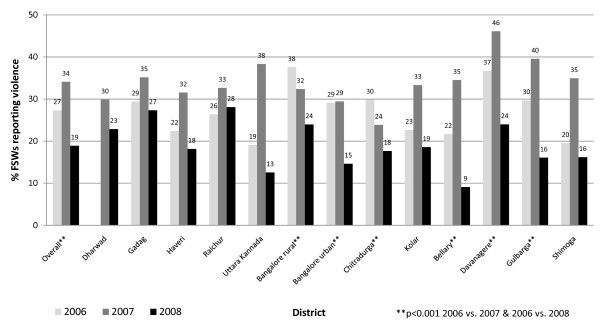
BACKGROUND: Violence against female sex workers (FSWs) can impede HIV prevention efforts and contravenes their human rights. We developed a multi-layered violence intervention targeting policy makers, secondary stakeholders (police, lawyers, media), and primary stakeholders (FSWs), as part of wider HIV prevention programming involving >60,000 FSWs in Karnataka state. This study examined if violence against FSWs is associated with reduced condom use and increased STI/HIV risk, and if addressing violence against FSWs within a large-scale HIV prevention program can reduce levels of violence against them. METHODS: FSWs were randomly selected to participate in polling booth surveys (PBS 2006-2008; short behavioural questionnaires administered anonymously) and integrated behavioural-biological assessments (IBBAs 2005-2009; administered face-to-face). RESULTS: 3,852 FSWs participated in the IBBAs and 7,638 FSWs participated in the PBS. Overall, 11.0% of FSWs in the IBBAs and 26.4% of FSWs in the PBS reported being beaten or raped in the past year. FSWs who reported violence in the past year were significantly less likely to report condom use with clients (zero unprotected sex acts in previous month, 55.4% vs. 75.5%, adjusted odds ratio (AOR) 0.4, 95% confidence interval (CI) 0.3 to 0.5, p < 0.001); to have accessed the HIV intervention program (ever contacted by peer educator, 84.9% vs. 89.6%, AOR 0.7, 95% CI 0.4 to 1.0, p = 0.04); or to have ever visited the project sexual health clinic (59.0% vs. 68.1%, AOR 0.7, 95% CI 0.6 to 1.0, p = 0.02); and were significantly more likely to be infected with gonorrhea (5.0% vs. 2.6%, AOR 1.9, 95% CI 1.1 to 3.3, p = 0.02). By the follow-up surveys, significant reductions were seen in the proportions of FSWs reporting violence compared with baseline (IBBA 13.0% vs. 9.0%, AOR 0.7, 95% CI 0.5 to 0.9 p = 0.01; PBS 27.3% vs. 18.9%, crude OR 0.5, 95% CI 0.4 to 0.5, p < 0.001). CONCLUSIONS: This program demonstrates that a structural approach to addressing violence can be effectively delivered at scale. Addressing violence against FSWs is important for the success of HIV prevention programs, and for protecting their basic human rights.
Overview
The claims and statistics of this paper haven’t been checked yet.
Free: it reads the open-access text and checks the first 5 claims that cite a source we can check. Create a free account to check every claim.
Integrity signals
Registry
Cites
Statistics
Figures
Verification
Claims the paper makes
The claims and statistics of this paper haven’t been checked yet.
Free: it reads the open-access text and checks the first 5 claims that cite a source we can check. Create a free account to check every claim.
Claims other papers make about this one
Each is checked against this paper’s own text: does it say what the citing paper says it does?
The source backs part of the claim, not all of it — or backs it for a different population, condition or comparison.
In the citing paper
“Globally, sex workers experience a disproportionate burden of violence compared to the general population [1–6].”
From Comparing typologies of violence exposure and associations with syndemic health outcomes among cisgender and transgender female sex workers living with HIV in the Dominican Republic (2023) · cites this paper as [1]
Experimental — accuracy not yet measuredThe source backs part of the claim, not all of it — or backs it for a different population, condition or comparison.
In the citing paper
“FSW face high rates of verbal, physical, and sexual abuse from a variety of perpetrators,5,36,45–47 which can harm their mental health.23,45”
From Mindfulness, Mental Health, and Violence Exposure Among Transgender Female Sex Workers Living with HIV in the Dominican Republic. (2026) · cites this paper as [46]
Experimental — accuracy not yet measured
Self-check
Percentages, sums and reported differences re-computed from the paper’s own numbers.
The self-check needs the paper’s full text.
Citations
Cites
Ellsberg, M., Jansen, H. A., Heise, L., Watts, C. H., & Garcia-Moreno, C. (2008) · The Lancet · doi:10.1016/s0140-6736(08)60522-x · Cited by 1,820 · cited 2×
“Rates of reported violence were very high, and were much higher in the PBS compared with the IBBA, likely reflecting social desirability bias in the face-to-face interviews, and highlighting the importance of using alternative survey methods when collecting information on sensitive behaviours [6,29-31].”
BackgroundDunkle, K. L., Jewkes, R. K., Brown, H. C., Gray, G. E., McIntryre, J. A., & Harlow, S. D. (2004) · The Lancet · doi:10.1016/s0140-6736(04)16098-4 · Cited by 1,323 · cited 2×
“Research on domestic violence from developing countries suggests that anywhere from 10-60% of married women of reproductive age report experiencing some form of domestic violence [2], and that domestic violence is strongly associated with physical and mental health morbidity, including homicide, suicide, physical inju…”
BackgroundViolence against women: global scope and magnitude
Watts, C., & Zimmerman, C. (2002) · The Lancet · doi:10.1016/s0140-6736(02)08221-1 · Cited by 1,190 · cited 4×
“Research on domestic violence from developing countries suggests that anywhere from 10-60% of married women of reproductive age report experiencing some form of domestic violence [2], and that domestic violence is strongly associated with physical and mental health morbidity, including homicide, suicide, physical inju…”
BackgroundInfluentialPronyk, P. M., Hargreaves, J. R., Kim, J. C., Morison, L. A., Phetla, G., Watts, C., Busza, J., & Porter, J. D. (2006) · The Lancet · doi:10.1016/s0140-6736(06)69744-4 · Cited by 919 · cited 1×
“There is growing recognition of the impact of physical and sexual violence on the mental and physical health of women, including HIV infection [3,13,33], and studies with non-sex workers have reported reductions in violence within intimate partnerships as part of broader HIV intervention programs [34-36].”
BackgroundJewkes, R., Nduna, M., Levin, J., Jama, N., Dunkle, K., Puren, A., & Duvvury, N. (2008) · BMJ · doi:10.1136/bmj.a506 · Cited by 757 · cited 1×
“There is growing recognition of the impact of physical and sexual violence on the mental and physical health of women, including HIV infection [3,13,33], and studies with non-sex workers have reported reductions in violence within intimate partnerships as part of broader HIV intervention programs [34-36].”
BackgroundKim, J. C., Watts, C. H., Hargreaves, J. R., Ndhlovu, L. X., Phetla, G., Morison, L. A., Busza, J., Porter, J. D. H., & Pronyk, P. (2007) · American Journal of Public Health · doi:10.2105/ajph.2006.095521 · Cited by 619 · cited 1×
“There is growing recognition of the impact of physical and sexual violence on the mental and physical health of women, including HIV infection [3,13,33], and studies with non-sex workers have reported reductions in violence within intimate partnerships as part of broader HIV intervention programs [34-36].”
BackgroundMaman, S., Mbwambo, J. K., Hogan, N. M., Kilonzo, G. P., Campbell, J. C., Weiss, E., & Sweat, M. D. (2002) · American Journal of Public Health · doi:10.2105/ajph.92.8.1331 · Cited by 406 · cited 1×
“Research on domestic violence from developing countries suggests that anywhere from 10-60% of married women of reproductive age report experiencing some form of domestic violence [2], and that domestic violence is strongly associated with physical and mental health morbidity, including homicide, suicide, physical inju…”
BackgroundThe Sonagachi Project: A Sustainable Community Intervention Program
Jana, S., Basu, I., Rotheram-Borus, M. J., & Newman, P. A. (2004) · AIDS Education and Prevention · doi:10.1521/aeap.16.5.405.48734 · Cited by 371 · cited 1×
“In addition to increased knowledge and awareness of sexual risk leading to increase condom use following participation in an HIV prevention program, the conversion of a hostile environment to a more facilitative enabling environment for sex work has been reported elsewhere as a contributing factor to improved condom u…”
BackgroundDunkle, K. L., Jewkes, R. K., Nduna, M., Levin, J., Jama, N., Khuzwayo, N., Koss, M. P., & Duvvury, N. (2006) · AIDS · doi:10.1097/01.aids.0000247582.00826.52 · Cited by 324
Target cells in vaginal HIV transmission
Miller, C. J., & Shattock, R. J. (2003) · Microbes and Infection · doi:10.1016/s1286-4579(02)00056-4 · Cited by 220 · cited 1×
“As well as negatively impacting on their mental health and emotional wellbeing [11,13], violence against sex workers can heighten their vulnerability to HIV and other sexually transmitted infections (STIs) through multiple mechanisms: (i) coerced sex is rarely protected; (ii) coerced sex can result in injuries that ca…”
Background
Research works printed but not linked: 6
- Wolffers I van Beelen N Brussa L Violence, repression and other health threats. Sex workers at risk Research for Sex Work 2001 4 1 32 http://iac.nswp.org/research-for-sex-work/editions/research-for-sex-work-4-risk-and-violence/ Accessed 10th February 2010
- Beattie T Shetty A Devi Vanta U Lowndes CM Alary M Bradley JE The evolution of female sex work in Guntur, Andhra Pradesh: a qualitative study of HIV-related issues Volume CHARME Working Paper No. 5. Bangalore, India: Charme Working Paper No. 5 2009 http://khpt.org/CHARME%20WP%205.pdf Accessed 10th February 2010
- National AIDS Control Organisation (NACO) HIV Sentinel Surveillance and HIV Estimation, 2006 NACO 2007 https://www.nacoonline.org/upload/NACO%20PDF/Note%20on%20HIV%20Sentinel%20Surveillance%20and%20HIV%20Estimation_01%20Feb%2008.pdf New Delhi: accessed 4th January 2010
- International Institute for Population Sciences (IIPS) and Macro International National Family Health Survey (NFHS-3): India, Volume I 2005 I
- Lowndes CM Jayachandran AA Pradeep BS Ramesh BM Washington R Mahapatra B Blanchard J Moses S Alary M High levels of HIV-related risky behaviour reported through polling booth surveys in comparison to face-to-face interviews in a general population survey in Mysore district, Karnataka state, southern India [Abstract P-339] XVII Biennial Meeting of the International Society for STD Research (ISSTDR), Seattle, Washington, USA, July 29 - August 1 2007
- World Health Organisation Violence against women and HIV/AIDS: Critical Intersections. Violence against sex workers and HIV prevention Volume Information Bulletin Series, Number 3 2005 The department of gender women and health
Cited by
Items 201–260 of 260
Degree and correlates of sexual mixing in female sex workers in Karnataka, India
Mahapatra, B., Lowndes, C. M., Gurav, K., Ramesh, B. M., Moses, S., Washington, R., & Alary, M. (2013) · Sexual Health · doi:10.1071/sh12215 · Cited by 4
Promoting women’s health in an era of globalization: a South Asian perspective
Mohindra, K. S. (2016) · Global Health Promotion · doi:10.1177/1757975916660673 · Cited by 4
“There has been a slow but growing recognition of GBV as a public health issue.”
BackgroundInfluentialMisra, G., Sahu, D., Reddy, U. S., & Nair, S. (2018) · International Journal of STD & AIDS · doi:10.1177/0956462418799018 · Cited by 4
Policy and programme responses for addressing the structural determinants of HIV.
Pronyk, P., & Lutz, B. (2013) · Cited by 8
What Works to Reduce Sex Workers’ Risk of Crime Victimization? A Scoping Review
Molnar, L., & Chopin, J. (2025) · Journal of Evidence-Based Social Work · doi:10.1080/26408066.2025.2456758 · Cited by 4
Female Sex Work Dynamics: Empowerment, Mobilization, Mobility
Pachauri, S., Pachauri, A., & Mittal, K. (2021) · SpringerBriefs in public health · doi:10.1007/978-981-16-4578-5_4 · Cited by 8
South African female sex workers’ interactions with law enforcement: An exploratory study
Motsoeneng, M. S. (2021) · Journal of Psychology in Africa · doi:10.1080/14330237.2021.2001951 · Cited by 3
Sherman, S. G., Tomko, C. A., Silberzahn, B. E., White, R. H., Nestadt, D. F., Clouse, E., Haney, K., & Galai, N. (2021) · BMC Public Health · doi:10.1186/s12889-021-12293-4 · Cited by 3
Dhungana, N., Blankenship, K. M., Biradavolu, M. R., Tankasala, N., & George, A. K. (2017) · Social aspects of HIV · doi:10.1007/978-3-319-63522-4_4 · Cited by 3
Vijayakumar, G. (2019) · Social Problems · doi:10.1093/socpro/spz031 · Cited by 6
Pickles, M., Mountain, E., Bhattacharjee, P., Kioko, J., Musimbi, J., Musyoki, H., Gichangi, P., Stannah, J., Maheu‐Giroux, M., Becker, M., et al. (2024) · BMC Medicine · doi:10.1186/s12916-024-03670-y · Cited by 2
Violence prevention and support interventions for sex workers
Broad, C., Guinness, E. M., Holt, V., Stuart, R., Grenfell, P., Llangarí, L. M., Bowen, R., Goldenberg, S. M., & Platt, L. (2026) · The Lancet Public Health · doi:10.1016/s2468-2667(25)00323-8 · Cited by 2
Learning from women who trade sex in Kenya about the antiblackness of Global Health
Simmons, B., & Syvertsen, J. L. (2022) · Social Science & Medicine · doi:10.1016/j.socscimed.2022.115246 · Cited by 3
Navani-Vazirani, S. (2017) · AIDS Clinical Research & STDs · doi:10.24966/acrs-7370/100008 · Cited by 4
What Underlies Violence against Women and Girls in South Asia?
Solotaroff, J. L., & Pande, R. (2014) · World Bank, Washington, DC eBooks · doi:10.1596/978-1-4648-0171-6_ch3 · Cited by 2
Smith, A., Tulk, D., Snook, K., Ropson, M., & Gıwa, S. (2020) · Greenwich Social Work Review · doi:10.21100/gswr.v1i2.1109 · Cited by 2
Experience of Violence and Health Issues among Female Sex Workers in Kathmandu
Saud, S. K., Aryal, B., & Ranabhat, C. L. (2024) · Contemporary Research An Interdisciplinary Academic Journal · doi:10.3126/craiaj.v7i1.67262 · Cited by 2
“Notably, there might be a high probability of mental health problems caused by violence and rape (Beattie et al., 2010).”
BackgroundCharacterizing HIV risk and vulnerability among commercial sex workers in Zaporizhzhya, Ukraine
McClarty, L. M., Becker, M., Pavlova, D., Isak, S., Emmanuel, F., Balakireva, O. M., Bondar, T., Sazonova, Y., International HIV/AIDS Alliance in Ukraine, Sakovych, O., et al. (2016) · Ukrainian society · doi:10.15407/socium2016.01.028 · Cited by 2
“Structural interventions that include police sensitization programmes, policy level advocacy, and CSW community mobilization strategies are feasible and effective at reducing physical and sexual violence toward CSW [37; 39], and have been shown to significantly reduce rates of HIV infection among CSW [38].”
BackgroundResultKeddem, S., Frye, V. A., Davis, A., Koblin, B. A., Tieu, H., Lipsky, R. K., Nandi, V., & Teitelman, A. M. (2024) · Archives of Sexual Behavior · doi:10.1007/s10508-024-02812-w · Cited by 1
“…consistent with the strong link between IPV and sexual violence and potentially forced or coerced anal intercourse (Lescano et al., 2009; Marston & Lewis, 2014; Roye et al., 2013), especially in the context of transactional sex (Beattie et al., 2010; Decker et al., 2012, 2013; Patra et al., 2012).”
Intersecting stigma as a fundamental barrier to the health and wellbeing of sex workers
Logie, C. H., Goldenberg, S. M., Brisson, J., Mackenzie, F., Nguyen, M., Vahedi, L., Pearson, J., Isaieva, N., Abdulghani, F., Dziuban, A., et al. (2026) · The Lancet Public Health · doi:10.1016/s2468-2667(25)00220-8 · Cited by 3
Psychosocial Correlates among Adolescents of Responses to HIV Prevention Interventions
STANTON, B. F., Rosenthal, S. L., & Li, X. (2012) · AIDS Research and Treatment · doi:10.1155/2012/864683 · Cited by 1
Positioning Health Interventions from the Perspective of Well-Being-as Conceived by the Community
(2018) · Journal of Nursing and Women s Health · doi:10.29011/2577-1450.100047
Violence and HIV among female street sex workers in South Africa
Motsoeneng, M. S. (2021) · Journal of Psychology in Africa · doi:10.1080/14330237.2020.1871219 · Cited by 1
Sexual and Reproductive Health and Rights in India: Self-care for Universal Health Coverage
Pachauri, S., Pachauri, A., & Mittal, K. (2021) · SpringerBriefs in public health · doi:10.1007/978-981-16-4578-5 · Cited by 4
Haldar, P., Kumar, P., Rai, S., Kant, S., Raj, Y., Reddy, C., Rajan, S., Pandey, A., Venkatesh, S., Goswami, K., et al. (2023) · International Journal of STD & AIDS · doi:10.1177/09564624221147960 · Cited by 1
“Studies have attributed similar findings to the low empowerment and consequently compromised decision making capacity of FSW under such adverse circumstances.(3,7,16) Moreover, physical violence could also be an underlying determinant by affecting risk factors such as, perpetrator of violence choosing not to use a con…”
BackgroundPolice, Law Enforcement and HIV
Crofts, N., & Patterson, D. (2016) · Journal of the International AIDS Society · doi:10.7448/ias.19.4.21260 · Cited by 4
Kazungu, J., Richter, M. L., Luchters, S. M. F., Chersich, M., & Quaife, M. (2022) · Social Sciences & Humanities Open · doi:10.1016/j.ssaho.2022.100251 · Cited by 1
Dasgupta, S. (2011) · TUScholarShare (Temple University) · Cited by 1
Deering, K. (2011) · cIRcle (University of British Columbia) · doi:10.14288/1.0071771 · Cited by 1
“assault, also increases with higher numbers of clients [Beattie et al., 2010].”
BackgroundAyamah, P., Atuahene, K., Annang, D., Nartey, D., Amuasi, S., Abrefa‐Gyan, T., & Aheto, J. M. K. (2022) · Research Square · doi:10.21203/rs.3.rs-1670809/v2 · Cited by 1
Maclin, B. J., Donastorg, Y., Perez, M., Gomez, H., Barrington, C., & Kerrigan, D. (2026) · Transgender Health · doi:10.1177/26884887251365815 · Cited by 1
Pillai, P., & Holmes, A. E. (2015)
A Family-Based Sexual Health Communication Intervention With Sex Worker Mothers in Kolkata, india
Ali, S. (2013) · ScholarlyCommons (University of Pennsylvania)
Sex Worker Leadership in Responding to HIV and Promoting Human Rights
Kerrigan, D. L., Wirtz, A. L., Baral, S., Decker, M. R., Murray, L., Poteat, T., Pretorius, C., Sherman, S. G., Sweat, M., Semini, I., et al. (2012) · World Bank, Washington, DC eBooks · doi:10.1596/9780821397749_ch07
A neglected risk factor in HIV transmission, and implications for prevention
Owen, B. N. (2018) · Spiral (Imperial College London) · doi:10.25560/75199 · Cited by 2
Direniş Anlatıları: Seks Ticaretinde Şiddet ve Müzakere
Dasgupta, S. (2021) · Istanbul Bilgi University · doi:10.47613/reflektif.2021.16
Deering, K., Shannon, K., & Strathdee, S. A. (2018) · Springer eBooks · doi:10.1007/978-1-4939-7101-5_90
Deering, K., Shannon, K., & Strathdee, S. A. (2015) · Springer eBooks · doi:10.1007/978-1-4614-9610-6_90-1
Ayamah, P., Atuahene, K., Annang, D., Nartey, D., Amuasi, S., Abrefa‐Gyan, T., & Aheto, J. M. K. (2022) · Research Square · doi:10.21203/rs.3.rs-1670809/v1
Sexual Offending in South Asia
Chan, H. C. (2023) · Wiley eBooks · doi:10.1002/9781119853350.ch9
Ayamah, P., Atuahene, K., Annang, D., Nartey, D., Amuasi, S., Abrefa‐Gyan, T., & Aheto, J. M. K. (2023) · Research Square · doi:10.21203/rs.3.rs-1670809/v3
Ayamah, P., Atuahene, K., Annang, D., Nartey, D., Amuasi, S., Abrefa‐Gyan, T., & Aheto, J. M. K. (2023) · Research Square · doi:10.21203/rs.3.rs-1670809/v4
A Qualitative Study on Health and Socio-demographic Facilities of Brothels’ Children in Bangladesh
Uddin, S. M., Rana, M. M., & Hossain, M. G. (2024) · Springer eBooks · doi:10.1007/978-981-97-7890-4_11
Sinha, S. (2024) · Palgrave advances in sex work studies · doi:10.1007/978-3-031-82975-8_1
Barriers to Exercise Rights of Female Sex Workers in Chittoor District
author, & Reddy, G. M. (2025) · INTERANTIONAL JOURNAL OF SCIENTIFIC RESEARCH IN ENGINEERING AND MANAGEMENT · doi:10.55041/ijsrem48021
Acharya, A., & Azhar, S. (2025) · Violence Against Women · doi:10.1177/10778012251362233
“As evidenced by research on sex workers in the south Indian state of Karnataka, violence against sex workers also has an impact on health and mental health outcomes (Beattie et al., 2010; Deb, 2008).”
Bhattacharjee, P., Ma, H., Musyoki, H., Cheuk, E., Isac, S. K., Njiraini, M., Gichangi, P., Mishra, S., Becker, M., & Pickles, M. (2020) · Figshare · doi:10.6084/m9.figshare.13083368
Prevention, Intervention, and Rehabilitation
Swathisha, P., & Deb, S. (2026) · Springer eBooks · doi:10.1007/978-981-95-3365-7_6
Rock, A., Shoen, M., Shipp, L., Mulumba, N., Ryan, S., Makama, S., Mcingana, M., Comins, C. A., Hausler, H., Baral, S., et al. (2026) · BMC Public Health · doi:10.1186/s12889-026-26375-8
Dawe, J., Mazhar, M. K. A., Khan, S. A., Njiro, B. J., Bendaud, V., Sabin, K. M., Ambia, J., Trickey, A., Barrass, L., Asgharzadeh, A., et al. (2026) · medRxiv · doi:10.64898/2026.02.27.26346881
Molnar, L., & Hashimoto, Y. Z. (2026) · Journal of Evidence-Based Social Work · doi:10.1080/26408066.2026.2654498
Palacio, I. G., Mejía, S. B., Ospina, D. S., Navarro, V. B., Ochoa, M. S. M., Echeverri, I. F. M., Arbeláez, C. A. R., Arroyave, D. M. C., Vélez, C. G. M., & Zapata, I. C. P. (2026) · BMC Public Health · doi:10.1186/s12889-026-26789-4 · Cited by 1
İslambay-Yapalı, D. (2021) · Emerald Group Publishing Limited eBooks · doi:10.1108/978-1-64802-322-420251016
Balancing Morality and Human Rights: A Path Forward for Sex Workers in the Indian Legal Framework
Johari, B. (2026) · Journal of Human Rights and Social Work · doi:10.1007/s41134-026-00471-6
Bazrafshani, M. S., Tavakoli, F., Mehmandoost, S., Mirzaei, H., Nasiri, N., Rafiee, M., Mahzari, K., Tajlili, A., Khatami, M. G., Hosseinpour, A. M., et al. (2026) · International Journal of Behavioral Medicine · doi:10.1007/s12529-026-10490-2
Dawe, J., Mazhar, M. K. A., Aijaz, S., Njiro, B. J., Bendaud, V., Sabin, K. M., Ambia, J., Trickey, A., Barrass, L., Asgharzadeh, A., et al. (2026) · PLoS Medicine · doi:10.1371/journal.pmed.1004977
Metadata
- Authors
- Beattie, T. S., Bhattacharjee, P., Ramesh, B., Gurnani, V., Anthony, J., Isac, S., Mohan, H., Ramakrishnan, A., Wheeler, T., Bradley, J., Blanchard, J. F., & Moses, S.
- Affiliations
- London School of Hygiene & Tropical Medicine (GB)
- Karnataka Health Promotion Trust (IN)
- India Health Action Trust (IN)
- Gates Foundation (US)
- Hôpital du Saint-Sacrement (CA)
- University of Manitoba (CA)
- Corresponding author
- Beattie, Tara SH
- ORCID
- Venue
- BMC Public Health
- Published
- 2010-08-11
- Volume
- 10
- Issue
- 1
- Pages
- 476-476
- ISSN
- 1471-2458 (ISSN-L)
- PMC
- PMC2931467
- OpenAlex
- W2164369667
- Cited by
- 260
- References
- 33
- Citations by year
- 2026: 10 · 2025: 4 · 2024: 10 · 2023: 9 · 2022: 13 · 2021: 19 · 2020: 16 · 2019: 17 · 2018: 17 · 2017: 15 · 2016: 21 · 2015: 25 · 2014: 27 · 2013: 16 · 2012: 33
- FWCI
- 58.87
- Type
- journal article
- Language
- en
- Open access
- gold
- doi.org
- Licence
- cc-by
- creativecommons.org/licenses/by/2.0 (tdm)
- Locations
- BMC Public Health (publishedVersion, cc-by)
- PubMed Central (publishedVersion, cc-by)
- PubMed (publishedVersion)
- LSHTM Research Online (London School of Hygiene and Tropical Medicine) (acceptedVersion)
- LSHTM Research Online (London School of Hygiene and Tropical Medicine) (submittedVersion, cc-by)
- DOAJ (DOAJ: Directory of Open Access Journals) (submittedVersion, cc-by-sa)
- Mspace (University of Manitoba) (submittedVersion)
- Funders
- Bill and Melinda Gates Foundation
- Topics
- Social Sciences › Sociology and Political Science › Sex work and related issues
- Health Sciences › Medicine › Epidemiology › HIV, Drug Use, Sexual Risk
- Health Sciences › Medicine › Infectious Diseases › HIV/AIDS Research and Interventions
- Keywords
- HIV prevention, violence intervention programs, condom use, sexually transmitted infections, gonorrhea, HIV risk, sexual health services access, peer educators, Karnataka, human rights, violence reduction, sexual health clinics, HIV counseling and testing, stigma and discrimination
- MeSH terms
- Adult, Coitus, Female, Health Policy, Health Promotion, Humans, India, Health Knowledge, Attitudes, Practice, Sex Work, Surveys and Questionnaires, Residence Characteristics, Risk-Taking, Sexually Transmitted Diseases, Socioeconomic Factors, Violence, HIV Infections, Condoms, Risk Assessment
About these checks
Registry, retraction, Cites and statistics results are computed, not judged, with one exception: a printed reference that no index lists is read once by a model before it counts as a citation error. Claims are extracted by a model and kept only when their quote appears verbatim in the text; each cited source is then checked, with a model’s help, for whether it says what the claim relies on. Those verdicts can be wrong — read the claim’s quote and the cited source before relying on one.
Statistics and arithmetic are recomputed, not judged.
Confidence bands are shown only for fields calibrated on our annotated test set. None is calibrated yet, so no band is shown.
What counts as a claim ›How we measure confidence ›How we check this ›
Are you an author, or do you see a problem with this page? Request a review
Data sources
Bibliographic data: Semantic Scholar, OpenAlex, Crossref.
Contains information from the Semantic Scholar Academic Graph Datasets, made available under the ODC Attribution License (ODC-BY 1.0).
Semantic Scholar’s data is described in: Kinney, R., et al. (2023). The Semantic Scholar Open Data Platform. arXiv:2301.10140.
