

The DOI matches its Crossref record; 41 of the 41 references it cites were found in a registry or an index.
Dose-dependent positive association between cigarette smoking, abdominal obesity and body fat: cross-sectional data from a population-based survey
Open accessAbstract
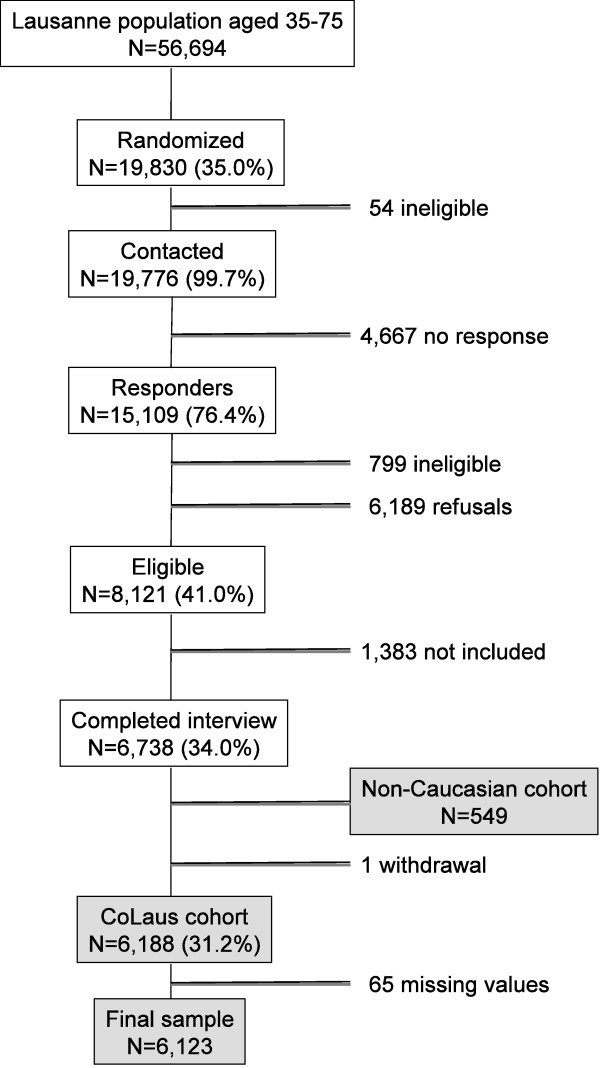
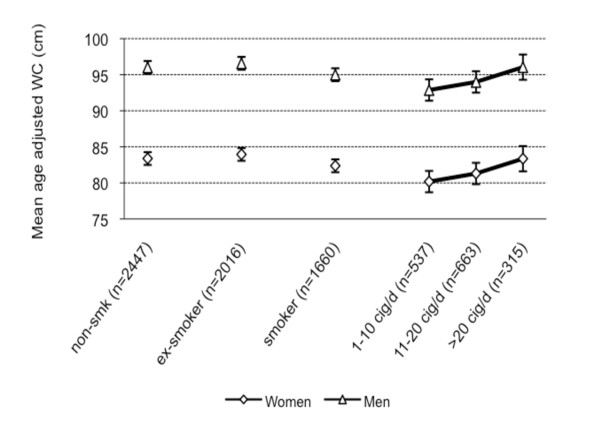
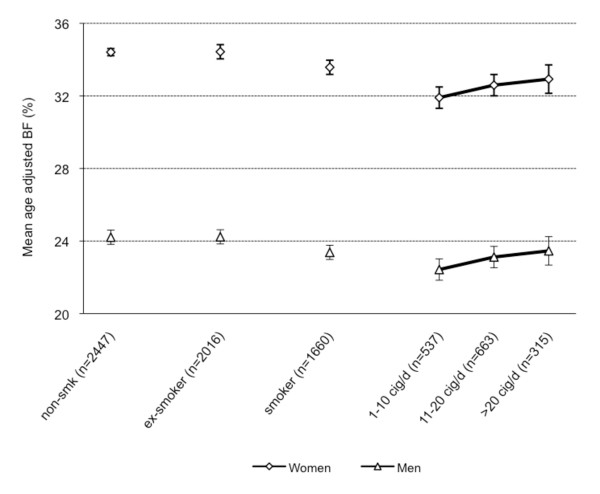
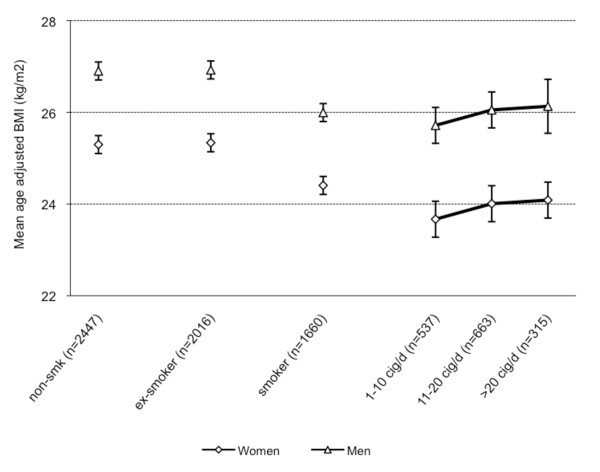
BACKGROUND: Although smokers tend to have a lower body-mass index than non-smokers, smoking may favour abdominal body fat accumulation. To our knowledge, no population-based studies have assessed the relationship between smoking and body fat composition. We assessed the association between cigarette smoking and waist circumference, body fat, and body-mass index. METHODS: Height, weight, and waist circumference were measured among 6,123 Caucasians (ages 35-75) from a cross-sectional population-based study in Switzerland. Abdominal obesity was defined as waist circumference ≥ 102 cm for men and ≥ 88 cm for women. Body fat (percent total body weight) was measured by electrical bioimpedance. Age- and sex-specific body fat cut-offs were used to define excess body fat. Cigarettes smoked per day were assessed by self-administered questionnaire. Age-adjusted means and odds ratios were calculated using linear and logistic regression. RESULTS: Current smokers (29% of men and 24% of women) had lower mean waist circumference, body fat percentage, and body-mass index compared with non-smokers. Age-adjusted mean waist circumference and body fat increased with cigarettes smoked per day among smokers. The association between cigarettes smoked per day and body-mass index was non-significant. Compared with light smokers, the adjusted odds ratio (OR) for abdominal obesity in men was 1.28 (0.78-2.10) for moderate smokers and 1.94 (1.15-3.27) for heavy smokers (P = 0.03 for trend), and 1.07 (0.72-1.58) and 2.15 (1.26-3.64) in female moderate and heavy smokers, respectively (P < 0.01 for trend). Compared with light smokers, the OR for excess body fat in men was 1.05 (95% CI: 0.58-1.92) for moderate smokers and 1.15 (0.60-2.20) for heavy smokers (P = 0.75 for trend) and 1.34 (0.89-2.00) and 2.11 (1.25-3.57), respectively in women (P = 0.07 for trend). CONCLUSION: Among smokers, cigarettes smoked per day were positively associated with central fat accumulation, particularly in women.
Overview
The claims and statistics of this paper haven’t been checked yet.
Run the check — free, no account needed. It reads the open-access text and checks the sources it cites.
Integrity signals
Registry
Cites
Statistics
Figures
Verification
Claims the paper makes
The claims and statistics of this paper haven’t been checked yet.
Run the check — free, no account needed. It reads the open-access text and checks the sources it cites.
Claims other papers make about this one
Each is checked against this paper’s own text: does it say what the citing paper says it does?
The source backs part of the claim, not all of it — or backs it for a different population, condition or comparison.
In the citing paper
“It has been shown that body weight is negatively associated with long-term CS [34,35,36].”
From An Overlooked Bone Metabolic Disorder: Cigarette Smoking-Induced Osteoporosis (2022) · cites this paper as [35]
Experimental — accuracy not yet measuredIn the citing paper
“In fact, several studies in the literature have shown that there is an inverse relationship between smoking and body weight [22,23,24].”
From Skeletal System Biology and Smoke Damage: From Basic Science to Medical Clinic (2021) · cites this paper as [23]
Self-check
Percentages, sums and reported differences re-computed from the paper’s own numbers.
The self-check needs the paper’s full text.
Citations
Cites
(2000) · PubMed · Cited by 13,173
Obesity : Preventing and managing the global epidemic
Akram, D. S., Astrup, A. V., Atinmo, T., Boissin, J.-L., Bray, G. A., Carroll, K. N., Chitson, P., Chen, C., Dietz, W. H., Hill, J. O., et al. (2000) · Research at the University of Copenhagen (University of Copenhagen) · Cited by 12,945
General and abdominal adiposity and risk of death in Europe
Pischon, T., Boeing, H., Hoffmann, K., Bergmann, M., Schulze, M. B., Overvad, K., van der Schouw, Y. T., Spencer, E., Moons, K. G. M., Tjønneland, A., et al. (2008) · New England Journal of Medicine · doi:10.1056/nejmoa0801891 · Cited by 2,155
Participation Rates in Epidemiologic Studies
Galea, S., & Tracy, M. (2007) · Annals of Epidemiology · doi:10.1016/j.annepidem.2007.03.013 · Cited by 1,877
Waist circumference as a measure for indicating need for weight management
Lean, M. E. J., Han, T. S., & Morrison, C. E. (1995) · BMJ · doi:10.1136/bmj.311.6998.158 · Cited by 1,869
Obesity in Adulthood and Its Consequences for Life Expectancy: A Life-Table Analysis
Peeters, A., Barendregt, J. J., Willekens, F., Mackenbach, J. P., Mamun, A. A., & Bonneux, L. (2003) · Annals of Internal Medicine · doi:10.7326/0003-4819-138-1-200301070-00008 · Cited by 1,494
Outcome criteria in smoking cessation trials: proposal for a common standard
West, R., Hajek, P., Stead, L., & Stapleton, J. (2005) · Addiction · doi:10.1111/j.1360-0443.2004.00995.x · Cited by 1,285 · cited 1×
“Fifth, in our survey, former smoking was not defined according to time since quitting (smokers who have quit smoking for 6 months or more) as suggested by the literature [40], therefore, this category might include smokers who recently quit and in whom metabolic changes might not have occurred yet.”
BackgroundActive Smoking and the Risk of Type 2 Diabetes: A Systematic Review and Meta-analysis
Willi, C., Bodenmann, P., Ghali, W. A., Faris, P. D., & Cornuz, J. (2007) · JAMA · doi:10.1001/jama.298.22.2654 · Cited by 1,268
Self-citationConsequences of smoking for body weight, body fat distribution, and insulin resistance
Chiolero, A., Faeh, D., Paccaud, F., & Cornuz, J. (2008) · The American Journal of Clinical Nutrition · doi:10.1093/ajcn/87.4.801 · Cited by 1,192
Self-citationCryer, P. E., Haymond, M. W., Santiago, J. V., & Shah, S. D. (1976) · New England Journal of Medicine · doi:10.1056/nejm197609092951101 · Cited by 1,101 · cited 1×
“Indeed, several studies have shown that nicotine leads to insulin resistance [28,29], has an anti-estrogenic effect [30], and increases the level of stress hormones like cortisol [31].”
Background
Cited by
Sorted by citations
Justice, A. E., Winkler, T. W., Feitosa, M. F., Graff, M., Fisher, V. A., Young, K. L., Barata, L., Deng, X., Czajkowski, J., Hadley, D., et al. (2017) · Nature Communications · doi:10.1038/ncomms14977 · Cited by 204
Metabolic effects of smoking cessation
Harris, K. K., Zopey, M., & Friedman, T. C. (2016) · Nature Reviews Endocrinology · doi:10.1038/nrendo.2016.32 · Cited by 195
Smoking and the Risk of Non-Alcoholic Fatty Liver Disease: A Cohort Study
Jung, H. S., Chang, Y., Kwon, M., Sung, E., Yun, K. E., Cho, Y. K., Shin, H. C., & Ryu, S. (2018) · The American Journal of Gastroenterology · doi:10.1038/s41395-018-0283-5 · Cited by 144
Smoking and diabetes interplay: A comprehensive review and joint statement
Durlach, V., Vergès, B. L., Al‐Salameh, A., Bahougne, T., Benzerouk, F., Berlin, I., Clair, C., Mansourati, J., Rouland, A., Thomas, D., et al. (2022) · Diabetes & Metabolism · doi:10.1016/j.diabet.2022.101370 · Cited by 160
Self-citationZyoud, S. H., Daraghmeh, D. N., Mezyed, D. O., Khdeir, R. L., Sawafta, M. N., Ayaseh, N. A., Tabeeb, G. H., Sweileh, W. M., Awang, R., & Al‐Jabi, S. W. (2016) · BMC Nephrology · doi:10.1186/s12882-016-0257-z · Cited by 141
Metadata
- Authors
- Clair, C., Chiolero, A., Faeh, D., Cornuz, J., Marques-Vidal, P., Paccaud, F., Mooser, V., Waeber, G., & Vollenweider, P.
- Affiliations
- University of Lausanne (CH)
- Institute of Social and Preventive Medicine (CH)
- Centre Hospitalier Universitaire Vaudois (CH)
- GlaxoSmithKline (United States) (US)
- Corresponding author
- Clair, Carole
- Venue
- BMC Public Health
- Published
- 2011-01-11
- Volume
- 11
- Issue
- 1
- Pages
- 23-23
- ISSN
- 1471-2458 (ISSN-L)
- PMC
- PMC3025841
- OpenAlex
- W2011284750
- Cited by
- 177
- References
- 41
- Citations by year
- 2026: 1 · 2025: 7 · 2024: 8 · 2023: 10 · 2022: 10 · 2021: 15 · 2020: 18 · 2019: 13 · 2018: 25 · 2017: 8 · 2016: 19 · 2015: 15 · 2014: 10 · 2013: 10 · 2012: 7
- FWCI
- 6.11
- Type
- journal article
- Language
- en
- Open access
- gold
- doi.org
- Licence
- Locations
- BMC Public Health (publishedVersion, cc-by)
- PubMed Central (publishedVersion, cc-by)
- PubMed (publishedVersion)
- SERVAL (Université de Lausanne) (publishedVersion, cc-by)
- Zurich Open Repository and Archive (University of Zurich) (acceptedVersion, cc-by)
- IRIS (submittedVersion, cc-by)
- DOAJ (DOAJ: Directory of Open Access Journals) (submittedVersion)
- Zurich Open Repository and Archive (University of Zurich)
- Funders
- Schweizerischer Nationalfonds zur Förderung der Wissenschaftlichen Forschung (122661)
- Topics
- Health Sciences › Medicine › Public Health, Environmental and Occupational Health › Smoking Behavior and Cessation
- Health Sciences › Medicine › Public Health, Environmental and Occupational Health › Obesity, Physical Activity, Diet
- Health Sciences › Medicine › Endocrinology, Diabetes and Metabolism › Diabetes, Cardiovascular Risks, and Lipoproteins
- Keywords
- cigarette smoking, abdominal obesity, waist circumference, body fat percentage, body mass index, dose-response relationship, central fat accumulation, sex differences, smoking intensity, excess body fat, middle-aged and older adults, cardiovascular risk factors, smoking cessation, weight gain after quitting smoking, tobacco-related cancer
- MeSH terms
- Adipose Tissue, Adult, Aged, Cross-Sectional Studies, Dose-Response Relationship, Drug, Female, Humans, Male, Middle Aged, Population Surveillance, Surveys and Questionnaires, Smoking, Switzerland, Body Mass Index, Sex Distribution, Waist Circumference, Obesity, Abdominal
About these checks
Registry, retraction, Cites and statistics results are computed, not judged, with one exception: a printed reference that no index lists is read once by a model before it counts as a citation error. Claims are extracted by a model and kept only when their quote appears verbatim in the text; each cited source is then checked, with a model’s help, for whether it says what the claim relies on. Those verdicts can be wrong — read the claim’s quote and the cited source before relying on one.
Statistics and arithmetic are recomputed, not judged.
Confidence bands are shown only for fields calibrated on our annotated test set. None is calibrated yet, so no band is shown.
What counts as a claim ›How we measure confidence ›How we check this ›
Are you an author, or do you see a problem with this page? Request a review
