

Costs and longer-term savings of parenting programmes for the prevention of persistent conduct disorder: a modelling study
Open accessThe DOI matches its Crossref record; 31 of the 32 references it cites were found in a registry or an index.
Abstract
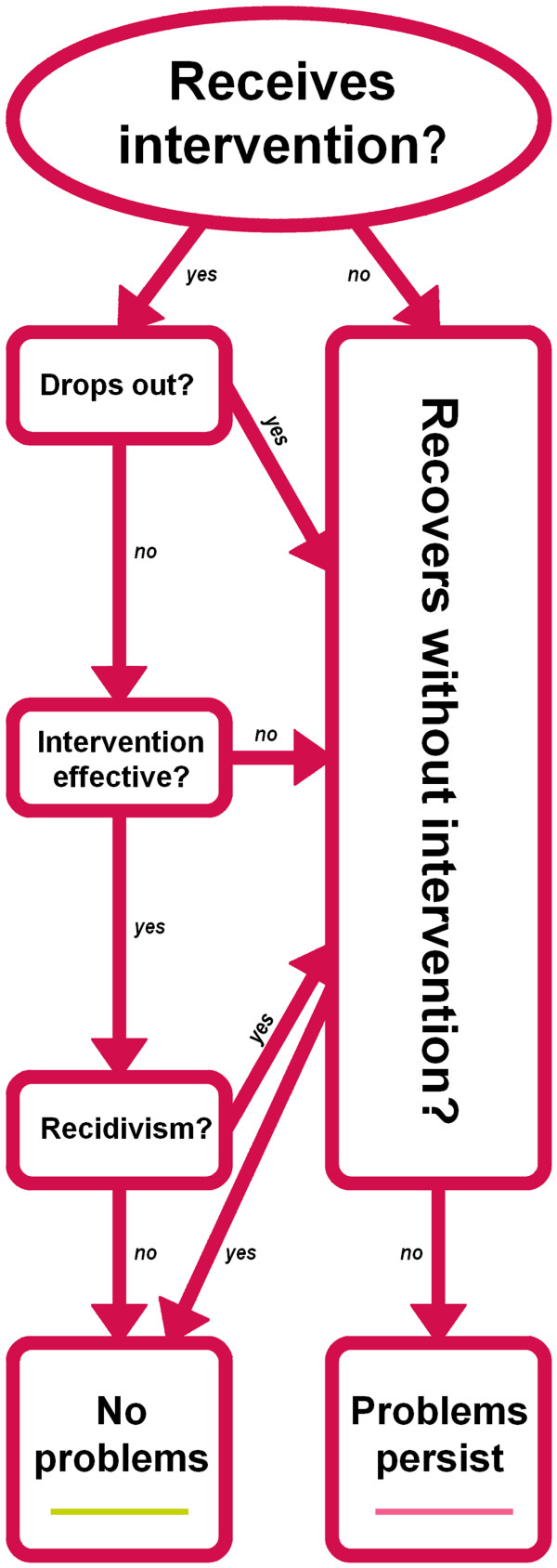
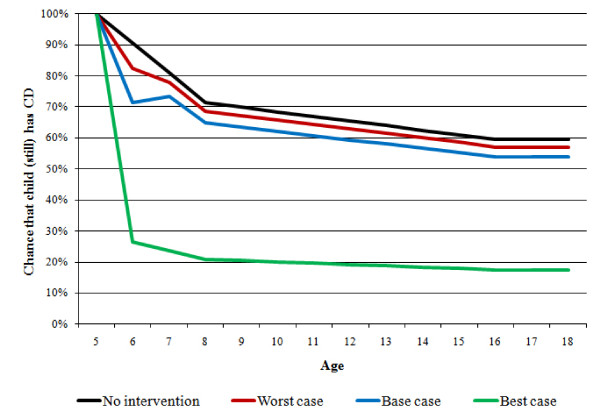
BACKGROUND: Conduct disorders are the most common psychiatric disorders in children and may persist into adulthood in about 50% of cases. The costs to society are high and impact many public sector agencies. Parenting programmes have been shown to positively affect child behaviour, but little is known about their potential long-term cost-effectiveness. We therefore estimate the costs of and longer-term savings from evidence-based parenting programmes for the prevention of persistent conduct disorder. METHODS: A decision-analytic Markov model compares two scenarios: 1) a 5-year old with clinical conduct disorder receives an evidence-based parenting programme; 2) the same 5-year old does not receive the programme. Cost-savings analysis is performed by comparing the probability that conduct disorder persists over time in each scenario, adopting both a public sector and a societal perspective. If the intervention is successful in reducing persistent conduct disorder, cost savings may arise from reduced use of health services, education support, social care, voluntary agencies and from crimes averted. RESULTS: Results strongly suggest that parenting programmes reduce the chance that conduct disorder persists into adulthood and are cost-saving to the public sector within 5-8 years under base case conditions. Total savings to society over 25 years are estimated at £16,435 per family, which compares with an intervention cost in the range of £952-£2,078 (2008/09 prices). CONCLUSIONS: Effective implementation of evidence-based parenting programmes is likely to yield cost savings to the public sector and society. More research is needed to address evidence gaps regarding the current level of provision, longer-term effectiveness and questions of implementation, engagement and equity.
Overview
The claims and statistics of this paper haven’t been checked yet.
Free: it reads the open-access text and checks the first 5 claims that cite a source we can check. Create a free account to check every claim.
Integrity signals
Registry
Cites
Statistics
Figures
Verification
Claims the paper makes
The claims and statistics of this paper haven’t been checked yet.
Free: it reads the open-access text and checks the first 5 claims that cite a source we can check. Create a free account to check every claim.
Self-check
Percentages, sums and reported differences re-computed from the paper’s own numbers.
The self-check needs the paper’s full text.
Citations
Cites
The rate of return to the HighScope Perry Preschool Program
Heckman, J. J., Moon, S. H., Pinto, R., Savelyev, P. A., & Yavitz, A. (2010) · Journal of Public Economics · doi:10.1016/j.jpubeco.2009.11.001 · Cited by 1,341 · cited 2×
“For the same reason, social security benefit receipt has also been excluded, although these costs may be substantial [16,26].”
BackgroundMental Health of Children and Young People in Great Britain, 2004: (557702010-001)
Green, H., McGinnity, A., Meltzer, H., Ford, T., & Goodman, R. (2005) · PsycEXTRA Dataset · doi:10.1037/e557702010-001 · Cited by 1,216
A meta-analysis of parent training: Moderators and follow-up effects
Lundahl, B., Risser, H. J., & Lovejoy, M. C. (2006) · Clinical Psychology Review · doi:10.1016/j.cpr.2005.07.004 · Cited by 1,072 · cited 2×
“Furthermore, meta-analyses have found that studies of parenting programmes for children with clinical levels of behaviour problems have bigger effect sizes than those for children with sub-clinical levels [23,35], meaning that the biggest improvements can be achieved for this group.”
BackgroundFinancial cost of social exclusion: follow up study of antisocial children into adulthood
Scott, S., Knapp, M., Henderson, J., & Maughan, B. (2001) · BMJ · doi:10.1136/bmj.323.7306.191 · Cited by 906 · cited 14×
“Klett-Davies M, Skaliotis E, Wollny I: Mapping and analysis of parenting services in England.”
BackgroundMethodInfluentialEarly Predictors of Adolescent Aggression and Adult Violence
Farrington, D. P. (1989) · Violence and Victims · doi:10.1891/0886-6708.4.2.79 · Cited by 743 · cited 1×
“In a study of UK children, Richman and colleagues [18] reported that about 60% of those showing behavioural problems at age 3 still exhibit these problems at age 8 and a review of the evidence [19] suggests that approximately 50% will continue to show problematic behaviours in adulthood.”
BackgroundInternational Statistical Classification of Diseases and Related Health Problems (ICD-10)
Schrader, K. (2023) · Angewandte Lymphologie · doi:10.1007/978-3-662-61452-5_49 · Cited by 683
Assessment of child behavior problems: The validation of a new inventory
Eyberg, S. M., & Ross, A. W. (1978) · Journal of Clinical Child Psychology · doi:10.1080/15374417809532835 · Cited by 630 · cited 1×
“One commonly used measure of child conduct problems is the Eyberg Child Behaviour Inventory (ECBI, [22]).”
MethodPre-school to School: a Behavioural Study
Sturge, J. C. (1983) · Archives of Disease in Childhood · doi:10.1136/adc.58.5.398-a · Cited by 450 · cited 1×
“In a study of UK children, Richman and colleagues [18] reported that about 60% of those showing behavioural problems at age 3 still exhibit these problems at age 8 and a review of the evidence [19] suggests that approximately 50% will continue to show problematic behaviours in adulthood.”
BackgroundOutcomes of conduct problems in adolescence: 40 year follow-up of national cohort
Colman, I., Murray, J., Abbott, R. A., Maughan, B., Kuh, D., Croudace, T. J., & Jones, P. B. (2009) · BMJ · doi:10.1136/bmj.a2981 · Cited by 381 · cited 1×
“Adults with a history of childhood conduct disorder experience a range of negative outcomes [30].”
BackgroundDretzke, J., Davenport, C., Frew, E., Barlow, J., Stewart-Brown, S., Bayliss, S., Taylor, R. S., Sandercock, J., & Hyde, C. (2009) · Child and Adolescent Psychiatry and Mental Health · doi:10.1186/1753-2000-3-7 · Cited by 347 · cited 3×
“A recent meta-analysis of randomised controlled trials found significant differences in parent and independent outcome reports of child behaviour, showing favourable results for the parenting programmes [7].”
BackgroundMethodResultInfluential
Research works printed but not linked: 9
- 3. Sainsbury Centre for Mental Health: The chance of a lifetime. Preventing early conduct problems and reducing crime. London: Sainsbury Centre for Mental Health; 2009.
- 6. Friedli L, Parsonage M: Mental health promotion: building an economic case. Belfast: Northern Ireland Association for Mental Health; 2007.
- 8. National Institute for Health and Clinical Excellence: Parent-training/ education programmes in the management of children with conduct disorders. London: National Institute for Health and Clinical Excellence; 2006.
- 25. Puig-Peiro R, Stevens M, Beecham J: The costs and characteristics of the parenting programmes in the NAPP Commissioners' Toolkit. London: Personal Social Services Research Unit, LSE; 2010.
- 27. Home Office Research, Development and Statistics Directorate: Social Research, Offending, Crime and Justice Survey 2006 [computer file]. Offending Surveys and Research. 2 edition. Colchester: National Centre for Social Research and BMRB; 2008.
- 29. Dubourg R, Hamed J, Thorns J: The economic and social costs of crime against individuals and households 2003/04. Home Office Online Report 30/05 London: Home Office; 2005.
- 31. Richards M, Abbott R, Collis G, Hackett P, Hotopf M, Kuh D, Jones P, Maughan B, Parsonage M: Childhood mental health and life chances in post-war Britain: insights from three national birth cohort studies. London: Sainsbury Centre for Mental Health; 2009.
- 36. de Graaf I, Speetjens P, Smit F, de Wolff M, Tavecchio L: Effectiveness of the Triple P Positive Parenting Program on behavioral problems in children: a meta-analysis. Behav Modif 2008, 32(5):714-735. · DOI · Paper page
- 38. Klett-Davies M, Skaliotis E, Wollny I: Mapping and analysis of parenting services in England. Assessing needs and patterns of spending. In Parenting services: filling in the gaps. Edited by: Henricson C. National Academy for Parenting Practitioners and Family and Parenting Institute; 2009:.
Cited by
Return on investment of public health interventions: a systematic review
Masters, R., Anwar, E., Collins, B., Cookson, R., & Capewell, S. (2017) · Journal of Epidemiology and Community Health · doi:10.1136/jech-2016-208141 · Cited by 480
“10 15 17 32 58 This has signi fi cant implications for policy-makers, who often work to a much shorter time horizon (typically 3 – 5 years).”
BackgroundA comparison of two sources of primary and social care resource use data in a care home setting
Sach, T., Desborough, J. A., Houghton, J., & Holland, R. (2018) · ePrints Soton (University of Southampton) · doi:10.22024/unikent/01.02.70995 · Cited by 425
Rivenbark, J. G., Odgers, C. L., Caspi, A., Harrington, H., Hogan, S., Houts, R. M., Poulton, R., & Moffitt, T. E. (2018) · Journal of Child Psychology and Psychiatry · doi:10.1111/jcpp.12850 · Cited by 262
Annual report of the Chief Medical Officer 2012 : our children deserve better : prevention pays
Lemer, C. (2013) · Digital Education Resource Archive (University College London) · Cited by 187
Snell, T., Knapp, M., Healey, A., Guglani, S., Evans‐Lacko, S., Fernandez, J., Meltzer, H., & Ford, T. (2013) · Journal of Child Psychology and Psychiatry · doi:10.1111/jcpp.12055 · Cited by 137
Beecham, J. (2014) · Journal of Child Psychology and Psychiatry · doi:10.1111/jcpp.12216 · Cited by 111
“…and run effectively in routine practice, how to encourage parents to complete the course, how to identify and target groups of parents likely to benefit, how to engage hard-to-reach populations and whether the programme will engender benefits into adulthood (Bonin et al., 2011; Stevens, 2012).”
BackgroundSelf-citationGardner, F., Leijten, P., Mann, J., Landau, S., Harris, V., Beecham, J., Bonin, E.-M., Hutchings, J., & Scott, S. (2017) · Public Health Research · doi:10.3310/phr05100 · Cited by 67
“In this study, we adapted our previous model estimating the longer-term savings from parenting programmes intended to prevent persistence of behaviour problems.(20) We drew on additional literature and created a ‘low-cost’ and a ‘high-cost’ scenario.”
MethodSelf-citationPsychosocial Interventions for Child Disruptive Behaviors: A Meta-analysis
EPSTEIN, R. A., Fonnesbeck, C., Potter, S., Rizzone, K. H., & McPheeters, M. L. (2015) · PEDIATRICS · doi:10.1542/peds.2015-2577 · Cited by 92
“Recognizing the potential for misclassification of treatments, there was some uncertainty about the correct classification of the PCIT intervention, here included with the multicomponent interventions because the focus of the intervention is on the parent–child interaction and includes the parent and child engaged tog…”
InfluentialBauer, A., Pawlby, S., Plant, D. T., King, D., Pariante, C. M., & Knapp, M. (2015) · Psychological Medicine · doi:10.1017/s0033291714001044 · Cited by 87
“…there is a substantial economic impact associated with mental health problems starting in childhood and reaching into adulthood and possibly later life, with wideranging implications for society (Scott et al. 2001; Healey et al. 2004; McCrone et al. 2005; Romeo et al. 2006; Knapp et al. 2011).”
From the Cradle to the Web: The Growth of “Sharenting”—A Scientometric Perspective
Cataldo, I., Lieu, A. A., Carollo, A., Bornstein, M. H., Gabrieli, G., Lee, A., & Esposito, G. (2022) · Human Behavior and Emerging Technologies · doi:10.1155/2022/5607422 · Cited by 90
The effectiveness of universal parenting programmes: the CANparent trial
Lindsay, G., & Totsika, V. (2017) · BMC Psychology · doi:10.1186/s40359-017-0204-1 · Cited by 61
“org/publicdomain/ze impact on the life chances of individuals, reduction in later negative outcomes will substantially reduce the financial cost to society [13].”
BackgroundSampaio, F., Barendregt, J. J., Feldman, I., Lee, Y. Y., SAWYER, M. G., Dadds, M. R., Scott, J. G., & Mihalopoulos, C. (2017) · European Child & Adolescent Psychiatry · doi:10.1007/s00787-017-1100-1 · Cited by 58
“[19] estimated the costs and longer term savings of parenting programmes in the UK associated with the reduction in the probability of persistent CD among children.”
BackgroundInfluentialMental health in an age of austerity
Knapp, M. R. J. (2012) · Evidence-Based Mental Health · doi:10.1136/ebmental-2012-100758 · Cited by 53
Costs and savings of parenting interventions: results of a systematic review
Duncan, K. M., MacGillivray, S. A., & Renfrew, M. J. (2017) · Child Care Health and Development · doi:10.1111/cch.12473 · Cited by 53
Herman, P. M., Mahrer, N. E., Wolchik, S. A., Porter, M. M., Jones, S., & Sandler, I. N. (2015) · Prevention Science · doi:10.1007/s11121-014-0527-6 · Cited by 50
“…health services, and reductions in criminal justice system involvement costs (e.g., Barnett 1993; Barnett and Masse 2007; Belfield et al. 2006; Bonin et al. 2011; Heckman et al. 2006; Kuklinski et al. 2012; Reynolds et al. 2002, 2011; Spoth et al. 2002; Temple and Reynolds 2007 ), a positive…”
BackgroundStevens, M. (2012) · Child & Family Social Work · doi:10.1111/j.1365-2206.2012.00888.x · Cited by 51
Self-citationNystrand, C., Feldman, I., Enebrink, P., & Sampaio, F. (2019) · PLoS ONE · doi:10.1371/journal.pone.0225503 · Cited by 49
“[44] also used a decision-analytic model for a hypothetical parenting intervention for the prevention of persistent conduct disorder in the United Kingdom.”
MethodInter-sectoral costs and benefits of mental health prevention: towards a new classification scheme.
Drost, R. M. W. A., Paulus, A. T. G., Ruwaard, D., & Evers, S. (2013) · PubMed · Cited by 46
Marryat, L., Thompson, L. C., & Wilson, P. (2017) · BMC Pediatrics · doi:10.1186/s12887-017-0800-5 · Cited by 45
Sampaio, F., Nystrand, C., Feldman, I., & Mihalopoulos, C. (2022) · European Child & Adolescent Psychiatry · doi:10.1007/s00787-022-01969-w · Cited by 44
“…= 14), there was evidence that preventive interventions targeting children with symptoms and parenting interventions delivered as treatment, including group and individual face-to-face programs [26, 27, 31, 35, 43, 46] were cost-effective and even cost-saving for targeting externalizing behaviors.”
BackgroundInfluentialBatura, N., Hill, Z. E., Haghparast‐Bidgoli, H., Lingam, R., Colbourn, T., Kim, S., Sikander, S., Pulkki‐Brännström, A., Rahman, A., Kirkwood, B. R., et al. (2014) · Health Policy and Planning · doi:10.1093/heapol/czu055 · Cited by 46
“2011) and two from a societal perspective (McIntosh et al. 2009; Bonin et al. 2011).”
BackgroundInfluentialIncredible Years parenting programme: cost-effectiveness and implementation
Edwards, R. T., Jones, C., Berry, V., Charles, J. M., Linck, P., Bywater, T. J., & Hutchings, J. (2016) · Journal of Children s Services · doi:10.1108/jcs-02-2015-0005 · Cited by 43
“For children with early onset CD, problems frequently persist into adulthood (Bonin et al., 2011a, b; Robins, 1978; Scott et al., 2001) and, amongst other things, predict poor employment prospects, relationship breakdown and self-harming and/or anti-social criminal behaviour (Kazdin, 1989;…”
BackgroundRedfern, A., Cluver, L. D., Casale, M., & Steinert, J. I. (2019) · BMJ Global Health · doi:10.1136/bmjgh-2018-001147 · Cited by 36
Zhang, J., Liu, W., Zhang, J., Wu, Q., Gao, Y., Jiang, Y., Gao, J., Yao, S., & Huang, B. (2018) · Frontiers in Human Neuroscience · doi:10.3389/fnhum.2018.00152 · Cited by 34
“It is often seen as the precursor to adulthood antisocial personality disorder (Bonin et al., 2011).”
BackgroundOutcomes of a Comparison Study into a Group-Based Infant Parenting Programme
Ch, J., Erjavec, M., Viktor, S., & Hutchings, J. (2016) · Journal of Child and Family Studies · doi:10.1007/s10826-016-0489-3 · Cited by 33
“…by identifying 5-year-old children with conduct disorder and offering support through an evidence-based parenting programme, the invested support would yield savings of £16,400 per family over the following 25 years compared to the cost incurred if no treatment were provided (Bonin et al. 2011).”
BackgroundInfluentialCary, M., Butler, S., Baruch, G., Hickey, N., & Byford, S. (2013) · PLoS ONE · doi:10.1371/journal.pone.0061070 · Cited by 32
“First we computed the weighted average of non-violent offences for the age range of the young persons included in the study, using the 2006 cross-sectional sample from the Offending, Crime and Justice Survey.[16] This sample includes over 5,000 individuals aged 10–25, is weighted to be UK representative and details me…”
MethodSelf-citationMasi, G., Milone, A., Paciello, M., Lenzi, F., Muratori, P., Manfredi, A., Polidori, L., Ruglioni, L., Lochman, J. E., & Muratori, F. (2014) · Psychiatry Research · doi:10.1016/j.psychres.2014.05.048 · Cited by 32
“Hence, it is crucial to evaluate the efficacy of treatments, in terms of persistence of the disorder, repeated utilization of mental health services, and school- and work-failure (Lochman and Wells, 2004; Bonin et al., 2011; Fonagy et al., 2013).”
BackgroundPaasio, P. (2014) · Jyväskylä University Digital Archive (University of Jyväskylä) · Cited by 34
Ramchandani, P. G., O’Farrelly, C., Babalis, D. S., Bakermans‐Kranenburg, M. J., Byford, S., Grimås, E., Iles, J. E., van IJzendoorn, M. H., McGinley, J., Phillips, C., et al. (2017) · Trials · doi:10.1186/s13063-017-2293-9 · Cited by 26
“These longer-term outcomes will be explored using decision analytic modelling, following methods applied in similar research [64].”
MethodSelf-citationHelping the Noncompliant Child: An Assessment of Program Costs and Cost-Effectiveness
Honeycutt, A., Khavjou, O., Jones, D. J., Cuellar, J., & Forehand, R. (2013) · Journal of Child and Family Studies · doi:10.1007/s10826-013-9862-7 · Cited by 26
Zhang, J., Li, X., Li, Y., Wang, M., Huang, B., Yao, S., & Shen, L. (2019) · Brain Imaging and Behavior · doi:10.1007/s11682-019-00186-5 · Cited by 25
O’Farrelly, C., Barker, B., Watt, H., Babalis, D. S., Bakermans‐Kranenburg, M. J., Byford, S., Ganguli, P., Grimås, E., Iles, J. E., Mattock, H., et al. (2021) · Health Technology Assessment · doi:10.3310/hta25290 · Cited by 24
Self-citationA Cost-Effectiveness Analysis of the Swedish Universal Parenting Program All Children in Focus
Ulfsdotter, M., Lindberg, L., & Månsdotter, A. (2015) · PLoS ONE · doi:10.1371/journal.pone.0145201 · Cited by 27
“The ECBI has also been used in modeling studies pertaining to reduction in clinical cases of conduct disorder [8, 10].”
MethodSupport for Adoption Placements: The First Six Months
Bonin, E., Beecham, J. K., Dance, C., & Farmer, E. (2013) · The British Journal of Social Work · doi:10.1093/bjsw/bct008 · Cited by 23
Self-citationMytton, J. A., Ingram, J. C., Manns, S., Stevens, T., Mulvaney, C. A., Blair, P. S., Powell, J. E., Potter, B., Towner, E., Emond, A. M., et al. (2014) · Health Technology Assessment · doi:10.3310/hta18030 · Cited by 22
Nystrand, C., Hultkrantz, L., Vimefall, E., & Feldman, I. (2019) · Administration and Policy in Mental Health and Mental Health Services Research · doi:10.1007/s10488-019-00984-5 · Cited by 23
LifeSim: A Lifecourse Dynamic Microsimulation Model of the Millennium Birth Cohort in England
Skarda, I., Asaria, M., & Cookson, R. (2021) · doi:10.34196/ijm.00228 · Cited by 22
Mahrer, N. E., Winslow, E., Wolchik, S. A., Tein, J.-Y., & Sandler, I. N. (2014) · Child Development · doi:10.1111/cdev.12258 · Cited by 21
McDonough-Caplan, H. M., & Beauchaine, T. P. (2018) · Elsevier eBooks · doi:10.1016/b978-0-12-811323-3.00003-1 · Cited by 20
Wynne, C., Doyle, C., Kenny, R., Brosnan, E., & Sharry, J. (2016) · Journal of Child and Adolescent Mental Health · doi:10.2989/17280583.2015.1135804 · Cited by 20
Investing in advocacy for parents with learning disabilities: what is the economic argument?
Bauer, A., Wistow, G., Dixon, J., & Knapp, M. R. J. (2014) · British Journal of Learning Disabilities · doi:10.1111/bld.12089 · Cited by 19
Evaluating Parent Gym: a community implemented universal parenting programme
Lindsay, G., Totsika, V., & Thomas, R. (2019) · Journal of Children s Services · doi:10.1108/jcs-09-2018-0017 · Cited by 18
“This estimate does not include the lifelong costs of late interventions (Bonin et al., 2011).”
BackgroundAttachment, behavior problems and interventions
Hutchings, J., Williams, M. E., & Leijten, P. H. O. (2023) · Frontiers in Child and Adolescent Psychiatry · doi:10.3389/frcha.2023.1156407 · Cited by 19
McDaid, D. (2018) · London School of Economics and Political Science Research Online (London School of Economics and Political Science) · Cited by 18
Deidda, M., Boyd, K., Minnis, H., Donaldson, J., Brown, K., Boyer, N. R. S., & McIntosh, E. (2018) · BMJ Open · doi:10.1136/bmjopen-2017-020066 · Cited by 17
Skarda, I., Asaria, M., & Cookson, R. (2022) · Social Science & Medicine · doi:10.1016/j.socscimed.2022.114960 · Cited by 16
Humphrey, N., Hennessey, A., Troncoso, P., Panayiotou, M., Black, L., Petersen, K. J., Wo, L., Mason, C., Ashworth, E., Frearson, K., et al. (2022) · Public Health Research · doi:10.3310/vkof7695 · Cited by 16
Gardner, F. E. M., Shenderovich, Y., McCoy, A., Schafer, M., Martin, M., Janowski, R., Varadan, S., Backhaus, S., Barlow, J., & Ward, C. (2023) · ORCA Online Research @Cardiff (Cardiff University) · Cited by 12
Outcomes of a School-Based Program for Young Children with Disruptive Behaviors
Plath, D., Croce, N., Crofts, P., & Stuart, G. (2015) · Children & Schools · doi:10.1093/cs/cdv036 · Cited by 12
Day, C., Briskman, J., Crawford, M., Foote, L., Harris, L., Boadu, J., McCrone, P., McMurran, M., Michelson, D., Moran, P., et al. (2020) · Health Technology Assessment · doi:10.3310/hta24140 · Cited by 13
Preventing Domestic Violence in Alberta: A Cost Savings Perspective
Wells, L., & Boodt, C. (2012) · The School of Public Policy Publications · doi:10.55016/ojs/sppp.v5i1.42386 · Cited by 11
Freitag, C. M. (2014) · European Child & Adolescent Psychiatry · doi:10.1007/s00787-014-0536-9 · Cited by 11
“Associated costs for society are tremendous and of permanent duration [4, 10].”
BackgroundParenting programmes: identification and referral
Khan, L., Parsonage, M., & Brown, E. R. (2013) · Journal of Children s Services · doi:10.1108/jcs-03-2013-0011 · Cited by 10
Self-citationChildhood adversity and approach/avoidance-related behaviour in boys
Großheinrich, N., Schaeffer, J., Firk, C., Eggermann, T., Huestegge, L., & Konrad, K. (2022) · Journal of Neural Transmission · doi:10.1007/s00702-022-02481-w · Cited by 9
Knapp, M. R. J., & Evans-Lacko, S. E. (2015) · Wiley eBooks · doi:10.1002/9781118381953.ch18 · Cited by 9
Scavenius, C., Amilon, A., & Schultz, E. A. (2020) · Journal of Child and Family Studies · doi:10.1007/s10826-020-01788-0 · Cited by 9
Tozan, Y., Capasso, A., Namatovu, P., Kiyingi, J., Damulira, C., Nabayinda, J., Bahar, O. S., McKay, M. M., Hoagwood, K., & Ssewamala, F. M. (2022) · American Journal of Tropical Medicine and Hygiene · doi:10.4269/ajtmh.21-0895 · Cited by 10
Economic Benefits of Sustained Investments in Parenting
Sampaio, F., Feldman, I., Richards‐Jones, S., & Mihalopoulos, C. (2018) · Springer eBooks · doi:10.1007/978-3-319-94598-9_35 · Cited by 9
Helping the noncompliant child: An updated assessment of program costs and cost-effectiveness
Khavjou, O., Forehand, R., Loiselle, R., Turner, P., Buell, N., & Jones, D. J. (2020) · Children and Youth Services Review · doi:10.1016/j.childyouth.2020.105050 · Cited by 9
Özdemir, M. (2015) · Journal of Children s Services · doi:10.1108/jcs-02-2014-0016 · Cited by 9
Gerhardt, H., Heinzel‐Gutenbrunner, M., & Bachmann, C. (2018) · BMC Health Services Research · doi:10.1186/s12913-018-3520-0 · Cited by 9
Stevens, M., Harris, L., Ellis, M. M., Day, C., & Beecham, J. K. (2013) · Child and Adolescent Mental Health · doi:10.1111/camh.12035 · Cited by 8
Self-citationScaling parent management training through digital and microlearning approaches
Grodberg, D., & Smith, I. (2022) · Frontiers in Psychology · doi:10.3389/fpsyg.2022.934665 · Cited by 8
“The family unit as a whole also benefits from PMT through increased family resilience, improved sibling behavior, increased marital satisfaction, and better parental functioning (Bonin et al., 2011; Slusher, 2020).”
BackgroundThe economic case for better mental health
Knapp, M. R. J., & Iemmi, V. (2014) · London School of Economics and Political Science Research Online (London School of Economics and Political Science) · Cited by 8
Engaging Families in Early Intervention for Child Conduct Concerns
Plath, D., Crofts, P., & Stuart, G. (2015) · Children Australia · doi:10.1017/cha.2015.5 · Cited by 8
Health Policies Informed by Severity Classification: A UK Perspective
Monk-Cunliffe, J., & Dale, O. (2025) · Oxford University Press eBooks · doi:10.1093/9780191964343.003.0034 · Cited by 8
Parenting programmes for parents of children and young people with behavioural difficulties
Lindsay, G. (2018) · Counselling and Psychotherapy Research · doi:10.1002/capr.12192 · Cited by 7
Carsley, S., Prowse, R. J. L., Richmond, S. A., Manson, H. E., & Moloughney, B. (2020) · Public Health Nursing · doi:10.1111/phn.12719 · Cited by 7
Supporting adoption and supporting families that adopt value for money
Bonin, E., Lushey, C., Blackmore, J., Holmes, L., & Beecham, J. K. (2013) · Sussex Research Online (University of Sussex) · Cited by 7
Self-citationMorris, H., Valentine, C., Cummins, J., Dwyer, A., & Skouteris, H. (2019) · Australian and New Zealand Journal of Family Therapy · doi:10.1002/anzf.1389 · Cited by 7
Edginton, E., Walwyn, R. E. A., Burton, K., Cicero, R., Graham, L., Reed, S., Tubeuf, S., Twiddy, M., Wright-Hughes, A. M., Ellis, L., et al. (2017) · Trials · doi:10.1186/s13063-017-2166-2 · Cited by 7
Axford, N., Bjornstad, G. J., Matthews, J., Heilmann, S., Raja, A., Ukoumunne, O. C., Berry, V., Wilkinson, T., Timmons, L., Hobbs, T., et al. (2020) · Children and Youth Services Review · doi:10.1016/j.childyouth.2020.105245 · Cited by 7
Herrera-Ferrá, K. (2016) · Acta Psychopathologica · doi:10.4172/2469-6676.100032 · Cited by 6
Law, J., Beecham, J. K., & Lindsay, G. (2012) · doi:10.13140/2.1.4637.8243 · Cited by 6
Self-citationPreventing Domestic Violence in Alberta: A Cost Savings PerspectivePreprint
Wells, L., Emery, J. C. H., & Boodt, C. (2012) · SSRN Electronic Journal · doi:10.2139/ssrn.2088960 · Cited by 6
Klein, M., Levy, T., Shulman, C., Lwow, E., & Silberg, T. (2024) · Frontiers in Psychology · doi:10.3389/fpsyg.2024.1387944 · Cited by 5
Societal Costs of Child and Adolescent Mental Health Disorders
Lynch, F. L., & Dickerson, J. F. (2018) · Oxford University Press eBooks · doi:10.1093/oxfordhb/9780190634841.013.11 · Cited by 5
Kowalski, M. A. (2019) · Research Exchange (Washington State University) · Cited by 5
Parent and group leader reflections on a group-based programme for parents and babies.
Ch, J., Hutchings, J., Erjaves, M., & Jc, H. (2012) · PubMed · Cited by 5
Wellbeing: Alternative Policy Perspectives
Besley, T., & Bucelli, I. (2022) · LSE Press eBooks · doi:10.31389/lsepress.well · Cited by 4
The Economic Case for a Shift to Prevention
Strelitz, J., Nolte, E., Pitchforth, E., Miani, C., Winpenny, E. M., Henham, M.-L., Ball, S. L., & Jahagirdar, D. (2013) · Cited by 4
Child-focused psychosocial interventions for anger and aggression in children under 12 years of age
Hanratty, J., Macdonald, G. M., & Livingstone, N. (2015) · Cochrane Database of Systematic Reviews · doi:10.1002/14651858.cd011788 · Cited by 4
RetractedSchool-Based Programme for Young Children with Disruptive Behaviours: Two-Year Follow-Up
Plath, D. (2018) · Children Australia · doi:10.1017/cha.2018.2 · Cited by 4
“Bonin et al. (2011) un- dertook a meta-analysis of randomised controlled trials of prevention programmes and found an average 34% reduction in conduct problems (range: 20–68”
BackgroundThe Geography of World Happiness
John F, H., Huang, H., & Wang, S. (2015) · KDI Central Archives (Korea Development Institute) · Cited by 5
Oral Narrative Interventions Implemented by Teachers, Speech- Language Pathologists, and Parents
Kirby, M. S. (2022) · Digital Commons - University of South Florida (University of South Florida) · doi:10.13140/rg.2.2.35049.88162 · Cited by 4
Prevention: wrestling with new economic realities
Knapp, M. R. J. (2013) · Tizard Learning Disability Review · doi:10.1108/tldr-03-2013-0029 · Cited by 3
“The work on parenting programmes by Bonin et al. (2011) summarised above was one of those 15 analyses.”
BackgroundInfluentialParenting group composition does not impact program effects on children’s conduct problems.
Leijten, P. H. O., Meij, L. W., Weeland, J., Menting, A. T. A., de Castro, B. O., Overbeek, G. J., & Matthys, W. (2021) · Journal of Family Psychology · doi:10.1037/fam0000820 · Cited by 3
“The costs for group program typically range from $345 to $1,844, with a median of $1,168 per family, compared to $954 to $7,001, with a median of $2,578, for individual programs (Bonin et al., 2011).”
Bauer, A., Wistow, G., Dixon, J., & Knapp, M. R. J. (2013) · London School of Economics and Political Science Research Online (London School of Economics and Political Science) · Cited by 3
Parent Training for Childhood Conduct Problems
Samimy, S., Schettini, E. M., Fernhoff, K., Webster-Stratton, C. H., & Beauchaine, T. P. (2021) · Elsevier eBooks · doi:10.1016/b978-0-12-818697-8.00047-9 · Cited by 3
The societal costs of Anorexia nervosa in England:
Bonin, E. (2017) · London School of Economics and Political Science Theses Online (London School of Economics and Political Science) · doi:10.21953/lse.s6nqjjilq067 · Cited by 3
Self-citationAltmann, B. A. (2020) · eDiss (Georg-August-Universität Göttingen) · doi:10.53846/goediss-8224 · Cited by 3
Comparative social costs of six early years disadvantages: a birth cohort microsimulation study
Venkatesh, S., Skarda, I., Villadsen, A., Warburton, M., Mansukoski, L., Mon-Williams, M. A., & Cookson, R. (2026) · Journal of Epidemiology & Community Health · doi:10.1136/jech-2025-225472 · Cited by 2
Hampshire’s Supporting Troubled Families Programme (STFP): Final Report
Hayden, C. (2015) · Cited by 2
Boege, I., Reck, N., Schepker, R., & Fegert, J. M. (2014) · Psychotherapeut · doi:10.1007/s00278-014-1072-2 · Cited by 2
Five-year Development of Psychopathology in Young People with Intellectual Disabilities
de Ruiter, K. P. (2013) · Digital Academic REpository of VU University Amsterdam (Vrije Universiteit Amsterdam) · Cited by 2
Offending risk factors and area: an investigation using structural equation modelling
Cunliffe, J. (2015) · London School of Economics and Political Science Theses Online (London School of Economics and Political Science) · Cited by 2
The Early Intervention Support Service in Northern Ireland: a Cost Comparison
Lynn, F., & van Willenswaard, K. C. (2018) · Research Portal (Queen's University Belfast) · Cited by 2
Ardino, V., & Benedetto, G. D. (2017) · MALTRATTAMENTO E ABUSO ALL INFANZIA · doi:10.3280/mal2017-002004 · Cited by 1
Clinical Approaches to Personality Disorder (AKA Complex Emotional Needs)
Dale, O., & Howe, A. J. (2024) · Cambridge University Press eBooks · doi:10.1017/9781911623861.021 · Cited by 1
Metadata
- Authors
- Bonin, E.-M., Stevens, M., Beecham, J., Byford, S., & Parsonage, M.
- Affiliations
- London School of Economics and Political Science (GB)
- University of Kent (GB)
- King's College London (GB)
- Centre for Mental Health (GB)
- Corresponding author
- Bonin, Eva-Maria
- Venue
- BMC Public Health
- Published
- 2011-10-14
- Volume
- 11
- Issue
- 1
- Pages
- 803-803
- ISSN
- 1471-2458 (ISSN-L)
- PMC
- PMC3209459
- OpenAlex
- W2131553993
- Cited by
- 107
- References
- 32
- Citations by year
- 2026: 5 · 2025: 2 · 2024: 3 · 2023: 2 · 2022: 10 · 2021: 7 · 2020: 7 · 2019: 6 · 2018: 8 · 2017: 10 · 2016: 7 · 2015: 10 · 2014: 13 · 2013: 12 · 2012: 5
- FWCI
- 24.25
- Type
- journal article
- Language
- en
- Open access
- gold
- doi.org
- Licence
- Locations
- BMC Public Health (publishedVersion, cc-by)
- Europe PMC (PubMed Central) (publishedVersion, cc-by)
- PubMed Central (publishedVersion, cc-by)
- PubMed (publishedVersion)
- Research Portal (King's College London) (publishedVersion, other-oa)
- London School of Economics and Political Science Research Online (London School of Economics and Political Science) (acceptedVersion)
- LSE Research Online Documents on Economics (submittedVersion)
- RePEc: Research Papers in Economics (submittedVersion)
- DOAJ (DOAJ: Directory of Open Access Journals) (submittedVersion, cc-by-sa)
- Kent Academic Repository (University of Kent) (submittedVersion)
- Funders
- King's College London
- Menzies Centre for Australian Studies, King's College London, University of London
- Topics
- Social Sciences › Economics, Econometrics and Finance › Economics and Econometrics › Health Systems, Economic Evaluations, Quality of Life
- Social Sciences › Psychology › Clinical Psychology › Child and Adolescent Psychosocial and Emotional Development
- Social Sciences › Psychology › Clinical Psychology › Psychopathy, Forensic Psychiatry, Sexual Offending
- Keywords
- parent training, conduct disorder, cost-effectiveness, cost reduction, child mental health prevention, Markov model, societal perspective, public sector costs, social care costs, health care costs
- MeSH terms
- Child Behavior Disorders, Child, Preschool, Cost-Benefit Analysis, Decision Support Techniques, Health Promotion, Humans, Parents, Parenting, Cost Savings, Evidence-Based Medicine, Conduct Disorder
About these checks
Registry, retraction, Cites and statistics results are computed, not judged, with one exception: a printed reference that no index lists is read once by a model before it counts as a citation error. Claims are extracted by a model and kept only when their quote appears verbatim in the text; each cited source is then checked, with a model’s help, for whether it says what the claim relies on. Those verdicts can be wrong — read the claim’s quote and the cited source before relying on one.
Statistics and arithmetic are recomputed, not judged.
Confidence bands are shown only for fields calibrated on our annotated test set. None is calibrated yet, so no band is shown.
What counts as a claim ›How we measure confidence ›How we check this ›
Are you an author, or do you see a problem with this page? Request a review
Data sources
Bibliographic data: Semantic Scholar, OpenAlex, Crossref.
Contains information from the Semantic Scholar Academic Graph Datasets, made available under the ODC Attribution License (ODC-BY 1.0).
Semantic Scholar’s data is described in: Kinney, R., et al. (2023). The Semantic Scholar Open Data Platform. arXiv:2301.10140.
