

Costs and longer-term savings of parenting programmes for the prevention of persistent conduct disorder: a modelling study
Open accessThe DOI matches its Crossref record; 31 of the 32 references it cites were found in a registry or an index.
Abstract
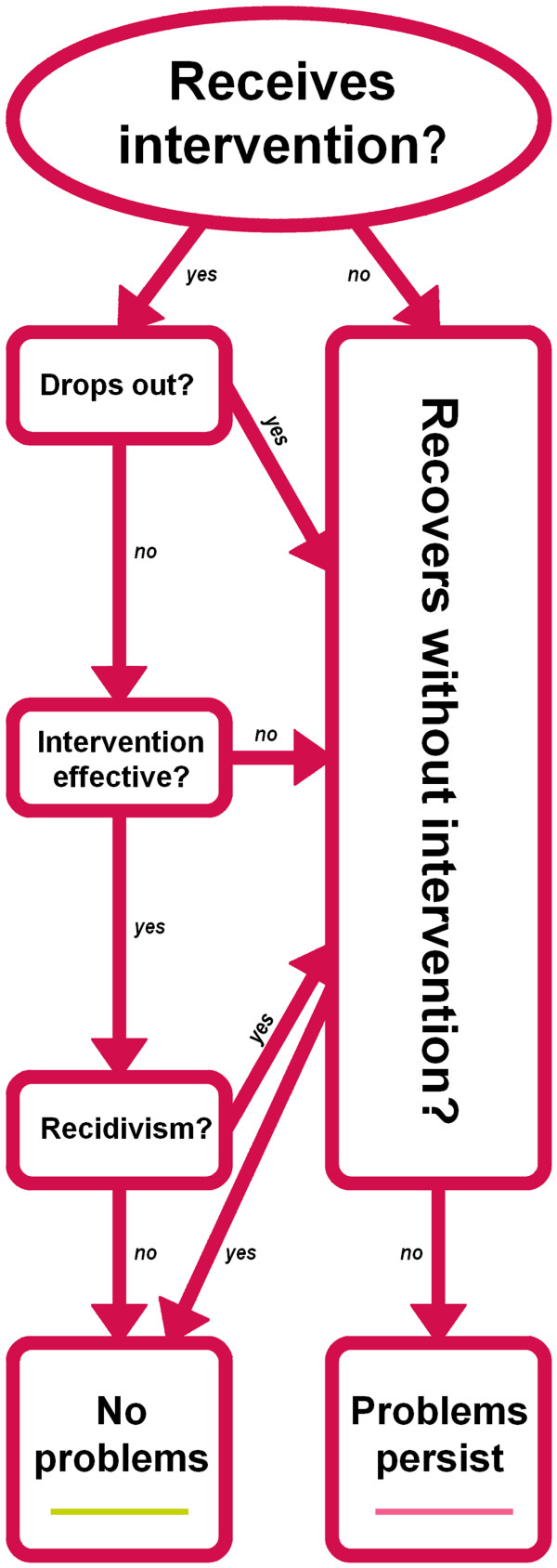
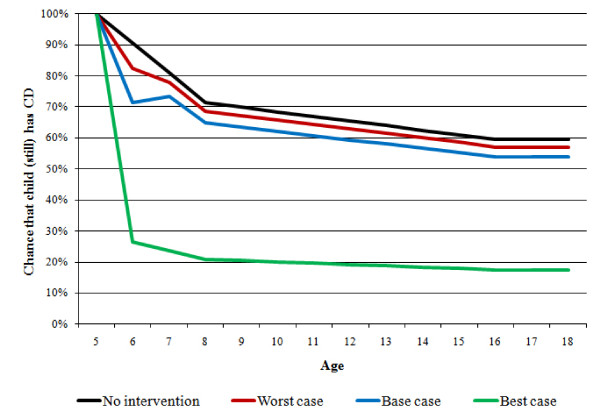
BACKGROUND: Conduct disorders are the most common psychiatric disorders in children and may persist into adulthood in about 50% of cases. The costs to society are high and impact many public sector agencies. Parenting programmes have been shown to positively affect child behaviour, but little is known about their potential long-term cost-effectiveness. We therefore estimate the costs of and longer-term savings from evidence-based parenting programmes for the prevention of persistent conduct disorder. METHODS: A decision-analytic Markov model compares two scenarios: 1) a 5-year old with clinical conduct disorder receives an evidence-based parenting programme; 2) the same 5-year old does not receive the programme. Cost-savings analysis is performed by comparing the probability that conduct disorder persists over time in each scenario, adopting both a public sector and a societal perspective. If the intervention is successful in reducing persistent conduct disorder, cost savings may arise from reduced use of health services, education support, social care, voluntary agencies and from crimes averted. RESULTS: Results strongly suggest that parenting programmes reduce the chance that conduct disorder persists into adulthood and are cost-saving to the public sector within 5-8 years under base case conditions. Total savings to society over 25 years are estimated at £16,435 per family, which compares with an intervention cost in the range of £952-£2,078 (2008/09 prices). CONCLUSIONS: Effective implementation of evidence-based parenting programmes is likely to yield cost savings to the public sector and society. More research is needed to address evidence gaps regarding the current level of provision, longer-term effectiveness and questions of implementation, engagement and equity.
Overview
The claims and statistics of this paper haven’t been checked yet.
Free: it reads the open-access text and checks the first 5 claims that cite a source we can check. Create a free account to check every claim.
Integrity signals
Registry
Cites
Statistics
Figures
Verification
Claims the paper makes
The claims and statistics of this paper haven’t been checked yet.
Free: it reads the open-access text and checks the first 5 claims that cite a source we can check. Create a free account to check every claim.
Self-check
Percentages, sums and reported differences re-computed from the paper’s own numbers.
The self-check needs the paper’s full text.
Citations
Cites
The rate of return to the HighScope Perry Preschool Program
Heckman, J. J., Moon, S. H., Pinto, R., Savelyev, P. A., & Yavitz, A. (2010) · Journal of Public Economics · doi:10.1016/j.jpubeco.2009.11.001 · Cited by 1,341 · cited 2×
“For the same reason, social security benefit receipt has also been excluded, although these costs may be substantial [16,26].”
BackgroundMental Health of Children and Young People in Great Britain, 2004: (557702010-001)
Green, H., McGinnity, A., Meltzer, H., Ford, T., & Goodman, R. (2005) · PsycEXTRA Dataset · doi:10.1037/e557702010-001 · Cited by 1,216
A meta-analysis of parent training: Moderators and follow-up effects
Lundahl, B., Risser, H. J., & Lovejoy, M. C. (2006) · Clinical Psychology Review · doi:10.1016/j.cpr.2005.07.004 · Cited by 1,072 · cited 2×
“Furthermore, meta-analyses have found that studies of parenting programmes for children with clinical levels of behaviour problems have bigger effect sizes than those for children with sub-clinical levels [23,35], meaning that the biggest improvements can be achieved for this group.”
BackgroundFinancial cost of social exclusion: follow up study of antisocial children into adulthood
Scott, S., Knapp, M., Henderson, J., & Maughan, B. (2001) · BMJ · doi:10.1136/bmj.323.7306.191 · Cited by 906 · cited 14×
“Klett-Davies M, Skaliotis E, Wollny I: Mapping and analysis of parenting services in England.”
BackgroundMethodInfluentialEarly Predictors of Adolescent Aggression and Adult Violence
Farrington, D. P. (1989) · Violence and Victims · doi:10.1891/0886-6708.4.2.79 · Cited by 743 · cited 1×
“In a study of UK children, Richman and colleagues [18] reported that about 60% of those showing behavioural problems at age 3 still exhibit these problems at age 8 and a review of the evidence [19] suggests that approximately 50% will continue to show problematic behaviours in adulthood.”
BackgroundInternational Statistical Classification of Diseases and Related Health Problems (ICD-10)
Schrader, K. (2023) · Angewandte Lymphologie · doi:10.1007/978-3-662-61452-5_49 · Cited by 683
Assessment of child behavior problems: The validation of a new inventory
Eyberg, S. M., & Ross, A. W. (1978) · Journal of Clinical Child Psychology · doi:10.1080/15374417809532835 · Cited by 630 · cited 1×
“One commonly used measure of child conduct problems is the Eyberg Child Behaviour Inventory (ECBI, [22]).”
MethodPre-school to School: a Behavioural Study
Sturge, J. C. (1983) · Archives of Disease in Childhood · doi:10.1136/adc.58.5.398-a · Cited by 450 · cited 1×
“In a study of UK children, Richman and colleagues [18] reported that about 60% of those showing behavioural problems at age 3 still exhibit these problems at age 8 and a review of the evidence [19] suggests that approximately 50% will continue to show problematic behaviours in adulthood.”
BackgroundOutcomes of conduct problems in adolescence: 40 year follow-up of national cohort
Colman, I., Murray, J., Abbott, R. A., Maughan, B., Kuh, D., Croudace, T. J., & Jones, P. B. (2009) · BMJ · doi:10.1136/bmj.a2981 · Cited by 381 · cited 1×
“Adults with a history of childhood conduct disorder experience a range of negative outcomes [30].”
BackgroundDretzke, J., Davenport, C., Frew, E., Barlow, J., Stewart-Brown, S., Bayliss, S., Taylor, R. S., Sandercock, J., & Hyde, C. (2009) · Child and Adolescent Psychiatry and Mental Health · doi:10.1186/1753-2000-3-7 · Cited by 347 · cited 3×
“A recent meta-analysis of randomised controlled trials found significant differences in parent and independent outcome reports of child behaviour, showing favourable results for the parenting programmes [7].”
BackgroundMethodResultInfluential
Research works printed but not linked: 9
- 3. Sainsbury Centre for Mental Health: The chance of a lifetime. Preventing early conduct problems and reducing crime. London: Sainsbury Centre for Mental Health; 2009.
- 6. Friedli L, Parsonage M: Mental health promotion: building an economic case. Belfast: Northern Ireland Association for Mental Health; 2007.
- 8. National Institute for Health and Clinical Excellence: Parent-training/ education programmes in the management of children with conduct disorders. London: National Institute for Health and Clinical Excellence; 2006.
- 25. Puig-Peiro R, Stevens M, Beecham J: The costs and characteristics of the parenting programmes in the NAPP Commissioners' Toolkit. London: Personal Social Services Research Unit, LSE; 2010.
- 27. Home Office Research, Development and Statistics Directorate: Social Research, Offending, Crime and Justice Survey 2006 [computer file]. Offending Surveys and Research. 2 edition. Colchester: National Centre for Social Research and BMRB; 2008.
- 29. Dubourg R, Hamed J, Thorns J: The economic and social costs of crime against individuals and households 2003/04. Home Office Online Report 30/05 London: Home Office; 2005.
- 31. Richards M, Abbott R, Collis G, Hackett P, Hotopf M, Kuh D, Jones P, Maughan B, Parsonage M: Childhood mental health and life chances in post-war Britain: insights from three national birth cohort studies. London: Sainsbury Centre for Mental Health; 2009.
- 36. de Graaf I, Speetjens P, Smit F, de Wolff M, Tavecchio L: Effectiveness of the Triple P Positive Parenting Program on behavioral problems in children: a meta-analysis. Behav Modif 2008, 32(5):714-735. · DOI · Paper page
- 38. Klett-Davies M, Skaliotis E, Wollny I: Mapping and analysis of parenting services in England. Assessing needs and patterns of spending. In Parenting services: filling in the gaps. Edited by: Henricson C. National Academy for Parenting Practitioners and Family and Parenting Institute; 2009:.
Cited by
Items 101–135 of 135
Papazafiri, M. (2025) · Education Sciences · doi:10.3390/educsci15081040 · Cited by 1
Venkatesh, S., Skarda, I., Villadsen, A., Asaria, M., Boehnke, J. R., Brennan, A., Krekel, C., Mon-Williams, M. A., Ploubidis, G. B., Tiffin, P. A., et al. (2026) · The international journal of microsimulation · doi:10.34196/ijm.00343 · Cited by 1
Ueno, K., & Schwenck, C. (2015) · Zeitschrift für Kinder- und Jugendpsychiatrie und Psychotherapie · doi:10.1024/1422-4917/a000369 · Cited by 1
Estimating the unit costs of vision rehabilitation services
Baxter, K., & Rabiee, P. (2015) · White Rose Research Online (University of Leeds, The University of Sheffield, University of York) · Cited by 1
Bauer, A. (2022) · LSE Press eBooks · doi:10.31389/lsepress.well.g · Cited by 1
Communications of the European Society for Child and Adolescent Psychiatry
(2012) · European Child & Adolescent Psychiatry · doi:10.1007/s00787-012-0317-2 · Cited by 1
Stevens, M. (2017) · London School of Economics and Political Science Theses Online (London School of Economics and Political Science) · doi:10.21953/lse.gah9haxnpfy5 · Cited by 1
“Criminal outcomes account for much of the estimated long-term costs of conduct disorders (Bonin et al., 2011).”
BackgroundSelf-citationvan Aar, J. (2019) · UvA-DARE (University of Amsterdam) · Cited by 1
A Reference Ontology for Putting Together Pregnancy and Mental HealthPreprint
Teixeira, M. D. G. D. S., Meireles, L., Cândido, C. P., Prado, K. D. S., Hisatugu, W. H., Garcia, A. S., Dias, R. D. S., Sousa, R. T., Mota, A. S., Galletta, M. A. K., et al. (2024) · Research Square · doi:10.21203/rs.3.rs-4541012/v1 · Cited by 1
Zebron, S. (2014) · Research on humanities and social sciences
Emotional stimulation processing and empathy in aggressive adolescents
Euler, F. (2015) · edoc (University of Basel) · doi:10.5451/unibas-006388057
Sampaio, F. (2016) · Uppsala University Publications (Uppsala University)
Psychiatric Care, Economics of
Knapp, M. R. J. (2015) · Elsevier eBooks · doi:10.1016/b978-0-08-097086-8.27053-0
Humayun, S., & Scott, S. (2016) · Cambridge University Press eBooks · doi:10.1017/9781316104453.015
Atherton, K. J. (2016) · Durham e-Theses (Durham University)
Pinto, R. F. Q. (2019) · Portuguese National Funding Agency for Science, Research and Technology (RCAAP Project by FCT)
Overview of Conduct Disorder: Implications for School Rehabilitation Professionals
Shaughnessy, M. F., Williams, M., II, Carlson, C. M., & Yeh, C. J. (2021) · Advances in early childhood and K-12 education · doi:10.4018/978-1-7998-7630-4.ch018
Jeong, H. J. (2014) · SECONDARY EDUCATION RESEARCH · doi:10.25152/ser.2014.62.1.199
Bonnett, T. H., McCorquodale, L., & Schouten, K. R. (2021) · Journal of Community Psychology · doi:10.1002/jcop.22669
Bauer, A. (2021) · LSE Public Policy Review · doi:10.31389/lseppr.45
Evidence-based mental health policy
Iemmi, V., Votruba, N., & Thornicroft, G. (2020) · Oxford University Press eBooks · doi:10.1093/med/9780198735564.003.0024
Overview of Conduct Disorder: Implications for School Rehabilitation Professionals
Shaughnessy, M. F., Williams, M., II, Carlson, C. M., & Yeh, C. J. (2022) · IGI Global eBooks · doi:10.4018/978-1-6684-6315-4.ch013
Dirscherl, R. (2023) · Public Health Forum · doi:10.1515/pubhef-2023-0060
Vanhemmuustaito-ohjauksen taloudellinen arviointi lasten käytösongelmissa
Rissanen, E. (2024) · Kasvun tuki -aikakauslehti · doi:10.61259/kt.146084
Health Policies Informed by Severity Classification: A UK Perspective
Monk-Cunliffe, J., & Dale, O. (2025) · Oxford University Press eBooks · doi:10.1093/9780191964343.003.0038
Quanjel, M. M. H., Peters-Scheffer, N. C., Evers, A. B., & Rommes, E. W. M. (2021) · Radboud Repository (Radboud University)
Öll börn eiga rétt á uppeldi : notkun PMTO sem stuðningur við foreldra í uppeldishlutverkinu
1983, B. H. P., & 1978, S. H. G. (2016) · Skemman
Law, J., Beecham, J., & Lindsay, G. (2012) · Digital Education Resource Archive (University College London)
Self-citationLachman, J. (2016) · Oxford University Research Archive (ORA) (University of Oxford) · doi:10.5287/ora-zrvxgxzx1
Prävention psychischer Störungen
Koschig, M., & Riedel-Heller, S. G. (2026) · Springer Reference Medizin · doi:10.1007/978-3-642-45028-0_160-1
The Promise of Psychoeducation in Relieving the Societal Burden of Psychopathology
Strayhorn, J. M., Chai, K. Y. Y., & Zhang‐James, Y. (2026) · SpringerBriefs in modern perspectives on disability research. · doi:10.1007/978-981-92-0922-4
Evidence So Far on Psychoeducation
Strayhorn, J. M., Chai, K. Y. Y., & Zhang‐James, Y. (2026) · SpringerBriefs in modern perspectives on disability research. · doi:10.1007/978-981-92-0922-4_8
Caregiver Adherence in Behavior Interventions: An Evaluation of Definition and Measurement
Brown, K. R., & Pence, S. T. (2026) · Perspectives on Behavior Science · doi:10.1007/s40614-026-00511-6
Brown, K. R., Pence, S. T., Tamrazi, S., Lavin, A., Corbin, J., & Diaz-Myers, M. (2026) · Behavior Analysis in Practice · doi:10.1007/s40617-026-01225-6
Lie, T. W., Linderoth, L., & Bach, B. (2025) · Oxford University Press eBooks · doi:10.1093/9780191964343.003.0029
Metadata
- Authors
- Bonin, E.-M., Stevens, M., Beecham, J., Byford, S., & Parsonage, M.
- Affiliations
- London School of Economics and Political Science (GB)
- University of Kent (GB)
- King's College London (GB)
- Centre for Mental Health (GB)
- Corresponding author
- Bonin, Eva-Maria
- Venue
- BMC Public Health
- Published
- 2011-10-14
- Volume
- 11
- Issue
- 1
- Pages
- 803-803
- ISSN
- 1471-2458 (ISSN-L)
- PMC
- PMC3209459
- OpenAlex
- W2131553993
- Semantic Scholar
- ca99228091ec2d51753b28fac6a7a2657b49180c
- Cited by
- 107
- References
- 32
- Citations by year
- 2026: 5 · 2025: 2 · 2024: 3 · 2023: 2 · 2022: 10 · 2021: 7 · 2020: 7 · 2019: 6 · 2018: 8 · 2017: 10 · 2016: 7 · 2015: 10 · 2014: 13 · 2013: 12 · 2012: 5
- FWCI
- 24.25
- Type
- journal article
- Language
- en
- Open access
- gold
- doi.org
- Licence
- Locations
- BMC Public Health (publishedVersion, cc-by)
- Europe PMC (PubMed Central) (publishedVersion, cc-by)
- PubMed Central (publishedVersion, cc-by)
- PubMed (publishedVersion)
- Research Portal (King's College London) (publishedVersion, other-oa)
- London School of Economics and Political Science Research Online (London School of Economics and Political Science) (acceptedVersion)
- LSE Research Online Documents on Economics (submittedVersion)
- RePEc: Research Papers in Economics (submittedVersion)
- DOAJ (DOAJ: Directory of Open Access Journals) (submittedVersion, cc-by-sa)
- Kent Academic Repository (University of Kent) (submittedVersion)
- Funders
- King's College London
- Menzies Centre for Australian Studies, King's College London, University of London
- Topics
- Social Sciences › Economics, Econometrics and Finance › Economics and Econometrics › Health Systems, Economic Evaluations, Quality of Life
- Social Sciences › Psychology › Clinical Psychology › Child and Adolescent Psychosocial and Emotional Development
- Social Sciences › Psychology › Clinical Psychology › Psychopathy, Forensic Psychiatry, Sexual Offending
- Keywords
- parent training, conduct disorder, cost-effectiveness, cost reduction, child mental health prevention, Markov model, societal perspective, public sector costs, social care costs, health care costs
- MeSH terms
- Child Behavior Disorders, Child, Preschool, Cost-Benefit Analysis, Decision Support Techniques, Health Promotion, Humans, Parents, Parenting, Cost Savings, Evidence-Based Medicine, Conduct Disorder
About these checks
Registry, retraction, Cites and statistics results are computed, not judged, with one exception: a printed reference that no index lists is read once by a model before it counts as a citation error. Claims are extracted by a model and kept only when their quote appears verbatim in the text; each cited source is then checked, with a model’s help, for whether it says what the claim relies on. Those verdicts can be wrong — read the claim’s quote and the cited source before relying on one.
Statistics and arithmetic are recomputed, not judged.
Confidence bands are shown only for fields calibrated on our annotated test set. None is calibrated yet, so no band is shown.
What counts as a claim ›How we measure confidence ›How we check this ›
Are you an author, or do you see a problem with this page? Request a review
Data sources
Bibliographic data: Semantic Scholar, OpenAlex, Crossref.
Contains information from the Semantic Scholar Academic Graph Datasets, made available under the ODC Attribution License (ODC-BY 1.0).
Semantic Scholar’s data is described in: Kinney, R., et al. (2023). The Semantic Scholar Open Data Platform. arXiv:2301.10140.
