

The DOI matches its Crossref record; 35 of the 35 references it cites were found in a registry or an index.
Internal construct validity of the Shirom-Melamed Burnout Questionnaire (SMBQ)
Open accessAbstract
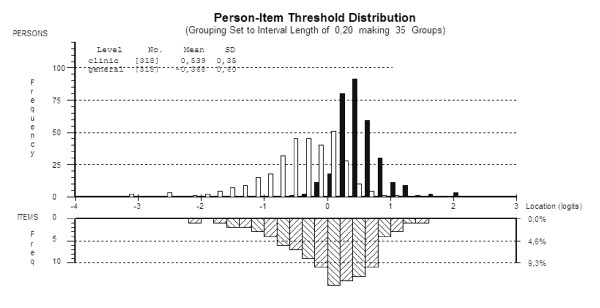
BACKGROUND: Burnout is a mental condition defined as a result of continuous and long-term stress exposure, particularly related to psychosocial factors at work. This paper seeks to examine the psychometric properties of the Shirom-Melamed Burnout Questionnaire (SMBQ) for validation of use in a clinical setting. METHODS: Data from both a clinical (319) and general population (319) samples of health care and social insurance workers were included in the study. Data were analysed using both classical and modern test theory approaches, including Confirmatory Factor Analysis (CFA) and Rasch analysis. RESULTS: Of the 638 people recruited into the study 416 (65%) persons were working full or part time. Data from the SMBQ failed a CFA, and initially failed to satisfy Rasch model expectations. After the removal of 4 of the original items measuring tension, and accommodating local dependency in the data, model expectations were met. As such, the total score from the revised scale is a sufficient statistic for ascertaining burnout and an interval scale transformation is available. The scale as a whole was perfectly targeted to the joint sample. A cut point of 4.4 for severe burnout was chosen at the intersection of the distributions of the clinical and general population. CONCLUSION: A revised 18 item version of the SMBQ satisfies modern measurement standards. Using its cut point it offers the opportunity to identify potential clinical cases of burnout.
Overview
The claims and statistics of this paper haven’t been checked yet.
Run the check — free, no account needed. It reads the open-access text and checks the sources it cites.
Integrity signals
Registry
Cites
Statistics
Figures
Verification
Claims the paper makes
The claims and statistics of this paper haven’t been checked yet.
Run the check — free, no account needed. It reads the open-access text and checks the sources it cites.
Claims other papers make about this one
Each is checked against this paper’s own text: does it say what the citing paper says it does?
The source backs part of the claim, not all of it — or backs it for a different population, condition or comparison.
In the citing paper
“SMBQ’s psychometric characteristics and factorial validity have been supported [30, 33]”
From Psychological inflexibility explains distress in parents whose children have chronic conditions (2018) · cites this paper as [33]
Experimental — accuracy not yet measuredThe source backs part of the claim, not all of it — or backs it for a different population, condition or comparison.
In the citing paper
“The cut-off scores for burnout on the SMBQ are 2.75–3.74 indicating low burnout, 3,75–4,46 indicating high burnout and ≥ 4.47 indicating pathological level of burnout.”
From Psychological inflexibility explains distress in parents whose children have chronic conditions (2018) · cites this paper as [33]
Experimental — accuracy not yet measuredThe check wasn’t confident either way, so it gives no verdict — never disputed.
In the citing paper
“The measures have been translated and back translated for previous studies [33, 36–38], except the Cognitive Fusion Questionnaire (CFQ) that was translated for this study by a group of researchers with long experience in acceptance-, mindfulness-, and value-based interventions.”
From Psychological inflexibility explains distress in parents whose children have chronic conditions (2018) · cites this paper as [33]
Experimental — accuracy not yet measured
Self-check
Percentages, sums and reported differences re-computed from the paper’s own numbers.
The self-check needs the paper’s full text.
Citations
Cites
Confirmatory factor analysis for applied research
Brown, T. A. (2007) · Choice Reviews Online · doi:10.5860/choice.44-2769 · Cited by 15,621
Maslach, C., Schaufeli, W. B., & Leiter, M. P. (2001) · Annual Review of Psychology · doi:10.1146/annurev.psych.52.1.397 · Cited by 12,852
Probabilistic Models for Some Intelligence and Attainment Tests
Psychology, M. (1961) · Information and Control · doi:10.1016/s0019-9958(61)80061-2 · Cited by 6,936
A Rasch model for partial credit scoring
Masters, G. N. (1982) · Psychometrika · doi:10.1007/bf02296272 · Cited by 3,782
Multiple significance tests: the Bonferroni method
Bland, J. M., & Altman, D. G. (1995) · BMJ · doi:10.1136/bmj.310.6973.170 · Cited by 3,341
A Rating Formulation for Ordered Response Categories
Andrich, D. (1978) · Psychometrika · doi:10.1007/bf02293814 · Cited by 2,984
International Review of Industrial and Organizational Psychology
Cooper, C. L., & Robertson, I. T. (2003) · Wiley eBooks · doi:10.1002/0470013311.oth1 · Cited by 2,787
Simultaneous conjoint measurement: A new type of fundamental measurement
Luce, R. D., & Tukey, J. W. (1964) · Journal of Mathematical Psychology · doi:10.1016/0022-2496(64)90015-x · Cited by 2,047
Tennant, A., & Conaghan, P. G. (2007) · Arthritis Care & Research · doi:10.1002/art.23108 · Cited by 1,654
Handbook of Occupational Health Psychology
Quick, J. C., & American Psychological Association (2010) · American Psychological Association eBooks · doi:10.2307/j.ctv1chs29w · Cited by 1,364
Research works printed but not linked: 3
- National Board of Health and Welfare: Exhaustion disorder. (Swedish: Utmattningssyndrom-stressrelaterad psykisk ohälsa) Stockholm. 2003
- Andrich D, Lyne A, Sheridan B, Luo G: RUMM 2030. 2010, Perth: RUMM Laboratory
- Muthen LK, Muthen BO: Mplus User's Guide. 2010, Los Angeles CA: Muthen & Muthen, Sixth
Cited by
Sorted by citations
Items 401–500 of 626
Nelson, A., Gavelin, H. M., Andersson, M., Josefsson, M., Eskilsson, T., Järvholm, L. S., Neely, A. S., & Boraxbekk, C. (2023) · Stress · doi:10.1080/10253890.2023.2188092 · Cited by 4
The Hepatorenal Protective Potential of Caffeic Acid Consumption on the Arsenic-Exposed Syrian Mice
Chekneh, F., Azadi, H. G., Baghshani, H., & Moosavi, Z. B. (2023) · Biological Trace Element Research · doi:10.1007/s12011-023-04008-0 · Cited by 4
Factors associated with awareness of and undergoing Pap smear tests among Jordanian women
Annab, A. W., Lataifeh, L., Lataifeh, I. M., Al-Rabadi, D., Alkouri, O. A., & Khader, Y. S. (2024) · Narra J · doi:10.52225/narra.v4i3.1018 · Cited by 4
Goscé, L., Tadesse, A. W., Foster, N., van Kalmthout, K., van Rest, J., van der Wal, J., Harker, M. J., Madden, N., Abdurhman, T., Gadissa, D., et al. (2024) · BMJ Global Health · doi:10.1136/bmjgh-2024-016997 · Cited by 6
Tautolo, E., Edwards, R., & Gifford, H. (2014) · Tobacco Control · doi:10.1136/tobaccocontrol-2013-051345 · Cited by 4
‘Kafeteria Sihat’ initiative in Malaysian public hospitals: Do customers accept it?
Rahman, A. R. A., Zahari, M. S. M., & Chik, C. T. (2019) · Journal of Foodservice Business Research · doi:10.1080/15378020.2019.1679064 · Cited by 4
Уявлення про професійне вигорання медичних працівників та дослідження його феноменології
Hromtseva, O. V. (2019) · European Journal of Management Issues · doi:10.15421/191907 · Cited by 4
Buratti, S., Geisler, M., & Allwood, C. M. (2020) · Review of Religious Research · doi:10.1007/s13644-020-00420-3 · Cited by 4
Norström, F., Järvholm, L. S., & Eskilsson, T. (2022) · BMC Psychiatry · doi:10.1186/s12888-022-04300-8 · Cited by 4
Almén, N. (2022) · International Journal of Environmental Research and Public Health · doi:10.3390/ijerph192114005 · Cited by 5
Pelletier, J., Bergeron, D. A., Rouleau, G., & Guillaumie, L. (2022) · BMJ Open · doi:10.1136/bmjopen-2022-062569 · Cited by 6
Evaluating Workforce Mental Health and Well-Being: A Review of Assessments
Imboden, M. T., Wolfe, E., Evers, K. E., Ferrão, A., Greenberger, H. M., Johnson, S. S., Kirsten, W., & Seaverson, E. L. D. (2023) · American Journal of Health Promotion · doi:10.1177/08901171231223786 · Cited by 5
Bete, T., Misgana, T., Nigussie, K., Aliye, K., Abdeta, T., Wedaje, D., Hunduma, G., Asefa, A., Tesfaye, D., Asfaw, H., et al. (2024) · BMC Psychiatry · doi:10.1186/s12888-023-05466-5 · Cited by 7
Christopher, C. M., Blebil, A. Q., Bhuvan, K. C., Alex, D., Ibrahim, M. I. M., Ismail, N., & Cheong, W. L. (2024) · International Journal of Clinical Pharmacy · doi:10.1007/s11096-024-01711-3 · Cited by 4
Ly, H., & Irwin, J. D. (2020) · Journal of American College Health · doi:10.1080/07448481.2020.1739052 · Cited by 4
Kim, I.-O., & Shin, S. H. (2016) · The Journal of the Korea Contents Association · doi:10.5392/jkca.2016.16.08.247 · Cited by 4
Chronic stress among adolescents : Contributing factors and associations with academic achievement
Schraml, K. (2013) · DiVA (Stockholm University) · Cited by 4
Lungu, A., Chella, C., Zambwe, M., & Chipimo, P. J. (2022) · medRxiv · doi:10.1101/2022.05.28.22275722 · Cited by 4
Gichuhi, H. W., Magumba, M. A., Kumar, M., & Mayega, R. W. (2022) · medRxiv · doi:10.1101/2022.12.01.22283003 · Cited by 4
Integrating sickle cell disease care into primary healthcare in Uganda: a narrative review
Obeagu, E. I., & Olateju, O. R.-T. (2025) · Annals of Medicine and Surgery · doi:10.1097/ms9.0000000000003713 · Cited by 3
Sabo, K. G., Mare, K. U., Lahole, B. K., Wengoro, B. F., Demeke, H. S., Mohamed, A. A., Bilal, M. A., & Moloro, A. H. (2025) · BMJ Open · doi:10.1136/bmjopen-2025-101845 · Cited by 3
Content Comparison of Patient-Reported Outcome Instruments Used to Measure Burnout
Sabariego, C., Al-Kudwah, H. M., & Cieza, A. (2014) · European Journal of Psychological Assessment · doi:10.1027/1015-5759/a000210 · Cited by 4
Egozi, L., & Pardo, A. (2023) · Journal of Occupational and Environmental Medicine · doi:10.1097/jom.0000000000002975 · Cited by 4
The Impact of Edentulism on Self-Reported Health Among Indian Elderly
Shri, N., & Jaiswal, A. K. (2023) · Springer eBooks · doi:10.1007/978-981-16-1914-4_121-1 · Cited by 3
A home-based educational intervention for cervical cancer screening services in rural Uganda
Mereth, M., Drake, K., & Sebuliba, F. R. K. (2024) · African Journal of Midwifery and Women s Health · doi:10.12968/ajmw.2023.0013 · Cited by 3
Eskilsson, T., Olsson, D., Ekbäck, A.-M., & Järvholm, L. S. (2024) · BMC Psychiatry · doi:10.1186/s12888-024-05975-x · Cited by 3
Figueiredo, S. M., Arrieux, J. P., Abdallah, S. M., McCall, T. C., Koch, U., & Oliveira, E. (2024) · Journal of Patient-Reported Outcomes · doi:10.1186/s41687-024-00788-8 · Cited by 5
Le, C., Guttersrud, Ø., Joranger, P., Okan, O., & Finbråten, H. S. (2024) · BMJ Open · doi:10.1136/bmjopen-2023-081892 · Cited by 4
Collins, J. H., Cambiano, V., Phillips, A. N., & Colbourn, T. (2024) · PLoS ONE · doi:10.1371/journal.pone.0296540 · Cited by 3
Mboineki, J. F., & Chen, C. (2024) · Frontiers in Global Women s Health · doi:10.3389/fgwh.2024.1209441 · Cited by 3
Belay, A. S., Yilak, G., Kassie, A., Abza, L. F., Emrie, A. A., Ayele, M., Tilahun, B. D., & Lake, E. S. (2025) · BMJ Public Health · doi:10.1136/bmjph-2024-001161 · Cited by 3
Yao, H., Ma, R., Sun, Q., Zhao, J., Li, Y., Bao, T., & Li, T. (2025) · BMC Medical Education · doi:10.1186/s12909-025-07286-5 · Cited by 3
Söderberg, M., Andersson, E. M., Björk, L., & Wastensson, G. (2020) · Journal of Educational and Social Research · doi:10.36941/jesr-2020-0040 · Cited by 5
Svärd, V., & Alexanderson, K. A. E. (2021) · BMJ Open · doi:10.1136/bmjopen-2021-051555 · Cited by 3
A modularly tailored commuter ferry platform
Cheemakurthy, H., & Garme, K. (2022) · International Shipbuilding Progress · doi:10.3233/isp-210016 · Cited by 3
Adaptation of the All Aspects of Health Literacy Scale (AAHLS) for Karen refugees: factor analysis
Kim, W., Kim, J., Baltimore, K., & Kim, I. (2023) · Social Work in Health Care · doi:10.1080/00981389.2023.2199795 · Cited by 3
Petitt, E., Rolander, B., & Johnsson, P. (2023) · International Journal of Environmental Research and Public Health · doi:10.3390/ijerph20176677 · Cited by 4
Arsenic and adipose tissue: an unexplored pathway for toxicity and metabolic dysfunction
Khandayataray, P., Samal, D., & Murthy, M. K. (2024) · Environmental Science and Pollution Research · doi:10.1007/s11356-023-31683-2 · Cited by 3
El‐Khani, A., Asif, M., Shahzad, S., Bux, M. S., Maalouf, W. E., Rafiq, N. U. Z., Khoso, A. B., Chaudhry, I. B., Hout, M. C. V., Zadeh, Z. F., et al. (2024) · BMJ Open · doi:10.1136/bmjopen-2023-081557 · Cited by 3
Kiilu, E., Karanja, S. M., Kikuvi, G. M., & Muthoki, L. (2025) · AIDS and Behavior · doi:10.1007/s10461-025-04648-4 · Cited by 3
Geta, M., Hailu, A., & Woldeamanuel, Y. (2025) · Scientific Reports · doi:10.1038/s41598-025-02906-y · Cited by 3
Olivares-Faúndez, V. E., Gil-Monte, P. R., Espinoza, R. M. M., Capot, R. B., Collarte, D. F., & Figueiredo‐Ferraz, H. (2018) · Re-Unir (International University of La Rioja) · Cited by 3
Effect of patient COVID-19 vaccine hesitancy on hospital care team perceptions
Caspi, I., Freund, O., Pines, O., Elkana, O., Ablin, J. N., & Bornstein, G. (2023) · World Journal of Clinical Cases · doi:10.12998/wjcc.v11.i4.821 · Cited by 4
Síndrome de Burnout: una revisión breve
Gómez-de-Regil, L., & Castillo, D. F. E. (2016) · Ciencia y Humanismo en la Salud · Cited by 3
Kershenbaum, A. D., Fu, B., & Gilbert, R. E. (2016) · Journal of Public Health · doi:10.1093/pubmed/fdw114 · Cited by 3
Grooten, W. J. A., Hansson, A., Forsman, M., Kjellberg, K., Toomingas, A., Müller, M., Svartengren, M., & Äng, B. O. (2019) · BMC Health Services Research · doi:10.1186/s12913-019-3949-9 · Cited by 5
A Virtual Coach and a Worker Dashboard to Promote Well-Being and Workability: An Acceptance Study
Lithoxoidou, E. E., Mastoras, R.-E., Papaprodromou, A., Georgiadis, C., Abril-Jiménez, P., Gonzalez, S., Cabrera-Umpiérrez, M. F., Loeck, M., Carretón, R., Segkouli, S., et al. (2022) · Lecture notes in computer science · doi:10.1007/978-3-031-05028-2_19 · Cited by 3
Stochastic Modeling and Optimal Time-Frequency Estimation of Task-Related HRV
Anderson, R., Jönsson, P., & Sandsten, M. (2019) · Applied Sciences · doi:10.3390/app9235154 · Cited by 3
Lundkvist, E., Gustafsson, H., Gerber, M., Lundqvist, C., Ivarsson, A., & Madigan, D. J. (2019) · Frontiers in Psychology · doi:10.3389/fpsyg.2019.02721 · Cited by 3
Mindfulness-based symptom management and the treatment of burnout
Shaw, C. (2012) · Carleton University's Institutional Repository (MacOdrum Library, Carleton University) · doi:10.22215/etd/2012-06940 · Cited by 3
Developing a male-specific counselling curriculum for HIV treatment in MalawiPreprint
Mphande, M., Robson, I., Hubbard, J., Chikuse, E., Lungu, E., Phiri, K., Cornell, M., Phiri, S., Coates, T. J., & Dovel, K. L. (2023) · medRxiv · doi:10.1101/2023.08.08.23293583 · Cited by 2
Darko, R. A., & Glozah, F. N. (2024) · medRxiv · doi:10.1101/2024.07.18.24310635 · Cited by 3
Wang, Y., Yang, Y., Slanzi, C. M., Li, X., Ojeda, A. E., Paro, F. R., Deblais, L., Yakubu, H., Mummed, B., Game, H., et al. (2024) · medRxiv · doi:10.1101/2024.08.29.24312786 · Cited by 3
Automated Extraction of Mortality Information from Publicly Available Sources Using Language ModelsPreprint
Al-Garadi, M. A., Lenoue-Newton, M. L., Matheny, M. E., McPheeters, M. L., Whitaker, J. M., Deere, J., McLemore, M. F., Westerman, D. M., Khan, M. S., Hernández‐Muñoz, J. J., et al. (2024) · medRxiv · doi:10.1101/2024.10.28.24316027 · Cited by 3
Arega, B., Mengistu, M., Mersha, A., & Agunie, A. (2024) · BMJ Open · doi:10.1136/bmjopen-2023-082908 · Cited by 2
Spatiotemporal dispersion of DENV-1 genotype V in Western Colombia
Rojas-Gallardo, D., Ferrell, T., Escobar-Pereira, P. M., Muñoz, D. F. L., Giraldo, B., Restrepo-Chica, J., Jiménez-Posada, E. V., Martínez‐Gutierrez, M., Ruíz-Saenz, J., Key, A., et al. (2025) · Virus Evolution · doi:10.1093/ve/veaf018 · Cited by 2
Cully, S., Hatinova, K., van de Leur, J. C., & Björnsdotter, M. (2025) · Frontiers in Psychiatry · doi:10.3389/fpsyt.2025.1548967 · Cited by 3
Trappolini, E., Arezzo, M. F., & Guagnano, G. (2025) · Quality & Quantity · doi:10.1007/s11135-025-02256-x · Cited by 2
The silent epidemic: unravelling NCD risk clusters and socioeconomic determinants in Zambia
Christian, A. K., Egerson, D., & Sanuade, O. A. (2025) · BMC Public Health · doi:10.1186/s12889-025-23769-y · Cited by 2
Kern, M. R., Neumann, C., Bosompim, B., Ann, D., Kurniawan, A. L., Dlamini, N., Nabukeera, S., Machanyangwa, S., Tewahido, D., Shinde, S., et al. (2025) · BMJ Open · doi:10.1136/bmjopen-2024-094209 · Cited by 2
Beyond Desynchronization: The Impact of Social Jetlag on Tourists’ Venturesomeness
Fan, X., Yang, Y., & Li, C. (2025) · Journal of Travel Research · doi:10.1177/00472875251385074 · Cited by 2
Association Between Health Literacy and Outpatient Expenditure in Korea
Moon, S., Yoo, J., Jung, J., & Go, D. (2026) · Journal of Korean Medical Science · doi:10.3346/jkms.2026.41.e65 · Cited by 2
Lennartsson, A.-K., Jónsdóttir, I. H., Jansson, P., & Sjörs, A. (2026) · Frontiers in Psychiatry · doi:10.3389/fpsyt.2026.1664680 · Cited by 2
Weinstein, S., Bixenstine, P. J., Karlin, D. M., Saab, F. G., Schuttner, L., Zen, A., & Kuo, A. A. (2016) · Springer eBooks · doi:10.1007/978-3-319-43827-6_2 · Cited by 2
AÇÕES TERAPÊUTICAS PARA O TRATAMENTO DO BURNOUT PARENTAL: UMA REVISÃO INTEGRATIVA
da Costa, R. F., Silva, A. V. S. E., & Feitosa, A. N. D. C. (2023) · Revista Foco · doi:10.54751/revistafoco.v16n4-045 · Cited by 2
Prudenzi, A., Jadhakhan, F., Gill, K., MacArthur, M., Patel, K., Moukhtarian, T. R., Kershaw, C., Norton-Brown, E., Johnston, N., Daly, G. B. J., et al. (2023) · PLoS ONE · doi:10.1371/journal.pone.0283598 · Cited by 4
Tarkang, E. E., Adu-Gyamfi, M., Sackey, E., Kye-Mensah, E., & Khuzwayo, N. (2023) · International Journal of Health Promotion and Education · doi:10.1080/14635240.2023.2248596 · Cited by 2
Cully, S., & Björnsdotter, M. (2023) · Frontiers in Psychiatry · doi:10.3389/fpsyt.2023.1314667 · Cited by 2
Sassano, M., Mariani, M., Pastorino, R., Ricciardi, W., Vecchia, C. L., & Boccia, S. (2024) · Journal of Epidemiology & Community Health · doi:10.1136/jech-2023-220746 · Cited by 2
de Haan-Du, J., Groenier, K. H., Kleefstra, N., van der Vegt, B., Siesling, S., Landman, G. W. D., & de Bock, G. H. (2024) · BMJ Public Health · doi:10.1136/bmjph-2023-000050 · Cited by 2
Ssegujja, E., Kiggundu, P., Kayemba, Y., Karen, S. Z., & Rutebemberwa, E. (2024) · Discover Health Systems · doi:10.1007/s44250-024-00109-2 · Cited by 2
From the Negative Effect of Perceived Oppressiveness to Mental Restoration in Streetscapes
Khaledi, H. J., Khakzand, M., Faizi, M., & Gharehbaglou, M. (2024) · Environmental Justice · doi:10.1089/env.2024.0021 · Cited by 2
Lord, J., Pugh, S., & Thompson, S. R. (2024) · BMC Public Health · doi:10.1186/s12889-024-20881-3 · Cited by 2
Sennerstam, V., Hedman‐Lagerlöf, E., Nilsonne, G., Lekander, M., Rück, C., Wallert, J., Axelsson, E., & Lindsäter, E. (2024) · Scandinavian Journal of Psychology · doi:10.1111/sjop.13087 · Cited by 2
Jia, Y., Zhuang, X., Zhao, Y., Meng, G., Zhang, J., Cao, Y., & Zhang, Y. (2025) · Health and Quality of Life Outcomes · doi:10.1186/s12955-025-02349-z · Cited by 2
Zou, B., Tan, C., Deng, R., Chen, Q., Peng, Q., Xu, D., Gou, Y., Du, Y., Li, K., Chen, Z., et al. (2025) · Frontiers in Pediatrics · doi:10.3389/fped.2025.1465998 · Cited by 2
How burnout is measured in the workplace
McCormack, N., & Cotter, C. (2013) · Elsevier eBooks · doi:10.1016/b978-1-84334-734-7.50005-0 · Cited by 2
Guidelines for mandated documents
Westbrook, L. (2015) · Journal of Documentation · doi:10.1108/jd-10-2013-0132 · Cited by 2
Group Medical Visits: Primary Care for the Next Century? Rethinking Chronic Care
Simon, B. (2014) · Springer eBooks · doi:10.1007/978-3-319-12178-9_31 · Cited by 2
Sharma, M., Batra, K., Singh, T. P., Dua, R., Ickes, M. J., Batra, R., & Nahar, V. K. (2021) · Community Health Equity Research & Policy · doi:10.1177/0272684x211006604 · Cited by 2
Horn, L., de Munter, L., Papageorgiou, G., Lansink, K. W. W., de Jongh, M. A. C., & Joosen, M. C. W. (2021) · BMJ Open · doi:10.1136/bmjopen-2021-055593 · Cited by 2
Does Democracy Matter for Public Health?
Lee, S. (2022) · International Journal of Social Determinants of Health and Health Services · doi:10.1177/00207314221126110 · Cited by 2
Turning the promise of multipurpose prevention technologies into a market reality: a commentary
Dam, A., Schueller, J., Peine, K. J., Mason, J., Dorward, E., & Vij, A. (2023) · Frontiers in Reproductive Health · doi:10.3389/frph.2023.1181043 · Cited by 2
Terefe, B. (2024) · Frontiers in Reproductive Health · doi:10.3389/frph.2024.1305671 · Cited by 2
Aspects of validity in stress research
Hadžibajramović, E. (2015) · Gothenburg University Publications Electronic Archive (Gothenburg University) · Cited by 2
Hydrothermal sulphur bacteria enhance mercury availability for coastal marine organismsPreprint
Ruiz, E., Lacoue‐Labarthe, T., Brault‐Favrou, M., & Pascal, P. (2022) · bioRxiv (Cold Spring Harbor Laboratory) · doi:10.1101/2022.04.26.489323 · Cited by 2
Sitorus, R. J., Antara, N. Y., Sangalang, R. V., Panjaitan, M. N., & Fauk, N. K. (2022) · medRxiv · doi:10.1101/2022.09.02.22279532 · Cited by 2
Fokukora, T., Alangea, D. O., Amoah, E. M., & Godi, A. (2023) · medRxiv · doi:10.1101/2023.06.19.23291619 · Cited by 2
The Economic Burden of BurnoutPreprint
Nekoei, A., Sigurðsson, J., & Wehr, D. (2024) · SSRN Electronic Journal · doi:10.2139/ssrn.4856947 · Cited by 2
Greenness, Blue Spaces and Human Health: An Updated Umbrella Review of Epidemiological Meta-analysesPreprint
Wang, X., Feng, B., & Wang, J. (2024) · medRxiv · doi:10.1101/2024.06.20.24309223 · Cited by 2
Davies, N., Murray, R. L., Morling, J. R., Bains, M., Jones, M., & Langley, T. E. (2025) · medRxiv · doi:10.1101/2025.06.13.25328563 · Cited by 2
Berg, C. J., Schubel, L. C., McCready, D. M., Shajan, S., Bhanot, P., Dopke, C., Howlader, A., Hinds, P. S., Levine, J., Lyon, M. E., et al. (2025) · Quality of Life Research · doi:10.1007/s11136-025-04010-0 · Cited by 1
Job Burnout Assessment Among Officer Grade Bank Employees of Meerut District
Singh, A., Bansal, R., & Gupta, C. K. (2022) · Indian Journal of Community Health · doi:10.47203/ijch.2022.v34i02.009 · Cited by 2
The impact ofemotional burnout on general well-being of secondary school teachers
Валентиновна, К. И., Клименко, Е. В., & Остякова, Г. В. (2023) · Vocational education and labour market · doi:10.52944/port.2023.52.1.008 · Cited by 1
Karmakar, S., Ikbal, A. M. A., Bhardwaj, P., Tiwari, O. N., Sláma, P., Roychoudhury, S., Mandal, S. C., Vanitha, K., De, S., & Palit, P. (2024) · ChemistrySelect · doi:10.1002/slct.202400089 · Cited by 1
Health promotion intervention in at-risk South African primary schools
Mahomed, R. S., & Etokabeka, E. M. D. C. (2024) · Health Education Journal · doi:10.1177/00178969241289331 · Cited by 1
Aryeetey, G. C., Koduah, A., Affram, A. A., Owusu, R., Ruiz, F. J., Vassall, A., & Nonvignon, J. (2024) · BMJ Public Health · doi:10.1136/bmjph-2024-001097 · Cited by 1
Föyen, L. F., Sennerstam, V., Kontio, E., Flygare, O., Boman, M., & Lindsäter, E. (2025) · JMIR Research Protocols · doi:10.2196/65790 · Cited by 1
Tipayalai, K., & Subchavaroj, C. (2025) · GeoJournal · doi:10.1007/s10708-025-11356-y · Cited by 1
Getachew, E., & Aragaw, F. M. (2025) · BMJ Open · doi:10.1136/bmjopen-2024-086571 · Cited by 1
Metadata
- Authors
- Lundgren-Nilsson, Å., Jonsdottir, I. H., Pallant, J., & Ahlborg, G.
- Affiliations
- The University of Melbourne (AU)
- University of Gothenburg (SE)
- ORCID
- Pallant, Julie
- Venue
- BMC Public Health
- Published
- 2012-01-03
- Volume
- 12
- Issue
- 1
- Pages
- 1-1
- ISSN
- 1471-2458 (ISSN-L)
- PMC
- PMC3307433
- OpenAlex
- W2148425918
- Cited by
- 626
- References
- 35
- Citations by year
- 2026: 27 · 2025: 58 · 2024: 81 · 2023: 58 · 2022: 63 · 2021: 54 · 2020: 37 · 2019: 46 · 2018: 44 · 2017: 47 · 2016: 43 · 2015: 27 · 2014: 20 · 2013: 18 · 2012: 3
- FWCI
- 32.72
- Type
- journal article
- Language
- en
- Open access
- gold
- doi.org
- Licence
- Locations
- BMC Public Health (publishedVersion, cc-by)
- PubMed Central (publishedVersion, cc-by)
- PubMed (publishedVersion)
- Gothenburg University Publications Electronic Archive (Gothenburg University) (acceptedVersion)
- Minerva Access (University of Melbourne) (submittedVersion, cc-by)
- DOAJ (DOAJ: Directory of Open Access Journals) (submittedVersion, cc-by-sa)
- Topics
- Social Sciences › Psychology › Social Psychology › Stress and Burnout Research
- Social Sciences › Decision Sciences › Management Science and Operations Research › Psychometric Methodologies and Testing
- Health Sciences › Medicine › Public Health, Environmental and Occupational Health › Occupational Health and Burnout
- Keywords
- burnout, psychometric validation, Rasch analysis, confirmatory factor analysis, scale revision, healthcare workers, occupational stress
- MeSH terms
- Adult, Burnout, Professional, Factor Analysis, Statistical, Female, Health Personnel, Humans, Male, Middle Aged, Psychometrics, Surveys and Questionnaires, Stress, Psychological, Sweden
About these checks
Registry, retraction, Cites and statistics results are computed, not judged, with one exception: a printed reference that no index lists is read once by a model before it counts as a citation error. Claims are extracted by a model and kept only when their quote appears verbatim in the text; each cited source is then checked, with a model’s help, for whether it says what the claim relies on. Those verdicts can be wrong — read the claim’s quote and the cited source before relying on one.
Statistics and arithmetic are recomputed, not judged.
Confidence bands are shown only for fields calibrated on our annotated test set. None is calibrated yet, so no band is shown.
What counts as a claim ›How we measure confidence ›How we check this ›
Are you an author, or do you see a problem with this page? Request a review
