

The DOI matches its Crossref record; 35 of the 35 references it cites were found in a registry or an index.
Internal construct validity of the Shirom-Melamed Burnout Questionnaire (SMBQ)
Open accessAbstract
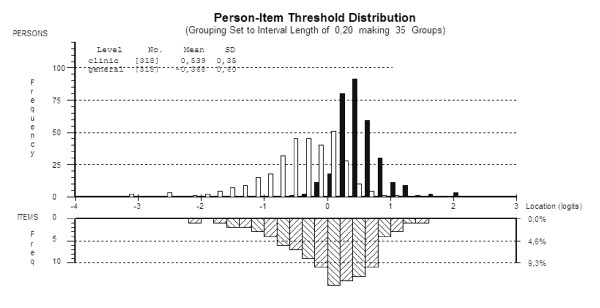
BACKGROUND: Burnout is a mental condition defined as a result of continuous and long-term stress exposure, particularly related to psychosocial factors at work. This paper seeks to examine the psychometric properties of the Shirom-Melamed Burnout Questionnaire (SMBQ) for validation of use in a clinical setting. METHODS: Data from both a clinical (319) and general population (319) samples of health care and social insurance workers were included in the study. Data were analysed using both classical and modern test theory approaches, including Confirmatory Factor Analysis (CFA) and Rasch analysis. RESULTS: Of the 638 people recruited into the study 416 (65%) persons were working full or part time. Data from the SMBQ failed a CFA, and initially failed to satisfy Rasch model expectations. After the removal of 4 of the original items measuring tension, and accommodating local dependency in the data, model expectations were met. As such, the total score from the revised scale is a sufficient statistic for ascertaining burnout and an interval scale transformation is available. The scale as a whole was perfectly targeted to the joint sample. A cut point of 4.4 for severe burnout was chosen at the intersection of the distributions of the clinical and general population. CONCLUSION: A revised 18 item version of the SMBQ satisfies modern measurement standards. Using its cut point it offers the opportunity to identify potential clinical cases of burnout.
Overview
The claims and statistics of this paper haven’t been checked yet.
Run the check — free, no account needed. It reads the open-access text and checks the sources it cites.
Integrity signals
Registry
Cites
Statistics
Figures
Verification
Claims the paper makes
The claims and statistics of this paper haven’t been checked yet.
Run the check — free, no account needed. It reads the open-access text and checks the sources it cites.
Claims other papers make about this one
Each is checked against this paper’s own text: does it say what the citing paper says it does?
The source backs part of the claim, not all of it — or backs it for a different population, condition or comparison.
In the citing paper
“SMBQ’s psychometric characteristics and factorial validity have been supported [30, 33]”
From Psychological inflexibility explains distress in parents whose children have chronic conditions (2018) · cites this paper as [33]
Experimental — accuracy not yet measuredThe source backs part of the claim, not all of it — or backs it for a different population, condition or comparison.
In the citing paper
“The cut-off scores for burnout on the SMBQ are 2.75–3.74 indicating low burnout, 3,75–4,46 indicating high burnout and ≥ 4.47 indicating pathological level of burnout.”
From Psychological inflexibility explains distress in parents whose children have chronic conditions (2018) · cites this paper as [33]
Experimental — accuracy not yet measuredThe check wasn’t confident either way, so it gives no verdict — never disputed.
In the citing paper
“The measures have been translated and back translated for previous studies [33, 36–38], except the Cognitive Fusion Questionnaire (CFQ) that was translated for this study by a group of researchers with long experience in acceptance-, mindfulness-, and value-based interventions.”
From Psychological inflexibility explains distress in parents whose children have chronic conditions (2018) · cites this paper as [33]
Experimental — accuracy not yet measured
Self-check
Percentages, sums and reported differences re-computed from the paper’s own numbers.
The self-check needs the paper’s full text.
Citations
Cites
Confirmatory factor analysis for applied research
Brown, T. A. (2007) · Choice Reviews Online · doi:10.5860/choice.44-2769 · Cited by 15,621
Maslach, C., Schaufeli, W. B., & Leiter, M. P. (2001) · Annual Review of Psychology · doi:10.1146/annurev.psych.52.1.397 · Cited by 12,852
Probabilistic Models for Some Intelligence and Attainment Tests
Psychology, M. (1961) · Information and Control · doi:10.1016/s0019-9958(61)80061-2 · Cited by 6,936
A Rasch model for partial credit scoring
Masters, G. N. (1982) · Psychometrika · doi:10.1007/bf02296272 · Cited by 3,782
Multiple significance tests: the Bonferroni method
Bland, J. M., & Altman, D. G. (1995) · BMJ · doi:10.1136/bmj.310.6973.170 · Cited by 3,341
A Rating Formulation for Ordered Response Categories
Andrich, D. (1978) · Psychometrika · doi:10.1007/bf02293814 · Cited by 2,984
International Review of Industrial and Organizational Psychology
Cooper, C. L., & Robertson, I. T. (2003) · Wiley eBooks · doi:10.1002/0470013311.oth1 · Cited by 2,787
Simultaneous conjoint measurement: A new type of fundamental measurement
Luce, R. D., & Tukey, J. W. (1964) · Journal of Mathematical Psychology · doi:10.1016/0022-2496(64)90015-x · Cited by 2,047
Tennant, A., & Conaghan, P. G. (2007) · Arthritis Care & Research · doi:10.1002/art.23108 · Cited by 1,654
Handbook of Occupational Health Psychology
Quick, J. C., & American Psychological Association (2010) · American Psychological Association eBooks · doi:10.2307/j.ctv1chs29w · Cited by 1,364
Research works printed but not linked: 3
- National Board of Health and Welfare: Exhaustion disorder. (Swedish: Utmattningssyndrom-stressrelaterad psykisk ohälsa) Stockholm. 2003
- Andrich D, Lyne A, Sheridan B, Luo G: RUMM 2030. 2010, Perth: RUMM Laboratory
- Muthen LK, Muthen BO: Mplus User's Guide. 2010, Los Angeles CA: Muthen & Muthen, Sixth
Cited by
Sorted by citations
Items 601–626 of 626
Franke Föyen, L., Sennerstam, V., Kontio, E., Lekander, M., Hedman-Lagerlöf, E., & Lindsäter, E. (2023) · Figshare · doi:10.6084/m9.figshare.23902993
Zhao, Y., Zhao, S., Zhang, L., Haregu, T. N., & Wang, H. (2021) · Figshare · doi:10.6084/m9.figshare.14966269
Additional file 2 of Burnout among family medicine residents: a cross-sectional nationwide study
Treister‐Goltzman, Y., Samson, T., Rosenberg, R., Granek-Catarivas, M., Gaver, A., Alperin, M., & Biderman, A. (2024) · Figshare · doi:10.6084/m9.figshare.26673363
Ndlovu, R., & Moyo, P. L. (2026) · BMJ Public Health · doi:10.1136/bmjph-2025-004364
Gilbert, P., Matos, M., Basran, J. K., Morter, K., Plowright, P., Ferreira, A., Salvador, M. D. C., & Kirby, W. (2026) · Frontiers in Psychology · doi:10.3389/fpsyg.2025.1513067
Hussein, M. A., Yousuf, A. M., Muse, A. H., Esse, A. A., Abdi, A. N., Osman, A. A., Abdikarim, H., & Chesneau, C. (2026) · BMJ Open · doi:10.1136/bmjopen-2025-104454
Jeong, Y., & Son, S. (2025) · 한국가정관리학회지 · doi:10.7466/jfbl.2025.43.4.117
Tesler, R., Zwilling, M., Fhcima, D., Shtainmetz, N., Zigdon, A., Korn, L., Levi, S., Shachaf, M., & Gannot, R. N. (2026) · Research Square · doi:10.21203/rs.3.rs-8637002/v1
What is the best tobacco control policy in Tuscany? An assessment using uncertainty analysis
Lachi, A., Carreras, G., Viscardi, C., Saltelli, A., & Baccini, M. (2026) · Tobacco Control · doi:10.1136/tc-2025-059596
Harvey, B. P., Kebede, T. T., Fors, A., Cederberg, M., Alsén, S., Barenfeld, E., van Dijk, M. L., & Gyllensten, H. (2026) · Journal of Patient-Reported Outcomes · doi:10.1186/s41687-026-01043-y
Shrestha, S., Peden, A. E., Kalougivaki, J. J., Khan, S., Nadakuca, M., Bali, A., Lesuma, J., Kiani, B., & Linhart, C. (2026) · BMJ Public Health · doi:10.1136/bmjph-2025-003002
La dissonance éthique au travail, de l'objectivation à la création d'une échelle de mesure
Melou, F. (2020) · theses.fr (ABES) · doi:10.70675/1ffffd6ez0b93z4758zacbfz4227967c2546
Ali, N. A., Hudson, J., Stratton, G., & Mullin, J. (2026) · BMJ Open · doi:10.1136/bmjopen-2025-107380
Möller, J., Ellbin, S., Ehnvall, A., Bagge, A. L., & Jónsdóttir, I. H. (2026) · Journal of Child & Adolescent Trauma · doi:10.1007/s40653-026-00891-6
Turner, W., Marca, R. L., Infanger, D., Brühl, A. B., Marschall, K., Schulze, B., Pfaff, M., Russmann, T., Böker, H., & Schmidt‐Trucksäss, A. (2026) · Journal of Affective Disorders Reports · doi:10.1016/j.jadr.2026.101065
Olando, Y. A., Onyango, R., Bukusi, E. A., Brown, J., Ongeri, L., Shade, S. B., Vijayaraghavan, M., Odhiambo, F., Osongo, C. O., Cohen, C. R., et al. (2026) · BMJ Public Health · doi:10.1136/bmjph-2025-003544
Mudrák, J., Zábrodská, K., Kollerová, L., Jakerlová, J., Sedláček, M., & Šeďová, K. (2026) · Social Psychology of Education · doi:10.1007/s11218-026-10245-7 · Cited by 1
Preventing Teachers’ Burnout in the Workplace: Lessons from a Large-Scale Mixed- Methods StudyPreprint
Petiot, O., & Kermarrec, G. (2026) · Research Square · doi:10.21203/rs.3.rs-10084310/v1
The effectiveness of nature‐based interventions on mental health: A systematic review
Heinen, D., Herbold, E., Hendricks, C. L., Zuch, N., Rapp, M. A., Birtel, M. D., & Tschorn, M. (2026) · Applied Psychology Health and Well-Being · doi:10.1111/aphw.70164 · Cited by 2
Bales, G., Schoenfelder, B., Kressig, R., & Mayer, H. (2026) · BMJ Open · doi:10.1136/bmjopen-2025-112165
Debertshaeuser, J., Tarassova, O., Strahler, J., Klinger, S., Heiland, E. G., & Ekblom, M. M. (2026) · Frontiers in Human Neuroscience · doi:10.3389/fnhum.2026.1856059
Böckelmann, I., Hartung, J., Darius, S., Sammito, S., & Thielmann, B. (2026) · Frontiers in Physiology · doi:10.3389/fphys.2026.1908141 · Cited by 1
Prediction Models for Treatment Response in Stress-Related Disorders (Preprint)Preprint
Föyen, L. F., Sennerstam, V., Kontio, E., Flygare, O., Boman, M., & Lindsäter, E. (2026) · doi:10.2196/preprints.109431
Poprawa, R. W., Ślazyk-Sobol, M., & Barański, M. (2026) · Probacja · doi:10.5604/01.3001.0055.9420
Structural brain correlates of symptom severity in stress-induced exhaustion
Björnsdotter, M., Cully, S., Hermansson, M., McCulloch, S., & Petrović, P. (2026) · NeuroImage · doi:10.1016/j.neuroimage.2026.122307
Metadata
- Authors
- Lundgren-Nilsson, Å., Jonsdottir, I. H., Pallant, J., & Ahlborg, G.
- Affiliations
- The University of Melbourne (AU)
- University of Gothenburg (SE)
- ORCID
- Pallant, Julie
- Venue
- BMC Public Health
- Published
- 2012-01-03
- Volume
- 12
- Issue
- 1
- Pages
- 1-1
- ISSN
- 1471-2458 (ISSN-L)
- PMC
- PMC3307433
- OpenAlex
- W2148425918
- Cited by
- 626
- References
- 35
- Citations by year
- 2026: 27 · 2025: 58 · 2024: 81 · 2023: 58 · 2022: 63 · 2021: 54 · 2020: 37 · 2019: 46 · 2018: 44 · 2017: 47 · 2016: 43 · 2015: 27 · 2014: 20 · 2013: 18 · 2012: 3
- FWCI
- 32.72
- Type
- journal article
- Language
- en
- Open access
- gold
- doi.org
- Licence
- Locations
- BMC Public Health (publishedVersion, cc-by)
- PubMed Central (publishedVersion, cc-by)
- PubMed (publishedVersion)
- Gothenburg University Publications Electronic Archive (Gothenburg University) (acceptedVersion)
- Minerva Access (University of Melbourne) (submittedVersion, cc-by)
- DOAJ (DOAJ: Directory of Open Access Journals) (submittedVersion, cc-by-sa)
- Topics
- Social Sciences › Psychology › Social Psychology › Stress and Burnout Research
- Social Sciences › Decision Sciences › Management Science and Operations Research › Psychometric Methodologies and Testing
- Health Sciences › Medicine › Public Health, Environmental and Occupational Health › Occupational Health and Burnout
- Keywords
- burnout, psychometric validation, Rasch analysis, confirmatory factor analysis, scale revision, healthcare workers, occupational stress
- MeSH terms
- Adult, Burnout, Professional, Factor Analysis, Statistical, Female, Health Personnel, Humans, Male, Middle Aged, Psychometrics, Surveys and Questionnaires, Stress, Psychological, Sweden
About these checks
Registry, retraction, Cites and statistics results are computed, not judged, with one exception: a printed reference that no index lists is read once by a model before it counts as a citation error. Claims are extracted by a model and kept only when their quote appears verbatim in the text; each cited source is then checked, with a model’s help, for whether it says what the claim relies on. Those verdicts can be wrong — read the claim’s quote and the cited source before relying on one.
Statistics and arithmetic are recomputed, not judged.
Confidence bands are shown only for fields calibrated on our annotated test set. None is calibrated yet, so no band is shown.
What counts as a claim ›How we measure confidence ›How we check this ›
Are you an author, or do you see a problem with this page? Request a review
