

Rationale and study protocol for the supporting children’s outcomes using rewards, exercise and skills (SCORES) group randomized controlled trial: A physical activity and fundamental movement skills intervention for primary schools in low-income communities
Open accessThe DOI matches its Crossref record; 84 of the 84 references it cites were found in a registry or an index.
Abstract
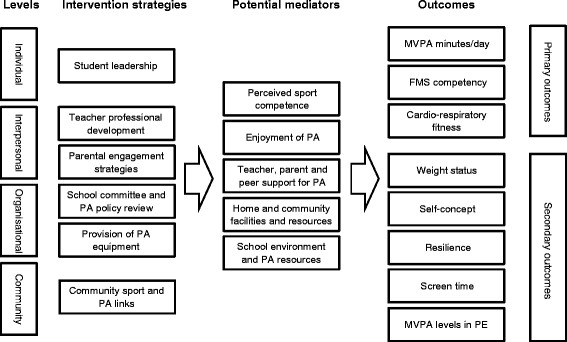
BACKGROUND: Many Australian children are insufficiently active to accrue health benefits and physical activity (PA) levels are consistently lower among youth of low socio-economic position. PA levels decline dramatically during adolescence and evidence suggests that competency in a range of fundamental movement skills (FMS) may serve as a protective factor against this trend. METHODS/DESIGN: The Supporting Children's Outcomes Using Rewards Exercise and Skills (SCORES) intervention is a multi-component PA and FMS intervention for primary schools in low-income communities, which will be evaluated using a group randomized controlled trial. The socio-ecological model provided a framework for the 12-month intervention, which includes the following components: teacher professional learning, student leadership workshops (including leadership accreditation and rewards, e.g., stickers, water bottles), PA policy review, PA equipment packs, parental engagement via newsletters, FMS homework and a parent evening, and community partnerships with local sporting organizations. Outcomes will be assessed at baseline, 6- and 12-months. The primary outcomes are PA (accelerometers), FMS (Test of Gross Motor Development II) and cardiorespiratory fitness (multi-stage fitness test). Secondary outcomes include body mass index [using weight (kg)/height (m2)], perceived competence, physical self-esteem, and resilience. Individual and environmental mediators of behavior change (e.g. social support and enjoyment) will also be assessed. The System for Observing Fitness Instruction Time will be used to assess the impact of the intervention on PA within physical education lessons. Statistical analyses will follow intention-to-treat principles and hypothesized mediators of PA behavior change will be explored. DISCUSSION: SCORES is an innovative primary school-based PA and FMS intervention designed to support students attending schools in low-income communities to be more skilled and active. The findings from the study may be used to guide teacher pre-service education, professional learning and school policy in primary schools. TRIAL REGISTRATION: Australian New Zealand Clinical Trials Registry No: ACTRN12611001080910.
Overview
The claims and statistics of this paper haven’t been checked yet.
Free: it reads the open-access text and checks the first 5 claims that cite a source we can check. Create a free account to check every claim.
Integrity signals
Registry
Cites
Statistics
Figures

Verification
Claims the paper makes
The claims and statistics of this paper haven’t been checked yet.
Free: it reads the open-access text and checks the first 5 claims that cite a source we can check. Create a free account to check every claim.
Claims other papers make about this one
Each is checked against this paper’s own text: does it say what the citing paper says it does?
The cited source says what the claim attributes to it.
In the citing paper
“The SAAFE principles were originally designed to promote a psychologically supportive environment, foster a mastery climate and enhance young people’s autonomous motivation in the Supporting Children’s Outcomes using Rewards, Exercise and Skills (SCORES) primary school physical activity intervention [51, 52].”
Self-check
Percentages, sums and reported differences re-computed from the paper’s own numbers.
The self-check needs the paper’s full text.
Citations
Cites
The "what" and "why" of goal pursuits: Human needs and the self-determination of behavior
Deci, E. L., & Ryan, R. M. (2000) · Psychological Inquiry · doi:10.1207/s15327965pli1104_01 · Cited by 34,210
Intrinsic Motivation and Self-Determination in Human Behavior
Deci, E. L., & Ryan, R. M. (1985) · doi:10.1007/978-1-4899-2271-7 · Cited by 26,772
Establishing a standard definition for child overweight and obesity worldwide: international survey
Cole, T. J. (2000) · BMJ · doi:10.1136/bmj.320.7244.1240 · Cited by 16,480
Intrinsic Motivation and Self-Determination in Human Behavior
Miller, K. A., Deci, E. L., & Ryan, R. M. (1988) · Contemporary Sociology · doi:10.2307/2070638 · Cited by 15,312
‘Small Changes' to Diet and Physical Activity Behaviors for Weight Management
Hills, A. P., Byrne, N. M., Lindstrom, R., & Hill, J. O. (2013) · Obesity Facts · doi:10.1159/000345030 · Cited by 9,493
An ecological perspective on health promotion programs
McLeroy, K. R., Bibeau, D., Steckler, A., & Glanz, K. (1988) · Health Education Quarterly · doi:10.1177/109019818801500401 · Cited by 8,502
Evidence Based Physical Activity for School-age Youth
Strong, W. B., Malina, R. M., Blimkie, C. J. R., Daniels, S. R., Dishman, R. K., Gutin, B., Hergenroeder, A. C., Must, A., Nixon, P. A., Pivarnik, J. M., et al. (2005) · The Journal of Pediatrics · doi:10.1016/j.jpeds.2005.01.055 · Cited by 4,222
Consort 2010 statement: extension to cluster randomised trials
Campbell, M. K., Piaggio, G., Elbourne, D. R., Altman, D. G., & for the CONSORT Group (2012) · BMJ · doi:10.1136/bmj.e5661 · Cited by 3,510
Calibration of two objective measures of physical activity for children
Evenson, K. R., Catellier, D. J., Gill, K., Ondrak, K. S., & McMurray, R. G. (2008) · Journal of Sports Sciences · doi:10.1080/02640410802334196 · Cited by 2,677 · cited 1×
“The mean activity counts per minute (CPM) and daily step counts will be calculated, thresholds for activity counts will be used to categorize PA into sedentary, light, moderate and vigorous intensity activity [56].”
MethodCONSORT statement: extension to cluster randomised trials
Campbell, M. K., Elbourne, D. R., & Altman, D. G. (2004) · BMJ · doi:10.1136/bmj.328.7441.702 · Cited by 2,557 · cited 1×
“The design, conduct and reporting of this group RCT will adhere to the Consolidated Standards of Reporting Trials (CONSORT) guidelines for group trials [41].”
Method
Research works printed but not linked: 7
- Department of Health & Ageing: 2007 Australian National Children’s Nutrition and Physical Activity Survey - Main Findings. 2008, Commonwealth of Australia: ACT, 35-38.
- Clark JE, Metcalfe JS: The mountain of motor development. Motor development: Research and reviews. Volume 2. Edited by: Clark JE, Humprehy JH. 2002, Reston, VA: National Association of Sport & Physical Education, 163-190.
- Ulrich DA: Test of Gross Motor Development Examiner’s Manual. 2000, Austin, Texas: Pro.Ed, 2
- Weiss MR: Motivating kids in physical activity. Pres Counc Phys Fit Sports Res Dig. 2000, 3 (11): 1-8.
- Harter S: Competence as a dimension of self-evaluation: Toward a comprehensive model of self-worth. Perceptions of competence and incompetence across the lifespan. Edited by: Kolligian J, Strenberg R. 1985, New Haven: Yale University Press
- Harter S: Manual for the self-perception profile for children. 1985, University of Denver, Denver
- Resilience Research Centre: The Child and Youth Resilience Measure-28: User Manual. 2009, Halifax, NS: Resilience Research Centre, Dalhousie University
Cited by
Dobbins, M., Husson, H., DeCorby, K., & LaRocca, R. L. (2013) · Cochrane Database of Systematic Reviews · doi:10.1002/14651858.cd007651.pub2 · Cited by 1,358
Langford, R., Bonell, C. P., Jones, H. E., Pouliou, T., Murphy, S. M., Waters, E., Komro, K. A., Gibbs, L. F., Magnus, D., & Campbell, R. (2014) · Cochrane Database of Systematic Reviews · doi:10.1002/14651858.cd008958.pub2 · Cited by 768
Hills, A. P., Dengel, D. R., & Lubans, D. R. (2015) · Progress in Cardiovascular Diseases · doi:10.1016/j.pcad.2014.09.010 · Cited by 705
Self-citationNeil-Sztramko, S. E., Caldwell, H., & Dobbins, M. (2021) · Cochrane Database of Systematic Reviews · doi:10.1002/14651858.cd007651.pub3 · Cited by 449
Fundamental motor skills: A systematic review of terminology
Logan, S. W., Ross, S. M., Chee, K., Stodden, D. F., & Robinson, L. E. (2018) · Journal of Sports Sciences · doi:10.1080/02640414.2017.1340660 · Cited by 353
Metadata
- Authors
- Lubans, D. R., Morgan, P. J., Weaver, K., Callister, R., Dewar, D. L., Costigan, S. A., Finn, T. L., Smith, J., Upton, L., & Plotnikoff, R. C.
- Affiliations
- University of Newcastle Australia (AU)
- Corresponding author
- Lubans, David R
- ORCID
- Venue
- BMC Public Health
- Published
- 2012-06-12
- Volume
- 12
- Issue
- 1
- Pages
- 427-427
- ISSN
- 1471-2458 (ISSN-L)
- PMC
- PMC3490777
- OpenAlex
- W2059147065
- Cited by
- 48
- References
- 84
- Citations by year
- 2024: 2 · 2023: 5 · 2022: 2 · 2021: 3 · 2020: 2 · 2019: 3 · 2018: 2 · 2017: 7 · 2016: 7 · 2015: 2 · 2014: 9 · 2013: 4
- FWCI
- 3.22
- Type
- journal article
- Language
- en
- Open access
- gold
- doi.org
- Licence
- cc-by
- creativecommons.org/licenses/by/2.0 (tdm)
- Locations
- BMC Public Health (publishedVersion, cc-by)
- Europe PMC (PubMed Central) (publishedVersion, cc-by)
- PubMed Central (publishedVersion, cc-by)
- PubMed (publishedVersion)
- EPubDev Repository (submittedVersion)
- DOAJ (DOAJ: Directory of Open Access Journals) (submittedVersion, cc-by-sa)
- Figshare (submittedVersion, cc-by)
- RUNE (Research UNE) (submittedVersion)
- NOVA (University of Newcastle Australia) (submittedVersion)
- Funders
- Hunter Medical Research Institute
- Topics
- Health Sciences › Medicine › Public Health, Environmental and Occupational Health › Physical Activity and Health
- Social Sciences › Psychology › Developmental and Educational Psychology › Children's Physical and Motor Development
- Social Sciences › Education › Physical Education and Pedagogy
- Keywords
- physical activity, basic motor skills, elementary school students, low-income communities, socioeconomic position, socio-ecological model, teacher learning, student leadership, reward, cardiorespiratory fitness, body mass index, physical self-esteem, resilience, physical education, school-based intervention, parental engagement, community partnerships
- MeSH terms
- Australia, Child, Health Promotion, Humans, Motor Skills, Poverty, Research Design, Reward, School Health Services, Schools, Program Evaluation, Exercise
About these checks
Registry, retraction, Cites and statistics results are computed, not judged, with one exception: a printed reference that no index lists is read once by a model before it counts as a citation error. Claims are extracted by a model and kept only when their quote appears verbatim in the text; each cited source is then checked, with a model’s help, for whether it says what the claim relies on. Those verdicts can be wrong — read the claim’s quote and the cited source before relying on one.
Statistics and arithmetic are recomputed, not judged.
Confidence bands are shown only for fields calibrated on our annotated test set. None is calibrated yet, so no band is shown.
What counts as a claim ›How we measure confidence ›How we check this ›
Are you an author, or do you see a problem with this page? Request a review
How to cite
Cite CoChat for the checks on this page, and the paper for its own findings.
- This page
- CoChat. (2026). Citation check: Rationale and study protocol for the supporting children’s outcomes using rewards, exercise and skills (SCORES) group randomized controlled trial: A physical activity and fundamental movement skills intervention for primary schools in low-income communities. https://app.cochat.ai/papers/10.1186/1471-2458-12-427
- The paper
- Lubans, D. R., Morgan, P. J., Weaver, K., Callister, R., Dewar, D. L., Costigan, S. A., Finn, T. L., Smith, J., Upton, L., & Plotnikoff, R. C. (2012). Rationale and study protocol for the supporting children’s outcomes using rewards, exercise and skills (SCORES) group randomized controlled trial: A physical activity and fundamental movement skills intervention for primary schools in low-income communities. BMC Public Health. https://doi.org/10.1186/1471-2458-12-427
Data sources
Bibliographic data: Semantic Scholar, OpenAlex, Crossref.
Contains information from the Semantic Scholar Academic Graph Datasets, made available under the ODC Attribution License (ODC-BY 1.0).
Semantic Scholar’s data is described in: Kinney, R., et al. (2023). The Semantic Scholar Open Data Platform. arXiv:2301.10140.
