

Rationale and study protocol for the supporting children’s outcomes using rewards, exercise and skills (SCORES) group randomized controlled trial: A physical activity and fundamental movement skills intervention for primary schools in low-income communities
Open accessThe DOI matches its Crossref record; 84 of the 84 references it cites were found in a registry or an index.
Abstract
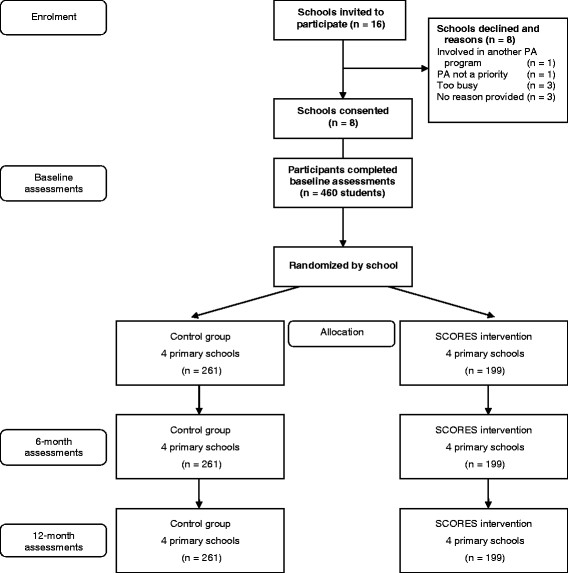
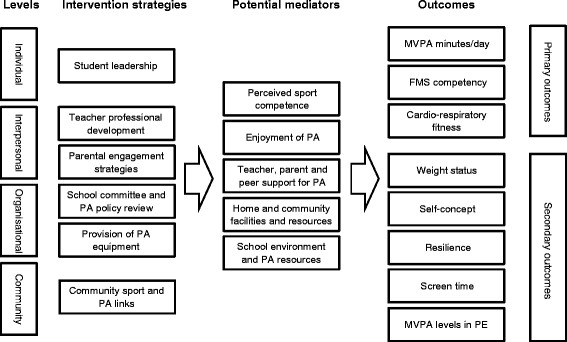
BACKGROUND: Many Australian children are insufficiently active to accrue health benefits and physical activity (PA) levels are consistently lower among youth of low socio-economic position. PA levels decline dramatically during adolescence and evidence suggests that competency in a range of fundamental movement skills (FMS) may serve as a protective factor against this trend. METHODS/DESIGN: The Supporting Children's Outcomes Using Rewards Exercise and Skills (SCORES) intervention is a multi-component PA and FMS intervention for primary schools in low-income communities, which will be evaluated using a group randomized controlled trial. The socio-ecological model provided a framework for the 12-month intervention, which includes the following components: teacher professional learning, student leadership workshops (including leadership accreditation and rewards, e.g., stickers, water bottles), PA policy review, PA equipment packs, parental engagement via newsletters, FMS homework and a parent evening, and community partnerships with local sporting organizations. Outcomes will be assessed at baseline, 6- and 12-months. The primary outcomes are PA (accelerometers), FMS (Test of Gross Motor Development II) and cardiorespiratory fitness (multi-stage fitness test). Secondary outcomes include body mass index [using weight (kg)/height (m2)], perceived competence, physical self-esteem, and resilience. Individual and environmental mediators of behavior change (e.g. social support and enjoyment) will also be assessed. The System for Observing Fitness Instruction Time will be used to assess the impact of the intervention on PA within physical education lessons. Statistical analyses will follow intention-to-treat principles and hypothesized mediators of PA behavior change will be explored. DISCUSSION: SCORES is an innovative primary school-based PA and FMS intervention designed to support students attending schools in low-income communities to be more skilled and active. The findings from the study may be used to guide teacher pre-service education, professional learning and school policy in primary schools. TRIAL REGISTRATION: Australian New Zealand Clinical Trials Registry No: ACTRN12611001080910.
Overview
The claims and statistics of this paper haven’t been checked yet.
Free: it reads the open-access text and checks the first 5 claims that cite a source we can check. Create a free account to check every claim.
Integrity signals
Registry
Cites
Statistics
Figures
Verification
Claims the paper makes
The claims and statistics of this paper haven’t been checked yet.
Free: it reads the open-access text and checks the first 5 claims that cite a source we can check. Create a free account to check every claim.
Claims other papers make about this one
Each is checked against this paper’s own text: does it say what the citing paper says it does?
The cited source says what the claim attributes to it.
In the citing paper
“The SAAFE principles were originally designed to promote a psychologically supportive environment, foster a mastery climate and enhance young people’s autonomous motivation in the Supporting Children’s Outcomes using Rewards, Exercise and Skills (SCORES) primary school physical activity intervention [51, 52].”
Self-check
Percentages, sums and reported differences re-computed from the paper’s own numbers.
The self-check needs the paper’s full text.
Citations
Cites
The "what" and "why" of goal pursuits: Human needs and the self-determination of behavior
Deci, E. L., & Ryan, R. M. (2000) · Psychological Inquiry · doi:10.1207/s15327965pli1104_01 · Cited by 34,210
Intrinsic Motivation and Self-Determination in Human Behavior
Deci, E. L., & Ryan, R. M. (1985) · doi:10.1007/978-1-4899-2271-7 · Cited by 26,772
Establishing a standard definition for child overweight and obesity worldwide: international survey
Cole, T. J. (2000) · BMJ · doi:10.1136/bmj.320.7244.1240 · Cited by 16,480
Intrinsic Motivation and Self-Determination in Human Behavior
Miller, K. A., Deci, E. L., & Ryan, R. M. (1988) · Contemporary Sociology · doi:10.2307/2070638 · Cited by 15,312
‘Small Changes' to Diet and Physical Activity Behaviors for Weight Management
Hills, A. P., Byrne, N. M., Lindstrom, R., & Hill, J. O. (2013) · Obesity Facts · doi:10.1159/000345030 · Cited by 9,493
An ecological perspective on health promotion programs
McLeroy, K. R., Bibeau, D., Steckler, A., & Glanz, K. (1988) · Health Education Quarterly · doi:10.1177/109019818801500401 · Cited by 8,502
Evidence Based Physical Activity for School-age Youth
Strong, W. B., Malina, R. M., Blimkie, C. J. R., Daniels, S. R., Dishman, R. K., Gutin, B., Hergenroeder, A. C., Must, A., Nixon, P. A., Pivarnik, J. M., et al. (2005) · The Journal of Pediatrics · doi:10.1016/j.jpeds.2005.01.055 · Cited by 4,222
Consort 2010 statement: extension to cluster randomised trials
Campbell, M. K., Piaggio, G., Elbourne, D. R., Altman, D. G., & for the CONSORT Group (2012) · BMJ · doi:10.1136/bmj.e5661 · Cited by 3,510
Calibration of two objective measures of physical activity for children
Evenson, K. R., Catellier, D. J., Gill, K., Ondrak, K. S., & McMurray, R. G. (2008) · Journal of Sports Sciences · doi:10.1080/02640410802334196 · Cited by 2,677 · cited 1×
“The mean activity counts per minute (CPM) and daily step counts will be calculated, thresholds for activity counts will be used to categorize PA into sedentary, light, moderate and vigorous intensity activity [56].”
MethodCONSORT statement: extension to cluster randomised trials
Campbell, M. K., Elbourne, D. R., & Altman, D. G. (2004) · BMJ · doi:10.1136/bmj.328.7441.702 · Cited by 2,557 · cited 1×
“The design, conduct and reporting of this group RCT will adhere to the Consolidated Standards of Reporting Trials (CONSORT) guidelines for group trials [41].”
Method
Research works printed but not linked: 7
- 10. Department of Health & Ageing: 2007 Australian National Children' s Nutrition and Physical Activity Survey -Main Findings. Commonwealth of Australia: ACT; 2008:35-38.
- 24. Clark JE, Metcalfe JS: The mountain of motor development. In Motor development: Research and reviews. Volume 2. Edited by Clark JE, Humprehy JH. Reston, VA: National Association of Sport & Physical Education; 2002:163-190.
- 44. Ulrich DA: Test of Gross Motor Development Examiner' s Manual. 2nd edition. Austin, Texas: Pro.Ed; 2000.
- 48. Weiss MR: Motivating kids in physical activity. Pres Counc Phys Fit Sports Res Dig 2000, 3(11):1-8.
- 49. Harter S: Competence as a dimension of self-evaluation: Toward a comprehensive model of self-worth. In Perceptions of competence and incompetence across the lifespan. Edited by Kolligian J, Strenberg R. New Haven: Yale University Press; 1985.
- 59. Harter S: Manual for the self-perception profile for children. Denver: University of Denver; 1985.
- 60. Resilience Research Centre: The Child and Youth Resilience Measure-28: User Manual. Halifax, NS: Resilience Research Centre, Dalhousie University; 2009.
Cited by
Dobbins, M., Husson, H., DeCorby, K., & LaRocca, R. L. (2013) · Cochrane Database of Systematic Reviews · doi:10.1002/14651858.cd007651.pub2 · Cited by 1,358
Langford, R., Bonell, C. P., Jones, H. E., Pouliou, T., Murphy, S. M., Waters, E., Komro, K. A., Gibbs, L. F., Magnus, D., & Campbell, R. (2014) · Cochrane Database of Systematic Reviews · doi:10.1002/14651858.cd008958.pub2 · Cited by 768
Hills, A. P., Dengel, D. R., & Lubans, D. R. (2015) · Progress in Cardiovascular Diseases · doi:10.1016/j.pcad.2014.09.010 · Cited by 705
Self-citationNeil-Sztramko, S. E., Caldwell, H., & Dobbins, M. (2021) · Cochrane Database of Systematic Reviews · doi:10.1002/14651858.cd007651.pub3 · Cited by 449
Fundamental motor skills: A systematic review of terminology
Logan, S. W., Ross, S. M., Chee, K., Stodden, D. F., & Robinson, L. E. (2018) · Journal of Sports Sciences · doi:10.1080/02640414.2017.1340660 · Cited by 353
Lonsdale, C., Sanders, T., Cohen, K. E., Parker, P., Noetel, M., Hartwig, T., Vasconcellos, D., Kirwan, M., Morgan, P., Salmon, J., et al. (2016) · BMC Public Health · doi:10.1186/s12889-016-3243-2 · Cited by 287
Self-citationLander, N., Eather, N., Morgan, P. J., Salmon, J., & Barnett, L. M. (2017) · Sports Medicine · doi:10.1007/s40279-016-0561-6 · Cited by 191
Self-citationCohen, K. E., Morgan, P. J., Plotnikoff, R. C., Callister, R., & Lubans, D. R. (2014) · International Journal of Behavioral Nutrition and Physical Activity · doi:10.1186/1479-5868-11-49 · Cited by 189
“A detailed description of the SCORES study protocol has been published elsewhere [21].”
MethodSelf-citationLubans, D. R., Lonsdale, C., Cohen, K., Eather, N., Beauchamp, M. R., Morgan, P. J., Sylvester, B. D., & Smith, J. J. (2017) · International Journal of Behavioral Nutrition and Physical Activity · doi:10.1186/s12966-017-0479-x · Cited by 180
“The SAAFE principles were originally designed to promote a psychologically supportive environment, foster a mastery climate and enhance young people’s autonomous motivation in the Supporting Children’s Outcomes using Rewards, Exercise and Skills (SCORES) primary school physical activity intervention [51, 52].”
BackgroundMethodSelf-citationPhysical Activity and Skills Intervention: SCORES Cluster Randomized Controlled Trial
COHEN, K. E., MORGAN, P. J., PLOTNIKOFF, R. C., CALLISTER, R., & LUBANS, D. R. (2015) · Medicine & Science in Sports & Exercise · doi:10.1249/mss.0000000000000452 · Cited by 150
Self-citationLubans, D. R., Smith, J. J., Plotnikoff, R. C., Dally, K. A., Okely, A. D., Salmon, J., & Morgan, P. J. (2016) · International Journal of Behavioral Nutrition and Physical Activity · doi:10.1186/s12966-016-0420-8 · Cited by 135
Self-citationPatey, A. M., Hurt, C. S., Grimshaw, J., & Francis, J. (2018) · Implementation Science · doi:10.1186/s13012-018-0826-6 · Cited by 128
Cohen, K. E., Morgan, P. J., Plotnikoff, R. C., Barnett, L. M., & Lubans, D. R. (2015) · Journal of Sports Sciences · doi:10.1080/02640414.2015.1017734 · Cited by 83
Self-citationApplying Psychological Theories to Promote Healthy Lifestyles
Linke, S., Robinson, C., & Pekmezi, D. (2013) · American Journal of Lifestyle Medicine · doi:10.1177/1559827613487496 · Cited by 78
Miller, A. A., Christensen, E., Eather, N., Sproule, J., Annis-Brown, L., & Lubans, D. R. (2015) · Preventive Medicine · doi:10.1016/j.ypmed.2015.02.002 · Cited by 73
Self-citationDevelopment of physical literacy and movement competency: a literature review
Tompsett, C., Burkett, B. J., & McKean, M. R. (2014) · UniSC Research Bank (University of the Sunshine Coast) · Cited by 66
Sutherland, R., Campbell, E., Lubans, D. R., Morgan, P. J., Okely, A. D., Nathan, N., Wolfenden, L., Jones, J., Davies, L., Gillham, K., et al. (2013) · BMC Public Health · doi:10.1186/1471-2458-13-57 · Cited by 65
Self-citationSmith, J. J., Morgan, P. J., Plotnikoff, R. C., Dally, K. A., Salmon, J., Okely, A. D., Finn, T. L., Babic, M. J., Skinner, G., & Lubans, D. R. (2014) · Contemporary Clinical Trials · doi:10.1016/j.cct.2013.11.008 · Cited by 64
Self-citationLubans, D. R., Plotnikoff, R. C., Miller, A. A., Scott, J. J., Thompson, D. I., & Tudor-Locke, C. E. (2014) · American Journal of Lifestyle Medicine · doi:10.1177/1559827614537774 · Cited by 60
Self-citationAn RCT to facilitate implementation of school practices known to increase physical activity
Sutherland, R. L., Nathan, N. K., Lubans, D. R., Cohen, K., Davies, L. J., Desmet, C., Cohen, J., McCarthy, N. J., Butler, P., Wiggers, J., et al. (2017) · American Journal of Preventive Medicine · doi:10.1016/j.amepre.2017.08.009 · Cited by 58
Self-citationBarnett, L. M., Verswijveren, S. J. J. M., Colvin, B., Lubans, D. R., Telford, R. M., Lander, N., Schott, N., Tietjens, M., Hesketh, K. D., Morgan, P. J., et al. (2024) · International Journal of Behavioral Nutrition and Physical Activity · doi:10.1186/s12966-023-01546-7 · Cited by 53
Self-citationLubans, D. R., Smith, J. J., Peralta, L. R., Plotnikoff, R. C., Okely, A. D., Salmon, J., Eather, N., Dewar, D. L., Kennedy, S. G., Lonsdale, C., et al. (2016) · BMJ Open · doi:10.1136/bmjopen-2015-010448 · Cited by 51
Self-citationHa, A. S. C., Lonsdale, C., Lubans, D. R., & Ng, J. Y. Y. (2017) · BMC Public Health · doi:10.1186/s12889-017-4553-8 · Cited by 49
Self-citationTaylor, S. L., Noonan, R. J., Knowles, Z. R., Owen, M. B., McGrane, B., Curry, W. B., & Fairclough, S. J. (2018) · International Journal of Environmental Research and Public Health · doi:10.3390/ijerph15051011 · Cited by 47
“Use in previous school-based PA interventions as a means for engaging parents [40–42].”
Kennedy, S. G., Peralta, L. R., Lubans, D. R., Foweather, L., & Smith, J. J. (2019) · Physical Education and Sport Pedagogy · doi:10.1080/17408989.2019.1571182 · Cited by 38
Self-citationChan, C. H. S., Ha, A. S. C., & Ng, J. Y. Y. (2016) · SpringerPlus · doi:10.1186/s40064-016-2517-6 · Cited by 37
Birnbaum, J., Geyer, C., Kirchberg, F. F., Μanios, Y., Koletzko, B. V., & on behalf of the ToyBox-study Group (2016) · Journal of Sports Sciences · doi:10.1080/02640414.2016.1166390 · Cited by 36
Ruz, R. P., García-Molina, R., & Puga-González, E. (2019) · Behavioral Sciences · doi:10.3390/bs9080084 · Cited by 31
Rico-González, M. (2023) · Journal of Physical Activity and Health · doi:10.1123/jpah.2022-0452 · Cited by 31
Harris, N., Warbrick, I., Atkins, D. R., Vandal, A. C., Plank, L. D., & Lubans, D. R. (2021) · Pediatric Exercise Science · doi:10.1123/pes.2020-0255 · Cited by 30
Self-citationRiley, N., Lubans, D. R., Holmes, K., & Morgan, P. J. (2014) · BMC Public Health · doi:10.1186/1471-2458-14-816 · Cited by 29
Self-citationMotor Competence in Adolescents: Exploring Association with Physical Fitness
Gísladóttir, Þ., Haga, M., & Sigmundsson, H. (2019) · Sports · doi:10.3390/sports7070176 · Cited by 28
Eather, N., Riley, N., Miller, D., & Jones, B. (2017) · doi:10.14221/ajte.2017v42n1.5 · Cited by 26
Cohen, K. E., Morgan, P. J., Plotnikoff, R. C., Hulteen, R. M., & Lubans, D. R. (2017) · Psychology of sport and exercise · doi:10.1016/j.psychsport.2017.05.001 · Cited by 25
Self-citationValentini, N. C., Nobre, G. C., de Souza, M. S., & Duncan, M. J. (2020) · Journal of Physical Activity and Health · doi:10.1123/jpah.2019-0532 · Cited by 25
Tomkinson, G. R., Schranz, N. K., Olds, T. S., Boyd, R., Evans, J., Gomersall, S., Hardy, L., Hesketh, K., Lubans, D., Ridgers, N., et al. (2016) · Adelaide Research & Scholarship (AR&S) (University of Adelaide) · doi:10.4226/78/57aad6bd49165 · Cited by 21
Self-citationThe Secret Sauce? Taking the Mystery Out of Scaling-Up School-Based Physical Activity Interventions
McKay, H. A., Kennedy, S. G., MACDONALD, H. M., Naylor, P., & Lubans, D. R. (2024) · Journal of Physical Activity and Health · doi:10.1123/jpah.2024-0274 · Cited by 20
Self-citationPranoto, N. W., Chaeroni, A., Rifki, M. S., Ilham, A., & Susanto, N. (2023) · Annals of Applied Sport Science · doi:10.52547/aassjournal.1162 · Cited by 17
Lubans, D. R., Sanders, T., Noetel, M., Parker, P. D., McKay, H. A., Morgan, P. J., Salmon, J., Kirwan, M., Bennie, A., Peralta, L. R., et al. (2022) · International Journal of Behavioral Nutrition and Physical Activity · doi:10.1186/s12966-022-01371-4 · Cited by 14
Self-citationLonsdale, C., Sanders, T., Cohen, K. E., Parker, P. D., Noetel, M., Hartwig, T. B., Vasconcellos, D., Kirwan, M., Morgan, P. J., Salmon, J., et al. (2016) · BMC Public Health · doi:10.1186/s12889-016-3724-3 · Cited by 9
Self-citationHulteen, R. M., Lubans, D. R., Rhodes, R. E., Faulkner, G., Liu, Y., Naylor, P., Nathan, N., Waldhauser, K. J., Wierts, C. M., & Beauchamp, M. R. (2023) · PLoS ONE · doi:10.1371/journal.pone.0280261 · Cited by 8
Self-citationPlotnikoff, R. C., Morgan, P. J., Lubans, D. R., Rhodes, R. E., & Costigan, S. A. (2014) · Australian Psychologist · doi:10.1111/ap.12037 · Cited by 6
Self-citationRelationship between physical activity, physical fitness, and motor competence in school children
dos Santos, C. R., Silva, C. C. D., & Marques, I. (2017) · Portuguese National Funding Agency for Science, Research and Technology (RCAAP Project by FCT) · Cited by 6
Hopkins, E., Bolton, N., Brown, D. H. K., Matthews, N., & Anderson, M. (2020) · Societies · doi:10.3390/soc10040080 · Cited by 3
Ruz, R. P., García-Molina, R., Cepero-González, M., & González, M. E. P. (2021) · Advances in early childhood and K-12 education · doi:10.4018/978-1-7998-7585-7.ch007 · Cited by 2
Ruz, R. P., García-Molina, R., Cepero-González, M., & González, M. E. P. (2022) · IGI Global eBooks · doi:10.4018/978-1-6684-7468-6.ch023 · Cited by 2
Inequalities in children's physical activity and interventions
Love, R. (2019) · Apollo (University of Cambridge) · doi:10.17863/cam.44801 · Cited by 2
Minnie, A. (2015) · UEF eRepo (University of Eastern Finland) · Cited by 2
Relationship between cardiorespiratory fitness and English performance as foreign language
Pizà-Mir, B., García-Mármol, E., & de la Cruz-Campos, J. C. (2023) · Porta Linguarum Revista Interuniversitaria de Didáctica de las Lenguas Extranjeras · doi:10.30827/portalin.vivii.29162 · Cited by 1
Colella, D., Monacis, D., Cinquepalmi, D., & d’Arando, C. (2021) · Giornale Italiano di Educazione alla Salute, Sport e Didattica Inclusiva · doi:10.32043/gsd.v5i1_sup.391 · Cited by 1
O’Brien, W. (2013) · Dublin City University Open Access Institutional Repository (Dublin City University) · Cited by 1
Huang, X., & Zhang, W. (2023) · Advances in Engineering Technology Research · doi:10.56028/aetr.3.1.633
Physical Education and Numeracy
Lloyd, A., Eather, N., & Riley, N. (2017) · Springer eBooks · doi:10.1007/978-981-10-5736-6_15
Acceptability of a School-Based Incentivised Physical Activity Intervention: The B-Active Program
Herman, W., Morton, D. P., & Grant, R. (2014) · TEACH Journal of Christian Education · doi:10.55254/1835-1492.1258
I CINAPSE – I International Conference of Physical Activity and Health Promotion at School
Júnior, J. A. P., Catunda, R., Garrido, N. D., Marques, A., Loureiro, A. C. C., Rombaldi, A. J., Netto, A. V., Oliveira, A. B., Catrib, A. F., Machado, A. A. N., et al. (2017) · Motricidade · doi:10.6063/motricidade.13580
Sottatipredawong, S., Yongyuan, B., & Nopmaneejumruslers, K. (2024) · Journal of Education and Innovative Learning
Gavigan, N. (2022) · Dublin City University Open Access Institutional Repository (Dublin City University)
Investigating a Nonlinear Pedagogy Approach to Primary School Physical Education
Cooke, D. (2022) · Tuwhera (Auckland University of Technology)
Assessment of physical activity in adolescents: protocols, compliance and participants’ perceptions
Scott, J. (2017) · UniSC Research Bank (University of the Sunshine Coast)
School-based health promotion: understanding the educational context to facilitate change
Ryan, M. (2023) · Apollo (University of Cambridge) · doi:10.17863/cam.104347
吏��뿭�븘�룞�꽱�꽣 �씠�슜 �븘�룞�쓽 �떊泥댄솢�룞 �닔以� 諛� �쁺�뼢 �슂�씤
�옣�옄�� (2018) · YUHSpace (Yonsei University Medical Library)
Relação entre competência motora, aptidão física e atividade física habitual em crianças
dos Santos, C. R. (2016) · LA Referencia (Red Federada de Repositorios Institucionales de Publicaciones Científicas)
Hulteen, R. M., Lubans, D. R., Rhodes, R. E., Faulkner, G., Liu, Y., Naylor, P.-J., Nathan, N., Waldhauser, K. J., Wierts, C. M., & Beauchamp, M. R. (2023) · doi:10.1371/journal.pone.0280261.r002
Self-citation
Metadata
- Authors
- Lubans, D. R., Morgan, P. J., Weaver, K., Callister, R., Dewar, D. L., Costigan, S. A., Finn, T. L., Smith, J., Upton, L., & Plotnikoff, R. C.
- Affiliations
- University of Newcastle Australia (AU)
- Corresponding author
- Lubans, David R
- ORCID
- Venue
- BMC Public Health
- Published
- 2012-06-12
- Volume
- 12
- Issue
- 1
- Pages
- 427-427
- ISSN
- 1471-2458 (ISSN-L)
- PMC
- PMC3490777
- OpenAlex
- W2059147065
- Cited by
- 48
- References
- 83
- Citations by year
- 2024: 2 · 2023: 5 · 2022: 2 · 2021: 3 · 2020: 2 · 2019: 3 · 2018: 2 · 2017: 7 · 2016: 7 · 2015: 2 · 2014: 9 · 2013: 4
- FWCI
- 3.22
- Type
- journal article
- Language
- en
- Open access
- gold
- doi.org
- Licence
- cc-by
- creativecommons.org/licenses/by/2.0 (tdm)
- Locations
- BMC Public Health (publishedVersion, cc-by)
- Europe PMC (PubMed Central) (publishedVersion, cc-by)
- PubMed Central (publishedVersion, cc-by)
- PubMed (publishedVersion)
- EPubDev Repository (submittedVersion)
- DOAJ (DOAJ: Directory of Open Access Journals) (submittedVersion, cc-by-sa)
- Figshare (submittedVersion, cc-by)
- RUNE (Research UNE) (submittedVersion)
- NOVA (University of Newcastle Australia) (submittedVersion)
- Funders
- Hunter Medical Research Institute
- Topics
- Health Sciences › Medicine › Public Health, Environmental and Occupational Health › Physical Activity and Health
- Social Sciences › Psychology › Developmental and Educational Psychology › Children's Physical and Motor Development
- Social Sciences › Education › Physical Education and Pedagogy
- Keywords
- physical activity, basic motor skills, elementary school students, low-income communities, socioeconomic position, socio-ecological model, teacher learning, student leadership, reward, cardiorespiratory fitness, body mass index, physical self-esteem, resilience, physical education, school-based intervention, parental engagement, community partnerships
- MeSH terms
- Australia, Child, Health Promotion, Humans, Motor Skills, Poverty, Research Design, Reward, School Health Services, Schools, Program Evaluation, Exercise
About these checks
Registry, retraction, Cites and statistics results are computed, not judged, with one exception: a printed reference that no index lists is read once by a model before it counts as a citation error. Claims are extracted by a model and kept only when their quote appears verbatim in the text; each cited source is then checked, with a model’s help, for whether it says what the claim relies on. Those verdicts can be wrong — read the claim’s quote and the cited source before relying on one.
Statistics and arithmetic are recomputed, not judged.
Confidence bands are shown only for fields calibrated on our annotated test set. None is calibrated yet, so no band is shown.
What counts as a claim ›How we measure confidence ›How we check this ›
Are you an author, or do you see a problem with this page? Request a review
Data sources
Bibliographic data: Semantic Scholar, OpenAlex, Crossref.
Contains information from the Semantic Scholar Academic Graph Datasets, made available under the ODC Attribution License (ODC-BY 1.0).
Semantic Scholar’s data is described in: Kinney, R., et al. (2023). The Semantic Scholar Open Data Platform. arXiv:2301.10140.
