

Rationale and study protocol for the supporting children’s outcomes using rewards, exercise and skills (SCORES) group randomized controlled trial: A physical activity and fundamental movement skills intervention for primary schools in low-income communities
Open accessThe DOI matches its Crossref record; 84 of the 84 references it cites were found in a registry or an index.
Abstract
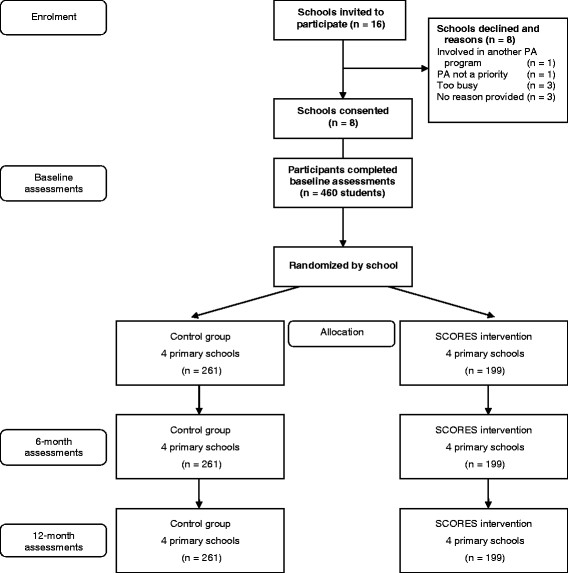
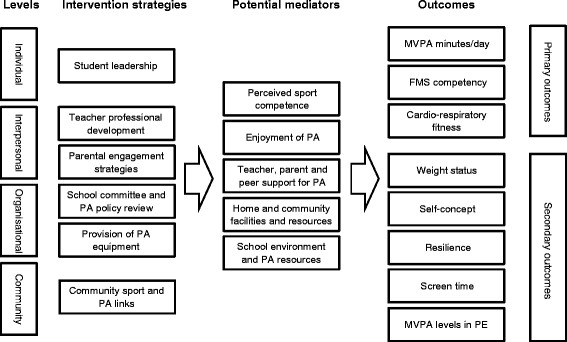
BACKGROUND: Many Australian children are insufficiently active to accrue health benefits and physical activity (PA) levels are consistently lower among youth of low socio-economic position. PA levels decline dramatically during adolescence and evidence suggests that competency in a range of fundamental movement skills (FMS) may serve as a protective factor against this trend. METHODS/DESIGN: The Supporting Children's Outcomes Using Rewards Exercise and Skills (SCORES) intervention is a multi-component PA and FMS intervention for primary schools in low-income communities, which will be evaluated using a group randomized controlled trial. The socio-ecological model provided a framework for the 12-month intervention, which includes the following components: teacher professional learning, student leadership workshops (including leadership accreditation and rewards, e.g., stickers, water bottles), PA policy review, PA equipment packs, parental engagement via newsletters, FMS homework and a parent evening, and community partnerships with local sporting organizations. Outcomes will be assessed at baseline, 6- and 12-months. The primary outcomes are PA (accelerometers), FMS (Test of Gross Motor Development II) and cardiorespiratory fitness (multi-stage fitness test). Secondary outcomes include body mass index [using weight (kg)/height (m2)], perceived competence, physical self-esteem, and resilience. Individual and environmental mediators of behavior change (e.g. social support and enjoyment) will also be assessed. The System for Observing Fitness Instruction Time will be used to assess the impact of the intervention on PA within physical education lessons. Statistical analyses will follow intention-to-treat principles and hypothesized mediators of PA behavior change will be explored. DISCUSSION: SCORES is an innovative primary school-based PA and FMS intervention designed to support students attending schools in low-income communities to be more skilled and active. The findings from the study may be used to guide teacher pre-service education, professional learning and school policy in primary schools. TRIAL REGISTRATION: Australian New Zealand Clinical Trials Registry No: ACTRN12611001080910.
Overview
The claims and statistics of this paper haven’t been checked yet.
Free: it reads the open-access text and checks the first 5 claims that cite a source we can check. Create a free account to check every claim.
Integrity signals
Registry
Cites
Statistics
Figures
Verification
Claims the paper makes
The claims and statistics of this paper haven’t been checked yet.
Free: it reads the open-access text and checks the first 5 claims that cite a source we can check. Create a free account to check every claim.
Claims other papers make about this one
Each is checked against this paper’s own text: does it say what the citing paper says it does?
The cited source says what the claim attributes to it.
In the citing paper
“The SAAFE principles were originally designed to promote a psychologically supportive environment, foster a mastery climate and enhance young people’s autonomous motivation in the Supporting Children’s Outcomes using Rewards, Exercise and Skills (SCORES) primary school physical activity intervention [51, 52].”
Self-check
Percentages, sums and reported differences re-computed from the paper’s own numbers.
The self-check needs the paper’s full text.
Citations
Cites
The "what" and "why" of goal pursuits: Human needs and the self-determination of behavior
Deci, E. L., & Ryan, R. M. (2000) · Psychological Inquiry · doi:10.1207/s15327965pli1104_01 · Cited by 34,210
Intrinsic Motivation and Self-Determination in Human Behavior
Deci, E. L., & Ryan, R. M. (1985) · doi:10.1007/978-1-4899-2271-7 · Cited by 26,772
Establishing a standard definition for child overweight and obesity worldwide: international survey
Cole, T. J. (2000) · BMJ · doi:10.1136/bmj.320.7244.1240 · Cited by 16,480
Intrinsic Motivation and Self-Determination in Human Behavior
Miller, K. A., Deci, E. L., & Ryan, R. M. (1988) · Contemporary Sociology · doi:10.2307/2070638 · Cited by 15,312
‘Small Changes' to Diet and Physical Activity Behaviors for Weight Management
Hills, A. P., Byrne, N. M., Lindstrom, R., & Hill, J. O. (2013) · Obesity Facts · doi:10.1159/000345030 · Cited by 9,493
An ecological perspective on health promotion programs
McLeroy, K. R., Bibeau, D., Steckler, A., & Glanz, K. (1988) · Health Education Quarterly · doi:10.1177/109019818801500401 · Cited by 8,502
Evidence Based Physical Activity for School-age Youth
Strong, W. B., Malina, R. M., Blimkie, C. J. R., Daniels, S. R., Dishman, R. K., Gutin, B., Hergenroeder, A. C., Must, A., Nixon, P. A., Pivarnik, J. M., et al. (2005) · The Journal of Pediatrics · doi:10.1016/j.jpeds.2005.01.055 · Cited by 4,222
Consort 2010 statement: extension to cluster randomised trials
Campbell, M. K., Piaggio, G., Elbourne, D. R., Altman, D. G., & for the CONSORT Group (2012) · BMJ · doi:10.1136/bmj.e5661 · Cited by 3,510
Calibration of two objective measures of physical activity for children
Evenson, K. R., Catellier, D. J., Gill, K., Ondrak, K. S., & McMurray, R. G. (2008) · Journal of Sports Sciences · doi:10.1080/02640410802334196 · Cited by 2,677 · cited 1×
“The mean activity counts per minute (CPM) and daily step counts will be calculated, thresholds for activity counts will be used to categorize PA into sedentary, light, moderate and vigorous intensity activity [56].”
MethodCONSORT statement: extension to cluster randomised trials
Campbell, M. K., Elbourne, D. R., & Altman, D. G. (2004) · BMJ · doi:10.1136/bmj.328.7441.702 · Cited by 2,557 · cited 1×
“The design, conduct and reporting of this group RCT will adhere to the Consolidated Standards of Reporting Trials (CONSORT) guidelines for group trials [41].”
MethodStodden, D. F., Goodway, J. D., Langendorfer, S. J., Roberton, M. A., Rudisill, M. E., Garcia, C., & Garcia, L. E. (2008) · Quest · doi:10.1080/00336297.2008.10483582 · Cited by 2,334
Teacher professional development in Teaching and Teacher Education over ten years
Avalos, B. (2011) · Teaching and Teacher Education · doi:10.1016/j.tate.2010.08.007 · Cited by 2,267
Conducting accelerometer-based activity assessments in field-based research
TROST, S. G., MCIVER, K. L., & PATE, R. R. (2005) · Medicine & Science in Sports & Exercise · doi:10.1249/01.mss.0000185657.86065.98 · Cited by 2,033
Gordon-Larsen, P., Nelson, M. C., Page, P., & Popkin, B. M. (2006) · Pediatrics · doi:10.1542/peds.2005-0058 · Cited by 1,768
Fundamental Movement Skills in Children and Adolescents: Review of Associated Health Benefits
Lubans, D. R., Morgan, P. J., Cliff, D. P., Barnett, L. M., & Okely, A. D. (2010) · Sports Medicine · doi:10.2165/11536850-000000000-00000 · Cited by 1,548
Self-citationUnderstanding Motor Development: Infants, Children, Adolescents, Adults
Gallahue, D. L., & Ozmun, J. C. (1994) · Medical Entomology and Zoology · Cited by 1,537
Dobbins, M., Husson, H., DeCorby, K., & LaRocca, R. L. (2013) · Cochrane Database of Systematic Reviews · doi:10.1002/14651858.cd007651.pub2 · Cited by 1,358
Summary of notifiable diseases--United States, 2012.
Adams, D. A., Jajosky, R. A., Ajani, U. A., Kriseman, J., Sharp, P., Onwen, D. H., Schley, A. W., Anderson, W. J., Grigoryan, A., Aranas, A. E., et al. (2014) · PubMed · Cited by 1,342
Multilevel Modeling of Individual and Group Level Mediated Effects
Krull, J. L., & MacKinnon, D. P. (2001) · Multivariate Behavioral Research · doi:10.1207/s15327906mbr3602_06 · Cited by 1,330
A Brief Review on Correlates of Physical Activity and Sedentariness in Youth
VAN DER HORST, K., PAW, M. J. C. A., TWISK, J. W. R., & VAN MECHELEN, W. (2007) · Medicine & Science in Sports & Exercise · doi:10.1249/mss.0b013e318059bf35 · Cited by 1,254
A maximal multistage 20-m shuttle run test to predict $$\dot V$$ O2 max
L�ger, L. A., & Lambert, J. (1982) · European Journal of Applied Physiology and Occupational Physiology · doi:10.1007/bf00428958 · Cited by 1,229
Moderate-to-Vigorous Physical Activity From Ages 9 to 15 Years
Nader, P. R. (2008) · JAMA · doi:10.1001/jama.300.3.295 · Cited by 1,210
Design and Analysis of Group-Randomized Trials
Sonnad, S. (1999) · Medicine & Science in Sports & Exercise · doi:10.1097/00005768-199902000-00025 · Cited by 1,125
van Sluijs, E. M. F., McMinn, A. M., & Griffin, S. J. (2007) · BMJ · doi:10.1136/bmj.39320.843947.be · Cited by 1,120
Design and Analysis of Group-Randomized Trials
Murray, D. M. (2007) · doi:10.1093/oso/9780195120363.001.0001 · Cited by 1,116
A self-determination approach to the understanding of motivation in physical education
Ntoumanis, N. (2001) · British Journal of Educational Psychology · doi:10.1348/000709901158497 · Cited by 1,031 · cited 1×
“SDT has been used extensively with adolescents in PE-based research [50-53] and evidence suggests that students who feel self-determined are more engaged and more active in PE lessons [51,52].”
MethodChildhood Motor Skill Proficiency as a Predictor of Adolescent Physical Activity
Barnett, L. M., van Beurden, E., Morgan, P. J., Brooks, L. O., & Beard, J. R. (2009) · Journal of Adolescent Health · doi:10.1016/j.jadohealth.2008.07.004 · Cited by 903
Self-citationExercise and Children’s Intelligence, Cognition, and Academic Achievement
Tomporowski, P. D., Davis, C. L., Miller, P. H., & Naglieri, J. A. (2008) · Educational Psychology Review · doi:10.1007/s10648-007-9057-0 · Cited by 874 · cited 1×
“Background Participation in physical activity (PA) is essential for optimizing children’s physical, social, cognitive and psychological development [1,2].”
BackgroundAge-related decline in physical activity: a synthesis of human and animal studies
SALLIS, J. F. (2000) · Medicine & Science in Sports & Exercise · doi:10.1097/00005768-200009000-00012 · Cited by 805
Ungar, M., & Liebenberg, L. (2011) · Journal of Mixed Methods Research · doi:10.1177/1558689811400607 · Cited by 740
Measuring enjoyment of physical activity in adolescent girls
Motl, R. W., Dishman, R. K., Saunders, R., Dowda, M., Felton, G., & Pate, R. R. (2001) · American Journal of Preventive Medicine · doi:10.1016/s0749-3797(01)00326-9 · Cited by 581
Availability of Recreational Resources in Minority and Low Socioeconomic Status Areas
Moore, L. V., Diez Roux, A. V., Evenson, K. R., McGinn, A. P., & Brines, S. J. (2008) · American Journal of Preventive Medicine · doi:10.1016/j.amepre.2007.09.021 · Cited by 572
Kriemler, S., Zahner, L., Schindler, C., Meyer, U., Hartmann, T., Hebestreit, H., Brunner-La Rocca, H. P., van Mechelen, W., & Puder, J. J. (2010) · BMJ · doi:10.1136/bmj.c785 · Cited by 524 · cited 6×
“05) values from the Kinder-Sportstudie (KISS) [42], it was calculated that a study sample of N= 440, with 8 clusters (i.”
BackgroundMethodInfluentialSOFIT: System for Observing Fitness Instruction Time
McKenzie, T. L., Sallis, J. F., & Nader, P. R. (1992) · Journal of Teaching in Physical Education · doi:10.1123/jtpe.11.2.195 · Cited by 491
Barnett, L. M., Morgan, P. J., van Beurden, E., & Beard, J. R. (2008) · International Journal of Behavioral Nutrition and Physical Activity · doi:10.1186/1479-5868-5-40 · Cited by 467
Self-citationMotor coordination as predictor of physical activity in childhood
Lopes, V. P., Rodrigues, L. P., Maia, J. A. R., & Malina, R. M. (2011) · Scandinavian Journal of Medicine & Science in Sports · doi:10.1111/j.1600-0838.2009.01027.x · Cited by 443
Physical Activity and Sedentary Behavior Among Schoolchildren: A 34-Country Comparison
Guthold, R., Cowan, M. J., Autenrieth, C. S., Kann, L., & Riley, L. M. (2010) · The Journal of Pediatrics · doi:10.1016/j.jpeds.2010.01.019 · Cited by 427
Tracking physical fitness and physical activity from childhood to adolescence: the Muscatine study
JANZ, K. F., DAWSON, J. D., & MAHONEY, L. T. (2000) · Medicine & Science in Sports & Exercise · doi:10.1097/00005768-200007000-00011 · Cited by 425
Promoting physical activity participation among children and adolescents
Salmon, J., Booth, M. L., Phongsavan, P., Murphy, N., & Timperio, A. (2007) · Epidemiologic Reviews · doi:10.1093/epirev/mxm010 · Cited by 402
Lubans, D. R., Foster, C., & Biddle, S. J. H. (2008) · Preventive Medicine · doi:10.1016/j.ypmed.2008.07.011 · Cited by 388
Self-citationSchool health guidelines to promote healthy eating and physical activity
Lee, S. M. (2011) · Cited by 381
Association of Parent and Peer Support with Adolescent Physical Activity
Prochaska, J. J., Rodgers, M. W., & Sallis, J. F. (2002) · Research Quarterly for Exercise and Sport · doi:10.1080/02701367.2002.10609010 · Cited by 367
Dobbins, M., DeCorby, K., Robeson, P., Husson, H., & Tirilis, D. (2009) · Cochrane Database of Systematic Reviews · doi:10.1002/14651858.cd007651 · Cited by 343
Hagger, M. S., Chatzisarantis, N. L. D., Barkoukis, V., Wang, C. K. J., & Baranowski, J. (2005) · Journal of Educational Psychology · doi:10.1037/0022-0663.97.3.376 · Cited by 317
Morgan, P. J., & Hansen, V. (2008) · Research Quarterly for Exercise and Sport · doi:10.1080/02701367.2008.10599517 · Cited by 305
Self-citationde Vet, E., de Ridder, D. T. D., & de Wit, J. B. F. (2011) · Obesity Reviews · doi:10.1111/j.1467-789x.2010.00784.x · Cited by 285
Lubans, D. R., Hesketh, K., Cliff, D. P., Barnett, L. M., Salmon, J., Dollman, J., Morgan, P. J., Hills, A. P., & Hardy, L. L. (2011) · Obesity Reviews · doi:10.1111/j.1467-789x.2011.00896.x · Cited by 282 · cited 1×
“The HBSC screen time questions compare favorably with other measures in sedentary behavior [63] and has acceptable reliability in children, with intraclass correlation coefficients ranging from 0.”
Self-citationDishman, R. K., Hales, D. P., Pfeiffer, K. A., Felton, G. A., Saunders, R., Ward, D. S., Dowda, M., & Pate, R. R. (2006) · Health Psychology · doi:10.1037/0278-6133.25.3.396 · Cited by 279
Rhodes, R. E., & Pfaeffli, L. A. (2010) · International Journal of Behavioral Nutrition and Physical Activity · doi:10.1186/1479-5868-7-37 · Cited by 277 · cited 1×
“A poor understanding of the mechanisms of behavior change in PA interventions has been noted in the literature [65,66].”
BackgroundSELF-PERCEPTION PROFILE FOR CHILDREN: MANUAL AND QUESTIONNAIRES
Harter, S. (2012) · Cited by 268
School health guidelines to promote healthy eating and physical activity.
(2011) · PubMed · Cited by 268
NSW Schools Physical Activity and Nutrition Survey (SPANS) 2004 - Summary Report
Booth, M., Okely, A. D., Denney‐Wilson, E., Hardy, L. L., Yang, B., & Dobbins, T. (2013) · The Sydney eScholarship Repository (The University of Sydney) · Cited by 267
Telford, A., Salmon, J., Jolley, D., & Crawford, D. (2004) · Pediatric Exercise Science · doi:10.1123/pes.16.1.64 · Cited by 260
Rizzo, N. S., Ruiz, J. R., Hurtig-Wennlöf, A., Ortega, F. B., & Sjöström, M. (2007) · The Journal of Pediatrics · doi:10.1016/j.jpeds.2006.12.039 · Cited by 251
Roberts, C., Currie, C., Samdal, O., Currie, D., Smith, R., & Maes, L. (2007) · Journal of Public Health · doi:10.1007/s10389-007-0100-x · Cited by 239
Robinson, L. E., & Goodway, J. D. (2009) · Research Quarterly for Exercise and Sport · doi:10.1080/02701367.2009.10599591 · Cited by 213
van Beurden, E., Zask, A., Barnett, L. M., & Dietrich, U. C. (2002) · Journal of science and medicine in sport · doi:10.1016/s1440-2440(02)80010-x · Cited by 212
Motivating Kids in Physical Activity: (603522007-001)
Weiss, M. R., Corbin, C., & Pangrazi, B. (2000) · PsycEXTRA Dataset · doi:10.1037/e603522007-001 · Cited by 210
Lonsdale, C., Sabiston, C. M., Raedeke, T. D., Ha, A. S. C., & Sum, R. K. W. (2009) · Preventive Medicine · doi:10.1016/j.ypmed.2008.09.013 · Cited by 201
Liu, Y., Wang, M., Tynjälä, J., Lv, Y., Villberg, J., Zhang, Z., & Kannas, L. (2010) · BMC Medical Research Methodology · doi:10.1186/1471-2288-10-73 · Cited by 198
From the Beginning: A Developmental Perspective on Movement and Mobility
Clark, J. E. (2005) · Quest · doi:10.1080/00336297.2005.10491841 · Cited by 197
Froberg, K., & Andersen, L. B. (2005) · International Journal of Obesity · doi:10.1038/sj.ijo.0803096 · Cited by 197
Taylor, I. M., & Lonsdale, C. (2010) · Journal of Sport and Exercise Psychology · doi:10.1123/jsep.32.5.655 · Cited by 180
Recommendations to Improve Primary School Physical Education: Classroom Teachers' Perspective
Morgan, P., & Hansen, V. (2007) · The Journal of Educational Research · doi:10.3200/joer.101.2.99-112 · Cited by 165
Self-citationvan Sluijs, E. M. F., McMinn, A. M., & Griffin, S. J. (2008) · PubMed · Cited by 164
Huang, Y. J., Wong, S. H. S., & Salmon, J. (2009) · Pediatric Exercise Science · doi:10.1123/pes.21.3.339 · Cited by 146
Cleland, V. J., Ball, K., Magnussen, C., Dwyer, T., & Venn, A. (2009) · American Journal of Epidemiology · doi:10.1093/aje/kwp271 · Cited by 136
Lubans, D. R., Morgan, P. J., Aguiar, E. J., & Callister, R. (2011) · Preventive Medicine · doi:10.1016/j.ypmed.2011.01.009 · Cited by 129
Self-citationUlrich, B. D. (1987) · Research Quarterly for Exercise and Sport · doi:10.1080/02701367.1987.10605421 · Cited by 128
Instructional Climates in Preschool Children Who Are At-Risk. Part II: Perceived Physical Competence
Robinson, L. E., Rudisill, M. E., & Goodway, J. D. (2009) · Research Quarterly for Exercise and Sport · doi:10.1080/02701367.2009.10599592 · Cited by 125
Reed, K. E., Warburton, D. E. R., Macdonald, H. M., Naylor, P. J., & McKay, H. A. (2008) · Preventive Medicine · doi:10.1016/j.ypmed.2008.02.020 · Cited by 124
Robinson, L. E., & Goodway, J. D. (2009) · Research Quarterly for Exercise and Sport · doi:10.5641/027013609x13088500159480 · Cited by 108
Physical education in primary schools: Classroom teachers' perceptions of benefits and outcomes
Morgan, P. J., & Hansen, V. (2008) · Health Education Journal · doi:10.1177/0017896908094637 · Cited by 106
Self-citationPhysical activity in relation to aerobic fitness and body fat in 14- to 15-year-old boys and girls
Ekelund, U., Poortvliet, E., Nilsson, A. E., Yngve, A., Holmberg, A., & Sjöström, M. (2001) · European Journal of Applied Physiology · doi:10.1007/s004210100460 · Cited by 103
Methods of the NSW Schools Physical Activity and Nutrition Survey (SPANS)
Booth, M. L., Denney‐Wilson, E., Okely, A. D., & Hardy, L. L. (2005) · Journal of science and medicine in sport · doi:10.1016/s1440-2440(05)80039-8 · Cited by 102
The future of sport in Australia
Panel, I. S. (2009) · Cited by 101
Methods of the NSW Schools Physical Activity and Nutrition Survey 2010 (SPANS 2010)
Hardy, L. L., King, L., Espinel, P. T., Okely, A. D., & Bauman, A. E. (2011) · Journal of science and medicine in sport · doi:10.1016/j.jsams.2011.03.003 · Cited by 90
Raudsepp, L., Liblik, R., & Hannus, A. (2002) · Pediatric Exercise Science · doi:10.1123/pes.14.1.97 · Cited by 86
Health Promotion Intervention in Low Socioeconomic Kindergarten Children
Nemet, D., Geva, D., & Eliakim, A. (2011) · The Journal of Pediatrics · doi:10.1016/j.jpeds.2010.10.040 · Cited by 79
Lubans, D. R., Morgan, P. J., & McCormack, A. (2011) · Physical Education & Sport Pedagogy · doi:10.1080/17408989.2010.532784 · Cited by 55
Self-citationResaland, G. K., Anderssen, S. A., Holme, I. M., Mamen, A., & Andersen, L. B. (2011) · Scandinavian Journal of Medicine & Science in Sports · doi:10.1111/j.1600-0838.2010.01181.x · Cited by 51
(2009) · PsycEXTRA Dataset · doi:10.1037/e525292010-001 · Cited by 39
Instructional Climates in Preschool Children Who Are At-Risk. Part II: Perceived Physical Competence
Robinson, L. E., Rudisill, M. E., & Goodway, J. D. (2009) · Research Quarterly for Exercise and Sport · doi:10.5641/027013609x13088500159525 · Cited by 35
Baker, B. L., & Davison, K. K. (2011) · Journal of Physical Activity and Health · doi:10.1123/jpah.8.2.192 · Cited by 25
Research works printed but not linked: 7
- 10. Department of Health & Ageing: 2007 Australian National Children' s Nutrition and Physical Activity Survey -Main Findings. Commonwealth of Australia: ACT; 2008:35-38.
- 24. Clark JE, Metcalfe JS: The mountain of motor development. In Motor development: Research and reviews. Volume 2. Edited by Clark JE, Humprehy JH. Reston, VA: National Association of Sport & Physical Education; 2002:163-190.
- 44. Ulrich DA: Test of Gross Motor Development Examiner' s Manual. 2nd edition. Austin, Texas: Pro.Ed; 2000.
- 48. Weiss MR: Motivating kids in physical activity. Pres Counc Phys Fit Sports Res Dig 2000, 3(11):1-8.
- 49. Harter S: Competence as a dimension of self-evaluation: Toward a comprehensive model of self-worth. In Perceptions of competence and incompetence across the lifespan. Edited by Kolligian J, Strenberg R. New Haven: Yale University Press; 1985.
- 59. Harter S: Manual for the self-perception profile for children. Denver: University of Denver; 1985.
- 60. Resilience Research Centre: The Child and Youth Resilience Measure-28: User Manual. Halifax, NS: Resilience Research Centre, Dalhousie University; 2009.
Cited by
Dobbins, M., Husson, H., DeCorby, K., & LaRocca, R. L. (2013) · Cochrane Database of Systematic Reviews · doi:10.1002/14651858.cd007651.pub2 · Cited by 1,358
Langford, R., Bonell, C. P., Jones, H. E., Pouliou, T., Murphy, S. M., Waters, E., Komro, K. A., Gibbs, L. F., Magnus, D., & Campbell, R. (2014) · Cochrane Database of Systematic Reviews · doi:10.1002/14651858.cd008958.pub2 · Cited by 768
Hills, A. P., Dengel, D. R., & Lubans, D. R. (2015) · Progress in Cardiovascular Diseases · doi:10.1016/j.pcad.2014.09.010 · Cited by 705
Self-citationNeil-Sztramko, S. E., Caldwell, H., & Dobbins, M. (2021) · Cochrane Database of Systematic Reviews · doi:10.1002/14651858.cd007651.pub3 · Cited by 449
Fundamental motor skills: A systematic review of terminology
Logan, S. W., Ross, S. M., Chee, K., Stodden, D. F., & Robinson, L. E. (2018) · Journal of Sports Sciences · doi:10.1080/02640414.2017.1340660 · Cited by 353
Metadata
- Authors
- Lubans, D. R., Morgan, P. J., Weaver, K., Callister, R., Dewar, D. L., Costigan, S. A., Finn, T. L., Smith, J., Upton, L., & Plotnikoff, R. C.
- Affiliations
- University of Newcastle Australia (AU)
- Corresponding author
- Lubans, David R
- ORCID
- Venue
- BMC Public Health
- Published
- 2012-06-12
- Volume
- 12
- Issue
- 1
- Pages
- 427-427
- ISSN
- 1471-2458 (ISSN-L)
- PMC
- PMC3490777
- OpenAlex
- W2059147065
- Cited by
- 48
- References
- 83
- Citations by year
- 2024: 2 · 2023: 5 · 2022: 2 · 2021: 3 · 2020: 2 · 2019: 3 · 2018: 2 · 2017: 7 · 2016: 7 · 2015: 2 · 2014: 9 · 2013: 4
- FWCI
- 3.22
- Type
- journal article
- Language
- en
- Open access
- gold
- doi.org
- Licence
- cc-by
- creativecommons.org/licenses/by/2.0 (tdm)
- Locations
- BMC Public Health (publishedVersion, cc-by)
- Europe PMC (PubMed Central) (publishedVersion, cc-by)
- PubMed Central (publishedVersion, cc-by)
- PubMed (publishedVersion)
- EPubDev Repository (submittedVersion)
- DOAJ (DOAJ: Directory of Open Access Journals) (submittedVersion, cc-by-sa)
- Figshare (submittedVersion, cc-by)
- RUNE (Research UNE) (submittedVersion)
- NOVA (University of Newcastle Australia) (submittedVersion)
- Funders
- Hunter Medical Research Institute
- Topics
- Health Sciences › Medicine › Public Health, Environmental and Occupational Health › Physical Activity and Health
- Social Sciences › Psychology › Developmental and Educational Psychology › Children's Physical and Motor Development
- Social Sciences › Education › Physical Education and Pedagogy
- Keywords
- physical activity, basic motor skills, elementary school students, low-income communities, socioeconomic position, socio-ecological model, teacher learning, student leadership, reward, cardiorespiratory fitness, body mass index, physical self-esteem, resilience, physical education, school-based intervention, parental engagement, community partnerships
- MeSH terms
- Australia, Child, Health Promotion, Humans, Motor Skills, Poverty, Research Design, Reward, School Health Services, Schools, Program Evaluation, Exercise
About these checks
Registry, retraction, Cites and statistics results are computed, not judged, with one exception: a printed reference that no index lists is read once by a model before it counts as a citation error. Claims are extracted by a model and kept only when their quote appears verbatim in the text; each cited source is then checked, with a model’s help, for whether it says what the claim relies on. Those verdicts can be wrong — read the claim’s quote and the cited source before relying on one.
Statistics and arithmetic are recomputed, not judged.
Confidence bands are shown only for fields calibrated on our annotated test set. None is calibrated yet, so no band is shown.
What counts as a claim ›How we measure confidence ›How we check this ›
Are you an author, or do you see a problem with this page? Request a review
Data sources
Bibliographic data: Semantic Scholar, OpenAlex, Crossref.
Contains information from the Semantic Scholar Academic Graph Datasets, made available under the ODC Attribution License (ODC-BY 1.0).
Semantic Scholar’s data is described in: Kinney, R., et al. (2023). The Semantic Scholar Open Data Platform. arXiv:2301.10140.
