

Study protocol for the 10 Top Tips (10TT) Trial: Randomised controlled trial of habit-based advice for weight control in general practice
Open accessThe DOI matches its Crossref record; 44 of the 45 references it cites were found in a registry or an index.
Abstract
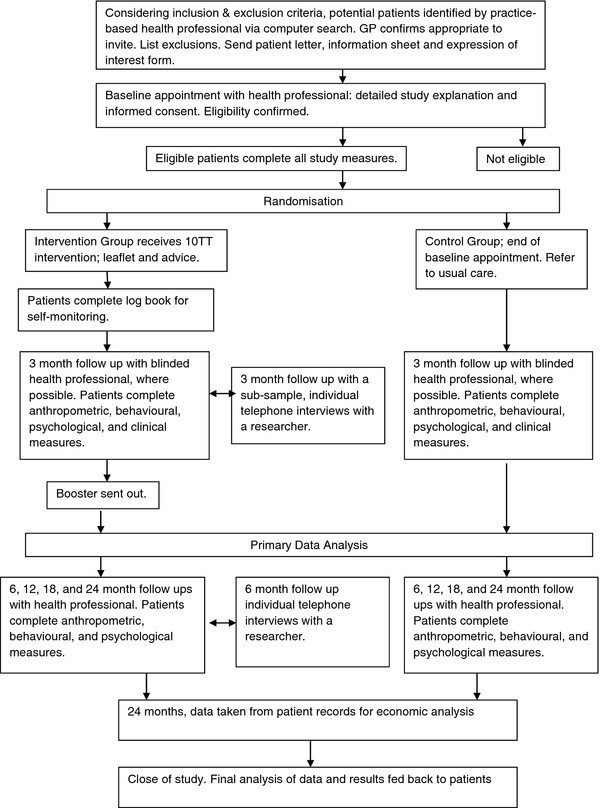
Background: Primary care is the first port of call for advice about weight control. There is hence a need for simple, effective interventions that can be delivered without specialist skills. We have developed such an intervention; the 10 Top Tips (10TT). This intervention was effective with respect to weight loss in a volunteer population, but has yet to be tested in primary care. The aim of this trial is therefore to test the effectiveness of the 10TT intervention in primary care, incorporating clinical outcomes and health economic analyses. Methods/Design: The trial is a two-arm, individually-randomised, controlled trial in obese (BMI ≥ 30) adults (n = 520) in primary care, comparing weight loss in patients receiving the 10TT intervention with weight loss in a control group of patients receiving usual care. The intervention is based on habit formation theory, using written materials to take people through a set of simple weight control behaviours with strategies to make them habitual; an approach that could make it more successful than others in establishing long-term behaviour change. Patients will be recruited from 14 General Practices across England. Randomisation will be through telephoning a central randomisation service using a computer-generated list of random numbers. Patients are followed up at 3, 6, 12, 18 and 24 months. The primary outcome is weight loss at 3 months, with assessment by a health professional who is blind to group allocation. Other follow-ups will be un-blinded. We will examine whether weight loss is maintained up to 24 months. We will also assess changes in the automaticity of the 10TT target behaviours and improvement in clinical markers for potential co-morbidities. Finally, we will undertake a full economic evaluation to establish cost-effectiveness in the NHS context. Discussion: If proven to be effective when delivered through primary care, 10TT could make a highly cost-effective contribution to improvements in population health. Trial Registration: ISRCTN16347068
Overview
The claims and statistics of this paper haven’t been checked yet.
Free: it reads the open-access text and checks the first 5 claims that cite a source we can check. Create a free account to check every claim.
Integrity signals
Registry
Cites
Statistics
Figures
Verification
Claims the paper makes
The claims and statistics of this paper haven’t been checked yet.
Free: it reads the open-access text and checks the first 5 claims that cite a source we can check. Create a free account to check every claim.
Claims other papers make about this one
Each is checked against this paper’s own text: does it say what the citing paper says it does?
The cited source says what the claim attributes to it.
In the citing paper
“Habit-based interventions promote the repetition of target behaviours in a consistent context in order to make them become more automatic and habitual [6, 7].”
The cited source says what the claim attributes to it.
In the citing paper
“The trial was powered to detect a significant weight difference between the intervention and control group as published previously [6].”
Self-check
Percentages, sums and reported differences re-computed from the paper’s own numbers.
The self-check needs the paper’s full text.
Citations
Cites
1 retracted
Psychological interventions for overweight or obesity
Shaw, K. A., O'Rourke, P., Del Mar, C., & Kenardy, J. (2005) · Cochrane Database of Systematic Reviews · doi:10.1002/14651858.cd003818.pub2 · Cited by 442 · cited 2×
“Existing reviews identify a need for novel, practical, empirically supported trials with adequate follow-up [8,48,51,52].”
BackgroundRetractedHow Many Steps/Day Are Enough?: Preliminary Pedometer Indices for Public Health
Tudor-Locke, C., & Bassett, D. R. (2004) · Sports Medicine · doi:10.2165/00007256-200434010-00001 · Cited by 2,054
How are habits formed: modelling habit formation in the real world
Lally, P., van Jaarsveld, C. H. M., Potts, H. W. W., & Wardle, J. (2010) · European Journal of Social Psychology · doi:10.1002/ejsp.674 · Cited by 2,036 · cited 1×
“Psychological research shows that repetition of a behaviour in a consistent context enables it to become automatic, and once automatic, it is more resistant to change than deliberative (intentional) behaviours [10,11].”
BackgroundSelf-citationReflections on Past Behavior: A Self‐Report Index of Habit Strength 1
Verplanken, B., & Orbell, S. (2003) · Journal of Applied Social Psychology · doi:10.1111/j.1559-1816.2003.tb01951.x · Cited by 2,030 · cited 1×
“Changes in the 10TT target behaviours will be measured using 2 items that ask about the frequency of the behaviour over the past two weeks, and automaticity of the behaviours (item taken from the Self-Report Habit Index [19]).”
MethodHu, F. B., Li, T. Y., Colditz, G. A., Willett, W. C., & Manson, J. E. (2003) · JAMA · doi:10.1001/jama.289.14.1785 · Cited by 1,892 · cited 1×
“Time spent in sedentary behaviors is related to overweight and obesity, independent of physical activity level [36,37]Decreasing sedentary time and increasing light–to-moderate activity may bring substantial health benefit [29,36].”
BackgroundQuality of life and pharmacoeconomics in clinical trials
Spilker, B. (1996) · DigitalGeorgetown (Georgetown University Library) · Cited by 1,862
Schulze, M. B. (2004) · JAMA · doi:10.1001/jama.292.8.927 · Cited by 1,639 · cited 2×
“Higher consumption of sugar-sweetened beverages is associated with greater weight gain [39].”
BackgroundA new look at habits and the habit-goal interface.
Wood, W., & Neal, D. T. (2007) · Psychological Review · doi:10.1037/0033-295x.114.4.843 · Cited by 1,470 · cited 2×
“they require minimal willpower or effort [10].”
BackgroundS UCCESSFUL W EIGHT L OSS M AINTENANCE
Wing, R. R., & Hill, J. O. (2001) · Annual Review of Nutrition · doi:10.1146/annurev.nutr.21.1.323 · Cited by 1,382 · cited 1×
“Following a low-fat diet is also associated with better weight maintenance [28].”
BackgroundAvenell, A., Broom, J., Brown, T., Poobalan, A., Aucott, L., Stearns, S., Smith, W., Jung, R., Campbell, M., & Grant, A. (2004) · Health Technology Assessment · doi:10.3310/hta8210 · Cited by 1,041 · cited 1×
“Existing reviews identify a need for novel, practical, empirically supported trials with adequate follow-up [8,48,51,52].”
Background
Research works printed but not linked: 3
- Mulvihill C Quigley R The management of obesity and overweight: An analysis of reviews of diet, physical activity and behavioural approaches: Evidence briefing 2003 London: Health Development Agency
- Department of Health At least five a week. Evidence on the impact of physical activity and its relationship to health. A report from the chief medical officer 2004 London: Department of Health
- Food Standards Agency Concept Testing of Alternative Labelling of Healthy/Less Healthy Foods 2004 London: Food Standards Agency
Cited by
Making health habitual: the psychology of ‘habit-formation’ and general practice
Gardner, B., Lally, P., & Wardle, J. (2012) · British Journal of General Practice · doi:10.3399/bjgp12x659466 · Cited by 591
Self-citationThe Handbook of Behavior Change
(2020) · Cambridge University Press eBooks · doi:10.1017/9781108677318 · Cited by 407
Changing Behavior Using the Theory of Planned Behavior
Ajzen, I., & Schmidt, P. (2020) · The Handbook of Behavior Change · doi:10.1017/9781108677318.002 · Cited by 266
Chan, A. P. C., Darko, A., & Ameyaw, E. E. (2017) · Sustainability · doi:10.3390/su9060969 · Cited by 240
“Another measure that was employed to minimize non-response bias in this research was maximizing follow-up during the data collection phase using reminder emails [55,56].”
MethodGardner, B., Sheals, K., Wardle, J., & McGowan, L. (2014) · International Journal of Behavioral Nutrition and Physical Activity · doi:10.1186/s12966-014-0135-7 · Cited by 182
“Larger scale trials with longer follow-up periods are needed, one of which is ongoing [18], but these findings nonetheless support habit-formation as a strategy for lasting behaviour change, at least in energy-balance related behaviours.”
BackgroundSelf-citation
Metadata
- Authors
- Beeken, R. J., Croker, H., Morris, S., Leurent, B., Omar, R., Nazareth, I., & Wardle, J.
- Affiliations
- University College London (GB)
- Corresponding author
- Wardle, Jane
- Venue
- BMC Public Health
- Published
- 2012-08-16
- Volume
- 12
- Issue
- 1
- Pages
- 667-667
- ISSN
- 1471-2458 (ISSN-L)
- PMC
- PMC3490723
- OpenAlex
- W2136478156
- Cited by
- 83
- References
- 45
- Citations by year
- 2024: 2 · 2023: 1 · 2022: 3 · 2021: 2 · 2020: 51 · 2019: 4 · 2018: 2 · 2017: 5 · 2016: 4 · 2015: 4 · 2014: 2 · 2013: 1 · 2012: 2
- FWCI
- 4.10
- Type
- journal article
- Language
- en
- Open access
- gold
- doi.org
- Licence
- Locations
- BMC Public Health (publishedVersion, cc-by)
- Europe PMC (PubMed Central) (publishedVersion, cc-by)
- PubMed Central (publishedVersion, cc-by)
- PubMed (publishedVersion)
- LSHTM Research Online (London School of Hygiene and Tropical Medicine) (acceptedVersion)
- DOAJ (DOAJ: Directory of Open Access Journals) (submittedVersion)
- UCL Discovery (University College London) (submittedVersion)
- Portuguese National Funding Agency for Science, Research and Technology (RCAAP Project by FCT) (submittedVersion, other-oa)
- Funders
- Cancer Research UK (14133)
- National Institute for Health and Care Research
- Medical Research Council
- Topics
- Social Sciences › Psychology › Applied Psychology › Behavioral Health and Interventions
- Health Sciences › Medicine › Public Health, Environmental and Occupational Health › Obesity and Health Practices
- Health Sciences › Medicine › Public Health, Environmental and Occupational Health › Obesity, Physical Activity, Diet
- Keywords
- weight management, obesity, habit formation, behavior change, primary care, weight loss, weight loss maintenance, cost-effectiveness, health economic evaluation, general practice
- MeSH terms
- Adolescent, Adult, Female, United Kingdom, Habits, Humans, Male, Middle Aged, Models, Theoretical, Obesity, Physician-Patient Relations, Primary Health Care, Research Design, Weight Loss, Qualitative Research, Risk Reduction Behavior, Young Adult, General Practice
About these checks
Registry, retraction, Cites and statistics results are computed, not judged, with one exception: a printed reference that no index lists is read once by a model before it counts as a citation error. Claims are extracted by a model and kept only when their quote appears verbatim in the text; each cited source is then checked, with a model’s help, for whether it says what the claim relies on. Those verdicts can be wrong — read the claim’s quote and the cited source before relying on one.
Statistics and arithmetic are recomputed, not judged.
Confidence bands are shown only for fields calibrated on our annotated test set. None is calibrated yet, so no band is shown.
What counts as a claim ›How we measure confidence ›How we check this ›
Are you an author, or do you see a problem with this page? Request a review
Data sources
Bibliographic data: Semantic Scholar, OpenAlex, Crossref.
Contains information from the Semantic Scholar Academic Graph Datasets, made available under the ODC Attribution License (ODC-BY 1.0).
Semantic Scholar’s data is described in: Kinney, R., et al. (2023). The Semantic Scholar Open Data Platform. arXiv:2301.10140.
