

Pre-pregnancy predictors of hypertension in pregnancy among Aboriginal and Torres Strait Islander women in north Queensland, Australia; a prospective cohort study
Open accessThe DOI matches its Crossref record; 35 of the 35 references it cites were found in a registry or an index.
Abstract
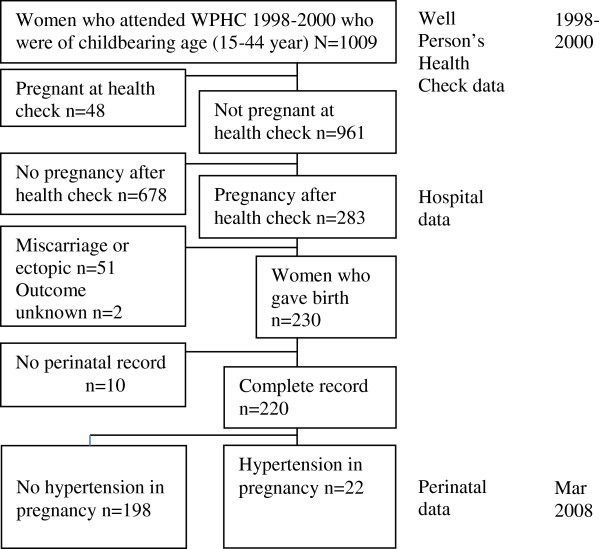
BACKGROUND: Compared to other Australian women, Indigenous women are frequently at greater risk for hypertensive disorders of pregnancy. We examined pre-pregnancy factors that may predict hypertension in pregnancy in a cohort of Aboriginal and Torres Strait Islander women in north Queensland. METHODS: Data on a cohort of 1009 Indigenous women of childbearing age (15-44 years) who participated in a 1998-2000 health screening program in north Queensland were combined with 1998-2008 Queensland hospitalisations data using probabilistic data linkage. Data on the women in the cohort who were hospitalised for birth (n = 220) were further combined with Queensland perinatal data which identified those diagnosed with hypertension in pregnancy. RESULTS: Of 220 women who gave birth, 22 had hypertension in the pregnancy after their health check. The mean age of women with and without hypertension was similar (23.7 years and 23.9 years respectively) however Aboriginal women were more affected compared to Torres Strait Islanders. Pre-pregnancy adiposity and elevated blood pressure at the health screening program were predictors of a pregnancy affected by hypertension. After adjusting for age and ethnicity, each 1 cm increase in waist circumference showed a 4% increased risk for hypertension in pregnancy (PR 1.04; 95% CI; 1.02-1.06); each 1 point increase in BMI showed a 9% adjusted increase in risk (1.09; 1.04-1.14). For each 1 mmHg increase in baseline systolic blood pressure there was an age and ethnicity adjusted 6% increase in risk and each 1 mmHg increase in diastolic blood pressure showed a 7% increase in risk (1.06; 1.03-1.09 and 1.07; 1.03-1.11 respectively). Among those free of diabetes at baseline, the presence of the metabolic syndrome (International Diabetes Federation criteria) predicted over a three-fold increase in age-ethnicity-adjusted risk (3.5; 1.50-8.17). CONCLUSIONS: Pre-pregnancy adiposity and features of the metabolic syndrome among these young Aboriginal and Torres Strait Islander women track strongly to increased risk of hypertension in pregnancy with associated risks to the health of babies.
Overview
The claims and statistics of this paper haven’t been checked yet.
Free: it reads the open-access text and checks the first 5 claims that cite a source we can check. Create a free account to check every claim.
Integrity signals
Registry
Cites
Statistics
Figures
Verification
Claims the paper makes
The claims and statistics of this paper haven’t been checked yet.
Free: it reads the open-access text and checks the first 5 claims that cite a source we can check. Create a free account to check every claim.
Claims other papers make about this one
Each is checked against this paper’s own text: does it say what the citing paper says it does?
The source backs part of the claim, not all of it — or backs it for a different population, condition or comparison.
In the citing paper
“Higher incidence rates of HDP have also been found in Māori, Indigenous Australian, American Indian and Alaskan Native populations94,115–117”
From A global view of hypertensive disorders and diabetes mellitus during pregnancy (2022) · cites this paper as [117]
Experimental — accuracy not yet measuredThe source backs part of the claim, not all of it — or backs it for a different population, condition or comparison.
In the citing paper
“Certain ethnic and racial groups have been widely reported to have a disproportionately increased disease burden of maternal CMDs.”
From A global view of hypertensive disorders and diabetes mellitus during pregnancy (2022) · cites this paper as [117]
Experimental — accuracy not yet measured
Self-check
Percentages, sums and reported differences re-computed from the paper’s own numbers.
The self-check needs the paper’s full text.
Citations
Cites
(2000) · PubMed · Cited by 13,173
Obesity : Preventing and managing the global epidemic
Akram, D. S., Astrup, A. V., Atinmo, T., Boissin, J.-L., Bray, G. A., Carroll, K. N., Chitson, P., Chen, C., Dietz, W. H., Hill, J. O., et al. (2000) · Research at the University of Copenhagen (University of Copenhagen) · Cited by 12,945
Sibai, B., Dekker, G., & Kupferminc, M. (2005) · The Lancet · doi:10.1016/s0140-6736(05)17987-2 · Cited by 1,814
Risk factors for pre-eclampsia at antenatal booking: systematic review of controlled studies
Duckitt, K., & Harrington, D. (2005) · BMJ · doi:10.1136/bmj.38380.674340.e0 · Cited by 1,784 · cited 1×
“67) is one of the few amenable to intervention [28].”
BackgroundInfluence of Weight Reduction on Blood Pressure: A Meta-Analysis of Randomized Controlled Trials
Neter, J. E., Stam, B. E., Kok, F. J., Grobbee, D. E., & Geleijnse, J. M. (2003) · Hypertension · doi:10.1161/01.hyp.0000094221.86888.ae · Cited by 1,391 · cited 1×
“Programs that incorporate a combination of physical activity and nutrition education have been shown to reduce body weight [29] and blood pressure [30,31].”
BackgroundSIBAI, B., DEKKER, G., & KUPFERMINC, M. (2005) · The Lancet · doi:10.1016/s0140-6736(05)71003-5 · Cited by 1,089
Exercise for overweight or obesity
Shaw, K. A., Gennat, H. C., O'Rourke, P., & Del Mar, C. (2006) · Cochrane Database of Systematic Reviews · doi:10.1002/14651858.cd003817.pub3 · Cited by 950 · cited 1×
“Programs that incorporate a combination of physical activity and nutrition education have been shown to reduce body weight [29] and blood pressure [30,31].”
BackgroundA meta-analysis of randomized controlled trials: Efficacy of selenium treatment for sepsis
Li, S., Tang, T., Guo, P., Zou, Q., Ao, X., Hu, L., & Tan, L. (2019) · Medicine · doi:10.1097/md.0000000000014733 · Cited by 802
The health and welfare of Australia?s Aboriginal and Torres Strait Islander peoples 1999
Cunningham, J. (1999) · New South Wales Public Health Bulletin · doi:10.1071/nb99075 · Cited by 801
Summary of the NHLBI Working Group on Research on Hypertension During Pregnancy
Roberts, J. M., Pearson, G., Cutler, J., & Lindheimer, M. (2003) · Hypertension · doi:10.1161/01.hyp.0000054981.03589.e9 · Cited by 677
The prevalence and impact of overweight and obesity in an Australian obstetric population
Callaway, L. K., Chang, A. M., McIntyre, H. D., & Prins, J. B. (2006) · Medical Journal of Australia · doi:10.5694/j.1326-5377.2006.tb00115.x · Cited by 634
Overweight, Obesity, and Blood Pressure: The Effects of Modest Weight Reduction
Mertens, I. L., & van Gaal, L. F. (2000) · Obesity Research · doi:10.1038/oby.2000.32 · Cited by 330 · cited 1×
“Programs that incorporate a combination of physical activity and nutrition education have been shown to reduce body weight [29] and blood pressure [30,31].”
BackgroundEffect of prepregnancy body mass index categories on obstetrical and neonatal outcomes
Abenhaim, H. A., Kinch, R. A., Morin, L., Benjamin, A., & Usher, R. (2006) · Archives of Gynecology and Obstetrics · doi:10.1007/s00404-006-0219-y · Cited by 285 · cited 1×
“Pre-pregnancy overweight and obesity have been identified as risk factors for hypertensive disorders of pregnancy [14,15].”
BackgroundPre-eclampsia and cardiovascular disease: metabolic syndrome of pregnancy?
RODIE, V (2004) · Atherosclerosis · doi:10.1016/j.atherosclerosis.2004.01.038 · Cited by 275
Joseph, K. S., & Mahey, J. (2009) · Chronic Diseases in Canada · doi:10.24095/hpcdp.29.3.01 · Cited by 231
Hypertensive disorders in pregnancy: a population‐based study
Roberts, C. L., Ford, J. B., Henderson‐Smart, D. J., Algert, C. S., & Morris, J. M. (2005) · Medical Journal of Australia · doi:10.5694/j.1326-5377.2005.tb06730.x · Cited by 215 · cited 2×
“Populationbased Australian studies undertaken in Victoria [4] and South Australia [5] have shown a prevalence of 9.”
BackgroundInfluentialThe role of obesity in preeclampsia
Roberts, J. M., Bodnar, L. M., Patrick, T. E., & Powers, R. W. (2011) · Pregnancy Hypertension: An International Journal of Women's Cardiovascular Health · doi:10.1016/j.preghy.2010.10.013 · Cited by 203 · cited 1×
“In the United States, obesity is the leading risk factor for preeclampsia; it confers a threefold increased risk and is present in 30% of cases [16].”
BackgroundPregnancy outcomes in women with chronic hypertension: a population-based study.
Gilbert, W. M., Young, A. L., & Danielsen, B. H. (2007) · PubMed · Cited by 200
Lindheimer, M. D., Taler, S. J., & Cunningham, F. G. (2010) · Journal of the American Society of Hypertension · doi:10.1016/j.jash.2010.03.002 · Cited by 200
Exercise Guidelines in Pregnancy: New Perspectives
Zavorsky, G. S., & Longo, L. D. (2011) · Sports Medicine · doi:10.2165/11583930-000000000-00000 · Cited by 183
Hypertension in Pregnancy: A Comprehensive Update
Jim, B., Sharma, S., Kebede, T., & Acharya, A. (2010) · Cardiology in Review · doi:10.1097/crd.0b013e3181c60ca6 · Cited by 106
Leonard, D., McDermott, R. A., O’Dea, K., Rowley, K., Pensio, P., Sambo, E., Twist, A., Toolis, R., Lowson, S., & Best, J. D. (2002) · Australian and New Zealand Journal of Public Health · doi:10.1111/j.1467-842x.2002.tb00907.x · Cited by 91 · cited 1×
“Australian Aboriginal and Torres Strait Islander women are also at comparatively higher risk for developing chronic hypertension and cardiovascular disease at a younger age than other Australian women [7,8].”
BackgroundSelf-citationPanaretto, K. S., Lee, H. J., Mitchell, M. R., Larkins, S., Manessis, V., Buettner, P. G., & Watson, D. (2006) · Australian and New Zealand Journal of Public Health · doi:10.1111/j.1467-842x.2006.tb00111.x · Cited by 90 · cited 1×
“Hypertension during pregnancy has been identified as a predictor of poor birth outcomes in Aboriginal and Torres Strait Islander women in north Queensland [13].”
BackgroundPregnancy outcomes in urban Aboriginal women
Costa, C. M. D., & Child, A. (1996) · The Medical Journal of Australia · doi:10.5694/j.1326-5377.1996.tb122160.x · Cited by 80 · cited 1×
“2% respectively, however, Australian Indigenous women have been reported as having 66% greater risk for pregnancy-induced hypertension when compared with non-Indigenous women [6].”
BackgroundAlbuminuria: Marker or target in indigenous populations
Hoy, W. E., & McDonald, S. P. (2004) · Kidney International · doi:10.1111/j.1523-1755.2004.09207.x · Cited by 79 · cited 1×
“4-34 g/mol, and macroalbuminuria as >34 g/mol [26].”
Perceived Exertion during Prepregnancy Physical Activity and Preeclampsia Risk
RUDRA, C. B., WILLIAMS, M. A., LEE, I.-M., MILLER, R. S., & SORENSEN, T. K. (2005) · Medicine & Science in Sports & Exercise · doi:10.1249/01.mss.0000175862.41620.41 · Cited by 78 · cited 1×
“It has been shown that when women exercise between 3 months and 1 year before or during pregnancy, the risk of preeclampsia is reduced [32,33].”
BackgroundPrepregnancy body mass index, hypertensive disorders of pregnancy, and long-term maternal mortality
Samuels‐Kalow, M. E., Funai, E. F., Buhimschi, C. S., Norwitz, E. R., Perrin, M. C., Calderon‐Margalit, R., Deutsch, L., Paltiel, O., Friedlander, Y., Manor, O., et al. (2007) · American Journal of Obstetrics and Gynecology · doi:10.1016/j.ajog.2007.04.043 · Cited by 77
McDermott, R. A., Campbell, S., Li, M., & McCulloch, B. (2009) · Public Health Nutrition · doi:10.1017/s1368980009005783 · Cited by 73 · cited 1×
“With the change from traditional carbohydrate based diets to energy dense high fat diets, combined with lower levels of physical activity [17], rates of obesity among Aboriginal and Torres Strait Islander women of childbearing age have escalated [18].”
BackgroundSelf-citationHatzis, C., Bertsias, G. K., Linardakis, M. K., Scott, J. M., & Kafatos, A. G. (2006) · Nutrition Journal · doi:10.1186/1475-2891-5-5 · Cited by 62 · cited 1×
“The physical activity, smoking and alcohol intake measures have been widely used [23] and the 24-h recall dietary questionnaire and red cell folate measure have been validated against other measures of micronutrient intake and the quality of the diet with respect to fruit and vegetables [24,25].”
MethodMiller, G., McDermott, R. A., McCulloch, B., Leonard, D., Arabena, K., & Muller, R. (2002) · Australian Health Review · doi:10.1071/ah020136b · Cited by 47 · cited 2×
“The Aboriginal and Torres Strait Islander women in this study were participants in the March 1998-December 2000 Well Person’s Health Check (WPHC) crosssectional health survey [19], which included 26 rural and remote Indigenous communities in the Bowen, Cairns, Cape York, Torres Strait and Mount Isa Health service dist…”
BackgroundSelf-citationO’Dea, K. (2005) · Heart Lung and Circulation · doi:10.1016/j.hlc.2005.06.004 · Cited by 41 · cited 2×
“With the change from traditional carbohydrate based diets to energy dense high fat diets, combined with lower levels of physical activity [17], rates of obesity among Aboriginal and Torres Strait Islander women of childbearing age have escalated [18].”
BackgroundRisk factors for hypertension during pregnancy in South Australia
Jacobs, D. J., Vreeburg, S. A., Dekker, G. A., Heard, A. R., Priest, K. R., & Chan, A. (2003) · Australian and New Zealand Journal of Obstetrics and Gynaecology · doi:10.1046/j.0004-8666.2003.00120.x · Cited by 39 · cited 8×
“3School of Nursing and Midwifery, Division of Health Sciences, University of South Australia, Adelaide, SA, Australia.”
BackgroundInfluentialCOYNE, K. L., Costa, C. M. D., Heazlewood, R., & Newman, H. C. S. (2008) · Australian and New Zealand Journal of Obstetrics and Gynaecology · doi:10.1111/j.1479-828x.2008.00861.x · Cited by 30 · cited 1×
“The physical activity, smoking and alcohol intake measures have been widely used [23] and the 24-h recall dietary questionnaire and red cell folate measure have been validated against other measures of micronutrient intake and the quality of the diet with respect to fruit and vegetables [24,25].”
MethodMcCulloch, B., McDermott, R. A., Miller, G., Leonard, D., Elwell, M., & Müller, R. (2003) · Diabetes Care · doi:10.2337/diacare.26.2.397 · Cited by 29 · cited 1×
“The physical activity, smoking and alcohol intake measures have been widely used [23] and the 24-h recall dietary questionnaire and red cell folate measure have been validated against other measures of micronutrient intake and the quality of the diet with respect to fruit and vegetables [24,25].”
MethodSelf-citationCampbell, S., Lynch, J. W., Esterman, A., & McDermott, R. A. (2011) · Maternal and Child Health Journal · doi:10.1007/s10995-011-0889-3 · Cited by 25 · cited 2×
“Characteristics of the cohort (demographics, waist circumferences BMIs, smoking status, alcohol use, fruit and vegetable intake, physical activity, blood pressure, blood lipids, red cell folate, fasting glucose, kidney and liver function tests, prevalences of metabolic syndrome and diabetes) are reported in detail els…”
BackgroundSelf-citation
Research works printed but not linked: 2
- Roberts J Bodnar L Patrick T Powers R The role of obesity in preeclampsia Pregnancy Hypertens 2011 1 6 16 21532964 PMC3082136 · DOI · Paper page
- Flenady V King J Charles A Perinatal Society of Australia and New Zealand (PSANZ) Clinical Practice Guidelines for Perinatal Mortality 2009 2 Canberra: PSANZ
Cited by
A global view of hypertensive disorders and diabetes mellitus during pregnancy
Jiang, L., Tang, K., Magee, L. A., von Dadelszen, P., Ekeroma, A., Li, X., Zhang, E., & Bhutta, Z. A. (2022) · Nature Reviews Endocrinology · doi:10.1038/s41574-022-00734-y · Cited by 314
Vanderlelie, J., Scott, R., Shibl, R., Lewkowicz, J., Perkins, A., & Scuffham, P. A. (2016) · Maternal & Child Nutrition · doi:10.1111/mcn.12133 · Cited by 37
Xiong, Y., Chen, J., Wu, Y., Zhao, P., Liao, M., Guo, J., Liu, C., Zheng, M., Ren, Y., Zou, K., et al. (2025) · EClinicalMedicine · doi:10.1016/j.eclinm.2025.103395 · Cited by 36
Mogos, M. F., Salinas‐Miranda, A., Salemi, J. L., Medina, I. M., & Salihu, H. M. (2016) · Journal of Immigrant and Minority Health · doi:10.1007/s10903-016-0410-6 · Cited by 25
“The 26 % average risk reduction for immigrants observed in this study emphasizes that immigration status may be an important risk factor or proxy for PRH, with a risk magnitude similar to other perinatal conditions such as a one centimeter increase in waist circumference [44], a one point increase in body mass index (…”
BackgroundEngstrom, T., Lobo, E. H., Watego, K., Nelson, C., Wang, J., Wong, H., Kim, S. L., Oh, S. I., Lawley, M., Gorse, A., et al. (2024) · npj Digital Medicine · doi:10.1038/s41746-024-01070-3 · Cited by 28
“…measurements 23,32,40 , laboratory report 31,50,74,87 , disease history and severity 58,71,92 , costs 40,50,97 , socioeconomic status 23 , risks 51,77 , charts 53 , health service utilisation 24,46 , diagnosis and treatment 39,40,49,55,80 , discharge abstracts 21 , and critical social and…”
Metadata
- Authors
- Campbell, S. K., Lynch, J., Esterman, A., & McDermott, R.
- Affiliations
- University of South Australia (AU)
- The University of Adelaide (AU)
- Corresponding author
- Campbell, Sandra K
- Venue
- BMC Public Health
- Published
- 2013-02-15
- Volume
- 13
- Issue
- 1
- Pages
- 138-138
- ISSN
- 1471-2458 (ISSN-L)
- PMC
- PMC3599805
- OpenAlex
- W2056378399
- Cited by
- 18
- References
- 35
- Citations by year
- 2025: 2 · 2024: 3 · 2022: 2 · 2020: 1 · 2019: 2 · 2018: 1 · 2017: 2 · 2016: 3 · 2014: 2
- FWCI
- 1.87
- Type
- journal article
- Language
- en
- Open access
- gold
- doi.org
- Licence
- Locations
- BMC Public Health (publishedVersion, cc-by)
- Europe PMC (PubMed Central) (publishedVersion, cc-by)
- PubMed Central (publishedVersion, cc-by)
- PubMed (publishedVersion)
- Adelaide Research & Scholarship (AR&S) (University of Adelaide) (submittedVersion, cc-by)
- ResearchOnline - JCU (James Cook University) (submittedVersion)
- UniSA Research Outputs Repository (University of South Australia) (submittedVersion, other-oa)
- Funders
- National Heart Foundation of Australia
- National Health and Medical Research Council (279402, 456402)
- Topics
- Health Sciences › Medicine › Obstetrics and Gynecology › Pregnancy and preeclampsia studies
- Health Sciences › Medicine › Cardiology and Cardiovascular Medicine › Blood Pressure and Hypertension Studies
- Health Sciences › Medicine › Obstetrics and Gynecology › Gestational Diabetes Research and Management
- Keywords
- hypertension in pregnancy, hypertensive disorders of pregnancy, Aboriginal and Torres Strait Islander women, Indigenous health, metabolic syndrome, waist circumference, body mass index, baseline blood pressure, risk prediction, North Queensland
- MeSH terms
- Australian Aboriginal and Torres Strait Islander Peoples, Adolescent, Adult, Female, Humans, Hypertension, Predictive Value of Tests, Pregnancy, Pregnancy Complications, Cardiovascular, Prospective Studies, Queensland, Risk Factors, Preconception Care, Risk Assessment, Adiposity, Young Adult
About these checks
Registry, retraction, Cites and statistics results are computed, not judged, with one exception: a printed reference that no index lists is read once by a model before it counts as a citation error. Claims are extracted by a model and kept only when their quote appears verbatim in the text; each cited source is then checked, with a model’s help, for whether it says what the claim relies on. Those verdicts can be wrong — read the claim’s quote and the cited source before relying on one.
Statistics and arithmetic are recomputed, not judged.
Confidence bands are shown only for fields calibrated on our annotated test set. None is calibrated yet, so no band is shown.
What counts as a claim ›How we measure confidence ›How we check this ›
Are you an author, or do you see a problem with this page? Request a review
Data sources
Bibliographic data: Semantic Scholar, OpenAlex, Crossref.
Contains information from the Semantic Scholar Academic Graph Datasets, made available under the ODC Attribution License (ODC-BY 1.0).
Semantic Scholar’s data is described in: Kinney, R., et al. (2023). The Semantic Scholar Open Data Platform. arXiv:2301.10140.
