

Are healthcare workers’ intentions to vaccinate related to their knowledge, beliefs and attitudes? a systematic review
Open accessThe DOI matches its Crossref record; 77 of the 78 references it cites were found in a registry or an index.
Abstract
Background: The Summit of Independent European Vaccination Experts (SIEVE) recommended in 2007 that efforts be made to improve healthcare workers’ knowledge and beliefs about vaccines, and their attitudes towards them, to increase vaccination coverage. The aim of the study was to compile and analyze the areas of disagreement in the existing evidence about the relationship between healthcare workers’ knowledge, beliefs and attitudes about vaccines and their intentions to vaccinate the populations they serve. Methods: We conducted a systematic search in four electronic databases for studies published in any of seven different languages between February 1998 and June 2009. We included studies conducted in developed countries that used statistical methods to relate or associate the variables included in our research question. Two independent reviewers verified that the studies met the inclusion criteria, assessed the quality of the studies and extracted their relevant characteristics. The data were descriptively analyzed. Results: Of the 2354 references identified in the initial search, 15 studies met the inclusion criteria. The diversity in the study designs and in the methods used to measure the variables made it impossible to integrate the results, and each study had to be assessed individually. All the studies found an association in the direction postulated by the SIEVE experts: among healthcare workers, higher awareness, beliefs that are more aligned with scientific evidence and more favorable attitudes toward vaccination were associated with greater intentions to vaccinate. All the studies included were cross-sectional; thus, no causal relationship between the variables was established. Conclusion: The results suggest that interventions aimed at improving healthcare workers’ knowledge, beliefs and attitudes about vaccines should be encouraged, and their impact on vaccination coverage should be assessed.
Overview
The claims and statistics of this paper haven’t been checked yet.
Free: it reads the open-access text and checks the first 5 claims that cite a source we can check. Create a free account to check every claim.
Integrity signals
Registry
Cites
Statistics
Figures
Verification
Claims the paper makes
The claims and statistics of this paper haven’t been checked yet.
Free: it reads the open-access text and checks the first 5 claims that cite a source we can check. Create a free account to check every claim.
Claims other papers make about this one
Each is checked against this paper’s own text: does it say what the citing paper says it does?
The source backs part of the claim, not all of it — or backs it for a different population, condition or comparison.
In the citing paper
“The methodological quality of the studies was assessed using the Newcastle-Ottawa Scale, based on criteria related to selection and comparability between cohorts and related to study outcomes. The methodological quality of the cross-sectional studies was performed using the adapted Newcastle Ottawa for cross-sectional studies [20]. The evaluation was performed in pairs, by four reviewers and dis”
From The associations between screen time and mental health in adolescents: a systematic review (2023) · cites this paper as [20]
Experimental — accuracy not yet measuredThe cited source says what the claim attributes to it.
In the citing paper
“The NOS classification has been used in similar systematic reviews (Herzog et al., 2013; Moore et al., 2021).”
From Parental stress and mental health outcomes following very preterm birth: A systematic review of recent findings (2024) · cites this paper as Herzog et al., 2013
The cited source says what the claim attributes to it.
In the citing paper
“The present review uses the adapted Newcastle-Ottawa Scale for crosssectional studies (Herzog et al., 2013) to critically evaluate the risk of bias in the included studies.”
From Parental stress and mental health outcomes following very preterm birth: A systematic review of recent findings (2024) · cites this paper as Herzog et al., 2013
The cited source says what the claim attributes to it.
In the citing paper
“We used the Newcastle-Ottawa validated tool for the evaluation of internal validity of longitudinal studies (NOS) 32 and the adapted version for cross-sectional studies.33”
From Defining risk factors associated with difficult peripheral venous Cannulation: A systematic review and meta-analysis (2020) · cites this paper as [33]
The cited source says what the claim attributes to it.
In the citing paper
“All eligible studies were assessed for quality using an adapted version of the Newcastle-Ottawa quality assessment scale for cross-sectional studies, which was used to score the risk of bias for each study [29].”
From Problematic Social Media Use in Adolescents and Young Adults: Systematic Review and Meta-analysis. (2022) · cites this paper as [29]
1 more claim about this paper
Create a free account to see every claim other papers make about this one.
Self-check
Percentages, sums and reported differences re-computed from the paper’s own numbers.
The self-check needs the paper’s full text.
Citations
Cites
1 retracted
Wakefield, A., Murch, S., Anthony, A., Linnell, J., Casson, D., Malik, M., Berelowitz, M., Dhillon, A., Thomson, M., Harvey, P., et al. (1998) · The Lancet · doi:10.1016/s0140-6736(97)11096-0 · Cited by 3,006
RetractedDermyshi, E., Wang, Y., Yan, C., Hong, W., Qiu, G., Gong, X., & Zhang, T. (2017) · Neonatology · doi:10.1159/000454668 · Cited by 24,451
Meta-analysis of Observational Studies in Epidemiology<SUBTITLE>A Proposal for Reporting</SUBTITLE>
Stroup, D. F. (2000) · JAMA · doi:10.1001/jama.283.15.2008 · Cited by 20,623
Stang, A. (2010) · European Journal of Epidemiology · doi:10.1007/s10654-010-9491-z · Cited by 17,396 · cited 1×
“The tools used to determine the risk of bias and the quality of the studies included were based on the Newcastle-Ottawa scales, which are widely used for observational studies [37].”
MethodTen great public health achievements--United States, 1900-1999.
(1999) · PubMed · Cited by 662
Do Parents Understand Immunizations? A National Telephone Survey
Gellin, B. G., Maibach, E. W., Marcuse, E. K., & for the National Network for Immunization Information Steering Committee∥ (2000) · Pediatrics · doi:10.1542/peds.106.5.1097 · Cited by 512
Meta-analysis of Observational Studies in Epidemiology
Stroup, D. F., Berlin, J. A., Morton, S. C., Olkin, I., Williamson, G. D., Rennie, D., Moher, D., Becker, B. J., Sipe, T. A., & Thacker, S. B. (2000) · Cited by 473
Mills, E., Jadad, A. R., Ross, C., & Wilson, K. (2005) · Journal of Clinical Epidemiology · doi:10.1016/j.jclinepi.2005.09.002 · Cited by 374 · cited 2×
“It ́s also interesting to highlight that the knowledge, beliefs and attitude themes explored in the HCW in the included studies, do not differ from the barriers towards vaccination explored in the general population [6].”
BackgroundSmallpox: The Triumph over the Most Terrible of the Ministers of Death
Barquet, N., & Domingo, P. (1997) · Annals of Internal Medicine · doi:10.7326/0003-4819-127-8_part_1-199710150-00010 · Cited by 263
Factors influencing pandemic influenza vaccination of healthcare workers—A systematic review
Prematunge, C., Corace, K., McCarthy, A., Nair, R. C., Pugsley, R., & Garber, G. (2012) · Vaccine · doi:10.1016/j.vaccine.2012.05.018 · Cited by 186 · cited 1×
“Even HCW (healthcare workers) have low vaccine coverage, as is the case with the influenza vaccine, due to various factors, including knowledge about the disease, knowledge about the vaccine or past beliefs and past attitudes (related to influenza vaccination in previous seasons) [10,11].”
BackgroundStefanoff, P., Mamelund, S., Robinson, M., Netterlid, E., Tuells, J., Bergsaker, M. A. R., Heijbel, H., & Yarwood, J. (2010) · Vaccine · doi:10.1016/j.vaccine.2010.06.009 · Cited by 184
Salmon, D. A., Moulton, L. H., Omer, S. B., Chace, L. M., Klassen, A. C., Talebian, P., & Halsey, N. A. (2004) · PEDIATRICS · doi:10.1542/peds.113.6.e552 · Cited by 114
How to optimise the coverage rate of infant and adult immunisations in Europe
Schmitt, H.-J., Booy, R., Aston, R., Van Damme, P., Schumacher, R. F., Campins, M., Rodrigo, C., Heikkinen, T., Weil-Olivier, C., Finn, A., et al. (2007) · BMC Medicine · doi:10.1186/1741-7015-5-11 · Cited by 112
BOVIER, P. A., Chamot, E., Gallacchi, M. B., & Loutan, L. (2001) · Vaccine · doi:10.1016/s0264-410x(01)00223-7 · Cited by 110 · cited 1×
“Health professionals are key players in recommending vaccination and encouraging the final decision to be vaccinated [12-17].”
BackgroundBedford, H. (2000) · BMJ · doi:10.1136/bmj.320.7229.240 · Cited by 101
Second dose of measles, mumps, and rubella vaccine: questionnaire survey of health professionals
Petrovic, M. (2001) · BMJ · doi:10.1136/bmj.322.7278.82 · Cited by 83 · cited 1×
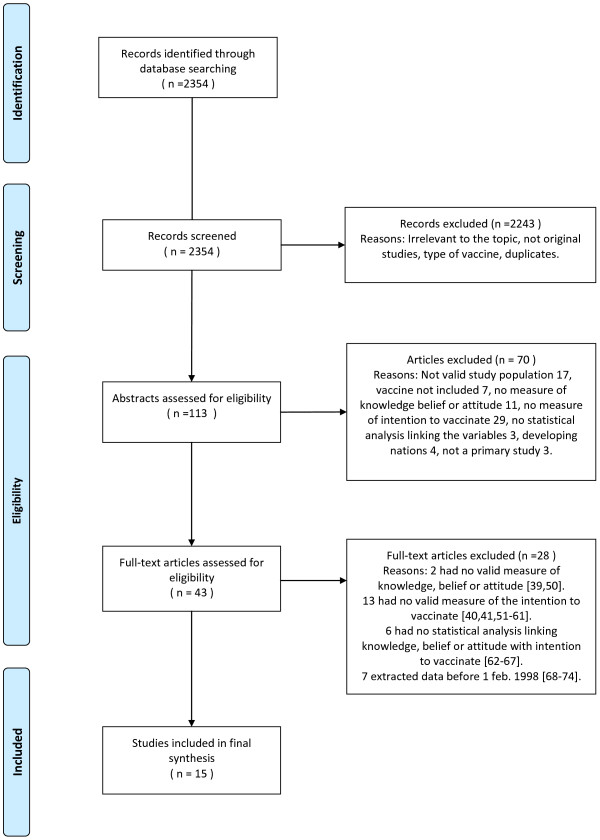
“Figure 1 Flow chart of the reviewing process [39-41,50-74].”
BackgroundWilson, K. R., Mills, E. J., Norman, G. R., & TOMLINSON, G. A. (2004) · Vaccine · doi:10.1016/j.vaccine.2004.12.002 · Cited by 69 · cited 1×
“Figure 1 Flow chart of the reviewing process [39-41,50-74].”
BackgroundVorsters, A., Tack, S., Hendrickx, G., Vladimirova, N., Bonanni, P., Pistol, A., Metličar, T., Pasquín, M. J. Á., Mayer, M. Á., Aronsson, B., et al. (2009) · Vaccine · doi:10.1016/j.vaccine.2009.12.033 · Cited by 69 · cited 1×
“Despite this lack of evidence, various studies have evaluated the impact of interventions on the intent to vaccinate or the practice of vaccination [25,39-44], and others have even assessed their cost-effectiveness [45].”
BackgroundThe obstetrician-gynecologist's role in vaccine-preventable diseases and immunization
Gonik, B. (2000) · Obstetrics & Gynecology · doi:10.1016/s0029-7844(00)00860-7 · Cited by 66 · cited 3×
“Of the studies ultimately selected, 14 were cross-sectional studies [19-32], and one was a case–control study [33].”
BackgroundMills, E. J., Montori, V. M., Ross, C. P., Shea, B., Wilson, K. R., & Guyatt, G. H. (2005) · Journal of Clinical Epidemiology · doi:10.1016/j.jclinepi.2005.01.014 · Cited by 61 · cited 1×
“Studies that investigate why a segment of the population does not accept universal vaccination [5-7] have highlighted reasons such as lack of knowledge, misperceptions and distrust in vaccines [8], combined with a low perceived risk of acquiring the disease because the incidence has declined as a result of vaccination…”
BackgroundSchmitt, H., Booy, R., Weil-Olivier, C., Damme, P. V., Cohen, R., & Peltola, H. (2003) · The Lancet Infectious Diseases · doi:10.1016/s1473-3099(03)00519-x · Cited by 60
Vaccine knowledge and practices of primary care providers of exempt vs. vaccinated children
Salmon, D. A., Pan, W., Omer, S. B., Návar, A. M., Orenstein, W. A., Marcuse, E. K., Taylor, J. A., deHart, M. P., Stokley, S. K., Carter, T., et al. (2008) · Human Vaccines · doi:10.4161/hv.4.4.5752 · Cited by 60
Family physician perspectives on barriers to childhood immunisation
Petousis‐Harris, H., Goodyear‐Smith, F., Turner, N. M., & Soe, B. T. A. (2003) · Vaccine · doi:10.1016/j.vaccine.2003.10.037 · Cited by 58 · cited 1×
“Figure 1 Flow chart of the reviewing process [39-41,50-74].”
BackgroundLlupià, A., García‐Basteiro, A. L., Mena, G., Ríos, J., Puig, J., Bayas, J. M., & Trilla, A. (2012) · PLoS ONE · doi:10.1371/journal.pone.0039496 · Cited by 53 · cited 1×
“Even HCW (healthcare workers) have low vaccine coverage, as is the case with the influenza vaccine, due to various factors, including knowledge about the disease, knowledge about the vaccine or past beliefs and past attitudes (related to influenza vaccination in previous seasons) [10,11].”
BackgroundFamily practice nurse views on barriers to immunising children
Petousis‐Harris, H., Goodyear‐Smith, F., Turner, N. M., & Soe, B. T. A. (2004) · Vaccine · doi:10.1016/j.vaccine.2004.11.038 · Cited by 50 · cited 4×
“…coverage per each contraindication less stated At 8 months 2B,1C,3E 2.0% (95% CI 0.3-3.7) p < 0.05 At 19 months 2.6% (95% CI 1.1 - 4.7) p < 0.05 Petousis-Harris et al. (2005) [28] New Zealand 150/89,3% family practice nurses Knowledge in vaccine contraindications Report of vaccination…”
BackgroundInfluentialImmunisation: causes of failure and strategies and tactics for success.
Nicoll, A., Elliman, D. A. C., & Begg, N. T. (1989) · BMJ · doi:10.1136/bmj.299.6703.808 · Cited by 50
Varicella Immunization Practices and the Factors That Influence Them
Schaffer, S. J., & Bruno, S. (1999) · Archives of Pediatrics and Adolescent Medicine · doi:10.1001/archpedi.153.4.357 · Cited by 48 · cited 1×
“Figure 1 Flow chart of the reviewing process [39-41,50-74].”
BackgroundPediatric disease burden and vaccination recommendations: understanding local differences
de Gentile, A. S., Bhutta, Z. A., Bravo, L. C., Samy, A. G., Garcia, R. D. J., Hoosen, A. A., Islam, T., Karimi, A., Salem, M. A., Simasathien, S., et al. (2010) · International Journal of Infectious Diseases · doi:10.1016/j.ijid.2009.11.006 · Cited by 48 · cited 2×
“HCWs’ perceptions of vaccines and of vaccinepreventable diseases may be different in developing countries because they face different disease burdens, and this is the reason why these studies were not included [35,36].”
BackgroundDavis, M. M., Ndiaye, S. M., Freed, G. L., & Clark, S. J. (2003) · The Journal of the American Board of Family Medicine · doi:10.3122/jabfm.16.5.363 · Cited by 48 · cited 7×
“Of the studies ultimately selected, 14 were cross-sectional studies [19-32], and one was a case–control study [33].”
BackgroundInfluentialReactions of Pediatricians to the Recommendation for Universal Varicella Vaccination
Newman, R. D., & Taylor, J. A. (1998) · Archives of Pediatrics and Adolescent Medicine · doi:10.1001/archpedi.152.8.792 · Cited by 47 · cited 1×
“Figure 1 Flow chart of the reviewing process [39-41,50-74].”
BackgroundEhresmann, K., Mills, W. A., Loewenson, P. R., & Moore, K. A. (2000) · American Journal of Public Health · doi:10.2105/ajph.90.12.1917 · Cited by 42 · cited 1×
“Figure 1 Flow chart of the reviewing process [39-41,50-74].”
BackgroundDeveloping Curricula to Promote Preventive Medicine Skills
Zimmerman, R. K. (1997) · JAMA · doi:10.1001/jama.1997.03550090029028 · Cited by 42
Addressing Parents’ Concerns About Childhood Immunizations: A Tutorial for Primary Care Providers
Levi, B. H. (2007) · PEDIATRICS · doi:10.1542/peds.2006-2627 · Cited by 42 · cited 1×
“Despite this lack of evidence, various studies have evaluated the impact of interventions on the intent to vaccinate or the practice of vaccination [25,39-44], and others have even assessed their cost-effectiveness [45].”
BackgroundA survey of attitudes towards paediatric vaccinations amongst Canadian naturopathic students
Wilson, K. R., Mills, E., Boon, H. S., TOMLINSON, G. A., & Ritvo, P. (2003) · Vaccine · doi:10.1016/j.vaccine.2003.08.014 · Cited by 40 · cited 1×
“…Willingness to advise full vaccination A) OR: 16.4 (95% CI 5.15–73.6) p < 0.05 1D, 5E B) Vaccines are risky B) OR: 0.30 ( 0.11–0.74) p < 0.05 Russell et al. (2004) [27] Canada 503/78,2% chiropractors Belief that: A) Vaccines are safe and efficacious Reported habit of recommending…”
BackgroundInfluentialBeliefs and behaviours: understanding chiropractors and immunization
Russell, M. L., Injeyan, H. S., Verhoef, M. J., & Eliasziw, M. (2004) · Vaccine · doi:10.1016/j.vaccine.2004.05.027 · Cited by 39 · cited 5×
“(2004) [27] Crosssectional + + + + ++ + +”
BackgroundInfluentialAttitudes of homoeopathic physicians towards vaccination
Lehrke, P., Nuebling, M., Hofmann, F., & Stoessel, U. (2001) · Vaccine · doi:10.1016/s0264-410x(01)00180-3 · Cited by 38 · cited 1×
“Figure 1 Flow chart of the reviewing process [39-41,50-74].”
BackgroundImmunisation: the views of parents and health professionals in Ireland
Cotter, S. M., Ryan, F., Hegarty, H., McCabe, T., & Keane, E. (2003) · Eurosurveillance · doi:10.2807/esm.08.06.00416-en · Cited by 37 · cited 1×
“Figure 1 Flow chart of the reviewing process [39-41,50-74].”
BackgroundImproving Community Coverage of Oral Cholera Mass Vaccination Campaigns: Lessons Learned in Zanzibar
Schaetti, C., Ali, S. M., Chaignat, C., Khatib, A., Hutubessy, R. C. W., & Weiss, M. G. (2012) · PLoS ONE · doi:10.1371/journal.pone.0041527 · Cited by 36 · cited 2×
“HCWs’ perceptions of vaccines and of vaccinepreventable diseases may be different in developing countries because they face different disease burdens, and this is the reason why these studies were not included [35,36].”
BackgroundPhysicians Who Do and Do Not Recommend Children Get All Vaccinations
Gust, D. A., Weber, D., Weintraub, E., Kennedy, A., Soud, F., & Burns, A. M. (2008) · Journal of Health Communication · doi:10.1080/10810730802281726 · Cited by 36 · cited 3×
“Of the studies ultimately selected, 14 were cross-sectional studies [19-32], and one was a case–control study [33].”
BackgroundMethodTaylor, J. A., Darden, P. M., Brooks, D. A., Hendricks, J. W., Baker, A. E., & Wasserman, R. C. (2002) · PEDIATRICS · doi:10.1542/peds.109.2.294 · Cited by 35 · cited 7×
“H erzog et al.BM C Public H ealth 2013,13:154 Page 4 of 17 http://w w w .biom edcentral.com /1471-2458/13/154 Table 3 Associations between HCWs’ beliefs and their intentions to vaccinate in cross-sectional studies Authors Setting Study population/ response rate Determinant (belief) Intention to vaccinate Measure of as…”
BackgroundInfluentialDeterminants of adult vaccination at inner-city health centers: A descriptive study
Nowalk, M. P., Zimmerman, R. K., Tabbarah, M., Raymund, M., & Jewell, I. K. (2006) · BMC Family Practice · doi:10.1186/1471-2296-7-2 · Cited by 33 · cited 1×
“Studies that investigate why a segment of the population does not accept universal vaccination [5-7] have highlighted reasons such as lack of knowledge, misperceptions and distrust in vaccines [8], combined with a low perceived risk of acquiring the disease because the incidence has declined as a result of vaccination…”
BackgroundProvider characteristics and behaviors as predictors of immunization coverage
Koepke, C. P., Vogel, C. A., & Kohrt, A. E. (2001) · American Journal of Preventive Medicine · doi:10.1016/s0749-3797(01)00373-7 · Cited by 33 · cited 1×
“Figure 1 Flow chart of the reviewing process [39-41,50-74].”
BackgroundPhysician Concerns About Vaccine Adverse Effects and Potential Litigation
Zimmerman, R. K., Schlesselman, J. J., Mieczkowski, T. A., Medsger, A. R., & Raymund, M. (1998) · Archives of Pediatrics and Adolescent Medicine · doi:10.1001/archpedi.152.1.12 · Cited by 32 · cited 1×
“Figure 1 Flow chart of the reviewing process [39-41,50-74].”
BackgroundSabnis, S. S., Pomeranz, A. J., & Amateau, M. M. (2003) · Clinical Pediatrics · doi:10.1177/000992280304200208 · Cited by 30
Shaw, J. S., Samuels, R. C., LaRusso, E. M., & Bernstein, H. H. (2000) · PEDIATRICS · doi:10.1542/peds.105.s3.978 · Cited by 30
Measles outbreak in Germany: over 1000 cases now reported in Nordrhein Westfalen
van Treeck, U. (2006) · Weekly releases (1997–2007) · doi:10.2807/esw.11.19.02955-en · Cited by 30
Analysis of factors influencing vaccine uptake: perspective from Spain
Navarro-Alonso, J.-A., González, P. J. B., & Carbonell, J. C. N. (2001) · Vaccine · doi:10.1016/s0264-410x(01)00300-0 · Cited by 30
Improvement in Provider Immunization Knowledge and Behaviors Following a Peer Education Intervention
Boom, J. A., Nelson, C. S., Laufman, L. E., Kohrt, A. E., & Kozinetz, C. A. (2007) · Clinical Pediatrics · doi:10.1177/0009922807301484 · Cited by 29 · cited 2×
“Despite this lack of evidence, various studies have evaluated the impact of interventions on the intent to vaccinate or the practice of vaccination [25,39-44], and others have even assessed their cost-effectiveness [45].”
BackgroundClark, S. J., Adolphe, S., Davis, M. M., Cowan, A. E., & Kretsinger, K. (2006) · Infectious Diseases in Obstetrics and Gynecology · doi:10.1155/idog/2006/87040 · Cited by 27 · cited 3×
“Of the studies ultimately selected, 14 were cross-sectional studies [19-32], and one was a case–control study [33].”
BackgroundZucs, A. P., Crispin, A., Eckl, E.-M., Weitkunat, R., & Schlipk�ter, U. (2004) · Infection · doi:10.1007/s15010-004-3122-0 · Cited by 26 · cited 1×
“Figure 1 Flow chart of the reviewing process [39-41,50-74].”
BackgroundManque de conviction face à la vaccination chez certains vaccinateurs québécois
Dionne, M., Boulianne, N., Duval, B., Lavoie, F., Laflamme, N., Carsley, J., Valiquette, L., Gagnon, S., Rochette, L., & Serres, G. D. (2001) · Canadian Journal of Public Health · doi:10.1007/bf03404939 · Cited by 25
Missed opportunities to immunize Psychosocial and practice correlates
Prišlin, R., Sawyer, M. H., Guire, M. D., Brennan, J. J., Holcomb, K., & Nader, P. R. (2002) · American Journal of Preventive Medicine · doi:10.1016/s0749-3797(01)00429-9 · Cited by 24 · cited 1×
“Figure 1 Flow chart of the reviewing process [39-41,50-74].”
Background(2012) · PubMed · Cited by 24
Henderson, R. P., Oates, K., MacDonald, H., & Smith, W. C. (2004) · PubMed · Cited by 22
Provider–Staff Discrepancies in Reported Immunization Knowledge and Practices
Prišlin, R., Sawyer, M. H., Nader, P. R., Goerlitz, M. J., Guire, M. D., & Ho, S. (2002) · Preventive Medicine · doi:10.1006/pmed.2002.1019 · Cited by 21 · cited 1×
“Figure 1 Flow chart of the reviewing process [39-41,50-74].”
BackgroundUnderstanding Physician Agreement with Varicella Immunization Guidelines
Zimmerman, R. K. (2002) · Preventive Medicine · doi:10.1006/pmed.2002.1068 · Cited by 21
Smith, A., McCann, R., & McKinlay, I. (2001) · PubMed · Cited by 21
Physician Attitudes and Preferences About Combined Tdap Vaccines for Adolescents
Davis, M. M., Broder, K. R., Cowan, A. E., Sells, C. M. M., Kretsinger, K., Stokley, S. K., & Clark, S. J. (2006) · American Journal of Preventive Medicine · doi:10.1016/j.amepre.2006.03.023 · Cited by 19 · cited 1×
“Figure 1 Flow chart of the reviewing process [39-41,50-74].”
BackgroundMeasles is still a cause for concern in Europe
Muscat, M., Bang, H., & Glismann, S. (2008) · Eurosurveillance · doi:10.2807/ese.13.16.18837-en · Cited by 19 · cited 1×
“; licensee BioMed Central Commons Attribution License (http://creativec reproduction in any medium, provided the or region [3], including epidemics such as the one that occurred in Germany in 2006 [4].”
BackgroundMilledge, J., Cooper, C., & Woolfenden, S. R. (2003) · Journal of Paediatrics and Child Health · doi:10.1046/j.1440-1754.2003.00176.x · Cited by 18 · cited 6×
“(2003) [24] Australia 160/67% general practitioners Agreement that the following are a deterrent to vaccination: A) Cost- toparent Would recommend universal varicella vaccination A) OR 1.”
BackgroundInfluentialImmunization Practices and Beliefs of Physicians in Suburban Cook County, Illinois
Smith, S. W., Connery, P., Knudsen, K., Scott, K. L., Frintner, M. P., Outlaw, G., & Weingart, S. (1999) · Journal of Community Health · doi:10.1023/a:1018766430491 · Cited by 17 · cited 1×
“Figure 1 Flow chart of the reviewing process [39-41,50-74].”
BackgroundManque de conviction face à la vaccination chez certains vaccinateurs québécois
Dionne, M., Boulianne, N., Duval, B., et al. (2001) · doi:10.17269/cjph.92.65 · Cited by 17
Canadian Chiropractors' Perception of Educational Preparation to Counsel Patients on Immunization
Injeyan, H. S., Russell, M. L., Verhoef, M. J., & Mutasingwa, D. R. (2006) · Journal of Manipulative and Physiological Therapeutics · doi:10.1016/j.jmpt.2006.08.009 · Cited by 16
Cost-Effectiveness Analysis of a Practice-Based Immunization Education Intervention
Franzini, L., Boom, J. A., & Nelson, C. (2007) · Ambulatory Pediatrics · doi:10.1016/j.ambp.2006.12.001 · Cited by 15 · cited 1×
“Despite this lack of evidence, various studies have evaluated the impact of interventions on the intent to vaccinate or the practice of vaccination [25,39-44], and others have even assessed their cost-effectiveness [45].”
BackgroundDer Arzteinfluss auf die Durchimpfungsrate
Jungbauer-Gans, M., & Kriwy, P. (2003) · Das Gesundheitswesen · doi:10.1055/s-2003-40806 · Cited by 15
Health professionals' attitudes to MMR vaccine
Howell, J., Duggal, H., & Howell, K. (2001) · BMJ · doi:10.1136/bmj.322.7294.1120 · Cited by 14
Goodyear‐Smith, F., Petousis‐Harris, H., & Turner, N. M. (2009) · Human Vaccines · doi:10.4161/hv.5.6.8356 · Cited by 13
Public health approaches to promoting dental health
Sheiham, A. (2001) · Journal of Public Health · doi:10.1007/bf02962505 · Cited by 12 · cited 1×
“Figure 1 Flow chart of the reviewing process [39-41,50-74].”
BackgroundDo we practice what we teach about childhood immunization in New Jersey?
Sharkness, C. M., Goun, B. D., Davis, L. A., & Sykes, L. E. (1998) · PubMed · Cited by 11
Davis, M. M., Kretsinger, K., Cowan, A. E., Stokley, S. K., & Clark, S. J. (2007) · Human Vaccines · doi:10.4161/hv.3.4.4307 · Cited by 10 · cited 3×
“[30] attitude 2 crosssectional survey mail not specified not specified FP/GP, Int.”
BackgroundVaccine Liability and Safety Revisited
Evans, G. (1998) · Archives of Pediatrics and Adolescent Medicine · doi:10.1001/archpedi.152.1.7 · Cited by 10
Lasserre, A., Rivière, M., Blanchon, T., Alvarez, F. P., Gaillat, J., Romain, O., Bouhour, D., & Guiso, N. (2009) · Médecine et Maladies Infectieuses · doi:10.1016/j.medmal.2009.01.006 · Cited by 9 · cited 1×
“Figure 1 Flow chart of the reviewing process [39-41,50-74].”
BackgroundSlora, E. J., Steffes, J., Harris, D., Clegg, H. W., Norton, D. P., Darden, P. M., Sullivan, S. A., & Wasserman, R. C. (2007) · Clinical Pediatrics · doi:10.1177/0009922807304597 · Cited by 9 · cited 1×
“Figure 1 Flow chart of the reviewing process [39-41,50-74].”
BackgroundImmunization Update: A Community-Based Nursing Education Program
Mawn, B. E., & Pakkala, K. (2000) · The Journal of Continuing Education in Nursing · doi:10.3928/0022-0124-20000501-04 · Cited by 7 · cited 1×
“Figure 1 Flow chart of the reviewing process [39-41,50-74].”
BackgroundMahony, A., Percival, P., & Condon, R. (1999) · Collegian Journal of the Royal College of Nursing Australia · doi:10.1016/s1322-7696(08)60325-x · Cited by 6 · cited 1×
“Figure 1 Flow chart of the reviewing process [39-41,50-74].”
BackgroundWie impfen Kinderärzte in München?: eine versorgungsepidemiologische Untersuchung
Schupfner, R., Reimer, B., Markuzzi, A., & von Sonnenburg, F. (2002) · Sozial- und Präventivmedizin · doi:10.1007/bf01318391 · Cited by 2 · cited 1×
“Yes vs no B) To children 12-18m: 62% vs 86% (p < 0.05) To Children 4–6 years: 73% vs 85% (p > 0.05) To children 11–12 years: 76% vs 87% (p > 0.05) Schupfner et al. (2002) [20] Germany 97/73% pediatricians Belief that: A) Official vaccination recommendations are influenced by the industry Reported…”
BackgroundInfluential
Research works printed but not linked: 3
- Schmitt HJ Booy R Aston R Van Damme P Schumacher RF Campins M Rodrigo C Heikkinen T Weil-Oliver C Finn A Olcen P Fedson D Peltola H How to optimise the coverage rates of infant and adult immunisation in Europe BMC Med 2007 5 11 10.1186/1741-7015-5-11 17535430 PMC1903356 · DOI · Paper page
- Rivera JA Lo que Sócrates le diría a Woody Allen 2008 Madrid: Espasa Calpe
- World economic and social survey 2006 Diverging Growth and Development 2006 New York: United Nations Publications
Cited by
Increasing Vaccination: Putting Psychological Science Into Action
Brewer, N. T., Chapman, G. B., Rothman, A. J., Leask, J., & Kempe, A. (2017) · Psychological Science in the Public Interest · doi:10.1177/1529100618760521 · Cited by 1,233
“Research suggests that the same psychology that motivates the general public to get vaccination also motivates health-care providers, including risk appraisals and vaccine confidence (Corace et al., 2016; Herzog et al., 2013).”
BackgroundThe Global Prevalence of Anxiety Among Medical Students: A Meta-Analysis
Tian-Ci Quek, T., Wai-San Tam, W., X. Tran, B., Zhang, M., Zhang, Z., Su-Hui Ho, C., & Chun-Man Ho, R. (2019) · International Journal of Environmental Research and Public Health · doi:10.3390/ijerph16152735 · Cited by 990
“To appraise the quality of the selected studies, we adopted an adapted version of the Newcastle-Ottawa cohort scale for cross-sectional studies [19].”
MethodPrescription Opioid Analgesics Commonly Unused After Surgery: A Systematic Review
Bicket, M. C., Long, J. J., Pronovost, P. J., Alexander, G. C., & Wu, C. L. (2017) · JAMA Surgery · doi:10.1001/jamasurg.2017.0831 · Cited by 873
“Bartels et al,10 2016a 5/24 (21) Cupboard/wardrobe 16/22 (73) 2/24 (8) 1/24 (4) NR”
Prevalence of depression amongst medical students: A meta-analysis
Puthran, R., Zhang, M. W. B., Tam, W. W., & Ho, R. C. (2016) · Medical Education · doi:10.1111/medu.12962 · Cited by 855
Sleep problems during the COVID-19 pandemic by population: A systematic review and meta-analysis
Jahrami, H., BaHammam, A. S., Bragazzi, N. L., Saif, Z., Faris, M., & Vitiello, M. V. (2021) · Journal of Clinical Sleep Medicine · doi:10.5664/jcsm.8930 · Cited by 751
“We used the Newcastle – Ottawa Scale adapted for cross-sectional studies by Herzog et al 11 to assess the quality of the included studies.”
Metadata
- Authors
- Herzog, R., Álvarez-Pasquin, M. J., Díaz, C., Del Barrio, J. L., Estrada, J. M., & Gil, Á.
- Affiliations
- Madrid Health Service (ES)
- Agencia Laín Entralgo (ES)
- Venue
- BMC Public Health
- Published
- 2013-02-19
- Volume
- 13
- Issue
- 1
- Pages
- 154-154
- ISSN
- 1471-2458 (ISSN-L)
- PMC
- PMC3602084
- OpenAlex
- W1987319584
- Semantic Scholar
- fd7bd1060c48f806bd3030e5d6061719ad5ad04b
- Cited by
- 1,652
- References
- 78
- Citations by year
- 2026: 131 · 2025: 178 · 2024: 236 · 2023: 188 · 2022: 198 · 2021: 210 · 2020: 137 · 2019: 119 · 2018: 99 · 2017: 76 · 2016: 46 · 2015: 22 · 2014: 10
- FWCI
- 4.49
- Type
- journal article
- Language
- en
- Open access
- gold
- doi.org
- Licence
- Locations
- BMC Public Health (publishedVersion, cc-by)
- Europe PMC (PubMed Central) (publishedVersion, cc-by)
- PubMed Central (publishedVersion, cc-by)
- PubMed (publishedVersion)
- Topics
- Social Sciences › Health › Vaccine Coverage and Hesitancy
- Health Sciences › Medicine › Emergency Medicine › Intramuscular injections and effects
- Health Sciences › Health Professions › General Health Professions › Health Policy Implementation Science
- Keywords
- healthcare workers, vaccination intention, vaccine knowledge, vaccine beliefs, vaccine attitudes, vaccine hesitancy, vaccination coverage
- MeSH terms
- Attitude of Health Personnel, Health Personnel, Humans, Health Knowledge, Attitudes, Practice, Vaccination, Intention
About these checks
Registry, retraction, Cites and statistics results are computed, not judged, with one exception: a printed reference that no index lists is read once by a model before it counts as a citation error. Claims are extracted by a model and kept only when their quote appears verbatim in the text; each cited source is then checked, with a model’s help, for whether it says what the claim relies on. Those verdicts can be wrong — read the claim’s quote and the cited source before relying on one.
Statistics and arithmetic are recomputed, not judged.
Confidence bands are shown only for fields calibrated on our annotated test set. None is calibrated yet, so no band is shown.
What counts as a claim ›How we measure confidence ›How we check this ›
Are you an author, or do you see a problem with this page? Request a review
Data sources
Bibliographic data: Semantic Scholar, OpenAlex, Crossref.
Contains information from the Semantic Scholar Academic Graph Datasets, made available under the ODC Attribution License (ODC-BY 1.0).
Semantic Scholar’s data is described in: Kinney, R., et al. (2023). The Semantic Scholar Open Data Platform. arXiv:2301.10140.
