

Are healthcare workers’ intentions to vaccinate related to their knowledge, beliefs and attitudes? a systematic review
Open accessThe DOI matches its Crossref record; 77 of the 78 references it cites were found in a registry or an index.
Abstract
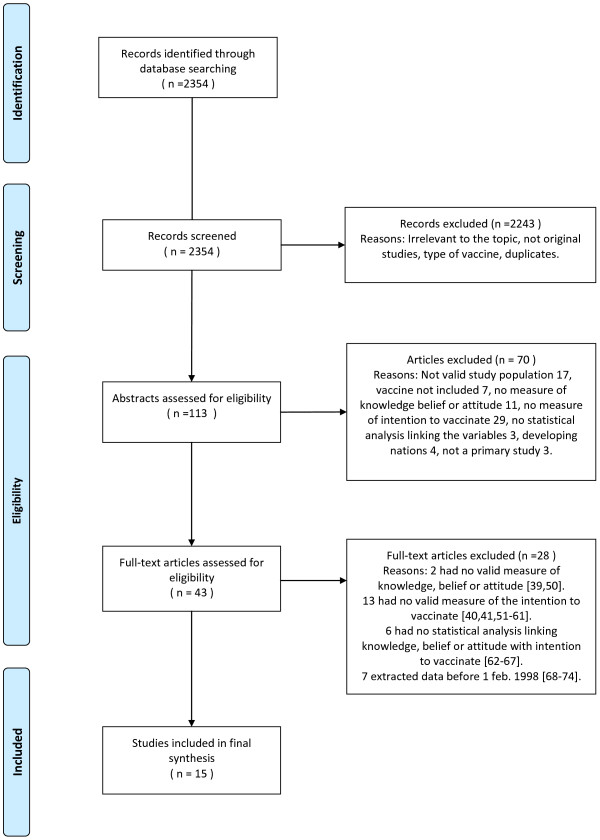
Background: The Summit of Independent European Vaccination Experts (SIEVE) recommended in 2007 that efforts be made to improve healthcare workers’ knowledge and beliefs about vaccines, and their attitudes towards them, to increase vaccination coverage. The aim of the study was to compile and analyze the areas of disagreement in the existing evidence about the relationship between healthcare workers’ knowledge, beliefs and attitudes about vaccines and their intentions to vaccinate the populations they serve. Methods: We conducted a systematic search in four electronic databases for studies published in any of seven different languages between February 1998 and June 2009. We included studies conducted in developed countries that used statistical methods to relate or associate the variables included in our research question. Two independent reviewers verified that the studies met the inclusion criteria, assessed the quality of the studies and extracted their relevant characteristics. The data were descriptively analyzed. Results: Of the 2354 references identified in the initial search, 15 studies met the inclusion criteria. The diversity in the study designs and in the methods used to measure the variables made it impossible to integrate the results, and each study had to be assessed individually. All the studies found an association in the direction postulated by the SIEVE experts: among healthcare workers, higher awareness, beliefs that are more aligned with scientific evidence and more favorable attitudes toward vaccination were associated with greater intentions to vaccinate. All the studies included were cross-sectional; thus, no causal relationship between the variables was established. Conclusion: The results suggest that interventions aimed at improving healthcare workers’ knowledge, beliefs and attitudes about vaccines should be encouraged, and their impact on vaccination coverage should be assessed.
Overview
The claims and statistics of this paper haven’t been checked yet.
Free: it reads the open-access text and checks the first 5 claims that cite a source we can check. Create a free account to check every claim.
Integrity signals
Registry
Cites
Statistics
Figures
Verification
Claims the paper makes
The claims and statistics of this paper haven’t been checked yet.
Free: it reads the open-access text and checks the first 5 claims that cite a source we can check. Create a free account to check every claim.
Claims other papers make about this one
Each is checked against this paper’s own text: does it say what the citing paper says it does?
The source backs part of the claim, not all of it — or backs it for a different population, condition or comparison.
In the citing paper
“The methodological quality of the studies was assessed using the Newcastle-Ottawa Scale, based on criteria related to selection and comparability between cohorts and related to study outcomes. The methodological quality of the cross-sectional studies was performed using the adapted Newcastle Ottawa for cross-sectional studies [20]. The evaluation was performed in pairs, by four reviewers and dis”
From The associations between screen time and mental health in adolescents: a systematic review (2023) · cites this paper as [20]
Experimental — accuracy not yet measuredThe cited source says what the claim attributes to it.
In the citing paper
“The NOS classification has been used in similar systematic reviews (Herzog et al., 2013; Moore et al., 2021).”
From Parental stress and mental health outcomes following very preterm birth: A systematic review of recent findings (2024) · cites this paper as Herzog et al., 2013
The cited source says what the claim attributes to it.
In the citing paper
“The present review uses the adapted Newcastle-Ottawa Scale for crosssectional studies (Herzog et al., 2013) to critically evaluate the risk of bias in the included studies.”
From Parental stress and mental health outcomes following very preterm birth: A systematic review of recent findings (2024) · cites this paper as Herzog et al., 2013
The cited source says what the claim attributes to it.
In the citing paper
“We used the Newcastle-Ottawa validated tool for the evaluation of internal validity of longitudinal studies (NOS) 32 and the adapted version for cross-sectional studies.33”
From Defining risk factors associated with difficult peripheral venous Cannulation: A systematic review and meta-analysis (2020) · cites this paper as [33]
The cited source says what the claim attributes to it.
In the citing paper
“All eligible studies were assessed for quality using an adapted version of the Newcastle-Ottawa quality assessment scale for cross-sectional studies, which was used to score the risk of bias for each study [29].”
From Problematic Social Media Use in Adolescents and Young Adults: Systematic Review and Meta-analysis. (2022) · cites this paper as [29]
1 more claim about this paper
Create a free account to see every claim other papers make about this one.
Self-check
Percentages, sums and reported differences re-computed from the paper’s own numbers.
The self-check needs the paper’s full text.
Citations
Cites
1 retracted
Wakefield, A., Murch, S., Anthony, A., Linnell, J., Casson, D., Malik, M., Berelowitz, M., Dhillon, A., Thomson, M., Harvey, P., et al. (1998) · The Lancet · doi:10.1016/s0140-6736(97)11096-0 · Cited by 3,006
RetractedDermyshi, E., Wang, Y., Yan, C., Hong, W., Qiu, G., Gong, X., & Zhang, T. (2017) · Neonatology · doi:10.1159/000454668 · Cited by 24,451
Meta-analysis of Observational Studies in Epidemiology<SUBTITLE>A Proposal for Reporting</SUBTITLE>
Stroup, D. F. (2000) · JAMA · doi:10.1001/jama.283.15.2008 · Cited by 20,623
Stang, A. (2010) · European Journal of Epidemiology · doi:10.1007/s10654-010-9491-z · Cited by 17,396 · cited 1×
“The tools used to determine the risk of bias and the quality of the studies included were based on the Newcastle-Ottawa scales, which are widely used for observational studies [37].”
MethodTen great public health achievements--United States, 1900-1999.
(1999) · PubMed · Cited by 662
Do Parents Understand Immunizations? A National Telephone Survey
Gellin, B. G., Maibach, E. W., Marcuse, E. K., & for the National Network for Immunization Information Steering Committee∥ (2000) · Pediatrics · doi:10.1542/peds.106.5.1097 · Cited by 512
Meta-analysis of Observational Studies in Epidemiology
Stroup, D. F., Berlin, J. A., Morton, S. C., Olkin, I., Williamson, G. D., Rennie, D., Moher, D., Becker, B. J., Sipe, T. A., & Thacker, S. B. (2000) · Cited by 473
Mills, E., Jadad, A. R., Ross, C., & Wilson, K. (2005) · Journal of Clinical Epidemiology · doi:10.1016/j.jclinepi.2005.09.002 · Cited by 374 · cited 2×
“It ́s also interesting to highlight that the knowledge, beliefs and attitude themes explored in the HCW in the included studies, do not differ from the barriers towards vaccination explored in the general population [6].”
BackgroundSmallpox: The Triumph over the Most Terrible of the Ministers of Death
Barquet, N., & Domingo, P. (1997) · Annals of Internal Medicine · doi:10.7326/0003-4819-127-8_part_1-199710150-00010 · Cited by 263
Factors influencing pandemic influenza vaccination of healthcare workers—A systematic review
Prematunge, C., Corace, K., McCarthy, A., Nair, R. C., Pugsley, R., & Garber, G. (2012) · Vaccine · doi:10.1016/j.vaccine.2012.05.018 · Cited by 186 · cited 1×
“Even HCW (healthcare workers) have low vaccine coverage, as is the case with the influenza vaccine, due to various factors, including knowledge about the disease, knowledge about the vaccine or past beliefs and past attitudes (related to influenza vaccination in previous seasons) [10,11].”
Background
Research works printed but not linked: 3
- Schmitt HJ Booy R Aston R Van Damme P Schumacher RF Campins M Rodrigo C Heikkinen T Weil-Oliver C Finn A Olcen P Fedson D Peltola H How to optimise the coverage rates of infant and adult immunisation in Europe BMC Med 2007 5 11 10.1186/1741-7015-5-11 17535430 PMC1903356 · DOI · Paper page
- Rivera JA Lo que Sócrates le diría a Woody Allen 2008 Madrid: Espasa Calpe
- World economic and social survey 2006 Diverging Growth and Development 2006 New York: United Nations Publications
Cited by
Increasing Vaccination: Putting Psychological Science Into Action
Brewer, N. T., Chapman, G. B., Rothman, A. J., Leask, J., & Kempe, A. (2017) · Psychological Science in the Public Interest · doi:10.1177/1529100618760521 · Cited by 1,233
“Research suggests that the same psychology that motivates the general public to get vaccination also motivates health-care providers, including risk appraisals and vaccine confidence (Corace et al., 2016; Herzog et al., 2013).”
BackgroundThe Global Prevalence of Anxiety Among Medical Students: A Meta-Analysis
Tian-Ci Quek, T., Wai-San Tam, W., X. Tran, B., Zhang, M., Zhang, Z., Su-Hui Ho, C., & Chun-Man Ho, R. (2019) · International Journal of Environmental Research and Public Health · doi:10.3390/ijerph16152735 · Cited by 990
“To appraise the quality of the selected studies, we adopted an adapted version of the Newcastle-Ottawa cohort scale for cross-sectional studies [19].”
MethodPrescription Opioid Analgesics Commonly Unused After Surgery: A Systematic Review
Bicket, M. C., Long, J. J., Pronovost, P. J., Alexander, G. C., & Wu, C. L. (2017) · JAMA Surgery · doi:10.1001/jamasurg.2017.0831 · Cited by 873
“Bartels et al,10 2016a 5/24 (21) Cupboard/wardrobe 16/22 (73) 2/24 (8) 1/24 (4) NR”
Prevalence of depression amongst medical students: A meta-analysis
Puthran, R., Zhang, M. W. B., Tam, W. W., & Ho, R. C. (2016) · Medical Education · doi:10.1111/medu.12962 · Cited by 855
Sleep problems during the COVID-19 pandemic by population: A systematic review and meta-analysis
Jahrami, H., BaHammam, A. S., Bragazzi, N. L., Saif, Z., Faris, M., & Vitiello, M. V. (2021) · Journal of Clinical Sleep Medicine · doi:10.5664/jcsm.8930 · Cited by 751
“We used the Newcastle – Ottawa Scale adapted for cross-sectional studies by Herzog et al 11 to assess the quality of the included studies.”
Determinants of COVID-19 Vaccine Acceptance in Saudi Arabia: A Web-Based National Survey
Al-Mohaithef, M., & Padhi, B. K. (2020) · Journal of Multidisciplinary Healthcare · doi:10.2147/jmdh.s276771 · Cited by 749
The global prevalence of apical periodontitis: a systematic review and meta‐analysis
Tibúrcio‐Machado, C. S., Michelon, C., Zanatta, F. B., Gomes, M. S., Marin, J. A., & Bier, C. A. (2021) · International Endodontic Journal · doi:10.1111/iej.13467 · Cited by 584
Problematic Social Media Use in Adolescents and Young Adults: Systematic Review and Meta-analysis.
Shannon, H., Bush, K., Villeneuve, P. J., Hellemans, K. G., & Guimond, S. (2022) · JMIR Mental Health · doi:10.2196/33450 · Cited by 593
“All eligible studies were assessed for quality using an adapted version of the Newcastle-Ottawa quality assessment scale for cross-sectional studies, which was used to score the risk of bias for each study [29].”
MethodMeta-analysis: Exposure to Early Life Stress and Risk for Depression in Childhood and Adolescence
LeMoult, J., Humphreys, K. L., Tracy, A., Hoffmeister, J.-A., Ip, E., & Gotlib, I. H. (2020) · Journal of the American Academy of Child & Adolescent Psychiatry · doi:10.1016/j.jaac.2019.10.011 · Cited by 576
The relationship between frailty and polypharmacy in older people: A systematic review
Gutiérrez‐Valencia, M., Izquierdo, M., Cesari, M., Casas‐Herrero, Á., Inzitari, M., & Martínez‐Velilla, N. (2018) · British Journal of Clinical Pharmacology · doi:10.1111/bcp.13590 · Cited by 480
Risk Factors for Early-Onset Colorectal Cancer: A Systematic Review and Meta-analysis
O’Sullivan, D. E., Sutherland, R. L., Town, S., Chow, K., Fan, J., Forbes, N., Heitman, S. J., Hilsden, R. J., & Brenner, D. R. (2022) · Clinical Gastroenterology and Hepatology · doi:10.1016/j.cgh.2021.01.037 · Cited by 413
Yang, J., Fu, X., Liao, X., & Li, Y. (2020) · Psychiatry Research · doi:10.1016/j.psychres.2019.112686 · Cited by 377
Definition, symptoms and risk of techno-stress: a systematic review
La Torre, G., Esposito, A., Sciarra, I., & Chiappetta, M. (2019) · International Archives of Occupational and Environmental Health · doi:10.1007/s00420-018-1352-1 · Cited by 409
Postpartum depression in India: a systematic review and meta-analysis
Upadhyay, R. P., Chowdhury, R., Salehi, A., Sarkar, K., Singh, S. K., Sinha, B., Pawar, A., Rajalakshmi, A. K., & Kumar, A. (2017) · Bulletin of the World Health Organization · doi:10.2471/blt.17.192237 · Cited by 363
Using behavioral insights to increase vaccination policy effectiveness
Betsch, C., Böhm, R., & Chapman, G. B. (2015) · Policy Insights from the Behavioral and Brain Sciences · doi:10.1177/2372732215600716 · Cited by 378
“Importantly, attitudes toward vaccination are a strong predictor of vaccination and also moderate the effect of risk perceptions on vaccine uptake (Godin, Vézina-Im, & Naccache, 2010; Herzog et al., 2013; Hollmeyer, Hayden, Poland, & Buchholz, 2009; LaVail & Kennedy, 2012).”
BackgroundSingal, A. G., Manjunath, H., Yopp, A. C., Beg, M. S., Marrero, J. A., Gopal, P., & Waljee, A. K. (2014) · American Journal of Gastroenterology · doi:10.1038/ajg.2013.476 · Cited by 362
Transmitting Trauma: A systematic review of vicarious racism and child health
Heard-Garris, N. J., Cale, M., Camaj, L., Hamati, M. C., & Dominguez, T. P. (2018) · Social Science & Medicine · doi:10.1016/j.socscimed.2017.04.018 · Cited by 352
Moskalewicz, A., & Oremus, M. (2020) · Journal of Clinical Epidemiology · doi:10.1016/j.jclinepi.2019.12.013 · Cited by 336
Sarcopenia and cognitive impairment: A systematic review and meta-analysis
Peng, T.-C., Chen, W.-L., Wu, L.-W., Chang, Y.-W., & Kao, T.-W. (2020) · Clinical Nutrition · doi:10.1016/j.clnu.2019.12.014 · Cited by 333
Kim, K., Shin, S., Kim, S., & Lee, E. (2023) · Journal of Medical Internet Research · doi:10.2196/40778 · Cited by 306
“While the NOS was developed for assessing the risk of bias in nonrandomized observational studies [27], our study used the modified NOS [28] that was developed for cross-sectional studies.”
Chuasuwan, A., Pooripussarakul, S., Thakkinstian, A., Ingsathit, A., & Pattanaprateep, O. (2020) · Health and Quality of Life Outcomes · doi:10.1186/s12955-020-01449-2 · Cited by 314
Purba, A., & Demou, E. (2019) · BMC Public Health · doi:10.1186/s12889-019-7609-0 · Cited by 328
Systematic review of burnout among healthcare providers in sub-Saharan Africa
Dubale, B. W., Friedman, L. E., Chemali, Z., Denninger, J. W., Mehta, D. H., Alem, A., Fricchione, G. L., Dossett, M. L., & Gelaye, B. (2019) · BMC Public Health · doi:10.1186/s12889-019-7566-7 · Cited by 327
“Methodological quality of studies was assessed using the Newcastle-Ottawa Scale for cross-sectional studies [52], the Newcastle-Ottawa Scale for cohort studies [53], and the Cochrane Risk of Bias Tool for randomized controlled trials [54].”
MethodHygum, K., Starup-Linde, J., Harsløf, T., Vestergaard, P., & Langdahl, B. L. (2017) · European Journal of Endocrinology · doi:10.1530/eje-16-0652 · Cited by 320
Risk factors for post–intensive care syndrome: A systematic review and meta-analysis
Lee, M., Kang, J., & Jeong, Y. J. (2020) · Australian Critical Care · doi:10.1016/j.aucc.2019.10.004 · Cited by 303
The associations between screen time and mental health in adolescents: a systematic review
Santos, R. M. S., Mendes, C. G., Sen Bressani, G. Y., de Alcantara Ventura, S., de Almeida Nogueira, Y. J., de Miranda, D. M., & Romano-Silva, M. A. (2023) · BMC Psychology · doi:10.1186/s40359-023-01166-7 · Cited by 311
“The methodological quality of the cross-sectional studies was performed using the adapted Newcastle Ottawa for cross-sectional studies [20].”
MethodOffeddu, V., Yung, C. F., Low, M. S. F., & Tam, C. C. (2017) · Clinical Infectious Diseases · doi:10.1093/cid/cix681 · Cited by 297
“Adapted Newcastle-Ottawa scales were used to assess the risk of bias in case-control, cohort [17], and cross-sectional studies [18].”
MethodElectroencephalographic Patterns in Chronic Pain: A Systematic Review of the Literature
Pinheiro, E. S. D. S., Queirós, F. C. D., Montoya, P., Santos, C. L., Nascimento, M. A. D., Ito, C. H., Silva, M., Nunes Santos, D. B., Benevides, S., Miranda, J. G. V., et al. (2016) · PLOS ONE · doi:10.1371/journal.pone.0149085 · Cited by 261
“Adapted from: Herzog et al., 2013 1 and; Eijkemans et al., 2012 2 Note: A study can be awarded a maximum of one star for each numbered item within the Selection and Exposure categories.”
MethodThe prevalence and trends of waterpipe tobacco smoking: A systematic review
Jawad, M., Charide, R., Waziry, R., Darzi, A., Ballout, R. A., & Akl, E. A. (2018) · PLOS ONE · doi:10.1371/journal.pone.0192191 · Cited by 269
“We quantitatively rated the quality of studies using a modified version of the NewcastleOttawa Scale for cross-sectional studies[14].”
MethodWiss, D. A., & Brewerton, T. D. (2020) · Physiology & Behavior · doi:10.1016/j.physbeh.2020.112964 · Cited by 273
Risk of Bias Evaluation of Cross‐Sectional Studies: Adaptation of the Newcastle‐Ottawa Scale
Carra, M. C., Romandini, P., & Romandini, M. (2026) · Journal of Periodontal Research · doi:10.1111/jre.13405 · Cited by 260
“Given that the NOS scale does not include a version for evaluating cross-sectional studies, several systematic reviews have developed ad hoc modifications of the NOS to assess these types of studies [6, 29–33].”
Physical activity and suicidal ideation: A systematic review and meta-analysis
Vancampfort, D., Hallgren, M., Firth, J., Rosenbaum, S., Schuch, F. B., Mugisha, J., Probst, M., Van Damme, T., Carvalho, A. F., & Stubbs, B. (2018) · Journal of Affective Disorders · doi:10.1016/j.jad.2017.08.070 · Cited by 255
“…ascertainment of the variable of interest = a subtotal score of 5); (b) comparability, (confounding factors are controlled for = a subtotal score of 1), and (c) outcomes, (adequate assessment of outcome, statistical test and outcomes clearly described= a subtotal score of 3) (Herzog et al., 2013).”
BackgroundLatent classes of polysubstance use among adolescents—a systematic review
Tomczyk, S., Isensee, B., & Hanewinkel, R. (2016) · Drug and Alcohol Dependence · doi:10.1016/j.drugalcdep.2015.11.035 · Cited by 253
Medical cannabis and mental health: A guided systematic review
Walsh, Z., Gonzalez, R., Crosby, K., S. Thiessen, M., Carroll, C., & Bonn-Miller, M. O. (2017) · Clinical Psychology Review · doi:10.1016/j.cpr.2016.10.002 · Cited by 244
“, 2000) adapted to evaluate crosssectional studies (Herzog et al., 2013).”
BackgroundMethodRoberts, S. S. H., Teo, W.-P., & Warmington, S. A. (2019) · British Journal of Sports Medicine · doi:10.1136/bjsports-2018-099322 · Cited by 229
Tolerance of uncertainty: A systematic review of health and healthcare-related outcomes
Strout, T. D., Hillen, M., Gutheil, C., Anderson, E., Hutchinson, R., Ward, H., Kay, H., Mills, G. J., & Han, P. K. J. (2018) · Patient Education and Counseling · doi:10.1016/j.pec.2018.03.030 · Cited by 236
A systematic review of the factors affecting choice of surgery as a career
Peel, J. K., Schlachta, C. M., & Alkhamesi, N. A. (2018) · Canadian Journal of Surgery · doi:10.1503/cjs.008217 · Cited by 234
Williams, J., Allen, L., Wickramasinghe, K., Mikkelsen, B., Roberts, N., & Townsend, N. (2018) · Journal of Global Health · doi:10.7189/jogh.08.020409 · Cited by 228
Finning, K., Ukoumunne, O. C., Ford, T., Danielsson-Waters, E., Shaw, L., Romero De Jager, I., Stentiford, L., & Moore, D. A. (2019) · Journal of Affective Disorders · doi:10.1016/j.jad.2018.11.055 · Cited by 231
Psoriasis and suicidality: A systematic review and meta-analysis
Singh, S., Taylor, C., Kornmehl, H., & Armstrong, A. W. (2017) · Journal of the American Academy of Dermatology · doi:10.1016/j.jaad.2017.05.019 · Cited by 234
Nightingale, S., Spiby, H., Sheen, K., & Slade, P. (2018) · International Journal of Nursing Studies · doi:10.1016/j.ijnurstu.2018.01.006 · Cited by 229
“As all studies identified were quantitative 19 in nature, methodological quality was quality assessed using the Newcastle-Ottawa Scale 20 adapted for cross-sectional studies (Herzog et al., 2013).”
MethodKragt, L., Dhamo, B., Wolvius, E. B., & Ongkosuwito, E. M. (2016) · Clinical Oral Investigations · doi:10.1007/s00784-015-1681-3 · Cited by 224
“We assessed the methodological quality of the individual studies with the Newcastle-Ottawa Scale (NOS) adapted for crosssectional studies [37, 38].”
Prevalence of and risk factors for dysphagia in the community dwelling elderly: A systematic review
Madhavan, A., Lagorio, L. A., Crary, M. A., Dahl, W. J., & Carnaby, G. D. (2016) · The Journal of nutrition, health and aging · doi:10.1007/s12603-016-0712-3 · Cited by 221
“The NOS scales are validated, reliable, and commonly used for assessing the quality of observational studies (28, 29).”
Bwire, G. M., Majigo, M. V., Njiro, B. J., & Mawazo, A. (2021) · Journal of Medical Virology · doi:10.1002/jmv.26349 · Cited by 230
“On the other hand, the quality of the included studies (risk of bias) was assessed using the Newcastle Ottawa Scale adapted for cross‐sectional studies (Supporting Information Additional File S3) as previously described elsewhere.(19)”
MethodBerger, M. N., Taba, M., Marino, J. L., Lim, M. S. C., & Skinner, S. R. (2022) · Journal of Medical Internet Research · doi:10.2196/38449 · Cited by 226
“The Newcastle-Ottawa Quality Assessment Scale (NOS) was used to assess the quality of quantitative studies [36], including an adapted version for cross-sectional studies [37].”
Wang, B.-Q., Yao, N.-Q., Zhou, X., Liu, J., & Lv, Z.-T. (2017) · BMC Psychiatry · doi:10.1186/s12888-017-1408-x · Cited by 216
Schwalm, F. D., Zandavalli, R. B., de Castro Filho, E. D., & Lucchetti, G. (2022) · Journal of Health Psychology · doi:10.1177/1359105320984537 · Cited by 196
“This instrument derives from the Newcastle–Ottawa scale for observational casecontrol and cohort studies, using an adaptation of the cohort scale for cross-sectional studies, as described in previous studies published in the literature (Herzog et al., 2013).”
MethodDzhambov, A., & Dimitrova, D. (2014) · Noise and Health · doi:10.4103/1463-1741.134916 · Cited by 219
“We performed quality assessment with using modifi ed versions of the previously adapted “Newcastle-Ottawa Quality Assessment Scale for cohort studies”,[28,29] of “Consolidated Standards of Reporting Trials (CONSORT) 2010 checklist of information to include when reporting a randomized trial” and of “CONSORT checklist.”
MethodLin, C., Mullen, J., Smith, D., Kotarba, M., Kaplan, S. J., & Tu, P. (2021) · Vaccines · doi:10.3390/vaccines9070713 · Cited by 206
Masefield, S. C., Prady, S. L., Sheldon, T. A., Small, N., Jarvis, S., & Pickett, K. E. (2020) · Maternal and Child Health Journal · doi:10.1007/s10995-020-02896-5 · Cited by 217
The effect of shift work on eating habits: a systematic review
Souza, R. V., Sarmento, R. A., de Almeida, J. C., & Canuto, R. (2019) · Scandinavian Journal of Work, Environment & Health · doi:10.5271/sjweh.3759 · Cited by 197
“9) Meat (g/day): 102 (IQR 62-136) Milk (g/day): 346 (IQR 197-541) Cakes/cookies (g/day) 25 (13-41) HDI SCORE: NS Rotating shift 2222 (IQR 1826-2700) β : 56kcal/day (95% CI 10-101) 15.”
InfluentialAssociation between Urban Greenspace and Health: A Systematic Review of Literature
Gianfredi, V., Buffoli, M., Rebecchi, A., Croci, R., Oradini-Alacreu, A., Stirparo, G., Marino, A., Odone, A., Capolongo, S., & Signorelli, C. (2021) · International Journal of Environmental Research and Public Health · doi:10.3390/ijerph18105137 · Cited by 203
“However, since the NOS did not provide a checklist for cross-sectional studies, we used a modified version [42], adapted to perform a quality assessment of cross-sectional studies.”
MethodWilliams, A. J., Jones, C., Arcelus, J., Townsend, E., Lazaridou, A., & Michail, M. (2021) · PLOS ONE · doi:10.1371/journal.pone.0245268 · Cited by 187
Sleep and obesity among children: A systematic review of multiple sleep dimensions
Morrissey, B., Taveras, E., Allender, S., & Strugnell, C. (2020) · Pediatric Obesity · doi:10.1111/ijpo.12619 · Cited by 192
Review: the association between anxiety and poor attendance at school – a systematic review
Finning, K., Ukoumunne, O. C., Ford, T., Danielson‐Waters, E., Shaw, L., Romero De Jager, I., Stentiford, L., & Moore, D. A. (2019) · Child and Adolescent Mental Health · doi:10.1111/camh.12322 · Cited by 189
Zhang, H., Lin, S., Gao, T., Zhong, F., Cai, J., Sun, Y., & Ma, A. (2018) · Nutrients · doi:10.3390/nu10030364 · Cited by 188
“Cross-sectional studies were evaluated by the modified Newcastle-Ottawa Scale [24].”
Sun, Y., Laksono, I., Selvanathan, J., Saripella, A., Nagappa, M., Pham, C., Englesakis, M., Peng, P., Morin, C. M., & Chung, F. (2021) · Sleep Medicine Reviews · doi:10.1016/j.smrv.2021.101467 · Cited by 175
Jakovljevic, A., Nikolic, N., Jacimovic, J., Pavlovic, O., Milicic, B., Beljic-Ivanovic, K., Miletic, M., Andric, M., & Milasin, J. (2020) · Journal of Endodontics · doi:10.1016/j.joen.2020.07.007 · Cited by 179
Prognosticating autoimmune encephalitis: A systematic review
Broadley, J., Seneviratne, U., Beech, P., Buzzard, K., Butzkueven, H., O'Brien, T., & Monif, M. (2019) · Journal of Autoimmunity · doi:10.1016/j.jaut.2018.10.014 · Cited by 183
Socioeconomic status and oral health‐related quality of life: A systematic review and meta‐analysis
Knorst, J. K., Sfreddo, C. S., de F. Meira, G., Zanatta, F. B., Vettore, M. V., & Ardenghi, T. M. (2021) · Community Dentistry and Oral Epidemiology · doi:10.1111/cdoe.12616 · Cited by 172
Eyden, J., Winsper, C., Wolke, D., Broome, M. R., & MacCallum, F. (2016) · Clinical Psychology Review · doi:10.1016/j.cpr.2016.04.002 · Cited by 177
Matsushita, K., Ding, N., Kou, M., Hu, X., Chen, M., Gao, Y., Honda, Y., Zhao, D., Dowdy, D., Mok, Y., et al. (2020) · Global Heart · doi:10.5334/gh.814 · Cited by 180
Girela-Serrano, B. M., Spiers, A. D. V., Ruotong, L., Gangadia, S., Toledano, M. B., & Di Simplicio, M. (2024) · European Child & Adolescent Psychiatry · doi:10.1007/s00787-022-02012-8 · Cited by 123
Insulin resistance and endometrial cancer risk: A systematic review and meta-analysis
Hernandez, A. V., Pasupuleti, V., Benites-Zapata, V. A., Thota, P., Deshpande, A., & Perez-Lopez, F. R. (2015) · European Journal of Cancer · doi:10.1016/j.ejca.2015.08.031 · Cited by 167
“An adapted form of the cohort NOS was used for assessing risk of bias in cross-sectional studies [23].”
MethodSexual harassment against female nurses: a systematic review
Kahsay, W. G., Negarandeh, R., Nayeri, N. D., & Hasanpour, M. (2020) · BMC Nursing · doi:10.1186/s12912-020-00450-w · Cited by 168
“Each component is rated as 9–10 points of very good study, 7–8 points for good studies, 5–6 points for satisfactory studies and 0 to 4 points for unsatisfactory studies in quality [20].”
BackgroundDepression in Patients with Tinnitus: A Systematic Review
Salazar, J. W., Meisel, K., Smith, E. R., Quiggle, A., McCoy, D. B., & Amans, M. R. (2019) · Otolaryngology–Head and Neck Surgery · doi:10.1177/0194599819835178 · Cited by 167
“We therefore elected to apply a modified version of the NewcastleOttawa Quality Assessment Scale adapted for crosssectional studies to assess bias (see supplemental material, available in the online version of the article).(13) We assessed bias in each of the following domains on an overall scale of 0-4: representativ…”
Predictors of smoking cessation during pregnancy: a systematic review and meta‐analysis
Riaz, M., Lewis, S., Naughton, F., & Ussher, M. (2018) · Addiction · doi:10.1111/add.14135 · Cited by 166
“A further strength of our review compared with previous reviews is that we included a thorough study quality assessment using established scales [27, 28].”
ResultInfluentialMental health in Europe during the COVID-19 pandemic: a systematic review
Ahmed, N., Barnett, P., Greenburgh, A., Pemovska, T., Stefanidou, T., Lyons, N., Ikhtabi, S., Talwar, S., Francis, E. R., Harris, S. M., et al. (2023) · The Lancet Psychiatry · doi:10.1016/s2215-0366(23)00113-x · Cited by 162
Prevalence of cancer-related fatigue based on severity: a systematic review and meta-analysis
Kang, Y.-E., Yoon, J.-H., Park, N.-H., Ahn, Y., Lee, E., & Son, C. (2023) · Scientific Reports · doi:10.1038/s41598-023-39046-0 · Cited by 203
“of data) Number of participants (mean ± SD) Male Female No information Total Total 57 (151) 11,805 (268 ± 407) 22,505 (417 ± 583) – 34,310 (6,02 ± 869)a Cross-sectional study 38 (99) 7651 (247 ± 334) 14,505 (403 ± 574) – 22,156 (583 ± 804) Longitudinal study 19 (52) 4154 (320 ± 557) 8000 (444 ± 617) – 12,154 (640 ± 10…”
Davis, D. M. R., Drucker, A. M., Alikhan, A., Bercovitch, L., Cohen, D. E., Darr, J. M., Eichenfield, L. F., Frazer-Green, L., Paller, A. S., Silverberg, J. I., et al. (2022) · Journal of the American Academy of Dermatology · doi:10.1016/j.jaad.2022.01.009 · Cited by 162
Orton, S., Jones, L. L., Cooper, S., Lewis, S., & Coleman, T. (2014) · PLoS ONE · doi:10.1371/journal.pone.0112690 · Cited by 161
Aoyagi, Y., Beck, C. R., Dingwall, R., & Nguyen‐Van‐Tam, J. S. (2015) · Influenza and Other Respiratory Viruses · doi:10.1111/irv.12310 · Cited by 156
Fleming, P., Bai, J. W., Pratt, M., Sibbald, C., Lynde, C., & Gulliver, W. P. (2017) · Journal of the European Academy of Dermatology and Venereology · doi:10.1111/jdv.13891 · Cited by 154
Wijarnpreecha, K., Thongprayoon, C., & Ungprasert, P. (2017) · European Journal of Gastroenterology & Hepatology · doi:10.1097/meg.0000000000000776 · Cited by 152
A systematic review of emotion regulation in children with Autism Spectrum Disorder
Cibralic, S., Kohlhoff, J., Wallace, N., McMahon, C., & Eapen, V. (2019) · Research in Autism Spectrum Disorders · doi:10.1016/j.rasd.2019.101422 · Cited by 148
Matsushita, K., Ding, N., Kim, E. D., Budoff, M. J., Chirinos, J. A., Fernhall, B., Hamburg, N. M., Kario, K., Miyoshi, T., Tanaka, H., et al. (2018) · Journal of Clinical Hypertension · doi:10.1111/jch.13425 · Cited by 162
Borle, P., Reichel, K., Niebuhr, F., & Voelter-Mahlknecht, S. (2021) · International Journal of Environmental Research and Public Health · doi:10.3390/ijerph18168673 · Cited by 149
“[22], we assessed the methodological quality of the included studies, whereas higher scores indicate better quality.”
MethodWathanavasin, W., Banjongjit, A., Avihingsanon, Y., Praditpornsilpa, K., Tungsanga, K., Eiam‐Ong, S., & Susantitaphong, P. (2022) · Nutrients · doi:10.3390/nu14194077 · Cited by 169
“Methodological Quality Regarding the Newcastle–Ottawa Scale (NOS) for cohort studies and the NOS adapted for cross-sectional studies [17,18], all cohort studies (n = 16:100%) were considered as good quality.”
MethodFacebook-based social support and health: A systematic review.
Gilmour, J., Machin, T., Brownlow, C., & Jeffries, C. (2020) · Psychology of Popular Media · doi:10.1037/ppm0000246 · Cited by 147
Ornello, R., Ripa, P., Pistoia, F., Degan, D., Tiseo, C., Carolei, A., & Sacco, S. (2015) · The Journal of Headache and Pain · doi:10.1186/s10194-015-0510-z · Cited by 165
“the criteria of the Newcastle-Ottawa Scale for observational studies [9] with modified criteria for crosssectional studies [10].”
MethodPrevalence of Early Childhood Caries in India – A Systematic Review
Ganesh, A., Muthu, M., Mohan, A., & Kirubakaran, R. (2018) · The Indian Journal of Pediatrics · doi:10.1007/s12098-018-2793-y · Cited by 145
Göstemeyer, G., Baker, S. R., & Schwendicke, F. (2019) · Clinical Oral Investigations · doi:10.1007/s00784-019-02812-4 · Cited by 169
Manohar, S., Thongprayoon, C., Cheungpasitporn, W., Mao, M. A., & Herrmann, S. M. (2017) · Journal of Hypertension · doi:10.1097/hjh.0000000000001442 · Cited by 141
“The quality of each study was evaluated by the investigators using the validated Newcastle–Ottawa quality assessment scale for cohort and case–control studies [30] and modified Newcastle–Ottawa scale [31] for the cross-sectional study.”
Newell, V., Phillips, L., Jones, C., Townsend, E., Richards, C., & Cassidy, S. (2023) · Molecular Autism · doi:10.1186/s13229-023-00544-7 · Cited by 143
“Quality assessment Quality of studies included in the final synthesis were assessed using an adapted Newcastle–Ottawa scale (NOS) [55] based on versions used in previous research [21, 56] (see Additional file 1: Supplementary Materials 2).”
MethodYoon, J.-H., Park, N.-H., Kang, Y.-E., Ahn, Y., Lee, E., & Son, C. (2023) · Frontiers in Public Health · doi:10.3389/fpubh.2023.1192121 · Cited by 171
“We considered studies with a score of 7 or higher to be of high quality (27, 28).”
MethodTang, X., Tang, S., Ren, Z., & Wong, D. F. K. (2020) · Journal of Affective Disorders · doi:10.1016/j.jad.2019.11.118 · Cited by 133
The relationship between cognition and functioning in schizophrenia: A semi-systematic review
Kharawala, S., Hastedt, C., Podhorná, J., Shukla, H., Kappelhoff, B. S., & Harvey, P. D. (2021) · Schizophrenia Research Cognition · doi:10.1016/j.scog.2021.100217 · Cited by 181
Menzel, J., Jabakhanji, A., Biemann, R., Mai, K., Abraham, K., & Weikert, C. (2020) · Scientific Reports · doi:10.1038/s41598-020-78426-8 · Cited by 168
Trunk biomechanics during hemiplegic gait after stroke: A systematic review
Criekinge, T. V., Saeys, W., Hallemans, A., Velghe, S., Viskens, P.-J., Vereeck, L., Hertogh, W. D., & Truijen, S. (2017) · Gait & Posture · doi:10.1016/j.gaitpost.2017.03.004 · Cited by 135
Health knowledge, health behaviors and attitudes during pandemic emergencies: A systematic review
Uribe, F. A. R., Godinho, R. C. D. S., Machado, M. A. S., de Oliveira, K. R. D. S. G., Espejo, C. A. N., de Sousa, N. C. V., de Sousa, L. L., Barbalho, M. V. M., Piani, P. P. F., & Pedroso, J. D. S. (2021) · PLoS ONE · doi:10.1371/journal.pone.0256731 · Cited by 135
“The quality assessment was conducting by one author (FR), with complete verification of JP and KS, using a modified version of the Ottawa–Newcastle scale (ONS) for cross sectional studies [24].”
MethodSelfish-rational non-vaccination: Experimental evidence from an interactive vaccination game
BOHM, R. M., Betsch, C., & Korn, L. (2015) · Journal of Economic Behavior & Organization · doi:10.1016/j.jebo.2015.11.008 · Cited by 144
Machine Learning and Prediction of Infectious Diseases: A Systematic Review
Santangelo, O. E., Gentile, V., Pizzo, S., Giordano, D., & Cedrone, F. (2023) · Machine Learning and Knowledge Extraction · doi:10.3390/make5010013 · Cited by 187
“An adapted version of the NOS was used to assess cross-sectional studies [17].”
MethodTo, K. W., Lai, A., Lee, K. C. K., Koh, D. S. Q., & Lee, S. S. (2016) · Journal of Hospital Infection · doi:10.1016/j.jhin.2016.07.003 · Cited by 138
Crowding Measures Associated With the Quality of Emergency Department Care: A Systematic Review
Stang, A. S., Crotts, J., Johnson, D. W., Hartling, L., & Guttmann, A. (2015) · Academic Emergency Medicine · doi:10.1111/acem.12682 · Cited by 138
van den Berg, R., Jongbloed, E. M., de Schepper, E. I. T., Bierma‐Zeinstra, S., Koes, B. W., & Luijsterburg, P. A. J. (2018) · The Spine Journal · doi:10.1016/j.spinee.2018.06.349 · Cited by 135
Demmer, D. H., Hooley, M., Sheen, J., McGillivray, J. A., & Lum, J. A. G. (2017) · Journal of Abnormal Child Psychology · doi:10.1007/s10802-016-0170-8 · Cited by 130
Maiorino, M. I., Chiodini, P., Bellastella, G., Giugliano, D., & Esposito, K. (2015) · Endocrine · doi:10.1007/s12020-015-0812-6 · Cited by 154
“We used a modified version of the scale adapted for cross-sectional studies [9].”
MethodPsychological Impacts of the New Ways of Working (NWW): A Systematic Review
Kotera, Y., & Vione, K. C. (2020) · International Journal of Environmental Research and Public Health · doi:10.3390/ijerph17145080 · Cited by 188
“The quality of cross-sectional studies was assessed using the adjusted version of NOS [43].”
MethodInfluentialObesity and periodontitis: A systematic review and updated meta-analysis
Kim, C. M., Lee, S., Hwang, W., Son, E., Kim, T., Kim, K., & Kim, Y. H. (2022) · Frontiers in Endocrinology · doi:10.3389/fendo.2022.999455 · Cited by 150
“(24) was used to evaluate crosssectional studies (24).”
MethodEpstein, S., Roberts, E., Sedgwick, R., Polling, C., Finning, K., Ford, T., Dutta, R., & Downs, J. (2020) · European Child & Adolescent Psychiatry · doi:10.1007/s00787-019-01327-3 · Cited by 127
Metadata
- Authors
- Herzog, R., Álvarez-Pasquin, M. J., Díaz, C., Del Barrio, J. L., Estrada, J. M., & Gil, Á.
- Affiliations
- Madrid Health Service (ES)
- Agencia Laín Entralgo (ES)
- Venue
- BMC Public Health
- Published
- 2013-02-19
- Volume
- 13
- Issue
- 1
- Pages
- 154-154
- ISSN
- 1471-2458 (ISSN-L)
- PMC
- PMC3602084
- OpenAlex
- W1987319584
- Semantic Scholar
- fd7bd1060c48f806bd3030e5d6061719ad5ad04b
- Cited by
- 1,652
- References
- 78
- Citations by year
- 2026: 131 · 2025: 178 · 2024: 236 · 2023: 188 · 2022: 198 · 2021: 210 · 2020: 137 · 2019: 119 · 2018: 99 · 2017: 76 · 2016: 46 · 2015: 22 · 2014: 10
- FWCI
- 4.49
- Type
- journal article
- Language
- en
- Open access
- gold
- doi.org
- Licence
- Locations
- BMC Public Health (publishedVersion, cc-by)
- Europe PMC (PubMed Central) (publishedVersion, cc-by)
- PubMed Central (publishedVersion, cc-by)
- PubMed (publishedVersion)
- Topics
- Social Sciences › Health › Vaccine Coverage and Hesitancy
- Health Sciences › Medicine › Emergency Medicine › Intramuscular injections and effects
- Health Sciences › Health Professions › General Health Professions › Health Policy Implementation Science
- Keywords
- healthcare workers, vaccination intention, vaccine knowledge, vaccine beliefs, vaccine attitudes, vaccine hesitancy, vaccination coverage
- MeSH terms
- Attitude of Health Personnel, Health Personnel, Humans, Health Knowledge, Attitudes, Practice, Vaccination, Intention
About these checks
Registry, retraction, Cites and statistics results are computed, not judged, with one exception: a printed reference that no index lists is read once by a model before it counts as a citation error. Claims are extracted by a model and kept only when their quote appears verbatim in the text; each cited source is then checked, with a model’s help, for whether it says what the claim relies on. Those verdicts can be wrong — read the claim’s quote and the cited source before relying on one.
Statistics and arithmetic are recomputed, not judged.
Confidence bands are shown only for fields calibrated on our annotated test set. None is calibrated yet, so no band is shown.
What counts as a claim ›How we measure confidence ›How we check this ›
Are you an author, or do you see a problem with this page? Request a review
Data sources
Bibliographic data: Semantic Scholar, OpenAlex, Crossref.
Contains information from the Semantic Scholar Academic Graph Datasets, made available under the ODC Attribution License (ODC-BY 1.0).
Semantic Scholar’s data is described in: Kinney, R., et al. (2023). The Semantic Scholar Open Data Platform. arXiv:2301.10140.
