

Giving voice to food insecurity in a remote indigenous community in subarctic Ontario, Canada: traditional ways, ways to cope, ways forward
Open accessThe DOI matches its Crossref record; 67 of the 69 references it cites were found in a registry or an index.
Abstract
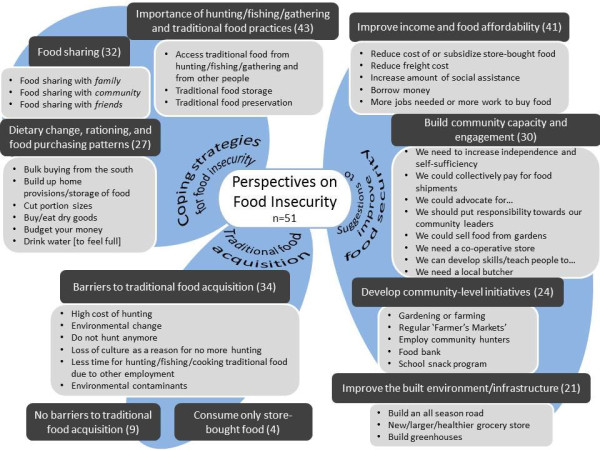
BACKGROUND: Food insecurity is a serious public health issue for Aboriginal people (First Nations [FN], Métis, and Inuit) living in Canada. Food security challenges faced by FN people are unique, especially for those living in remote and isolated communities. Conceptualizations of food insecurity by FN people are poorly understood. The purpose of this study was to explore the perceptions of food insecurity by FN adults living in a remote, on-reserve community in northern Ontario known to have a high prevalence of moderate to severe food insecurity. METHODS: A trained community research assistant conducted semi-directed interviews, and one adult from each household in the community was invited to participate. Questions addressed traditional food, coping strategies, and suggestions to improve community food security and were informed by the literature and a community advisory committee. Thematic data analyses were carried out and followed an inductive, data-driven approach. RESULTS: Fifty-one individuals participated, representing 67% of eligible households. The thematic analysis revealed that food sharing, especially with family, was regarded as one of the most significant ways to adapt to food shortages. The majority of participants reported consuming traditional food (wild meats) and suggested that hunting, preserving and storing traditional food has remained very important. However, numerous barriers to traditional food acquisition were mentioned. Other coping strategies included dietary change, rationing and changing food purchasing patterns. In order to improve access to healthy foods, improving income and food affordability, building community capacity and engagement, and community-level initiatives were suggested. CONCLUSIONS: Findings point to the continued importance of traditional food acquisition and food sharing, as well as community solutions for food systems change. These data highlight that traditional and store-bought food are both part of the strategies and solutions participants suggested for coping with food insecurity. Public health policies to improve food security for FN populations are urgently needed.
Overview
The claims and statistics of this paper haven’t been checked yet.
Free: it reads the open-access text and checks the first 5 claims that cite a source we can check. Create a free account to check every claim.
Integrity signals
Registry
Cites
Statistics
Figures
Verification
Claims the paper makes
The claims and statistics of this paper haven’t been checked yet.
Free: it reads the open-access text and checks the first 5 claims that cite a source we can check. Create a free account to check every claim.
Claims other papers make about this one
Each is checked against this paper’s own text: does it say what the citing paper says it does?
The source backs part of the claim, not all of it — or backs it for a different population, condition or comparison.
In the citing paper
“Successful implementation of such endeavors has valued community engagement and centred Indigenous perspectives and strengths in program planning [1–9].”
From Scale up of the learning circles: a participatory action approach to support local food systems in four diverse First Nations school communities within Canada (2024) · cites this paper as [8]
Experimental — accuracy not yet measured
Self-check
Percentages, sums and reported differences re-computed from the paper’s own numbers.
The self-check needs the paper’s full text.
Citations
Cites
Using thematic analysis in psychology
Braun, V., & Clarke, V. (2006) · Qualitative Research in Psychology · doi:10.1191/1478088706qp063oa · Cited by 194,414 · cited 1×
“Subsequently, data were organized into groups, and “themes” [37] were identified within a subsample of data from ten randomly selected interviews.”
Method(1998) · Sage eBooks · Cited by 38,631
(2006) · Cited by 18,730
(1998) · Cited by 13,501
Handbook of qualitative research
Griffin, T. F. (1999) · Psychology and Marketing · doi:10.1002/(sici)1520-6793(199907)16:4<371::aid-mar7>3.0.co;2-k · Cited by 9,037
Basics of Qualitative Research: Techniques and Procedures for Developing Grounded Theory
Wuetherick, B. (2010) · Canadian Journal of University Continuing Education · doi:10.21225/d5g01t · Cited by 8,311
Constructing grounded theory. A practical guide through qualitative analysis
Brink, E., Dellve, L., Hallberg, U., Abrahamsson, K. H., Klingberg, G., & Wentz, K. (2006) · International Journal of Qualitative Studies on Health and Well-being · doi:10.3402/qhw.v1i3.4932 · Cited by 6,862
Analyzing Social Settings: A Guide To Qualitative Observation And Analysis
Lofland, J., & , J. (1971) · Works - Scholarship, Research, & Creative Expression (Swarthmore College) · Cited by 5,634
Enhancing the quality and credibility of qualitative analysis.
(1999) · PubMed Central · Cited by 4,133
Utilization-Focused Evaluation: The New Century Text. Edition 3.
Patton, M. Q. (1997) · Cited by 1,684
Research works printed but not linked: 22
- Health Canada: Canadian Community Health Survey, Cycle 2.2, Nutrition Income-related household food security in Canada 2004 [ http://www.hc-sc.gc.ca/fn-an/alt_formats/hpfb-dgpsa/pdf/surveill/income_food_sec-sec_alim_e.pdf] 2007
- The First Nations Information Governance Centre First Nations Regional Health Survey (RHS) Phase 2 (2008/10) National Report on Adults, Youth and Children Living in First Nations Communities 2012 Ottawa: The First Nations Information Governance Centre
- Agriculture and Agri-Food Canada Canada’s fourth progress report on food security 2006 [ http://www.agr.gc.ca/misb/fsec-seca/pdf/report-rapport_4_e.pdf]23662347
- Dietitians of Canada Community food security: position of Dietitians of Canada 2007 [ http://www.dietitians.ca/Downloadable-Content/Public/cfs-position-paper.aspx]
- Power E Food security for First Nations and Inuit in Canada background paper 2007 Health Canada: Prepared for the First Nations and Inuit Health Branch
- Lincoln YS Guba EG Naturalistic Inquiry 1985 Newbury Park: Sage Publications
- Statistics Canada Concept: census family 2012 Ottawa: Statistics Canada [ http://www.statcan.gc.ca/concepts/definitions/cfamily-rfamille-eng.htm]
- Delormier T Traditional food of the James Bay Cree of Quebec 1993 Ottawa, ON: Final Report to Health and Welfare Canada
- Tsuji LJS Mandatory use of non-toxic shotshell for harvesting of migratory game birds in Canada: cultural and economic concerns Can J Native Stud 1998 18 19 36
- Tsuji LJS Nieboer E A question of sustainability in Cree harvesting practices: the seasons, technological and cultural changes in the western James Bay region of northern Ontario, Canada Can J Native Stud 1999 19 169 192
- Tsuji LJS Edwards E Ashamock M Stephens A Hunter J Edwards R Edwards G Martin ID LeBlanc A Dumas P Spring-harvested game birds from the western James Region of northern Ontario, Canada: organochlorine concentrations in breast tissues 2006 Ottawa, ON: Health Canada Report
- LeBlanc J Veeraraghavan G Food program a hit in Fort Albany 2012 Spring: In The NAN Advocate
- Socha T Zahaf M Chambers L Abraham R Fiddler T Food security in a northern First Nations community: an exploratory study on food availability and accessibility J Aboriginal Health 2012 8 5 14
- Maxwell D Caldwell R The coping strategies index: field methods manual 2008 2 [ http://documents.wfp.org/stellent/groups/public/documents/manual_guide_proced/wfp211058.pdf]
- Tarasuk V Discussion paper on household and individual food insecurity 2001 Health Canada [ http://www.hc-sc.gc.ca/fn-an/nutrition/pol/food_sec_entire-sec_aliments_entier-eng.php]
- McIntyre L Food security: more than a determinant of health 2003 Policy Options [ http://www.irpp.org/po/archive/mar03/mcintyre.pdf]
- LeBlanc J Get Growing program Nishnawbe Aski Nation Annual Report 2011–2012 2012 Thunder Bay, ON: Nishnawbe Aski Nation
- Government of Nunavut A consultation-based review of the harvester support programs of the Government of Nunavut and Nunavut Tunngavik Inc 2008 [ http://www.tunngavik.com/documents/publications/2008-08-11-Review-of-Harvester-Support-Programs-Final-Report-ENG.pdf]
- No author An Act respecting the support program for Inuit beneficiaries of the James Bay and Northern Québec agreement for their hunting, fishing and trapping activities, RSQ, c P-30.2 2006 [ http://canlii.ca/t/hbqv]
- Food Secure Canada Preliminary program for Powering up Food for the Future: Food Secure Canada’s 7th National Assembly 2012 [ http://foodsecurecanada.org/sites/foodsecurecanada.org/files/FSC-EdmontonProgram-web.pdf]
- Food Secure Canada Conference ‘PoweringUP-Food for the Future!’ 2012 [ http://storify.com/milzofsmilz/pwrup2012-food-secure-canada-conference-poweringu]
- Food Secure Canada Resetting the table: a people’s food policy for Canada 2011 [ http://foodsecurecanada.org/sites/foodsecurecanada.org/files/FSC-resetting2012-8half11-lowres-EN.pdf]12455339
Cited by
Items 101–189 of 189
Sharing Indigenous Foods Through Stories and Recipes
Skinner, K. A., Neufeld, H. T., Murray, E., Hajto, S., Andrews, L., & Garrett, A. (2020) · Canadian Journal of Dietetic Practice and Research · doi:10.3148/cjdpr-2020-020 · Cited by 6
Self-citationJohnson-Jennings, M., Jennings, D., Paul, K., & Little, M. M. (2020) · AlterNative An International Journal of Indigenous Peoples · doi:10.1177/1177180120954446 · Cited by 6
“This includes revitalizing their foodways, such as with reestablishing gardening, even in urban areas (Jennings, et al., 2018; Jennings et al., 2020; Johnson-Jennings et al., 2020) and instituting community driven, food sharing (Skinner et al., 2013).”
BackgroundCyr, M., & Slater, J. J. (2019) · Canadian Food Studies / La Revue canadienne des études sur l alimentation · doi:10.15353/cfs-rcea.v6i2.339 · Cited by 6
Ahmed, F., Moriarity, R. J., Spence, N. D., Kataquapit, G., Sutherland, C., Charania, N. A. M. A., Tsuji, L. J. S., & Liberda, E. N. (2024) · BMC Public Health · doi:10.1186/s12889-024-21052-0 · Cited by 5
Self-citationIndigenous‐Led Analysis of Important Subsistence Species Response to Resource Extraction
Carroll, K. A., Grey, F., Anderson, N., Anderson, N., & Fisher, J. T. (2025) · Ecology and Evolution · doi:10.1002/ece3.71170 · Cited by 5
“…(Gilbert et al. 2021; Shafiee et al. 2022), in part due to cost (i.e., permits, and equipment) and concerns about environmental contaminants in hunted food (Skinner et al. 2013), including cadmium, lead, arsenic, mercury, methylmercury, and other persistent organic pollutants (Chan et al. 2021).”
Wright, H. M., & Piperata, B. A. (2025) · Ecology of Food and Nutrition · doi:10.1080/03670244.2025.2539524 · Cited by 5
“…sharing, to access food (Athila and Leite 2020; Mucioki, Sowerwine, and Sarna-Wojcicki 2018; Power 2008; Ready 2016; Ready and Power 2018; Segall-Corr ê a et al. 2018; Skinner et al. 2013; Skinner, Pratley, and Burnett 2016; Soares et al. 2021; Yuyama et al. 2007, 2008; Zimmerer and de Haan 2020).”
Bliss, S., Musumeci, S., Belarmino, E. H., Merrill, S. C., Bertmann, F. M. W., Schattman, R. E., & Niles, M. T. (2024) · Agroecology and Sustainable Food Systems · doi:10.1080/21683565.2024.2378697 · Cited by 5
“Most research on how non-market production interacts with food security comes from outside of high-income nations (Heim 2021; Mattsson, Ostwald, and Nissanka 2018) or from Indigenous communities within them (Leibovitch Randazzo and Robidoux 2019; Skinner et al. 2013; Smith et al. 2019).”
Disparities in Economic Values for Nature-Based Activities in Canada
Spence, D. S., Schuster‐Wallace, C. J., & Lloyd-Smith, P. R. (2022) · Ecological Economics · doi:10.1016/j.ecolecon.2022.107724 · Cited by 5
Editorial: Traditional knowledge in food activism and governance
Fontefrancesco, M. F., Vandebroek, I., & Pieroni, A. (2024) · Frontiers in Sustainable Food Systems · doi:10.3389/fsufs.2024.1450833 · Cited by 5
Trott, N. (2023) · Spectrum Research Repository (Concordia University) · Cited by 5
Gender-Specific chemical exposure in arctic communities
Morales, M. M., Herrmann, T. M., Mobley, M., Prior, T., Karlsson, K., Mercier‐Bonin, M., Bizec, B. L., & Dervilly, G. (2025) · Exposome · doi:10.1093/exposome/osaf006 · Cited by 4
Conduits of Communion: Monstrous Affections in Algonquin Traditional Territory
Puppe, I. (2015) · Scholarship@Western (Western University) · Cited by 4
Gates, M. (2016) · UWSpace (University of Waterloo) · Cited by 5
Okorosobo, T. (2017) · Mspace (University of Manitoba) · Cited by 4
Cyr, M. (2018) · Mspace (University of Manitoba) · Cited by 4
Robidoux, M. A., Loukes, K. A., Vandermale, E. A., Keil, T. J., & Gaudet, J. C. (2023) · Canadian Food Studies / La Revue canadienne des études sur l alimentation · doi:10.15353/cfs-rcea.v10i3.637 · Cited by 3
Guan, J., & Wang, J. C. H. (2024) · BMC Public Health · doi:10.1186/s12889-023-17385-x · Cited by 3
“Skinner et al. [8] and Burnett et al. [9] reveal through qualitative semi-structured interviews that those living in remote communities are concerned about the high price of food as well as lower incomes in the north.”
BackgroundGyapay, J. (2022) · UWSpace (University of Waterloo) · Cited by 3
Balalio, T. M. F., & Robidoux, M. A. (2025) · Journal of Health Population and Nutrition · doi:10.1186/s41043-025-01196-4 · Cited by 2
“…local food initiatives that address the drivers of food security and support food sovereignty, such as community gardens and greenhouses [8, 10, 15–17], research collaborations with schools and Indigenous organizations food programs [18], and research-related health intervention…”
Batal, M., Kenny, T., Johnson‐Down, L., Ing, A., Fediuk, K., Sadik, T., Chan, H. M., & Willows, N. D. (2021) · Applied Physiology, Nutrition, and Metabolism · doi:10.1139/apnm-2020-0950 · Cited by 2
A modelling approach to inform regional cumulative effects assessment in northern Ontario
Antwi, E. K., Rempel, R. S., Carlson, M., Boakye-Danquah, J., Winder, R. S., Dabros, A., Owusu-Banahene, W., Berryman, E. J., & Eddy, I. M. S. (2023) · Frontiers in Environmental Science · doi:10.3389/fenvs.2023.1217195 · Cited by 2
Indigenous Food Sovereignty in Canada: Exploring Practices, Intersections, and Lessons for Policy
Merriam, A. (2021) · UVic’s Research and Learning Repository (University of Victoria) · Cited by 2
Decelles, S. (2014) · doi:10.71781/28828 · Cited by 2
Soares, G. H. (2018) · Digital Library of Theses and Dissertations (Universidade de São Paulo) · doi:10.11606/d.23.2018.tde-04042018-101947 · Cited by 2
Cook, C. (2018) · Mspace (University of Manitoba) · Cited by 2
Hanemaayer, R. (2019) · The Atrium (University of Guelph) · Cited by 2
Beyond Charity? Insights on a Food Rescue Work Integration Social Enterprise in Guelph, ON
Vennen, R. V. (2020) · The Atrium (University of Guelph) · Cited by 2
Food gardens in a Guarani Kaiowá indigenous community: a contribution to thinking ahead
Funai, F. N. D. I. , da Silva, S. R., da Silva, M. C., & Schlindwein, M. M. (2022) · Emancipacao · doi:10.5212/emancipacao.v.22.2220302.008 · Cited by 1
Shafiee, M., Al-Bazz, S., Szafron, M., Lane, G. L., & Vatanparast, H. (2024) · Nutrients · doi:10.3390/nu16152432 · Cited by 1
“Urbanization also leads to a reliance on social networks for access to traditional foods, which underscores a vulnerability to food insecurity when those networks are unavailable or disrupted [47].”
BackgroundResultTraditional Knowledge in Food Activism and Governance
Pieroni, A., Fontefrancesco, M. F., & Vandebroek, I. (2024) · Frontiers research topics · doi:10.3389/978-2-8325-5323-7 · Cited by 1
Ratelle, M., Phillipps, B., Skinner, K. A., Lamers, Y., de Melo, L. R. M., Laird, B. D., Andrew, L., Yakeleya, J., Bougie, A., Jensen, K., et al. (2024) · International Journal of Circumpolar Health · doi:10.1080/22423982.2024.2438434 · Cited by 1
Self-citationJoseph, L., Mathews, D. L., Cuerrier, A., & Boulos, L. (2025) · Botany · doi:10.1139/cjb-2025-0032 · Cited by 1
Participatory citizen science for Relational One Health and Indigenous food sovereignty
Sarapura-Escobar, S., Benalcazar, P., Potter, C., Berti, N. T., Sabourin, S., & Nishnaabeg, N. (2026) · Frontiers in Sustainable Food Systems · doi:10.3389/fsufs.2026.1886735 · Cited by 1
HOUSEHOLD FOOD SECURITY AND COPING STRATEGIES DURING COVID-19 PANDEMIC
Abdullah, R. G., Kiong, W. S., & Mersat, N. I. (2021) · Jurnal Kinabalu · doi:10.51200/ejk.vi.3666 · Cited by 1
Charles, C. J., & Datta, R. K. (2022) · Informed decisionmaking for sustainability · doi:10.1007/978-3-030-89312-5_16 · Cited by 1
KUMANDE SAMATURU’: BERDAULAT PANGAN DI KALUPPINI
Nurbaya, N. (2023) · Penerbit BRIN eBooks · doi:10.55981/brin.666 · Cited by 1
Sritharan, M. (2017) · York University Digital Library (York University) · Cited by 1
Pomier-Layrargues, C. (2017) · Papyrus : Institutional Repository (Université de Montréal) · doi:10.71781/30500 · Cited by 1
Al‐Hamad, A. (2019) · Lu Zone Ul (Laurentian University) · Cited by 1
Fish Consumption and Nutritional Health among First Nations in Canada
Marushka, L. (2018) · uO Research (University of Ottawa) · doi:10.20381/ruor-22706 · Cited by 1
“Furthermore, the high cost, lack of variety and quality of store-bought foods (especially in isolated communities) has been well-documented as barriers to a healthy diet and nutritional security (Chan et al. 2006; Lawn and Harvey 2004; Skinner et al. 2013).”
BackgroundImpacts of community food programs in northern Manitoba
Romero-Fawcett, K. (2019) · Mspace (University of Manitoba) · Cited by 1
Périllat-Amédée, S. (2020) · eScholarship@McGill (McGill) · doi:10.82308/44511 · Cited by 1
A human-health risk assessment of dietary methylmercury exposure in Fort Albany First Nation
Ahmed, F. (2021) · doi:10.32920/ryerson.14639886 · Cited by 1
Tsuji, L. J. S., Tsuji, S. R. J., Zuk, A. M., Davey, R., & Liberda, E. N. (2023) · doi:10.32920/22782704 · Cited by 1
Self-citationFood security in environmental assessment in the Northwest Territories' Mackenzie Valley
Mulders, T. (2024) · cIRcle (University of British Columbia) · doi:10.14288/1.0438372 · Cited by 1
Chowdhury, M. A. (2023) · HARVEST (University of Saskatchewan) · Cited by 1
Oloko, M. (2022) · HARVEST (University of Saskatchewan) · Cited by 1
Indigenous health, livestock, and climate change adaptation in Kanungu District, Uganda
Donnelly, B. (2016) · eScholarship@McGill (McGill) · doi:10.82308/39907 · Cited by 1
Gates, A. (2016) · UWSpace (University of Waterloo)
Charania, N. A. (2014) · UWSpace (University of Waterloo)
Mercury cycling in a remote boreal drainage basin
Lescord, G. L. (2018) · Lu Zone Ul (Laurentian University)
Spence, K. A. (2015) · Mspace (University of Manitoba) · Cited by 1
Mercer, N. (2020) · UWSpace (University of Waterloo)
Marchione, G. A. (2019) · Mspace (University of Manitoba)
Hum, A. (2020) · Carleton University's Institutional Repository (MacOdrum Library, Carleton University) · doi:10.22215/etd/2020-14399
Maternal sugar intake with maternal weight and body composition changes during and after pregnancy
Liu, A. (2021) · The Atrium (University of Guelph)
Food Security, Store Access, and Prices Paid: Do the Poor Pay More for Groceries?
Koschmann, A., & Wansink, B. C. (2021) · Journal of Hunger & Environmental Nutrition · doi:10.1080/19320248.2021.1997856
Saúde Coletiva: avanços e desafios para a integralidade do cuidado - Volume 2
Santos, D. S., Sousa, T. J., da Silva, A. V. S., Morais, A. C., Oliva, L. D. C., Leite, R. B., Almeida, D. R. D. M. F., Leite, R. B., Serrano, M. R., Pereira, Z. V., et al. (2021) · Editora Científica Digital eBooks · doi:10.37885/978-65-89826-67-5
First Nations’ Food Security in Canada
Alley‐Young, G. (2020) · Springer eBooks · doi:10.1007/978-3-319-74336-3_462-1
SEGURIDAD ALIMENTARIA EN POBLACIONES INDÍGENAS Y CAMPESINAS: UNA REVISIÓN SISTEMÁTICA
Restrepo-Arango, M., Gutiérrez-Builes, L. A., & Ríos-Osório, L. A. (2021) · Editora Científica Digital eBooks · doi:10.37885/210705204
“Thus, biodiversity sustainability is important for some Canadian aboriginal communities, wherein food insecurity is a severe problem 15 , and for the indigenous communities of Nepal, livestock biodiversity is of critical importance for sustaining food security and growth and for reducing poverty 16…”
InfluentialFirst Nations’ Food Security in Canada
Alley‐Young, G. (2023) · Springer eBooks · doi:10.1007/978-3-319-74319-6_462
Human exposure to soil contaminants in subarctic Ontario, Canada
Reyes, E. S., Liberda, E. N., & Tsuji, L. J. S. (2023) · doi:10.32920/22782698
Self-citationAhluwalia, M., Emery, H., Steadman, N., Beauchamp, D. M., von Holt, R. K., Cartwright, N. M., Brendel, E. B. K., & Monk, J. M. (2023) · Journal of food security · doi:10.12691/jfs-11-3-4
“…province of Alberta (20.3% of households experiencing food insecurity) and does not include individuals living in the northern territories of Canada or on Indigenous reservations, wherein previous studies have demonstrated these communities experience high vulnerability to food insecurity [11-12].”
BackgroundInfluentialIghilahriz, K., Dessureault, P.-L., Tremblay, C., & Paré, M. C. (2025) · Canadian Journal of Soil Science · doi:10.1139/cjss-2025-0073
Local Food Sustainability Planning in Moose Cree First Nation, Northern Ontario, Canada.
Ferreira, C. (2022) · uO Research (University of Ottawa) · doi:10.20381/ruor-27940
Majowicz, S., Meyer, S. B., Kirkpatrick, S., Graham, J. L., Shaikh, A., Elliott, S., Minaker, L. M., Scott, S., & Laird, B. (2016) · Figshare · doi:10.6084/m9.figshare.c.3641747_d1
The impact of poverty on children’s educational potential
Enns, S. E. (2023) · cIRcle (University of British Columbia) · doi:10.14288/1.0437723
Our Food Future: Community Voice Project
Duncan, E., Wrathall, M., Clark, H., & Bedi, G. (2021) · The Atrium (University of Guelph)
Articles ; Volume 10, September 2016
(2016) · Lu Zone Ul (Laurentian University)
The effect of the last mile on food security and nutrition in rural Zambia
(2021) · UpSpace Institutional Repository (University of Pretoria)
Wilson, H. (2018) · The Atrium (University of Guelph)
Growing Sustainability: Hydroponic Cultivation of Food Sovereignty in Canada
Mitchell, M. (2024) · UWSpace (University of Waterloo)
Rajdev, V. D. (2025) · Libraries and Cultural Resources (University of Calgary) · doi:10.11575/prism/50748
Coping with Food Insecurity among Low-Income Households in Klang Valley, Malaysia
(2025) · Jurnal Ekonomi Malaysia · doi:10.17576/jem-2025-5903-8
Astuty, E., & Amanah, D. (2025) · IOP Conference Series Earth and Environmental Science · doi:10.1088/1755-1315/1564/1/012018
Indigenous Approaches to Well-Being: Land-Based Programs in Subarctic Canada
Ahmed, F. (2024) · TSpace (University of Toronto)
Jung, S. (n.d.) · Summit (Simon Fraser University)
Renewable Energy and Economic Growth: A Quantitative Analysis of Remote Communities in Canada
Galdamez, D. (2026) · HARVEST (University of Saskatchewan)
Benalcazar, P. (2026) · Rural Review Ontario Rural Planning Development and Policy · doi:10.21083/ruralreview.v10i1.9138
Linking biodiversity to traditional food access and nutrition among First Nations in Canada
Klassen, H., Kenny, T., Humphries, M. M., Kerr, J. T., Batal, M., Sadik, T., & Chan, H. M. (2026) · FACETS · doi:10.1139/facets-2025-0233
Kansanga, M. M., Batung, E. S., Shanmugasundaram, L., & Smaldone, N. (2026) · The Professional Geographer · doi:10.1080/00330124.2026.2648297
“…subgroups (Polsky and Garriguet 2022; Berkowitz, Seligman, and Palakshappa 2024; Kansanga et al. 2024; Rachidi and Gundersen 2024; Troy et al. 2024), particularly Indigenous communities living on reserves (Skinner et al. 2013; Batal et al. 2021; Nikolaus et al. 2022; Shafiee et al. 2022).”
Wendel, D. R., Goode, C., & Robidoux, M. A. (2026) · Journal of food security · doi:10.12691/jfs-14-1-4
Harrigan, T., Acosta, J. E., Wakegijig, M., Charles, K.-A., Skinner, K., & Domingo, A. (2026) · Frontiers in Sustainable Food Systems · doi:10.3389/fsufs.2026.1876414
Self-citationIndigenous partnered research on contaminants in subsistence fish from the Sudbury Basin
Nicholls, T. J. (2024) · Lu Zone Ul (Laurentian University)
Whynott, E. (2024) · Lu Zone Ul (Laurentian University)
Roots or robots: futurizing Indigenous food sovereignty
Dell, K., Nicholson, A. J., Conroy, D. M., Young, J., & Nemec, S. (2026) · Food Culture & Society · doi:10.1080/15528014.2026.2724698
Metadata
- Authors
- Skinner, K., Hanning, R. M., Desjardins, E., & Tsuji, L. J.
- Affiliations
- University of Waterloo (CA)
- Corresponding author
- Skinner, Kelly
- Venue
- BMC Public Health
- Published
- 2013-05-02
- Volume
- 13
- Issue
- 1
- Pages
- 427-427
- ISSN
- 1471-2458 (ISSN-L)
- PMC
- PMC3651721
- OpenAlex
- W2071579347
- Cited by
- 135
- References
- 69
- Citations by year
- 2026: 6 · 2025: 8 · 2024: 17 · 2023: 16 · 2022: 11 · 2021: 22 · 2020: 13 · 2019: 8 · 2018: 9 · 2017: 2 · 2016: 10 · 2015: 3 · 2014: 8 · 2013: 1
- FWCI
- 13.21
- Type
- journal article
- Language
- en
- Open access
- gold
- doi.org
- Licence
- Locations
- BMC Public Health (publishedVersion, cc-by)
- Europe PMC (PubMed Central) (publishedVersion, cc-by)
- PubMed Central (publishedVersion, cc-by)
- PubMed (publishedVersion)
- Funders
- Canadian Foundation for Dietetic Research
- Canadian Institutes of Health Research
- Topics
- Health Sciences › Medicine › Public Health, Environmental and Occupational Health › Food Security and Health in Diverse Populations
- Social Sciences › Health › Indigenous Health, Education, and Rights
- Social Sciences › Anthropology › Indigenous Studies and Ecology
- Keywords
- food insecurity, First Nations, remote Indigenous communities, traditional food, food sharing, coping strategies, food affordability, food system transformation
- MeSH terms
- Adult, Arctic Regions, Diet, Inuit, Female, Food Supply, Humans, Interviews as Topic, Male, Middle Aged, Ontario, Residence Characteristics, Rural Population, Socioeconomic Factors, Resource Allocation, Population Groups, Resilience, Psychological, Young Adult
About these checks
Registry, retraction, Cites and statistics results are computed, not judged, with one exception: a printed reference that no index lists is read once by a model before it counts as a citation error. Claims are extracted by a model and kept only when their quote appears verbatim in the text; each cited source is then checked, with a model’s help, for whether it says what the claim relies on. Those verdicts can be wrong — read the claim’s quote and the cited source before relying on one.
Statistics and arithmetic are recomputed, not judged.
Confidence bands are shown only for fields calibrated on our annotated test set. None is calibrated yet, so no band is shown.
What counts as a claim ›How we measure confidence ›How we check this ›
Are you an author, or do you see a problem with this page? Request a review
Data sources
Bibliographic data: Semantic Scholar, OpenAlex, Crossref.
Contains information from the Semantic Scholar Academic Graph Datasets, made available under the ODC Attribution License (ODC-BY 1.0).
Semantic Scholar’s data is described in: Kinney, R., et al. (2023). The Semantic Scholar Open Data Platform. arXiv:2301.10140.
