

The DOI matches its Crossref record; 52 of the 52 references it cites were found in a registry or an index.
A systematic review of suicide prevention interventions targeting indigenous peoples in Australia, United States, Canada and New Zealand
Open accessAbstract
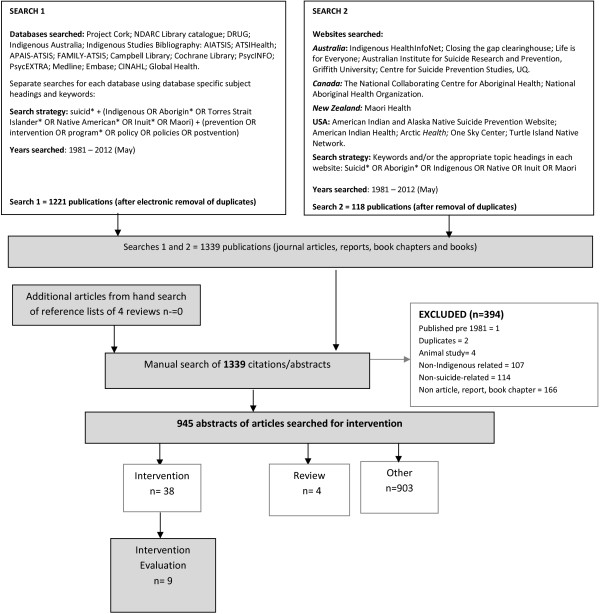
BACKGROUND: Indigenous peoples of Australia, Canada, United States and New Zealand experience disproportionately high rates of suicide. As such, the methodological quality of evaluations of suicide prevention interventions targeting these Indigenous populations should be rigorously examined, in order to determine the extent to which they are effective for reducing rates of Indigenous suicide and suicidal behaviours. This systematic review aims to: 1) identify published evaluations of suicide prevention interventions targeting Indigenous peoples in Australia, Canada, United States and New Zealand; 2) critique their methodological quality; and 3) describe their main characteristics. METHODS: A systematic search of 17 electronic databases and 13 websites for the period 1981-2012 (inclusive) was undertaken. The reference lists of reviews of suicide prevention interventions were hand-searched for additional relevant studies not identified by the electronic and web search. The methodological quality of evaluations of suicide prevention interventions was assessed using a standardised assessment tool. RESULTS: Nine evaluations of suicide prevention interventions were identified: five targeting Native Americans; three targeting Aboriginal Australians; and one First Nation Canadians. The main intervention strategies employed included: Community Prevention, Gatekeeper Training, and Education. Only three of the nine evaluations measured changes in rates of suicide or suicidal behaviour, all of which reported significant improvements. The methodological quality of evaluations was variable. Particular problems included weak study designs, reliance on self-report measures, highly variable consent and follow-up rates, and the absence of economic or cost analyses. CONCLUSIONS: There is an urgent need for an increase in the number of evaluations of preventive interventions targeting reductions in Indigenous suicide using methodologically rigorous study designs across geographically and culturally diverse Indigenous populations. Combining and tailoring best evidence and culturally-specific individual strategies into one coherent suicide prevention program for delivery to whole Indigenous communities and/or population groups at high risk of suicide offers considerable promise.
Overview
The claims and statistics of this paper haven’t been checked yet.
Run the check — free, no account needed. It reads the open-access text and checks the sources it cites.
Integrity signals
Registry
Cites
Statistics
Figures
Verification
Claims the paper makes
The claims and statistics of this paper haven’t been checked yet.
Run the check — free, no account needed. It reads the open-access text and checks the sources it cites.
Claims other papers make about this one
Each is checked against this paper’s own text: does it say what the citing paper says it does?
The check wasn’t confident either way, so it gives no verdict — never disputed.
In the citing paper
“Acceptance and commitment therapy has been found to be efficacious in a number of mental health domains, including depression [10], anxiety [11] and stress [12].”
From The effectiveness of a suicide prevention app for indigenous Australian youths: study protocol for a randomized controlled trial. (2013) · cites this paper as [11]
Experimental — accuracy not yet measured
Self-check
Percentages, sums and reported differences re-computed from the paper’s own numbers.
The self-check needs the paper’s full text.
Citations
Cites
Preferred Reporting Items for Systematic Reviews and Meta-Analyses: the PRISMA statement
Moher, D., Liberati, A., Tetzlaff, J., Altman, D. G., & for the PRISMA Group (2009) · BMJ · doi:10.1136/bmj.b2535 · Cited by 83,823
Preferred Reporting Items for Systematic Reviews and Meta-Analyses: The PRISMA Statement
Moher, D., Liberati, A., Tetzlaff, J., Altman, D. G., & The PRISMA Group (2009) · PLoS Medicine · doi:10.1371/journal.pmed.1000097 · Cited by 64,042
Preferred reporting items for systematic reviews and meta-analyses: the PRISMA Statement.
(2009) · PubMed Central · Cited by 44,859
Preferred Reporting Items for Systematic Reviews and Meta-Analyses: The PRISMA Statement
Moher, D., Liberati, A., Tetzlaff, J., & Altman, D. G. (2009) · Journal of Clinical Epidemiology · doi:10.1016/j.jclinepi.2009.06.005 · Cited by 19,575
Methods for the Economic Evaluation of Health Care Programmes
Drummond, M. E., Sculpher, M. J., Torrance, G. W., O’Brien, B. J., & Stoddart, G. L. (2005) · doi:10.1093/oso/9780198529446.001.0001 · Cited by 13,648
Publication bias in clinical research
Easterbrook, P. J., Gopalan, R., Berlin, J. A., & Matthews, D. R. (1991) · The Lancet · doi:10.1016/0140-6736(91)90201-y · Cited by 3,109 · cited 1×
“evaluations with statistically significant findings are more likely to be published, it is possible that the published evaluations reviewed over-estimate the true effectiveness of suicide prevention intervention targeting Indigenous peoples [50].”
BackgroundSuicide Prevention Strategies: A Systematic Review
Mann, J. J., Apter, A., Bertolote, J., Beautrais, A., Currier, D., Haas, A., Hegerl, U., Lonnqvist, J., Malone, K., Marusic, A., et al. (2005) · JAMA · doi:10.1001/jama.294.16.2064 · Cited by 2,852
Hawton, K., & van Heeringen, K. (2009) · The Lancet · doi:10.1016/s0140-6736(09)60372-x · Cited by 1,671
Indigenous health part 2: the underlying causes of the health gap
King, M., Smith, A., & Gracey, M. (2009) · The Lancet · doi:10.1016/s0140-6736(09)60827-8 · Cited by 1,469
Indigenous health part 1: Determinants and disease patterns
Gracey, M., & King, M. (2009) · The Lancet · doi:10.1016/s0140-6736(09)60914-4 · Cited by 1,303
Research works printed but not linked: 1
- Jackson N: Handbook: Systematic Reviews of Health Promotion and Public Health Interventions. 2007, Victoria: The Cochrane Collaboration, Victorian Health Promotion Foundation
Cited by
Sorted by citations
Suicide prevention strategies revisited: 10-year systematic review
Zalsman, G., Hawton, K., Wasserman, D., van Heeringen, K., Arensman, E., Sarchiapone, M., Carli, V., Höschl, C., Barzilay, R., Balazs, J., et al. (2016) · The Lancet Psychiatry · doi:10.1016/s2215-0366(16)30030-x · Cited by 1,765
Global trends in teenage suicide: 2003–2014
McLoughlin, A., Gould, M. S., & Malone, K. M. (2015) · QJM · doi:10.1093/qjmed/hcv026 · Cited by 360
Bainbridge, R. G., Tsey, K., McCalman, J., Kinchin, I., Saunders, V., Lui, F. W., Cadet‐James, Y., Miller, A., & Lawson, K. D. (2015) · BMC Public Health · doi:10.1186/s12889-015-2052-3 · Cited by 259
Self-citationWhat Works in Youth Suicide Prevention? A Systematic Review and Meta-Analysis
Robinson, J., Bailey, E., Witt, K., Stefanac, N., Milner, A., Currier, D., Pirkis, J., Condron, P., & Hetrick, S. (2018) · EClinicalMedicine · doi:10.1016/j.eclinm.2018.10.004 · Cited by 242
Tighe, J., Shand, F., Ridani, R., Mackinnon, A., De La Mata, N., & Christensen, H. (2017) · BMJ Open · doi:10.1136/bmjopen-2016-013518 · Cited by 227
Metadata
- Authors
- Clifford, A. C., Doran, C. M., & Tsey, K.
- Affiliations
- Institute for Urban Indigenous Health (AU)
- Hunter Medical Research Institute (AU)
- James Cook University (AU)
- Corresponding author
- Clifford, Anton C
- Venue
- BMC Public Health
- Published
- 2013-05-13
- Volume
- 13
- Issue
- 1
- Pages
- 463-463
- ISSN
- 1471-2458 (ISSN-L)
- PMC
- PMC3663804
- OpenAlex
- W2076166069
- Cited by
- 186
- References
- 52
- Citations by year
- 2026: 5 · 2025: 11 · 2024: 13 · 2023: 12 · 2022: 12 · 2021: 22 · 2020: 18 · 2019: 11 · 2018: 16 · 2017: 16 · 2016: 23 · 2015: 14 · 2014: 11 · 2013: 2
- FWCI
- 2.46
- Type
- journal article
- Language
- en
- Open access
- gold
- doi.org
- Licence
- Locations
- BMC Public Health (publishedVersion, cc-by)
- Europe PMC (PubMed Central) (publishedVersion, cc-by)
- PubMed Central (publishedVersion, cc-by)
- PubMed (publishedVersion)
- ResearchOnline - JCU (James Cook University) (submittedVersion)
- Acquire (CQUniversity) (submittedVersion)
- Figshare (submittedVersion, cc-by)
- NOVA (University of Newcastle Australia) (submittedVersion)
- Funders
- NSW Ministry of Health
- Topics
- Social Sciences › Psychology › Clinical Psychology › Suicide and Self-Harm Studies
- Social Sciences › Health › Indigenous Health, Education, and Rights
- Social Sciences › Sociology and Political Science › Homicide, Infanticide, and Child Abuse
- Keywords
- suicide prevention, indigenous peoples, Indigenous suicide, gatekeeper training, community-based prevention, suicide education, Aboriginal Australians, Native Americans, First Nations, culturally tailored interventions, suicidal behavior
- MeSH terms
- Indigenous Peoples, Suicide Prevention, Adolescent, Adult, Australia, Canada, Child, Female, Health Education, Humans, Indians, North American, Male, Middle Aged, New Zealand, Preventive Health Services, Suicide, United States, Population Groups, Native Hawaiian or Other Pacific Islander, Young Adult
About these checks
Registry, retraction, Cites and statistics results are computed, not judged, with one exception: a printed reference that no index lists is read once by a model before it counts as a citation error. Claims are extracted by a model and kept only when their quote appears verbatim in the text; each cited source is then checked, with a model’s help, for whether it says what the claim relies on. Those verdicts can be wrong — read the claim’s quote and the cited source before relying on one.
Statistics and arithmetic are recomputed, not judged.
Confidence bands are shown only for fields calibrated on our annotated test set. None is calibrated yet, so no band is shown.
What counts as a claim ›How we measure confidence ›How we check this ›
Are you an author, or do you see a problem with this page? Request a review
