

Social participation and mental health: moderating effects of gender, social role and rurality
Open accessThe DOI matches its Crossref record; 24 of the 26 references it cites were found in a registry or an index.
Abstract
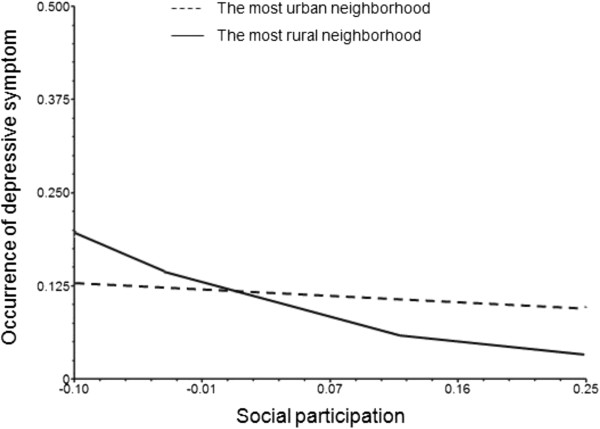
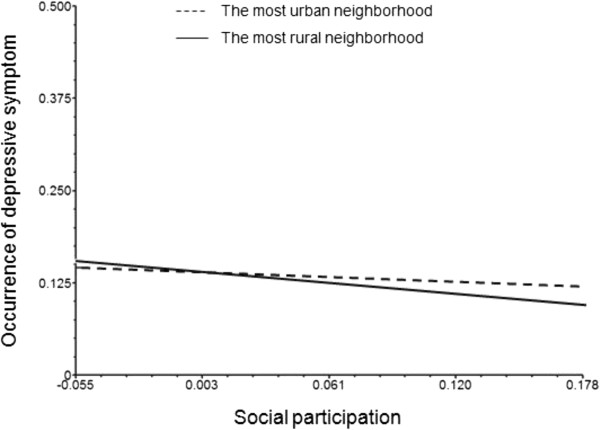
BACKGROUND: Previous studies have reported that older people's social participation has positive effects on their health. However, some studies showed that the impacts of social participation on health differ by gender. We sought to examine whether the effects of social participation on mental health differ for men and women in a Japanese population. We also examined the moderating influence of social position within the organization as well as urban/rural locality. METHODS: We used two waves of the Aichi Gerontological Evaluation Study's longitudinal survey, which targeted residents with aged 65 years or over (n=2,728) in a central part of Japan. The first wave survey was conducted in 2003, and the second wave in 2006. Depressive symptoms of the study participants were assessed using the short version of the Geriatric Depression Scale (GDS-15). A multilevel logistic regression model was used with individual-level as level 1 and the school district-level as level 2. RESULTS: We found that higher social participation and performing key roles in the organization had protective effects on depressive symptoms for women. However, there were no main effects of these variables for the mental health of men. We found an interaction between social participation, organizational position, and rural residence among men only. That is, men who occupied leadership positions in organizations reported better mental health, but only in rural areas. CONCLUSIONS: Our findings support the notion that increasing the opportunities for social participation improves older people's heath, especially for women. However, in the rural Japanese context, offering men meaningful roles within organizations may be important.
Overview
The claims and statistics of this paper haven’t been checked yet.
Free: it reads the open-access text and checks the first 5 claims that cite a source we can check. Create a free account to check every claim.
Integrity signals
Registry
Cites
Statistics
Figures
Verification
Claims the paper makes
The claims and statistics of this paper haven’t been checked yet.
Free: it reads the open-access text and checks the first 5 claims that cite a source we can check. Create a free account to check every claim.
Claims other papers make about this one
Each is checked against this paper’s own text: does it say what the citing paper says it does?
The source backs part of the claim, not all of it — or backs it for a different population, condition or comparison.
In the citing paper
“Considering gender differences is particularly important given that women may be more likely to engage in frequent social activity and are more likely to maintain close relationships and wider social networks than men [50, 97, 134–136].”
From Social Isolation and Cognitive Function in Later Life: A Systematic Review and Meta-Analysis (2019) · cites this paper as [136]
Experimental — accuracy not yet measured
Self-check
Percentages, sums and reported differences re-computed from the paper’s own numbers.
The self-check needs the paper’s full text.
Citations
Cites
Social Capital: Its Origins and Applications in Modern Sociology
Portes, A. (1998) · Annual Review of Sociology · doi:10.1146/annurev.soc.24.1.1 · Cited by 12,037 · cited 1×
“Portes [14] pointed out the “excess claims on group members” as one of the downsides of social capital.”
BackgroundSocial Foundations of Thought and Action
Bandura, A. (2002) · The Health Psychology Reader · doi:10.4135/9781446221129.n6 · Cited by 9,902 · cited 1×
“Antonucci & Jackson [6] and Bandura [7] stated that such social relationships are useful because they are helpful to develop self-efficacy.”
BackgroundKawachi, I. (2001) · Journal of Urban Health: Bulletin of the New York Academy of Medicine · doi:10.1093/jurban/78.3.458 · Cited by 3,538
Self-citationGlass, T. A., de Leon, C. M., Marottoli, R. A., & Berkman, L. F. (1999) · BMJ · doi:10.1136/bmj.319.7208.478 · Cited by 924 · cited 1×
“Studies from the field of gerontology have reported that older people’s social participation is associated with higher life satisfaction, higher self-esteem, lower rates of admission to a nursing homes, as well as lower mortality [1-3].”
BackgroundEffects of Volunteering on the Well-Being of Older Adults
Morrow-Howell, N., Hinterlong, J., Rozario, P. A., & Tang, F. (2003) · The Journals of Gerontology: Series B · doi:10.1093/geronb/58.3.s137 · Cited by 923 · cited 1×
“[12] examined the interaction effects of gender and participation in volunteer activities on self rated health, functional dependency and depressive symptoms, using panel data from three time points in the U.”
MethodThe Short Form of the Geriatric Depression Scale: A Comparison With the 30-Item Form
Burke, W. J., Roccaforte, W. H., & Wengel, S. P. (1991) · Journal of Geriatric Psychiatry and Neurology · doi:10.1177/089198879100400310 · Cited by 731 · cited 1×
“were measured by the short version of the Geriatric Depression Scale (GDS-15), using simple yes/no format, suitable for self-administration [17].”
MethodZunzunegui, M.-V., Alvarado, B. E., Del Ser, T., & Otero, A. (2003) · The Journals of Gerontology Series B: Psychological Sciences and Social Sciences · doi:10.1093/geronb/58.2.s93 · Cited by 719 · cited 1×
“Spanish research on older people also showed that friendship connections are associated with a protective effect on cognitive impairment for women, but not for men [9].”
BackgroundVolunteering and Mortality Among Older Adults: Findings From a National Sample
Musick, M. A., Herzog, A. R., & House, J. S. (1999) · The Journals of Gerontology Series B: Psychological Sciences and Social Sciences · doi:10.1093/geronb/54b.3.s173 · Cited by 585 · cited 1×
“[13] pointed out that both too little participation and too frequent participation in volunteer activities are more likely to be associated with negative impacts on the health of older people.”
BackgroundFried, L. P. (2004) · Journal of Urban Health: Bulletin of the New York Academy of Medicine · doi:10.1093/jurban/jth094 · Cited by 523 · cited 1×
“In the health promotion literature, increasing the opportunities for social participation has been suggested as a means of improving older people’s health [22-24].”
BackgroundSuccessful Aging: A Life-Course Perspective on Women's Multiple Roles and Health
Moen, P., Dempster-McClain, D., & Williams (1992) · American Journal of Sociology · doi:10.1086/229941 · Cited by 503 · cited 1×
“; licensee BioMed Central Commons Attribution License (http://creativec reproduction in any medium, provided the or increasing the participants’ range of social networks, as well as their social prestige, access to resources and emotional gratification [5].”
Background
Research works printed but not linked: 3
- Kondo K Health inequality in Japan: an empirical study of older people 2010 Melbourne: Trans Pacific Press
- Hanibuchi T Mapping and classifying of urbanization by using Japanese historic topographic maps: the case of Chita Peninsula, aichi prefecture, Japan Urban Geography of Japan 2008 3 7 17 (in Japanese)
- Antonucci TC Turner BF, Troll LE A life-span view of women’s social relations Woman growing older 1994 Thousand Oaks: Sage Publications 239 269
Cited by
Items 201–247 of 247
「人と人」・「人と社会」 のつながりが心身の健康に与える影響
穂大, 岩., & 琢也, 辻. (2019) · 心身医学 · doi:10.15064/jjpm.59.4_328
Ageing in a digital society : an occupational perspective on social participation
Fischl, C. (2020) · DiVA - Jönköping University · Cited by 4
Processes that enable public health professionals to organize preventive care support groups
Oichi, M., Kamishima, T., & Hirano, M. (2020) · Public Health Nursing · doi:10.1111/phn.12806
Three Papers on Social Participation over the Life Course
Ang, S. (2020) · Deep Blue (University of Michigan)
Domäne: Alleinsein und soziale Interaktion
Stefan, H., Allmer, F., Schalek, K., Eberl, J., Hansmann, R., Jedelsky, E., Pandzic, R., Tomacek, D., & Vencour, M. C. (2022) · Springer eBooks · doi:10.1007/978-3-662-62673-3_7
Sheng, M., Young, K. J., Li, Y., Zhang, Y., Wang, J., & Jiang, S. (2023) · Research Square · doi:10.21203/rs.3.rs-3304974/v1
Ow, Y. S. Y., Wei, C.-S., & Li, Y.-T. (2023) · Research Square · doi:10.21203/rs.3.rs-3318927/v1
Annora, C., Dewi, F. I. R., & Sari, M. P. (2023) · International Journal of Application on Social Science and Humanities · doi:10.24912/ijassh.11.889-898
Cho, M. H. (2023) · Korean Journal of Human Ecology · doi:10.5934/kjhe.2023.32.5.535
Shimoda, T., Tomida, K., Nakajima, C., Kawakami, A., & Shimada, H. (2024) · SSRN Electronic Journal · doi:10.2139/ssrn.4645561
Jiang, W., Yang, Y., He, Y., Liu, Q., Deng, X., Hua, Y., Hayixibayi, A., Ni, Y., & Guo, L. (2024) · Epidemiology and Psychiatric Sciences · doi:10.1017/s2045796024000313 · Cited by 2
“…it is important to note that previous studies conducted among the general population in Japan and Korea have documented a more significant influence of social participation on self-reported mental health among older women than older men (Mackenzie and Abdulrazaq, 2021; Takagi et al. , 2013).”
BackgroundResultHolistic Well-being Practices for Enriched Living in the Geriatric Population: A Literature Review
Patil, S. P., Dcosta, B., & Mahaveer, N. (2024) · Indian Journal of Physical Therapy and Research · doi:10.4103/ijptr.ijptr_78_24
Changes in Physical Activity and Cognitive Function of the Elderly Due to COVID-19 in South Korean
Lee, E., & Lim, S. (2025) · Exercise Science · doi:10.15857/ksep.2024.00556
“Previous studies have reported that considering gender differences is especially important given that females are more likely to engage in social activities and maintain intimate relationships and broader social networks [22,23].”
Marzban, A., Rezaei, M.-R., Yoshany, N., & Moori, M. K. (2025) · Health Science Monitor · doi:10.61186/hsm.4.2.82
He, Y., Yin, H., Luo, Y., & He, H. (2025) · Aging Neuropsychology and Cognition · doi:10.1080/13825585.2025.2549738 · Cited by 1
“Good mental health also promotes social engagement, which provides further cognitive enrichment (Hsu, 2007; Okabayashi et al., 2004; Pachucki et al., 2015; Rashedi et al., 2014; R. Wang et al., 2019; Takagi et al., 2013; Tomioka et al., 2017; Tough et al., 2017; Y. Zhang et al., 2022).”
Domínguez-Párraga, L. G., Carrillo, M. D. M. C., & Guisado, M. C. (2025) · Lecture notes in bioengineering · doi:10.1007/978-3-031-77282-5_9
Siette, J., Jorgensen, M. L., Georgiou, A., Dodds, L., McClean, T., & Westbrook, J. I. (2021) · Figshare · doi:10.6084/m9.figshare.14870345
Kanamori, M., Hanazato, M., Takagi, D., Kondo, K., Ojima, T., Amemiya, A., & Kondo, N. (2021) · Figshare · doi:10.6084/m9.figshare.16683110
Self-citationYokobori, Y., Fukunaga, A., Okawa, S., Hachiya, M., Nguyen, C. Q., Pham, T. T. P., Hoang, D. V., Phan, D. C., Huynh, D. V., Le, H. X., et al. (2024) · Figshare · doi:10.6084/m9.figshare.26670249
Kanamori, M., Hanazato, M., Takagi, D., Kondo, K., Ojima, T., Amemiya, A., & Kondo, N. (2021) · Figshare · doi:10.6084/m9.figshare.16683116
Self-citationShimoda, T., Tomida, K., Nakajima, C., Kawakami, A., Doi, T., & Shimada, H. (2024) · Figshare · doi:10.6084/m9.figshare.26085079
Yokobori, Y., Fukunaga, A., Okawa, S., Hachiya, M., Nguyen, C. Q., Pham, T. T. P., Hoang, D. V., Phan, D. C., Huynh, D. V., Le, H. X., et al. (2024) · Figshare · doi:10.6084/m9.figshare.26670252
Kanamori, M., Hanazato, M., Takagi, D., Kondo, K., Ojima, T., Amemiya, A., & Kondo, N. (2021) · Figshare · doi:10.6084/m9.figshare.16683107
Self-citationKanamori, M., Hanazato, M., Takagi, D., Kondo, K., Ojima, T., Amemiya, A., & Kondo, N. (2021) · Figshare · doi:10.6084/m9.figshare.16683119
Self-citationAly, N. M., Ihab, M., Ammar, N., Quritum, M., Moussa, H., & Tantawi, M. E. (2024) · Figshare · doi:10.6084/m9.figshare.26757364
Yokobori, Y., Fukunaga, A., Okawa, S., Hachiya, M., Nguyen, C. Q., Pham, T. T. P., Hoang, D. V., Phan, D. C., Huynh, D. V., Le, H. X., et al. (2024) · Figshare · doi:10.6084/m9.figshare.26670255
Kanamori, M., Hanazato, M., Takagi, D., Kondo, K., Ojima, T., Amemiya, A., & Kondo, N. (2021) · Figshare · doi:10.6084/m9.figshare.16683113
Self-citationMatsuoka, Y., Haseda, M., Kanamori, M., Sato, K., Amemiya, A., Ojima, T., Takagi, D., Hanazato, M., & Kondo, N. (2023) · Figshare · doi:10.6084/m9.figshare.24295608
Self-citationKanamori, M., Hanazato, M., Takagi, D., Kondo, K., Ojima, T., Amemiya, A., & Kondo, N. (2021) · Figshare · doi:10.6084/m9.figshare.16683104
Self-citationYokobori, Y., Fukunaga, A., Okawa, S., Hachiya, M., Nguyen, C. Q., Pham, T. T. P., Hoang, D. V., Phan, D. C., Huynh, D. V., Le, H. X., et al. (2024) · Figshare · doi:10.6084/m9.figshare.26670246
Shimoda, T., Tomida, K., Nakajima, C., Kawakami, A., Doi, T., & Shimada, H. (2024) · Figshare · doi:10.6084/m9.figshare.26085191
Zhang, H., & Zhu, S. (2026) · Frontiers in Public Health · doi:10.3389/fpubh.2025.1718222 · Cited by 1
Zhang, S., & Zhang, C. (2026) · Applied Economics · doi:10.1080/00036846.2026.2621154
Kobayashi, S., Nakagomi, A., Ide, K., Chen, Y.-R., Hanazato, M., Kondo, K., & Shiba, K. (2026) · Archives of Gerontology and Geriatrics · doi:10.1016/j.archger.2026.106186
Self-citationIde, K., Shioya, R., Kobayashi, S., Maeda, R., & Kondo, K. (2026) · Discover Mental Health · doi:10.1007/s44192-026-00395-7
“Previous studies have demonstrated that active engagement in social roles protects against depression [42] and dementia [43].”
Self-citationNoguchi, T., Fujihara, S., Ide, K., Jeong, S., Saito, T., Kondo, K., & Ojima, T. (2026) · Aging & Mental Health · doi:10.1080/13607863.2026.2634128 · Cited by 3
“We calculated age-friendliness scores for each community by aggregating individual responses on the AFC scale items by school districts, which are used as community units (Takagi et al., 2013).”
Self-citationMATSUMOTO, Y., Chen, Y.-R., Matsuoka, Y., Matsumoto, K., Yoshida, H., Kondo, K., & Hanazato, M. (2026) · Archives of Gerontology and Geriatrics · doi:10.1016/j.archger.2026.106258
Self-citationThe Protective Role of Country-level Social Capital for Mental Health During Large-scale Crises
Laurence, J., & Calvey, B. (2026) · Society and Mental Health · doi:10.1177/21568693251405194 · Cited by 1
Ando, S., MAEDA, S., & Kawakubo, S. (2026) · Journal of Environmental Engineering (Transactions of AIJ) · doi:10.3130/aije.91.276
Yu, Y., Ma, J., & Guo, W. (2026) · BMC Geriatrics · doi:10.1186/s12877-026-07722-1 · Cited by 1
Kubota, K., Aishima, M., Matsumura, Y., Miura, T., Minamizaki, M., Koizumi, Y., Kanoya, Y., & Tabuchi, T. (2026) · SSM - Population Health · doi:10.1016/j.ssmph.2026.101943
“…and social capital are associated with better mental health and lower mortality among older adults (Murayama et al., 2012; Steptoe et al., 2013; Takagi et al., 2013), yet relatively few have used nationwide data to examine graded associations between social network size and mental health using…”
Digital use as a mediator of social participation and older adults’ health in China
Cui, K., & Wei, S. (2026) · Critical Public Health · doi:10.1080/09581596.2026.2721036
Chen, A., & Ang, S. (2026) · Social Science & Medicine · doi:10.1016/j.socscimed.2026.119920
Metadata
- Authors
- Takagi, D., Kondo, K., & Kawachi, I.
- Affiliations
- The University of Tokyo (JP)
- Nihon Fukushi University (JP)
- Harvard University (US)
- Corresponding author
- Takagi, Daisuke
- Venue
- BMC Public Health
- Published
- 2013-07-31
- Volume
- 13
- Issue
- 1
- Pages
- 701-701
- ISSN
- 1471-2458 (ISSN-L)
- PMC
- PMC3734140
- OpenAlex
- W1988297099
- Semantic Scholar
- ac43a82d9012374b2ba7790f5bb7a746726ba762
- Cited by
- 250
- References
- 26
- Citations by year
- 2026: 15 · 2025: 20 · 2024: 34 · 2023: 24 · 2022: 33 · 2021: 27 · 2020: 20 · 2019: 16 · 2018: 16 · 2017: 19 · 2016: 13 · 2015: 8 · 2014: 5
- FWCI
- 8.72
- Type
- journal article
- Language
- en
- Open access
- gold
- doi.org
- Licence
- Locations
- BMC Public Health (publishedVersion, cc-by)
- Europe PMC (PubMed Central) (publishedVersion, cc-by)
- PubMed Central (publishedVersion, cc-by)
- PubMed (publishedVersion)
- Digital Access to Scholarship at Harvard (DASH) (Harvard University) (submittedVersion, cc-by)
- Funders
- Ministry of Education, Culture, Sports, Science and Technology
- Topics
- Health Sciences › Medicine › Public Health, Environmental and Occupational Health › Aging, Health, and Disability
- Social Sciences › Health › Health disparities and outcomes
- Social Sciences › Psychology › Developmental and Educational Psychology › Aging and Gerontology Research
- Keywords
- social participation (health and rehabilitation), mental health, depressive symptoms, older adults, gender differences, social roles, organizational position, leadership roles, rurality, urban-rural differences, Japanese older adults
- MeSH terms
- Aged, Aged, 80 and over, Depression, Female, Housing, Humans, Japan, Longitudinal Studies, Male, Mental Health, Organizations, Rural Population, Sex Factors, Logistic Models, Multilevel Analysis, Social Participation
About these checks
Registry, retraction, Cites and statistics results are computed, not judged, with one exception: a printed reference that no index lists is read once by a model before it counts as a citation error. Claims are extracted by a model and kept only when their quote appears verbatim in the text; each cited source is then checked, with a model’s help, for whether it says what the claim relies on. Those verdicts can be wrong — read the claim’s quote and the cited source before relying on one.
Statistics and arithmetic are recomputed, not judged.
Confidence bands are shown only for fields calibrated on our annotated test set. None is calibrated yet, so no band is shown.
What counts as a claim ›How we measure confidence ›How we check this ›
Are you an author, or do you see a problem with this page? Request a review
Data sources
Bibliographic data: Semantic Scholar, OpenAlex, Crossref.
Contains information from the Semantic Scholar Academic Graph Datasets, made available under the ODC Attribution License (ODC-BY 1.0).
Semantic Scholar’s data is described in: Kinney, R., et al. (2023). The Semantic Scholar Open Data Platform. arXiv:2301.10140.
