

The DOI matches its Crossref record; 88 of the 90 references it cites were found in a registry or an index.
The association between family and community social capital and health risk behaviours in young people: an integrative review
Open accessAbstract
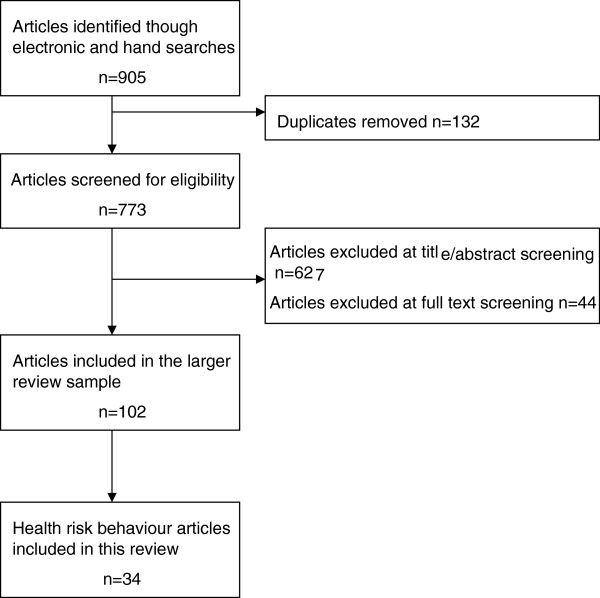
BACKGROUND: Health risk behaviours known to result in poorer outcomes in adulthood are generally established in late childhood and adolescence. These 'risky' behaviours include smoking, alcohol and illicit drug use and sexual risk taking. While the role of social capital in the establishment of health risk behaviours in young people has been explored, to date, no attempt has been made to consolidate the evidence in the form of a review. Thus, this integrative review was undertaken to identify and synthesise research findings on the role and impact of family and community social capital on health risk behaviours in young people and provide a consolidated evidence base to inform multi-sectorial policy and practice. METHODS: Key electronic databases were searched (i.e. ASSIA, CINAHL, Cochrane Database of Systematic Reviews, Cochrane Central Register of Controlled Trials, Database of Abstracts of Reviews of Effects, Embase, Medline, PsycINFO, Sociological Abstracts) for relevant studies and this was complemented by hand searching. Inclusion/exclusion criteria were applied and data was extracted from the included studies. Heterogeneity in study design and the outcomes assessed precluded meta-analysis/meta-synthesis; the results are therefore presented in narrative form. RESULTS: Thirty-four papers satisfied the review inclusion criteria; most were cross-sectional surveys. The majority of the studies were conducted in North America (n=25), with three being conducted in the UK. Sample sizes ranged from 61 to 98,340. The synthesised evidence demonstrates that social capital is an important construct for understanding the establishment of health risk behaviours in young people. The different elements of family and community social capital varied in terms of their saliency within each behavioural domain, with positive parent-child relations, parental monitoring, religiosity and school quality being particularly important in reducing risk. CONCLUSIONS: This review is the first to systematically synthesise research findings about the association between social capital and health risk behaviours in young people. While providing evidence that may inform the development of interventions framed around social capital, the review also highlights key areas where further research is required to provide a fuller account of the nature and role of social capital in influencing the uptake of health risk behaviours.
Overview
The claims and statistics of this paper haven’t been checked yet.
Run the check — free, no account needed. It reads the open-access text and checks the sources it cites.
Integrity signals
Registry
Cites
Statistics
Figures
Verification
Claims the paper makes
The claims and statistics of this paper haven’t been checked yet.
Run the check — free, no account needed. It reads the open-access text and checks the sources it cites.
Claims other papers make about this one
Each is checked against this paper’s own text: does it say what the citing paper says it does?
The source backs part of the claim, not all of it — or backs it for a different population, condition or comparison.
In the citing paper
“Typical youth development is facilitated in the context of stable family, school, and community networks (Brooks et al., 2012; Institute of Medicine, 2013; McPherson et al., 2013), and these socio-ecological contexts have protective associations with lower emotional distress, suicidal ideation, and substance abuse in young adulthood (Steiner et al., 2019).”
From Intervention development to improve foster youth mental health by targeting coping self-efficacy and help-seeking (2023) · cites this paper as McPherson et al., 2013
Experimental — accuracy not yet measured
Self-check
Percentages, sums and reported differences re-computed from the paper’s own numbers.
The self-check needs the paper’s full text.
Citations
Cites
Preferred Reporting Items for Systematic Reviews and Meta-Analyses: the PRISMA statement
Moher, D., Liberati, A., Tetzlaff, J., Altman, D. G., & for the PRISMA Group (2009) · BMJ · doi:10.1136/bmj.b2535 · Cited by 83,823
Preferred Reporting Items for Systematic Reviews and Meta-Analyses: The PRISMA Statement
Moher, D., Liberati, A., Tetzlaff, J., Altman, D. G., & The PRISMA Group (2009) · PLoS Medicine · doi:10.1371/journal.pmed.1000097 · Cited by 64,042
Preferred reporting items for systematic reviews and meta-analyses: the PRISMA Statement.
(2009) · PubMed Central · Cited by 44,859
Bowling alone: the collapse and revival of American community
(2000) · Choice Reviews Online · doi:10.5860/choice.38-2454 · Cited by 28,723
Social Capital in the Creation of Human Capital
Coleman, J. S. (1988) · American Journal of Sociology · doi:10.1086/228943 · Cited by 26,975
Social Capital in the Creation of Human Capital
Coleman, J. S. (2000) · Elsevier eBooks · doi:10.1016/b978-0-7506-7222-1.50005-2 · Cited by 21,751
Preferred Reporting Items for Systematic Reviews and Meta-Analyses: The PRISMA Statement
Moher, D., Liberati, A., Tetzlaff, J., & Altman, D. G. (2009) · Journal of Clinical Epidemiology · doi:10.1016/j.jclinepi.2009.06.005 · Cited by 19,575
Putnam, R. (2000) · doi:10.1145/358916.361990 · Cited by 17,114
Handbook of Theory and Research for the Sociology of Education.
O'Shea, D. W., & Richardson, J. G. (1987) · Contemporary Sociology A Journal of Reviews · doi:10.2307/2069964 · Cited by 15,197
Making democracy work: civic traditions in modern Italy
(1993) · Choice Reviews Online · doi:10.5860/choice.30-6408 · Cited by 14,338
Research works printed but not linked: 5
- World Health Organization/Pan American Health Organization: Plan of action for health and development of adolescents and youth in Americas, 1998–2001. 1998, Washington, DC: WHO
- Morgan A: Social capital as a health asset for young people's health and wellbeing. J Clin Child Adolesc Psychol. 2010, S2: 19-42.
- Morgan A, Swann C: Social capital for health: issues of definition, measurement and links to health. 2004, London: Health Development Agency
- Ottebjer L: Bourdieu, Coleman and Putnam on Social Capital. Applications in literature and implications for public health policy and practice. 2005, Stockholm Sweden: Karolinska Institutet
- World Health Organization Regional Office for Europe: Health 2020: a European policy framework supporting action across government and society for health and well-being. 2012, Copenhagen: World Health Organization Regional Office for Europe
Cited by
Sorted by citations
McPherson, K. E., Kerr, S., McGee, E., Morgan, A. R., Cheater, F., McLean, J. S., & Egan, J. (2014) · BMC Psychology · doi:10.1186/2050-7283-2-7 · Cited by 217
Self-citationSaito, M., Kondo, N., Aida, J., Kawachi, I. I., Koyama, S., Ojima, T., & Kondo, K. (2017) · Journal of Epidemiology · doi:10.1016/j.je.2016.06.005 · Cited by 195
Evidence suggests a need to rethink social capital and social capital interventions
Shiell, A., Hawe, P., & Kavanagh, S. (2018) · Social Science & Medicine · doi:10.1016/j.socscimed.2018.09.006 · Cited by 145
Social capital: theory, evidence, and implications for oral health
Rouxel, P. L., Heilmann, A., Aida, J., Tsakos, G., & Watt, R. G. (2014) · Community Dentistry And Oral Epidemiology · doi:10.1111/cdoe.12141 · Cited by 127
Yang, Y., Wang, S., Chen, L., Luo, M. Y., Xue, L., Cui, D., & Mao, Z. (2020) · Health and Quality of Life Outcomes · doi:10.1186/s12955-020-01540-8 · Cited by 84
Neighborhood Factors and Dating Violence Among Youth
Johnson, R. M., Parker, E. M. L., Rinehart, J. K., Nail, J. E., & Rothman, E. F. (2015) · American Journal of Preventive Medicine · doi:10.1016/j.amepre.2015.05.020 · Cited by 75
Paige, S. R., Stellefson, M., Chaney, B. H., Chaney, D. J., Alber, J. M., Chappell, C., & Barry, A. E. (2017) · American Journal of Health Education · doi:10.1080/19325037.2017.1316693 · Cited by 59
Coleman‐Minahan, K., Jean Stevenson, A., Obront, E., & Hays, S. (2020) · Perspectives on Sexual and Reproductive Health · doi:10.1363/psrh.12132 · Cited by 52
Blakeslee, J. E., & Best, J. I. (2019) · Children and Youth Services Review · doi:10.1016/j.childyouth.2018.11.049 · Cited by 45
Yu, C., Lou, C., Cheng, Y., Cui, Y., Lian, Q., Wang, Z., Gao, E., & Wang, L. (2019) · BMC Public Health · doi:10.1186/s12889-019-6661-0 · Cited by 43
Pengpid, S., & Peltzer, K. (2019) · International Journal of General Medicine · doi:10.2147/ijgm.s226633 · Cited by 43
Takakura, M. (2015) · International Journal of Public Health · doi:10.1007/s00038-015-0697-4 · Cited by 43
Raymond‐Flesch, M., Auerswald, C. L., McGlone, L., Comfort, M. L., & Minnis, A. M. (2017) · BMC Public Health · doi:10.1186/s12889-017-4110-5 · Cited by 48
Banstola, R. S., Ogino, T., & Înoue, S. (2020) · SSM - Population Health · doi:10.1016/j.ssmph.2020.100570 · Cited by 38
Health risk behaviours amongst school adolescents: protocol for a mixed methods study
Achhab, Y. E., El-Ammari, A., Kazdouh, H. E., Najdi, A., Berraho, M., Tachfouti, N., Lamri, D., Fakir, S. E., & Nejjari, C. (2016) · BMC Public Health · doi:10.1186/s12889-016-3873-4 · Cited by 35
Educação em Saúde: trabalhando com produtos educacionais
dos Santos, A. A. (2019) · EDITORA CRV eBooks · doi:10.24824/978854443437.6 · Cited by 34
Yu, B., Luo, M., Liu, M., Zhou, J., Yang, S., & Jia, P. (2021) · Frontiers in Public Health · doi:10.3389/fpubh.2021.697068 · Cited by 31
Kühner, S., Lau, M. K.-W., & Addae, E. A. (2021) · Child Indicators Research · doi:10.1007/s12187-021-09831-2 · Cited by 32
Noguchi, T., Kondo, K., Saito, M., Nakagawa‐Senda, H., & Suzuki, S. (2019) · BMJ Open · doi:10.1136/bmjopen-2019-029279 · Cited by 29
Pengpid, S., & Peltzer, K. (2020) · Journal of Public Health · doi:10.1093/pubmed/fdaa138 · Cited by 28
Loneliness and Social Isolation in a Sample of Youth Hospitalized for Psychiatric Illness
McBride, S., & Preyde, M. (2020) · Child and Adolescent Social Work Journal · doi:10.1007/s10560-020-00723-y · Cited by 31
Warner, E., & Andrews, F. J. (2019) · Health & Place · doi:10.1016/j.healthplace.2019.102165 · Cited by 26
Read, U. M., Karamanos, A., Silva, M. J., Molaodi, O. R., Enayat, Z. E., Cassidy, A., Cruickshank, J. K., & Harding, S. (2018) · PLoS ONE · doi:10.1371/journal.pone.0190496 · Cited by 24
Asamoah, B. O., & Agardh, A. (2017) · Archives of Sexual Behavior · doi:10.1007/s10508-017-0978-5 · Cited by 22
Advancing knowledge on social capital for young people’s mental health
Morgan, A. R., Svedberg, P., Nyholm, M., & Nygren, J. (2020) · Health Promotion International · doi:10.1093/heapro/daaa055 · Cited by 22
Self-citationMartin, G., Gavine, A. J., Inchley, J., & Currie, C. (2017) · SSM - Population Health · doi:10.1016/j.ssmph.2017.03.002 · Cited by 19
Nakagomi, A., Shiba, K., Kondo, K., & Kawachi, I. I. (2020) · Aging & Mental Health · doi:10.1080/13607863.2020.1793296 · Cited by 19
Association between sedentary behavior and bone mass in adolescents
Pelegrini, A., Klen, J. A., Costa, A. M., Bim, M. A., Claumann, G. S., de Angelo, H. C. C., & Pinto, A. D. A. (2020) · Osteoporosis International · doi:10.1007/s00198-020-05412-1 · Cited by 19
Wu, A. M. S., Lau, J. T. F., Cheng, K., Law, R. W., Tse, V. W. S., & Lau, M. M. C. (2016) · The Journal of Early Adolescence · doi:10.1177/0272431616671826 · Cited by 19
Parental social capital and children's sleep disturbances
Nagy, E., Moore, S., Gruber, R., Paquet, C., Arora, N. K., & Dubé, L. (2016) · Sleep Health · doi:10.1016/j.sleh.2016.09.003 · Cited by 15
Communication Hotspots: How Infrastructure Shapes People’s Health
Burgess, E. R., Walter, N., Ball‐Rokeach, S. J., & Murphy, S. T. (2019) · Health Communication · doi:10.1080/10410236.2019.1692490 · Cited by 14
Yoon, M. (2021) · Journal of Community Psychology · doi:10.1002/jcop.22621 · Cited by 14
Çiçekli, İ., & Eskin, S. G. (2025) · Frontiers in Public Health · doi:10.3389/fpubh.2024.1484164 · Cited by 14
Kim, H. H., & Chun, J. (2018) · PLoS ONE · doi:10.1371/journal.pone.0196824 · Cited by 16
Stjernqvist, N. W., Sabinsky, M. S., Morgan, A. R., Trolle, E., Thyregod, C., Maindal, H. T., Bonde, A. H., & Tetens, I. (2018) · BMC Public Health · doi:10.1186/s12889-018-6026-0 · Cited by 13
Self-citationPrevalence of Cigarette Smoking and Associated Factors among Male Citizens in Tehran, Iran
Kassani, A., Baghbanian, A., Menati, R., Hassanzadeh, J., Asadi‐Lari, M., & Menati, W. (2016) · Asian Pacific Journal of Cancer Prevention · doi:10.7314/apjcp.2016.17.3.1473 · Cited by 13
Social Capital and Health Risk: An Integrative Review
Yap, S. F., Kim, J., Lee, C. K. C., Xu, Y., & Kim, J. (2018) · Australasian Marketing Journal (AMJ) · doi:10.1016/j.ausmj.2018.10.012 · Cited by 13
Blakeslee, J. E., Kothari, B. H., & Miller, R. A. (2023) · Children and Youth Services Review · doi:10.1016/j.childyouth.2022.106753 · Cited by 12
“Typical youth development is facilitated in the context of stable family, school, and community networks (Brooks et al., 2012; Institute of Medicine, 2013; McPherson et al., 2013), and these socio-ecological contexts have protective associations with lower emotional distress, suicidal ideation, and substance abuse in…”
BackgroundPengpid, S., & Peltzer, K. (2021) · International Journal of Adolescent Medicine and Health · doi:10.1515/ijamh-2021-0021 · Cited by 11
Social Capital and Health Inequalities
Aida, J., & Kondo, K. (2014) · Iryo To Shakai · doi:10.4091/iken.24.57 · Cited by 11
The association between social capital indicators and psychological distress in Catalan adolescents
Álvarez, E. C., Andrés, A., Romaní, J. R., Novak, D., Rodríguez‐Monforte, M., Costa‐Tutusaus, L., & Guerra-Balic, M. (2022) · Frontiers in Psychology · doi:10.3389/fpsyg.2022.964689 · Cited by 10
Lichenstein, S. D., Shaw, D. S., & Forbes, E. E. (2022) · Frontiers in Human Neuroscience · doi:10.3389/fnhum.2022.951204 · Cited by 10
Yu, L., Li, L. M. W., & Tong, X. (2024) · Journal of Experimental Child Psychology · doi:10.1016/j.jecp.2024.105891 · Cited by 10
Development of the Brief Social Capital for Youth Sexual and Reproductive Health Scale
Córdova, D., Coleman‐Minahan, K., Bull, S. S., & Borrayo, E. A. (2017) · Youth & Society · doi:10.1177/0044118x17704088 · Cited by 10
Factores Individuales Asociados al Consumo de Sustancias Ilícitas: Una Revisión de Revisiones
Scoppetta, O., Prieto, B. L. A., & Cassiani-Miranda, C. A. (2020) · Revista Colombiana de Psiquiatría · doi:10.1016/j.rcp.2020.01.007 · Cited by 12
Personal and Social Consequences of Psychotropic Substance Use: A Population-Based Internet Survey
Ballestar‐Tarín, M. L., Valle, V. I.-D., Cauli, O., & Navarro-Martínez, R. (2022) · Medicina · doi:10.3390/medicina58010065 · Cited by 10
Ahlborg, M. G., Nyholm, M., Nygren, J., & Svedberg, P. (2022) · International Journal of Environmental Research and Public Health · doi:10.3390/ijerph192315596 · Cited by 10
Brodziak, A., Różyk-Myrta, A., & Wolińska, A. (2016) · BMC Public Health · doi:10.1186/s12889-016-3785-3 · Cited by 8
Satariano, B. (2018) · Social Science & Medicine · doi:10.1016/j.socscimed.2018.09.033 · Cited by 8
La participación social online y offline de estudiantes universitarios españoles
Elgarresta, I. L., Sánchez‐Queija, I., Jiménez, Á. P., & Freijo, E. B. A. (2018) · OBETS Revista de Ciencias Sociales · doi:10.14198/obets2018.13.2.04 · Cited by 8
Stefanovics, E. A., Zhai, Z. W., & Potenza, M. N. (2025) · PLoS ONE · doi:10.1371/journal.pone.0290589 · Cited by 7
Social Capital: Similarities and Differences Between Future Educators and Urban Youth Leaders
Pearrow, M. M., Zoino-Jeannetti, J., & Minami, T. (2015) · Journal of Educational and Psychological Consultation · doi:10.1080/10474412.2015.1050104 · Cited by 7
Pahl, K., Capasso, A., Lekas, H., Lee, J. Y., Winters, J., & Pérez‐Figueroa, R. (2020) · Journal of Behavioral Medicine · doi:10.1007/s10865-020-00184-9 · Cited by 7
Neighborhood Income Inequality and Alcohol Use among Adolescents in Boston, Massachusetts
Pabayo, R., Cook, D. M., Farmer, G., & Molnar, B. E. (2021) · International Journal of Environmental Research and Public Health · doi:10.3390/ijerph18168484 · Cited by 7
Factors Associated with the Consumption of Illicit Drugs: a Review of Reviews
Scoppetta, O., Prieto, B. L. A., & Cassiani-Miranda, C. A. (2021) · International Journal of Mental Health and Addiction · doi:10.1007/s11469-020-00464-0 · Cited by 6
Immigrant Generation and Sexual Initiation Among a Diverse Racial/Ethnic Group of Urban Youth
Coleman‐Minahan, K., Chavez, M., & Bull, S. S. (2016) · Journal of Immigrant and Minority Health · doi:10.1007/s10903-016-0420-4 · Cited by 6
The Relationships Among Social Capital, HIV Self-Management, and Substance Use in Women
Webel, A. R., Smith, C. R., Perazzo, J. D., Phillips, J. C., Battashi, H. A., & Dawson-Rose, C. S. (2019) · Western Journal of Nursing Research · doi:10.1177/0193945919842874 · Cited by 6
Social capital and community development in child health
Hyde-Peters, Z., & Simkiss, D. (2016) · Paediatrics and Child Health · doi:10.1016/j.paed.2016.02.004 · Cited by 6
School District Variation in Parental Influence on Underage Drinking Behaviors
Tseng, F., Chen, K.-H., Liu, C., Chen, W. J., & Chen, C. (2017) · Journal of Adolescent Health · doi:10.1016/j.jadohealth.2017.03.001 · Cited by 6
Nandha, B., Meenakshy, V., Khader, N. A., Vijayakumar, K. N., & Jambulingam, P. (2019) · Health Education Research · doi:10.1093/her/cyz005 · Cited by 6
Knox, P. N. (2024) · Theory & Practice in Rural Education · doi:10.3776/tpre.2024.v14n1p73-98 · Cited by 5
Risk Behaviors among Migrant Adolescents in Italy
Koumantakis, E., Comoretto, R. I., Dalmasso, P., Bersia, M., Lemma, P., Lazzeri, G., Nardone, P., Vieno, A., Galeotti, T., Berchialla, P., et al. (2023) · Children · doi:10.3390/children10111816 · Cited by 5
Andrews, F. J., SHELLEY, J. M., Rich, S., & James, A. (2015) · Journal of Social Inclusion · doi:10.36251/josi.91 · Cited by 5
Venuleo, C., Mossi, P., & Calogiuri, S. (2018) · Journal of Gambling Issues · doi:10.4309/jgi.2018.40.4 · Cited by 4
Hassanzadeh, J., Asadi‐Lari, M., Ghaem, H., Kassani, A., & Rezaianzadeh, A. (2016) · Journal of Substance Use · doi:10.3109/14659891.2015.1112850 · Cited by 4
Social Capital, Families, Friendships, and Inter-generational Mobility
Peterson, P. E., Dills, A. K., & Shakeel, M. D. (2025) · Journal of Family Issues · doi:10.1177/0192513x251347315 · Cited by 3
Children’s agency in building social capital and collective actions
Stjernqvist, N. W., Bonde, A. H., Trolle, E., Sabinsky, M. S., & Maindal, H. T. (2019) · Health Education · doi:10.1108/he-04-2018-0025 · Cited by 3
Marciniak, M. (2019) · Yearbook of Pedagogy · doi:10.2478/rp-2019-0012 · Cited by 3
Coleman‐Minahan, K., Gutierrez, Y., & Bull, S. S. (2018) · Youth & Society · doi:10.1177/0044118x18809199 · Cited by 3
Hardiyati, H., Iskandar, S., & Hernawaty, T. (2019) · Jurnal Keperawatan Padjadjaran · doi:10.24198/jkp.v7i1.410 · Cited by 3
Rahman, M. E. (2022) · Research Square · doi:10.21203/rs.3.rs-1887144/v1 · Cited by 3
Validation of a youth social capital scale Informed by positive youth development
Boat, A. A., Seward, M. D., Wu, C., & Scales, P. C. (2024) · Applied Developmental Science · doi:10.1080/10888691.2024.2350442 · Cited by 2
Neighbourhood Social Sustainability, Urban Renewal, and Health Inequalities
Macassa, G. (2022) · International Journal of Urban Planning and Smart Cities · doi:10.4018/ijupsc.301552 · Cited by 2
Individual factors associated with the consumption of illicit substances: a review of reviews
Scoppetta, O., Prieto, B. L. A., & Cassiani-Miranda, C. A. (2022) · Revista Colombiana de Psiquiatría (English ed ) · doi:10.1016/j.rcpeng.2022.08.002 · Cited by 2
Descubre tu Potencial para Educar a tus Hijas e Hijos: un programa de parentalidad positiva
Freijo, E. B. A., Barreto‐Zarza, F., García-García, L., Sánchez‐Pinedo, S., & de la Hidalga, A. M. (2021) · ZERBITZUAN · doi:10.5569/1134-7147.75.05 · Cited by 2
Association between forced displacement and cigarette smoking among Colombian adolescents
Campo‐Arias, A., & Caballero‐Domínguez, C. C. (2024) · Journal of Substance Use · doi:10.1080/14659891.2024.2351014 · Cited by 1
Freijo, E. B. A., Barreto‐Zarza, F., de la Hidalga, A. M., Llerena, C. T., Macía, P., Garcia‐Elburgo, S., & Sánchez‐Pinedo, S. (2024) · Family Relations · doi:10.1111/fare.13112 · Cited by 1
Trovato, D., Zimmerman, G. M., & Vu, H. G. H. (2025) · Journal of Criminal Justice · doi:10.1016/j.jcrimjus.2025.102368 · Cited by 1
Zhang, Y., Zhou, J. H., Zhang, X., Zhang, Y., Hou, Y., Zhang, L., & Gao, L. (2025) · BMC Public Health · doi:10.1186/s12889-025-25747-w · Cited by 2
Dutt, S., Roopesh, B. N., & Janardhana, N. (2026) · Cureus · doi:10.7759/cureus.101884 · Cited by 1
Sørensen, J. F. L., & Hansen, J. B. (2023) · Sociology of Health & Illness · doi:10.1111/1467-9566.13681 · Cited by 1
Canabarro, A. P. F., Eriksson, M., Nielsen, A. M., Zeebari, Z., & Salazar, M. (2023) · Heliyon · doi:10.1016/j.heliyon.2023.e20812 · Cited by 1
Social Network Enhancement: Bridging and Bonding the Social Networks of Child Welfare Involved Youth
Okland, I., Oterholm, I., & Brady, E. (2024) · Child & Family Social Work · doi:10.1111/cfs.13202 · Cited by 1
MULTIPLE HEALTH RISK BEHAVIOURS AMONG ADOLESCENT MALES IN INDIA
Preethi, K. (2019) · EPRA International Journal of Research & Development (IJRD) · doi:10.36713/epra3798 · Cited by 1
Behavioural and psychological control during adolescence: An ecological systems perspective
van Damme, E. C., & Naudé, L. (2022) · Journal of Psychology in Africa · doi:10.1080/14330237.2022.2121466 · Cited by 1
Kiani, M. M., Takian, A., Farzadfar, F., Rezaei, S., & Zandian, H. (2023) · Iranian Journal of Public Health · doi:10.18502/ijph.v52i9.13563 · Cited by 1
Bé, N. T. N., Vĩnh, N. T., & Uyên, L. T. T. (2022) · HUE UNIVERSITY JOURNAL OF SCIENCE SOCIAL SCIENCES AND HUMANITIES · doi:10.26459/hueunijssh.v131i6a.6428 · Cited by 1
Haddad, M. R., & Sarti, F. M. (2024) · European Journal of Investigation in Health Psychology and Education · doi:10.3390/ejihpe14070135 · Cited by 1
The Role of Social Capital in Drug Use and Dependence in Four Canadian Provinces
Treffers, S. R. (2016)
Depression and social capital in Norwegian adolescents - A quantitative study
Lyngstad-Alderfer, E. C. (2016) · NORA - Norwegian Open Research Archives
Kendall, T. (2022) · Digital Archive @ GSU · doi:10.57709/9473237
Viapude, G. N., Seng, T. C., & Lim, Y. Y. (2017) · Sains Humanika · doi:10.11113/sh.v9n3-2.1281
Volunteerism and Health Risk Behaviors
Lu, A. (2017)
Kim, J. H., & Tak, Y. R. (2019) · Journal of the Korean Society of School Health
The Primacy of Motivation in Preoperative Optimization
McAnally, H. B., & Darnall, B. D. (2019) · Oxford University Press eBooks · doi:10.1093/med/9780190920142.003.0003
Härtung, S. (2019) · Springer Reference Pflege, Therapie, Gesundheit · doi:10.1007/978-3-662-58314-2_17
Muruthi, B. A., McCoy, M. A., & Farnham, A. L. (2019) · Springer eBooks · doi:10.1007/978-3-319-49425-8_477
Muruthi, B. A., McCoy, M. A., & Farnham, A. L. (2016) · Springer eBooks · doi:10.1007/978-3-319-15877-8_477-1
Härtung, S. (2021) · Springer Reference Pflege, Therapie, Gesundheit · doi:10.1007/978-3-662-54179-1_17-2
Härtung, S. (2018) · Springer Reference Pflege, Therapie, Gesundheit · doi:10.1007/978-3-662-54179-1_17-1
Metadata
- Authors
- McPherson, K. E., Kerr, S., Morgan, A., McGee, E., Cheater, F. M., McLean, J., & Egan, J.
- Affiliations
- Glasgow Caledonian University (GB)
- University of East Anglia (GB)
- Glasgow Centre for Population Health (GB)
- Corresponding author
- McPherson, Kerri E
- Venue
- BMC Public Health
- Published
- 2013-10-19
- Volume
- 13
- Issue
- 1
- Pages
- 971-971
- ISSN
- 1471-2458 (ISSN-L)
- PMC
- PMC4015354
- OpenAlex
- W2114862583
- Cited by
- 117
- References
- 90
- Citations by year
- 2026: 8 · 2025: 6 · 2024: 8 · 2023: 5 · 2022: 13 · 2021: 9 · 2020: 13 · 2019: 15 · 2018: 12 · 2017: 9 · 2016: 11 · 2015: 5 · 2014: 3
- FWCI
- 11.47
- Type
- journal article
- Language
- en
- Open access
- gold
- doi.org
- Licence
- Locations
- BMC Public Health (publishedVersion, cc-by)
- Europe PMC (PubMed Central) (publishedVersion, cc-by)
- PubMed Central (publishedVersion, cc-by)
- PubMed (publishedVersion)
- ENLIGHTEN (Jurnal Bimbingan dan Konseling Islam) (acceptedVersion)
- ResearchOnline (Glasgow Caledonian University) (acceptedVersion, cc-by)
- ResearchOnline (submittedVersion, cc-by)
- UEA Digital Repository (University of East Anglia) (submittedVersion)
- Topics
- Health Sciences › Medicine › Public Health, Environmental and Occupational Health › Adolescent Health and Behaviors
- Social Sciences › Health › Health disparities and outcomes
- Health Sciences › Medicine › Epidemiology › Substance Abuse Treatment and Outcomes
- Keywords
- social capital, family social capital, community social capital, health risk behaviors, youth, adolescent smoking, alcohol consumption, illicit drug use, sexual risk behavior, parent-child relationship, parental supervision, religiosity, school quality
- MeSH terms
- Adolescent, Adolescent Behavior, Adult, Age Factors, Alcohol Drinking, Child, Child Behavior, Cross-Sectional Studies, Family, Female, Humans, Male, North America, Parent-Child Relations, Residence Characteristics, Risk-Taking, Schools, Sexual Behavior, Smoking, Health Behavior, Substance-Related Disorders, Young Adult, Social Capital
About these checks
Registry, retraction, Cites and statistics results are computed, not judged, with one exception: a printed reference that no index lists is read once by a model before it counts as a citation error. Claims are extracted by a model and kept only when their quote appears verbatim in the text; each cited source is then checked, with a model’s help, for whether it says what the claim relies on. Those verdicts can be wrong — read the claim’s quote and the cited source before relying on one.
Statistics and arithmetic are recomputed, not judged.
Confidence bands are shown only for fields calibrated on our annotated test set. None is calibrated yet, so no band is shown.
What counts as a claim ›How we measure confidence ›How we check this ›
Are you an author, or do you see a problem with this page? Request a review
