

The DOI matches its Crossref record; 88 of the 90 references it cites were found in a registry or an index.
The association between family and community social capital and health risk behaviours in young people: an integrative review
Open accessAbstract
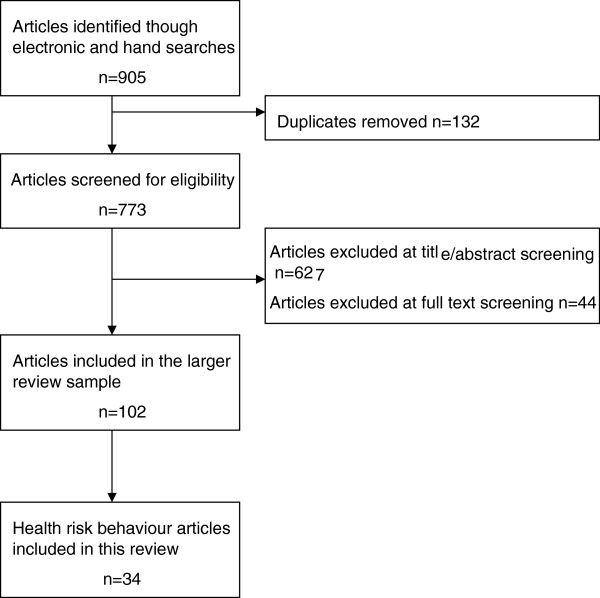
BACKGROUND: Health risk behaviours known to result in poorer outcomes in adulthood are generally established in late childhood and adolescence. These 'risky' behaviours include smoking, alcohol and illicit drug use and sexual risk taking. While the role of social capital in the establishment of health risk behaviours in young people has been explored, to date, no attempt has been made to consolidate the evidence in the form of a review. Thus, this integrative review was undertaken to identify and synthesise research findings on the role and impact of family and community social capital on health risk behaviours in young people and provide a consolidated evidence base to inform multi-sectorial policy and practice. METHODS: Key electronic databases were searched (i.e. ASSIA, CINAHL, Cochrane Database of Systematic Reviews, Cochrane Central Register of Controlled Trials, Database of Abstracts of Reviews of Effects, Embase, Medline, PsycINFO, Sociological Abstracts) for relevant studies and this was complemented by hand searching. Inclusion/exclusion criteria were applied and data was extracted from the included studies. Heterogeneity in study design and the outcomes assessed precluded meta-analysis/meta-synthesis; the results are therefore presented in narrative form. RESULTS: Thirty-four papers satisfied the review inclusion criteria; most were cross-sectional surveys. The majority of the studies were conducted in North America (n=25), with three being conducted in the UK. Sample sizes ranged from 61 to 98,340. The synthesised evidence demonstrates that social capital is an important construct for understanding the establishment of health risk behaviours in young people. The different elements of family and community social capital varied in terms of their saliency within each behavioural domain, with positive parent-child relations, parental monitoring, religiosity and school quality being particularly important in reducing risk. CONCLUSIONS: This review is the first to systematically synthesise research findings about the association between social capital and health risk behaviours in young people. While providing evidence that may inform the development of interventions framed around social capital, the review also highlights key areas where further research is required to provide a fuller account of the nature and role of social capital in influencing the uptake of health risk behaviours.
Overview
The claims and statistics of this paper haven’t been checked yet.
Run the check — free, no account needed. It reads the open-access text and checks the sources it cites.
Integrity signals
Registry
Cites
Statistics
Figures
Verification
Claims the paper makes
The claims and statistics of this paper haven’t been checked yet.
Run the check — free, no account needed. It reads the open-access text and checks the sources it cites.
Claims other papers make about this one
Each is checked against this paper’s own text: does it say what the citing paper says it does?
The source backs part of the claim, not all of it — or backs it for a different population, condition or comparison.
In the citing paper
“Typical youth development is facilitated in the context of stable family, school, and community networks (Brooks et al., 2012; Institute of Medicine, 2013; McPherson et al., 2013), and these socio-ecological contexts have protective associations with lower emotional distress, suicidal ideation, and substance abuse in young adulthood (Steiner et al., 2019).”
From Intervention development to improve foster youth mental health by targeting coping self-efficacy and help-seeking (2023) · cites this paper as McPherson et al., 2013
Experimental — accuracy not yet measured
Self-check
Percentages, sums and reported differences re-computed from the paper’s own numbers.
The self-check needs the paper’s full text.
Citations
Cites
Preferred Reporting Items for Systematic Reviews and Meta-Analyses: the PRISMA statement
Moher, D., Liberati, A., Tetzlaff, J., Altman, D. G., & for the PRISMA Group (2009) · BMJ · doi:10.1136/bmj.b2535 · Cited by 83,823
Preferred Reporting Items for Systematic Reviews and Meta-Analyses: The PRISMA Statement
Moher, D., Liberati, A., Tetzlaff, J., Altman, D. G., & The PRISMA Group (2009) · PLoS Medicine · doi:10.1371/journal.pmed.1000097 · Cited by 64,042
Preferred reporting items for systematic reviews and meta-analyses: the PRISMA Statement.
(2009) · PubMed Central · Cited by 44,859
Bowling alone: the collapse and revival of American community
(2000) · Choice Reviews Online · doi:10.5860/choice.38-2454 · Cited by 28,723
Social Capital in the Creation of Human Capital
Coleman, J. S. (1988) · American Journal of Sociology · doi:10.1086/228943 · Cited by 26,975
Social Capital in the Creation of Human Capital
Coleman, J. S. (2000) · Elsevier eBooks · doi:10.1016/b978-0-7506-7222-1.50005-2 · Cited by 21,751
Preferred Reporting Items for Systematic Reviews and Meta-Analyses: The PRISMA Statement
Moher, D., Liberati, A., Tetzlaff, J., & Altman, D. G. (2009) · Journal of Clinical Epidemiology · doi:10.1016/j.jclinepi.2009.06.005 · Cited by 19,575
Putnam, R. (2000) · doi:10.1145/358916.361990 · Cited by 17,114
Handbook of Theory and Research for the Sociology of Education.
O'Shea, D. W., & Richardson, J. G. (1987) · Contemporary Sociology A Journal of Reviews · doi:10.2307/2069964 · Cited by 15,197
Making democracy work: civic traditions in modern Italy
(1993) · Choice Reviews Online · doi:10.5860/choice.30-6408 · Cited by 14,338
Research works printed but not linked: 5
- World Health Organization/Pan American Health Organization: Plan of action for health and development of adolescents and youth in Americas, 1998–2001. 1998, Washington, DC: WHO
- Morgan A: Social capital as a health asset for young people's health and wellbeing. J Clin Child Adolesc Psychol. 2010, S2: 19-42.
- Morgan A, Swann C: Social capital for health: issues of definition, measurement and links to health. 2004, London: Health Development Agency
- Ottebjer L: Bourdieu, Coleman and Putnam on Social Capital. Applications in literature and implications for public health policy and practice. 2005, Stockholm Sweden: Karolinska Institutet
- World Health Organization Regional Office for Europe: Health 2020: a European policy framework supporting action across government and society for health and well-being. 2012, Copenhagen: World Health Organization Regional Office for Europe
Cited by
Sorted by citations
Items 101–112 of 112
Härtung, S. (2022) · Springer Reference Pflege, Therapie, Gesundheit · doi:10.1007/978-3-662-65219-0_17
Ardahan, F. (2023) · European Journal of Physical Education and Sport Science · doi:10.46827/ejpe.v10i2.4955
Social and Behavioral Influences on Child Health and Development
Hawkins, S. S. (2024) · Oxford University Press eBooks · doi:10.1093/oso/9780197662526.003.0005
Yang, Y., Wang, S., Chen, L., Luo, M., Xue, L., Cui, D., & 毛宗福 (2020) · Figshare · doi:10.6084/m9.figshare.12891355
Kwan, D. E., Choi, S., & Woo, H. (2026) · Journal of Social Science · doi:10.16881/jss.2026.01.37.1.3
Barreto‐Zarza, F., Unibaso-Markaida, I., Díaz-Argüello, A., Cabezón, C. S. M., & Arranz, E. B. (2026) · Anales de Psicología · doi:10.6018/analesps.657331
Li, B., Zhang, Z., Chen, Y., Zhang, B., Chen, M., Zeng, X., & Li, Q. (2025) · International Conference on Sports Technology and Performance Analysis (ICSTPA) · doi:10.1145/3796028.3796098
Luo, L., Huang, F., Tahir, S. R., Shao, H., & Li, B. (2026) · Frontiers in Public Health · doi:10.3389/fpubh.2026.1796300
Wu, Z., Gu, Z., Wei, Y., Huang, Y., & Wang, E. (2026) · Scientific Reports · doi:10.1038/s41598-026-57328-1
Selvaraja, K. S., Subhi, N., Razak, M. A. B. A., Aziz, N. R. A. B., & Masiran, N. B. (2026) · BMC Psychology · doi:10.21203/rs.3.rs-9765039/v1
Freibott, C. E., Stein, M. D., Lipson, S. K., & Vest, N. A. (2026) · Frontiers in Public Health · doi:10.3389/fpubh.2026.1844206
Zuma, T., Seeley, J., Gumede, D. M., Luthuli, M., Hlongwane, S., Chimbindi, N., Harling, G., Sherr, L., & Shahmanesh, M. (2026) · AIDS Care · doi:10.1080/09540121.2026.2710537
Metadata
- Authors
- McPherson, K. E., Kerr, S., Morgan, A., McGee, E., Cheater, F. M., McLean, J., & Egan, J.
- Affiliations
- Glasgow Caledonian University (GB)
- University of East Anglia (GB)
- Glasgow Centre for Population Health (GB)
- Corresponding author
- McPherson, Kerri E
- Venue
- BMC Public Health
- Published
- 2013-10-19
- Volume
- 13
- Issue
- 1
- Pages
- 971-971
- ISSN
- 1471-2458 (ISSN-L)
- PMC
- PMC4015354
- OpenAlex
- W2114862583
- Cited by
- 117
- References
- 90
- Citations by year
- 2026: 8 · 2025: 6 · 2024: 8 · 2023: 5 · 2022: 13 · 2021: 9 · 2020: 13 · 2019: 15 · 2018: 12 · 2017: 9 · 2016: 11 · 2015: 5 · 2014: 3
- FWCI
- 11.47
- Type
- journal article
- Language
- en
- Open access
- gold
- doi.org
- Licence
- Locations
- BMC Public Health (publishedVersion, cc-by)
- Europe PMC (PubMed Central) (publishedVersion, cc-by)
- PubMed Central (publishedVersion, cc-by)
- PubMed (publishedVersion)
- ENLIGHTEN (Jurnal Bimbingan dan Konseling Islam) (acceptedVersion)
- ResearchOnline (Glasgow Caledonian University) (acceptedVersion, cc-by)
- ResearchOnline (submittedVersion, cc-by)
- UEA Digital Repository (University of East Anglia) (submittedVersion)
- Topics
- Health Sciences › Medicine › Public Health, Environmental and Occupational Health › Adolescent Health and Behaviors
- Social Sciences › Health › Health disparities and outcomes
- Health Sciences › Medicine › Epidemiology › Substance Abuse Treatment and Outcomes
- Keywords
- social capital, family social capital, community social capital, health risk behaviors, youth, adolescent smoking, alcohol consumption, illicit drug use, sexual risk behavior, parent-child relationship, parental supervision, religiosity, school quality
- MeSH terms
- Adolescent, Adolescent Behavior, Adult, Age Factors, Alcohol Drinking, Child, Child Behavior, Cross-Sectional Studies, Family, Female, Humans, Male, North America, Parent-Child Relations, Residence Characteristics, Risk-Taking, Schools, Sexual Behavior, Smoking, Health Behavior, Substance-Related Disorders, Young Adult, Social Capital
About these checks
Registry, retraction, Cites and statistics results are computed, not judged, with one exception: a printed reference that no index lists is read once by a model before it counts as a citation error. Claims are extracted by a model and kept only when their quote appears verbatim in the text; each cited source is then checked, with a model’s help, for whether it says what the claim relies on. Those verdicts can be wrong — read the claim’s quote and the cited source before relying on one.
Statistics and arithmetic are recomputed, not judged.
Confidence bands are shown only for fields calibrated on our annotated test set. None is calibrated yet, so no band is shown.
What counts as a claim ›How we measure confidence ›How we check this ›
Are you an author, or do you see a problem with this page? Request a review
