

Trends in access to water supply and sanitation in 31 major sub-Saharan African cities: an analysis of DHS data from 2000 to 2012
Open accessThe DOI matches its Crossref record; 13 of the 14 references it cites were found in a registry or an index.
Abstract
BACKGROUND: By 2050, sub-Saharan Africa's (SSA) urban population is expected to grow from 414 million to over 1.2 billion. This growth will likely increase challenges to municipalities attempting to provide access to water supply and sanitation (WS&S). This study aims to characterize trends in access to WS&S in SSA cities and identify factors affecting those trends. METHODS: DHS data collected between 2000 and 2012 were used for this analysis of thirty-one cities in SSA. Four categories of household access to WS&S were studied using data from demographic and health surveys--these included: 1) household access to an improved water supply, 2) household's time spent collecting water, 3) household access to improved sanitation, and 4) households reporting to engage in open defecation. An exploratory analysis of these measures was then conducted to assess the relationship of access to several independent variables. RESULTS: Among the 31 cities, there was wide variability in coverage levels and trends in coverage with respect to the four categories of access. The majority of cities were found to be increasing access in the categories of improved water supply and improved sanitation (65% and 83% of cities, respectively), while fewer were making progress in reducing the amount of time spent collecting water and reducing open defecation (50% and 38% of cities, respectively). Additionally, the prevalence of open defecation in study cities was found to be, on average, increasing. CONCLUSIONS: Based on DHS data, cities appeared to be making the most progress in gaining access to WS&S along metrics which reflect specified targets of the Millennium Development Goals. Nearly half of the cities, however, did not make progress in reducing open defecation or the time spent collecting water. This may reflect that the MDGs have led to a focus on "improved" services while other measures, potentially more relevant to the extreme poor, are being neglected. This study highlights the need to better characterize access, beyond definitions of improved and unimproved, as well as the need to target resources to cities where changes in WS&S access have stalled, or in some cases regressed.
Overview
The claims and statistics of this paper haven’t been checked yet.
Free: it reads the open-access text and checks the first 5 claims that cite a source we can check. Create a free account to check every claim.
Integrity signals
Registry
Cites
Statistics
Figures
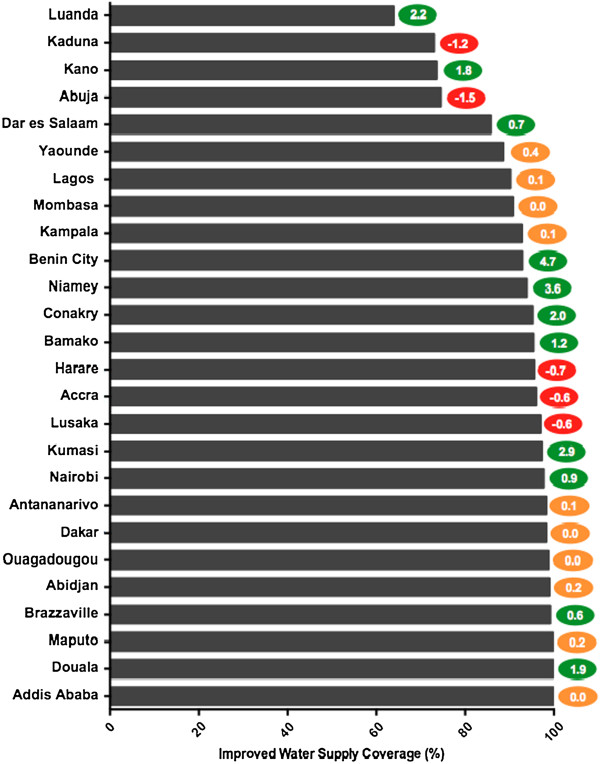
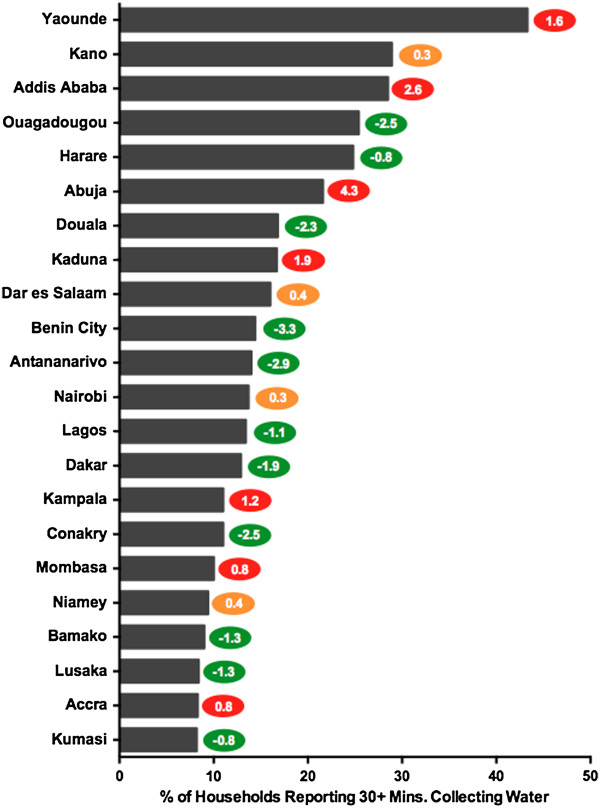
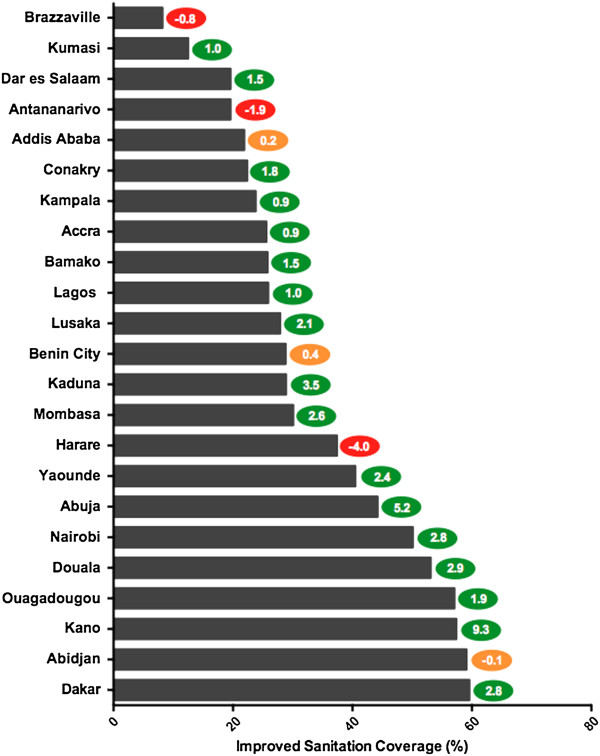
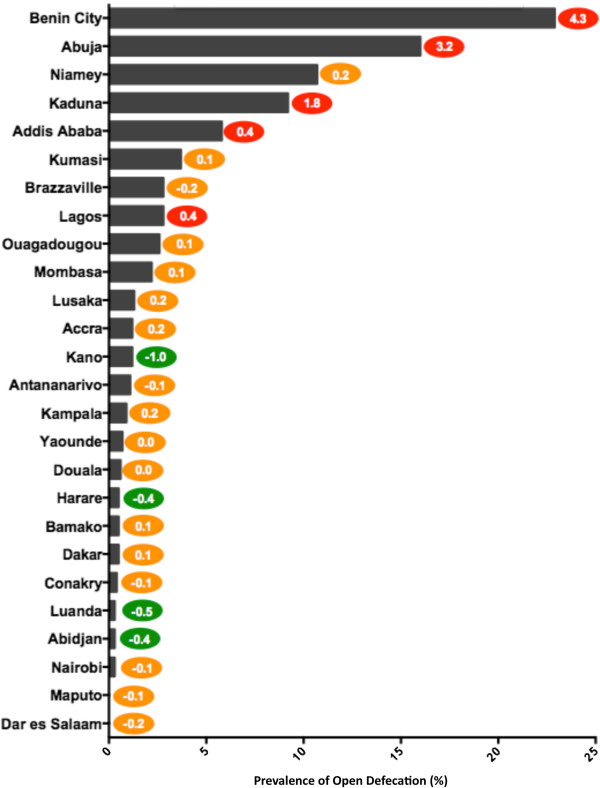
Verification
Claims the paper makes
The claims and statistics of this paper haven’t been checked yet.
Free: it reads the open-access text and checks the first 5 claims that cite a source we can check. Create a free account to check every claim.
Claims other papers make about this one
Each is checked against this paper’s own text: does it say what the citing paper says it does?
The source backs part of the claim, not all of it — or backs it for a different population, condition or comparison.
In the citing paper
“Sharing of water access points forces residents to spend hours seeking and queuing for water, both of which adversely impact health and economic status [ 60, 61].”
From Slum Health: Arresting COVID-19 and Improving Well-Being in Urban Informal Settlements (2020) · cites this paper as [60]
Experimental — accuracy not yet measured
Self-check
Percentages, sums and reported differences re-computed from the paper’s own numbers.
The self-check needs the paper’s full text.
Citations
Cites
Bocquier, P. (2005) · Demographic Research · doi:10.4054/demres.2005.12.9 · Cited by 1,746
World urbanization prospects: The 2014 revision - highlights
Nations, U. (2014) · Statistical Papers - United Nations (Ser. A), Population and Vital Statistics Report · doi:10.18356/527e5125-en · Cited by 1,057
Water, Waste, and Well-Being: A Multicountry Study
Esrey, S. A. (1996) · American Journal of Epidemiology · doi:10.1093/oxfordjournals.aje.a008791 · Cited by 419
Barreto, M. L., Genser, B., Strina, A., Assis, A. M. O., Rego, R. F., Teles, C. A., Prado, M. S., Matos, S. M., Santos, D. N., dos Santos, L. A., et al. (2007) · The Lancet · doi:10.1016/s0140-6736(07)61638-9 · Cited by 268 · cited 1×
“Furthermore, research has documented that improving sewage infrastructure in urban settings can greatly improve health outcomes [9-11].”
The Future of Water in African Cities
Jacobsen, M., Jacobsen, M., & Vairavamoorthy, K. (2012) · World Bank, Washington, DC eBooks · doi:10.1596/978-0-8213-9721-3 · Cited by 100
Barreto, M. L., Genser, B., Strina, A., Teixeira, M. G., Assis, A. M. O., Rego, R. F., Teles, C. A., Prado, M. S., Matos, S. M. A., Alcântara-Neves, N. M., et al. (2010) · Environmental Health Perspectives · doi:10.1289/ehp.1002058 · Cited by 89
Environmental Transformations in Cities as They Get Larger, Wealthier and Better Managed
Satterthwaite, D. (1997) · Geographical Journal · doi:10.2307/3060185 · Cited by 78 · cited 1×
“While there is an obvious link between domestic water supply and water resources, evidence suggests that domestic water use represents a minor fraction of water withdrawals [20].”
The sanitation environment in urban slums: implications for child health
Buttenheim, A. M. (2008) · Population and Environment · doi:10.1007/s11111-008-0074-9 · Cited by 73 · cited 1×
“…sanitation in densely populated urban informal settlements – where the human fecal waste may also be more densely concentrated – can have a greater impact on diarrhea and soil-transmitted helminths (STHs), and subsequently nutrition and mortality, than in less densely populated communities [5,6].”
Slums, climate change and human health in sub-Saharan Africa
Ramin, B. (2009) · Bulletin of the World Health Organization · doi:10.2471/blt.09.073445 · Cited by 72 · cited 1×
“Typified by congestion and poor access to vital resources, such as WS&S, residents of these areas often see health outcomes much worse than non-slum dwelling urban residents and even rural inhabitants [7].”
Mock, N. B., Sellers, T. A., Abdoh, A. A., & Franklin, R. R. (1993) · Social Science & Medicine · doi:10.1016/0277-9536(93)90041-2 · Cited by 69 · cited 1×
“A cross-sectional study of children in the Republic of Congo found that the odds of diarrhea among urban children was 3.5 times that of rural children [4].”
Influential
Research works printed but not linked: 10
- UN World urbanization prospects 2011 New York: United Nations
- WHO/UNICEF Progress on Drinking Water and Sanitation Report 2012 2012 New York: WHO/UNICEF Joint Monitoring Programme for Water Supply and Sanitation (JMP)
- AMCOW A snapshot of drinking water and sanitation in Africa 2012 Cairo: African Ministers’ Council on Water
- Tannerfeldt G Ljung P More urban – less poor 2006 London: Earthscan
- Demographia World urban areas 2012 Belville, Illinois: Deomgraphia
- UN HABITAT Global urban indicators – selected statistics 2010 Nairobi: The United Nations Settlements Programme
- McGranahan G Demand-side water strategies and the urban poor 2002 London: International Institute for Environment and Development
- Günther I Niwagaba CB Lüthi C Horst A Mosler HJ Tumwebaze I When is shared sanitation improved sanitation? – the correlation between number of users and toilet hygiene Muinch Personal RePec Archive 2012
- UN HABITAT Hidden cities report: unmasking and overcoming health inequities in urban settings 2010 Nairobi: The United Nations Settlements Programme
- UN HABITAT The state of African cities 2010 Nairobi: The United Nations Settlements Programme
Cited by
Slum Health: Arresting COVID-19 and Improving Well-Being in Urban Informal Settlements
Corburn, J., Vlahov, D., Mberu, B., Riley, L., Caiaffa, W. T., Rashid, S. F., Ko, A., Patel, S., Jukur, S., Martínez-Herrera, E., et al. (2020) · Journal of Urban Health · doi:10.1007/s11524-020-00438-6 · Cited by 587
“Sharing of water access points forces residents to spend hours seeking and queuing for water, both of which adversely impact health and economic status [ 60, 61].”
Dos Santos, S., Adams, E. A., Neville, G., Wada, Y., de Sherbinin, A., Mullin Bernhardt, E., & Adamo, S. B. (2017) · Science of The Total Environment · doi:10.1016/j.scitotenv.2017.06.157 · Cited by 347
“They also complicate spatial aspects of the urban waterscape, specifically the concentration and distribution of formal water outlets in relation to the geography of consumer demand and of the quality of supply (Brikké and Vairavamoorthy, 2016; Hopewell and Graham, 2014; Pullan et al., 2014).”
BackgroundAbubakar, I. R. (2017) · Sustainability · doi:10.3390/su9040547 · Cited by 155
Factors influencing household access to drinking water in Nigeria
Abubakar, I. R. (2019) · Utilities Policy · doi:10.1016/j.jup.2019.03.005 · Cited by 179
Socioeconomic Factors Affecting Water Access in Rural Areas of Low and Middle Income Countries
Gómez, M. S., Perdiguero, J., & Sanz, À. (2019) · Water · doi:10.3390/w11020202 · Cited by 164
“In their paper, Munatami et al. make a regression analysis to estimate the number of population gaining access to sanitation from years 2000 to 2015 depending on different economic variables and socio-political variables, such as Gross Domestic Product (GDP) per capita, Official Development Assistance (ODA) and politi…”
BackgroundResultInfluentialNdikumana, L., & Pickbourn, L. (2016) · World Development · doi:10.1016/j.worlddev.2016.09.001 · Cited by 117
Satterthwaite, D., Sverdlik, A., & Brown, D. (2018) · Journal of Urban Health · doi:10.1007/s11524-018-0264-4 · Cited by 124
Beyene, A., Hailu, T., Faris, K., & Kloos, H. (2015) · BMC Public Health · doi:10.1186/s12889-015-1804-4 · Cited by 106
Bishoge, O. K. (2021) · Local Environment · doi:10.1080/13549839.2021.1931074 · Cited by 94
Adams, E. A., Sambu, D., & Smiley, S. L. (2018) · International Journal of Water Resources Development · doi:10.1080/07900627.2017.1423282 · Cited by 100
“Cities in SSA are also growing very rapidly, with estimates suggesting that its urban population will triple by the year 2050 (Dos Santos et al., 2017; Hopewell & Graham, 2014).”
BackgroundInfluentialIrianti, S., Prasetyoputra, P., & Sasimartoyo, T. P. (2016) · Cogent Medicine · doi:10.1080/2331205x.2016.1151143 · Cited by 77
Stoler, J. B., Tutu, R. A., & Winslow, K. (2015) · Habitat International · doi:10.1016/j.habitatint.2015.01.009 · Cited by 71
From curiosity to commodity: a review of the evolution of sachet drinking water in West Africa
Stoler, J. B. (2017) · Wiley Interdisciplinary Reviews Water · doi:10.1002/wat2.1206 · Cited by 73
Geere, J., & Hunter, P. R. (2019) · International Journal of Hygiene and Environmental Health · doi:10.1016/j.ijheh.2019.08.007 · Cited by 77
Exploring the determinants of sanitation success in Sub-Saharan Africa
Munamati, M., Nhapi, I., & Misi, S. N. (2016) · Water Research · doi:10.1016/j.watres.2016.07.030 · Cited by 74
Electrochemical detection of selected heavy metals in water: a case study of African experiences
Okpara, E. C., Fayemi, O. E., Wojuola, O. B., Onwudiwe, D. C., & Ebenso, E. E. (2022) · RSC Advances · doi:10.1039/d2ra02733j · Cited by 60
Progress in sanitation among poor households in Kenya: evidence from demographic and health surveys
Njuguna, J. (2019) · BMC Public Health · doi:10.1186/s12889-019-6459-0 · Cited by 50
Kariuki, S., Dyson, Z. A., Mbae, C., Ngetich, R., Kavai, S. M., Wairimu, C., Anyona, S., Gitau, N., Onsare, R. S., Ongandi, B., et al. (2021) · eLife · doi:10.7554/elife.67852 · Cited by 50
Metrics in Urban Health: Current Developments and Future Prospects
Prasad, A., Gray, C. B., Ross, A., & Kano, M. (2016) · Annual Review of Public Health · doi:10.1146/annurev-publhealth-032315-021749 · Cited by 49
Shrestha, S., Aihara, Y., Bhattarai, A. P., Bista, N., Kondo, N., Kazama, F., Nishida, K., & Shindo, J. (2018) · SSM - Population Health · doi:10.1016/j.ssmph.2018.10.007 · Cited by 50
Mbae, C. K., Mwangi, M., Gitau, N., Irungu, T. W., Muendo, F., Wakio, Z., Wambui, R., Kavai, S. M., Onsaŕe, R., Wairimu, C., et al. (2020) · BMC Infectious Diseases · doi:10.1186/s12879-020-05134-z · Cited by 57
“Typhi is also endemic in SSA, partly because the supply of clean drinking water and sanitation have not kept pace with the rapid population growth [17].”
BackgroundDebela, T. H., Beyene, A., Tesfahun, E., Getaneh, A., Gize, A., & Mekonnen, Z. (2017) · Ecohydrology & Hydrobiology · doi:10.1016/j.ecohyd.2017.10.003 · Cited by 40
Mackinnon, E. M. E., Ayah, R., Taylor, R. G., Owor, M. M., Ssempebwa, J. C., Olago, L. D., Kubalako, R., Dia, A. T., Gaye, C., Campos, L. C., et al. (2018) · International Journal of Environmental Health Research · doi:10.1080/09603123.2018.1550193 · Cited by 48
Spatial heterogeneity in drinking water sources in the Greater Accra Metropolitan Area (GAMA), Ghana
Tetteh, J. D., Templeton, M. R., Cavanaugh, A., Bixby, H., Owusu, G., Yidana, S. M., Moulds, S., Robinson, B. E., Baumgartner, J., Annim, S. K., et al. (2022) · Population and Environment · doi:10.1007/s11111-022-00407-y · Cited by 39
“…household access to improved water and sanitation in resource poor settings, particularly in SSA cities, wide geographical inequities in access to safe, reliable, and affordable water persist within cities (Armah et al., 2018; Deshpande et al., 2020; Hopewell & Graham, 2014; Pullan et al., 2014).”
BackgroundDrinking water and sanitation: progress in 73 countries in relation to socioeconomic indicators
Luh, J., & Bartram, J. (2016) · Bulletin of the World Health Organization · doi:10.2471/blt.15.162974 · Cited by 32
Perceptions of urban land use and degradation of water bodies in Kumasi, Ghana
Eduful, M., & Shively, D. D. (2015) · Habitat International · doi:10.1016/j.habitatint.2015.08.034 · Cited by 34
Sustainable Development Goals (SDG) Target 6.2 in Ethiopia: Challenges and Opportunities
Baye, D. (2021) · OALib · doi:10.4236/oalib.1107458 · Cited by 36
“all population, South Asia with 953 million people and Sub-Saharan Africa, 695 million people demanding adequate sanitation [15] [27] [28].”
BackgroundAnand, A., & Roy, N. (2016) · Frontiers in Public Health · doi:10.3389/fpubh.2016.00087 · Cited by 30
Dangui, K., & Jia, S. (2022) · Water · doi:10.3390/w14213522 · Cited by 41
“Furthermore, Hopewell and Graham [31] investigated the trend in water and sanitation access in 31 major cities in Africa and found that the rapid increase in urban population growth and density has led to an increase in the number of people using the worst forms of sanitation or water supply, and a…”
BackgroundWater Shortages: Cause of Water Safety in Sub-Saharan Africa
Matchawe, C., Bonny, P., Yandang, G., Yangoua, H. C. M., & Bonglaisin, J. N. (2022) · IntechOpen eBooks · doi:10.5772/intechopen.103927 · Cited by 37
Factors affecting sanitation coverage in three income levels and potential toward achieving SDG 6.2
Bankole, A. O., James, A. O., Odjegba, E. E., Bankole, A. R., Emmanuel, B. I., Fiore, F. A., Pu, J. H., & Moruzzi, R. B. (2023) · Water Policy · doi:10.2166/wp.2023.181 · Cited by 29
Measuring the Impact of Environment on the Health of Large Cities
Stauber, C., Adams, E. A., Rothenberg, R., Dai, D., Luo, R., Weaver, S. R., Prasad, A., Kano, M., & Heath, J. (2018) · International Journal of Environmental Research and Public Health · doi:10.3390/ijerph15061216 · Cited by 25
Iddi, S., Akeyo, D., Bagayoko, M., Kiwuwa-Muyingo, S., Chikozho, C., & Kadengye, D. T. (2021) · Global Epidemiology · doi:10.1016/j.gloepi.2021.100050 · Cited by 24
Urban water security in Africa: The face of climate and development challenges
Müller, M. (2016) · Development Southern Africa · doi:10.1080/0376835x.2015.1113121 · Cited by 19
“…to collect water had increased significantly (and that, by 2012, the time required in Harare was fourth highest of the 21 African cities surveyed); similarly, although starting with a relatively high level of access to safe water, this access had declined steadily (Hopewell & Graham, 2014).”
BackgroundKariuki, S., Wairimu, C., & Mbae, C. K. (2021) · The Journal of Infectious Diseases · doi:10.1093/infdis/jiab457 · Cited by 21
Park, M. J., Clements, A., Gray, D. J., Sadler, R., Laksono, B., & Stewart, D. (2016) · Scientific Reports · doi:10.1038/srep30299 · Cited by 18
OBJECTIVES OF SUSTAINABLE DEVELOPMENT AND CONDITIONS OF HEALTH RISK AREAS
Djonú, P., Rabelo, L. S., Lima, P. V. P. S., Souto, M. V. S., Sabadia, J. A. B., & Sucupira, P. R. G. (2018) · Ambiente & sociedade · doi:10.1590/1809-4422asoc0091r1vu18l3td · Cited by 26
Inequalities in Access to Water and Sanitation in Rural Settlements in Parts of Southwest Nigeria
Akoteyon, I. S. (2019) · Ghana Journal of Geography · Cited by 18
Trends in access to water and sanitation in Malawi: progress and inequalities (1992–2017)
Cassivi, A., Tilley, E., Waygood, E. O. D., & Dorea, C. C. (2020) · Journal of Water and Health · doi:10.2166/wh.2020.069 · Cited by 16
Inconvenient truth: unsafely managed fecal sludge after achieving MDG for decades in Thailand
Koottatep, T., Taweesan, A., Kanabkaew, T., & Polprasert, C. (2021) · Journal of Water Sanitation and Hygiene for Development · doi:10.2166/washdev.2021.118 · Cited by 21
Equity dimensions in initiatives promoting urban health and wellbeing in east and southern Africa
Loewenson, R. H., Mhlanga, G., Gotto, D., Chayikosa, S., Goma, F. M., & Walyaro, C. (2023) · Frontiers in Public Health · doi:10.3389/fpubh.2023.1113550 · Cited by 18
Urban Water Governance as a Function of the ‘Urban Hydrosocial Transition’
Staddon, C., Sarkozi, R., & Langberg, S. (2016) · Global issues in water policy · doi:10.1007/978-3-319-43350-9_5 · Cited by 15
“Moreover, Hopewell and Graham ( 2014 ) note that it is still the case that fully 10 % of Kampala’s residents spend more than 30 min collecting water for household use each and every day.”
BackgroundPickbourn, L., Caraher, R., & Ndikumana, L. (2022) · World Development · doi:10.1016/j.worlddev.2022.105994 · Cited by 19
“Using similar techniques, but focusing on a sample of 29 countries in sub-Saharan Africa, Ndikumana and Pickbourn (2017) find that over the period 1990-2010, increased aid to the WASH sector as a share of GDP was associated with increases in rural access to improved sources of sanitation and increases in rural and urb…”
MethodDemoze, L., Tigabie, M., Worede, E. A., Alemaw, H. B., Gizaw, Z., Tesfaye, A. H., & Yitageasu, G. (2025) · BMC Public Health · doi:10.1186/s12889-025-24184-z · Cited by 19
“Although several studies have explored sanitation access in sub-Saharan Africa, many rely on descriptive statistics or single-level analyses, failing to account for the hierarchical structure of data (individuals nested within communities) [25–28].”
Progress on Sustainable Development Goal for Sanitation and Hygiene in Sub-Saharan Africa
Owho, O., & Ndakara, O. E. (2022) · Journal of applied science and environmental management · doi:10.4314/jasem.v26i6.22 · Cited by 10
“These statistics show that sanitation provisions in many countries in the region are progressing at a very uncomfortable rate, which corroborates previous findings (Hopewell and Graham, 2014; Armah et al, 2018; Ukoji and Ndakara, 2021).”
ResultCost-effectiveness and community impacts of two urine-collection programs in rural South Africa
Tilley, E. (2016) · Environmental Science Water Research & Technology · doi:10.1039/c5ew00237k · Cited by 10
Ananga, E. O. (2015) · Digital Commons - University of South Florida (University of South Florida) · Cited by 18
Overview of the low-cost technologies for household water treatment in developing countries
Mdee, O. J., Lwasa, A., & Sadiki, N. (2024) · Water Practice & Technology · doi:10.2166/wpt.2024.177 · Cited by 9
Kanoti, J. R., Olago, D. O., Opiyo, N., Nyamai, C. M., Dulo, S., & Ayah, R. (2019) · Journal of Water Resource and Protection · doi:10.4236/jwarp.2019.114024 · Cited by 9
Evaluating Water- and Health-related Development Projects: A Cross-project and Micro-based Approach
Greßer, C., & Stadelmann, D. (2020) · The Journal of Development Studies · doi:10.1080/00220388.2020.1849621 · Cited by 11
Nde, S. C., Bett, S. K., Okpara, E. C., Olagbaju, P. O., Fayemi, O. E., & Mathuthu, M. (2021) · IntechOpen eBooks · doi:10.5772/intechopen.95753 · Cited by 14
Nutor, J. J., Slaughter‐Acey, J., Marquez, S. P., DiMaria-Ghalili, R. A., Momplaisir, F. M., & Jemmott, L. S. (2020) · Health Care For Women International · doi:10.1080/07399332.2020.1746791 · Cited by 8
“Indeed, researchers have found that lack of access to water to flush toilets forces the urban poor to use unhygienic pit latrines or polythene bags and/or defecate into nearby drains and natural watercourses (Hopewell & Graham, 2014; Kwiringira et al., 2014).”
BackgroundFinancial inclusion and improved water usage among households in Ghana
Immurana, M., Kisseih, K. G., Yakubu, M. Z., Kizhakkekara, T. J. M., Boachie, M. K., Halidu, O. B., Mohammed, J., Kaleem, I., Mohammed, A., & Doegah, P. T. (2024) · BMC Public Health · doi:10.1186/s12889-024-18715-3 · Cited by 7
“Nonetheless, while some empirical studies have been carried out regarding the drivers of access or use of improved water sources in other settings [14–23] and Ghana [2, 24–26], only a handful of studies have tack-led the relationship between financial inclusion and access or use of improved water…”
BackgroundImpact of Human Management of Hand-Dug Well Facility and Its Accessories on Groundwater Quality
Ogunbode, T. O., Oyebamiji, V. O., Aromolaran, O., Faboro, O. O., & Ogunbode, I. R. (2023) · Environmental Health Insights · doi:10.1177/11786302231190988 · Cited by 7
Herawati, P., Wahyudi, K., & Afriandi, I. (2018) · Jurnal Sistem Kesehatan · doi:10.24198/jsk.v3i3.16988 · Cited by 7
Lindqvist, B., Lundberg, L. E., & Wieslander, J. (1994) · PubMed · Cited by 6
Munamati, M., Nhapi, I., & Misi, S. N. (2019) · Physics and Chemistry of the Earth Parts A/B/C · doi:10.1016/j.pce.2019.08.003 · Cited by 5
IMPACTS OF URBAN LAND USE CHANGE ON SOURCES OF DRINKING WATER IN KUMASI, GHANA
Eduful, M. (2014) · ScholarWorks at University of Montana · Cited by 6
Regional Drinking Water Supply in Pakistan: Regional Disparity, Inequality, and Development Pattern
Wu, Y., & Wei, Y. D. (2023) · The Professional Geographer · doi:10.1080/00330124.2023.2183414 · Cited by 5
Stéphane, C. J., Serge, K. K., Laurent, S. K., Arsène, S. M., Roland, N. K., Aïcha, T., Joseph, D., & Luc, K. K. (2024) · Open Journal of Modern Hydrology · doi:10.4236/ojmh.2024.142006 · Cited by 4
Djourdebbé, F. B., Santos, S. D., Legrand, T., & Soura, A. (2018) · European Scientific Journal ESJ · doi:10.19044/esj.2018.v14n11p163 · Cited by 5
“Selon les projections, l’Afrique subsaharienne devrait voir sa population urbaine multipliée par trois entre 2010 et 2050 (ONU-Habitat, 2010), ce qui constitue des défis majeurs pour les municipalités qui peinent à fournir un accès à l’eau potable et à l’assainissement (Hopewell & Graham, 2014).”
BackgroundTilley, E. (2015) · Repository for Publications and Research Data (ETH Zurich) · doi:10.3929/ethz-a-010419366 · Cited by 4
Insensitive waste management in deprived communities: the role of local authorities
Agyabeng, A. N., Acquah, A., Njoki, H. D., & Susuawu, D. (2024) · Proceedings of the Institution of Civil Engineers - Waste and Resource Management · doi:10.1680/jwarm.23.00049 · Cited by 2
Evaluating the performance of the existing water supply system in Dangila town, Ethiopia
Amogne, A. A. (2025) · Water Practice & Technology · doi:10.2166/wpt.2025.007 · Cited by 2
Quartey, E. T., & Darkwah, S. A. (2018) · Acta Universitatis Agriculturae et Silviculturae Mendelianae Brunensis · doi:10.11118/actaun201866040979 · Cited by 2
Population and Water Issues: Going Beyond Scarcity
Santos, S. D., Gastineau, B., & Golaz, V. (2022) · International handbooks of population · doi:10.1007/978-3-030-76433-3_13 · Cited by 4
Kariuki, S., Dyson, Z. A., Mbae, C. K., Ngetich, R., Kavai, S. M., Wairimu, C., Anyona, S., Gitau, N., Onsaŕe, R., Ongandi, B., et al. (2021) · eLife · doi:10.7554/elife.67852.sa2 · Cited by 1
Pham, N. T. A., & Sim, N. (2020) · Journal of African Economies · doi:10.1093/jafeco/ejaa005 · Cited by 1
Owusu, B. A., Salifu, Y., Swaray, S. M., Lasong, J., Alhassan, A., & Salifu, T. (2026) · Frontiers in Public Health · doi:10.3389/fpubh.2026.1712677 · Cited by 1
“Although nationally representative surveys conducted since the 1990s permit analysis of long-term WASH trends in Ghana (30–32), important evidence gaps remain.”
Bawuah, A., Okeke-Obayemi, D. O., Ejiwale, R. O., Okeke, S. R., & Yaya, S. (2026) · PLOS Global Public Health · doi:10.1371/journal.pgph.0005978 · Cited by 1
“This cutoff aligns with the WHO/UNICEF Joint Monitoring Programme definition of basic access to water services [49] and has been widely used in prior studies [50,51].”
Maidhane, O. M., Salih, O., Muse, A. H., Osman, A. O., Abdi, M. H., Hassan, M. H., Ali, N. M., & Elmi, S. A. (2026) · PLoS ONE · doi:10.1371/journal.pone.0348029 · Cited by 1
“Somalia, in particular, confronts acute sanitation challenges exacerbated by decades of conflict, political instability, climate-related disasters such as recurrent droughts, and large-scale displacement [1,22].”
Reflections on the Past, Present, and Future of Population-Environment Research
Entwisle, B. (2022) · International handbooks of population · doi:10.1007/978-3-030-76433-3_23 · Cited by 1
Tayo, Y. A. (2023) · doi:10.31274/td-20240329-96 · Cited by 1
Social Determinants of Health Inequality and Life Expectancy Among Women of Edo State, Nigeria
Odekina, D. A. (2015) · ScholarWorks (Walden University)
The Impact of Foreign Aid in Access to Clean Water : A Case Study in Dhaka
Khorshed, R. (2021) · UWSpace (University of Waterloo)
Hungerford, H. (2019) · The Wiley Blackwell Encyclopedia of Urban and Regional Studies · doi:10.1002/9781118568446.eurs0535
Estache, A. (2018) · Springer eBooks · doi:10.1007/978-3-319-98515-2_9 · Cited by 4
The Challenges of Sanitation in Developing Counties - Evidenced from Fourteen Studied TownsPreprint
Adugna, D. (2022) · SSRN Electronic Journal · doi:10.2139/ssrn.4169425
(2024) · Frontiers research topics · doi:10.3389/978-2-8325-4665-9
Sarkar, S. (2026) · Journal of Health Management · doi:10.1177/09720634261425045
“…of a differential load from varied degrees of access and fetching effort, which might happen via a number of different methods (Geere & Cortobius, 2017; Geere et al., 2018; Graham et al., 2016; Hopewell & Graham, 2014; Pickering & Davis, 2012; Porter et al., 2012; Wang & Hunter, 2010; WHO, 2017).”
Metadata
- Authors
- Hopewell, M. R., & Graham, J. P.
- Affiliations
- George Washington University (US)
- Corresponding author
- Graham, Jay P
- ORCID
- Graham, Jay P
- Venue
- BMC Public Health
- Published
- 2014-02-28
- Volume
- 14
- Issue
- 1
- Pages
- 208-208
- ISSN
- 1471-2458 (ISSN-L)
- PMC
- PMC3942065
- OpenAlex
- W2023969060
- Semantic Scholar
- 60c60b6ece887aeb6392404c13cc2f57fc7fcef9
- Cited by
- 80
- References
- 14
- Citations by year
- 2026: 4 · 2025: 2 · 2024: 5 · 2023: 5 · 2022: 9 · 2021: 9 · 2020: 6 · 2019: 8 · 2018: 10 · 2017: 4 · 2016: 8 · 2015: 8 · 2014: 1
- FWCI
- 6.52
- Type
- journal article
- Language
- en
- Open access
- gold
- doi.org
- Licence
- Locations
- BMC Public Health (publishedVersion, cc-by)
- Europe PMC (PubMed Central) (publishedVersion, cc-by)
- PubMed Central (publishedVersion, cc-by)
- PubMed (publishedVersion)
- eScholarship (California Digital Library) (submittedVersion)
- eScholarship (California Digital Library) (submittedVersion, cc-by)
- Topics
- Health Sciences › Nursing › Nutrition and Dietetics › Child Nutrition and Water Access
- Physical Sciences › Environmental Science › Water Science and Technology › Water Resource Management and Quality
- Social Sciences › Urban Studies › Urban and Rural Development Challenges
- Keywords
- water supply, sanitation, open defecation, improved water supply, improved sanitation, Millennium Development Goals, urbanization, sub-Saharan African cities
- MeSH terms
- Cities, Environmental Monitoring, Family Characteristics, Health Surveys, Humans, Surveys and Questionnaires, Sanitation, Socioeconomic Factors, Water Supply, Health Behavior, Africa South of the Sahara
About these checks
Registry, retraction, Cites and statistics results are computed, not judged, with one exception: a printed reference that no index lists is read once by a model before it counts as a citation error. Claims are extracted by a model and kept only when their quote appears verbatim in the text; each cited source is then checked, with a model’s help, for whether it says what the claim relies on. Those verdicts can be wrong — read the claim’s quote and the cited source before relying on one.
Statistics and arithmetic are recomputed, not judged.
Confidence bands are shown only for fields calibrated on our annotated test set. None is calibrated yet, so no band is shown.
What counts as a claim ›How we measure confidence ›How we check this ›
Are you an author, or do you see a problem with this page? Request a review
Data sources
Bibliographic data: Semantic Scholar, OpenAlex, Crossref.
Contains information from the Semantic Scholar Academic Graph Datasets, made available under the ODC Attribution License (ODC-BY 1.0).
Semantic Scholar’s data is described in: Kinney, R., et al. (2023). The Semantic Scholar Open Data Platform. arXiv:2301.10140.
