

Online Pestkoppenstoppen: systematic and theory-based development of a web-based tailored intervention for adolescent cyberbully victims to combat and prevent cyberbullying
Open accessThe DOI matches its Crossref record; 125 of the 131 references it cites were found in a registry or an index.
Abstract
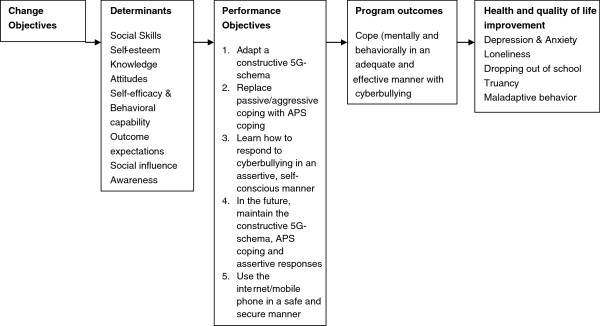
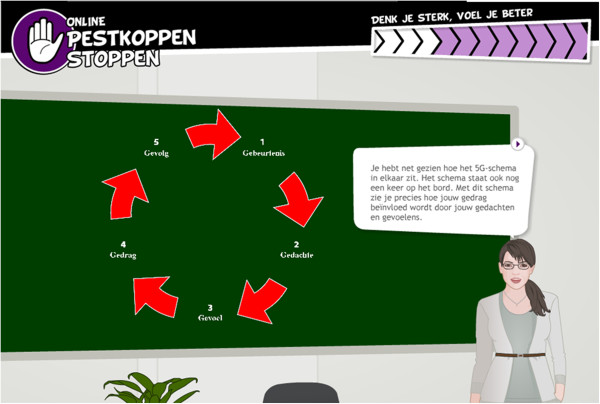
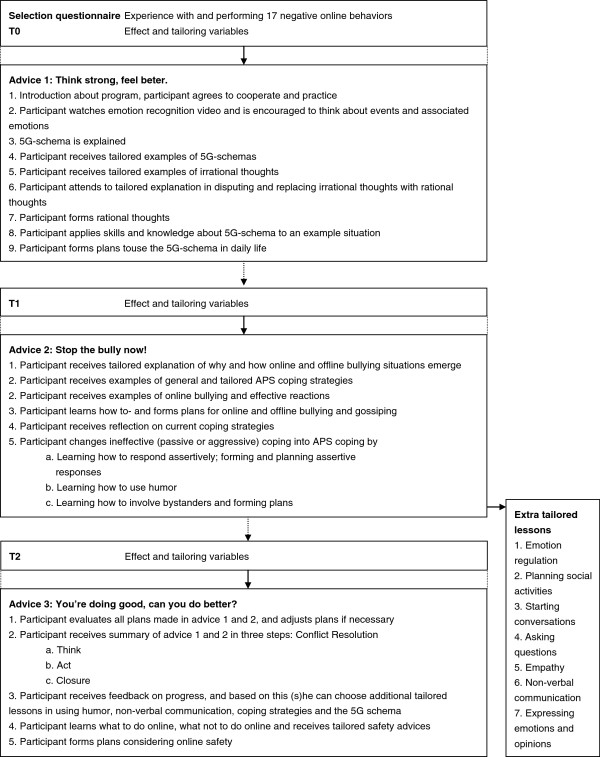
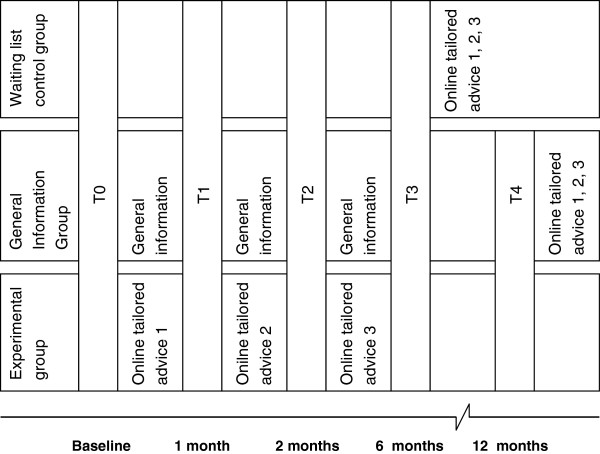
BACKGROUND: The purpose of this article is to give an integrative insight into the theoretical and empirical-based development of the Online Pestkoppenstoppen (Stop Bullies Online/Stop Online Bullies). This intervention aims to reduce the number of cyberbully victims and their symptoms of depression and anxiety (program goal), by teaching cyberbully victims how to cope in an adequate and effective manner with cyberbully incidents (program's outcomes). METHOD/DESIGN: In developing the program the different steps of the Intervention Mapping protocol are systematically used. In this article we describe each step of Intervention Mapping. Sources used for the development were a literature review, a Delphi study among experts, focus group interviews with the target group, and elements from a proven effective anti-bullying program. The result is a fully automated web-based tailored intervention for cyberbully victims (12-15 years) consisting of three web-based advice sessions delivered over three months. The first advice aims to teach participants how behavior is influenced by the thoughts they have, how to recognize and dispute irrational thoughts and how to form rational thoughts. In the second advice, participants will learn about the way bullying emerges, how their behavior influences bullying and how they can use effective coping strategies in order to stop (online) bullying. In the third advice, participants receive feedback and will learn how to use the Internet and mobile phones in a safe manner. Each advice is tailored to the participant's personal characteristics (e.g., personality, self-efficacy, coping strategies used and (ir)rational thoughts). To ensure implementation of the program after testing it for effectiveness, the intervention was pretested in the target-population and an implementation plan was designed. Finally, we will elaborate on the planned randomized controlled trial in which the intervention will be compared to a general information group and waiting list control group. This evaluation will provide insight into the intervention's efficacy to reduce cyberbullying and its negative effects. DISCUSSION: Intervention Mapping is a time consuming but profound way to ensure that each step of developing an intervention is taken, and resulted in three web-based tailored pieces of advices that teach adolescents how to cope more effectively with cyberbullying experiences. TRIAL REGISTRATION: NTR3613, 14-09-2012.
Overview
The claims and statistics of this paper haven’t been checked yet.
Free: it reads the open-access text and checks the first 5 claims that cite a source we can check. Create a free account to check every claim.
Integrity signals
Registry
Cites
Statistics
Figures
Verification
Claims the paper makes
The claims and statistics of this paper haven’t been checked yet.
Free: it reads the open-access text and checks the first 5 claims that cite a source we can check. Create a free account to check every claim.
Claims other papers make about this one
Each is checked against this paper’s own text: does it say what the citing paper says it does?
The cited source says what the claim attributes to it.
In the citing paper
“One such example for children and adolescents, is the web-based intervention Online Pestkoppenstoppen (Stop Bullies Online/Stop Online Bullies) which aims to teach victims effective ways of dealing with anxiety and depression associated with cyber victimisation (Jacobs et al., 2014).”
From A review of cyberbullying and suggestions for online psychological therapy (2015) · cites this paper as Jacobs et al., 2014
Self-check
Percentages, sums and reported differences re-computed from the paper’s own numbers.
The self-check needs the paper’s full text.
Citations
Cites
Self-efficacy: The exercise of control
Bandura, A., Freeman, W. H., & Lightsey, R. (1999) · Journal of Cognitive Psychotherapy · doi:10.1891/0889-8391.13.2.158 · Cited by 46,835
Eysenck, H. J. (1985) · Behaviour Research and Therapy · doi:10.1016/0005-7967(85)90087-7 · Cited by 31,975
“Stress: appraisal and coping,”
Folkman, S. (2013) · Encyclopedia of Behavioral Medicine · doi:10.1007/978-1-4419-1005-9_215 · Cited by 27,833
Self-efficacy: the exercise of control
(1997) · Choice Reviews Online · doi:10.5860/choice.35-1826 · Cited by 24,281
(1985) · Medical Entomology and Zoology · Cited by 19,180
The Elaboration Likelihood Model of Persuasion
Petty, R. E., & Cacioppo, J. T. (1986) · Advances in Experimental Social Psychology · doi:10.1016/s0065-2601(08)60214-2 · Cited by 8,822
Perceived self-efficacy in cognitive development and functioning
Bandura, A. (1993) · Educational Psychologist · doi:10.1207/s15326985ep2802_3 · Cited by 7,655 · cited 1×
“For example, to influence determinants such as self-efficacy, modeling [99,100] can be used as a theoretical method.”
MethodPetty, R. E., & Cacioppo, J. T. (1986) · doi:10.1007/978-1-4612-4964-1 · Cited by 5,219
Handbook of Personality : Theory and Research
Pervin, L. A. (1992) · Cited by 4,543
Cyberbullying: Its nature and impact in secondary school pupils
Smith, P. K., Mahdavi, J., Carvalho, M., Fisher, S., Russell, S., & Tippett, N. (2008) · Journal of Child Psychology and Psychiatry · doi:10.1111/j.1469-7610.2007.01846.x · Cited by 3,639
Research works printed but not linked: 7
- Ybarra ML Mitchell KJ Wolak J Finkelhor D Examining characteristics and associated distress related to internet harassment: findings from the second youth internet safety survey Pediatrics 2007 118 4 1169 1177 17015505 · DOI · Paper page
- Lenhart A Purcell K Smith A Zickuhr K Social Media & Mobile Internet Use among Teens and Young Adults 2010 Washington, DC: Pew Research Center, Pew Internet & American Life Project
- van der Vegt AL den Blanken M Jepma I Nationale scholierenmonitor: meting voorjaar 2007 Onderwijsvernieuwingenrosernl 2007 http://www.hetccv.nl/dossiers/geweld-op-school/landelijk---nationale-scholierenmonitor-2007
- Acirak OT Psychiatric symptomatology as predictor of cyberbullying among university students Eurasian J Educ Res 2009 34 167 184
- Ringrose HJ Nijenhuis EH Bang zijn voor andere kinderen 1986 Groningen: Wolters-Noordhoff
- Gollwitzer PM Sheeran P Implementation intentions: Bibliothek der Universität Konstanz 2008
- Geerlings M Lissenburg L Evaluatieonderzoek naar de effectiviteit van de cursus ‘Plezier op school’ 2005 Utrecht: Universiteit Utrecht
Cited by
A Comparative Analysis of Machine Learning Techniques for Cyberbullying Detection on Twitter
Muneer, A., & Fati, S. M. (2020) · Future Internet · doi:10.3390/fi12110187 · Cited by 208
“Thus, the accuracy of the overall iteration is enhanced [102].”
BackgroundAnti-bullying programs and Information and Communication Technologies (ICTs): A systematic review
Nocentini, A., Zambuto, V., & Menesini, E. (2015) · Aggression and Violent Behavior · doi:10.1016/j.avb.2015.05.012 · Cited by 129
Impact of the ConRed program on different cyberbulling roles
Del Rey, R., Casas, J. A., & Ortega, R. (2016) · Aggressive Behavior · doi:10.1002/ab.21608 · Cited by 99
A review of cyberbullying and suggestions for online psychological therapy
Foody, M., Samara, M., & Carlbring, P. (2015) · Internet Interventions · doi:10.1016/j.invent.2015.05.002 · Cited by 97
“Bullies) which aims to teach victims effective ways of dealing with anxiety and depression associated with cyber victimisation (Jacobs et al., 2014).”
BackgroundInfluentialKutok, E. R., Dunsiger, S., Patena, J. V., Nugent, N. R., Riese, A., Rosen, R. K., & Ranney, M. L. (2021) · JMIR Mental Health · doi:10.2196/26029 · Cited by 61
“Some use long and intensive in-person sessions plus electronic content [24,25], some are educational simulation video games [26], and several include web-based informational sites [27].”
BackgroundInfluentialJacobs, N., Goossens, L., Dehue, F., Völlink, T., & Lechner, L. (2015) · Societies · doi:10.3390/soc5010043 · Cited by 60
“We therefore aim to develop a cyberbullying-specific intervention for Dutch adolescents (12–15 years) who start attending secondary vocational education [32].”
BackgroundSelf-citationDeterminants of adolescents' ineffective and improved coping with cyberbullying: A Delphi study
Jacobs, N. C. L., Dehue, F., Völlink, T., & Lechner, L. (2014) · Journal of Adolescence · doi:10.1016/j.adolescence.2014.02.011 · Cited by 77
“We use the IM protocol to systematically develop an online tailored advice for adolescent cyberbully victims attending lower educational levels (Jacobs et al., 2014).”
MethodSelf-citationMontiel, J. H., Benítez‐Hidalgo, V., Ruíz-Pérez, I., Pastor‐Moreno, G., & Rodríguez‐Barranco, M. (2022) · International Journal of Environmental Research and Public Health · doi:10.3390/ijerph19127364 · Cited by 73
“Knowledge of these factors is essential when it comes to designing preventive programs targeted and adapted toward the characteristics of the target population [46].”
BackgroundDeSmet, A., Cleemput, K. V., Bastiaensens, S., Poels, K., Vandebosch, H., Malliet, S., Verloigne, M., Vanwolleghem, G., Mertens, L., Cardon, G., et al. (2015) · Computers in Human Behavior · doi:10.1016/j.chb.2015.11.039 · Cited by 63
“…behaviors, such as healthy diet and physical activity (e.g. Verbestel et al., 2011), sexual health (e.g. Brown, Bayley, & Newby, 2013), mental health promotion (e.g. Kraag, Kok, Abu-Saad, Lamberts, & Fekkes, 2005), and recently also to cyberbullying (Jacobs, V € ollink, Dehue, & Lechner, 2014).”
BackgroundSiddiqui, S., & Schultze‐Krumbholz, A. (2023) · Societies · doi:10.3390/soc13090212 · Cited by 71
“The contents of the program were developed using multiple strategies, such as information gathered from a literature review, data collected through a Delphi study among experts, focus group interviews with the target group, and successful elements from a previously tested anti-bullying program [54].”
Considering mindfulness techniques in school-based anti-bullying programmes
Foody, M., & Samara, M. M. (2018) · Journal of New Approaches in Educational Research · doi:10.7821/naer.2018.1.253 · Cited by 52
Examining the roles young people fulfill in five types of cyber bullying
Betts, L. R., Gkimitzoudis, A., Spenser, K. A., & Baguley, T. S. (2016) · Journal of Social and Personal Relationships · doi:10.1177/0265407516668585 · Cited by 38
How a Fully Automated eHealth Program Simulates Three Therapeutic Processes: A Case Study
Holter, M. T. S., Johansen, A., & Brendryen, H. (2016) · Journal of Medical Internet Research · doi:10.2196/jmir.5415 · Cited by 28
“Whereas skills are supported through information, advice, and exercises, self-efficacy is supported through cMI techniques, in combination with dynamic tailoring [42].”
InfluentialSaleme, P., Dietrich, T., Pang, B., & Parkinson, J. E. (2021) · Multimodal Technologies and Interaction · doi:10.3390/mti5100058 · Cited by 44
Feasibility and Cost of Using Instagram to Recruit Adolescents to a Remote Intervention
Kutok, E. R., Doria, N. A., DUNSIGER, S. I., Patena, J. V., Nugent, N. R., Riese, A., Rosen, R. K., & Ranney, M. L. (2021) · Journal of Adolescent Health · doi:10.1016/j.jadohealth.2021.04.021 · Cited by 26
Child Users of Online and Mobile Technologies – Risks, Harms and Intervention
Smith, P. K., & Livingstone, S. (2017) · Wiley eBooks · doi:10.1002/9781119170235.ch17 · Cited by 32
Experts and machines united against cyberbullying
Dadvar, M. (2014) · doi:10.3990/1.9789036537391 · Cited by 47
Geense, W. W., van Gaal, B. G. I., Knoll, J. L., Cornelissen, E. A. M., Schoonhoven, L., & Kok, G. (2016) · JMIR Research Protocols · doi:10.2196/resprot.4837 · Cited by 22
“IM has already been used for the development of online programs for preventing cyber bullying [24] or stimulating healthy nutrition and physical activity in adolescents [25,26].”
School-based interventions to address bullying
Smith, P. K. (2016) · Eesti Haridusteaduste Ajakiri = Estonian Journal of Education · doi:10.12697/eha.2016.4.2.06a · Cited by 27
Carvalho, M., Branquinho, C., & de Matos, M. G. (2018) · Violence and Victims · doi:10.1891/0886-6708.vv-d-16-00204 · Cited by 21
Jacobs, N. C. L., Völlink, T., Dehue, F., & Lechner, L. (2015) · Societies · doi:10.3390/soc5020460 · Cited by 26
“The baseline data obtained for the intervention study on Online Pestkoppenstoppen [108] was used for the PCA and confirmatory factor analysis (CFA), consisting of 211 participants (62.”
BackgroundMethodInfluentialSelf-citationCyberbullying: An overview of research and policy in OECD countries
Gottschalk, F. (2022) · OECD education working papers · doi:10.1787/f60b492b-en · Cited by 49
Herrijgers, C., Platteau, T., Vandebosch, H., Poels, K., & Florence, É. (2022) · JMIR Research Protocols · doi:10.2196/39678 · Cited by 19
“The IMP has already been successfully applied to develop a range of eHealth programs for several health behaviors such as a healthy diet [34,35], physical activity [36], alcohol consumption [37], sexual health [38,39], mental health promotion [40,41], and cyberbullying [42].”
BackgroundeHealth usage among Chinese college students: qualitative findings
Liu, H., Chow, B. C., Chun, H. U., HASSEL, H., & Huang, Y. (2022) · BMC Public Health · doi:10.1186/s12889-022-13521-1 · Cited by 17
“Additionally, previous research showed that adults’ performance on using eHealth tools diversified by education and culture [17]; however, when it came to college students, few studies focused on the comparison between students from health and non-health majors.”
BackgroundExamining adults’ participant roles in cyberbullying
Betts, L. R., Baguley, T. S., & Gardner, S. E. (2019) · Journal of Social and Personal Relationships · doi:10.1177/0265407518822774 · Cited by 19
A Systematic Review on Design-Based Nudges for Adolescent Online Safety
Agha, Z., Ali, N. S., Park, J., & Wisniewski, P. J. (2025) · International Journal of Child-Computer Interaction · doi:10.1016/j.ijcci.2024.100702 · Cited by 14
Stavropoulos, V., Wilson, P. H., Kuss, D. J., Griffiths, M. D., & Gentile, D. A. (2016) · Behaviour and Information Technology · doi:10.1080/0144929x.2016.1262900 · Cited by 13
“Third, interest in internet-delivered intervention has grown substantially, particularly in lieu of the range and severity of symptoms among adolescent clients including obsessive-compulsive behaviours, insomnia, and victimization (De Bruin et al., 2014; Jacobs et al., 2014; Lenhard et al., 2014).”
BackgroundSchenk, L. (2019) · Springer eBooks · doi:10.1007/978-3-658-26456-7_15 · Cited by 14
Karssen, L. T., Vink, J. M., de Weerth, C., Hermans, R. C. J., de Kort, C. P. M., Kremers, S., Ruiter, E. L. M., & Larsen, J. K. (2021) · JMIR Formative Research · doi:10.2196/24802 · Cited by 13
“Although it is not specific to app-based program development, the IMP has been successfully applied to the development of digital (including mobile) interventions for youth health promotion [35-41].”
MethodA scoping review of technological interventions to address ethnicity-related peer aggression
Vandebosch, H., Botezat, A., Amodeo, A. L., Pabian, S., Plichta, P., Puharić, Z., & Pyżalski, J. (2022) · Aggression and Violent Behavior · doi:10.1016/j.avb.2022.101794 · Cited by 9
Alim, S., & Khalid, S. (2019) · International Journal of Technoethics · doi:10.4018/ijt.2019070103 · Cited by 11
Uludaşdemir, D., & Küçük, S. (2024) · Journal of Pediatric Nursing · doi:10.1016/j.pedn.2024.03.027 · Cited by 16
Cyberbullying: Where Are We Now? A Cross-National Understanding
Guckin, C. M., & Corcoran, L. (2017) · MDPI eBooks · doi:10.3390/books978-3-03842-311-9 · Cited by 14
Cyberbullying among University Students: A Study on Bangladeshi Universities
Fakir, M. K. J. (2023) · Journal of Social Humanity and Education · doi:10.35912/jshe.v3i2.1263 · Cited by 11
Traditional and digital cyberbulling prevention
Vikhman, A. A., Volkova, E., & Skitnevskaya, L. V. (2021) · Vestnik of Minin University · doi:10.26795/2307-1281-2021-9-4-10 · Cited by 9
Kaiser, S., Martinussen, M., Adolfsen, F., Breivik, K., & Kyrrestad, H. (2021) · JMIR Research Protocols · doi:10.2196/31789 · Cited by 7
“How an adolescent copes with a cyberbullying event can determine whether he/she experiences long-term consequences [22].”
BackgroundInfluentialTesting a first online intervention to reduce conformity to cyber aggression in messaging apps
Bleize, D. N. M., Anschütz, D. J., Tanis, M., & Buijzen, M. (2022) · PLOS ONE · doi:10.1371/journal.pone.0272615 · Cited by 7
“Moreover, it would allow for the development of more tailored interventions, where interventions fit participants’ personal characteristics or previous experiences such as cyber aggression involvement [71].”
BackgroundWhat Can Be Done About Cyberbullying
Betts, L. R. (2016) · Palgrave Macmillan UK eBooks · doi:10.1057/978-1-137-50009-0_6 · Cited by 5
Advances in the cyberbullying literature: theory-based interventions
Barlett, C. P., Simmers, M. M., & Seyfert, L. W. (2020) · Elsevier eBooks · doi:10.1016/b978-0-12-817499-9.00017-x · Cited by 8
A content analysis of South Korean newspaper coverage of adolescent cyberbullying
Chun, J., Kim, J., & Lee, S. (2023) · Children & Society · doi:10.1111/chso.12695 · Cited by 8
Cyberbullying Prevention, Detection and Intervention
Vandebosch, H. (2019) · Springer eBooks · doi:10.1007/978-3-030-04960-7_3 · Cited by 7
Book Review Of Cyber Bullying Approaches, Consequences And Interventions
Sung, Y. (2018) · International journal of cyber criminology · doi:10.5281/zenodo.1467943 · Cited by 10
Ouellet‐Morin, I., & Robitaille, M.-P. (2018) · Elsevier eBooks · doi:10.1016/b978-0-12-811423-0.00012-2 · Cited by 7
Stop Online Bullies: The advantages and disadvantages of a standalone intervention
Dehue, F., Völlink, T., Günther, N., & Jacobs, N. C. L. (2018) · Elsevier eBooks · doi:10.1016/b978-0-12-811423-0.00013-4 · Cited by 7
Self-citationCreating Digital Safe Spaces for Gender Expression and Sexual Diversity
Justice, L. J., & Hooker, S. D. (2016) · Advances in higher education and professional development book series · doi:10.4018/978-1-5225-1668-2.ch012 · Cited by 4
The Psychological Factors and Treatment of Cyberbullying
刘, 言. (2019) · Advances in Psychology · doi:10.12677/ap.2019.95097 · Cited by 5
Intervention and Prevention Programmes on Cyberbullying: A Review
Guckin, C. M., & Corcoran, L. (2015) · Springer eBooks · doi:10.1007/978-3-319-25552-1_11 · Cited by 3
Hotspots and Trends of Teenagers Cyberbullying Based on WoS
He, W., & Su, Q. (2020) · Open Journal of Social Sciences · doi:10.4236/jss.2020.811010 · Cited by 3
+Fièr : une application mobile pour aider les jeunes issus de la communauté LGBTQ+ et leur famille
Bourdon, O., Rossi, M., Larocque, O., Jacmin-Park, S., Sansfaçon, A. P., Ouellet‐Morin, I., & Juster, R. (2021) · Santé mentale au Québec · doi:10.7202/1081517ar · Cited by 3
Hot Topics of Teenage Students’ Cyberbullying Based on Web of Science
Cao, W., & Liu, X. (2020) · Open Journal of Social Sciences · doi:10.4236/jss.2020.84036 · Cited by 3
Creating Digital Safe Spaces for Gender Expression and Sexual Diversity
Justice, L. J., & Hooker, S. D. (2017) · IGI Global eBooks · doi:10.4018/978-1-5225-1933-1.ch039 · Cited by 2
School‐Wide Interventions for Bullying: What Works?
Smith, P. K. (2017) · Wiley eBooks · doi:10.1002/9781119057574.whbva097 · Cited by 3
Enhancing psychological resilience in cyberbullying victims through AI-guided cognitive reappraisal
Bai, Q., Hao, X., Xia, Y., & Kishimoto, T. (2026) · Internet Interventions · doi:10.1016/j.invent.2026.100935 · Cited by 2
“Existing online programs have improved scalability, but most are still broad, preventive, or educational in focus rather than tailored to the psychological needs of victims (Jacobs et al., 2014).”
Thinnukool, O., Khuwuthyakorn, P., & Sittichai, R. (2018) · International Journal of Innovation and Technology Management · doi:10.1142/s0219877018500293 · Cited by 1
The research program on school bullying: How and why it has developed over the last 50 years
Smith, P. K. (2023) · Vernon Wall Lecture · doi:10.53841/bpsvern.2023.1.41.4 · Cited by 2
Zinteng, J., Fuseini, M., Deo-Donne, P., & Issah, S. (2023) · Integrated Journal for Research in Arts and Humanities · doi:10.55544/ijrah.3.5.6 · Cited by 1
Schenk, L. (2024) · Springer eBooks · doi:10.1007/978-3-658-43576-9_15 · Cited by 1
Fedunina, N. Y. (2015) · Психологические исследования · doi:10.54359/ps.v8i41.541 · Cited by 8
Cuffy, S. A. (2016) · ScholarWorks (Walden University) · doi:10.13140/rg.2.1.3496.4560 · Cited by 3
Chillemi, K. (2015) · Figshare · doi:10.25916/sut.26271118 · Cited by 1
School-based interventions to address bullying
Smith, P. K. (2016) · Eesti Haridusteaduste Ajakiri = Estonian Journal of Education · doi:10.12697/eha.2016.4.2.06 · Cited by 3
Martínez, S. C. (2017) · Dialnet (Universidad de la Rioja)
Tech That, Bully! Defeating Cyberbullying With Its Own Weapons
Miccoli, M. R., Gargaglione, G., Barbato, S., Natale, L. D., Rotelli, V., & Silvestri, V. (2020) · IGI Global eBooks · doi:10.4018/978-1-5225-9715-5.ch046
Development of Serious Games for Behaviour Change: A Practical Methodology (Preprint)Preprint
Ortega, C. A. C., Kolić‐Vehovec, S., Zubković, B. R., Smojver‐Ažić, S., & Dorčić, T. M. (2020) · doi:10.2196/preprints.21862
Tech That, Bully! Defeating Cyberbullying With Its Own Weapons
Miccoli, M. R., Gargaglione, G., Barbato, S., Natale, L. D., Rotelli, V., & Silvestri, V. (2022) · IGI Global eBooks · doi:10.4018/978-1-6684-5594-4.ch032
Alim, S., & Khalid, S. (2022) · IGI Global eBooks · doi:10.4018/978-1-6684-5594-4.ch082
(2019) · Elsevier eBooks · doi:10.1016/b978-0-12-816653-6.00025-x
Alim, S., & Khalid, S. (2022) · IGI Global eBooks · doi:10.4018/978-1-6684-6307-9.ch043
Nuna, R., Macharia, S., & Ngumi, O. (2023) · International Journal for Innovation Education and Research · doi:10.31686/ijier.vol11.iss5.4114 · Cited by 2
รุ่งแสง, พ., & เต้พันธ์, ณ. (2017) · Chula Digiverse · doi:10.58837/chula.the.2017.810 · Cited by 3
Yukang, X., & Zhu, L. (2023) · Cambridge University Press eBooks · doi:10.1017/9781107165250.020
Smith, P. K. (2023) · Cambridge University Press eBooks · doi:10.1017/9781107165250.032
Gunawan, I. M. S., Ahmad, H., & Hartati, A. (2024) · Bulletin of Counseling and Psychotherapy · doi:10.51214/002024061102000 · Cited by 3
Gunawan, I. M. S., Ahmad, H., Hartati, A., Senoaji, A. R., & Zulaifi, R. (2025) · Islamic Guidance and Counseling Journal · doi:10.25217/0020258696000
Metadata
- Authors
- Jacobs, N. C., Völlink, T., Dehue, F., & Lechner, L.
- Affiliations
- Open University of the Netherlands (NL)
- Corresponding author
- Jacobs, Niels CL
- Venue
- BMC Public Health
- Published
- 2014-04-24
- Volume
- 14
- Issue
- 1
- Pages
- 396-396
- ISSN
- 1471-2458 (ISSN-L)
- PMC
- PMC4040503
- OpenAlex
- W1976930398
- Cited by
- 75
- References
- 131
- Citations by year
- 2026: 1 · 2025: 1 · 2024: 4 · 2023: 8 · 2022: 9 · 2021: 7 · 2020: 6 · 2019: 6 · 2018: 6 · 2017: 6 · 2016: 10 · 2015: 9 · 2014: 2
- FWCI
- 13.31
- Type
- journal article
- Language
- en
- Open access
- gold
- doi.org
- Licence
- Locations
- BMC Public Health (publishedVersion, cc-by)
- Europe PMC (PubMed Central) (publishedVersion, cc-by)
- PubMed Central (publishedVersion, cc-by)
- PubMed (publishedVersion)
- DSpace (Open University in the Netherlands) (submittedVersion, other-oa)
- Topics
- Social Sciences › Psychology › Social Psychology › Bullying, Victimization, and Aggression
- Social Sciences › Sociology and Political Science › Impact of Technology on Adolescents
- Physical Sciences › Computer Science › Artificial Intelligence › Hate Speech and Cyberbullying Detection
- Keywords
- cyberbullying, cyberbullying victims, adolescents, online intervention, personalized interventions, intervention mapping, cognitive behavioral therapy, coping strategies, depression, anxiety, online safety, bullying prevention, implementation planning
- MeSH terms
- Adaptation, Psychological, Adolescent, Child, Female, Humans, Male, Social Support, Randomized Controlled Trials as Topic, Program Development, Focus Groups, Crime Victims, Internet, Cell Phone, Evidence-Based Practice, Bullying
About these checks
Registry, retraction, Cites and statistics results are computed, not judged, with one exception: a printed reference that no index lists is read once by a model before it counts as a citation error. Claims are extracted by a model and kept only when their quote appears verbatim in the text; each cited source is then checked, with a model’s help, for whether it says what the claim relies on. Those verdicts can be wrong — read the claim’s quote and the cited source before relying on one.
Statistics and arithmetic are recomputed, not judged.
Confidence bands are shown only for fields calibrated on our annotated test set. None is calibrated yet, so no band is shown.
What counts as a claim ›How we measure confidence ›How we check this ›
Are you an author, or do you see a problem with this page? Request a review
Data sources
Bibliographic data: Semantic Scholar, OpenAlex, Crossref.
Contains information from the Semantic Scholar Academic Graph Datasets, made available under the ODC Attribution License (ODC-BY 1.0).
Semantic Scholar’s data is described in: Kinney, R., et al. (2023). The Semantic Scholar Open Data Platform. arXiv:2301.10140.
