

A randomised controlled trial of a community-based healthy lifestyle program for overweight and obese adolescents: the Loozit® study protocol
Open accessThe DOI matches its Crossref record; 52 of the 52 references it cites were found in a registry or an index.
Abstract
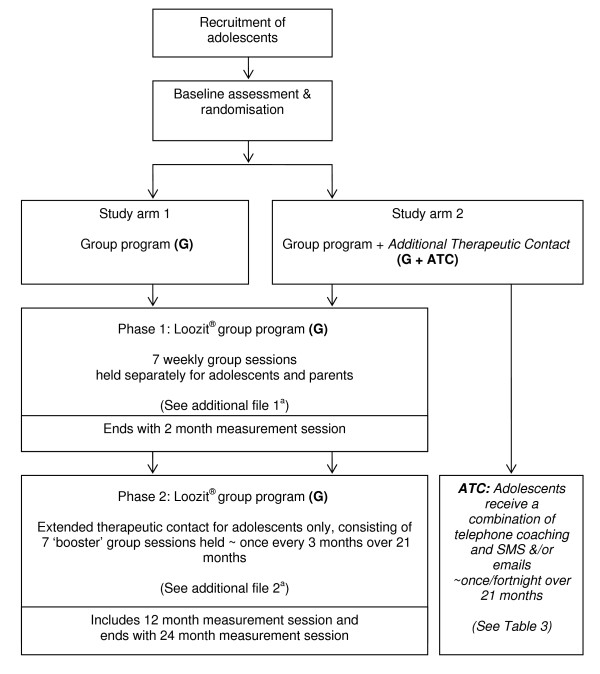
BACKGROUND: There is a need to develop sustainable and clinically effective weight management interventions that are suitable for delivery in community settings where the vast majority of overweight and obese adolescents should be treated. This study aims to evaluate the effect of additional therapeutic contact as an adjunct to the Loozit group program -- a community-based, lifestyle intervention for overweight and lower grade obesity in adolescents. The additional therapeutic contact is provided via telephone coaching and either mobile phone Short Message Service or electronic mail, or both. METHODS AND DESIGN: The study design is a two-arm randomised controlled trial that aims to recruit 168 overweight and obese 13-16 year olds (Body Mass Index z-score 1.0 to 2.5) in Sydney, Australia. Adolescents with secondary causes of obesity or significant medical illness are excluded. Participants are recruited via schools, media coverage, health professionals and several community organisations. Study arm one receives the Loozit group weight management program (G). Study arm two receives the same Loozit group weight management program plus additional therapeutic contact (G+ATC). The 'G' intervention consists of two phases. Phase 1 involves seven weekly group sessions held separately for adolescents and their parents. This is followed by phase 2 that involves a further seven group sessions held regularly, for adolescents only, until two years follow-up. Additional therapeutic contact is provided to adolescents in the 'G+ATC' study arm approximately once per fortnight during phase 2 only. Outcome measurements are assessed at 2, 12 and 24 months post-baseline and include: BMI z-score, waist z-score, metabolic profile indicators, physical activity, sedentary behaviour, eating patterns, and psychosocial well-being. DISCUSSION: The Loozit study is the first randomised controlled trial of a community-based adolescent weight management intervention to incorporate additional therapeutic contact via a combination of telephone coaching, mobile phone Short Message Service, and electronic mail. If shown to be successful, the Loozit group weight management program with additional therapeutic contact has the potential to be readily translatable to a range of health care settings. TRIAL REGISTRATION: The protocol for this study is registered with the Australian Clinical Trials Registry (ACTRNO12606000175572).
Overview
The claims and statistics of this paper haven’t been checked yet.
Free: it reads the open-access text and checks the first 5 claims that cite a source we can check. Create a free account to check every claim.
Integrity signals
Registry
Cites
Statistics
Figures
Verification
Claims the paper makes
The claims and statistics of this paper haven’t been checked yet.
Free: it reads the open-access text and checks the first 5 claims that cite a source we can check. Create a free account to check every claim.
Claims other papers make about this one
Each is checked against this paper’s own text: does it say what the citing paper says it does?
The check wasn’t confident either way, so it gives no verdict — never disputed.
In the citing paper
“This specific type of control group was selected based on empirical data which show that, although weight management interventions do not specifically address LOC eating, participants in these types of interventions tend to manifest reductions in bulimic symptoms [101, 102].”
From LIBER8 design and methods: An integrative intervention for loss of control eating among African American and White adolescent girls (2013) · cites this paper as [102]
Experimental — accuracy not yet measured
Self-check
Percentages, sums and reported differences re-computed from the paper’s own numbers.
The self-check needs the paper’s full text.
Citations
Cites
1 retracted
Interventions for treating obesity in children
Oude Luttikhuis, H., Baur, L., Jansen, H., Shrewsbury, V. A., O'Malley, C., Stolk, R. P., & Summerbell, C. D. (2009) · Cochrane Database of Systematic Reviews · doi:10.1002/14651858.cd001872.pub2 · Cited by 1,531 · cited 4×
“The conventional components of weight management in adolescents and children include dietary modification, increased physical activity, decreased sedentary activity, behaviour modification and family involvement [11].”
BackgroundInfluentialSelf-citationRetractedHealth Behavior and Health Education: Theory, Research, and Practice
(1992) · Annals of Internal Medicine · doi:10.7326/0003-4819-116-4-350_1 · Cited by 13,207
‘Small Changes' to Diet and Physical Activity Behaviors for Weight Management
Hills, A. P., Byrne, N. M., Lindstrom, R., & Hill, J. O. (2013) · Obesity Facts · doi:10.1159/000345030 · Cited by 9,493
CDC GROWTH CHARTS FOR THE UNITED STATES: METHODS AND DEVELOPMENT 2000
Kuczmarski, R. J., Ogden, C. L., Guo, S. S., Strawn, L. G., Flegal, K. M., & Mei, Z. (2002) · Cited by 6,426
CDC growth charts: United States.
Kuczmarski, R. J., Ogden, C. L., Grummer‐Strawn, L. M., Flegal, K. M., Guo, S. S., Wei, R. X., Mei, Z., Curtin, L. R., Roche, A. F., & Johnson, C. L. (2000) · PubMed · Cited by 6,045
Improving chronic illness care: translating evidence into action
Wagner, E. H., Austin, B. T., Davis, C., Hindmarsh, M., Schaefer, J., & Bonomi, A. (2001) · Health Affairs · doi:10.1377/hlthaff.20.6.64 · Cited by 3,446
Worldwide trends in childhood overweight and obesity
Wang, Y., & Lobstein, T. (2006) · International Journal of Pediatric Obesity · doi:10.1080/17477160600586747 · Cited by 2,669
Tracking of childhood overweight into adulthood: a systematic review of the literature
Singh, A. S., Mulder, C., Twisk, J. W. R., Van Mechelen, W., & Chinapaw, M. J. M. (2008) · Obesity Reviews · doi:10.1111/j.1467-789x.2008.00475.x · Cited by 2,494
Long-term weight loss maintenance
Wing, R. R., & Phelan, S. (2005) · The American Journal of Clinical Nutrition · doi:10.1093/ajcn/82.1.222s · Cited by 1,941 · cited 1×
“Persisting with positive lifestyle changes appears to be a universal and key factor in successful weight loss maintenance [15,16].”
BackgroundPerformance of a Five-Item Mental Health Screening Test
Berwick, D. M., Murphy, J. M., Goldman, P. A., Ware, J. E., Barsky, A. J., & Weinstein, M. C. (1991) · Medical Care · doi:10.1097/00005650-199102000-00008 · Cited by 1,660 · cited 1×
“▪ The Mental Health Inventory-5 (MHI-5), a 5 question mental health assessment component of the SF36, is used to assess quality of life for adolescents [50].”
MethodHealth consequences of obesity
Reilly, J. J. (2003) · Archives of Disease in Childhood · doi:10.1136/adc.88.9.748 · Cited by 1,646
Fernández, J. R., Redden, D. T., Pietrobelli, A., & Allison, D. B. (2004) · The Journal of Pediatrics · doi:10.1016/j.jpeds.2004.06.044 · Cited by 1,418
Behavior change interventions delivered by mobile telephone short message service
Fjeldsoe, B. S., Marshall, A. L., & Miller, Y. D. (2009) · American Journal of Preventive Medicine · doi:10.1016/j.amepre.2008.09.040 · Cited by 1,213 · cited 2×
“Strategies for extended therapeutic contact for adolescents with chronic disease The use of telephones [19], mobile phone SMS [ 20 ] and interactive technologies such as e-mail or the Internet [21], can be an effective means of providing therapeutic interventions for health behaviour change.”
BackgroundAdolescents' Perceptions of Social Status: Development and Evaluation of a New Indicator
Goodman, E., Adler, N. E., Kawachi, I., Frazier, A. L., Huang, B., & Colditz, G. A. (2001) · Pediatrics · doi:10.1542/peds.108.2.e31 · Cited by 1,115
How individuals, environments, and health behaviors interact: Social cognitive theory.
Perry, C. L., Baranowski, T., & Parcel, G. S. (1990) · Cited by 1,078
Kiddy, D. S., Hamilton‐Fairley, D., Bush, A., Short, F., Anyaoku, V., Reed, M. J., & Franks, S. (1992) · Clinical Endocrinology · doi:10.1111/j.1365-2265.1992.tb02909.x · Cited by 921
Ten-year outcomes of behavioral family-based treatment for childhood obesity.
Epstein, L. H., Valoski, A. M., Wing, R. R., & McCurley, J. (1994) · Health Psychology · doi:10.1037//0278-6133.13.5.373 · Cited by 874
Neinstein, L. S. (1982) · Clinical Pediatrics · doi:10.1177/000992288202100806 · Cited by 782
Tracking of Physical Activity and Physical Fitness across the Lifespan
Malina, R. M. (1996) · Research Quarterly for Exercise and Sport · doi:10.1080/02701367.1996.10608853 · Cited by 738
Adolescents' Self-Assessment of Sexual Maturation
Duke, P. M., Litt, I. F., & Gross, R. T. (1980) · Pediatrics · doi:10.1542/peds.66.6.918 · Cited by 681
Douketis, J. D., Macie, C., Thabane, L., & Williamson, D. F. (2005) · International Journal of Obesity · doi:10.1038/sj.ijo.0802982 · Cited by 665 · cited 1×
“2–4 years) following non-surgical treatment of overweight and obesity is modest at best in adults who complete interventions [12] but this outcome may be different in children and adolescents, particularly in those with height growth potential.”
BackgroundA Review of eHealth Interventions for Physical Activity and Dietary Behavior Change
Norman, G. J., Zabinski, M. F., Adams, M. A., Rosenberg, D. E., Yaroch, A. L., & Atienza, A. A. (2007) · American Journal of Preventive Medicine · doi:10.1016/j.amepre.2007.05.007 · Cited by 605 · cited 5×
“Washington, DC.: Pew Internet and American Life Project; 2005.”
BackgroundInfluentialFranklin, V. L., Waller, A., Pagliari, C., & Greene, S. A. (2006) · Diabetic Medicine · doi:10.1111/j.1464-5491.2006.01989.x · Cited by 543 · cited 1×
“These were developed based upon those used in studies with adults and adolescents with type 1 diabetes [39,40].”
MethodThe Increase of Childhood Chronic Conditions in the United States
Perrin, J. M., Bloom, S. R., & Gortmaker, S. L. (2007) · JAMA · doi:10.1001/jama.297.24.2755 · Cited by 537
Effect of Degree of Weight Loss on Health Benefits
Blackburn, G. (1995) · Obesity Research · doi:10.1002/j.1550-8528.1995.tb00466.x · Cited by 503
Long-term Effects of Modest Weight Loss in Type II Diabetic Patients
Wing, R. R. (1987) · Archives of Internal Medicine · doi:10.1001/archinte.1987.00370100063012 · Cited by 484
Treatment of Obese Children With and Without Their Mothers: Changes in Weight and Blood Pressure
Brownell, K. D., Kelman, J. H., & Stunkard, A. J. (1983) · Pediatrics · doi:10.1542/peds.71.4.515 · Cited by 357
Overweight, Obesity, and Blood Pressure: The Effects of Modest Weight Reduction
Mertens, I. L., & van Gaal, L. F. (2000) · Obesity Research · doi:10.1038/oby.2000.32 · Cited by 330
Telephone Interventions for Physical Activity and Dietary Behavior Change
Eakin, E. G., Lawler, S. P., Vandelanotte, C., & Owen, N. (2007) · American Journal of Preventive Medicine · doi:10.1016/j.amepre.2007.01.004 · Cited by 329
Periods of Risk in Childhood for the Development of Adult Obesity — What Do We Need to Learn?
Dietz, W. H. (1997) · The Journal of Nutrition · doi:10.1093/jn/127.9.1884s · Cited by 322
SMS STI: A Review of the Uses of Mobile Phone Text Messaging in Sexual Health
Lim, M. S. C., Hocking, J. S., Hellard, M. E., & Aitken, C. K. (2008) · International Journal of STD & AIDS · doi:10.1258/ijsa.2007.007264 · Cited by 293 · cited 1×
“Each of these communication modes differs with regards to cost, time required to communicate with multiple recipients, ability to communicate detailed information, and immediacy of access to recipients [28].”
BackgroundEfficacy of Maintenance Treatment Approaches for Childhood Overweight: A Randomized Controlled Trial
Wilfley, D. E., Stein, R. I., Saelens, B. E., Mockus, D. S., Matt, G. E., Hayden-Wade, H. A., Welch, R. R., Schechtman, K. B., Thompson, P. A., & Epstein, L. H. (2007) · JAMA · doi:10.1001/jama.298.14.1661 · Cited by 277
Telford, A., Salmon, J., Jolley, D., & Crawford, D. (2004) · Pediatric Exercise Science · doi:10.1123/pes.16.1.64 · Cited by 260
Golley, R. K., Magarey, A. M., Baur, L. A., Steinbeck, K. S., & Daniels, L. A. (2007) · Pediatrics · doi:10.1542/peds.2006-1746 · Cited by 244
Self-citationJones, M., Luce, K. H., Osborne, M. I., Taylor, K., Cunning, D., Doyle, A. C., Wilfley, D. E., & Taylor, C. B. (2008) · PEDIATRICS · doi:10.1542/peds.2007-1173 · Cited by 212
Tailored mobile phone text messages as an adjunct to obesity treatment for adolescents
Woolford, S. J., Clark, S. J., Strecher, V. J., & Resnicow, K. (2010) · Journal of Telemedicine and Telecare · doi:10.1258/jtt.2010.100207 · Cited by 175
Doyle, A. C., Goldschmidt, A. B., Huang, C., Winzelberg, A. J., Taylor, C. B., & Wilfley, D. E. (2008) · Journal of Adolescent Health · doi:10.1016/j.jadohealth.2008.01.011 · Cited by 173
Huang, Y. J., Wong, S. H. S., & Salmon, J. (2009) · Pediatric Exercise Science · doi:10.1123/pes.21.3.339 · Cited by 146
Four-year follow-up of children and adolescents participating in an obesity intervention program
Reinehr, T., Temmesfeld, M., Kersting, M., de Sousa, G., & Toschke, A. M. (2007) · International Journal of Obesity · doi:10.1038/sj.ijo.0803637 · Cited by 140
Methods of the NSW Schools Physical Activity and Nutrition Survey (SPANS)
Booth, M. L., Denney‐Wilson, E., Okely, A. D., & Hardy, L. L. (2005) · Journal of science and medicine in sport · doi:10.1016/s1440-2440(05)80039-8 · Cited by 102
Old and New Scales for the Assessment of Body Image
Stunkard, A. J. (2000) · Perceptual and Motor Skills · doi:10.2466/pms.2000.90.3.930 · Cited by 84
Adolescent determinants of cardiovascular risk factors in adult men and women
Barnekow-Bergkvist, M., Hedberg, G., Janlert, U., & Jansson, E. (2001) · Scandinavian Journal of Public Health · doi:10.1177/14034948010290031001 · Cited by 78
A brief, regular, proactive telephone “coaching” intervention for diabetes
Sacco, W. P., Morrison, A. D., & Malone, J. I. (2004) · Journal of Diabetes and its Complications · doi:10.1016/s1056-8727(02)00254-4 · Cited by 67
Flood, V. M., Webb, K., & Rangan, A. (2005) · Research Online (University of Wollongong) · Cited by 56
Fundamentals of Community Health Centers
Taylor, J. (2004) · Cited by 49
Post-treatment phone contact: a weight maintenance strategy in obese youngsters
Deforche, B. I., Bourdeaudhuij, I. D., Tanghe, A., Debode, P., Hills, A. P., & Bouckaert, J. J. (2005) · International Journal of Obesity · doi:10.1038/sj.ijo.0802924 · Cited by 42
Péneau, S., Thibault, H., Meless, D., Soulié, D., Carbonel, P., Roinsol, D., Longueville, E., Serog, P., Deheeger, M., Bellisle, F., et al. (2007) · The Journal of Pediatrics · doi:10.1016/j.jpeds.2007.09.053 · Cited by 29
O’Connor, J., Steinbeck, K. S., Hill, A. J., Booth, M. L., Kohn, M. R., Shah, S., & Baur, L. A. (2008) · Nutrition & Dietetics · doi:10.1111/j.1747-0080.2008.00222.x · Cited by 22
Self-citationTailored Mobile Phone Text Messages as an Adjunct to Obesity Treatment for Adolescents
Woolford, S. J., & Clark, S. J. (2009) · Journal of Adolescent Health · doi:10.1016/j.jadohealth.2008.10.012 · Cited by 17
Blood pressure in schoolchildren measured under standardized conditions
Jureidini, K. F., Hogg, R. J., van Renen, M. J., Adams, P. S., Burnell, R. H., Goldblatt, E., Baghurst, P., & Vimpani, G. (1988) · The Medical Journal of Australia · doi:10.5694/j.1326-5377.1988.tb120536.x · Cited by 14
Hung, S.-H., Hwang, S.-L., Su, M.-J., Lue, S.-H., Hsu, C.-Y., Chen, H.-L., & Chen, H.-S. (2008) · Telemedicine Journal and e-Health · doi:10.1089/tmj.2007.0121 · Cited by 12
OLD AND NEW SCALES FOR THE ASSESSMENT OF BODY IMAGE
Stunkard, A. J. (2000) · Perceptual and Motor Skills · doi:10.2466/pms.90.3.930-930 · Cited by 12
Research works printed but not linked: 4
- Hill AJ Fed up and friendless The Psychologist 2005 18 280 283
- Improving Care for People with Long-term Conditions: A review of UK and International Frameworks
- Lenhart A Madden M Hitlin P Teens and Technology: Youth are Leading to a Fully Wired and Mobile Nation 2005 Washington, DC.: Pew Internet and American Life Project
- Harter S Manual for the self perception profile for adolescents Denver, CO: University of Denver 1988
Cited by
Interventions for preventing obesity in children
Brown, T., Moore, T. H., Hooper, L., Gao, Y., Zayegh, A., Ijaz, S., Elwenspoek, M., Foxen, S. C., Magee, L., O'Malley, C., et al. (2019) · Cochrane Database of Systematic Reviews · doi:10.1002/14651858.cd001871.pub4 · Cited by 2,982
Interventions for preventing obesity in children
Waters, E., de Silva-Sanigorski, A., Burford, B. J., Brown, T., Campbell, K. J., Gao, Y., Armstrong, R., Prosser, L., & Summerbell, C. D. (2011) · Cochrane Database of Systematic Reviews · doi:10.1002/14651858.cd001871.pub3 · Cited by 1,455
Al-Khudairy, L., Loveman, E., Colquitt, J. L., Mead, E., Johnson, R. E., Fraser, H., Olajide, J., Murphy, M., Velho, R. M., O'Malley, C., et al. (2017) · Cochrane Database of Systematic Reviews · doi:10.1002/14651858.cd012691 · Cited by 455
Magarey, A., Watson, J., Golley, R. K., Burrows, T., Sutherland, R., McNaughton, S. A., Denney-Wilson, E., Campbell, K., & Collins, C. (2011) · International Journal of Pediatric Obesity · doi:10.3109/17477161003728469 · Cited by 178
Turner, T., Spruijt‐Metz, D., Wen, C. K. F., & Hingle, M. D. (2015) · Pediatric Obesity · doi:10.1111/ijpo.12002 · Cited by 173
“Social Cognitive Theory based group therapy [7,11,12] and concepts from Behavioral Determinants and the Transtheoretical Model of behaviour change [13]), adherence to the mHealth component was low to moderate (22% [11] and 47% [7]).”
Method
Metadata
- Authors
- Shrewsbury, V. A., O'Connor, J., Steinbeck, K. S., Stevenson, K., Lee, A., Hill, A. J., Kohn, M. R., Shah, S., Torvaldsen, S., & Baur, L. A.
- Affiliations
- The University of Sydney (AU)
- University of Leeds (GB)
- Children's Hospital at Westmead (AU)
- Western Sydney Local Health District (AU)
- Corresponding author
- Shrewsbury, Vanessa A
- ORCID
- Venue
- BMC Public Health
- Published
- 2009-04-29
- Volume
- 9
- Issue
- 1
- Pages
- 119-119
- ISSN
- 1471-2458 (ISSN-L)
- PMC
- PMC2687446
- OpenAlex
- W2135653222
- Semantic Scholar
- 6433cbca27a15fe1dbb317be2608d5f30409aa89
- Cited by
- 35
- References
- 51
- Citations by year
- 2023: 1 · 2022: 1 · 2020: 1 · 2019: 1 · 2018: 2 · 2017: 1 · 2016: 3 · 2015: 5 · 2014: 3 · 2013: 1 · 2012: 7
- FWCI
- 5.35
- Type
- journal article
- Language
- en
- Open access
- gold
- doi.org
- Licence
- cc-by
- creativecommons.org/licenses/by/2.0 (tdm)
- Locations
- BMC Public Health (publishedVersion, cc-by)
- Europe PMC (PubMed Central) (publishedVersion, cc-by)
- PubMed Central (publishedVersion, cc-by)
- PubMed (publishedVersion)
- White Rose Research Online (University of Leeds, The University of Sheffield, University of York) (acceptedVersion)
- DOAJ (DOAJ: Directory of Open Access Journals) (submittedVersion)
- Funders
- Medical Research Council
- National Health and Medical Research Council
- Topics
- Health Sciences › Medicine › Public Health, Environmental and Occupational Health › Obesity, Physical Activity, Diet
- Health Sciences › Health Professions › General Health Professions › Mobile Health and mHealth Applications
- Health Sciences › Medicine › Public Health, Environmental and Occupational Health › Obesity and Health Practices
- Keywords
- adolescent obesity, adolescent overweight, weight management interventions, community-based lifestyle intervention, telephone coaching, email, parental involvement, physical activity, sedentary behavior, dietary habits, psychosocial well-being, metabolic profile, BMI z-score
- MeSH terms
- Adolescent, Adolescent Behavior, Behavior Therapy, Community-Institutional Relations, Counseling, Diet, Female, Humans, Life Style, Male, Motor Activity, New South Wales, Obesity, Parents, Health Behavior, Body Mass Index, Overweight, Waist Circumference
About these checks
Registry, retraction, Cites and statistics results are computed, not judged, with one exception: a printed reference that no index lists is read once by a model before it counts as a citation error. Claims are extracted by a model and kept only when their quote appears verbatim in the text; each cited source is then checked, with a model’s help, for whether it says what the claim relies on. Those verdicts can be wrong — read the claim’s quote and the cited source before relying on one.
Statistics and arithmetic are recomputed, not judged.
Confidence bands are shown only for fields calibrated on our annotated test set. None is calibrated yet, so no band is shown.
What counts as a claim ›How we measure confidence ›How we check this ›
Are you an author, or do you see a problem with this page? Request a review
Data sources
Bibliographic data: Semantic Scholar, OpenAlex, Crossref.
Contains information from the Semantic Scholar Academic Graph Datasets, made available under the ODC Attribution License (ODC-BY 1.0).
Semantic Scholar’s data is described in: Kinney, R., et al. (2023). The Semantic Scholar Open Data Platform. arXiv:2301.10140.
