

Relationships, love and sexuality: what the Filipino teens think and feel
Open accessThe DOI matches its Crossref record; 77 of the 78 references it cites were found in a registry or an index; 4 of the 75 sources its claims cite were checked for support.
Abstract
A questionnaire including topics on relationships, love and sexuality was distributed to a target population of Filipino students from third year high school to third year college.
Overview
CoChat Summary
TL;DR
Filipino high school students aged 13–18 mainly get information about love and sexuality from friends, value parents’ opinions more than friends’, and report few parent conversations but strong desire for more information, especially about emotions. About 40% incorrectly believe or do not know that condoms are not 100% effective, and this belief plus approval of pornography/sexism was associated with being sexually experienced after adjustment.
Key findings
- Among 3,044 high school respondents aged 13–18, friends were the most common source of information on love and sexuality: 57.5% of males and 69.6% of females marked friends as “always” or “almost always”; for males, the next source was the Internet/youth magazines (27.1%), and for females it was parents (30.7%).
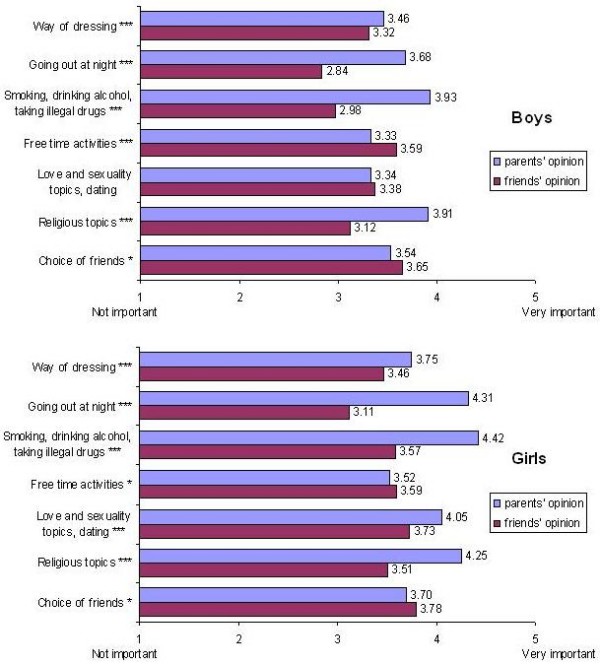
- Teens generally valued parents’ opinions more than friends’ opinions, especially girls, but reported relatively few conversations with parents; they wanted more information, particularly on emotion-related topics such as managing feelings and emotions (86.9% boys, 94.8% girls) and what “falling in love” means (83.3% and 89.9%).
- Condom knowledge was incomplete: 42.9% answered “none” or “I don’t know” for AIDS risk with condoms, 43.7% for genital warts, and 40.6% for pregnancy, with higher rates among boys.
- After adjusting for sex, age, and public/private institution, belief that condoms are 100% effective was associated with being sexually experienced (OR = 1.59; 95% CI 1.09–2.33), as was approval of pornography and equating masculinity/femininity with more sexual encounters (OR = 1.69; 95% CI 1.25–2.29).
Methods
- A paper-pencil questionnaire with mainly close-ended questions and a five-point Likert scale was pre-tested on 180 students and took about 45 minutes; it covered socio-demographics, friends, media, information sources, feelings/opinions on relationships, love and sexuality, and life goals.
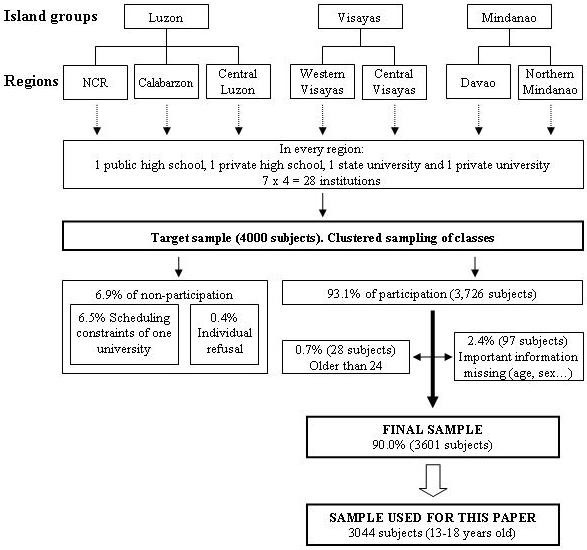
- The target population was 4,000 Filipino students from third-year high school to third-year college, obtained through multi-stage sampling of clusters of universities and schools; data were collected July–September 2007 in 28 schools from 7 of 17 regions. This paper analyzed 3,044 high school students aged 13–18.
- Analyses used STATA 9 survey commands accounting for sampling weights and clusters, with survey mean, proportion, and logistic commands; significance was tested using an Adjusted Wald test.
Limitations
- Stated in the paper: the cross-sectional design does not easily allow causal inference; data are self-reported; out-of-school youth were not included; and time/budget constraints limited the sample to seven of seventeen political regions.
- Evident from the text: the school-based sample and restriction to in-school high school students aged 13–18 limit generalizability to out-of-school youth and older adolescents.
Model-written summary. Check it against the paper before relying on it.
Integrity signals
Registry
Cites
Statistics
Figures
Verification
Claims the paper makes
3 Valid · 0 Not valid · 31 Not checked · 57 Own results and interpretations
The cited sources support only part of this claim — read each source’s verdict below.
In the paper
“Moreover, the use of contraceptive methods does not seem to be effective enough to avoid unplanned pregnancies in youth [19-22].”
§ Relationships, love and sexuality: what the Filipino teens think and feel > Background
What the sources say
- Not checked — no full text of the sourcecites [19] Santelli JS, Morrow B, Anderson JE, Lindberg LD: Contraceptive use and pregnancy risk among U.S. high school students, 1991–2003. Perspect Sex Reprod Health. 2006, 38 (2): 106-111. 10.1093/humrep/deg215. source
- Not checked — no full text of the sourcecites [20] Santelli JS Morrow B Anderson JE Lindberg LD Contraceptive use and pregnancy risk among U.S. high school students, 1991–2003 Perspect Sex Reprod Health 2006 38 2 106 111 10.1093/humrep/deg215 16772192 source
- Not checked — no full text of the sourcecites [21] Lete I Cabero L Alvarez D Olle C Observational study on the use of emergency contraception in Spain: Results of a national survey Eur J Contracept Reprod Health Care 2003 8 4 203 209 10.1080/713604471 15006267 source
- Partly supportedcites [22] Ruiz Sanz S Guell Perez E Herranz Calvo C Pedraza Moreno C Emergency contraception. Characteristics of the demand Aten Primaria 2002 30 6 381 387 12396945 PMC7677942 sourceExperimental — accuracy not yet measured
The Discussion reports relatively high pregnancy and abortion rates among adolescents and suggests that adolescent family-planning programs do not meet their needs. It also reports frequent condom breakage among women seeking emergency contraception. But the study's patients were mostly adults, and these passages do not establish that contraceptive methods used by youth are insufficient to prevent unplanned pregnancies. Page numbers were not supplied for these passages. (LLM, conf=0.82)
hedged- Asserted: passes — The authors put it forward as true.
- Checkable: passes — It can be checked against evidence.
- Load-bearing: unclear — It is unclear whether the paper’s conclusions depend on it.
- Based: passes — The paper gives a reason why it holds.
A result the paper reports from its own data — it cites no other source for it, so there is none to check. The quote shows it is in the paper.
In the paper
“After adjusting for sex, age and whether institutions were public or private, the students that believe condoms are 100% effective against AIDS, STIs and pregnancies were more likely to be sexually experienced (OR= 1.59; 95% CI 1.09–2.33).”
§ Relationships, love and sexuality: what the Filipino teens think and feel > Results
plainstates an association- Asserted: passes — The authors put it forward as true.
- Checkable: passes — It can be checked against evidence.
- Load-bearing: passes — The paper’s conclusions depend on it.
- Based: passes — The paper gives a reason why it holds.
A result the paper reports from its own data — it cites no other source for it, so there is none to check. The quote shows it is in the paper.
In the paper
“Referring to our paper sample of teens, the main information source about love and sexuality is friends.”
§ Relationships, love and sexuality: what the Filipino teens think and feel > Discussion
plain- Asserted: passes — The authors put it forward as true.
- Checkable: passes — It can be checked against evidence.
- Load-bearing: unclear — It is unclear whether the paper’s conclusions depend on it.
- Based: passes — The paper gives a reason why it holds.
A result the paper reports from its own data — it cites no other source for it, so there is none to check. The quote shows it is in the paper.
In the paper
“Students that are approving of pornography and masculinity and femininity being equated to having more sexual encounters, were as well more likely to be sexually experienced after the adjustments mentioned above (OR= 1.69; 95% CI 1.25–2.29).”
§ Relationships, love and sexuality: what the Filipino teens think and feel > Results
plainstates an association- Asserted: passes — The authors put it forward as true.
- Checkable: passes — It can be checked against evidence.
- Load-bearing: passes — The paper’s conclusions depend on it.
- Based: passes — The paper gives a reason why it holds.
A result the paper reports from its own data — it cites no other source for it, so there is none to check. The quote shows it is in the paper.
In the paper
“At the same time, parents' opinion regarding sexuality and other related topics is well valued by teens in our study.”
§ Relationships, love and sexuality: what the Filipino teens think and feel > Discussion
boosted- Asserted: passes — The authors put it forward as true.
- Checkable: passes — It can be checked against evidence.
- Load-bearing: passes — The paper’s conclusions depend on it.
- Based: passes — The paper gives a reason why it holds.
30 more claims
Create a free account to see all 91 claims and to verify the 18 references still open.
- It may state two separate claims as one. 27
- Probably not a substantial claim. 35
- The quote only partly states this claim. 1
- Borderline: one of the tests for a substantial claim is unclear. 1
Self-check
Percentages, sums and reported differences re-computed from the paper’s own numbers.
Each contradiction between two passages listed here was confirmed by an independent check.
Rated minor: it would not touch a result — a value no result rests on, a p-value that stays on the same side of the significance level, or a conflict that is clerical, resolved elsewhere in the paper, or outside its own findings.
In the paper
§ Relationships, love and sexuality: what the Filipino teens think and feel > Results
“for females, girls' physical changes (58.9%) and pregnancy (41.1%).”
§ Relationships, love and sexuality: what the Filipino teens think and feel > Results
“with 9.0% of boys and 59.9% of girls indicating they talked "somewhat" or "a lot" about this topic with their parents”
Citations
Cites
(1990) · Choice Reviews Online · doi:10.5860/choice.27-3338 · Cited by 35,305
Kupper, L. L., Hosmer, D. W., & Lemeshow, S. (1990) · Journal of the American Statistical Association · doi:10.2307/2290035 · Cited by 7,599
Relaxing the Rule of Ten Events per Variable in Logistic and Cox Regression
Vittinghoff, E., & McCulloch, C. E. (2007) · American Journal of Epidemiology · doi:10.1093/aje/kwk052 · Cited by 4,359
(2006) · PubMed · Cited by 3,378
Contraceptive failure in the United States
Trussell, J. (2011) · Contraception · doi:10.1016/j.contraception.2011.01.021 · Cited by 1,588
Sexual behaviour in context: a global perspective
Wellings, K., Collumbien, M., Slaymaker, E., Singh, S., Hodges, Z., Patel, D., & Bajos, N. (2006) · The Lancet · doi:10.1016/s0140-6736(06)69479-8 · Cited by 933
Kirby, D. B., Laris, B. A., & Rolleri, L. A. (2007) · Journal of Adolescent Health · doi:10.1016/j.jadohealth.2006.11.143 · Cited by 915 · cited 1×
“Furthermore, other studies do find some abstinence encouraging programs being effective in both developed and developing countries [76-78].”
BackgroundCondom effectiveness in reducing heterosexual HIV transmission.
Weller, S. C., & Davis-Beaty, K. (2002) · Cochrane Database of Systematic Reviews · doi:10.1002/14651858.cd003255 · Cited by 846 · cited 1×
“Concerning condom effectiveness, for example, several studies show that condoms are "risk reduction" measures with respect to unintended pregnancies, HIV infection and other STIs and should not, therefore, be presented as "risk avoidance" measures [57-61].”
BackgroundCondom Use and the Risk of Genital Human Papillomavirus Infection in Young Women
Winer, R. L., Hughes, J. P., Feng, Q., O'Reilly, S., Kiviat, N. B., Holmes, K. K., & Koutsky, L. A. (2006) · New England Journal of Medicine · doi:10.1056/nejmoa053284 · Cited by 694
Kohler, P. K., Manhart, L. E., & Lafferty, W. E. (2008) · Journal of Adolescent Health · doi:10.1016/j.jadohealth.2007.08.026 · Cited by 647
Pettifor, A. E., Rees, H. V., Kleinschmidt, I., Steffenson, A. E., MacPhail, C., Hlongwa-Madikizela, L., Vermaak, K., & Padian, N. S. (2005) · AIDS · doi:10.1097/01.aids.0000183129.16830.06 · Cited by 645 · cited 1×
“However, the average age of first sexual relation is still too low, while unplanned pregnancies and STIs remain high [10-13].”
BackgroundPredictors of Adolescent Sexual Behavior and Intention: A Theory-Guided Systematic Review
Buhi, E. R., & Goodson, P. (2007) · Journal of Adolescent Health · doi:10.1016/j.jadohealth.2006.09.027 · Cited by 522 · cited 1×
“Furthermore, according to the systematic review of American youth studies done by Buhi and Goodson, the youth's perception of parental attitudes toward sex is a stable predictor of sexual behavior outcomes [35].”
Background(2008) · PubMed · Cited by 510
Intimate-partner violence [letter]
Se, R., Stuart, G. S., Am, H., Recupero, P. R., & Short, Y. (2006) · The Lancet · Cited by 488
Kaestle, C. E. (2005) · American Journal of Epidemiology · doi:10.1093/aje/kwi095 · Cited by 485
AIDS epidemic update: December 1999.
(2000) · PubMed · Cited by 449
The Estimated Direct Medical Cost of Sexually Transmitted Diseases Among American Youth, 2000
Chesson, H. W., Blandford, J. M., Gift, T. L., Tao, G., & Irwin, K. L. (2004) · Perspectives on Sexual and Reproductive Health · doi:10.1363/3601104 · Cited by 444
Contraceptive failure in the United States
Trussell, J. (2004) · Contraception · doi:10.1016/j.contraception.2004.03.009 · Cited by 420 · cited 1×
“Concerning condom effectiveness, for example, several studies show that condoms are "risk reduction" measures with respect to unintended pregnancies, HIV infection and other STIs and should not, therefore, be presented as "risk avoidance" measures [57-61].”
BackgroundKirby, D. B. (2008) · Sexuality Research and Social Policy · doi:10.1525/srsp.2008.5.3.18 · Cited by 410
Kids Having Kids: Economic Costs and Social Consequences of Teen Pregnancy
(2018) · Routledge eBooks · doi:10.4324/9780429452635 · Cited by 409
Report of the APA Task Force on the Sexualization of Girls: (542142009-010)
(2007) · PsycEXTRA Dataset · doi:10.1037/e542142009-010 · Cited by 394
Risk compensation: the Achilles' heel of innovations in HIV prevention?
Cassell, M. M., Halperin, D. T., Shelton, J. D., & Stanton, D. (2006) · BMJ · doi:10.1136/bmj.332.7541.605 · Cited by 390 · cited 2×
“For example, the association between perceptions and beliefs about condom effectiveness, sexism and sexual experience are consistent with the theory of risk compensation as described by other researchers [69].”
BackgroundResultAdolescent depression and suicide risk
Hallfors, D. D., Waller, M. W., Ford, C. A., Halpern, C. T., Brodish, P. H., & Iritani, B. (2004) · American Journal of Preventive Medicine · doi:10.1016/j.amepre.2004.06.001 · Cited by 389 · cited 1×
“- Some studies assert that sexual activity is directly correlated to emotional problems among American teens; sexually active teenagers are more likely to be depressed and more likely to attempt suicide than teenagers who are not sexually active (even after controlling for sex, race, age and socio-economic status) [23…”
BackgroundEarly age of first sex: a risk factor for HIV infection among women in Zimbabwe
Pettifor, A. E., van der Straten, A., Dunbar, M. S., Shiboski, S. C., & Padian, N. S. (2004) · AIDS · doi:10.1097/01.aids.0000131338.61042.b8 · Cited by 314 · cited 2×
“Some behavioral factors such as starting sex relations at a young age and having multiple (concurrent or serial) sexual partners, increase the risk of infections [5,6,14-18].”
BackgroundA Meta-Analysis Summarizing the Effects of Pornography II Aggression After Exposure
ALLEN, M., D'ALESSIO, D., & BREZGEL, K. (1995) · Human Communication Research · doi:10.1111/j.1468-2958.1995.tb00368.x · Cited by 310 · cited 1×
“On the other hand, boys' exposure to pornography increases the risk of aggressiveness, rape myths and gender stereotypes, all of which may be indirectly harmful for women and equality between males and females [81-83].”
BackgroundParental communication and youth sexual behaviour
Aspy, C. B., Vesely, S. K., Oman, R. F., Rodine, S., Marshall, L., & McLeroy, K. (2007) · Journal of Adolescence · doi:10.1016/j.adolescence.2006.04.007 · Cited by 291 · cited 1×
“Literature shows that communication with parents protects against early sexual initiation and against risky behaviors [51,52].”
BackgroundExposure to Pornography and Acceptance of Rape Myths
Allen, M., Emmers, T., Gebhardt, L., & Giery, M. A. (1995) · Journal of Communication · doi:10.1111/j.1460-2466.1995.tb00711.x · Cited by 282 · cited 1×
“On the other hand, boys' exposure to pornography increases the risk of aggressiveness, rape myths and gender stereotypes, all of which may be indirectly harmful for women and equality between males and females [81-83].”
BackgroundInfectious syphilis in high-income settings in the 21st century
Fenton, K. A., Breban, R., Vardavas, R., Okano, J. T., Martin, T., Aral, S., & Blower, S. (2008) · The Lancet Infectious Diseases · doi:10.1016/s1473-3099(08)70065-3 · Cited by 240 · cited 1×
“However, the average age of first sexual relation is still too low, while unplanned pregnancies and STIs remain high [10-13].”
BackgroundSingh, S., Darroch, J. E., & Frost, J. J. (2001) · Family Planning Perspectives · doi:10.2307/3030192 · Cited by 218
Blake, S. M., Simkin, L., Ledsky, R., Perkins, C., & Calabrese, J. M. (2001) · Family Planning Perspectives · doi:10.2307/2673750 · Cited by 204
Vaccarella, S., Franceschi, S., Herrero, R., Muñoz, N., Snijders, P. J. F., Clifford, G. M., Smith, J. S., Lazcano-Ponce, E., Sukvirach, S., Shin, H.-R., et al. (2006) · Cancer Epidemiology, Biomarkers & Prevention · doi:10.1158/1055-9965.epi-05-0577 · Cited by 202
Kjær, S. K., van den Brule, A. J. C., Bock, J. E., Poll, P., Engholm, G., Sherman, M. E., Walboomers, J. M. M., & Meijer, C. J. L. M. (1997) · PubMed · Cited by 187
First sexual intercourse: age, coercion, and later regrets reported by a birth cohort
Dickson, N., Paul, C., Herbison, P., & Silva, P. (1998) · BMJ · doi:10.1136/bmj.316.7124.29 · Cited by 186 · cited 1×
“- Most sexually experienced teens are already reporting feelings of regret over premature sexual intercourse [26,27].”
BackgroundNational Survey of Adolescents and Young Adults: Sexual Health Knowledge Attitudes and Experiences.
Hoff, T., Greene, L.-G., & Davis, J. A. (2003) · Cited by 185
Contraception: from accessibility to efficiency
Bajos, N. (2003) · Human Reproduction · doi:10.1093/humrep/deg215 · Cited by 177 · cited 1×
“Moreover, the use of contraceptive methods does not seem to be effective enough to avoid unplanned pregnancies in youth [ 19-22 ].”
BackgroundUnderhill, K., Montgomery, P., & Operario, D. (2007) · BMJ · doi:10.1136/bmj.39245.446586.be · Cited by 176
“Always Use Protection”: Communication Boys Receive About Sex From Parents, Peers, and the Media
Epstein, M., & Ward, L. M. (2008) · Journal of Youth and Adolescence · doi:10.1007/s10964-007-9187-1 · Cited by 163
(2021) · Ceskoslovenska psychologie · doi:10.51561/cspsych · Cited by 158
Parent and Peer Communication Effects on AIDS-Related Behavior Among U.S. High School Students
Holtzman, D., & Rubinson, R. (1995) · Family Planning Perspectives · doi:10.2307/2136175 · Cited by 157 · cited 1×
“Parent-child communication is protective against early sex [30,33,34], especially for girls [33].”
BackgroundMartino, S. C., Elliott, M. N., Corona, R., Kanouse, D. E., & Schuster, M. A. (2008) · Pediatrics · doi:10.1542/peds.2007-2156 · Cited by 151 · cited 2×
“Literature shows that communication with parents protects against early sexual initiation and against risky behaviors [51,52].”
BackgroundThe time has come for common ground on preventing sexual transmission of HIV
Halperin, D. T., Steiner, M. J., Cassell, M. M., Green, E. C., Hearst, N., Kirby, D. B., Gayle, H. D., & Cates, W. (2004) · The Lancet · doi:10.1016/s0140-6736(04)17487-4 · Cited by 147
Condoms and seat belts: the parallels and the lessons
Richens, J., Imrie, J., & Copas, A. (2000) · The Lancet · doi:10.1016/s0140-6736(99)09109-6 · Cited by 144 · cited 1×
“More recently, other researchers have extended the concept of risk compensation to HIV prevention [68,69].”
BackgroundSexual health, contraception, and teenage pregnancy
Tripp, J., & Viner, R. (2005) · BMJ · doi:10.1136/bmj.330.7491.590 · Cited by 134
Lerum, K., & Dworkin, S. L. (2009) · Journal of Sex Research · doi:10.1080/00224490903079542 · Cited by 134
Sexuality, Contraception, and the Media
Strasburger, V. C., & The Council on Communications and Media (2010) · Pediatrics · doi:10.1542/peds.2010-1544 · Cited by 128
Young People, Pornography, And Sexuality: Sources And Attitudes
Wallmyr, G., & Welin, C. (2006) · The Journal of School Nursing · doi:10.1177/10598405060220050801 · Cited by 111
Cabezón, C., Pilar Vigil, P., Rojas, I., Leiva, M. E., Riquelme, R., Aranda, W., & García, C. M. (2005) · Journal of Adolescent Health · doi:10.1016/j.jadohealth.2003.10.011 · Cited by 94
Contraceptive Use and Pregnancy Risk Among U.S. High School Students, 1991-2003
Santelli, J. S., Morrow, B., Anderson, J. E., & Lindberg, L. D. (2006) · Perspectives on Sexual and Reproductive Health · doi:10.1363/3810606 · Cited by 90
Contraceptive Use and Pregnancy Risk Among U.S. High School Students, 1991?2003
Santelli, J. S., Morrow, B., Anderson, J. E., & Lindberg, L. D. (2006) · Perspectives on Sexual and Reproductive Health · doi:10.1111/j.1931-2393.2006.tb00067.x · Cited by 89
Nwagwu, W. E. (2007) · BMC Public Health · doi:10.1186/1471-2458-7-354 · Cited by 84
Crosby, R. A., DiClemente, R. J., Wingood, G. M., Lang, D., & Harrington, K. F. (2003) · American Journal of Public Health · doi:10.2105/ajph.93.6.901 · Cited by 81
Increasing Condom Use Without Reducing HIV Risk: Results of a Controlled Community Trial in Uganda
Kajubi, P., Kamya, M. R., Kamya, S., Chen, S., McFarland, W., & Hearst, N. (2005) · JAIDS Journal of Acquired Immune Deficiency Syndromes · doi:10.1097/01.qai.0000157391.63127.b2 · Cited by 67 · cited 2×
“Furthermore, research shows that in the last 25 years of AIDS epidemic no country with large epidemics has been able to curtail the advance of HIV epidemic relying solely on condom promotion [2,3].”
BackgroundMethodMehta, S. D. (2003) · Sexually Transmitted Infections · doi:10.1136/sti.79.2.124 · Cited by 58 · cited 1×
“Some behavioral factors such as starting sex relations at a young age and having multiple (concurrent or serial) sexual partners, increase the risk of infections [5,6,14-18].”
BackgroundSexuality, Contraception, and the Media
Committee on Public Education (2001) · Pediatrics · doi:10.1542/peds.107.1.191 · Cited by 43
DiClemente, R. J., Crosby, R. A., Wingood, G. M., Lang, D. L., Salazar, L. F., & Broadwell, S. D. (2005) · International Journal of STD & AIDS · doi:10.1258/095646205774988037 · Cited by 42
Learning About Sex: Results From Natsal 2000
Macdowall, W., Wellings, K., Mercer, C. H., Nanchahal, K., Copas, A. J., McManus, S., Fenton, K. A., Erens, B., & Johnson, A. M. (2006) · Health Education & Behavior · doi:10.1177/1090198106289003 · Cited by 39 · cited 5×
“Lete I, Cabero L, Alvarez D, Olle C: Observational study on the use of emergency contraception in Spain: Results of a national survey.”
BackgroundResultInfluentialFrable, D. E. S., Johnson, A. E., & Kellman, H. (1997) · Journal of Personality · doi:10.1111/j.1467-6494.1997.tb00957.x · Cited by 38 · cited 1×
“On the other hand, boys' exposure to pornography increases the risk of aggressiveness, rape myths and gender stereotypes, all of which may be indirectly harmful for women and equality between males and females [81-83].”
BackgroundRector, R. E., Johnson, K. A., & Noyes, L. R. (2003) · Cited by 37
Family influences on the lifestyle of Filipino youth
Cruz, G. T., Laguna, E. P., & Mejia-Raymundo, C. (2001) · ScholarSpace (University of Hawaii at Manoa) · Cited by 34
Analysis of content about sexuality and human reproduction in school textbooks in Spain
de Irala, J., Urdiain, I. G., & López del Burgo, C. (2008) · Public Health · doi:10.1016/j.puhe.2008.01.005 · Cited by 32 · cited 1×
“With sex education programs concentrating on biological information [36], they are in effect highlighting topics that are of relatively lower interest to teens while downplaying education in the affective aspects of human sexuality which could be a powerful means to empower teens to make healthier life choices [56].”
BackgroundThe benefit of seat belt legislation in the United Kingdom.
McCarthy, M. (1989) · Journal of Epidemiology and Community Health · doi:10.1136/jech.43.3.218 · Cited by 32 · cited 1×
“For example, risk compensation was described as an explanation for the initial failure of seat belt laws to prevent road accident deaths because drivers presumed that wearing a seat belt would protect them from riskier driving [66,67].”
BackgroundObservational study on the use of emergency contraception in Spain: results of a national survey
Lete, I., Cabero, L., Alvarez, D., & Olle, C. (2003) · The European Journal of Contraception & Reproductive Health Care · doi:10.1080/ejc.8.4.203.209 · Cited by 31 · cited 1×
“Moreover, the use of contraceptive methods does not seem to be effective enough to avoid unplanned pregnancies in youth [19-22].”
BackgroundCorrelates of sexually transmitted infections in young Australian women
Khan, A., Hussain, R., & Schofield, M. (2005) · International Journal of STD & AIDS · doi:10.1258/0956462054308459 · Cited by 29
Correlates of Sexual Abstinence Among Urban University Students in the Philippines
Lacson, R. S., Theocharis, T. R., Strack, R., Sy, F. S., Vincent, M. L., Osteria, T. S., & Jimenez, P. R. (1997) · International Family Planning Perspectives · doi:10.2307/2950841 · Cited by 29
Upadhyay, U. D., Hindin, M. J., & Gultiano, S. (2006) · International Family Planning Perspectives · doi:10.1363/3211006 · Cited by 28
Strategies in HIV prevention: the A-B-C approach
Alonso, A., & de Irala, J. (2004) · The Lancet · doi:10.1016/s0140-6736(04)17050-5 · Cited by 24 · cited 1×
“Risk compensation may come into play and increase their vulnerability to infections and unintended pregnancies [65].”
BackgroundWhy National Standards and Tests? Politics and the Quest for Better Schools
Wheelan, C. J. (1999) · Journal of Policy Analysis and Management · doi:10.1002/(sici)1520-6688(199922)18:3 · Cited by 24
Seat belt legislation: the evidence revisited
Adams, J. G. U. (1994) · Safety Science · doi:10.1016/0925-7535(94)90022-1 · Cited by 23 · cited 1×
“For example, risk compensation was described as an explanation for the initial failure of seat belt laws to prevent road accident deaths because drivers presumed that wearing a seat belt would protect them from riskier driving [66,67].”
Background(2004) · doi:10.1007/978-1-4302-0904-1 · Cited by 23
Anticoncepción poscoital. Características de la demanda
Ruiz Sanz, S., Güell Pérez, E., Herranz Calvo, C., & Pedraza Moreno, C. (2002) · Atención Primaria · doi:10.1016/s0212-6567(02)79051-3 · Cited by 17
Changes in sexual behaviours to prevent HIV
de Irala, J., & Alonso, A. (2006) · The Lancet · doi:10.1016/s0140-6736(06)69712-2 · Cited by 13
The Neglected Heart: The Emotional Dangers of Premature Sexual Involvement.
(1994) · Cited by 7
The Family as Protective Factor against Sexual Risk-Taking Behavior among Filipino Adolescents 1
da Paz, M. L. N., & Marquez, N. (2004) · Cited by 4
(2001) · ScholarSpace (University of Hawaii at Manoa)
Contraceptive use and pregnancy risk among U.S. high school students, 1991-2003
Santelli, J., Morrow, B., Anderson, J., et al. (2006) · Perspectives on sexual and reproductive health · doi:10.1363/psrh.38.106.06
Research works printed but not linked: 11
- Centers for Disease Control and Prevention Nationally Representative CDC Study Finds 1 in 4 Teenage Girls Has a Sexually Transmitted Disease Proceedings of the 2008 National STD Prevention Conference: 2008 March 11; Chicago 2008 http://www.cdc.gov/STDConference/2008/media/release-11march2008.htm
- Albert B With One Voice: America's Adults and Teens Sound Off About Teen Pregnancy 2007 Washington, DC: National Campaign to Prevent Teen Pregnancy
- Holtzman D Rubinson R Parent and peer communication effects on AIDS-related behavior among US high school students Fam Plann Perspect 1995 27 6 235 240 10.2307/2673750 8666087 · doi:10.2307/2673750 · Paper page
- Instituto Nacional de Estadística Salud y hábitos sexuales Cifras INE Boletín informativo del Instituto Nacional de Estadística 2004 4 http://www.ine.es/revistas/cifraine/cifine_sida0704.pdf
- Stata Corp STATA Survey Data. Reference Manual. Release 9 2005 College Station, Texas: Stata Press
- UNICEF The State Of The World's Children 2006. Excluded and invisible 2005 New York: UNICEF
- Lara Ortega F Heras Sevilla D Formación sobre sexualidad en la primera etapa de la adolescencia. Datos obtenidos en una muestra de 2° y 3° de ESO en Burgos International Journal of Developmental and Educational Psychology 2008 1 1 241 248
- Menkes C Suárez L Núñez L González S La salud reproductiva de los estudiantes de educación secundaria y media superior de Chiapas, Guanajuato, Guerrero, Puebla y San Luis Potosí 2006 Cuernavaca (México): Universidad Nacional Autónoma de México, Centro Regional de Investigaciones Multidisciplinarias
- Kim CC Rector R Abstinence Education: Assessing the Evidence Backgrounder 2008 2126 http://www.heritage.org/Research/Welfare/bg2126.cfm
- O'Leary A Jemmott J Jemmott L Icard L Bellamy S Mediation analysis of an effective HIV prevention for Xhosa adolescents in Eastern Cape, South Africa Proceedings of the XVII International AIDS Conference: 3–8 August, 2008; Mexico City, Mexico 2008 138 http://www.aids2008-abstracts.org/aids2008_book_vol2_web.pdf
- de Irala J Sexual abstinence education. What is the evidence we need? BMJ Fast response 2007 http://www.bmj.com/cgi/eletters/335/7613/248
Cited by
Horvath, M. A. H., Alys, L., Massey, K., Pina, A., Scally, M., & Adler, J. R. (2013) · Create (Canterbury Christ Church University) · Cited by 153
First Sexual Intercourse and Subsequent Regret in Three Developing Countries
Osorio, A., del Burgo, C. L., Carlos, S., Ruiz‐Canela, M., Delgado‐Rodríguez, M., & de Irala, J. (2011) · Journal of Adolescent Health · doi:10.1016/j.jadohealth.2011.07.012 · Cited by 46
Self-citationParental knowledge and adolescents' risk behaviors
Albertos, A., Osorio, A., del Burgo, C. L., Carlos, S., Beltramo, C., & Trullols, F. (2016) · Journal of Adolescence · doi:10.1016/j.adolescence.2016.10.010 · Cited by 42
Self-citationMean Age of First Sex: Do They Know What We Mean?
de Irala, J., Osorio, A., Carlos, S., Ruiz‐Canela, M., & del Burgo, C. L. (2011) · Archives of Sexual Behavior · doi:10.1007/s10508-011-9779-4 · Cited by 33
Self-citationRuiz‐Canela, M., del Burgo, C. L., Carlos, S., Calatrava, M., Osorio, A., & de Irala, J. (2012) · Revista Panamericana de Salud Pública · doi:10.1590/s1020-49892012000100008 · Cited by 84
Self-citation
Metadata
- Authors
- de Irala, J., Osorio, A., del Burgo, C. L., Belen, V. A., de Guzman, F. O., Calatrava, M. D. C., & Torralba, A. N.
- Affiliations
- Universidad de Navarra (ES)
- University of Asia and the Pacific (PH)
- Venue
- BMC Public Health
- Published
- 2009-08-05
- Volume
- 9
- Issue
- 1
- Pages
- 282-282
- ISSN
- 1471-2458 (ISSN-L)
- PMC
- PMC2907520
- OpenAlex
- W2140279349
- Cited by
- 35
- References
- 78
- Citations by year
- 2026: 1 · 2025: 2 · 2024: 1 · 2023: 3 · 2022: 1 · 2021: 4 · 2020: 1 · 2019: 1 · 2018: 3 · 2017: 2 · 2016: 4 · 2015: 3 · 2014: 2 · 2013: 3 · 2012: 1
- FWCI
- 2.41
- Type
- journal article
- Language
- en
- Open access
- gold
- doi.org
- Licence
- cc-by
- creativecommons.org/licenses/by/2.0 (tdm)
- Locations
- BMC Public Health (publishedVersion, cc-by)
- PubMed Central (publishedVersion, cc-by)
- PubMed (publishedVersion)
- Deposito Adademico Digital Universidad De Navarra (University of Navarra) (submittedVersion, other-oa)
- DOAJ (DOAJ: Directory of Open Access Journals) (submittedVersion)
- Topics
- Health Sciences › Medicine › Public Health, Environmental and Occupational Health › Adolescent Sexual and Reproductive Health
- Health Sciences › Medicine › Public Health, Environmental and Occupational Health › Adolescent Health and Behaviors
- Social Sciences › Psychology › Clinical Psychology › Sexuality, Behavior, and Technology
- Keywords
- adolescent sexual behavior, sexual knowledge, romantic relationships, love, parent-adolescent communication, sexually transmitted infections, contraception, condom use, sexism, sexual initiation, Filipino adolescents, high school and college students
- MeSH terms
- Adolescent, Female, Humans, Interpersonal Relations, Love, Male, Philippines, Surveys and Questionnaires, Sexuality
About these checks
Registry, retraction, Cites and statistics results are computed, not judged, with one exception: a printed reference that no index lists is read once by a model before it counts as a citation error. Claims are extracted by a model and kept only when their quote appears verbatim in the text; each cited source is then checked, with a model’s help, for whether it says what the claim relies on. Those verdicts can be wrong — read the claim’s quote and the cited source before relying on one.
The claim verdicts this report counts are experimental: their accuracy is not yet measured.
A language model drew the claims from the paper on 2026-10-10, under version 3 of the claim definition (model deepseek-v4.1-flash, prompt extract-v3).
A second model labelled each claim on 2026-10-10 (model jev-1.13-20260917, definition revision gold-guideline-v0.2).
Cited sources are checked with a language model’s help (gpt-6-sol).
Statistics and arithmetic are recomputed, not judged.
Confidence bands are shown only for fields calibrated on our annotated test set. None is calibrated yet, so no band is shown.
What counts as a claim ›How we measure confidence ›How we check this ›
Are you an author, or do you see a problem with this page? Request a review
Data sources
Bibliographic data: Semantic Scholar, OpenAlex, Crossref.
Contains information from the Semantic Scholar Academic Graph Datasets, made available under the ODC Attribution License (ODC-BY 1.0).
Semantic Scholar’s data is described in: Kinney, R., et al. (2023). The Semantic Scholar Open Data Platform. arXiv:2301.10140.
