

Lung transplantation in idiopathic pulmonary fibrosis: a systematic review of the literature
Open accessThe DOI matches its Crossref record; 76 of the 77 references it cites were found in a registry or an index; 8 of the 54 sources its claims cite were checked for support.
Abstract
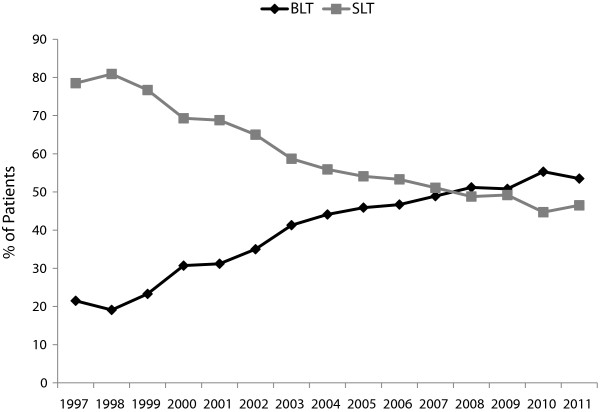
BACKGROUND: Idiopathic pulmonary fibrosis (IPF) is a distinct form of interstitial pneumonia with unknown origin and poor prognosis. Current pharmacologic treatments are limited and lung transplantation is a viable option for appropriate patients. The aim of this review was to summarize lung transplantation survival in IPF patients overall, between single (SLT) vs. bilateral lung transplantation (BLT), pre- and post Lung Allocation Score (LAS), and summarize wait-list survival. METHODS: A systematic review of English-language studies published in Medline or Embase between 1990 and 2013 was performed. Eligible studies were those of observational design reporting survival post-lung transplantation or while on the wait list among IPF patients. RESULTS: Median survival post-transplantation among IPF patients is estimated at 4.5 years. From ISHLT and OPTN data, one year survival ranged from 75% - 81%; 3-year: 59% - 64%; and 5-year: 47% - 53%. Post-transplant survival is lower for IPF vs. other underlying pre-transplant diagnoses. The proportion of IPF patients receiving BLT has steadily increased over the last decade and a half. Unadjusted analyses suggest improved long-term survival for BLT vs. SLT; after adjustment for patient characteristics, the differences tend to disappear. IPF patients account for the largest proportion of patients on the wait list and while wait list time has decreased, the number of transplants for IPF patients has increased over time. OPTN data show that wait list mortality is higher for IPF patients vs. other diagnoses. The proportion of IPF patients who died while awaiting transplantation ranged from 14% to 67%. While later transplant year was associated with increased survival, no significant differences were noted pre vs. post LAS implementation; however a high LAS vs low LAS was associated with decreased one-year survival. CONCLUSIONS: IPF accounts for the largest proportion of patients awaiting lung transplants, and IPF is associated with higher wait-list and post-transplant mortality vs. other diagnoses. Improved BLT vs. SLT survival may be the result of selection bias. Survival pre- vs. post LAS appears to be similar except for IPF patients with high LAS, who have lower survival compared to pre-LAS. Data on post-transplant morbidity outcomes are sparse.
Overview
CoChat Summary
TL;DR
This systematic review found that lung transplantation offers a survival benefit for IPF patients, but their post-transplant and wait-list mortality remain worse than for other diagnoses. Evidence suggested better unadjusted outcomes for bilateral over single lung transplantation, but those differences often disappeared after adjustment, pointing to likely selection bias.
Key findings
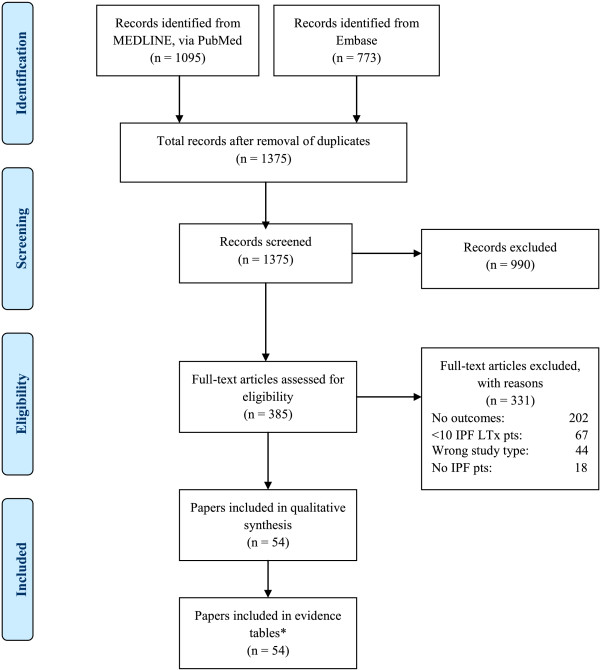
- The review included 54 publications; the literature search identified 1,375 citations, screened 385 full-text articles, and excluded 331 at full-text review.
- Among 8,528 IPF patients transplanted from 1990 to 2011 in ISHLT data, median survival was 4.5 years; survival was 75% at 1 year, 59% at 3 years, 47% at 5 years, and 24% at 10 years.
- In OPTN data, IPF patients’ 1-, 3-, and 5-year post-transplant survival ranged from 75%–81%, 59%–64%, and 47%–53%, respectively; post-transplant survival was lower for IPF than for CF, COPD, or alpha-1 antitrypsin deficiency.
- Wait-list burden was high: in 2011, IPF accounted for 46.1% of lung transplant wait-list patients in the US, and the proportion who died while waiting ranged from 14% to 67% across studies; OPTN wait-list mortality was higher for IPF than for other diagnoses.
- For BLT vs. SLT, unadjusted analyses often favored BLT: in one OPTN analysis of 3,830 IPF patients, mean survival was 8.34 years for BLT vs. 7.37 years for SLT, but after adjustment the difference was no longer statistically significant (HR 0.92, 95% CI 0.81–1.06).
Methods
- Systematic review of English-language observational studies in MEDLINE/EMBASE from 1990 to March 2013, supplemented by manual reference checking and data from ISHLT and OPTN websites.
- Included studies had to report on at least 10 IPF patients who underwent lung transplantation and report survival post-transplant or while waiting.
- The review extracted study-, patient-, and outcome-level data; one investigator extracted data and a second independently checked it for completeness and accuracy.
Limitations
- The paper states that data on post-transplant morbidity and resource use are sparse.
- The paper also states that a limitation is the lack of actual confirmation of IPF in most of the studies.
- Evident from the text: much of the evidence comes from observational studies, so comparisons such as BLT vs. SLT and pre- vs. post-LAS are vulnerable to selection bias and confounding, which the authors explicitly discuss.
Model-written summary. Check it against the paper before relying on it.
Integrity signals
Registry
Cites
Statistics
Figures
Verification
Claims the paper makes
6 Valid · 0 Not valid · 34 Not checked · 18 Own results and interpretations
Every source the paper cites for this claim was checked and supports it.
In the paper
“Long-term survival, conditional to surviving one-year, was also significantly (P < 0.0006) better for patients who received a BLT vs. SLT (12.08 years versus 6.8 years) [51].”
§ Lung transplantation in idiopathic pulmonary fibrosis: a systematic review of the literature > Results > Single vs. bilateral lung transplantation
What the sources say
- Supportedcites [51] Force SD Kilgo P Neujahr DC Pelaez A Pickens A Fernandez FG Miller DL Lawrence C Bilateral lung transplantation offers better long-term survival, compared with single-lung transplantation, for younger patients with idiopathic pulmonary fibrosis Ann Thorac Surg 2011 91 1 244 249 10.1016/j.athoracsur.2010.08.055 21172522 PMC3395073 source
The Results section (page not provided) reports significantly better long-term survival for BLT than SLT among patients alive at one year: 12.08 versus 6.8 years (p = 0.0006). (LLM, conf=0.95)
plainstates an associationn = 3,830 ·- Asserted: passes — The authors put it forward as true.
- Checkable: passes — It can be checked against evidence.
- Load-bearing: passes — The paper’s conclusions depend on it.
- Based: passes — The paper gives a reason why it holds.
- Supported
In the paper
“Data available via the OPTN web site demonstrated that long-term post-transplant survival among US IPF lung transplant recipients transplanted between 1997 – 2004 was lower (3-year: 57%; 5-year: 41%) [19].”
§ Lung transplantation in idiopathic pulmonary fibrosis: a systematic review of the literature > Results > Post-transplant survival
What the sources say
- Not matchedcites [19] OPTN data [ http://optn.transplant.hrsa.gov/latestData/rptData.asp]
Its entry has no title and year that we can search by.
boosted- Asserted: passes — The authors put it forward as true.
- Checkable: passes — It can be checked against evidence.
- Load-bearing: unclear — It is unclear whether the paper’s conclusions depend on it.
- Based: passes — The paper gives a reason why it holds.
- Not matched
In the paper
“However, the difference was not evident in an analysis restricted to 1,218 patients who had lung transplantation from 2002 onward (BLT: 5.0 years vs SLT: 4.6 years, P = 0.29).”
§ Lung transplantation in idiopathic pulmonary fibrosis: a systematic review of the literature > Results > Single vs. bilateral lung transplantation
What the sources say
- Not checked — no full text of the sourcecites [21] Thabut G Christie JD Ravaud P Castier Y Dauriat G Jebrak G Fournier M Leseche G Porcher R Mal H Survival after bilateral versus single-lung transplantation for idiopathic pulmonary fibrosis Ann Intern Med 2009 151 11 767 774 10.7326/0003-4819-151-11-200912010-00004 19949142 source
plainn = 1,218- Asserted: passes — The authors put it forward as true.
- Checkable: passes — It can be checked against evidence.
- Load-bearing: passes — The paper’s conclusions depend on it.
- Based: passes — The paper gives a reason why it holds.
In the paper
“From the 8,528 IPF patients transplanted from 1990 to 2011 and reported to the ISHLT, the median survival was 4.5 years [12].”
§ Lung transplantation in idiopathic pulmonary fibrosis: a systematic review of the literature > Results > Post-transplant survival
What the sources say
- Not matchedcites [12] Adult Lung Transplantation Statistics [ https://www.ishlt.org/registries/slides.asp?slides=heartLungRegistry]
Its entry has no title and year that we can search by.
plainn = 8,528- Asserted: passes — The authors put it forward as true.
- Checkable: passes — It can be checked against evidence.
- Load-bearing: passes — The paper’s conclusions depend on it.
- Based: passes — The paper gives a reason why it holds.
- Not matched
In the paper
“Another analysis of the OPTN data that included 3,327 IPF patients transplanted between 1997 and 2009 also found significantly (P < 0.001) longer median survival after BLT (5.2 years [95% CI, 4.3 to 6.7 years]) vs. SLT (3.8 years [95% CI, 3.6 to 4.1 years]) [21].”
§ Lung transplantation in idiopathic pulmonary fibrosis: a systematic review of the literature > Results > Single vs. bilateral lung transplantation
What the sources say
- Not checked — no full text of the sourcecites [21] Thabut G Christie JD Ravaud P Castier Y Dauriat G Jebrak G Fournier M Leseche G Porcher R Mal H Survival after bilateral versus single-lung transplantation for idiopathic pulmonary fibrosis Ann Intern Med 2009 151 11 767 774 10.7326/0003-4819-151-11-200912010-00004 19949142 source
plainstates an associationn = 3,327 ·- Asserted: passes — The authors put it forward as true.
- Checkable: passes — It can be checked against evidence.
- Load-bearing: passes — The paper’s conclusions depend on it.
- Based: passes — The paper gives a reason why it holds.
25 more claims
Create a free account to see all 58 claims and to verify the 8 references still open.
- Probably not a substantial claim. 10
- It may state two separate claims as one. 20
Self-check
Percentages, sums and reported differences re-computed from the paper’s own numbers.
Each contradiction between two passages listed here was confirmed by an independent check.
Rated minor: it would not touch a result — a value no result rests on, a p-value that stays on the same side of the significance level, or a conflict that is clerical, resolved elsewhere in the paper, or outside its own findings.
In the paper
§ Lung transplantation in idiopathic pulmonary fibrosis: a systematic review of the literature > Results > Post-transplant survival vs. wait list survival
“In 2011, patients with IPF accounted for the largest proportion (46.1%) of patients on the lung transplant wait-list in the US [19].”
§ Lung transplantation in idiopathic pulmonary fibrosis: a systematic review of the literature > Background
“Since the implementation of the LAS system in the US, the percentage of patients on the wait list with restrictive lung disease (i.e., IPF or re-transplants) has increased from 33.8% to 46.1% [11].”
Citations
Cites
Cochrane Handbook for Systematic Reviews of Interventions Version 5.0.1. The Cochrane Collaboration
Higgins, J. P. T., Green, S. R., & Higgins, J. P. T. (2008) · Cited by 7,259
Raghu, G., Collard, H. R., Egan, J. J., Martinez, F. J., Behr, J., Brown, K. K., Colby, T. V., Cordier, J.-F., Flaherty, K. R., Lasky, J. A., et al. (2011) · American Journal of Respiratory and Critical Care Medicine · doi:10.1164/rccm.2009-040gl · Cited by 7,186
J Heart Lung Transplant 2021;40(4).
(2021) · The Journal of Heart and Lung Transplantation · doi:10.1016/j.healun.2021.04.002 · Cited by 6,665
Efficacy and Safety of Nintedanib in Idiopathic Pulmonary Fibrosis
Richeldi, L., du Bois, R. M., Raghu, G., Azuma, A., Brown, K. K., Costabel, U., Cottin, V., Flaherty, K. R., Hansell, D. M., Inoue, Y., et al. (2014) · New England Journal of Medicine · doi:10.1056/nejmoa1402584 · Cited by 4,654
A phase 3 trial of pirfenidone in patients with idiopathic pulmonary fibrosis.
King, T. E., Bradford, W. Z., Castro-Bernardini, S., Fagan, E. A., Glaspole, I., Glassberg, M. K., Gorina, E., Hopkins, P. M., Kardatzke, D., Lancaster, L., et al. (2014) · New England Journal of Medicine · doi:10.1056/nejmoa1402582 · Cited by 3,975
Systematic Reviews: Synthesis of Best Evidence for Clinical Decisions
Cook, D. J., Mulrow, C. D., & Haynes, R. B. (1997) · Annals of Internal Medicine · doi:10.7326/0003-4819-126-5-199703010-00006 · Cited by 2,184 · cited 1×
“The methods used to perform this review involved both electronic and manual components, and followed established best methods used in the science of systematic review research [15-17].”
MethodIncidence and Prevalence of Idiopathic Pulmonary Fibrosis
Raghu, G., Weycker, D., Edelsberg, J., Bradford, W. Z., & Oster, G. (2006) · American Journal of Respiratory and Critical Care Medicine · doi:10.1164/rccm.200602-163oc · Cited by 1,310 · cited 1×
“Using a prevalence of 14–43 per 100,000 [73] and a US adult population of approximately 311 million in 2011 [74], less than 1% of the estimated 42,000–130,000 US IPF patients had received a lung transplant during 2011.”
BackgroundAcute Exacerbations of Idiopathic Pulmonary Fibrosis
Collard, H. R., Moore, B. B., Flaherty, K. R., Brown, K. K., Kaner, R. J., King, T. E., Lasky, J. A., Loyd, J. E., Noth, I., Olman, M. A., et al. (2007) · American Journal of Respiratory and Critical Care Medicine · doi:10.1164/rccm.200703-463pp · Cited by 1,130
Orens, J. B., Estenne, M., Arcasoy, S., Conte, J. V., Corris, P., Egan, J. J., Egan, T., Keshavjee, S., Knoop, C., Kotloff, R., et al. (2006) · The Journal of Heart and Lung Transplantation · doi:10.1016/j.healun.2006.03.011 · Cited by 1,073
Prognostic Significance of Histopathologic Subsets in Idiopathic Pulmonary Fibrosis
BJORAKER, J. A., RYU, J. H., EDWIN, M. K., MYERS, J. L., TAZELAAR, H. D., SCHROEDER, D. R., & OFFORD, K. P. (1998) · American Journal of Respiratory and Critical Care Medicine · doi:10.1164/ajrccm.157.1.9704130 · Cited by 1,039 · cited 1×
“The median survival time for patients with IPF is 2 to 3 years from diagnosis and the 5-year survival rate ranges between 30% and 50% [1,5-7].”
Background
Research works printed but not linked: 1
- Organ Procurement and Transplantation Network (OPTN) and Scientific Registry of Transplant Recipients (SRTR) OPTN/SRTR 2011 Annual Data Report 2012 Rockville, MD: Department of Health and Human Services, Health Resources and Services Administration, Healthcare Systems Bureau, Division of Transplantation
Cited by
Richeldi, L., Collard, H. R., & Jones, M. G. (2017) · The Lancet · doi:10.1016/s0140-6736(17)30866-8 · Cited by 2,020
Raghu, G., Rochwerg, B., Zhang, Y., Garcia, C. A. C., Azuma, A., Behr, J., Brozek, J. L., Collard, H. R., Cunningham, W., Homma, S., et al. (2015) · American Journal of Respiratory and Critical Care Medicine · doi:10.1164/rccm.201506-1063st · Cited by 1,916
Martinez, F. J., Collard, H. R., Pardo, A., Raghu, G., Richeldi, L., Selman, M., Swigris, J. J., Taniguchi, H., & Wells, A. U. (2017) · Nature Reviews Disease Primers · doi:10.1038/nrdp.2017.74 · Cited by 1,388
European IPF Patient Charter: unmet needs and a call to action for healthcare policymakers
Bonella, F., Wijsenbeek, M., Molina-Molina, M., Duck, A., Mele, R., Geissler, K., & Wuyts, W. (2016) · European Respiratory Journal · doi:10.1183/13993003.01204-2015 · Cited by 144
Idiopathic Pulmonary Fibrosis: Epidemiology, Natural History, Phenotypes
Sauleda, J., Núñez, B., Sala, E., & Soriano, J. B. (2018) · Medical Sciences · doi:10.3390/medsci6040110 · Cited by 137
“Whether bilateral is superior to single-lung transplantation in patients with IPF is still unclear, although observational studies and available databases suggest improved outcomes with bilateral transplantation [60].”
Quantitative Proteomics of Bronchoalveolar Lavage Fluid in Idiopathic Pulmonary Fibrosis
Foster, M. W., Morrison, L. D., Todd, J. L., Snyder, L. D., Thompson, J. W., Soderblom, E. J., Plonk, K., Weinhold, K. J., Townsend, R., Minnich, A., et al. (2015) · Journal of Proteome Research · doi:10.1021/pr501149m · Cited by 108
Ni, K., Liu, M., Zheng, J. H., Wen, L., Chen, Q., Xiang, Z., Lam, K.-T., Liu, Y., Chan, G., Lau, Y., et al. (2018) · American Journal of Respiratory Cell and Molecular Biology · doi:10.1165/rcmb.2017-0326oc · Cited by 111
“However, factors such as limited availability of donors, allogeneic graft rejection, complications resulting from prolonged immunosuppression, and organ deterioration after lung transplant all contribute to the high pre- and postoperative mortality rates (5).”
Raghu, G., Mouded, M., Chambers, D. C., Martinez, F. J., Richeldi, L., Lancaster, L. H., Hamblin, M. J., Gibson, K. F., Rosas, I. O., Prasse, A., et al. (2022) · American Journal of Respiratory and Critical Care Medicine · doi:10.1164/rccm.202112-2824oc · Cited by 100
Bing, P., Zhou, W., & Tan, S. (2022) · Frontiers in Pharmacology · doi:10.3389/fphar.2022.865065 · Cited by 108
“Except for lung transplantation, there is still a lack of very effective treatment drugs and methods (Kistler et al., 2014).”
BackgroundCurrent approaches to the management of idiopathic pulmonary fibrosis
Raghu, G., & Richeldi, L. (2017) · Respiratory Medicine · doi:10.1016/j.rmed.2017.05.017 · Cited by 90
Rivera‐Ortega, P., Hayton, C., Blaikley, J., Leonard, C. T., & Chaudhuri, N. (2018) · Therapeutic Advances in Respiratory Disease · doi:10.1177/1753466618800618 · Cited by 90
Gu, Y., Lawrence, T., Mohamed, R., Liang, Y., & Yahaya, B. H. (2022) · Frontiers in Immunology · doi:10.3389/fimmu.2022.923235 · Cited by 77
Delanote, I., Wuyts, W. A., Yserbyt, J., Verbeken, E. K., Verleden, G. M., & Vos, R. (2016) · BMC Pulmonary Medicine · doi:10.1186/s12890-016-0308-z · Cited by 65
“indication for LTx and reducing waiting list time for IPF in these countries [8].”
BackgroundLung transplantation in idiopathic pulmonary fibrosis
Kumar, A., Kapnadak, S. G., Girgis, R. E., & Raghu, G. (2018) · Expert Review of Respiratory Medicine · doi:10.1080/17476348.2018.1462704 · Cited by 76
Jiang, L., Wang, J., Ju, J., & Dai, J. (2020) · European Journal of Pharmacology · doi:10.1016/j.ejphar.2020.173352 · Cited by 58
Lung transplantation for pulmonary sarcoidosis. Twenty-five years of experience in the USA
Taimeh, Z. A., Hertz, M. I., Shumway, S. J., & PRITZKER, M. R. (2016) · Thorax · doi:10.1136/thoraxjnl-2015-207497 · Cited by 65
Checa, J., & Aran, J. M. (2020) · International Journal of Molecular Sciences · doi:10.3390/ijms21239317 · Cited by 61
When to start and when to stop antifibrotic therapies
Torrisi, S. E., Pavone, M., Vancheri, A., & Vancheri, C. (2017) · European Respiratory Review · doi:10.1183/16000617.0053-2017 · Cited by 56
Early clinical experiences with nintedanib in three UK tertiary interstitial lung disease centres
Toellner, H., Hughes, G., Beswick, W., Crooks, M. G., Donaldson, C., Forrest, I., Hart, S. P., Leonard, C. T., Major, M., Simpson, A. J., et al. (2017) · Clinical and Translational Medicine · doi:10.1186/s40169-017-0172-3 · Cited by 54
“This intervention is not available to a large proportion of this patient group [5].”
BackgroundVainshelboim, B., de Oliveira, J. J. F., Fox, B. D., & Kramer, M. R. (2016) · Respiratory Care · doi:10.4187/respcare.04471 · Cited by 56
Lung Transplantation in Idiopathic Pulmonary Fibrosis
Hernández, R. L., Pérez, M. A., Mt, L.-C., & Gil, P. U. (2018) · Medical Sciences · doi:10.3390/medsci6030068 · Cited by 68
“Despite the fact that the application of LAS has reduced the waiting time and increased the number of procedures for IPF, the mortality of these patients on the waiting list is still higher (14–67%) than that observed in other diagnostic groups [5].”
BackgroundLiu, Q., Bi, Y., Song, S., Zhu, K., Qiao, X., Wang, H., & Ji, G. (2023) · Stem Cell Research & Therapy · doi:10.1186/s13287-023-03449-7 · Cited by 53
“Lung transplantation is the optimal option for end-stage patients, but is limited by scarce donors [3, 4].”
BackgroundBilateral versus single lung transplantation: are two lungs better than one?
Subramanian, M. P., & Meyers, B. F. (2018) · Journal of Thoracic Disease · doi:10.21037/jtd.2018.06.56 · Cited by 55
“Median survival time for patients with IPF ranges from 2–3 years post diagnosis without lung transplantation, with 5-year post-transplant survival rates ranging from 30–50% (14,15).”
Therapeutic Approach to Adult Fibrotic Lung Diseases
Adegunsoye, A., & Strek, M. E. (2016) · CHEST Journal · doi:10.1016/j.chest.2016.07.027 · Cited by 52
“Although the proportion of patients with IPF receiving bilateral lung transplants has increased over the last decade, a systematic review evaluating posttransplant survival in IPF showed no difference in mortality between single and bilateral lung transplantation.(128) There is limited evidence regarding the use of ni…”
BackgroundEl‐Chemaly, S., O’Brien, K., Nathan, S. D., Weinhouse, G. L., Goldberg, H. J., Connors, J. M., Cui, Y., Astor, T. L., Camp, P. C., Rosas, I. O., et al. (2018) · PLoS ONE · doi:10.1371/journal.pone.0194193 · Cited by 49
“While the surgical outcome and survival of these 3 patients with HPS pulmonary fibrosis are similar to those in patients who undergo bilateral lung transplantation for idiopathic pulmonary fibrosis, further studies are needed to assess the clinical outcome of patients with HPS pulmonary fibrosis [30].”
BackgroundPergolizzi, J. V., LeQuang, J. A., Varrassi, M., Breve, F., Magnusson, P., & Varrassi, G. (2023) · Advances in Therapy · doi:10.1007/s12325-022-02395-9 · Cited by 47
“Even in appropriate candidates, the 5-year survival rate following lung transplantation in patients with IPF is approximately 50% [60].”
BackgroundMoideen, F. M., Shaikh, S. B., Jeena, T. M., & Bhandary, Y. P. (2021) · International Immunopharmacology · doi:10.1016/j.intimp.2021.107608 · Cited by 43
Yu, C., Chen, Z., Li, X., Bao, H., Wang, Y., Zhang, B., Huang, J., & Zhang, Z. (2021) · Small · doi:10.1002/smll.202101861 · Cited by 45
Alveolar macrophages drive lung fibroblast function in cocultures of IPF and normal patient samples
Novak, C. M., Sethuraman, S., Luikart, K. L., Reader, B. F., Wheat, J. S., Whitson, B. A., Ghadiali, S. N., & Ballinger, M. N. (2023) · American Journal of Physiology-Lung Cellular and Molecular Physiology · doi:10.1152/ajplung.00263.2022 · Cited by 45
Qiu, C., Zhao, Z., Xu, C., Yuan, R., Ha, Y., Tu, Q., Zhang, H., Mu, Z., Xin, Q., Tian, Y., et al. (2024) · Journal of Nanobiotechnology · doi:10.1186/s12951-024-02721-z · Cited by 46
“While lung transplantation is the most efficacious intervention for PF, its utility is hampered by the criticality of referral timing and diminished post-transplant survival rates [9, 10].”
BackgroundNintedanib for Idiopathic Pulmonary Fibrosis
Tepede, A. K., & Yogaratnam, D. (2017) · Journal of Pharmacy Practice · doi:10.1177/0897190017735242 · Cited by 40
“Median 5year survival rates after lung transplantation has been estimated to be 47% to 53%.(3) In a recent cohort study conducted in the United States, IPF was found to have a prevalence of 19.”
BackgroundXaubet, A., Ancochea, J., & Molina‐Molina, M. (2017) · Medicina Clínica (English Edition) · doi:10.1016/j.medcle.2016.11.035 · Cited by 45
Evaluation of Skeletal Muscle Function in Lung Transplant Candidates
Rozenberg, D., Singer, L. G., Herridge, M. S., Goldstein, R. S., Wickerson, L. M., Chowdhury, N., & Mathur, S. (2017) · Transplantation · doi:10.1097/tp.0000000000001754 · Cited by 40
Single and Double Lung Transplantation Have Equivalent Survival for Idiopathic Pulmonary Fibrosis
Ranganath, N. K., Malas, J., Phillips, K. G., Lesko, M. B., Smith, D. E., Angel, L. F., Lonze, B. E., & Kon, Z. N. (2019) · The Annals of Thoracic Surgery · doi:10.1016/j.athoracsur.2019.06.090 · Cited by 37
Xaubet, A., Ancochea, J., & Molina‐Molina, M. (2016) · Medicina Clínica · doi:10.1016/j.medcli.2016.11.004 · Cited by 41
Pulmonary hypertension in interstitial lung disease: screening, diagnosis and treatment
Behr, J., & Nathan, S. D. (2021) · Current Opinion in Pulmonary Medicine · doi:10.1097/mcp.0000000000000790 · Cited by 40
Treatment of idiopathic pulmonary fibrosis: a position paper from a Nordic expert group
Sköld, C. M., Bendstrup, E. M., Myllärniemi, M., Guðmundsson, G., Sjåheim, T., Hilberg, O., Altraja, A., Kaarteenaho, R. L., & Ferrara, G. (2016) · Journal of Internal Medicine · doi:10.1111/joim.12571 · Cited by 38
Cleemput, J. V., Sonaglioni, A., Wuyts, W. A., Bengus, M., Stauffer, J. L., & Harari, S. A. (2018) · Advances in Therapy · doi:10.1007/s12325-018-0857-z · Cited by 34
Zou, R. H., Nouraie, M. S., Chen, X., Saul, M. I., Kaminski, N., Gibson, K. F., Kass, D. J., & Lindell, K. O. (2019) · Journal of Palliative Medicine · doi:10.1089/jpm.2018.0400 · Cited by 33
Paglicci, L., Borgo, V., Lanzarone, N., Fabbiani, M., Cassol, C., Cusi, M. G., Valassina, M., Scolletta, S., Bargagli, E., Marchetti, L., et al. (2021) · European Journal of Clinical Microbiology & Infectious Diseases · doi:10.1007/s10096-021-04153-1 · Cited by 37
Wong, A. M., Lu, J., Dorfman, A., McInnis, P., Famouri, M., Manary, D., Lee, J. R. H., & Lynch, M. (2021) · Frontiers in Artificial Intelligence · doi:10.3389/frai.2021.764047 · Cited by 34
Identification and Validation of Aging-Related Genes in Idiopathic Pulmonary Fibrosis
He, J., & Li, X. (2022) · Frontiers in Genetics · doi:10.3389/fgene.2022.780010 · Cited by 41
“At present, the key treatment approaches for IPF are based mainly on the symptoms and have low therapeutic effects; the 5 year survival rate after diagnosis is less than 50%, and the median survival time is only 2–3 years (Kistler et al., 2014; Yoshihara et al., 2020).”
BackgroundValidation of the COPD Assessment Test (CAT) in patients with idiopathic pulmonary fibrosis
Grufstedt, H. K., Shaker, S. B., & Konradsen, H. (2018) · European Clinical Respiratory Journal · doi:10.1080/20018525.2018.1530028 · Cited by 29
“However, some patients experience an accelerated decline, with acute respiratory worsening and exacerbations [12,13].”
BackgroundIdiopathic pulmonary fibrosis: the turning point is now!
Funke, M., & Geiser, T. (2015) · Swiss Medical Weekly · doi:10.4414/smw.2015.14139 · Cited by 38
Lung transplantation for idiopathic pulmonary fibrosis
Pavec, J. L., Dauriat, G., Gazengel, P., Dolidon, S., Hanna, A., Feuillet, S., Pradère, P., Crutu, A., Florea, V., Boulate, D., et al. (2020) · La Presse Médicale · doi:10.1016/j.lpm.2020.104026 · Cited by 33
Evolution and treatment of idiopathic pulmonary fibrosis
Torrisi, S. E., Kahn, N. C., Vancheri, C., & Kreuter, M. (2020) · La Presse Médicale · doi:10.1016/j.lpm.2020.104025 · Cited by 29
An update on emerging drugs for the treatment of idiopathic pulmonary fibrosis
Aryal, S., & Nathan, S. D. (2018) · Expert Opinion on Emerging Drugs · doi:10.1080/14728214.2018.1471465 · Cited by 29
“5 years, which is shorter than the average survival after lung transplant in general [12].”
BackgroundNatural polysaccharides as potential anti-fibrotic agents: A review of their progress
Wang, M., Lu, S., Zhao, H., Liu, Z., Sheng, K., & Fang, J. (2022) · Life Sciences · doi:10.1016/j.lfs.2022.120953 · Cited by 29
Safety of nintedanib before lung transplant: an Italian case series
Balestro, E., Solidoro, P., Parigi, P., Boffini, M., Lucianetti, A., & Rea, F. (2018) · Respirology Case Reports · doi:10.1002/rcr2.312 · Cited by 25
“Waitlist mortality for IPF patients is higher than that of those with other diagnoses, probably due to the clinical behaviour and rapid progression of IPF compared with other diseases [18].”
BackgroundIdentification of Key Cost Generating Events for Idiopathic Pulmonary Fibrosis: A Systematic Review
Vaidya, S., Hibbert, C. L., Kinter, E. T., & Boes, S. (2016) · Lung · doi:10.1007/s00408-016-9960-6 · Cited by 23
Yang, X., Sun, W., Jing, X., Zhang, Q., Huang, H. F., & Xu, Z. (2022) · Respiratory Research · doi:10.1186/s12931-022-02012-x · Cited by 24
“However, because the pathogenic etiology of IPF is unknown, there is no viable treatment for end-stage cases other than lung transplantation [23, 24].”
BackgroundSingh, V., Singh, S., Sharma, B., Bairwa, M. L., Gothi, D., Desai, U. D., Joshi, J. M., Talwar, D., Singh, A., Dhar, R., et al. (2020) · Lung India · doi:10.4103/lungindia.lungindia_275_20 · Cited by 25
“Desirable effects Lung transplant is a viable option with proven survival benefits in selected patients with end stage fibrotic lung disease.[90]”
BackgroundLi, D., Liu, Y., & Wang, B. (2020) · PLoS ONE · doi:10.1371/journal.pone.0233732 · Cited by 25
“Given the shortage of donor lungs availability, it is crucial to understand whether there is a subgroup of IPF patients for whom DLT does offer a true survival advantage [32].”
BackgroundThe Spanish Lung Transplant Registry: First Report of Results (2006–2010)
Coll, E., Santos, F., Ussetti, P., Canela, M., Borro, J. M., de la Torre, M., Varela, A., Zurbano, F., Mons, R., Morales, P., et al. (2013) · Archivos de Bronconeumología · doi:10.1016/j.arbr.2013.01.002 · Cited by 26
Yuan, S., Zuo, B., Zhou, S., Wang, M., Tan, K.-Y., Chen, Z., & Cao, W.-F. (2023) · Drug Design Development and Therapy · doi:10.2147/dddt.s404710 · Cited by 22
“29 Although Pirfenidone and Nintedanib are approved by FDA to treat IPF, they do not significantly lower mortality.”
Ji, K., Jian-ling, M., Liangmin, W., Li, N., Dong, S., & Li-qing, S. (2020) · Evidence-based Complementary and Alternative Medicine · doi:10.1155/2020/1752387 · Cited by 22
“Besides pharmacological therapy, lung transplantation can prolong survival with a 5year survival of near 50% and improve quality of life of IPF patients [9].”
BackgroundTogami, K., Ogasawara, A., Irie, S., Iwata, K., Yamaguchi, K., Tada, H., & Chono, S. (2022) · European Journal of Pharmaceutics and Biopharmaceutics · doi:10.1016/j.ejpb.2022.02.009 · Cited by 19
Togami, K., Maruta, Y., Nanbu, M., Tada, H., & Chono, S. (2020) · Drug Development and Industrial Pharmacy · doi:10.1080/03639045.2020.1825473 · Cited by 19
Comorbidities, Complications and Non-Pharmacologic Treatment in Idiopathic Pulmonary Fibrosis
Millan‐Billi, P., Serra, C., Leon, A. A., & Castillo, D. (2018) · Medical Sciences · doi:10.3390/medsci6030059 · Cited by 25
“Since the implementation of LAS, a greater number of IPF patients received a lung transplant and the percentage of patients on the waiting list with restrictive lung disease has increased [74].”
BackgroundChen, Y., Li, M., Yang, J., Chen, Y., & Wang, J. (2025) · Stem Cell Research & Therapy · doi:10.1186/s13287-025-04490-4 · Cited by 26
“Lung transplantation, while the only curative option for end-stage PF, is constrained by donor shortages, and post-transplant immunosuppressive complications [9, 10].”
Antifibrotic drugs in lung transplantation and chronic lung allograft dysfunction: a review
Bos, S., Sadeleer, L. D., Vanstapel, A., Beeckmans, H., Sacreas, A., Yserbyt, J., Wuyts, W. A., & Vos, R. (2021) · European Respiratory Review · doi:10.1183/16000617.0050-2021 · Cited by 26
Intraoperative Extracorporeal Circulatory Support in Lung Transplantation for Pulmonary Fibrosis
Salman, J., Bernhard, B.-A., Ius, F., Poyanmehr, R., Sommer, W., Aburahma, K., Alhadidi, H., Siemeni, T., Kuehn, C., Avsar, M., et al. (2020) · The Annals of Thoracic Surgery · doi:10.1016/j.athoracsur.2020.06.083 · Cited by 16
Pulmonary fibrosis, part II: state-of-the-art patient management
Meyer, K. C. (2017) · Expert Review of Respiratory Medicine · doi:10.1080/17476348.2017.1312347 · Cited by 18
“Current recommendations [134] state that LTx referral should occur early rather than late in the disease course for patients with IPF or other forms of advanced/progressive PF (preferably at the time of diagnosis for advanced fibrosis), and waitlisted patients have a higher waitlist mortality than those with other tra…”
BackgroundKulkarni, T., Willoughby, J., Lara, M. D. P. A., et al. (2016) · Respiratory Medicine · doi:10.1016/j.rmed.2016.04.010 · Cited by 15
“The components included were [1]: visits to a specialized interstitial lung disease (ILD) Center with evaluation of pulmonary physiology at least every 6 months [2]; referral to pulmonary rehabilitation at least once a year [3]; timed walk test to screen for hypoxemia at least once a year [4]; echocardiogram (ECHO) at…”
Blandinières, A., Gille, T., Sadoine, J., Bièche, I., Slimani, L., Dizier, B., Gaussem, P., Chaussain, C., Planès, C., Dorfmüller, P., et al. (2018) · Stem Cell Reviews and Reports · doi:10.1007/s12015-018-9846-5 · Cited by 15
Recent advances in managing idiopathic pulmonary fibrosis
Scelfo, C., Caminati, A., & Harari, S. A. (2017) · F1000Research · doi:10.12688/f1000research.10720.1 · Cited by 15
Tanaka, S., Miyoshi, K., Higo, H., Kurosaki, T., Otani, S., Sugimoto, S., Yamane, M., Kiura, K., Toyooka, S., & Oto, T. (2018) · Respiratory Investigation · doi:10.1016/j.resinv.2018.12.002 · Cited by 15
A comprehensive and practical approach to the management of idiopathic pulmonary fibrosis
Moran‐Mendoza, O., Colman, R., Kalluri, M., Cabalteja, C., & Harle, I. A. (2019) · Expert Review of Respiratory Medicine · doi:10.1080/17476348.2019.1627204 · Cited by 15
“Many patients with IPF (14–67%) die after listing and before receiving a lung transplant due to shortage of donor organs [103].”
BackgroundSingle versus double lung transplantation for fibrotic disease—systematic review
Wilson‐Smith, A. R., Kim, Y. S., Evans, G. E., et al. (2020) · Annals of Cardiothoracic Surgery · doi:10.21037/acs.2019.12.04 · Cited by 14
“Given the heterogeneity of interstitial lung diseases, particularly in terms of their etiology and pathophysiology, substantive subgroup analysis to date has been hindered outside of registry findings, with patient outcomes highly variable within the literature (3).”
BackgroundDonno, M. D., Sorbo, A. D., & Micco, A. (2019) · Springer eBooks · doi:10.1007/978-3-030-26664-6_40 · Cited by 15
Jing, C., Fu, R., Liu, X., Zang, G., Zhu, X. L., Wang, C., & Zhang, W. Y. (2023) · Frontiers in Immunology · doi:10.3389/fimmu.2023.1268141 · Cited by 13
Lee, J.-H., Lim, C., Koh, Y., Hong, S., Song, J.-W., & Huh, J. W. (2020) · Journal of Thoracic Disease · doi:10.21037/jtd.2019.12.48 · Cited by 15
“J Thorac Dis 2020;12(3):966-972 | http://dx.”
Fakhro, M., Broberg, E., Algotsson, L., Hansson, L., Koul, B. L., Gustafsson, R., Wierup, P. N., Ingemansson, R., & Lindstedt, S. (2017) · Journal of Cardiothoracic Surgery · doi:10.1186/s13019-017-0666-5 · Cited by 11
“interstitial lung disease, in combination with Sweden having younger recipients [26].”
BackgroundJiang, H., Zhao, Y., Tang, H., Duan, S., Li, M., Yang, X., Liu, J., Lou, X., Cai, Y., Zhao, W., et al. (2021) · Pharmacological Research · doi:10.1016/j.phrs.2021.105923 · Cited by 12
An Overview of Herbal Medicines for Idiopathic Pulmonary Fibrosis
Murthy, P., Shaibie, N. A., Lim, C. L., Ling, A. P. K., Chye, S. M., & Koh, R. Y. (2022) · Processes · doi:10.3390/pr10061131 · Cited by 11
Selection of Candidates for Lung Transplantation and Controversial Issues
Merlo, C. A., & Orens, J. B. (2018) · Seminars in Respiratory and Critical Care Medicine · doi:10.1055/s-0037-1615796 · Cited by 11
Vainshelboim, B., Kramer, M. R., MYERS, J. N., Unterman, A., Izhakian, S., & de Oliveira, J. J. F. (2019) · Lung · doi:10.1007/s00408-018-0189-4 · Cited by 13
Sabater, L., Gossart, J. B., Hernandez, I., Rico, D., Blanchard, A. D., Borthwick, L. A., Fisher, A. J., Majo, J., Jiwa, K., Collins, A., et al. (2023) · American Journal Of Pathology · doi:10.1016/j.ajpath.2022.12.015 · Cited by 11
Tuyls, S., Verleden, S. E., Wuyts, W. A., Yserbyt, J., Vos, R., & Verleden, G. M. (2018) · Transplant International · doi:10.1111/tri.13382 · Cited by 10
“vival, rather than the presence of a true positive effect of SSLTx [46].”
BackgroundThe Effect of Blood Transfusion in Lung Donors on Recipient Survival
Said, S. A., Okamoto, T., Nowacki, A. S., Niikawa, H., Ayyat, K. S., Sakanoue, I., Yun, J. J., & McCurry, K. R. (2020) · The Annals of Thoracic Surgery · doi:10.1016/j.athoracsur.2020.10.027 · Cited by 9
Vainshelboim, B., MYERS, J. N., de Oliveira, J. J. F., Izhakian, S., Unterman, A., & Kramer, M. R. (2018) · Journal of Cardiopulmonary Rehabilitation and Prevention · doi:10.1097/hcr.0000000000000362 · Cited by 8
Pulmonary Fibrosis and Diabetes Mellitus: Two coins with the same face
Mendoza‐Marí, Y., Fraix, M. P., & Agrawal, D. K. (2024) · Archives of Internal Medicine Research · doi:10.26502/aimr.0165 · Cited by 16
“Lung transplantation is the only option that offers hope for long-term survival, but it is only available to very few individuals [9].”
BackgroundArmand, T. P. T., Mozumder, M. A. I., Carole, K. S., Deji-Oloruntoba, O. O., Kim, H.-C., & Ajakwe, S. O. (2024) · BioMedInformatics · doi:10.3390/biomedinformatics4030099 · Cited by 8
“In the worst cases where the patient’s lungs are severely damaged, a lung transplant is recommended to increase the patient’s lifetime [9].”
BackgroundClinical Trials in IPF: What Are the Best Endpoints?
Spagnolo, P., Cocconcelli, E., & Cottin, V. (2018) · Respiratory medicine · doi:10.1007/978-3-319-99975-3_19 · Cited by 9
NOVEL NANOPARTICULATE SYSTEMS FOR IDIOPATHIC PULMONARY FIBROSIS: A REVIEW
Dudhat, K. R., & Patel, H. V. (2020) · Asian Journal of Pharmaceutical and Clinical Research · doi:10.22159/ajpcr.2020.v13i11.39035 · Cited by 8
“The advisory group perceives the significance of recognizing patients with expanded hazard for mortality inside 2 years to incite thought for lung transplantation [16,32].”
BackgroundScar tissue to lung cancer; pathways and treatment
Sapalidis, K. G., Sardeli, C., Pavlidis, E. T., Koimtzis, G. D., Koulouris, C., Michalopoulos, N., Mantalovas, S., Tsiouda, T., Passos, I. D., Kosmidis, C. S., et al. (2019) · Journal of Cancer · doi:10.7150/jca.30300 · Cited by 6
“We have this information from patients who underwent double lung transplantation and pulmonary fibrosis occurred again.[87] There are possibly antibodies that attack the lung parenchyma.”
BackgroundAdult lung transplantation case-volume and in-hospital and long-term mortality in Korea
Yoon, S., Jang, E. J., Kim, G. H., Kim, D. H., Lim, T. Y., Lee, H., & Ryu, H. G. (2019) · Journal of Cardiothoracic Surgery · doi:10.1186/s13019-019-0849-3 · Cited by 7
Nonpharmacological interventions: rehabilitation, palliative care and transplantation
Kenn, K., Gloeckl, R., Heinzelmann, I., & Kneidinger, N. (2016) · European Respiratory Society eBooks · doi:10.1183/2312508x.10006315 · Cited by 6
Anti-Inflammatory Effects of Aptamin C in Pulmonary Fibrosis Induced by Bleomycin
Shin, S., Jo, H., Agura, T., Jeong, S., Ahn, H., Pang, S., Lee, J., Park, J.-H., Kim, Y., & Kang, J. S. (2024) · Pharmaceuticals · doi:10.3390/ph17121577 · Cited by 4
“In very advanced cases, lung transplantation may be the only treatment option, depending on the patient’s condition and eligibility for transplantation [22,23].”
Pre-anaesthetic evaluation of the patient with end-stage lung disease
Prabhu, M., & Valchanov, K. P. (2017) · Best practice & research. Clinical anaesthesiology · doi:10.1016/j.bpa.2017.05.002 · Cited by 4
Severe idiopathic pulmonary fibrosis: A clinical approach
Lipsi, R., Mazzola, D., Caminati, A., Elia, D., Lonati, C., & Harari, S. A. (2018) · European Journal of Internal Medicine · doi:10.1016/j.ejim.2018.01.014 · Cited by 5
Respiratory Disorders: Contemporary Issues in 2020
Jindal, S. K., & Jindal, A. (2022) · Springer eBooks · doi:10.1007/978-981-16-8845-4_8 · Cited by 5
Wong, A. M., Lu, J., Dorfman, A., et al. (2021) · Research Square · doi:10.21203/rs.3.rs-610010/v1 · Cited by 4
Herbal Remedies Effective on Treating Idiopathic Pulmonary Fibrosis
Chaudhary, A., Kumar, R., & Barti, H. (2024) · Journal of Pharmaceutical Care · doi:10.18502/jpc.v11i4.16021 · Cited by 2
Cardiac protection of wogonin in mice with pulmonary fibrosis by regulating Sirt1/ γ-H2AX pathway
Wang, L., Lin, F., Miao, R., Zhao, T., Liu, Y., Yang, L., & Zhang, M. (2025) · Frontiers in Pharmacology · doi:10.3389/fphar.2025.1551141 · Cited by 5
Chiba, H., & Takahashi, H. (2015) · Springer eBooks · doi:10.1007/978-4-431-55582-7_5 · Cited by 5
“To prompt consideration for lung transplantation, the importance of identifying patients with increased risk of mortality within 2 years has been mentioned [1, 6].”
BackgroundManzetti, G. M., Hosein, K., Cecchini, M. J., Kwan, K. F., Abdelrazek, M., Zompatori, M., Rogliani, P., & Mura, M. (2021) · BMC Pulmonary Medicine · doi:10.1186/s12890-021-01753-7 · Cited by 3
“Not surprisingly, LTx waitlist mortality is the highest among patients with IPF [35].”
BackgroundLung Transplant Type and Donor Age in Idiopathic Pulmonary Fibrosis: A Single Center Study
Ander, E. H., Kashem, A. M., Zhao, H., Montgomery, K., Sunagawa, G., Yanagida, R., Shigemura, N., & Toyoda, Y. (2021) · Journal of Surgical Research · doi:10.1016/j.jss.2021.10.027 · Cited by 3
Idiopathic pulmonary fibrosis in East Asian
Sun, C., Sun, Y., Shen, H., Yang, C., & Xu, S. (2017) · Intractable & Rare Diseases Research · doi:10.5582/irdr.2017.01014 · Cited by 3
“Post-transplant survival is lower for patients with IPF than for patients with other pre-transplant conditions, with a 5-year survival rate of about 50% internationally (17).”
BackgroundEmerging Therapeutic Targets and Therapies in Idiopathic Pulmonary Fibrosis
Parvathaneni, V., Shukla, S. K., & Gupta, V. (2018) · Molecular and translational medicine · doi:10.1007/978-3-319-98143-7_8 · Cited by 4
Metadata
- Authors
- Kistler, K. D., Nalysnyk, L., Rotella, P., & Esser, D.
- Affiliations
- Boehringer Ingelheim (Germany) (DE)
- Corresponding author
- Kistler, Kristin D
- ORCID
- Kistler, Kristin D
- Venue
- BMC Pulmonary Medicine
- Published
- 2014-08-16
- Volume
- 14
- Issue
- 1
- Pages
- 139-139
- ISSN
- 1471-2466 (ISSN-L)
- PMC
- PMC4151866
- OpenAlex
- W2039943389
- Cited by
- 151
- References
- 77
- Citations by year
- 2026: 4 · 2025: 6 · 2024: 16 · 2023: 8 · 2022: 13 · 2021: 15 · 2020: 13 · 2019: 13 · 2018: 25 · 2017: 18 · 2016: 11 · 2015: 7 · 2014: 1
- FWCI
- 2.33
- Type
- journal article
- Language
- en
- Open access
- gold
- doi.org
- Licence
- Locations
- BMC Pulmonary Medicine (publishedVersion, cc-by)
- PubMed Central (publishedVersion, cc-by)
- PubMed (publishedVersion)
- Topics
- Health Sciences › Medicine › Surgery › Transplantation: Methods and Outcomes
- Health Sciences › Medicine › Pulmonary and Respiratory Medicine › Interstitial Lung Diseases and Idiopathic Pulmonary Fibrosis
- Health Sciences › Medicine › Pulmonary and Respiratory Medicine › Occupational and environmental lung diseases
- Keywords
- idiopathic pulmonary fibrosis, lung transplantation, bilateral lung transplantation, single lung transplantation, lung allocation score, waitlist mortality, post-transplant survival, interstitial lung disease, OPTN registry, ISHLT registry
- MeSH terms
- Graft Survival, Humans, Waiting Lists, Survival Rate, Lung Transplantation, Idiopathic Pulmonary Fibrosis, Patient Acuity
About these checks
Registry, retraction, Cites and statistics results are computed, not judged, with one exception: a printed reference that no index lists is read once by a model before it counts as a citation error. Claims are extracted by a model and kept only when their quote appears verbatim in the text; each cited source is then checked, with a model’s help, for whether it says what the claim relies on. Those verdicts can be wrong — read the claim’s quote and the cited source before relying on one.
The claim verdicts this report counts are experimental: their accuracy is not yet measured.
A language model drew the claims from the paper on 2026-10-10, under version 3 of the claim definition (model deepseek-v4.1-flash, prompt extract-v3).
A second model labelled each claim on 2026-10-10 (model jev-1.13-20260917, definition revision gold-guideline-v0.2).
Cited sources are checked with a language model’s help (gpt-6-sol).
Statistics and arithmetic are recomputed, not judged.
Confidence bands are shown only for fields calibrated on our annotated test set. None is calibrated yet, so no band is shown.
What counts as a claim ›How we measure confidence ›How we check this ›
Are you an author, or do you see a problem with this page? Request a review
Data sources
Bibliographic data: Semantic Scholar, OpenAlex, Crossref.
Contains information from the Semantic Scholar Academic Graph Datasets, made available under the ODC Attribution License (ODC-BY 1.0).
Semantic Scholar’s data is described in: Kinney, R., et al. (2023). The Semantic Scholar Open Data Platform. arXiv:2301.10140.
