

Lung transplantation in idiopathic pulmonary fibrosis: a systematic review of the literature
Open accessThe DOI matches its Crossref record; 76 of the 77 references it cites were found in a registry or an index; 8 of the 54 sources its claims cite were checked for support.
Abstract
BACKGROUND: Idiopathic pulmonary fibrosis (IPF) is a distinct form of interstitial pneumonia with unknown origin and poor prognosis. Current pharmacologic treatments are limited and lung transplantation is a viable option for appropriate patients. The aim of this review was to summarize lung transplantation survival in IPF patients overall, between single (SLT) vs. bilateral lung transplantation (BLT), pre- and post Lung Allocation Score (LAS), and summarize wait-list survival. METHODS: A systematic review of English-language studies published in Medline or Embase between 1990 and 2013 was performed. Eligible studies were those of observational design reporting survival post-lung transplantation or while on the wait list among IPF patients. RESULTS: Median survival post-transplantation among IPF patients is estimated at 4.5 years. From ISHLT and OPTN data, one year survival ranged from 75% - 81%; 3-year: 59% - 64%; and 5-year: 47% - 53%. Post-transplant survival is lower for IPF vs. other underlying pre-transplant diagnoses. The proportion of IPF patients receiving BLT has steadily increased over the last decade and a half. Unadjusted analyses suggest improved long-term survival for BLT vs. SLT; after adjustment for patient characteristics, the differences tend to disappear. IPF patients account for the largest proportion of patients on the wait list and while wait list time has decreased, the number of transplants for IPF patients has increased over time. OPTN data show that wait list mortality is higher for IPF patients vs. other diagnoses. The proportion of IPF patients who died while awaiting transplantation ranged from 14% to 67%. While later transplant year was associated with increased survival, no significant differences were noted pre vs. post LAS implementation; however a high LAS vs low LAS was associated with decreased one-year survival. CONCLUSIONS: IPF accounts for the largest proportion of patients awaiting lung transplants, and IPF is associated with higher wait-list and post-transplant mortality vs. other diagnoses. Improved BLT vs. SLT survival may be the result of selection bias. Survival pre- vs. post LAS appears to be similar except for IPF patients with high LAS, who have lower survival compared to pre-LAS. Data on post-transplant morbidity outcomes are sparse.
Overview
CoChat Summary
TL;DR
This systematic review found that lung transplantation offers a survival benefit for IPF patients, but their post-transplant and wait-list mortality remain worse than for other diagnoses. Evidence suggested better unadjusted outcomes for bilateral over single lung transplantation, but those differences often disappeared after adjustment, pointing to likely selection bias.
Key findings
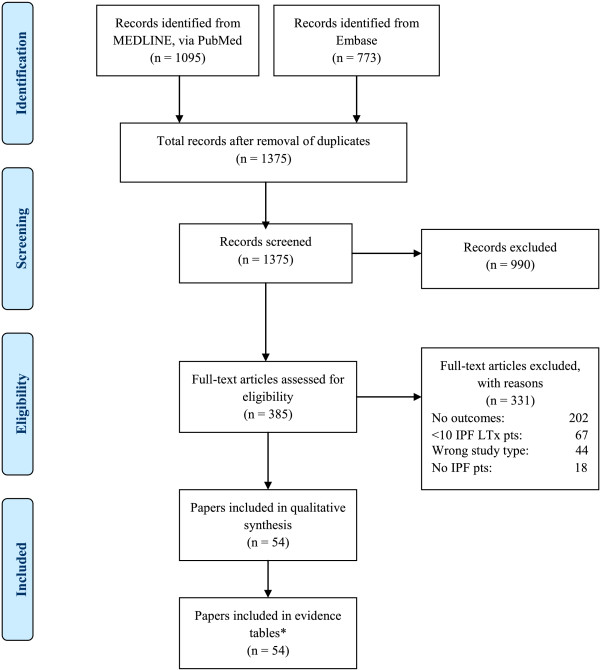
- The review included 54 publications; the literature search identified 1,375 citations, screened 385 full-text articles, and excluded 331 at full-text review.
- Among 8,528 IPF patients transplanted from 1990 to 2011 in ISHLT data, median survival was 4.5 years; survival was 75% at 1 year, 59% at 3 years, 47% at 5 years, and 24% at 10 years.
- In OPTN data, IPF patients’ 1-, 3-, and 5-year post-transplant survival ranged from 75%–81%, 59%–64%, and 47%–53%, respectively; post-transplant survival was lower for IPF than for CF, COPD, or alpha-1 antitrypsin deficiency.
- Wait-list burden was high: in 2011, IPF accounted for 46.1% of lung transplant wait-list patients in the US, and the proportion who died while waiting ranged from 14% to 67% across studies; OPTN wait-list mortality was higher for IPF than for other diagnoses.
- For BLT vs. SLT, unadjusted analyses often favored BLT: in one OPTN analysis of 3,830 IPF patients, mean survival was 8.34 years for BLT vs. 7.37 years for SLT, but after adjustment the difference was no longer statistically significant (HR 0.92, 95% CI 0.81–1.06).
Methods
- Systematic review of English-language observational studies in MEDLINE/EMBASE from 1990 to March 2013, supplemented by manual reference checking and data from ISHLT and OPTN websites.
- Included studies had to report on at least 10 IPF patients who underwent lung transplantation and report survival post-transplant or while waiting.
- The review extracted study-, patient-, and outcome-level data; one investigator extracted data and a second independently checked it for completeness and accuracy.
Limitations
- The paper states that data on post-transplant morbidity and resource use are sparse.
- The paper also states that a limitation is the lack of actual confirmation of IPF in most of the studies.
- Evident from the text: much of the evidence comes from observational studies, so comparisons such as BLT vs. SLT and pre- vs. post-LAS are vulnerable to selection bias and confounding, which the authors explicitly discuss.
Model-written summary. Check it against the paper before relying on it.
Integrity signals
Registry
Cites
Statistics
Figures
Verification
Claims the paper makes
6 Valid · 0 Not valid · 34 Not checked · 18 Own results and interpretations
Every source the paper cites for this claim was checked and supports it.
In the paper
“Long-term survival, conditional to surviving one-year, was also significantly (P < 0.0006) better for patients who received a BLT vs. SLT (12.08 years versus 6.8 years) [51].”
§ Lung transplantation in idiopathic pulmonary fibrosis: a systematic review of the literature > Results > Single vs. bilateral lung transplantation
What the sources say
- Supportedcites [51] Force SD Kilgo P Neujahr DC Pelaez A Pickens A Fernandez FG Miller DL Lawrence C Bilateral lung transplantation offers better long-term survival, compared with single-lung transplantation, for younger patients with idiopathic pulmonary fibrosis Ann Thorac Surg 2011 91 1 244 249 10.1016/j.athoracsur.2010.08.055 21172522 PMC3395073 source
The Results section (page not provided) reports significantly better long-term survival for BLT than SLT among patients alive at one year: 12.08 versus 6.8 years (p = 0.0006). (LLM, conf=0.95)
plainstates an associationn = 3,830 ·- Asserted: passes — The authors put it forward as true.
- Checkable: passes — It can be checked against evidence.
- Load-bearing: passes — The paper’s conclusions depend on it.
- Based: passes — The paper gives a reason why it holds.
- Supported
In the paper
“Data available via the OPTN web site demonstrated that long-term post-transplant survival among US IPF lung transplant recipients transplanted between 1997 – 2004 was lower (3-year: 57%; 5-year: 41%) [19].”
§ Lung transplantation in idiopathic pulmonary fibrosis: a systematic review of the literature > Results > Post-transplant survival
What the sources say
- Not matchedcites [19] OPTN data [ http://optn.transplant.hrsa.gov/latestData/rptData.asp]
Its entry has no title and year that we can search by.
boosted- Asserted: passes — The authors put it forward as true.
- Checkable: passes — It can be checked against evidence.
- Load-bearing: unclear — It is unclear whether the paper’s conclusions depend on it.
- Based: passes — The paper gives a reason why it holds.
- Not matched
In the paper
“However, the difference was not evident in an analysis restricted to 1,218 patients who had lung transplantation from 2002 onward (BLT: 5.0 years vs SLT: 4.6 years, P = 0.29).”
§ Lung transplantation in idiopathic pulmonary fibrosis: a systematic review of the literature > Results > Single vs. bilateral lung transplantation
What the sources say
- Not checked — no full text of the sourcecites [21] Thabut G Christie JD Ravaud P Castier Y Dauriat G Jebrak G Fournier M Leseche G Porcher R Mal H Survival after bilateral versus single-lung transplantation for idiopathic pulmonary fibrosis Ann Intern Med 2009 151 11 767 774 10.7326/0003-4819-151-11-200912010-00004 19949142 source
plainn = 1,218- Asserted: passes — The authors put it forward as true.
- Checkable: passes — It can be checked against evidence.
- Load-bearing: passes — The paper’s conclusions depend on it.
- Based: passes — The paper gives a reason why it holds.
In the paper
“From the 8,528 IPF patients transplanted from 1990 to 2011 and reported to the ISHLT, the median survival was 4.5 years [12].”
§ Lung transplantation in idiopathic pulmonary fibrosis: a systematic review of the literature > Results > Post-transplant survival
What the sources say
- Not matchedcites [12] Adult Lung Transplantation Statistics [ https://www.ishlt.org/registries/slides.asp?slides=heartLungRegistry]
Its entry has no title and year that we can search by.
plainn = 8,528- Asserted: passes — The authors put it forward as true.
- Checkable: passes — It can be checked against evidence.
- Load-bearing: passes — The paper’s conclusions depend on it.
- Based: passes — The paper gives a reason why it holds.
- Not matched
In the paper
“Another analysis of the OPTN data that included 3,327 IPF patients transplanted between 1997 and 2009 also found significantly (P < 0.001) longer median survival after BLT (5.2 years [95% CI, 4.3 to 6.7 years]) vs. SLT (3.8 years [95% CI, 3.6 to 4.1 years]) [21].”
§ Lung transplantation in idiopathic pulmonary fibrosis: a systematic review of the literature > Results > Single vs. bilateral lung transplantation
What the sources say
- Not checked — no full text of the sourcecites [21] Thabut G Christie JD Ravaud P Castier Y Dauriat G Jebrak G Fournier M Leseche G Porcher R Mal H Survival after bilateral versus single-lung transplantation for idiopathic pulmonary fibrosis Ann Intern Med 2009 151 11 767 774 10.7326/0003-4819-151-11-200912010-00004 19949142 source
plainstates an associationn = 3,327 ·- Asserted: passes — The authors put it forward as true.
- Checkable: passes — It can be checked against evidence.
- Load-bearing: passes — The paper’s conclusions depend on it.
- Based: passes — The paper gives a reason why it holds.
25 more claims
Create a free account to see all 58 claims and to verify the 8 references still open.
- Probably not a substantial claim. 10
- It may state two separate claims as one. 20
Self-check
Percentages, sums and reported differences re-computed from the paper’s own numbers.
Each contradiction between two passages listed here was confirmed by an independent check.
Rated minor: it would not touch a result — a value no result rests on, a p-value that stays on the same side of the significance level, or a conflict that is clerical, resolved elsewhere in the paper, or outside its own findings.
In the paper
§ Lung transplantation in idiopathic pulmonary fibrosis: a systematic review of the literature > Results > Post-transplant survival vs. wait list survival
“In 2011, patients with IPF accounted for the largest proportion (46.1%) of patients on the lung transplant wait-list in the US [19].”
§ Lung transplantation in idiopathic pulmonary fibrosis: a systematic review of the literature > Background
“Since the implementation of the LAS system in the US, the percentage of patients on the wait list with restrictive lung disease (i.e., IPF or re-transplants) has increased from 33.8% to 46.1% [11].”
Citations
Cites
Cochrane Handbook for Systematic Reviews of Interventions Version 5.0.1. The Cochrane Collaboration
Higgins, J. P. T., Green, S. R., & Higgins, J. P. T. (2008) · Cited by 7,261
Raghu, G., Collard, H. R., Egan, J. J., Martinez, F. J., Behr, J., Brown, K. K., Colby, T. V., Cordier, J.-F., Flaherty, K. R., Lasky, J. A., et al. (2011) · American Journal of Respiratory and Critical Care Medicine · doi:10.1164/rccm.2009-040gl · Cited by 7,186
J Heart Lung Transplant 2021;40(4).
(2021) · The Journal of Heart and Lung Transplantation · doi:10.1016/j.healun.2021.04.002 · Cited by 6,665
Efficacy and Safety of Nintedanib in Idiopathic Pulmonary Fibrosis
Richeldi, L., du Bois, R. M., Raghu, G., Azuma, A., Brown, K. K., Costabel, U., Cottin, V., Flaherty, K. R., Hansell, D. M., Inoue, Y., et al. (2014) · New England Journal of Medicine · doi:10.1056/nejmoa1402584 · Cited by 4,654
A phase 3 trial of pirfenidone in patients with idiopathic pulmonary fibrosis.
King, T. E., Bradford, W. Z., Castro-Bernardini, S., Fagan, E. A., Glaspole, I., Glassberg, M. K., Gorina, E., Hopkins, P. M., Kardatzke, D., Lancaster, L., et al. (2014) · New England Journal of Medicine · doi:10.1056/nejmoa1402582 · Cited by 3,975
Systematic Reviews: Synthesis of Best Evidence for Clinical Decisions
Cook, D. J., Mulrow, C. D., & Haynes, R. B. (1997) · Annals of Internal Medicine · doi:10.7326/0003-4819-126-5-199703010-00006 · Cited by 2,184 · cited 1×
“The methods used to perform this review involved both electronic and manual components, and followed established best methods used in the science of systematic review research [15-17].”
MethodIncidence and Prevalence of Idiopathic Pulmonary Fibrosis
Raghu, G., Weycker, D., Edelsberg, J., Bradford, W. Z., & Oster, G. (2006) · American Journal of Respiratory and Critical Care Medicine · doi:10.1164/rccm.200602-163oc · Cited by 1,310 · cited 1×
“Using a prevalence of 14–43 per 100,000 [73] and a US adult population of approximately 311 million in 2011 [74], less than 1% of the estimated 42,000–130,000 US IPF patients had received a lung transplant during 2011.”
BackgroundAcute Exacerbations of Idiopathic Pulmonary Fibrosis
Collard, H. R., Moore, B. B., Flaherty, K. R., Brown, K. K., Kaner, R. J., King, T. E., Lasky, J. A., Loyd, J. E., Noth, I., Olman, M. A., et al. (2007) · American Journal of Respiratory and Critical Care Medicine · doi:10.1164/rccm.200703-463pp · Cited by 1,130
Orens, J. B., Estenne, M., Arcasoy, S., Conte, J. V., Corris, P., Egan, J. J., Egan, T., Keshavjee, S., Knoop, C., Kotloff, R., et al. (2006) · The Journal of Heart and Lung Transplantation · doi:10.1016/j.healun.2006.03.011 · Cited by 1,073
Prognostic Significance of Histopathologic Subsets in Idiopathic Pulmonary Fibrosis
BJORAKER, J. A., RYU, J. H., EDWIN, M. K., MYERS, J. L., TAZELAAR, H. D., SCHROEDER, D. R., & OFFORD, K. P. (1998) · American Journal of Respiratory and Critical Care Medicine · doi:10.1164/ajrccm.157.1.9704130 · Cited by 1,039 · cited 1×
“The median survival time for patients with IPF is 2 to 3 years from diagnosis and the 5-year survival rate ranges between 30% and 50% [1,5-7].”
Background
Research works printed but not linked: 1
- Organ Procurement and Transplantation Network (OPTN) and Scientific Registry of Transplant Recipients (SRTR) OPTN/SRTR 2011 Annual Data Report 2012 Rockville, MD: Department of Health and Human Services, Health Resources and Services Administration, Healthcare Systems Bureau, Division of Transplantation
Cited by
Items 101–139 of 139
Smallwood, N., & Goh, N. S. L. (2021) · doi:10.1093/med/9780198821328.003.0090 · Cited by 2
Mathur, T., & Singh, I. (2023) · Current Drug Research Reviews · doi:10.2174/0125899775269970231218100959 · Cited by 3
Ho, R. S., Souza, C., Oliveira, C., Lisondo, C., & Alves, M. R. (2017) · Jornal Brasileiro de Economia da Saúde · doi:10.21115/jbes.v9.suppl1.89-95 · Cited by 3
Dartsch, R. C., Fink, L., Breithecker, A., Markart, P., Tello, S., Seeger, W., & Günther, A. (2019) · Der Internist · doi:10.1007/s00108-019-0571-1 · Cited by 2
Akute Exazerbation der idiopathischen Lungenfibrose
Polke, M., Kahn, N. C., & Kreuter, M. (2021) · Pneumologie · doi:10.1055/a-1273-4105 · Cited by 2
“[51] Kistler KD, Nalysnyk L, Rotella P et al.”
BackgroundMethodIdiopathic Interstitial Pneumonias
Barış, S. A., Başyiğit, İ., & Nathan, S. D. (2023) · Springer eBooks · doi:10.1007/978-3-031-22483-6_88-1 · Cited by 1
All in the Family: Role for Precision Medicine in Screening and Disease Course Prediction
Pearmain, L., Callum, J., Stanel, S. C., & Rivera‐Ortega, P. (2025) · Respiratory medicine · doi:10.1007/978-3-031-87183-2_2 · Cited by 1
Primer Consenso Mexicano sobre Fibrosis Pulmonar Idiopática
Mejía, M. E., Buendía-Roldán, I., Mateos‐Toledo, H., Estrada, A., Espinoza-Hernández, M., Juárez-Hernández, F., Vargas-Domínguez, C., & Selman, M. (2016) · NCT Neumología y Cirugía de Tórax · doi:10.35366/65161 · Cited by 8
Real-World Comprehensive Disease Management of Patients With Idiopathic Pulmonary Fibrosis
Mason, W. R., McLaughlin, S., Dedopoulos, S., Mahoney, E., Meadows, T., Stauffer, J. L., & LANCASTER, L. H. (2019) · Current Respiratory Medicine Reviews · doi:10.2174/1573398x15666190212155051 · Cited by 1
Lung Transplant for Interstitial Lung Diseases
Nokes, B. T., Golts, E. M., & Afshar, K. (2019) · IntechOpen eBooks · doi:10.5772/intechopen.82722 · Cited by 2
Long-Term Impact of Coronary Artery Disease in Lung Transplantation
Ragalie, W. S., de OLIVEIRA, C., Cornwell, R. D., Meyer, K., & Maloney, J. D. (2019) · Journal of Cardiology and Cardiovascular Medicine · doi:10.29328/journal.jccm.1001073 · Cited by 1
Lung Transplantation for Idiopathic Pulmonary Fibrosis: A Narrative Review
Mehfooz, N., Siraj, F., & Koul, P. A. (2021) · Indian Journal of Respiratory Care · doi:10.4103/ijrc.ijrc_18_20 · Cited by 1
Lung transplantation from past to future
Mehfooz, N., & Kaul, P. (2022) · Egyptian Journal of Chest Diseases and Tuberculosis · doi:10.4103/ecdt.ecdt_6_20 · Cited by 1
Progress in the Diagnosis and Treatment of Idiopathic Pulmonary Fibrosis
Schwartz, R. S., & Glassberg, M. K. (2016) · touchREVIEWS in Respiratory & Pulmonary Diseases · doi:10.17925/usrpd.2016.01.01.22 · Cited by 1
Management of patients with combined pulmonary fibrosis and emphysema
Triantafillidou, C. (2015) · Shortness of Breath · doi:10.11138/sob/2015.4.1.014
“IPF accounts for the largest proportion of patients awaiting lung transplants and is associated with higher waiting-list and post-transplant mortality compared with other diseases (16).”
BackgroundIndicaciones de trasplante pulmonar según patología de base
María Teresa Parada, C., & L, C. S. (2015) · Revista chilena de enfermedades respiratorias · doi:10.4067/s0717-73482015000400005
María Teresa Parada, C., Joel Melo, T., L, C. S., David Lazo, P., S, V. L., R, E. V., Clavero, J. M., C, M. L., Cristina Herzog, O., Lorena Calabrán, R., et al. (2015) · Revista chilena de enfermedades respiratorias · doi:10.4067/s0717-73482015000400002 · Cited by 1
Raghu, G., Rochwerg, B. N., Zhang, Y., Cuello‐García, C. A., Azuma, A., Behr, J., Brożek, J., Collard, H. R., Cunningham, W., Homma, S. A., et al. (2017) · Advances in respiratory medicine · doi:10.5603/arm.50373
“Kolejna metaanaliza została opublikowana po spotkaniu komisji wytycznych i dlatego nie została uwzględniona, chociaż wyniki przedstawione w tej pracy przeglądowej były zgodne z poprzednimi badaniami i nie zmieniłyby ogólnego wniosku [62].”
BackgroundMałaczyńska-Rajpold, K. (2017) · Cardiology Journal · doi:10.5603/cj.2017.0095
Murillo, D. A., Cerezo, F., Gauman, H. D., et al. (2018) · Transplantation Proceedings · doi:10.1016/j.transproceed.2017.09.049
Pretransplant Considerations in Patients with Pulmonary Fibrosis
Carbone, R. G., Monselise, A., Wille, K. M., Bottino, G., & Puppo, F. (2018) · Springer eBooks · doi:10.1007/978-3-319-91184-7_4
Diffuse Parenchymal Lung Diseases in the Elderly
Walsh, S. M., & O'Regan, A. W. (2018) · Current Geriatrics Reports · doi:10.1007/s13670-018-0249-x
Surgical Approaches: Tricks of the Trade
Dhital, K. K., & Kawanishi, Y. (2018) · Springer eBooks · doi:10.1007/978-3-319-90933-2_2
Lung Transplantation for Interstitial Lung Disease
Malouf, M. A. (2018) · Springer eBooks · doi:10.1007/978-3-319-90933-2_12
Taugt bei akut exazerbierter idiopathischer Lungenfibrose der Kortisonstoß noch?
Polke, M., & Kreuter, M. (2018) · Pneumo News · doi:10.1007/s15033-018-0817-y
Interstitial Lung Disease in Systemic Sclerosis: Lessons Learned from Idiopathic Pulmonary Fibrosis
Chung, A., English, J., & Volkmann, E. R. (2019) · Current Treatment Options in Rheumatology · doi:10.1007/s40674-019-00121-1
Dartsch, R. C., Fink, L., Breithecker, A., Markart, P., Tello, S., Seeger, W., & Günther, A. (2019) · Der Internist
Mäkelä, K. (2021) · Helda - University of Helsinki Institutional Repository
Sun, F., Wu, Z., Jiang, F., Huang, M., Wang, J., Sun, W., & Zhang, L. (2021) · Research Square · doi:10.21203/rs.3.rs-772721/v1
Yang, Y., Xu, X., Liu, M., Zhao, Y., Yu, Y., Liu, X., Chen, C., Jiang, G., & He, W. (2022) · Frontiers of Medicine · doi:10.1007/s11684-021-0899-5
Singh, H., Jankharia, B. G., Singh, S., Dhar, R., Gothi, D., Behera, D., Hadda, V., Talwar, D., Pilania, K., Desai, U. D., et al. (2022) · The Indian Journal of Chest Diseases and Allied Sciences · doi:10.5005/ijcdas-62-2-73
Jones, B. M., Walsh, A., & Bishop, K. (2024) · Physiotherapy Theory and Practice · doi:10.1080/09593985.2024.2343046
“Lung transplantation is considered an accepted treatment option for patients with chronic end-stage lung disorders including IPF (Kistler, Nalysnyk, Rotella, and Esser, 2014).”
Lung Transplantation Outcomes in Candidates Aged ≥ 70 Years Old: A 10-Year Single Center Experience
Aubrey, J. M., Thorp, S., Lawson, C., Pokora, I., Weissman, C. R., Pamidighantam, P., Zimmer, T., Chen, C., Chicotka, S. R., Girgis, R. E., et al. (2025) · JHLT Open · doi:10.1016/j.healun.2025.02.396
Uncovering an antifibrotic Prrx1-lineage mesenchymal cell subpopulation in fibrotic lungs
Homps-Legrand, M., Jaillet, M., Deneuville, L., Gautier, G., Crestani, B., & Mailleux, A. (2025) · Disease Models & Mechanisms · doi:10.1242/dmm.052179 · Cited by 1
“IPF is characterized by the reactivation of developmental pathways (SHH, Wnt, Notch and TGF-β ) and downstream TFs [ETV (ETV4/5), β -catenin, GLI and SMADs, respectively] (Chilosi et al., 2003; Cigna et al., 2012; Froidure et al., 2020; Zhang et al., 2017; Zhao et al., 2002).”
InfluentialTóth, N. M., Kramer, M. R., Šterclová, M., Müller, V., Lewandowska, K. B., Moğulkoç, N., Hájková, M., Studnicka, M., Tekavec-Trkanjec, J., Dimić-Janjić, S., et al. (2025) · Biomedicines · doi:10.3390/biomedicines13112684
“As the post-transplant median survival in IPF is estimated to be around 4.5 years [16], most of these countries use lower age limits as a relative contraindication for transplant.”
InfluentialChéhère, B. (2017) · theses.fr (ABES) · doi:10.70675/8dd0e9c7z1a2dz4994zb913z5f359264b7c3
“De nos jours, la greffe est le seul traitement permettant une augmentation significative de la survie des patients atteints de FPI (Thabut et al. 2009; Ten Klooster et al. 2015) avec une médiane de survie post-transplantation pulmonaire de 4,5 ans (Kistler et al. 2014). iv.”
BackgroundMesenchymal stem cells and extracellular vesicles in lung regeneration
Melo, M. M., Santos, R. T., & Silva, J. D. (2026) · Elsevier eBooks · doi:10.1016/b978-0-443-45056-3.00004-2
Zhu, Y., Ke, Z., Zhang, T., Sun, S. X., & Fan, X. Q. (2026) · Journal of Clinical Medicine · doi:10.3390/jcm15135124
“Consequently, the accurate identification of elderly patients at high risk for early mortality is imperative for timely transplant referral, which is crucial for improving clinical outcomes [13].”
Youssef, S. B., Trabelsi, A., Boudiaf, K., & Jebali, N. (2026) · Journal of Medical Sciences and Interdisciplinary Research · doi:10.51847/aytcetox5x
Metadata
- Authors
- Kistler, K. D., Nalysnyk, L., Rotella, P., & Esser, D.
- Affiliations
- Boehringer Ingelheim (Germany) (DE)
- Corresponding author
- Kistler, Kristin D
- ORCID
- Kistler, Kristin D
- Venue
- BMC Pulmonary Medicine
- Published
- 2014-08-16
- Volume
- 14
- Issue
- 1
- Pages
- 139-139
- ISSN
- 1471-2466 (ISSN-L)
- PMC
- PMC4151866
- OpenAlex
- W2039943389
- Semantic Scholar
- 045aac60abf7f250b493cbc72ba162823edec37a
- Cited by
- 151
- References
- 77
- Citations by year
- 2026: 4 · 2025: 6 · 2024: 16 · 2023: 8 · 2022: 13 · 2021: 15 · 2020: 13 · 2019: 13 · 2018: 25 · 2017: 18 · 2016: 11 · 2015: 7 · 2014: 1
- FWCI
- 2.33
- Type
- journal article
- Language
- en
- Open access
- gold
- doi.org
- Licence
- Locations
- BMC Pulmonary Medicine (publishedVersion, cc-by)
- PubMed Central (publishedVersion, cc-by)
- PubMed (publishedVersion)
- Topics
- Health Sciences › Medicine › Surgery › Transplantation: Methods and Outcomes
- Health Sciences › Medicine › Pulmonary and Respiratory Medicine › Interstitial Lung Diseases and Idiopathic Pulmonary Fibrosis
- Health Sciences › Medicine › Pulmonary and Respiratory Medicine › Occupational and environmental lung diseases
- Keywords
- idiopathic pulmonary fibrosis, lung transplantation, bilateral lung transplantation, single lung transplantation, lung allocation score, waitlist mortality, post-transplant survival, interstitial lung disease, OPTN registry, ISHLT registry
- MeSH terms
- Graft Survival, Humans, Waiting Lists, Survival Rate, Lung Transplantation, Idiopathic Pulmonary Fibrosis, Patient Acuity
About these checks
Registry, retraction, Cites and statistics results are computed, not judged, with one exception: a printed reference that no index lists is read once by a model before it counts as a citation error. Claims are extracted by a model and kept only when their quote appears verbatim in the text; each cited source is then checked, with a model’s help, for whether it says what the claim relies on. Those verdicts can be wrong — read the claim’s quote and the cited source before relying on one.
The claim verdicts this report counts are experimental: their accuracy is not yet measured.
A language model drew the claims from the paper on 2026-10-10, under version 3 of the claim definition (model deepseek-v4.1-flash, prompt extract-v3).
A second model labelled each claim on 2026-10-10 (model jev-1.13-20260917, definition revision gold-guideline-v0.2).
Cited sources are checked with a language model’s help (gpt-6-sol).
Statistics and arithmetic are recomputed, not judged.
Confidence bands are shown only for fields calibrated on our annotated test set. None is calibrated yet, so no band is shown.
What counts as a claim ›How we measure confidence ›How we check this ›
Are you an author, or do you see a problem with this page? Request a review
Data sources
Bibliographic data: Semantic Scholar, OpenAlex, Crossref.
Contains information from the Semantic Scholar Academic Graph Datasets, made available under the ODC Attribution License (ODC-BY 1.0).
Semantic Scholar’s data is described in: Kinney, R., et al. (2023). The Semantic Scholar Open Data Platform. arXiv:2301.10140.
