

Comparative transfection of DNA into primary and transformed mammalian cells from different lineages
Open accessThe DOI matches its Crossref record; 37 of the 37 references it cites were found in a registry or an index; none of the 37 sources its claims cite is checked for support yet.
Abstract
Background: The delivery of DNA into human cells has been the basis of advances in the understanding of gene function and the development of genetic therapies. Numerous chemical and physical approaches have been used to deliver the DNA, but their efficacy has been variable and is highly dependent on the cell type to be transfected. Results: Studies were undertaken to evaluate and compare the transfection efficacy of several chemical reagents to that of the electroporation/nucleofection system using both adherent cells (primary and transformed airway epithelial cells and primary fibroblasts as well as embryonic stem cells) and cells in suspension (primary hematopoietic stem/progenitor cells and lymphoblasts). With the exception of HEK 293 cell transfection, nucleofection proved to be less toxic and more efficient at effectively delivering DNA into the cells as determined by cell proliferation and GFP expression, respectively. Lipofectamine and nucleofection of HEK 293 were essentially equivalent in terms of toxicity and efficiency. Transient transfection efficiency in all the cell systems ranged from 40%-90%, with minimal toxicity and no apparent species specificity. Differences in efficiency and toxicity were cell type/system specific. Conclusions: In general, the Amaxa electroporation/nucleofection system appears superior to other chemical systems. However, there are cell-type and species specific differences that need to be evaluated empirically to optimize the conditions for transfection efficiency and cell survival.
Overview
CoChat Summary
TL;DR
This study compared Amaxa nucleofection with four chemical transfection reagents (Effectene, Lipofectamine 2000, Lipofectamine Plus, PEI) for delivering a GFP reporter plasmid into primary and transformed mammalian cells from human, pig, rabbit, and mouse lineages. Nucleofection was generally more efficient and less toxic, except in HEK 293 cells where Lipofectamine and nucleofection were essentially equivalent.
Key findings
- Across all cell systems, transient transfection efficiency ranged from 40%–90%, with minimal toxicity and no apparent species specificity; differences in efficiency and toxicity were cell type/system specific.
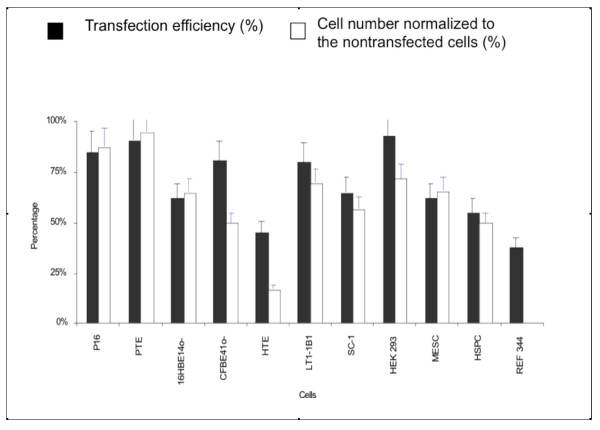
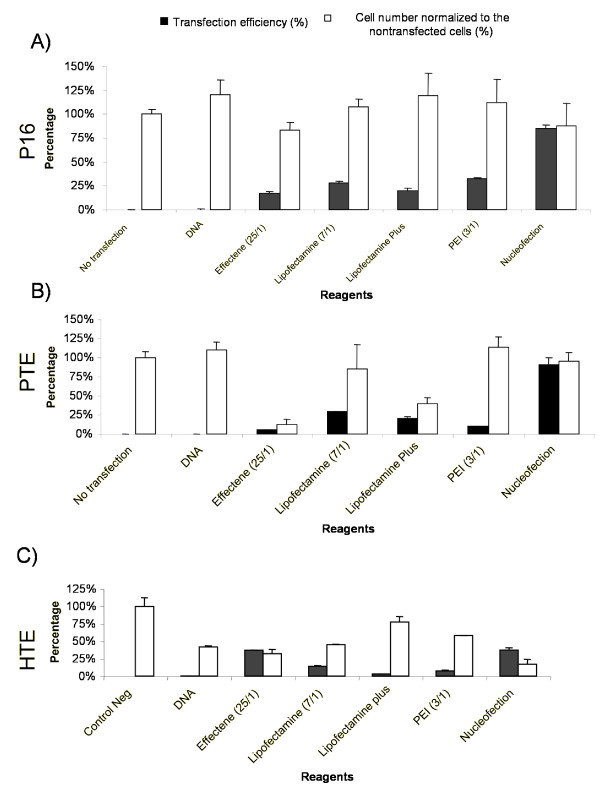
- Nucleofection outperformed chemical reagents in most direct comparisons: pig fetal fibroblasts (P16) 85% vs 18–32%; pig tracheal epithelial (PTE) 90% vs 5–30%; human tracheal epithelial (HTE) 45% vs 3–37% (Figure 2). In Figure 1, P16 nucleofection gave 90% GFP and 5% cytotoxicity; PTE gave 90% and 5% cytotoxicity; HTE gave 47% efficiency with 83% cytotoxicity (17% viability).
- Nucleofection efficiencies/viabilities for other cells: REF 38% GFP; 16HBE14o- 65% efficiency/62% viability; CFBE41o- 81%/50%; HSPC 55%/50%; lymphoblasts 75%/80%; MESC 62%/66%; HEK 293 93%/72%.
- HEK 293 was the exception: Lipofectamine 2000 gave 98% efficiency and 67% viability, Lipofectamine Plus 82% and 80% viability, comparable to nucleofection (93% efficiency, 72% viability).
Methods
- Compared nucleofection to Effectene, Lipofectamine 2000, Lipofectamine Plus, and PEI using pmaxGFP plasmid in adherent primary/transformed airway epithelial cells, primary fibroblasts, embryonic stem cells, and suspension hematopoietic stem/progenitor cells and lymphoblasts from human, pig, rabbit, and mouse.
- Nucleofection used 1–2×10^6 cells in 100 µl buffer with 2 µg pmaxGFP and cell-type-specific Amaxa programs/buffers (Table 1); chemical transfections used 3–5×10^5 cells/well with 2 µg pmaxGFP and tested reagent/DNA ratios.
- Transfection efficiency (GFP expression) and viability/cytotoxicity were assessed 48 h post-transfection by flow cytometry; adherent cells counted if attached, suspension cells stained with propidium iodide; experiments in triplicate, repeated 2–3 times, SEM n=3.
Limitations
- Stated: additional studies are needed to determine whether nucleofection efficiency and viability can be further enhanced; the reason for HTE vs PTE differences is uncertain, possibly passage/differentiation, and species-specific factors, cell age, and density need empirical optimization.
- Evident: comparisons used a single reporter plasmid (pmaxGFP) and a limited set of cell types and reagents; chemical comparisons used only optimal reagent/DNA ratios, and some supporting data are unpublished/not shown (e.g., MESC chemical transfection, Lipofectamine Plus HEK 293 data).
- Evident: no mechanistic explanation for nucleofection superiority, no long-term stable expression or functional/therapeutic outcome data, and efficiency/viability measured only at 48 h post-transfection.
Model-written summary. Check it against the paper before relying on it.
Integrity signals
Registry
Cites
Statistics
Figures
Verification
Claims the paper makes
0 Valid · 0 Not valid · 13 Not checked · 66 Own results and interpretations
A result the paper reports from its own data — it cites no other source for it, so there is none to check. The quote shows it is in the paper.
In the paper
“The 16HBE14o- cells showed a 62% viability and 65% transfection efficiency, while transfection of the CFBE41o- cells gave 81% expression efficiency at 50% viability (Figure 1).”
§ Comparative transfection of DNA into primary and transformed mammalian cells from different lineages > Results > Nucleofection
plain- Asserted: passes — The authors put it forward as true.
- Checkable: passes — It can be checked against evidence.
- Load-bearing: unclear — It is unclear whether the paper’s conclusions depend on it.
- Based: passes — The paper gives a reason why it holds.
- Rests on an assumption not shown here.
A result the paper reports from its own data — it cites no other source for it, so there is none to check. The quote shows it is in the paper.
In the paper
“Program U-20 was the most effective and resulted in a 90% efficiency of GFP expression and 5% cytotoxicity (Figure 1).”
§ Comparative transfection of DNA into primary and transformed mammalian cells from different lineages > Results > Nucleofection
plainstates a causen = 3- Asserted: passes — The authors put it forward as true.
- Checkable: passes — It can be checked against evidence.
- Load-bearing: unclear — It is unclear whether the paper’s conclusions depend on it.
- Based: passes — The paper gives a reason why it holds.
- Rests on an assumption not shown here.
A result the paper reports from its own data — it cites no other source for it, so there is none to check. The quote shows it is in the paper.
In the paper
“Transient transfection efficiency in all the cell systems ranged from 40%-90%, with minimal toxicity and no apparent species specificity.”
§ Comparative transfection of DNA into primary and transformed mammalian cells from different lineages > Abstract > Results
hedged- Asserted: passes — The authors put it forward as true.
- Checkable: passes — It can be checked against evidence.
- Load-bearing: unclear — It is unclear whether the paper’s conclusions depend on it.
- Based: passes — The paper gives a reason why it holds.
A result the paper reports from its own data — it cites no other source for it, so there is none to check. The quote shows it is in the paper.
In the paper
“The optimal transfection efficiency was achieved using program T-20 and the Amaxa Basic Epithelial Cell buffer and resulted in 47% expression efficiency and 83% cytotoxicity (17% viability) (Figure 1, Table 1).”
§ Comparative transfection of DNA into primary and transformed mammalian cells from different lineages > Results > Nucleofection
plainstates a cause- Asserted: passes — The authors put it forward as true.
- Checkable: passes — It can be checked against evidence.
- Load-bearing: passes — The paper’s conclusions depend on it.
- Based: passes — The paper gives a reason why it holds.
51 more claims
Create a free account to see all 79 claims and to verify the 36 references still open.
- It may state two separate claims as one. 13
- Probably not a substantial claim. 12
Claims other papers make about this one
Each is checked against this paper’s own text: does it say what the citing paper says it does?
In the citing paper
“Nonetheless, the two major drawbacks of DNA-based transient transfection are the inability to carefully control the expression level of the foreign construct even by using weak versus strong promoters [10] and, for most cell lines, the inability to reach up to 95% of transfected cells [11].”
From The Prodigious Potential of mRNA Electrotransfer as a Substitute to Conventional DNA-Based Transient Transfection (2023) · cites this paper as [11]
Self-check
Percentages, sums and reported differences re-computed from the paper’s own numbers.
Each contradiction between two passages listed here was confirmed by an independent check.
Rated minor: it would not touch a result — a value no result rests on, a p-value that stays on the same side of the significance level, or a conflict that is clerical, resolved elsewhere in the paper, or outside its own findings.
In the paper
§ Comparative transfection of DNA into primary and transformed mammalian cells from different lineages > Background
“a number of primary and immortalized cell systems in three different mammalian species (human, rabbit, and pig)”
§ Comparative transfection of DNA into primary and transformed mammalian cells from different lineages > Methods > Nucleofection
“| Mouse | MESC | Transgenic mouse embryonic stem cells (βS-globin mutant) | A-24 | Mouse ES cell |”
Rated minor: it would not touch a result — a value no result rests on, a p-value that stays on the same side of the significance level, or a conflict that is clerical, resolved elsewhere in the paper, or outside its own findings.
In the paper
§ Comparative transfection of DNA into primary and transformed mammalian cells from different lineages > Discussion
“Primary human airway epithelial cells were difficult to transfect even by nucleofection (45%) when compared to the PTE (95%).”
§ Comparative transfection of DNA into primary and transformed mammalian cells from different lineages > Results > Nucleofection
“Nucleofection of primary pig tracheal epithelial (PTE) cells under the same conditions, i.e., using the same buffer and program, gave a transfection efficiency of 90%. The 5% cytotoxicity (95% viability) of the transfected PTE cells detected 48 h after transfection”
Rated minor: it would not touch a result — a value no result rests on, a p-value that stays on the same side of the significance level, or a conflict that is clerical, resolved elsewhere in the paper, or outside its own findings.
In the paper
§ Comparative transfection of DNA into primary and transformed mammalian cells from different lineages > Discussion
“Greater than 95% of the P16 cells expressed GFP following nucleofection”
§ Comparative transfection of DNA into primary and transformed mammalian cells from different lineages > Results > Nucleofection
“Program U-20 was the most effective and resulted in a 90% efficiency of GFP expression and 5% cytotoxicity (Figure 1).”
Rated minor: it would not touch a result — a value no result rests on, a p-value that stays on the same side of the significance level, or a conflict that is clerical, resolved elsewhere in the paper, or outside its own findings.
In the paper
§ Comparative transfection of DNA into primary and transformed mammalian cells from different lineages > Abstract > Results
“with minimal toxicity and no apparent species specificity.”
§ Comparative transfection of DNA into primary and transformed mammalian cells from different lineages > Abstract > Conclusions
“However, there are cell-type and species specific differences that need to be evaluated empirically to optimize the conditions for transfection efficiency and cell survival.”
Rated minor: it would not touch a result — a value no result rests on, a p-value that stays on the same side of the significance level, or a conflict that is clerical, resolved elsewhere in the paper, or outside its own findings.
In the paper
§ Comparative transfection of DNA into primary and transformed mammalian cells from different lineages > Methods > Nucleofection
“| Human | 16HBE41o- | Immortalized Human Bronchial Epithelial cell Line (WT) | O-17 | V |”
§ Comparative transfection of DNA into primary and transformed mammalian cells from different lineages > Results > Nucleofection
“Normal, 16HBE14o- [16], and CF, CFBE41o- [17-20], cell lines were optimally transfected with buffer V and program O-17 (Table 1).”
Citations
Cites
Characteristics of a human cell line transformed by DNA from human adenovirus type 5
Graham, F. L., Russell, W. C., Smiley, J., & Nairn, R. (1977) · Journal of General Virology · doi:10.1099/0022-1317-36-1-59 · Cited by 4,793 · cited 1×
“Immortalized human bronchial epithelial cells (16HBE14o- [16,17] and CFBE41o- [18-20]) cells and the adenovirus 5 immortalized human embryo kidney cell line, HEK 293 [21], (American Type Tissue Culture Collection, Manassas, VA) were grown on tissue culture plastic coated with an extra-cellular matrix cocktail comprise…”
MethodMulti-Organ, Multi-Lineage Engraftment by a Single Bone Marrow-Derived Stem Cell
Krause, D. S., Theise, N. D., Collector, M. I., Henegariu, O., Hwang, S., Gardner, R., Neutzel, S., & Sharkis, S. J. (2001) · Cell · doi:10.1016/s0092-8674(01)00328-2 · Cited by 2,667 · cited 1×
“Hematopoietic stem/progenitor cells (HSPCs) are attractive targets for gene delivery and therapy because of their potential for self-renewal and multilineage differentiation [29,30].”
BackgroundEnhanced gene delivery and mechanism studies with a novel series of cationic lipid formulations.
Felgner, J. H., Kumar, R., Sridhar, C. N., Wheeler, C. J., Tsai, Y. J., Border, R., Ramsey, P., Martin, M., & Felgner, P. L. (1994) · Journal of Biological Chemistry · doi:10.1016/s0021-9258(17)41980-6 · Cited by 1,312 · cited 1×
“Previous studies indicated that the ratio of DNA to lipid is an important variable that determines the efficiency of transfection and the cellular toxicity [1,13].”
BackgroundElectric field-mediated fusion and related electrical phenomena
Zimmermann, U. (1982) · Biochimica et Biophysica Acta (BBA) - Reviews on Biomembranes · doi:10.1016/0304-4157(82)90007-7 · Cited by 1,012 · cited 1×
“One of the most effective and accessible physical transfection methods, electroporation (also known as electrotransfer, electropermeabilization, or nucleofection), involves the application of brief electric pulses to cells or tissues to increase the permeability of cells to macromolecules [1,4].”
BackgroundCFTR expression and chloride secretion in polarized immortal human bronchial epithelial cells.
Cozens, A. L., Yezzi, M. J., Kunzelmann, K., Ohrui, T., Chin, L., Eng, K., Finkbeiner, W. E., Widdicombe, J. H., & Gruenert, D. C. (1994) · American Journal of Respiratory Cell and Molecular Biology · doi:10.1165/ajrcmb.10.1.7507342 · Cited by 929 · cited 2×
“Normal, 16HBE14o[16], and CF, CFBE41o- [17-20], cell lines were optimally transfected with buffer V and program O-17 (Table 1).”
MethodSelf-citationPlasticity of marrow-derived stem cells
Herzog, E. L., Chai, L., & Krause, D. S. (2003) · Blood · doi:10.1182/blood-2003-05-1664 · Cited by 830
Cloned rabbits produced by nuclear transfer from adult somatic cells
Chesné, P., Adenot, P. G., Viglietta, C., Baratte, M., Boulanger, L., & Renard, J.-P. (2002) · Nature Biotechnology · doi:10.1038/nbt0402-366 · Cited by 558 · cited 1×
“The development of somatic cell nuclear transfer using fetal fibroblast as donor cells has played a central role in the cloning of animals such as the pig and the rabbit [14,35-37].”
BackgroundCulture and transformation of human airway epithelial cells
Gruenert, D. C., Finkbeiner, W. E., & Widdicombe, J. H. (1995) · American Journal of Physiology-Lung Cellular and Molecular Physiology · doi:10.1152/ajplung.1995.268.3.l347 · Cited by 293 · cited 1×
“Immortalized bronchial epithelial cells [26-28] were studied, because they are routinely used as models of cystic fibrosis (CF) and airway disease.”
Self-citationNew non-viral method for gene transfer into primary cells
Gresch, O. (2004) · Methods · doi:10.1016/j.ymeth.2003.11.009 · Cited by 253 · cited 1×
“The development of a novel electroporation system by AMAXA has shown considerable promise as a system for delivering DNA to a broad range of cell lines and cell systems that grow either as adherent monolayers or in suspension [7,31-34].”
BackgroundKues, W. A., Anger, M., Carnwath, J. W., Paul, D., Motlik, J., & Niemann, H. (2000) · Biology of Reproduction · doi:10.1095/biolreprod62.2.412 · Cited by 226 · cited 1×
“The ability to generate transgenic animals through somatic cell nuclear transfer (SCNT) has opened up many possibilities for the study of disease and the development of therapies [25].”
Background
Research works printed but not linked: 1
- Gruenert DC Differentiated properties of human epithelial cells trnsformed in vitro BioTechniques 1987 5 740 749
Cited by
Items 101–200 of 228
Non-viral transfection methods optimized for gene delivery to a lung cancer cell line.
(2013) · Europe PMC (PubMed Central) · Cited by 12
Gene delivery into Siberian sturgeon cell lines by commercial transfection reagents
Lee, J. H., Lee, S. T., Nam, Y. K., & Gong, S. P. (2019) · In Vitro Cellular & Developmental Biology - Animal · doi:10.1007/s11626-018-00316-1 · Cited by 12
Arun, S., Vanisree, A. J., & Ravisankar, S. (2016) · Brain Research · doi:10.1016/j.brainres.2016.04.061 · Cited by 12
Saponin and fluorine-modified polycation as a versatile gene delivery system
Hasanzadeh, A., Vahabi, A. H., Hooshmand, S. E., Hosseini, E. S., Azar, B. K. Y., Kiani, J., Saeedi, S., Shahbazi, A., Rudra, A., Hamblin, M. R., et al. (2022) · Nanotechnology · doi:10.1088/1361-6528/ac842d · Cited by 11
Nimsanor, N., Phetfong, J., Kitiyanant, N., Kamprom, W., & Supokawej, A. (2019) · BioScience Trends · doi:10.5582/bst.2019.01191 · Cited by 11
Schneberger, D., Cloonan, D. J., DeVasure, J. M., Bailey, K. L., Romberger, D. J., & Wyatt, T. A. (2015) · International Immunopharmacology · doi:10.1016/j.intimp.2015.04.031 · Cited by 11
Fang, S., Tang, N., Li, Y., Guo, S., Chen, Y., Wang, X., Li, X., Hu, Y., Hao, J., Wu, J., et al. (2026) · Nature Biomedical Engineering · doi:10.1038/s41551-026-01671-1 · Cited by 11
Sultana, A., & Kumar, R. (2022) · Journal of Drug Delivery Science and Technology · doi:10.1016/j.jddst.2022.103159 · Cited by 11
NIR-Triggered siRNA Release and Lysosomal Escape for Synergistic Photothermal Tumor Therapy
Baldan, M., Zhang, S., Sun, Q., Su, Y., Mei, D., Sun, R., Zheng, A., Liu, D., Zhang, J., Huo, R., et al. (2025) · International Journal of Nanomedicine · doi:10.2147/ijn.s511655 · Cited by 11
Gene Therapy of Malignant Solid Tumors by Targeting erbB2 Receptors and by Activating T Cells
Hu, W., Chen, R., Yu, K., Shen, L., Wang, C., Su, S.-Z., Sui, W.-J., Shan, D., & Li, H. (2012) · Cancer Biotherapy and Radiopharmaceuticals · doi:10.1089/cbr.2012.1246 · Cited by 11
Identification of Aptamers That Bind to Sickle Hemoglobin and Inhibit Its Polymerization
Purvis, S. H., Keefer, J. R., Fortenberry, Y. M., Barron‐Casella, E. A., & Casella, J. F. (2017) · Nucleic Acid Therapeutics · doi:10.1089/nat.2016.0646 · Cited by 10
Chastagnier, L., Marquette, C. A., & Petiot, E. (2023) · Biotechnology Advances · doi:10.1016/j.biotechadv.2023.108211 · Cited by 10
Optimization of precision nanofiber micelleplexes for DNA delivery
Street, S. T. G., Parkin, H. C., Shopperly, L. K., Chrenek, J., Letwin, K., Willerth, S. M., & Manners, I. (2023) · Biomaterials Science · doi:10.1039/d2bm02014a · Cited by 9
An efficient low cost means of biophysical gene transfection in primary cells
Huang, S., Henderson, T. R., Soeandy, C. D., Lezhanska, A., & Henderson, J. T. (2024) · Scientific Reports · doi:10.1038/s41598-024-62996-y · Cited by 9
Factors affecting rAAV titers during triple-plasmid transient transfection in HEK-293 cells
Pistek, M., Andorfer, P., Grabherr, R. M., Kraus, B., & Bort, J. A. H. (2024) · Biotechnology Letters · doi:10.1007/s10529-024-03520-0 · Cited by 9
Мима, К. А., Burmakina, G. S., Titov, I. A., & Malogolovkin, A. S. (2015) · Sel skokhozyaistvennaya Biologiya · doi:10.15389/agrobiology.2015.6.785eng · Cited by 9
Transient Gene Expression‐Based Protein Production in Recombinant Mammalian Cells
Lee, J., Hansen, H. G., Park, S., Park, J., & Kim, Y. (2019) · Wiley eBooks · doi:10.1002/9783527811410.ch3 · Cited by 8
Reberšek, M., Kandušer, M., & Miklavčič, D. (2011) · Radiology and Oncology · doi:10.2478/v10019-011-0025-4 · Cited by 8
Tales from an academic RNAi screening facility; FAQs
Jiang, M., Instrell, R., Saunders, B., Berven, H., & Howell, M. T. (2011) · Briefings in Functional Genomics · doi:10.1093/bfgp/elr016 · Cited by 7
Punetha, M., Saini, S., Choudhary, S., Sharma, S., Bala, R., Kumar, P., Sharma, R. K., Yadav, P., Datta, T. K., & Kumar, D. (2024) · Theriogenology · doi:10.1016/j.theriogenology.2024.08.027 · Cited by 7
Engineered Human Adipose-Derived Stem Cells Inducing Endothelial Lineage and Angiogenic Response
Ajit, A., Kumar, T. R. S., & Krishnan, L. K. (2019) · Tissue Engineering Part C Methods · doi:10.1089/ten.tec.2018.0333 · Cited by 7
Xiao, L. (2016) · Pain Physician · doi:10.36076/ppj/2019.19.189 · Cited by 7
Juncker, T., Chatton, B., & Donzeau, M. (2023) · Cells · doi:10.3390/cells12121591 · Cited by 6
Becerra, N., Gómez, C. M. A., Vargas, M. I. P., Charris, J.-P. D., López, C. E., & Múnera, L. M. R. (2018) · Tissue Engineering Part C Methods · doi:10.1089/ten.tec.2017.0435 · Cited by 6
Jérôme, V., Synatschke, C. V., & Freitag, R. (2020) · ACS Omega · doi:10.1021/acsomega.0c03367 · Cited by 6
Diener, Y., Bosio, A., & Bissels, U. (2016) · Experimental Hematology · doi:10.1016/j.exphem.2016.08.004 · Cited by 6
Gonzalez‐Rivera, J. C., Galvan, A., Ryder, T., Milman, M., Agarwal, K., Kandari, L., & Khetan, A. (2024) · Biotechnology and Bioengineering · doi:10.1002/bit.28817 · Cited by 6
Tarwadi, Pambudi, S., Sriherwanto, C., Sasangka, A. N., Bowolaksono, A., Wijayadikusumah, A. R., Zeng, W., Rachmawati, H., Kartasasmita, R. E., & Kazi, M. (2024) · International Journal of Pharmaceutics · doi:10.1016/j.ijpharm.2024.124492 · Cited by 6
Comprehensive Comparison of Baculoviral and Plasmid Gene Delivery in Mammalian Cells
Toth, M., Reithofer, M., Dutra, G., Aguilar, P. P., Dürauer, A., & Grabherr, R. M. (2024) · Viruses · doi:10.3390/v16030426 · Cited by 6
Generation of Transgenic Porcine Fibroblast Cell Lines Using Nanomagnetic Gene Delivery Vectors
Grześkowiak, B. F., Hryhorowicz, M., Tuśnio, K., Grzeszkowiak, M., Załęski, K., Lipiński, D., Zeyland, J., Mykhaylyk, O. M., Słomski, R., Jurga, S., et al. (2016) · Molecular Biotechnology · doi:10.1007/s12033-016-9934-1 · Cited by 6
Pharmacological Regulation of Heat Shock Response via Aptamer–Antidote Couple
Kaur, J., & Roy, I. (2025) · ACS Chemical Neuroscience · doi:10.1021/acschemneuro.4c00865 · Cited by 5
Goswami, S., Hu, X., Chen, Q., Qiu, J., Yang, J., Poudyal, D., Sherman, B. T., Chang, W., & Imamichi, T. (2020) · JAIDS Journal of Acquired Immune Deficiency Syndromes · doi:10.1097/qai.0000000000002565 · Cited by 5
Ghoshal, B., Chakraborty, D., Nag, M., Varadarajan, R., & Jhunjhunwala, S. (2024) · ACS Bio & Med Chem Au · doi:10.1021/acsbiomedchemau.4c00057 · Cited by 5
Takatsu, M., Morihiro, K., Watanabe, H., Yuki, M., Hattori, T., Noi, K., Aikawa, K., Noguchi, K., Yohda, M., Okazoe, T., et al. (2023) · ACS Chemical Biology · doi:10.1021/acschembio.3c00612 · Cited by 5
Sharma, N., Sodhi, S. S., Kim, J. H., Ghosh, M., Zhang, J., Koo, D., Kang, M., & Jeong, D. K. (2016) · TURKISH JOURNAL OF BIOLOGY · doi:10.3906/biy-1501-69 · Cited by 5
Protocol for Lipid-Mediated Transient Transfection in A549 Epithelial Lung Cell Line
Marcos-Vadillo, E., & García-Sánchez, A. (2016) · Methods in molecular biology · doi:10.1007/978-1-4939-3652-6_13 · Cited by 5
Rodríguez‐García, M. E., Cotrina‐Vinagre, F. J., Carnicero‐Rodríguez, P., & Martínez‐Azorín, F. (2017) · Human Genetics · doi:10.1007/s00439-017-1812-9 · Cited by 5
Production and Use of Gesicles for Nucleic Acid Delivery
Mangion, M., Robert, M.-A., Slivac, I., Gilbert, R., & Gaillet, B. (2021) · Molecular Biotechnology · doi:10.1007/s12033-021-00389-6 · Cited by 4
van Saparoea, A. C. H. V. D. B., van Loosen, Q. C., Sarno, F., Ntini, E., Rots, M. G., Gjaltema, R. A. F., & Verschure, P. J. (2024) · Methods in molecular biology · doi:10.1007/978-1-0716-4051-7_13 · Cited by 4
Zhang, C., Suckow, A. T., & Chessler, S. D. (2013) · Journal of Visualized Experiments · doi:10.3791/50365-v · Cited by 4
Cellular transfection using rapid decrease in hydrostatic pressure
Huang, S., Suo, N. J., Henderson, T. R., Macgregor, R. B., & Henderson, J. T. (2024) · Scientific Reports · doi:10.1038/s41598-024-54463-5 · Cited by 4
Campelo, I. S., Canel, N. G., Bevacqua, R. J., Melo, L. M., Rádis‐Baptista, G., Freitas, V. J. D. F., & Salamone, D. (2016) · Journal of Assisted Reproduction and Genetics · doi:10.1007/s10815-016-0772-7 · Cited by 4
Application of POLARIC™ fluorophores in an in vivo tumor model
Maishi, N., Kawamoto, T., Ohga, N., Yamada, K., Akiyama, K., Yamamoto, K., Osawa, T., Hida, Y., & Hida, K. (2013) · Oncology Reports · doi:10.3892/or.2013.2620 · Cited by 4
Shayestehfar, M., Farahi, S., Azar, B. K. Y., Memari, A. H., Baluchnejadmojarad, T., & Faghihi, F. (2022) · DNA and Cell Biology · doi:10.1089/dna.2022.0331 · Cited by 3
Marek’s disease virus pathogenesis and latency
Hunter, G. (2012) · ERA · Cited by 3
Champeil, J., Mangion, M., Gilbert, R., & Gaillet, B. (2024) · Molecular Biotechnology · doi:10.1007/s12033-023-01007-3 · Cited by 3
Optimization of chemical transfection in airway epithelial cell lines
Guo, T. J. F., Liang, W. Y., Singhera, G. K., Vaghri, J. M., Leung, J. M., & Dorscheid, D. (2025) · BMC Biotechnology · doi:10.1186/s12896-025-00945-x · Cited by 3
Antisense Oligonucleotides as a Tool for Prolonged Knockdown of Nuclear lncRNAs in Human Cell Lines
Montiel-Manríquez, R., Hernández, C. C., Arriaga-Canon, C., & Herrera, L. A. (2023) · Journal of Visualized Experiments · doi:10.3791/65124 · Cited by 3
Baier, S. R. (2015) · Lincoln (University of Nebraska) · Cited by 3
Optimization of SW480 Colon Cancer Cells Transfection with Lipofectamine 2000
Gray, Z., Douzandegan, Y., Tabarraei, A., & Moradi, A. (2018) · Medical Laboratory Journal · doi:10.29252/mlj.12.4.12 · Cited by 3
Peptide Nucleic Acid-Mediated Recombination for Targeted Genomic Repair and Modification
Schleifman, E., & Glazer, P. M. (2013) · Methods in molecular biology · doi:10.1007/978-1-62703-553-8_17 · Cited by 3
Advances in Polyethyleneimine‐Derived Nanoformulations
Attia, M. S., Skwarczyński, M., & Hussein, W. M. (2026) · Small Science · doi:10.1002/smsc.70330 · Cited by 2
Highly efficient cellular cloning using Ferro-core Micropallet Arrays
Westerhof, T. M., Cox-Muranami, W. A., Li, G. P., Bachman, M., Fan, H., & Nelson, E. L. (2017) · Scientific Reports · doi:10.1038/s41598-017-13242-1 · Cited by 2
de Semir, D., Maurisse, R., Du, F., Xu, J., Yang, X., Illek, B., & Gruenert, D. C. (2012) · Cell and Tissue Research · doi:10.1007/s00441-011-1296-1 · Cited by 2
Self-citationNucleofection Efficiency of Sheep Primary Fibroblasts Established from Refrigerated Skin
Singh, M., & Ma, X. (2018) · International Journal of Biology · doi:10.5539/ijb.v10n4p12 · Cited by 2
Células mesenquimales humanas diferenciadas in vitro a células de schwann.
Romero, A. A. (2011) · El Repositorio Academico Digital de la UANL (Universidad Autónoma de Nuevo León) · Cited by 2
Fernández Gutiérrez, C. (2011) · El Repositorio Academico Digital de la UANL (Universidad Autónoma de Nuevo León) · Cited by 2
Efecto de la dexametasona sobre el mecanismo inflamatorio que subyace en el asma
Marcos-Vadillo, E. (2016) · Gredos (University of Salamanca) · doi:10.14201/gredos.132831 · Cited by 1
Droplet Microfluidics: Applications in Synthetic Biology
Little, S. R., Perry, J., Samlali, K., & Shih, S. C. C. (2020) · Royal Society of Chemistry eBooks · doi:10.1039/9781839162855-00193 · Cited by 1
Development of a Serial Dilution Technique for Obtaining Monoclonal Cell PopulationsPreprint
Ranjbar, M., Nourigorji, M., Amiri, F., Khamirani, H. J., Zoghi, S., & Dianatpour, M. (2021) · Research Square · doi:10.21203/rs.3.pex-1685/v1 · Cited by 1
Webber, B. R., Johnson, M. J., Slipek, N. J., Lahr, W. S., DeFeo, A. P., Skeate, J. G., Qiu, X., Rathmann, B., Diers, M. D., Wick, B. J., et al. (2021) · bioRxiv (Cold Spring Harbor Laboratory) · doi:10.1101/2021.11.12.468427 · Cited by 1
Aptamer-mediated targeted approach to disrupt oncogenic HSP90α
Kaur, J., Nautiyal, S., & Roy, I. (2026) · International Journal of Biological Macromolecules · doi:10.1016/j.ijbiomac.2026.150576 · Cited by 1
Transfection optimisation in HEK-293 cell line
Sah, J. P., Salahuddin, M., Sayed, M. A., Salauddin, A. S. A., Sayfullah, M., Rashid, M., Saclain, S., Washim, M. R., Zeb, M. A., Hossain, D., et al. (2015) · Asian Journal of Medical and Biological Research · doi:10.3329/ajmbr.v1i1.25508 · Cited by 1
Wagner, D. E. (2011) · OhioLink ETD Center (Ohio Library and Information Network) · Cited by 1
Finding the balance: EpCaM signaling in health and disease
Schnell, U. (2012) · University of Groningen research database (University of Groningen / Centre for Information Technology) · Cited by 1
Optimization of transfection of primary hepatocytes from Atlantic salmon for functional studies
Wilberg, R. (2020) · NVA (Nasjonalt vitenarkiv) · Cited by 1
Sajid, S. (2019) · The Knowledge Bank (The Ohio State University) · Cited by 1
Chen, T., & Chang, S. (2022) · PLoS ONE · doi:10.1371/journal.pone.0265183 · Cited by 1
Sinreih, M., Zottel, A., Kristan, K., & Rižner, T. L. (2026) · Pharmaceutics · doi:10.3390/pharmaceutics18060652 · Cited by 1
Microfluidic Single-Cell Analysis from Phenotype to Genotype
Li, X. (2019) · eScholarship (California Digital Library) · Cited by 1
Creation of a Retroviral RNAi Knockdown System to Investigate Gene Variants in SLE
Lifeso, K. (2013) · TSpace (University of Toronto)
Factors That Affect Chromosomal Translocations in Cells
Canoy, R. J. (2021) · theses.fr (ABES) · doi:10.70675/9f331f7az9151z4c95zbf47zbc6ed65a5896
What Makes an “Ideal” Cell Line for Recombinant Adeno‐Associated Virus Production?
Conheady, J., Donohue, N., Bogdanovic, A., Davin, S., Glennon, B., Barron, N., & Smales, C. M. (2026) · Biotechnology and Bioengineering · doi:10.1002/bit.70260
Xia, J. (2011) · STARS (University of Central Florida)
Electroporation for High-Efficiency Delivery of CRISPR to Hematopoietic Cells
Papaioannou, N. Y., Papasavva, P. L., Patsali, P., & Lederer, C. W. (2026) · Methods in molecular biology · doi:10.1007/978-1-0716-5547-4_18
Induced Pluripotency: Current Reprogramming Methods and Areas for Improved Therapeutic CapabilitiesPreprint
Lu, B., & Horowitz, N. B. (2023) · doi:10.14293/pr2199.000455.v1
Establishment of BAC-targeting in porcine primary cells
Kraehe, K. (2012) · doi:10.5282/edoc.14873
Engineering Human Skin Equivalents to Prevent Infections in Skin Wounds
Vargas, M. I. P. (2021) · University of Groningen research database (University of Groningen / Centre for Information Technology) · doi:10.33612/diss.191419793
Non-invasive nanosensor monitoring of mRNA expression for regenerative medicine application
Wiraja, C. (2017) · DR-NTU (Nanyang Technological University) · doi:10.32657/10356/72855
Mordhorst, B. R. (2017) · MOspace Institutional Repository (University of Missouri) · doi:10.32469/10355/66732
Sou, S. N. (2015) · Spiral (Imperial College London) · doi:10.25560/58304
Filatova, E. N., Преснякова, Н. Б., & Utkin, O. V. (2018) · Успехи современной биологии · doi:10.7868/s0042132418060030
Mise au point de nanoparticules polycationiques pour le transfert de gènes
Gargouri, M. (2010) · theses.fr (ABES) · doi:10.70675/8a958440za735z41c6za731z16f4ecd7e7ea
Singh, M., & Ma, X. (2024) · Journal of Biotechnology and Biomedicine · doi:10.26502/jbb.2642-91280130
Lee, S., Ko, M., & Kwon, H. J. (2026) · Journal of Ginseng Research · doi:10.1016/j.jgr.2026.101069
An evaluation of DREADD receptor pharmacology in recombinant cells and astrocytes
Carpenter, J. (2020) · Nottingham ePrints (University of Nottingham)
Champeil, J. (2023) · Corpus Université Laval (Université Laval)
Application de la thérapie cellulaire et génique au traitement du syndrome cutané radio-induit
Riccobono, D. (2014) · theses.fr (ABES) · doi:10.70675/8ed1c374z169az4af0za97dz9c2750432472
Chastagnier, L. (2023) · theses.fr (ABES) · doi:10.70675/cc18befdzd6a5z49b4za5d1z84a3e9c538bc
NLRP1 drives inflammasome responses in the human respiratory epithelium
Lam, N. L. (2023) · Trinity's Access to Research Output (TARA) (Trinity College Dublin)
Mangion, M. (2020) · Corpus Université Laval (Université Laval)
BLaER1 macrophage model for the investigation of RNA stimulation and viral infections
Pawusch, S. (2026) · Gutenberg Open Science · doi:10.25358/openscience-15871
Metadata
- Authors
- Maurisse, R., De Semir, D., Emamekhoo, H., Bedayat, B., Abdolmohammadi, A., Parsi, H., & Gruenert, D. C.
- Affiliations
- California Pacific Medical Center (US)
- University of California, San Francisco (US)
- Harvard University (US)
- Good Samaritan Hospital (US)
- University of Vermont (US)
- Corresponding author
- Gruenert, Dieter C
- Venue
- BMC Biotechnology
- Published
- 2010-02-08
- Volume
- 10
- Issue
- 1
- Pages
- 9-9
- ISSN
- 1472-6750 (ISSN-L)
- PMC
- PMC2830169
- OpenAlex
- W2140000006
- Semantic Scholar
- 7417af8ccf0f059b3c0c4395238e0fb5959a39da
- Cited by
- 228
- References
- 37
- Citations by year
- 2026: 10 · 2025: 4 · 2024: 17 · 2023: 16 · 2022: 9 · 2021: 18 · 2020: 19 · 2019: 18 · 2018: 16 · 2017: 10 · 2016: 14 · 2015: 17 · 2014: 17 · 2013: 10 · 2012: 14
- FWCI
- 3.96
- Type
- journal article
- Language
- en
- Open access
- gold
- doi.org
- Licence
- cc-by
- Locations
- BMC Biotechnology (publishedVersion, cc-by)
- PubMed Central (publishedVersion, cc-by)
- PubMed (publishedVersion)
- Digital Access to Scholarship at Harvard (DASH) (Harvard University) (submittedVersion, cc-by)
- DOAJ (DOAJ: Directory of Open Access Journals) (submittedVersion, cc-by-sa)
- Funders
- Cystic Fibrosis Foundation
- National Institutes of Health
- National Heart, Lung, and Blood Institute (R41HL080814)
- National Institute of General Medical Sciences (R01GM075111)
- National Institute of Diabetes and Digestive and Kidney Diseases (R21DK066403, T32DK007636)
- Topics
- Life Sciences › Biochemistry, Genetics and Molecular Biology › Molecular Biology › RNA Interference and Gene Delivery
- Life Sciences › Biochemistry, Genetics and Molecular Biology › Biotechnology › Microbial Inactivation Methods
- Life Sciences › Biochemistry, Genetics and Molecular Biology › Molecular Biology › Molecular Biology Techniques and Applications
- Keywords
- DNA transfection, nucleofection, electroporation, lipofectamine, transfection efficiency, transfection toxicity, primary cells, transformed cells, airway epithelial cells, fibroblasts, embryonic stem cells, hematopoietic stem and progenitor cells, lymphoblasts, HEK293 cells, GFP expression, cell proliferation
- MeSH terms
- Animals, Cell Line, Cell Survival, DNA, Epithelial Cells, Fibroblasts, Humans, Lipids, Polyethyleneimine, Rabbits, Swine, Transfection, Electroporation, Mice, Embryonic Stem Cells
About these checks
Registry, retraction, Cites and statistics results are computed, not judged, with one exception: a printed reference that no index lists is read once by a model before it counts as a citation error. Claims are extracted by a model and kept only when their quote appears verbatim in the text; each cited source is then checked, with a model’s help, for whether it says what the claim relies on. Those verdicts can be wrong — read the claim’s quote and the cited source before relying on one.
A language model drew the claims from the paper on 2026-11-21, under version 3 of the claim definition (model deepseek-v4.1-flash, prompt extract-v3).
A second model labelled each claim on 2026-11-21 (model jev-1.13-20260917, definition revision gold-guideline-v0.2).
Statistics and arithmetic are recomputed, not judged.
Confidence bands are shown only for fields calibrated on our annotated test set. None is calibrated yet, so no band is shown.
What counts as a claim ›How we measure confidence ›How we check this ›
Are you an author, or do you see a problem with this page? Request a review
Data sources
Bibliographic data: Semantic Scholar, OpenAlex, Crossref.
Contains information from the Semantic Scholar Academic Graph Datasets, made available under the ODC Attribution License (ODC-BY 1.0).
Semantic Scholar’s data is described in: Kinney, R., et al. (2023). The Semantic Scholar Open Data Platform. arXiv:2301.10140.
