

Comparative transfection of DNA into primary and transformed mammalian cells from different lineages
Open accessThe DOI matches its Crossref record; 37 of the 37 references it cites were found in a registry or an index; none of the 37 sources its claims cite is checked for support yet.
Abstract
Background: The delivery of DNA into human cells has been the basis of advances in the understanding of gene function and the development of genetic therapies. Numerous chemical and physical approaches have been used to deliver the DNA, but their efficacy has been variable and is highly dependent on the cell type to be transfected. Results: Studies were undertaken to evaluate and compare the transfection efficacy of several chemical reagents to that of the electroporation/nucleofection system using both adherent cells (primary and transformed airway epithelial cells and primary fibroblasts as well as embryonic stem cells) and cells in suspension (primary hematopoietic stem/progenitor cells and lymphoblasts). With the exception of HEK 293 cell transfection, nucleofection proved to be less toxic and more efficient at effectively delivering DNA into the cells as determined by cell proliferation and GFP expression, respectively. Lipofectamine and nucleofection of HEK 293 were essentially equivalent in terms of toxicity and efficiency. Transient transfection efficiency in all the cell systems ranged from 40%-90%, with minimal toxicity and no apparent species specificity. Differences in efficiency and toxicity were cell type/system specific. Conclusions: In general, the Amaxa electroporation/nucleofection system appears superior to other chemical systems. However, there are cell-type and species specific differences that need to be evaluated empirically to optimize the conditions for transfection efficiency and cell survival.
Overview
CoChat Summary
TL;DR
This study compared Amaxa nucleofection with four chemical transfection reagents (Effectene, Lipofectamine 2000, Lipofectamine Plus, PEI) for delivering a GFP reporter plasmid into primary and transformed mammalian cells from human, pig, rabbit, and mouse lineages. Nucleofection was generally more efficient and less toxic, except in HEK 293 cells where Lipofectamine and nucleofection were essentially equivalent.
Key findings
- Across all cell systems, transient transfection efficiency ranged from 40%–90%, with minimal toxicity and no apparent species specificity; differences in efficiency and toxicity were cell type/system specific.
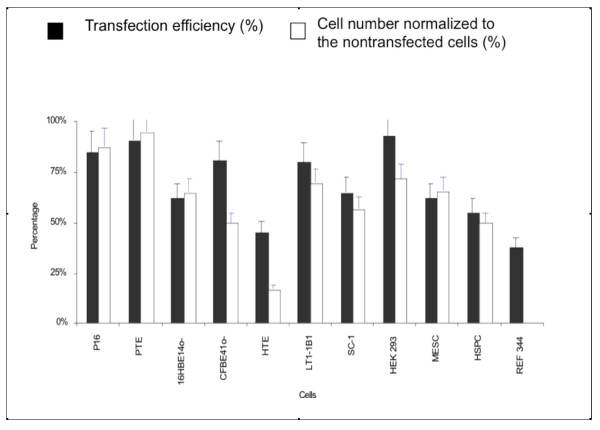
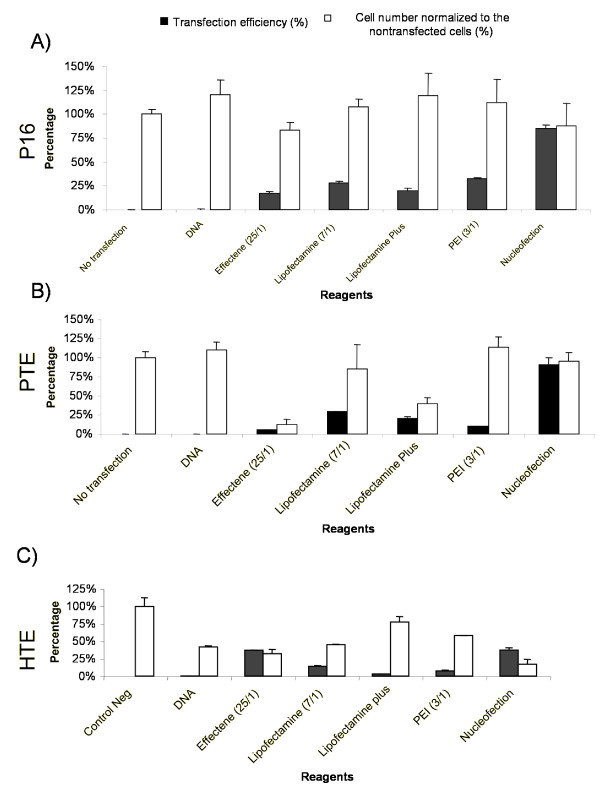
- Nucleofection outperformed chemical reagents in most direct comparisons: pig fetal fibroblasts (P16) 85% vs 18–32%; pig tracheal epithelial (PTE) 90% vs 5–30%; human tracheal epithelial (HTE) 45% vs 3–37% (Figure 2). In Figure 1, P16 nucleofection gave 90% GFP and 5% cytotoxicity; PTE gave 90% and 5% cytotoxicity; HTE gave 47% efficiency with 83% cytotoxicity (17% viability).
- Nucleofection efficiencies/viabilities for other cells: REF 38% GFP; 16HBE14o- 65% efficiency/62% viability; CFBE41o- 81%/50%; HSPC 55%/50%; lymphoblasts 75%/80%; MESC 62%/66%; HEK 293 93%/72%.
- HEK 293 was the exception: Lipofectamine 2000 gave 98% efficiency and 67% viability, Lipofectamine Plus 82% and 80% viability, comparable to nucleofection (93% efficiency, 72% viability).
Methods
- Compared nucleofection to Effectene, Lipofectamine 2000, Lipofectamine Plus, and PEI using pmaxGFP plasmid in adherent primary/transformed airway epithelial cells, primary fibroblasts, embryonic stem cells, and suspension hematopoietic stem/progenitor cells and lymphoblasts from human, pig, rabbit, and mouse.
- Nucleofection used 1–2×10^6 cells in 100 µl buffer with 2 µg pmaxGFP and cell-type-specific Amaxa programs/buffers (Table 1); chemical transfections used 3–5×10^5 cells/well with 2 µg pmaxGFP and tested reagent/DNA ratios.
- Transfection efficiency (GFP expression) and viability/cytotoxicity were assessed 48 h post-transfection by flow cytometry; adherent cells counted if attached, suspension cells stained with propidium iodide; experiments in triplicate, repeated 2–3 times, SEM n=3.
Limitations
- Stated: additional studies are needed to determine whether nucleofection efficiency and viability can be further enhanced; the reason for HTE vs PTE differences is uncertain, possibly passage/differentiation, and species-specific factors, cell age, and density need empirical optimization.
- Evident: comparisons used a single reporter plasmid (pmaxGFP) and a limited set of cell types and reagents; chemical comparisons used only optimal reagent/DNA ratios, and some supporting data are unpublished/not shown (e.g., MESC chemical transfection, Lipofectamine Plus HEK 293 data).
- Evident: no mechanistic explanation for nucleofection superiority, no long-term stable expression or functional/therapeutic outcome data, and efficiency/viability measured only at 48 h post-transfection.
Model-written summary. Check it against the paper before relying on it.
Integrity signals
Registry
Cites
Statistics
Figures
Verification
Claims the paper makes
0 Valid · 0 Not valid · 13 Not checked · 66 Own results and interpretations
A result the paper reports from its own data — it cites no other source for it, so there is none to check. The quote shows it is in the paper.
In the paper
“The 16HBE14o- cells showed a 62% viability and 65% transfection efficiency, while transfection of the CFBE41o- cells gave 81% expression efficiency at 50% viability (Figure 1).”
§ Comparative transfection of DNA into primary and transformed mammalian cells from different lineages > Results > Nucleofection
plain- Asserted: passes — The authors put it forward as true.
- Checkable: passes — It can be checked against evidence.
- Load-bearing: unclear — It is unclear whether the paper’s conclusions depend on it.
- Based: passes — The paper gives a reason why it holds.
- Rests on an assumption not shown here.
A result the paper reports from its own data — it cites no other source for it, so there is none to check. The quote shows it is in the paper.
In the paper
“Program U-20 was the most effective and resulted in a 90% efficiency of GFP expression and 5% cytotoxicity (Figure 1).”
§ Comparative transfection of DNA into primary and transformed mammalian cells from different lineages > Results > Nucleofection
plainstates a causen = 3- Asserted: passes — The authors put it forward as true.
- Checkable: passes — It can be checked against evidence.
- Load-bearing: unclear — It is unclear whether the paper’s conclusions depend on it.
- Based: passes — The paper gives a reason why it holds.
- Rests on an assumption not shown here.
A result the paper reports from its own data — it cites no other source for it, so there is none to check. The quote shows it is in the paper.
In the paper
“Transient transfection efficiency in all the cell systems ranged from 40%-90%, with minimal toxicity and no apparent species specificity.”
§ Comparative transfection of DNA into primary and transformed mammalian cells from different lineages > Abstract > Results
hedged- Asserted: passes — The authors put it forward as true.
- Checkable: passes — It can be checked against evidence.
- Load-bearing: unclear — It is unclear whether the paper’s conclusions depend on it.
- Based: passes — The paper gives a reason why it holds.
A result the paper reports from its own data — it cites no other source for it, so there is none to check. The quote shows it is in the paper.
In the paper
“The optimal transfection efficiency was achieved using program T-20 and the Amaxa Basic Epithelial Cell buffer and resulted in 47% expression efficiency and 83% cytotoxicity (17% viability) (Figure 1, Table 1).”
§ Comparative transfection of DNA into primary and transformed mammalian cells from different lineages > Results > Nucleofection
plainstates a cause- Asserted: passes — The authors put it forward as true.
- Checkable: passes — It can be checked against evidence.
- Load-bearing: passes — The paper’s conclusions depend on it.
- Based: passes — The paper gives a reason why it holds.
51 more claims
Create a free account to see all 79 claims and to verify the 36 references still open.
- It may state two separate claims as one. 13
- Probably not a substantial claim. 12
Claims other papers make about this one
Each is checked against this paper’s own text: does it say what the citing paper says it does?
In the citing paper
“Nonetheless, the two major drawbacks of DNA-based transient transfection are the inability to carefully control the expression level of the foreign construct even by using weak versus strong promoters [10] and, for most cell lines, the inability to reach up to 95% of transfected cells [11].”
From The Prodigious Potential of mRNA Electrotransfer as a Substitute to Conventional DNA-Based Transient Transfection (2023) · cites this paper as [11]
Self-check
Percentages, sums and reported differences re-computed from the paper’s own numbers.
Each contradiction between two passages listed here was confirmed by an independent check.
Rated minor: it would not touch a result — a value no result rests on, a p-value that stays on the same side of the significance level, or a conflict that is clerical, resolved elsewhere in the paper, or outside its own findings.
In the paper
§ Comparative transfection of DNA into primary and transformed mammalian cells from different lineages > Background
“a number of primary and immortalized cell systems in three different mammalian species (human, rabbit, and pig)”
§ Comparative transfection of DNA into primary and transformed mammalian cells from different lineages > Methods > Nucleofection
“| Mouse | MESC | Transgenic mouse embryonic stem cells (βS-globin mutant) | A-24 | Mouse ES cell |”
Rated minor: it would not touch a result — a value no result rests on, a p-value that stays on the same side of the significance level, or a conflict that is clerical, resolved elsewhere in the paper, or outside its own findings.
In the paper
§ Comparative transfection of DNA into primary and transformed mammalian cells from different lineages > Discussion
“Primary human airway epithelial cells were difficult to transfect even by nucleofection (45%) when compared to the PTE (95%).”
§ Comparative transfection of DNA into primary and transformed mammalian cells from different lineages > Results > Nucleofection
“Nucleofection of primary pig tracheal epithelial (PTE) cells under the same conditions, i.e., using the same buffer and program, gave a transfection efficiency of 90%. The 5% cytotoxicity (95% viability) of the transfected PTE cells detected 48 h after transfection”
Rated minor: it would not touch a result — a value no result rests on, a p-value that stays on the same side of the significance level, or a conflict that is clerical, resolved elsewhere in the paper, or outside its own findings.
In the paper
§ Comparative transfection of DNA into primary and transformed mammalian cells from different lineages > Discussion
“Greater than 95% of the P16 cells expressed GFP following nucleofection”
§ Comparative transfection of DNA into primary and transformed mammalian cells from different lineages > Results > Nucleofection
“Program U-20 was the most effective and resulted in a 90% efficiency of GFP expression and 5% cytotoxicity (Figure 1).”
Rated minor: it would not touch a result — a value no result rests on, a p-value that stays on the same side of the significance level, or a conflict that is clerical, resolved elsewhere in the paper, or outside its own findings.
In the paper
§ Comparative transfection of DNA into primary and transformed mammalian cells from different lineages > Abstract > Results
“with minimal toxicity and no apparent species specificity.”
§ Comparative transfection of DNA into primary and transformed mammalian cells from different lineages > Abstract > Conclusions
“However, there are cell-type and species specific differences that need to be evaluated empirically to optimize the conditions for transfection efficiency and cell survival.”
Rated minor: it would not touch a result — a value no result rests on, a p-value that stays on the same side of the significance level, or a conflict that is clerical, resolved elsewhere in the paper, or outside its own findings.
In the paper
§ Comparative transfection of DNA into primary and transformed mammalian cells from different lineages > Methods > Nucleofection
“| Human | 16HBE41o- | Immortalized Human Bronchial Epithelial cell Line (WT) | O-17 | V |”
§ Comparative transfection of DNA into primary and transformed mammalian cells from different lineages > Results > Nucleofection
“Normal, 16HBE14o- [16], and CF, CFBE41o- [17-20], cell lines were optimally transfected with buffer V and program O-17 (Table 1).”
Citations
Cites
Characteristics of a human cell line transformed by DNA from human adenovirus type 5
Graham, F. L., Russell, W. C., Smiley, J., & Nairn, R. (1977) · Journal of General Virology · doi:10.1099/0022-1317-36-1-59 · Cited by 4,793 · cited 1×
“Immortalized human bronchial epithelial cells (16HBE14o- [16,17] and CFBE41o- [18-20]) cells and the adenovirus 5 immortalized human embryo kidney cell line, HEK 293 [21], (American Type Tissue Culture Collection, Manassas, VA) were grown on tissue culture plastic coated with an extra-cellular matrix cocktail comprise…”
MethodMulti-Organ, Multi-Lineage Engraftment by a Single Bone Marrow-Derived Stem Cell
Krause, D. S., Theise, N. D., Collector, M. I., Henegariu, O., Hwang, S., Gardner, R., Neutzel, S., & Sharkis, S. J. (2001) · Cell · doi:10.1016/s0092-8674(01)00328-2 · Cited by 2,667 · cited 1×
“Hematopoietic stem/progenitor cells (HSPCs) are attractive targets for gene delivery and therapy because of their potential for self-renewal and multilineage differentiation [29,30].”
BackgroundEnhanced gene delivery and mechanism studies with a novel series of cationic lipid formulations.
Felgner, J. H., Kumar, R., Sridhar, C. N., Wheeler, C. J., Tsai, Y. J., Border, R., Ramsey, P., Martin, M., & Felgner, P. L. (1994) · Journal of Biological Chemistry · doi:10.1016/s0021-9258(17)41980-6 · Cited by 1,312 · cited 1×
“Previous studies indicated that the ratio of DNA to lipid is an important variable that determines the efficiency of transfection and the cellular toxicity [1,13].”
BackgroundElectric field-mediated fusion and related electrical phenomena
Zimmermann, U. (1982) · Biochimica et Biophysica Acta (BBA) - Reviews on Biomembranes · doi:10.1016/0304-4157(82)90007-7 · Cited by 1,012 · cited 1×
“One of the most effective and accessible physical transfection methods, electroporation (also known as electrotransfer, electropermeabilization, or nucleofection), involves the application of brief electric pulses to cells or tissues to increase the permeability of cells to macromolecules [1,4].”
BackgroundCFTR expression and chloride secretion in polarized immortal human bronchial epithelial cells.
Cozens, A. L., Yezzi, M. J., Kunzelmann, K., Ohrui, T., Chin, L., Eng, K., Finkbeiner, W. E., Widdicombe, J. H., & Gruenert, D. C. (1994) · American Journal of Respiratory Cell and Molecular Biology · doi:10.1165/ajrcmb.10.1.7507342 · Cited by 929 · cited 2×
“Normal, 16HBE14o[16], and CF, CFBE41o- [17-20], cell lines were optimally transfected with buffer V and program O-17 (Table 1).”
MethodSelf-citationPlasticity of marrow-derived stem cells
Herzog, E. L., Chai, L., & Krause, D. S. (2003) · Blood · doi:10.1182/blood-2003-05-1664 · Cited by 830
Cloned rabbits produced by nuclear transfer from adult somatic cells
Chesné, P., Adenot, P. G., Viglietta, C., Baratte, M., Boulanger, L., & Renard, J.-P. (2002) · Nature Biotechnology · doi:10.1038/nbt0402-366 · Cited by 558 · cited 1×
“The development of somatic cell nuclear transfer using fetal fibroblast as donor cells has played a central role in the cloning of animals such as the pig and the rabbit [14,35-37].”
BackgroundCulture and transformation of human airway epithelial cells
Gruenert, D. C., Finkbeiner, W. E., & Widdicombe, J. H. (1995) · American Journal of Physiology-Lung Cellular and Molecular Physiology · doi:10.1152/ajplung.1995.268.3.l347 · Cited by 293 · cited 1×
“Immortalized bronchial epithelial cells [26-28] were studied, because they are routinely used as models of cystic fibrosis (CF) and airway disease.”
Self-citationNew non-viral method for gene transfer into primary cells
Gresch, O. (2004) · Methods · doi:10.1016/j.ymeth.2003.11.009 · Cited by 253 · cited 1×
“The development of a novel electroporation system by AMAXA has shown considerable promise as a system for delivering DNA to a broad range of cell lines and cell systems that grow either as adherent monolayers or in suspension [7,31-34].”
BackgroundKues, W. A., Anger, M., Carnwath, J. W., Paul, D., Motlik, J., & Niemann, H. (2000) · Biology of Reproduction · doi:10.1095/biolreprod62.2.412 · Cited by 226 · cited 1×
“The ability to generate transgenic animals through somatic cell nuclear transfer (SCNT) has opened up many possibilities for the study of disease and the development of therapies [25].”
Background
Research works printed but not linked: 1
- Gruenert DC Differentiated properties of human epithelial cells trnsformed in vitro BioTechniques 1987 5 740 749
Cited by
Items 201–228 of 228
Acute Megakaryoblastic Leukemia
Monc, L., Emmrich, S., Streltsov, R., Schmidt, F., Thangap, V. R., Reinhardt, D., & Klusmann, J.-H. (2012) · Springer eBooks · doi:10.1007/springerreference_171715
Aydın, Ş. (2024) · Yildiz Technical University - AVESIS
Alonso‐Crisostomo, L. (2020) · Apollo (University of Cambridge) · doi:10.17863/cam.66362
The role of CFTR in lumen formation and maintenance in mammary epithelial cells
Luna Perez, A. A. (2024) · White Rose eTheses Online (University of Leeds, The University of Sheffield, University of York)
The characterisation of 5-BDBD antagonism of human P2X4 ion channels.
Hickey, H. (2020) · UEA Digital Repository (University of East Anglia)
Baba, S., Elengoe, A., Hussein, A. R., Sugeng, T., Draman, S., & Hamdan, S. (2015)
Viney, R. (2014) · University of Birmingham Institutional Research Archive (University of Birmingham)
Μοριακοί μηχανισμοί κυτταρικού επαναπρογραμματισμού
Αλεξοπούλου, Ε. (2021) · doi:10.12681/eadd/49371
Rationalization of design of recombinant proteins for maximizing expressibility
Fu, S. J. (2015) · Research Explorer (The University of Manchester)
Dodatek lokalizacijskih signalov gasderminu D in njihov vpliv na učinkovitost sprožitve piroptoze
Videčnik, B. (2023) · Repository of the University of Ljubljana (University of Ljubljana)
Godsmark, G. (2016) · Open University of Cape Town (University of Cape Town)
Mapping Domains for ZIC3 Molecular Function
Ahmed, J. N. (2015) · ANU Open Research (Australian National University) · doi:10.25911/5d78d653a1c34
Stecklum, M. (2015) · DepositOnce · doi:10.14279/depositonce-4405
Al-Khazraji, S. K. (2018) · Keele Research Repository (Keele University)
Novel approaches to identify and characterise dominant negative mutants of essential MCMV genes
Pogoda, M. (2013) · Elektronische Hochschulschriften der LMU München (Ludwig-Maximilians-Universität München) · doi:10.5282/edoc.17709
Tissue‐Targeted Gene Electrodelivery of Minicircle DNA
Chabot, S., Golzio, M., & Teissié, J. (2013) · Wiley eBooks · doi:10.1002/9783527670420.ch12
Virion Display: A High‐Throughput Method to Express Functional Membrane Proteins
Syu, G., Johansen, E., & Zhu, H. (2020) · Current Protocols in Molecular Biology · doi:10.1002/cpmb.126
Kumar, P. (2020) · Oxford University Research Archive (ORA) (University of Oxford) · doi:10.5287/ora-n1vzdgdqn
Septisetyani, E. P., Kusumawati, A., & Santoso, A. (2015) · ANNALES BOGORIENSES
Diener, Y. (2016) · RWTH Publications (RWTH Aachen) · doi:10.18154/rwth-2017-04040
Pogoda, M., Bosse, J. B., Conzelmann, K., Koszinowski, U. H., & Ruzsics, Z. (2014) · PLoS ONE · doi:10.1371/journal.pone.0094918
Michel, M. M. (2014) · OPen Access Repositorium der Universität Ulm (OPARU) (Ulm University) · doi:10.18725/oparu-3614
Mechanisms and possible function of SIRT3 in mESC
Ribeiro, M. F. (2015) · Portuguese National Funding Agency for Science, Research and Technology (RCAAP Project by FCT)
Virus as Renal Functional Genetic Tools
Sharma, A., & Cattavarayane, S. (2019) · Methods in molecular biology · doi:10.1007/978-1-4939-9021-4_12
Membrane phospholipids as regulators of tetraspanin oligomerisation
Ayub, H. (2019) · Aston Publications Explorer (Aston University) · doi:10.48780/publications.aston.ac.uk.00042513
Navaridas Fernández de Bobadilla, R. (2022) · RECERCAT (Consorci de Serveis Universitaris de Catalunya)
Многофункциональный полиэтиленимин: физико-химические свойства и современные области применения
Нурлыбаева, Т., Абилова, Г., Махамбетова, Ж., Sultamuratova, Z., & Жакупова, Г. (2025) · BULLETIN of the L N Gumilyov Eurasian National University Chemistry Geography Series · doi:10.32523/3107-278x-2025-153-4-56-73
Guo, Y., Chen, Z., Lu, J., Zhang, S., Dang, Z., Zhang, K., Cui, Y., Bai, R., Zhao, Y., Chen, C., et al. (2026) · Talanta · doi:10.1016/j.talanta.2026.130205
Metadata
- Authors
- Maurisse, R., De Semir, D., Emamekhoo, H., Bedayat, B., Abdolmohammadi, A., Parsi, H., & Gruenert, D. C.
- Affiliations
- California Pacific Medical Center (US)
- University of California, San Francisco (US)
- Harvard University (US)
- Good Samaritan Hospital (US)
- University of Vermont (US)
- Corresponding author
- Gruenert, Dieter C
- Venue
- BMC Biotechnology
- Published
- 2010-02-08
- Volume
- 10
- Issue
- 1
- Pages
- 9-9
- ISSN
- 1472-6750 (ISSN-L)
- PMC
- PMC2830169
- OpenAlex
- W2140000006
- Semantic Scholar
- 7417af8ccf0f059b3c0c4395238e0fb5959a39da
- Cited by
- 228
- References
- 37
- Citations by year
- 2026: 10 · 2025: 4 · 2024: 17 · 2023: 16 · 2022: 9 · 2021: 18 · 2020: 19 · 2019: 18 · 2018: 16 · 2017: 10 · 2016: 14 · 2015: 17 · 2014: 17 · 2013: 10 · 2012: 14
- FWCI
- 3.96
- Type
- journal article
- Language
- en
- Open access
- gold
- doi.org
- Licence
- cc-by
- Locations
- BMC Biotechnology (publishedVersion, cc-by)
- PubMed Central (publishedVersion, cc-by)
- PubMed (publishedVersion)
- Digital Access to Scholarship at Harvard (DASH) (Harvard University) (submittedVersion, cc-by)
- DOAJ (DOAJ: Directory of Open Access Journals) (submittedVersion, cc-by-sa)
- Funders
- Cystic Fibrosis Foundation
- National Institutes of Health
- National Heart, Lung, and Blood Institute (R41HL080814)
- National Institute of General Medical Sciences (R01GM075111)
- National Institute of Diabetes and Digestive and Kidney Diseases (R21DK066403, T32DK007636)
- Topics
- Life Sciences › Biochemistry, Genetics and Molecular Biology › Molecular Biology › RNA Interference and Gene Delivery
- Life Sciences › Biochemistry, Genetics and Molecular Biology › Biotechnology › Microbial Inactivation Methods
- Life Sciences › Biochemistry, Genetics and Molecular Biology › Molecular Biology › Molecular Biology Techniques and Applications
- Keywords
- DNA transfection, nucleofection, electroporation, lipofectamine, transfection efficiency, transfection toxicity, primary cells, transformed cells, airway epithelial cells, fibroblasts, embryonic stem cells, hematopoietic stem and progenitor cells, lymphoblasts, HEK293 cells, GFP expression, cell proliferation
- MeSH terms
- Animals, Cell Line, Cell Survival, DNA, Epithelial Cells, Fibroblasts, Humans, Lipids, Polyethyleneimine, Rabbits, Swine, Transfection, Electroporation, Mice, Embryonic Stem Cells
About these checks
Registry, retraction, Cites and statistics results are computed, not judged, with one exception: a printed reference that no index lists is read once by a model before it counts as a citation error. Claims are extracted by a model and kept only when their quote appears verbatim in the text; each cited source is then checked, with a model’s help, for whether it says what the claim relies on. Those verdicts can be wrong — read the claim’s quote and the cited source before relying on one.
A language model drew the claims from the paper on 2026-11-21, under version 3 of the claim definition (model deepseek-v4.1-flash, prompt extract-v3).
A second model labelled each claim on 2026-11-21 (model jev-1.13-20260917, definition revision gold-guideline-v0.2).
Statistics and arithmetic are recomputed, not judged.
Confidence bands are shown only for fields calibrated on our annotated test set. None is calibrated yet, so no band is shown.
What counts as a claim ›How we measure confidence ›How we check this ›
Are you an author, or do you see a problem with this page? Request a review
Data sources
Bibliographic data: Semantic Scholar, OpenAlex, Crossref.
Contains information from the Semantic Scholar Academic Graph Datasets, made available under the ODC Attribution License (ODC-BY 1.0).
Semantic Scholar’s data is described in: Kinney, R., et al. (2023). The Semantic Scholar Open Data Platform. arXiv:2301.10140.
