

Comparative transfection of DNA into primary and transformed mammalian cells from different lineages
Open accessThe DOI matches its Crossref record; 37 of the 37 references it cites were found in a registry or an index; none of the 37 sources its claims cite is checked for support yet.
Abstract
Background: The delivery of DNA into human cells has been the basis of advances in the understanding of gene function and the development of genetic therapies. Numerous chemical and physical approaches have been used to deliver the DNA, but their efficacy has been variable and is highly dependent on the cell type to be transfected. Results: Studies were undertaken to evaluate and compare the transfection efficacy of several chemical reagents to that of the electroporation/nucleofection system using both adherent cells (primary and transformed airway epithelial cells and primary fibroblasts as well as embryonic stem cells) and cells in suspension (primary hematopoietic stem/progenitor cells and lymphoblasts). With the exception of HEK 293 cell transfection, nucleofection proved to be less toxic and more efficient at effectively delivering DNA into the cells as determined by cell proliferation and GFP expression, respectively. Lipofectamine and nucleofection of HEK 293 were essentially equivalent in terms of toxicity and efficiency. Transient transfection efficiency in all the cell systems ranged from 40%-90%, with minimal toxicity and no apparent species specificity. Differences in efficiency and toxicity were cell type/system specific. Conclusions: In general, the Amaxa electroporation/nucleofection system appears superior to other chemical systems. However, there are cell-type and species specific differences that need to be evaluated empirically to optimize the conditions for transfection efficiency and cell survival.
Overview
CoChat Summary
TL;DR
This study compared Amaxa nucleofection with four chemical transfection reagents (Effectene, Lipofectamine 2000, Lipofectamine Plus, PEI) for delivering a GFP reporter plasmid into primary and transformed mammalian cells from human, pig, rabbit, and mouse lineages. Nucleofection was generally more efficient and less toxic, except in HEK 293 cells where Lipofectamine and nucleofection were essentially equivalent.
Key findings
- Across all cell systems, transient transfection efficiency ranged from 40%–90%, with minimal toxicity and no apparent species specificity; differences in efficiency and toxicity were cell type/system specific.
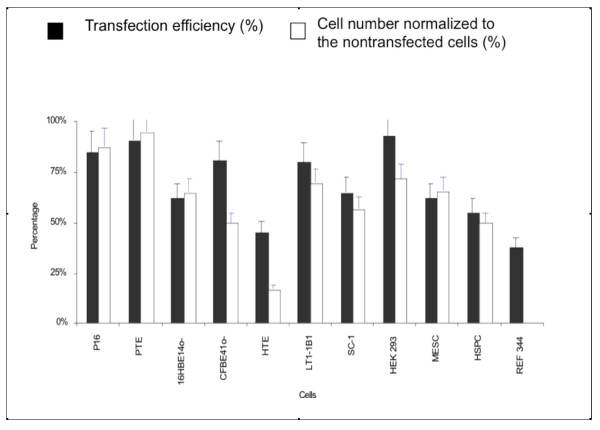
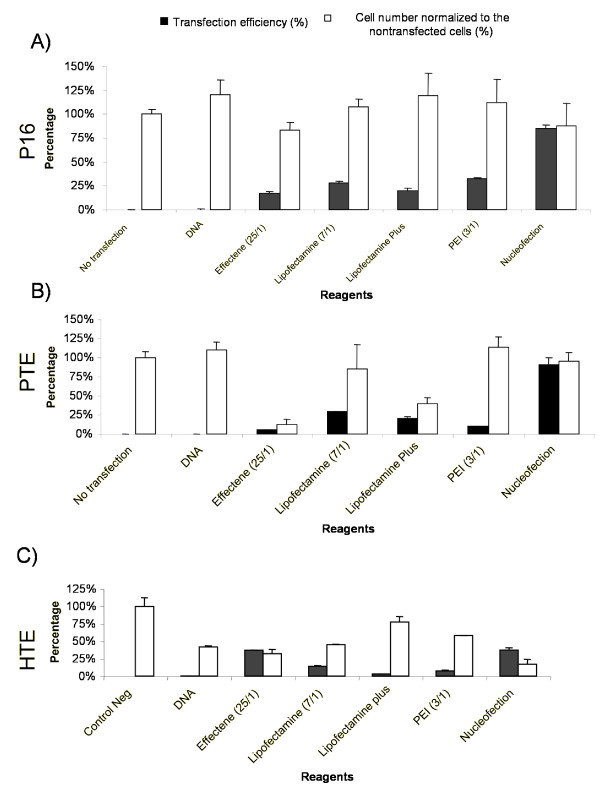
- Nucleofection outperformed chemical reagents in most direct comparisons: pig fetal fibroblasts (P16) 85% vs 18–32%; pig tracheal epithelial (PTE) 90% vs 5–30%; human tracheal epithelial (HTE) 45% vs 3–37% (Figure 2). In Figure 1, P16 nucleofection gave 90% GFP and 5% cytotoxicity; PTE gave 90% and 5% cytotoxicity; HTE gave 47% efficiency with 83% cytotoxicity (17% viability).
- Nucleofection efficiencies/viabilities for other cells: REF 38% GFP; 16HBE14o- 65% efficiency/62% viability; CFBE41o- 81%/50%; HSPC 55%/50%; lymphoblasts 75%/80%; MESC 62%/66%; HEK 293 93%/72%.
- HEK 293 was the exception: Lipofectamine 2000 gave 98% efficiency and 67% viability, Lipofectamine Plus 82% and 80% viability, comparable to nucleofection (93% efficiency, 72% viability).
Methods
- Compared nucleofection to Effectene, Lipofectamine 2000, Lipofectamine Plus, and PEI using pmaxGFP plasmid in adherent primary/transformed airway epithelial cells, primary fibroblasts, embryonic stem cells, and suspension hematopoietic stem/progenitor cells and lymphoblasts from human, pig, rabbit, and mouse.
- Nucleofection used 1–2×10^6 cells in 100 µl buffer with 2 µg pmaxGFP and cell-type-specific Amaxa programs/buffers (Table 1); chemical transfections used 3–5×10^5 cells/well with 2 µg pmaxGFP and tested reagent/DNA ratios.
- Transfection efficiency (GFP expression) and viability/cytotoxicity were assessed 48 h post-transfection by flow cytometry; adherent cells counted if attached, suspension cells stained with propidium iodide; experiments in triplicate, repeated 2–3 times, SEM n=3.
Limitations
- Stated: additional studies are needed to determine whether nucleofection efficiency and viability can be further enhanced; the reason for HTE vs PTE differences is uncertain, possibly passage/differentiation, and species-specific factors, cell age, and density need empirical optimization.
- Evident: comparisons used a single reporter plasmid (pmaxGFP) and a limited set of cell types and reagents; chemical comparisons used only optimal reagent/DNA ratios, and some supporting data are unpublished/not shown (e.g., MESC chemical transfection, Lipofectamine Plus HEK 293 data).
- Evident: no mechanistic explanation for nucleofection superiority, no long-term stable expression or functional/therapeutic outcome data, and efficiency/viability measured only at 48 h post-transfection.
Model-written summary. Check it against the paper before relying on it.
Integrity signals
Registry
Cites
Statistics
Figures
Verification
Claims the paper makes
0 Valid · 0 Not valid · 13 Not checked · 66 Own results and interpretations
A result the paper reports from its own data — it cites no other source for it, so there is none to check. The quote shows it is in the paper.
In the paper
“The 16HBE14o- cells showed a 62% viability and 65% transfection efficiency, while transfection of the CFBE41o- cells gave 81% expression efficiency at 50% viability (Figure 1).”
§ Comparative transfection of DNA into primary and transformed mammalian cells from different lineages > Results > Nucleofection
plain- Asserted: passes — The authors put it forward as true.
- Checkable: passes — It can be checked against evidence.
- Load-bearing: unclear — It is unclear whether the paper’s conclusions depend on it.
- Based: passes — The paper gives a reason why it holds.
- Rests on an assumption not shown here.
A result the paper reports from its own data — it cites no other source for it, so there is none to check. The quote shows it is in the paper.
In the paper
“Program U-20 was the most effective and resulted in a 90% efficiency of GFP expression and 5% cytotoxicity (Figure 1).”
§ Comparative transfection of DNA into primary and transformed mammalian cells from different lineages > Results > Nucleofection
plainstates a causen = 3- Asserted: passes — The authors put it forward as true.
- Checkable: passes — It can be checked against evidence.
- Load-bearing: unclear — It is unclear whether the paper’s conclusions depend on it.
- Based: passes — The paper gives a reason why it holds.
- Rests on an assumption not shown here.
A result the paper reports from its own data — it cites no other source for it, so there is none to check. The quote shows it is in the paper.
In the paper
“Transient transfection efficiency in all the cell systems ranged from 40%-90%, with minimal toxicity and no apparent species specificity.”
§ Comparative transfection of DNA into primary and transformed mammalian cells from different lineages > Abstract > Results
hedged- Asserted: passes — The authors put it forward as true.
- Checkable: passes — It can be checked against evidence.
- Load-bearing: unclear — It is unclear whether the paper’s conclusions depend on it.
- Based: passes — The paper gives a reason why it holds.
A result the paper reports from its own data — it cites no other source for it, so there is none to check. The quote shows it is in the paper.
In the paper
“The optimal transfection efficiency was achieved using program T-20 and the Amaxa Basic Epithelial Cell buffer and resulted in 47% expression efficiency and 83% cytotoxicity (17% viability) (Figure 1, Table 1).”
§ Comparative transfection of DNA into primary and transformed mammalian cells from different lineages > Results > Nucleofection
plainstates a cause- Asserted: passes — The authors put it forward as true.
- Checkable: passes — It can be checked against evidence.
- Load-bearing: passes — The paper’s conclusions depend on it.
- Based: passes — The paper gives a reason why it holds.
51 more claims
Create a free account to see all 79 claims and to verify the 36 references still open.
- It may state two separate claims as one. 13
- Probably not a substantial claim. 12
Claims other papers make about this one
Each is checked against this paper’s own text: does it say what the citing paper says it does?
In the citing paper
“Nonetheless, the two major drawbacks of DNA-based transient transfection are the inability to carefully control the expression level of the foreign construct even by using weak versus strong promoters [10] and, for most cell lines, the inability to reach up to 95% of transfected cells [11].”
From The Prodigious Potential of mRNA Electrotransfer as a Substitute to Conventional DNA-Based Transient Transfection (2023) · cites this paper as [11]
Self-check
Percentages, sums and reported differences re-computed from the paper’s own numbers.
Each contradiction between two passages listed here was confirmed by an independent check.
Rated minor: it would not touch a result — a value no result rests on, a p-value that stays on the same side of the significance level, or a conflict that is clerical, resolved elsewhere in the paper, or outside its own findings.
In the paper
§ Comparative transfection of DNA into primary and transformed mammalian cells from different lineages > Background
“a number of primary and immortalized cell systems in three different mammalian species (human, rabbit, and pig)”
§ Comparative transfection of DNA into primary and transformed mammalian cells from different lineages > Methods > Nucleofection
“| Mouse | MESC | Transgenic mouse embryonic stem cells (βS-globin mutant) | A-24 | Mouse ES cell |”
Rated minor: it would not touch a result — a value no result rests on, a p-value that stays on the same side of the significance level, or a conflict that is clerical, resolved elsewhere in the paper, or outside its own findings.
In the paper
§ Comparative transfection of DNA into primary and transformed mammalian cells from different lineages > Discussion
“Primary human airway epithelial cells were difficult to transfect even by nucleofection (45%) when compared to the PTE (95%).”
§ Comparative transfection of DNA into primary and transformed mammalian cells from different lineages > Results > Nucleofection
“Nucleofection of primary pig tracheal epithelial (PTE) cells under the same conditions, i.e., using the same buffer and program, gave a transfection efficiency of 90%. The 5% cytotoxicity (95% viability) of the transfected PTE cells detected 48 h after transfection”
Rated minor: it would not touch a result — a value no result rests on, a p-value that stays on the same side of the significance level, or a conflict that is clerical, resolved elsewhere in the paper, or outside its own findings.
In the paper
§ Comparative transfection of DNA into primary and transformed mammalian cells from different lineages > Discussion
“Greater than 95% of the P16 cells expressed GFP following nucleofection”
§ Comparative transfection of DNA into primary and transformed mammalian cells from different lineages > Results > Nucleofection
“Program U-20 was the most effective and resulted in a 90% efficiency of GFP expression and 5% cytotoxicity (Figure 1).”
Rated minor: it would not touch a result — a value no result rests on, a p-value that stays on the same side of the significance level, or a conflict that is clerical, resolved elsewhere in the paper, or outside its own findings.
In the paper
§ Comparative transfection of DNA into primary and transformed mammalian cells from different lineages > Abstract > Results
“with minimal toxicity and no apparent species specificity.”
§ Comparative transfection of DNA into primary and transformed mammalian cells from different lineages > Abstract > Conclusions
“However, there are cell-type and species specific differences that need to be evaluated empirically to optimize the conditions for transfection efficiency and cell survival.”
Rated minor: it would not touch a result — a value no result rests on, a p-value that stays on the same side of the significance level, or a conflict that is clerical, resolved elsewhere in the paper, or outside its own findings.
In the paper
§ Comparative transfection of DNA into primary and transformed mammalian cells from different lineages > Methods > Nucleofection
“| Human | 16HBE41o- | Immortalized Human Bronchial Epithelial cell Line (WT) | O-17 | V |”
§ Comparative transfection of DNA into primary and transformed mammalian cells from different lineages > Results > Nucleofection
“Normal, 16HBE14o- [16], and CF, CFBE41o- [17-20], cell lines were optimally transfected with buffer V and program O-17 (Table 1).”
Citations
Cites
Characteristics of a human cell line transformed by DNA from human adenovirus type 5
Graham, F. L., Russell, W. C., Smiley, J., & Nairn, R. (1977) · Journal of General Virology · doi:10.1099/0022-1317-36-1-59 · Cited by 4,793 · cited 1×
“Immortalized human bronchial epithelial cells (16HBE14o- [16,17] and CFBE41o- [18-20]) cells and the adenovirus 5 immortalized human embryo kidney cell line, HEK 293 [21], (American Type Tissue Culture Collection, Manassas, VA) were grown on tissue culture plastic coated with an extra-cellular matrix cocktail comprise…”
MethodMulti-Organ, Multi-Lineage Engraftment by a Single Bone Marrow-Derived Stem Cell
Krause, D. S., Theise, N. D., Collector, M. I., Henegariu, O., Hwang, S., Gardner, R., Neutzel, S., & Sharkis, S. J. (2001) · Cell · doi:10.1016/s0092-8674(01)00328-2 · Cited by 2,667 · cited 1×
“Hematopoietic stem/progenitor cells (HSPCs) are attractive targets for gene delivery and therapy because of their potential for self-renewal and multilineage differentiation [29,30].”
BackgroundEnhanced gene delivery and mechanism studies with a novel series of cationic lipid formulations.
Felgner, J. H., Kumar, R., Sridhar, C. N., Wheeler, C. J., Tsai, Y. J., Border, R., Ramsey, P., Martin, M., & Felgner, P. L. (1994) · Journal of Biological Chemistry · doi:10.1016/s0021-9258(17)41980-6 · Cited by 1,312 · cited 1×
“Previous studies indicated that the ratio of DNA to lipid is an important variable that determines the efficiency of transfection and the cellular toxicity [1,13].”
BackgroundElectric field-mediated fusion and related electrical phenomena
Zimmermann, U. (1982) · Biochimica et Biophysica Acta (BBA) - Reviews on Biomembranes · doi:10.1016/0304-4157(82)90007-7 · Cited by 1,012 · cited 1×
“One of the most effective and accessible physical transfection methods, electroporation (also known as electrotransfer, electropermeabilization, or nucleofection), involves the application of brief electric pulses to cells or tissues to increase the permeability of cells to macromolecules [1,4].”
BackgroundCFTR expression and chloride secretion in polarized immortal human bronchial epithelial cells.
Cozens, A. L., Yezzi, M. J., Kunzelmann, K., Ohrui, T., Chin, L., Eng, K., Finkbeiner, W. E., Widdicombe, J. H., & Gruenert, D. C. (1994) · American Journal of Respiratory Cell and Molecular Biology · doi:10.1165/ajrcmb.10.1.7507342 · Cited by 929 · cited 2×
“Normal, 16HBE14o[16], and CF, CFBE41o- [17-20], cell lines were optimally transfected with buffer V and program O-17 (Table 1).”
MethodSelf-citationPlasticity of marrow-derived stem cells
Herzog, E. L., Chai, L., & Krause, D. S. (2003) · Blood · doi:10.1182/blood-2003-05-1664 · Cited by 830
Cloned rabbits produced by nuclear transfer from adult somatic cells
Chesné, P., Adenot, P. G., Viglietta, C., Baratte, M., Boulanger, L., & Renard, J.-P. (2002) · Nature Biotechnology · doi:10.1038/nbt0402-366 · Cited by 558 · cited 1×
“The development of somatic cell nuclear transfer using fetal fibroblast as donor cells has played a central role in the cloning of animals such as the pig and the rabbit [14,35-37].”
BackgroundCulture and transformation of human airway epithelial cells
Gruenert, D. C., Finkbeiner, W. E., & Widdicombe, J. H. (1995) · American Journal of Physiology-Lung Cellular and Molecular Physiology · doi:10.1152/ajplung.1995.268.3.l347 · Cited by 293 · cited 1×
“Immortalized bronchial epithelial cells [26-28] were studied, because they are routinely used as models of cystic fibrosis (CF) and airway disease.”
Self-citationNew non-viral method for gene transfer into primary cells
Gresch, O. (2004) · Methods · doi:10.1016/j.ymeth.2003.11.009 · Cited by 253 · cited 1×
“The development of a novel electroporation system by AMAXA has shown considerable promise as a system for delivering DNA to a broad range of cell lines and cell systems that grow either as adherent monolayers or in suspension [7,31-34].”
BackgroundKues, W. A., Anger, M., Carnwath, J. W., Paul, D., Motlik, J., & Niemann, H. (2000) · Biology of Reproduction · doi:10.1095/biolreprod62.2.412 · Cited by 226 · cited 1×
“The ability to generate transgenic animals through somatic cell nuclear transfer (SCNT) has opened up many possibilities for the study of disease and the development of therapies [25].”
Background
Research works printed but not linked: 1
- Gruenert DC Differentiated properties of human epithelial cells trnsformed in vitro BioTechniques 1987 5 740 749
Cited by
Wang, H.-X., Li, M., Lee, C. M., Chakraborty, S., Kim, H.-W., Bao, G., & Leong, K. W. (2017) · Chemical Reviews · doi:10.1021/acs.chemrev.6b00799 · Cited by 560
Immunolabeling artifacts and the need for live-cell imaging
Schnell, U., Dijk, F., Sjollema, K. A., & Giepmans, B. N. G. (2012) · Nature Methods · doi:10.1038/nmeth.1855 · Cited by 506
“Cell type−dependent differences to chemical exposure are well known from other studies, for example, cell type−specific transfection efficienc”
BackgroundBaier, S. R., Nguyen, C., Xie, F., Wood, J. R., & Zempleni, J. (2014) · The Journal of Nutrition · doi:10.3945/jn.114.196436 · Cited by 445
Transfection types, methods and strategies: a technical review
Chong, Z. X., Yeap, S. K., & Ho, W. Y. (2021) · PeerJ · doi:10.7717/peerj.11165 · Cited by 303
Wang, H.-X., Song, Z., Lao, Y.-H., Xu, X., Gong, J., Cheng, D., Chakraborty, S., Park, J. S., Li, M., Huang, D., et al. (2018) · Proceedings of the National Academy of Sciences · doi:10.1073/pnas.1712963115 · Cited by 277
“Physical methods, including electroporation and microinjection, afford high transfection efficiency but may suffer from low cell viability and cell-specific efficiency; physical methods are also difficult for in vivo application (4, 5).”
BackgroundCell-Type-Specific CRISPR/Cas9 Delivery by Biomimetic Metal Organic Frameworks
Alyami, M. Z., Alsaiari, S. K., Li, Y., Qutub, S. S., Aleisa, F. A., Sougrat, R., Merzaban, J. S., & Khashab, N. M. (2020) · Journal of the American Chemical Society · doi:10.1021/jacs.9b11638 · Cited by 227
LincRNAs MONC and MIR100HG act as oncogenes in acute megakaryoblastic leukemia
Emmrich, S., Streltsov, A., Schmidt, F., Thangapandi, V. R., Reinhardt, D., & Klusmann, J. (2014) · Molecular Cancer · doi:10.1186/1476-4598-13-171 · Cited by 163
Mokbel, A. N., El Tookhy, O. S., Shamaa, A. A., Rashed, L. A., Sabry, D., & El Sayed, A. M. (2011) · BMC Musculoskeletal Disorders · doi:10.1186/1471-2474-12-259 · Cited by 161
“For imaging GFP auto-fluorescence of MSCs, unstained slides were directly analyzed by confocal laser microscopy (LSM 510, Zeiss, Jena, Germany) incorporating two lasers (Ar and HeNe) equipped with an inverted Axiovert 100 M microscope [28].”
MethodPoddar, A., Conesa, J. J., Liang, K., Dhakal, S., Reineck, P., Bryant, G., Pereiro, E., Ricco, R., Amenitsch, H., Doonan, C., et al. (2019) · Small · doi:10.1002/smll.201902268 · Cited by 158
Hypoxia‐Responsive Gene Editing to Reduce Tumor Thermal Tolerance for Mild‐Photothermal Therapy
Li, X., Pan, Y., Chen, C., Gao, Y., Liu, X., Yang, K., Luan, X., Zhou, D., Zeng, F., Han, X., et al. (2021) · Angewandte Chemie International Edition · doi:10.1002/anie.202107036 · Cited by 149
Efficient delivery of nuclease proteins for genome editing in human stem cells and primary cells
Liu, J., Gaj, T., Yang, Y., Wang, N., Shui, S., Kim, S., Kanchiswamy, C. N., Kim, J., & Barbas, C. F. (2015) · Nature Protocols · doi:10.1038/nprot.2015.117 · Cited by 137
How to screen non-viral gene delivery systems in vitro?
van Gaal, E. V. B., van Eijk, R., Oosting, R. S., Kok, R. J., Hennink, W. E., Crommelin, D. J. A., & Mastrobattista, E. (2011) · Journal of Controlled Release · doi:10.1016/j.jconrel.2011.05.001 · Cited by 132
Genome editing by natural and engineered CRISPR-associated nucleases
Wu, W. Y., Lebbink, J. H. G., Kanaar, R., Geijsen, N., & John van der, O. O. S. T. (2018) · Nature Chemical Biology · doi:10.1038/s41589-018-0080-x · Cited by 125
Wan, T., Niu, D., Wu, C., Xu, F.-J., Church, G., & Ping, Y. (2019) · Materials Today · doi:10.1016/j.mattod.2018.12.003 · Cited by 117
Haridhasapavalan, K. K., Borgohain, M. P., Dey, C., Saha, B., Narayan, G., Kumar, S., & Thummer, R. P. (2019) · Gene · doi:10.1016/j.gene.2018.11.069 · Cited by 115
Arora, S., Sharma, D., & Singh, J. (2020) · ACS Chemical Neuroscience · doi:10.1021/acschemneuro.0c00076 · Cited by 107
McNeer, N. A., Chin, J., Schleifman, E., Fields, R. J., Glazer, P. M., & Saltzman, W. M. (2010) · Molecular Therapy · doi:10.1038/mt.2010.200 · Cited by 103
Rádis‐Baptista, G., Campelo, I. S., Morlighem, J.-É. R. L., Melo, L. M., & Freitas, V. J. D. F. (2017) · Journal of Biotechnology · doi:10.1016/j.jbiotec.2017.05.002 · Cited by 99
Silk-Based Gene Carriers with Cell Membrane Destabilizing Peptides
Numata, K., & Kaplan, D. L. (2010) · Biomacromolecules · doi:10.1021/bm101055m · Cited by 93
Kizer, M. E., Deng, Y., Kang, G., Mikael, P. E., Wang, X., & Chung, A. J. (2019) · Lab on a Chip · doi:10.1039/c9lc00041k · Cited by 89
Optimization of electroporation and other non‐viral gene delivery strategies for T cells
Harris, E., & Elmer, J. J. (2020) · Biotechnology Progress · doi:10.1002/btpr.3066 · Cited by 86
McNeer, N. A., Schleifman, E., Cuthbert, A., Brehm, M. A., Jackson, A. M., Cheng, C., Anandalingam, K. K., Kumar, P., Shultz, L. D., Greiner, D. L., et al. (2012) · Gene Therapy · doi:10.1038/gt.2012.82 · Cited by 83
Exploring arrays of vertical one-dimensional nanostructures for cellular investigations
Bonde, S., Buch‐Månson, N., Rostgaard, K. R., Andersen, T. K., Berthing, T., & Martinez, K. L. (2014) · Nanotechnology · doi:10.1088/0957-4484/25/36/362001 · Cited by 81
Zhang, H., Wu, C., Alshareef, A., Gupta, N., Zhao, Q., Xu, X., Jiao, J.-W., Li, E., Xu, L., & Lai, R. L. (2016) · Stem Cells · doi:10.1002/stem.2395 · Cited by 81
Lyu, Z., Zhou, X., Liu, Q., Xue, H. Y., Yu, Q., & Chen, H. (2016) · Advanced Functional Materials · doi:10.1002/adfm.201602036 · Cited by 73
Regulation of stem cell signaling by nanoparticle-mediated intracellular protein delivery
Shah, D. A., Kwon, S., Bale, S. S., Banerjee, A., Dordick, J. S., & Kane, R. S. (2011) · Biomaterials · doi:10.1016/j.biomaterials.2010.11.077 · Cited by 67
Potential of primary kidney cells for somatic cell nuclear transfer mediated transgenesis in pig
Richter, A., Kurome, M., Keßler, B., Zakhartchenko, V., Klymiuk, N., Nagashima, H., Wolf, E., & Wuensch, A. (2012) · BMC Biotechnology · doi:10.1186/1472-6750-12-84 · Cited by 66
dos Santos Rodrigues, B., Banerjee, A., Kanekiyo, T., & Singh, J. (2019) · International Journal of Pharmaceutics · doi:10.1016/j.ijpharm.2019.06.026 · Cited by 62
Lipoplex‐Mediated Single‐Cell Transfection via Droplet Microfluidics
Li, X., Aghaamoo, M., Liu, S., Lee, D., & Lee, A. P. (2018) · Small · doi:10.1002/smll.201802055 · Cited by 61
Therapeutic cell engineering: designing programmable synthetic genetic circuits in mammalian cells
Mansouri, M., & Fussenegger, M. (2021) · Protein & Cell · doi:10.1007/s13238-021-00876-1 · Cited by 57
Wiraja, C., Yeo, D., Chong, M. S. K., & Xu, C. (2016) · Small · doi:10.1002/smll.201502047 · Cited by 50
Comparison of transfection efficiency of polymer-based and lipid-based transfection reagents
Rahimi, P., Mobarakeh, V. I., Kamalzare, S., SajadianFard, F., Vahabpour, R., & Zabihollahi, R. (2018) · Bratislavské lekárske listy/Bratislava medical journal · doi:10.4149/bll_2018_125 · Cited by 48
Recent advances in micro/nanoscale intracellular delivery
Sun, M., & Duan, X. (2019) · Nanotechnology and Precision Engineering · doi:10.1016/j.npe.2019.12.003 · Cited by 47
Lipid Nanoparticle Delivery of Small Proteins for Potent In Vivo RAS Inhibition
Haley, R. M., Chan, A., Billingsley, M. M., Gong, N., Padilla, M. S., Kim, E. H., Wang, H. H., Yin, D., Wangensteen, K. J., Tsourkas, A., et al. (2023) · ACS Applied Materials & Interfaces · doi:10.1021/acsami.3c01501 · Cited by 46
Schleifman, E., McNeer, N. A., Jackson, A. M., Yamtich, J., Brehm, M. A., Shultz, L. D., Greiner, D. L., Kumar, P., Saltzman, W. M., & Glazer, P. M. (2013) · Molecular Therapy — Nucleic Acids · doi:10.1038/mtna.2013.59 · Cited by 46
In vitro and in vivo characterization of CPP and transferrin modified liposomes encapsulating pDNA
Rodrigues, B. D. S., Kanekiyo, T., & Singh, J. (2020) · Nanomedicine Nanotechnology Biology and Medicine · doi:10.1016/j.nano.2020.102225 · Cited by 44
Castaño, I. M., Raftery, R. M., Chen, G., Cavanagh, B., Quinn, B., Duffy, G. P., O’Brien, F. J., & Curtin, C. M. (2020) · Acta Biomaterialia · doi:10.1016/j.actbio.2020.03.042 · Cited by 43
Lu, F., Luo, C., Li, N., Liu, Q., Wei, Y., Deng, H., Wang, X., Li, X., Jiang, J., Deng, Y., et al. (2018) · Scientific Reports · doi:10.1038/s41598-018-25120-5 · Cited by 43
Kumari, D., & Usdin, K. (2014) · Human Molecular Genetics · doi:10.1093/hmg/ddu378 · Cited by 42
Li, H., Pan, G.-F., Jiang, Z.-Z., Yang, J., Sun, L.-X., & Zhang, L.-Y. (2015) · Acta Pharmacologica Sinica · doi:10.1038/aps.2014.162 · Cited by 42
Kavanagh, E. W., Tzeng, S. Y., Sharma, N., Cutting, G. R., & Green, J. J. (2024) · Biomaterials · doi:10.1016/j.biomaterials.2024.122753 · Cited by 42
Length-Controlled Nanofiber Micelleplexes as Efficient Nucleic Acid Delivery Vehicles
Street, S. T. G., Chrenek, J., Harniman, R. L., Letwin, K., Mantell, J., Borucu, U., Willerth, S. M., & Manners, I. (2022) · Journal of the American Chemical Society · doi:10.1021/jacs.2c06695 · Cited by 34
Canoy, R. J., André, F., Shmakova, A., Wiels, J., Lipinski, M., Vassetzky, Y., & Germini, D. (2023) · Gene Therapy · doi:10.1038/s41434-020-00194-x · Cited by 31
Webber, B. R., Johnson, M. J., Skeate, J. G., Slipek, N. J., Lahr, W. S., DeFeo, A. P., Mills, L. J., Qiu, X., Rathmann, B., Diers, M. D., et al. (2023) · Nature Biomedical Engineering · doi:10.1038/s41551-023-01157-4 · Cited by 31
Tabar, M. S., Hesaraki, M., Esfandiari, F., Samani, F. S., Vakilian, H., & Baharvand, H. (2015) · PubMed Central · doi:10.22074/cellj.2015.5 · Cited by 31
Huérfano, S., Ryabchenko, B., & Forstová, J. (2013) · DNA and Cell Biology · doi:10.1089/dna.2012.1950 · Cited by 31
Liu, Y., Bailey, J. T., Abu‐Laban, M., Li, S., Chen, C., Glick, A. B., & Hayes, D. J. (2020) · Biomaterials · doi:10.1016/j.biomaterials.2020.120212 · Cited by 30
Nucleic Acid Strand Displacement with Synthetic mRNA Inputs in Living Mammalian Cells
Chatterjee, G., Chen, Y.-J., & Seelig, G. (2018) · ACS Synthetic Biology · doi:10.1021/acssynbio.8b00288 · Cited by 30
Boeri, L., Albani, D., Raimondi, M. T., & Jacchetti, E. (2019) · Biophysical Reviews · doi:10.1007/s12551-019-00594-3 · Cited by 29
Koloskova, O. O., Nikonova, A. A., Буданова, У. А., Shilovskiy, I. P., Кофиади, И. А., Ivanov, A. V., Smirnova, O. A., Зверев, В. В., Sebaykin, Y. L., Михайлович, А. С., et al. (2016) · European Journal of Pharmaceutics and Biopharmaceutics · doi:10.1016/j.ejpb.2016.03.014 · Cited by 29
Optimization of transfection methods for Huh-7 and Vero cells: A comparative study
Hashemi, A., Roohvand, F., Ghahremani, M. H., Aghasadeghi, M. R., Vahabpour, R., Motevalli, F., & Memarnejadian, A. (2012) · Cytology and Genetics · doi:10.3103/s0095452712060035 · Cited by 29
Figueroa, E. R., Bugga, P., Asthana, V., Chen, A. L., Yan, J. S., Evans, E. R., & Drezek, R. A. (2017) · Journal of Nanobiotechnology · doi:10.1186/s12951-017-0271-8 · Cited by 29
Targeted genome editing in pluripotent stem cells using zinc-finger nucleases
Bobis‐Wozowicz, S., Osiak, A., Rahman, S. H., & Cathomen, T. (2010) · Methods · doi:10.1016/j.ymeth.2010.12.019 · Cited by 28
Nanomagnetic Activation as a Way to Control the Efficacy of Nucleic Acid Delivery
Grześkowiak, B. F., Sánchez-Antequera, Y., Hammerschmid, E., Döblinger, M., Eberbeck, D., Woźniak, A., Słomski, R., Plank, C., & Mykhaylyk, O. M. (2014) · Pharmaceutical Research · doi:10.1007/s11095-014-1448-6 · Cited by 28
Colosimo, A., Curini, V., Russo, V., Mauro, A., Bernabò, N., Marchisio, M., Alfonsi, M., Muttini, A., Mattioli, M., & Barboni, B. (2013) · Cell Transplantation · doi:10.3727/096368912x638883 · Cited by 28
Current standards and pitfalls associated with the transfection of primary fibroblast cells
Kucharski, M., Mrowiec, P., & Oclon, E. A. (2021) · Biotechnology Progress · doi:10.1002/btpr.3152 · Cited by 27
Wagner, D. E., & Bhaduri, S. B. (2011) · Tissue Engineering Part B Reviews · doi:10.1089/ten.teb.2011.0081 · Cited by 27
Tucker, W., Kinghorn, A. B., Fraser, L. A., Cheung, Y., & Tanner, J. A. (2018) · International Journal of Molecular Sciences · doi:10.3390/ijms19030763 · Cited by 27
Targeted Genome Modification via Triple Helix Formation
Ricciardi, A. S., McNeer, N. A., Anandalingam, K. K., Saltzman, W. M., & Glazer, P. M. (2014) · Methods in molecular biology · doi:10.1007/978-1-4939-0992-6_8 · Cited by 26
Methods to Investigate miRNA Function: Focus on Platelet Reactivity
Garcia, A., Dunoyer-Geindre, S., Fish, R. J., Neerman‐Arbez, M., Reny, J., & Fontana, P. (2020) · Thrombosis and Haemostasis · doi:10.1055/s-0040-1718730 · Cited by 26
Phillips, H. R., Tolstyka, Z. P., Hall, B. C., Hexum, J. K., Hackett, P. B., & Reineke, T. M. (2019) · Biomacromolecules · doi:10.1021/acs.biomac.8b01704 · Cited by 26
Boura, J. S., Vance, M. A., Yin, W., Madeira, C. G., da Silva, C. L., Porada, C. D., & Almeida-Porada, G. D. (2014) · Molecular Therapy — Methods & Clinical Development · doi:10.1038/mtm.2014.41 · Cited by 26
Larsen, H. Ø., Roug, A. S., Nielsen, K., Søndergaard, C. S., & Hokland, P. (2011) · Experimental Hematology · doi:10.1016/j.exphem.2011.08.003 · Cited by 24
Polydepsipeptide Block-Stabilized Polyplexes for Efficient Transfection of Primary Human Cells
Wang, W., Naolou, T., Ma, N., Deng, Z., Xu, X., Mansfeld, U., Wischke, C., Gossen, M., Neffe, A. T., & Lendlein, A. (2017) · Biomacromolecules · doi:10.1021/acs.biomac.7b01034 · Cited by 23
A simple and efficient method for transfecting mouse embryonic stem cells using polyethylenimine
Bartman, C. M., Egelston, J. N., Ren, X., Das, R., & Phiel, C. J. (2014) · Experimental Cell Research · doi:10.1016/j.yexcr.2014.07.020 · Cited by 23
Xia, J., Martinez, A., Daniell, H., & Ebert, S. N. (2011) · BMC Biotechnology · doi:10.1186/1472-6750-11-62 · Cited by 22
Automating CAR‐T Transfection with Micro and Nano‐Technologies
Hu, T., Kumar, A. R. K., Luo, Y., & Tay, A. K. P. (2023) · Small Methods · doi:10.1002/smtd.202301300 · Cited by 22
Bhavsar, D. V., Krishnakumar, S., Sethuraman, S., & Krishnan, U. M. (2017) · European Journal of Pharmaceutics and Biopharmaceutics · doi:10.1016/j.ejpb.2017.06.006 · Cited by 22
Guerreiro, S. R., & Maciel, P. (2023) · Cells · doi:10.3390/cells12040538 · Cited by 21
Oh, H. J., Park, E. J., Lee, S. Y., Soh, J. W., Kong, I. S., Choi, S.-J., Ra, J. C., Kang, S. K., & Lee, B. C. (2012) · Cell Proliferation · doi:10.1111/j.1365-2184.2012.00838.x · Cited by 21
Plasmid Transfection in Mammalian Cells Spatiotemporally Tracked by a Gold Nanoparticle
Muroski, M. E., Carnevale, K. J. F., Riskowski, R. A., & Strouse, G. F. (2014) · ACS Nano · doi:10.1021/nn5060305 · Cited by 21
Marš, T., Strazisar, M., Miš, K., Kotnik, N., Pegan, K., Lojk, J., Grubič, Z., & Pavlin, M. (2014) · The Journal of Membrane Biology · doi:10.1007/s00232-014-9766-5 · Cited by 20
Near‐Infrared Induced miR‐34a Delivery from Nanoparticles in Esophageal Cancer Treatment
Alden, N. A., Yeingst, T. J., Pfeiffer, H. M., Celik, N., Arrizabalaga, J. H., Helton, A. M., Liu, Y., Stairs, D. B., Glick, A. B., Goyal, N., et al. (2024) · Advanced Healthcare Materials · doi:10.1002/adhm.202303593 · Cited by 20
Dwivedi, P. P., Anderson, P. J., & Powell, B. C. (2012) · BMC Biotechnology · doi:10.1186/1472-6750-12-45 · Cited by 20
Hypoxia‐Responsive Gene Editing to Reduce Tumor Thermal Tolerance for Mild‐Photothermal Therapy
Li, X., Pan, Y., Chen, C., Gao, Y., Liu, X., Yang, K., Luan, X., Zhou, D., Zeng, F., Han, X., et al. (2021) · Angewandte Chemie · doi:10.1002/ange.202107036 · Cited by 20
Polymeric Carriers for Delivery of RNA Cancer Therapeutics
Mirón‐Barroso, S., Correia, J. S., Frampton, A. E., Lythgoe, M. P., Clark, J., Tookman, L. A., Ottaviani, S., Castellano, L., Porter, A. E., Georgiou, T. K., et al. (2022) · Non-Coding RNA · doi:10.3390/ncrna8040058 · Cited by 19
Development and application of a high-content virion display human GPCR array
Syu, G., Wang, S.-C., Ma, G., Liu, S., Pearce, D., Prakash, A. K., Henson, B. W., Weng, L.-C., Ghosh, D., Ramos, P., et al. (2019) · Nature Communications · doi:10.1038/s41467-019-09938-9 · Cited by 19
Transfecting RAW264.7 Cells with a Luciferase Reporter Gene
Cheung, S. T., Shakibakho, S., So, E., & Mui, A. (2015) · Journal of Visualized Experiments · doi:10.3791/52807 · Cited by 19
Martín-Sánchez, C., Alés, E., Balseiro-Gómez, S., Atienza, G., Arnalich, F., Bordas, A., Cedillo, J. L., Rueda-Extremera, M., Chávez‐Reyes, A., & Montiel, C. (2021) · Journal of Biological Chemistry · doi:10.1016/j.jbc.2021.100341 · Cited by 18
Nucleic acid direct delivery to fibroblasts: a review of nucleofection and applications
Ren, R., Guo, J., Liu, G., Kang, H., Machens, H., Schilling, A. F., Slobodianski, A., & Zhang, Z. (2022) · Journal of Biological Engineering · doi:10.1186/s13036-022-00309-5 · Cited by 18
Polymer delivery systems for site-specific genome editing
McNeer, N. A., Schleifman, E., Glazer, P. M., & Saltzman, W. M. (2011) · Journal of Controlled Release · doi:10.1016/j.jconrel.2011.05.011 · Cited by 18
Wang, Y., Shang, S., & Li, C. (2015) · Journal of Dental Sciences · doi:10.1016/j.jds.2015.02.002 · Cited by 18
Gene delivery to pancreatic exocrine cells in vivo and in vitro
Houbracken, I., Baeyens, L., Ravassard, P., Heimberg, H., & Bouwens, L. (2012) · BMC Biotechnology · doi:10.1186/1472-6750-12-74 · Cited by 17
Sargent, R. G., Suzuki, S., & Gruenert, D. C. (2014) · Methods in molecular biology · doi:10.1007/978-1-62703-761-7_18 · Cited by 17
Self-citationMehta, P., Kaushik, R., Singh, K. P., Sharma, A., Singh, M. K., Chauhan, M. S., Palta, P., Singla, S. K., & Manik, R. S. (2018) · Cellular Reprogramming · doi:10.1089/cell.2017.0013 · Cited by 17
Silencing myostatin gene by RNAi in sheep embryos
Tang, D., Zhu, H., Wu, J., Chen, H., Zhang, Y., Zhao, X., Chen, X., Du, W., Wang, D., & Lin, X. (2012) · Journal of Biotechnology · doi:10.1016/j.jbiotec.2012.01.008 · Cited by 16
Improving Drug Discovery with Contextual Assays and Cellular Systems Analysis
Westwick, J. K., & Lamerdin, J. E. (2011) · Methods in molecular biology · doi:10.1007/978-1-61779-160-4_3 · Cited by 16
Multigene delivery in mammalian cells: Recent advances and applications
Mansouri, M., & Berger, P. (2018) · Biotechnology Advances · doi:10.1016/j.biotechadv.2018.01.012 · Cited by 15
Kijanka, G. S., Dimov, I. K., Burger, R., & Ducrée, J. (2014) · Analytica Chimica Acta · doi:10.1016/j.aca.2014.12.035 · Cited by 15
Shabani, M., Hemmati, S., Hadavi, R., Amirghofran, Z., Jeddi‐Tehrani, M., Rabbani, H., & Shokri, F. (2010) · PubMed Central · Cited by 15
Zanin, M., Hellström, M., Shepherd, R. K., Harvey, A. R., & Gillespie, L. N. (2014) · Neuroscience · doi:10.1016/j.neuroscience.2014.07.044 · Cited by 15
RNA-based, transient modulation of gene expression in human haematopoietic stem and progenitor cells
Diener, Y., Jurk, M., Kandil, B., Choi, Y., Wild, S., Bissels, U., & Bosio, A. (2015) · Scientific Reports · doi:10.1038/srep17184 · Cited by 14
Nanoparticles‐Mediated CRISPR/Cas Gene Editing Delivery System
Saw, P. E., Cui, G., & Xu, X. (2022) · ChemMedChem · doi:10.1002/cmdc.202100777 · Cited by 14
Dissolving Microneedles for Nucleic Acid Delivery: A Systematic Search, Review, and Data Synthesis
Tobos, C. I., & Woodrow, K. A. (2024) · Acta Biomaterialia · doi:10.1016/j.actbio.2025.05.025 · Cited by 14
Lentivirus Manufacturing Process for Primary T‐Cell Biofactory Production
Radhakrishnan, H., Javitz, H. S., & Bhatnagar, P. (2020) · Advanced Biosystems · doi:10.1002/adbi.201900288 · Cited by 14
Kuperwasser, C., & El‐Deiry, W. S. (2026) · Oncotarget · doi:10.18632/oncotarget.28824 · Cited by 13
Jain, S., & Roy, I. (2023) · ACS Chemical Neuroscience · doi:10.1021/acschemneuro.3c00226 · Cited by 13
Applications of PNA-laden nanoparticles for hematological disorders
Malik, S., Oyaghire, S. N., & Bahal, R. (2018) · Cellular and Molecular Life Sciences · doi:10.1007/s00018-018-2979-5 · Cited by 13
Sharma, A., Kumaresan, A., Mehta, P., Nala, N., Singh, M. K., Palta, P., Singla, S. K., Manik, R. S., & Chauhan, M. S. (2019) · Theriogenology · doi:10.1016/j.theriogenology.2019.10.019 · Cited by 13
Mehta, P., Kaushik, R., Singh, K. P., Sharma, A., Singh, M. K., Chauhan, M. S., Palta, P., Singla, S. K., & Manik, R. S. (2019) · Theriogenology · doi:10.1016/j.theriogenology.2019.06.004 · Cited by 13
Metadata
- Authors
- Maurisse, R., De Semir, D., Emamekhoo, H., Bedayat, B., Abdolmohammadi, A., Parsi, H., & Gruenert, D. C.
- Affiliations
- California Pacific Medical Center (US)
- University of California, San Francisco (US)
- Harvard University (US)
- Good Samaritan Hospital (US)
- University of Vermont (US)
- Corresponding author
- Gruenert, Dieter C
- Venue
- BMC Biotechnology
- Published
- 2010-02-08
- Volume
- 10
- Issue
- 1
- Pages
- 9-9
- ISSN
- 1472-6750 (ISSN-L)
- PMC
- PMC2830169
- OpenAlex
- W2140000006
- Semantic Scholar
- 7417af8ccf0f059b3c0c4395238e0fb5959a39da
- Cited by
- 228
- References
- 37
- Citations by year
- 2026: 10 · 2025: 4 · 2024: 17 · 2023: 16 · 2022: 9 · 2021: 18 · 2020: 19 · 2019: 18 · 2018: 16 · 2017: 10 · 2016: 14 · 2015: 17 · 2014: 17 · 2013: 10 · 2012: 14
- FWCI
- 3.96
- Type
- journal article
- Language
- en
- Open access
- gold
- doi.org
- Licence
- cc-by
- Locations
- BMC Biotechnology (publishedVersion, cc-by)
- PubMed Central (publishedVersion, cc-by)
- PubMed (publishedVersion)
- Digital Access to Scholarship at Harvard (DASH) (Harvard University) (submittedVersion, cc-by)
- DOAJ (DOAJ: Directory of Open Access Journals) (submittedVersion, cc-by-sa)
- Funders
- Cystic Fibrosis Foundation
- National Institutes of Health
- National Heart, Lung, and Blood Institute (R41HL080814)
- National Institute of General Medical Sciences (R01GM075111)
- National Institute of Diabetes and Digestive and Kidney Diseases (R21DK066403, T32DK007636)
- Topics
- Life Sciences › Biochemistry, Genetics and Molecular Biology › Molecular Biology › RNA Interference and Gene Delivery
- Life Sciences › Biochemistry, Genetics and Molecular Biology › Biotechnology › Microbial Inactivation Methods
- Life Sciences › Biochemistry, Genetics and Molecular Biology › Molecular Biology › Molecular Biology Techniques and Applications
- Keywords
- DNA transfection, nucleofection, electroporation, lipofectamine, transfection efficiency, transfection toxicity, primary cells, transformed cells, airway epithelial cells, fibroblasts, embryonic stem cells, hematopoietic stem and progenitor cells, lymphoblasts, HEK293 cells, GFP expression, cell proliferation
- MeSH terms
- Animals, Cell Line, Cell Survival, DNA, Epithelial Cells, Fibroblasts, Humans, Lipids, Polyethyleneimine, Rabbits, Swine, Transfection, Electroporation, Mice, Embryonic Stem Cells
About these checks
Registry, retraction, Cites and statistics results are computed, not judged, with one exception: a printed reference that no index lists is read once by a model before it counts as a citation error. Claims are extracted by a model and kept only when their quote appears verbatim in the text; each cited source is then checked, with a model’s help, for whether it says what the claim relies on. Those verdicts can be wrong — read the claim’s quote and the cited source before relying on one.
A language model drew the claims from the paper on 2026-11-21, under version 3 of the claim definition (model deepseek-v4.1-flash, prompt extract-v3).
A second model labelled each claim on 2026-11-21 (model jev-1.13-20260917, definition revision gold-guideline-v0.2).
Statistics and arithmetic are recomputed, not judged.
Confidence bands are shown only for fields calibrated on our annotated test set. None is calibrated yet, so no band is shown.
What counts as a claim ›How we measure confidence ›How we check this ›
Are you an author, or do you see a problem with this page? Request a review
Data sources
Bibliographic data: Semantic Scholar, OpenAlex, Crossref.
Contains information from the Semantic Scholar Academic Graph Datasets, made available under the ODC Attribution License (ODC-BY 1.0).
Semantic Scholar’s data is described in: Kinney, R., et al. (2023). The Semantic Scholar Open Data Platform. arXiv:2301.10140.
