

The DOI matches its Crossref record; 23 of the 23 references it cites were found in a registry or an index.
Facile, high efficiency immobilization of lipase enzyme on magnetic iron oxide nanoparticles via a biomimetic coating
Open accessAbstract
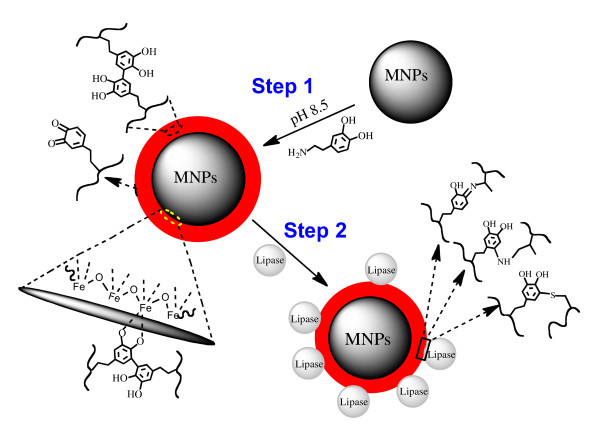
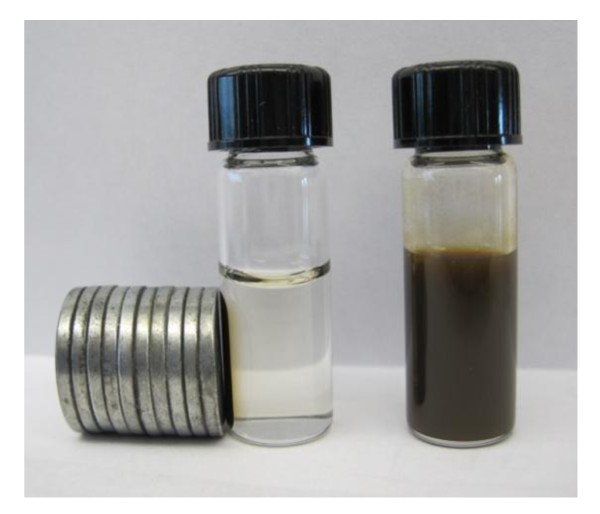
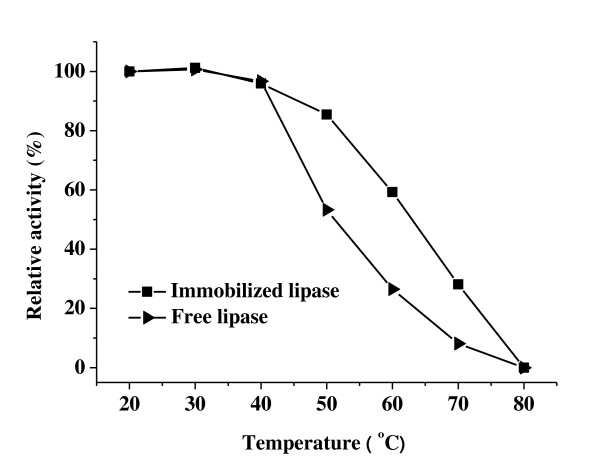
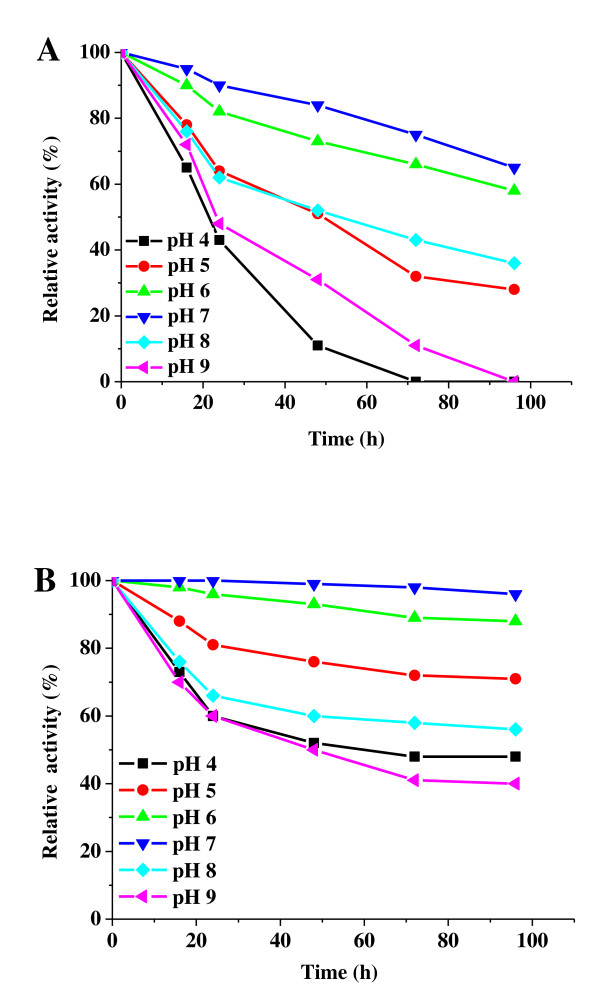
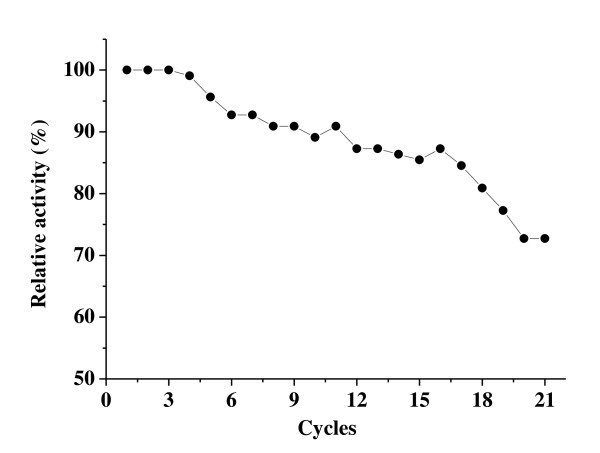
BACKGROUND: Immobilization of lipase on appropriate solid supports is one way to improve their stability and activity, and can be reused for large scale applications. A sample, cost- effective and high loading capacity method is still challenging. RESULTS: A facile method of lipase immobilization was developed in this study, by the use of polydopamine coated magnetic nanoparticles (PD-MNPs). Under optimal conditions, 73.9% of the available lipase was immobilized on PD-MNPs, yielding a lipase loading capacity as high as 429 mg/g. Enzyme assays revealed that lipase immobilized on PD-MNPs displayed enhanced pH and thermal stability compared to free lipase. Furthermore, lipase immobilized on PD-MNPs was easily isolated from the reaction medium by magnetic separation and retained more than 70% of initial activity after 21 repeated cycles of enzyme reaction followed by magnetic separation. CONCLUSIONS: Immobilization of enzyme onto magnetic iron oxide nanoparticles via poly-dopamine film is economical, facile and efficient.
Overview
The claims and statistics of this paper haven’t been checked yet.
Run the check — free, no account needed. It reads the open-access text and checks the sources it cites.
Integrity signals
Registry
Cites
Statistics
Figures
Verification
Claims the paper makes
The claims and statistics of this paper haven’t been checked yet.
Run the check — free, no account needed. It reads the open-access text and checks the sources it cites.
Claims other papers make about this one
Each is checked against this paper’s own text: does it say what the citing paper says it does?
The source backs part of the claim, not all of it — or backs it for a different population, condition or comparison.
In the citing paper
“In addition, biomacromolecules, such as proteins, peptides, and DNA, can anchor on the surface of biosubstitutes via the PDA coating layer [50, 57–60].”
From Polydopamine-Assisted Surface Modification for Bone Biosubstitutes (2016) · cites this paper as [60]
Experimental — accuracy not yet measured
Self-check
Percentages, sums and reported differences re-computed from the paper’s own numbers.
The self-check needs the paper’s full text.
Citations
Cites
Bradford, M. M. (1976) · Analytical Biochemistry · doi:10.1016/0003-2697(76)90527-3 · Cited by 255,302
Mussel-inspired surface chemistry for multifunctional coatings
Lee, H., Dellatore, S. M., Miller, W. M., & Messersmith, P. B. (2007) · Science · doi:10.1126/science.1147241 · Cited by 10,965
Self-citationImprovement of enzyme activity, stability and selectivity via immobilization techniques
Mateo, C., Palomo, J. M., Fernández‐Lorente, G., Guisan, J. M., & Fernández‐Lafuente, R. (2007) · Enzyme and Microbial Technology · doi:10.1016/j.enzmictec.2007.01.018 · Cited by 3,385
Single-molecule mechanics of mussel adhesion
Lee, H., Scherer, N. F., & Messersmith, P. B. (2006) · Proceedings of the National Academy of Sciences · doi:10.1073/pnas.0605552103 · Cited by 2,112
Self-citationFacile Conjugation of Biomolecules onto Surfaces via Mussel Adhesive Protein Inspired Coatings
Lee, H., Rho, J., & Messersmith, P. B. (2009) · Advanced Materials · doi:10.1002/adma.200801222 · Cited by 1,495
Self-citationXu, C., Xu, K., Gu, H., Zheng, R., Liu, H., Zhang, X., Guo, Z., & Xu, B. (2004) · Journal of the American Chemical Society · doi:10.1021/ja0464802 · Cited by 886
Immobilised enzymes: science or art?
Cao, L. (2005) · Current Opinion in Chemical Biology · doi:10.1016/j.cbpa.2005.02.014 · Cited by 634
Iron oxide nanoparticles–chitosan composite based glucose biosensor
Kaushik, A. K., Khan, R., Solanki, P. R., Pandey, P., Alam, J., Ahmad, S., & Malhotra, B. D. (2008) · Biosensors and Bioelectronics · doi:10.1016/j.bios.2008.06.032 · Cited by 462
Amstad, E., Gillich, T., Bilecka, I., Textor, M., & Reimhult, E. (2009) · Nano Letters · doi:10.1021/nl902212q · Cited by 460
Magnetic Nanoparticles and Their Applications in Medicine
Duguet, É., Vasseur, S., Mornet, S., & Devoisselle, J. (2006) · Nanomedicine · doi:10.2217/17435889.1.2.157 · Cited by 396
Cited by
Sorted by citations
Non‐Covalent Self‐Assembly and Covalent Polymerization Co‐Contribute to Polydopamine Formation
Hong, S., Na, Y. S., Choi, S., Song, I. T., Kim, W. Y., & Lee, H. (2012) · Advanced Functional Materials · doi:10.1002/adfm.201201156 · Cited by 1,367
Structure of Polydopamine: A Never-Ending Story?
Liebscher, J., Mrówczyński, R., Scheidt, H. A., Filip, C., Hădade, N. D., Turcu, R., Bende, A., & Beck, S. (2013) · Langmuir · doi:10.1021/la4020288 · Cited by 1,058
Microbial lipases and their industrial applications: a comprehensive review
Chandra, P., Enespa, Singh, R. P., & Arora, P. K. (2020) · Microbial Cell Factories · doi:10.1186/s12934-020-01428-8 · Cited by 964
Surface Modification of Water Purification Membranes
Miller, D. J., Dreyer, D. R., Bielawski, C. W., Paul, D. R., & Freeman, B. D. (2016) · Angewandte Chemie International Edition · doi:10.1002/anie.201601509 · Cited by 759
Recent approaches in designing bioadhesive materials inspired by mussel adhesive protein
Kord Forooshani, P., & Lee, B. P. (2017) · Journal of Polymer Science Part A: Polymer Chemistry · doi:10.1002/pola.28368 · Cited by 632
Metadata
- Authors
- Ren, Y., Rivera, J. G., He, L., Kulkarni, H., Lee, D.-K., & Messersmith, P. B.
- Affiliations
- East China University of Science and Technology (CN)
- Northwestern University (US)
- Corresponding author
- Ren, Yuhong
- Messersmith, Phillip B
- Venue
- BMC Biotechnology
- Published
- 2011-06-08
- Volume
- 11
- Issue
- 1
- Pages
- 63-63
- ISSN
- 1472-6750 (ISSN-L)
- PMC
- PMC3212977
- OpenAlex
- W2165613512
- Cited by
- 284
- References
- 23
- Citations by year
- 2026: 4 · 2025: 8 · 2024: 21 · 2023: 13 · 2022: 14 · 2021: 12 · 2020: 16 · 2019: 19 · 2018: 25 · 2017: 22 · 2016: 38 · 2015: 25 · 2014: 29 · 2013: 20 · 2012: 16
- FWCI
- 8.71
- Type
- journal article
- Language
- en
- Open access
- gold
- doi.org
- Licence
- Locations
- BMC Biotechnology (publishedVersion, cc-by)
- PubMed Central (publishedVersion, cc-by)
- PubMed (publishedVersion)
- DOAJ (DOAJ: Directory of Open Access Journals) (submittedVersion)
- eScholarship (California Digital Library) (submittedVersion)
- eScholarship (California Digital Library) (submittedVersion, cc-by)
- Funders
- National Institutes of Health
- National Institute of Dental and Craniofacial Research (R37DE014193)
- Topics
- Life Sciences › Biochemistry, Genetics and Molecular Biology › Molecular Biology › Enzyme Catalysis and Immobilization
- Life Sciences › Biochemistry, Genetics and Molecular Biology › Biotechnology › Enzyme Production and Characterization
- Life Sciences › Biochemistry, Genetics and Molecular Biology › Molecular Biology › Advanced Biosensing Techniques and Applications
- Keywords
- lipase immobilization, magnetic iron oxide nanoparticles, polydopamine coating, biomimetic coatings, enzyme loading capacity, enzyme stability, magnetic separation, enzyme reusability
- MeSH terms
- Dopamine, Enzymes, Immobilized, Ferric Compounds, Hydrogen-Ion Concentration, Lipase, Polymers, Temperature, Biomimetic Materials, Magnetite Nanoparticles
About these checks
Registry, retraction, Cites and statistics results are computed, not judged, with one exception: a printed reference that no index lists is read once by a model before it counts as a citation error. Claims are extracted by a model and kept only when their quote appears verbatim in the text; each cited source is then checked, with a model’s help, for whether it says what the claim relies on. Those verdicts can be wrong — read the claim’s quote and the cited source before relying on one.
Statistics and arithmetic are recomputed, not judged.
Confidence bands are shown only for fields calibrated on our annotated test set. None is calibrated yet, so no band is shown.
What counts as a claim ›How we measure confidence ›How we check this ›
Are you an author, or do you see a problem with this page? Request a review
