

Mindfulness-based stress reduction for low back pain. A systematic review
Open accessThe DOI matches its Crossref record; 39 of the 39 references it cites were found in a registry or an index.
Abstract
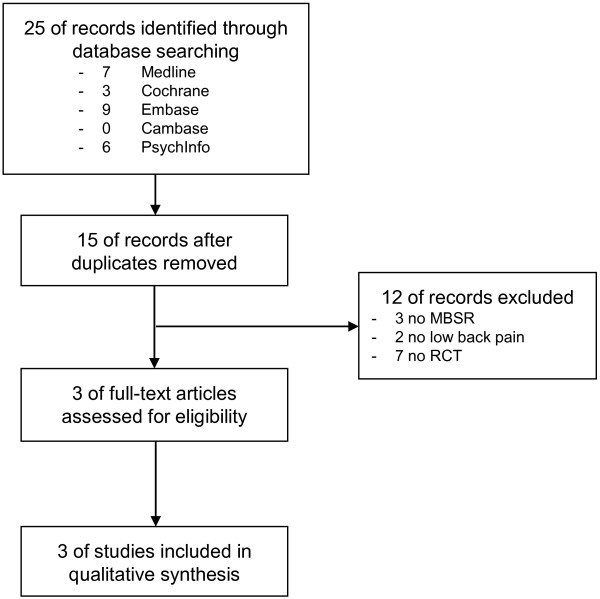
BACKGROUND: Mindfulness-based stress reduction (MBSR) is frequently used for pain conditions. While systematic reviews on MBSR for chronic pain have been conducted, there are no reviews for specific pain conditions. Therefore a systematic review of the effectiveness of MBSR in low back pain was performed. METHODS: MEDLINE, the Cochrane Library, EMBASE, CAMBASE, and PsycInfo were screened through November 2011. The search strategy combined keywords for MBSR with keywords for low back pain. Randomized controlled trials (RCTs) comparing MBSR to control conditions in patients with low back pain were included. Two authors independently assessed risk of bias using the Cochrane risk of bias tool. Clinical importance of group differences was assessed for the main outcome measures pain intensity and back-specific disability. RESULTS: Three RCTs with a total of 117 chronic low back pain patients were included. One RCT on failed back surgery syndrome reported significant and clinically important short-term improvements in pain intensity and disability for MBSR compared to no treatment. Two RCTs on older adults (age ≥ 65 years) with chronic specific or non-specific low back pain reported no short-term or long-term improvements in pain or disability for MBSR compared to no treatment or health education. Two RCTs reported larger short-term improvements of pain acceptance for MBSR compared to no treatment. CONCLUSION: This review found inconclusive evidence of effectiveness of MBSR in improving pain intensity or disability in chronic low back pain patients. However, there is limited evidence that MBSR can improve pain acceptance. Further RCTs with larger sample sizes, adequate control interventions, and longer follow-ups are needed before firm conclusions can be drawn.
Overview
The claims and statistics of this paper haven’t been checked yet.
Free: it reads the open-access text and checks the first 5 claims that cite a source we can check. Create a free account to check every claim.
Integrity signals
Registry
Cites
Statistics
Figures
Verification
Claims the paper makes
The claims and statistics of this paper haven’t been checked yet.
Free: it reads the open-access text and checks the first 5 claims that cite a source we can check. Create a free account to check every claim.
Claims other papers make about this one
Each is checked against this paper’s own text: does it say what the citing paper says it does?
The source backs part of the claim, not all of it — or backs it for a different population, condition or comparison.
In the citing paper
“In addition, studies on Mindfulness-Based Stress Reduction (MBSR) program report decreasing pain intensity and disability (Cramer et al., 2012).”
From The Development of Mindful-Based Dance Movement Therapy Intervention for Chronic Pain: A Pilot Study With Chronic Headache Patients (2021) · cites this paper as Cramer et al., 2012
Experimental — accuracy not yet measuredThe cited source says what the claim attributes to it.
In the citing paper
“Information on stress management was adapted from principles of Mindfulness Based Stress Reduction (MBSR) [16], a promising mind-body intervention [28–31].”
From Engaging women with an embodied conversational agent to deliver mindfulness and lifestyle recommendations: A feasibility randomized control trial (2017) · cites this paper as [30]
In the citing paper
“published work does show that MBIs generally improve depression, pain acceptance, coping, and the ability to better control pain in people with chronic pain conditions [28–33].”
From Mindfulness and physical disease: a concise review (2019) · cites this paper as [31]
In the citing paper
“For clinical population, highlights the decrease in pain intensity, stress, and psychological complaints among patients suffering from diverse chronic pain/inflammatory diseases (Cramer et al., 2012; Lauche et al., 2013) and cancer (Ledesma and Kumano, 2009).”
From Mindfulness and Emotion Regulation: Insights from Neurobiological, Psychological, and Clinical Studies (2017) · cites this paper as Cramer et al., 2012
Self-check
Percentages, sums and reported differences re-computed from the paper’s own numbers.
The self-check needs the paper’s full text.
Citations
Cites
Preferred Reporting Items for Systematic Reviews and Meta-Analyses: the PRISMA statement
Moher, D., Liberati, A., Tetzlaff, J., Altman, D. G., & for the PRISMA Group (2009) · BMJ · doi:10.1136/bmj.b2535 · Cited by 83,823
Preferred Reporting Items for Systematic Reviews and Meta-Analyses: The PRISMA Statement
Moher, D., Liberati, A., Tetzlaff, J., Altman, D. G., & The PRISMA Group (2009) · PLoS Medicine · doi:10.1371/journal.pmed.1000097 · Cited by 64,042
Preferred reporting items for systematic reviews and meta-analyses: the PRISMA Statement.
(2009) · PubMed Central · Cited by 44,859
Preferred reporting items for systematic reviews and meta-analyses: The PRISMA statement
Moher, D., Liberati, A., Tetzlaff, J., Altman, D. G., & the PRISMA Group* (2009) · Annals of Internal Medicine · doi:10.7326/0003-4819-151-4-200908180-00135 · Cited by 37,554
(2008) · Medical Entomology and Zoology · Cited by 7,477
Cochrane Handbook for Systematic Reviews of Interventions Version 5.0.1. The Cochrane Collaboration
Higgins, J. P. T., Green, S. R., & Higgins, J. P. T. (2008) · Cited by 7,259
Mindfulness: A proposed operational definition.
Bishop, S. R., Lau, M., Shapiro, S., Carlson, L., Anderson, N. D., Carmody, J., Segal, Z. V., Abbey, S., Speca, M., Velting, D., et al. (2004) · Clinical Psychology: Science and Practice · doi:10.1093/clipsy.bph077 · Cited by 7,234 · cited 2×
“While mindfulness has been described as the core construct of Buddhist meditation [5], it also comprises a specific state of consciousness that has been characterized as non-elaborative, non-judgmental moment-to moment awareness, a way to accept and trust in one’s own experience [6].”
BackgroundEisenberg, D. M., Davis, R. B., Ettner, S. L., Appel, S., Wilkey, S., Van Rompay, M., & Kessler, R. C. (1998) · JAMA · doi:10.1001/jama.280.18.1569 · Cited by 6,658 · cited 1×
“Low back pain is the most common condition for which complementary therapies are used [3].”
BackgroundMindfulness training as a clinical intervention: a conceptual and empirical review
Baer, R. A. (2003) · Clinical Psychology: Science and Practice · doi:10.1093/clipsy.bpg015 · Cited by 4,577 · cited 1×
“Pain has been a key topic of research on MBSR from the beginning [9].”
BackgroundMindfulness training as a clinical intervention: A conceptual and empirical review.
Baer, R. A. (2003) · Clinical Psychology: Science and Practice · doi:10.1093/clipsy/bpg015 · Cited by 4,576
Kabat-Zinn, J. (1982) · General Hospital Psychiatry · doi:10.1016/0163-8343(82)90026-3 · Cited by 4,255 · cited 1×
“Several trials assessed the effect of MBSR on patients with heterogeneous chronic pain conditions, mainly reporting positive results [15-19].”
BackgroundShapiro, S. L., Carlson, L. E., Astin, J. A., & Freedman, B. (2006) · Journal of Clinical Psychology · doi:10.1002/jclp.20237 · Cited by 4,002 · cited 1×
“Therefore, mindfulness-based therapies not only include training in so-called formal practice of mindfulness, this is meditation, but also training in so-called informal practice of mindfulness, this is retaining a mindful state of consciousness during routine activities in everyday life [7,8].”
BackgroundDworkin, R. H., Turk, D. C., Wyrwich, K. W., Beaton, D., Cleeland, C. S., Farrar, J. T., Haythornthwaite, J. A., Jensen, M. P., Kerns, R. D., Ader, D. N., et al. (2008) · The Journal of Pain · doi:10.1016/j.jpain.2007.09.005 · Cited by 3,471 · cited 1×
“100 mm visual analog scale of pain intensity [22], and”
BackgroundPrevention of relapse/recurrence in major depression by mindfulness-based cognitive therapy.
Teasdale, J. D., Segal, Z. V., Williams, J. M. G., Ridgeway, V. A., Soulsby, J. M., & Lau, M. A. (2000) · Journal of Consulting and Clinical Psychology · doi:10.1037/0022-006x.68.4.615 · Cited by 3,236 · cited 2×
“depression [11], MBCT is more and more adapted for other specific conditions [12].”
Background(2005) · Medical Entomology and Zoology · Cited by 3,197
Updated Method Guidelines for Systematic Reviews in the Cochrane Collaboration Back Review Group
van Tulder, M., Furlan, A., Bombardier, C., & Bouter, L. (2003) · Spine · doi:10.1097/01.brs.0000065484.95996.af · Cited by 2,180
The clinical use of mindfulness meditation for the self-regulation of chronic pain
Kabat-Zinn, J., Lipworth, L., & Burney, R. (1985) · Journal of Behavioral Medicine · doi:10.1007/bf00845519 · Cited by 1,745 · cited 1×
“Several trials assessed the effect of MBSR on patients with heterogeneous chronic pain conditions, mainly reporting positive results [15-19].”
BackgroundVeehof, M. M., Oskam, M.-J., Schreurs, K. M. G., & Bohlmeijer, E. T. (2011) · PAIN · doi:10.1016/j.pain.2010.11.002 · Cited by 792
Learning to live with the pain: acceptance of pain predicts adjustment in persons with chronic pain
McCracken, L. M. (1998) · Pain · doi:10.1016/s0304-3959(97)00146-2 · Cited by 685 · cited 1×
“lower pain intensity and disability [33].”
Morone, N. E., Greco, C. M., & Weiner, D. K. (2008) · Pain · doi:10.1016/j.pain.2007.04.038 · Cited by 546
Acceptance and Values-Based Action in Chronic Pain: A Study of Treatment Effectiveness and Process
Vowles, K. E., & McCracken, L. M. (2008) · Journal of Consulting and Clinical Psychology · doi:10.1037/0022-006x.76.3.397 · Cited by 500 · cited 1×
“Several trials assessed the effect of MBSR on patients with heterogeneous chronic pain conditions, mainly reporting positive results [15-19].”
BackgroundKabat-Zinn, J., Lipworth, L., Burncy, R., & Sellers, W. (1986) · The Clinical Journal of Pain · doi:10.1097/00002508-198602030-00004 · Cited by 483 · cited 1×
“Several trials assessed the effect of MBSR on patients with heterogeneous chronic pain conditions, mainly reporting positive results [15-19].”
BackgroundA Systematic Review and Meta-analysis of Yoga for Low Back Pain
Cramer, H., Lauche, R., Haller, H., & Dobos, G. (2013) · The Clinical Journal of Pain · doi:10.1097/ajp.0b013e31825e1492 · Cited by 405
Schmidt, C. O., Raspe, H., Pfingsten, M., Hasenbring, M., Basler, H. D., Eich, W., & Kohlmann, T. (2007) · Spine · doi:10.1097/brs.0b013e318133fad8 · Cited by 379 · cited 1×
“Background Low back pain is a major public health problem, with 76 % of the population experiencing low back pain in a given year [1].”
BackgroundDeveloping patient-reported outcome measures for pain clinical trials: IMMPACT recommendations
Turk, D. C., Dworkin, R. H., Burke, L. B., Gershon, R., Rothman, M., Scott, J., Allen, R. R., Atkinson, H. J., Chandler, J., Cleeland, C., et al. (2006) · Pain · doi:10.1016/j.pain.2006.09.028 · Cited by 301 · cited 1×
“IMMPACT recommendations [31], pain relief is not the”
BackgroundPatterns and Perceptions of Care for Treatment of Back and Neck Pain: Results of a National Survey
Wolsko, P. M., Eisenberg, D. M., Davis, R. B., Kessler, R., & Phillips, R. S. (2003) · Spine · doi:10.1097/01.brs.0000042225.88095.7c · Cited by 240 · cited 1×
“In the US, more than half of patients suffering from low back pain use complementary therapies [4].”
Background(2006) · doi:10.1016/b978-012088519-0/50002-2 · Cited by 178
A mind-body program for older adults with chronic low back pain: results of a pilot study.
Morone, N. E., Rollman, B. L., Moore, C. G., Li, Q., & Weiner, D. K. (2009) · Pain Medicine · doi:10.1111/j.1526-4637.2009.00746.x · Cited by 157 · cited 10×
“2009 [26] Low risk Low risk Low risk Low risk High risk Low risk Low risk”
BackgroundMethodResultInfluentialYoga for low back pain: a systematic review of randomized clinical trials
Posadzki, P., & Ernst, E. (2011) · Clinical Rheumatology · doi:10.1007/s10067-011-1764-8 · Cited by 128 · cited 1×
“Yoga has been reported to increase back-related function and to decrease disability in patients suffering from low back pain [29,30].”
BackgroundGardner-Nix, J., Backman, S., Barbati, J., & Grummitt, J. (2008) · Journal of Telemedicine and Telecare · doi:10.1258/jtt.2007.070811 · Cited by 124 · cited 1×
“Several trials assessed the effect of MBSR on patients with heterogeneous chronic pain conditions, mainly reporting positive results [15-19].”
BackgroundMindfulness-Based Cognitive Therapy: Distinctive Features
Crane, R. S. (2008) · Cited by 114
Effects of mindful and non‐mindful exercises on people with depression: A systematic review
Tsang, H. W. H., Chan, E. P., & Cheung, W. M. (2008) · British Journal of Clinical Psychology · doi:10.1348/014466508x279260 · Cited by 110 · cited 1×
“interventions include mindful exercise [13] and acceptance and commitment therapy [14] that do not necessarily include formal meditation practice.”
Background(2010) · PubMed · Cited by 108
von Trott, P., Wiedemann, A. M., Lüdtke, R., Reißhauer, A., Willich, S. N., & Witt, C. M. (2009) · Journal of Pain · doi:10.1016/j.jpain.2008.11.004 · Cited by 108 · cited 1×
“It has been argued that standard pain measurement instruments might not be suitable for elderly patients [27,28].”
BackgroundNilges, P., Köster, B., & Schmidt, C. O. (2007) · Der Schmerz · doi:10.1007/s00482-006-0508-1 · Cited by 82 · cited 1×
“tion in spite of their pain as far as possible [32].”
BackgroundEpidemiology of occupational low back pain.
Shelerud, R. A. (1998) · PubMed · doi:10.1016/j.coem.2006.05.004 · Cited by 77 · cited 1×
“It has become the largest category of medical claims, placing a major burden on individuals and health care systems [2].”
BackgroundCUSHING'S SYNDROME: CLINICAL DIFFERENTIAL DIAGNOSIS AND COMPLICATIONS
HURXTHAL, L. M., & O'SULLIVAN, J. B. (1959) · Annals of Internal Medicine · doi:10.7326/0003-4819-51-1-1 · Cited by 67
Pain Assessment in a Geriatric Psychiatry Program
Stolee, P., Hillier, L. M., Esbaugh, J., Bol, N., McKellar, L., Gauthier, N., & Gibson, M. (2007) · Pain Research and Management · doi:10.1155/2007/975282 · Cited by 8 · cited 2×
“Specialized comprehensive approaches might be needed to correctly assess pain intensity in elderly patients [28].”
Background
Cited by
Mindfulness Meditation for Chronic Pain: Systematic Review and Meta-analysis
Hilton, L., Hempel, S., Ewing, B. A., Apaydin, E., Xenakis, L., Newberry, S., Colaiaco, B., Maher, A. R., Shanman, R. M., Sorbero, M. E., et al. (2017) · Annals of Behavioral Medicine · doi:10.1007/s12160-016-9844-2 · Cited by 977
“Of those that report pain outcomes, several have focused on specific types of pain such as low back pain [13], fibromyalgia [15], or somatization disorder [16].”
BackgroundCherkin, D. C., Sherman, K. J., Balderson, B. H., Cook, A. J., Anderson, M. L., Hawkes, R. J., Hansen, K. E., & Turner, J. A. (2016) · JAMA · doi:10.1001/jama.2016.2323 · Cited by 729
Hannibal, K. E., & Bishop, M. D. (2014) · Physical Therapy · doi:10.2522/ptj.20130597 · Cited by 729
Guendelman, S., Medeiros, S., & Rampes, H. (2017) · Frontiers in Psychology · doi:10.3389/fpsyg.2017.00220 · Cited by 577
“For clinical population, highlights the decrease in pain intensity, stress, and psychological complaints among patients suffering from diverse chronic pain/inflammatory diseases (Cramer et al., 2012; Lauche et al., 2013) and cancer (Ledesma and Kumano, 2009).”
BackgroundGotink, R. A., Chu, P., Busschbach, J. J. V., Benson, H., Fricchione, G. L., & Hunink, M. G. M. (2015) · PLOS ONE · doi:10.1371/journal.pone.0124344 · Cited by 539
“Quality of life favoured MBSR compared to the health education program but did not reach statistical significance when compared to wait list control [23].”
ResultRetracted
Metadata
- Authors
- Cramer, H., Haller, H., Lauche, R., & Dobos, G.
- Affiliations
- Kliniken Essen-Mitte (DE)
- University of Duisburg-Essen (DE)
- Corresponding author
- Cramer, Holger
- Venue
- BMC Complementary and Alternative Medicine
- Published
- 2012-09-25
- Volume
- 12
- Issue
- 1
- Pages
- 162-162
- ISSN
- 1472-6882 (ISSN-L)
- PMC
- PMC3520871
- OpenAlex
- W2094934517
- Cited by
- 193
- References
- 36
- Citations by year
- 2026: 8 · 2025: 7 · 2024: 14 · 2023: 12 · 2022: 11 · 2021: 18 · 2020: 9 · 2019: 12 · 2018: 13 · 2017: 24 · 2016: 20 · 2015: 25 · 2014: 12 · 2013: 7
- FWCI
- 1.97
- Type
- journal article
- Language
- en
- Open access
- gold
- doi.org
- Licence
- cc-by
- creativecommons.org/licenses/by/2.0 (tdm)
- Locations
- BMC Complementary and Alternative Medicine (publishedVersion, cc-by)
- Europe PMC (PubMed Central) (publishedVersion, cc-by)
- PubMed Central (publishedVersion, cc-by)
- PubMed (publishedVersion)
- Universitätsbibliographie, Universität Duisburg-Essen (submittedVersion)
- DOAJ (DOAJ: Directory of Open Access Journals) (submittedVersion, cc-by-sa)
- DuEPublico (University of Duisburg-Essen) (submittedVersion, cc-by)
- UTS ePRESS (University of Technology Sydney) (submittedVersion)
- Topics
- Social Sciences › Psychology › Clinical Psychology › Mindfulness and Compassion Interventions
- Health Sciences › Health Professions › Physical Therapy, Sports Therapy and Rehabilitation › Musculoskeletal pain and rehabilitation
- Health Sciences › Medicine › Anesthesiology and Pain Medicine › Pain Management and Treatment
- Keywords
- mindfulness-based stress reduction, low back pain, chronic low back pain, pain intensity, disability, pain acceptance, failed back surgery syndrome, older adults, mindfulness-based interventions
- MeSH terms
- Chronic Disease, Disability Evaluation, Humans, Severity of Illness Index, Stress, Psychological, Low Back Pain, Meditation
About these checks
Registry, retraction, Cites and statistics results are computed, not judged, with one exception: a printed reference that no index lists is read once by a model before it counts as a citation error. Claims are extracted by a model and kept only when their quote appears verbatim in the text; each cited source is then checked, with a model’s help, for whether it says what the claim relies on. Those verdicts can be wrong — read the claim’s quote and the cited source before relying on one.
Statistics and arithmetic are recomputed, not judged.
Confidence bands are shown only for fields calibrated on our annotated test set. None is calibrated yet, so no band is shown.
What counts as a claim ›How we measure confidence ›How we check this ›
Are you an author, or do you see a problem with this page? Request a review
Data sources
Bibliographic data: Semantic Scholar, OpenAlex, Crossref.
Contains information from the Semantic Scholar Academic Graph Datasets, made available under the ODC Attribution License (ODC-BY 1.0).
Semantic Scholar’s data is described in: Kinney, R., et al. (2023). The Semantic Scholar Open Data Platform. arXiv:2301.10140.
