

The DOI matches its Crossref record; 26 of the 26 references it cites were found in a registry or an index.
Spirituality and health in the curricula of medical schools in Brazil
Open accessAbstract
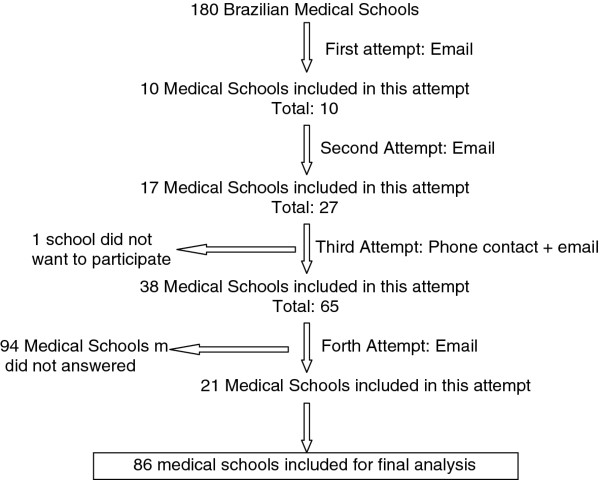
BACKGROUND: According to recent surveys, 59% of British medical schools and 90% of US medical schools have courses or content on spirituality and health (S/H). There is little research, however, on the teaching of S/H in medical schools in other countries, such as those in Latin America, Asia, Australia and Africa. The present study seeks to investigate the current status of teaching on S/H in Brazilian medical schools. METHODS: All medical schools in Brazil (private and public) were selected for evaluation, were contacted by email and phone, and were administered a questionnaire. The questionnaire, sent by e-mail, asked medical school directors/deans about any S/H courses that were taught, details about those courses, S/H lectures or seminars, importance of teaching this subject for medical school directors, and medical schools characteristics. RESULTS: A total of 86 out of 180 (47.7%) medical schools responded. Results indicated that 10.4% of Brazilian Medical Schools have a dedicated S/H courses and 40.5% have courses or content on spirituality and health. Only two medical schools have S/H courses that involve hands-on training and three schools have S/H courses that teach how to conduct a spiritual history. The majority of medical directors (54%) believe that S/H is important to teach in their schools. CONCLUSION: Few Brazilian medical schools have courses dealing specifically with S/H and less than half provide some form of teaching on the subject. Unfortunately, there is no standard curriculum on S/H. Nevertheless, the majority of medical directors believe this issue is an important subject that should be taught.
Overview
The claims and statistics of this paper haven’t been checked yet.
Run the check — free, no account needed. It reads the open-access text and checks the sources it cites.
Integrity signals
Registry
Cites
Statistics
Figures
Verification
Claims the paper makes
The claims and statistics of this paper haven’t been checked yet.
Run the check — free, no account needed. It reads the open-access text and checks the sources it cites.
Claims other papers make about this one
Each is checked against this paper’s own text: does it say what the citing paper says it does?
The source backs part of the claim, not all of it — or backs it for a different population, condition or comparison.
In the citing paper
“Fourth, physicians' own R/S beliefs often influence medical decisions they make and affect the type of care they offer to patients, including decisions about use of pain medications [588], abortion [589], vaccinations [590], and contraception [591].”
From Religion, Spirituality, and Health: The Research and Clinical Implications (2012) · cites this paper as [588]
Experimental — accuracy not yet measured
Self-check
Percentages, sums and reported differences re-computed from the paper’s own numbers.
The self-check needs the paper’s full text.
Citations
Cites
Handbook of Religion and Health
Koenig, H. G., McCullough, M. E., & Larson, D. B. (2004) · American Journal of Geriatric Psychiatry · doi:10.1097/00019442-200405000-00015 · Cited by 3,262
Self-citationHandbook of Religion and Health
Koenig, H., McCullough, M., & Larson, D. (2001) · doi:10.1093/acprof:oso/9780195118667.001.0001 · Cited by 2,581
Self-citationPuchalski, C., Ferrell, B., Virani, R., Otis-Green, S., Baird, P., Bull, J., Chochinov, H., Handzo, G., Nelson-Becker, H., Prince-Paul, M., et al. (2009) · Journal of Palliative Medicine · doi:10.1089/jpm.2009.0142 · Cited by 1,566
Spirituality, religion, and health: An emerging research field.
Miller, W. R., & Thoresen, C. E. (2003) · American Psychologist · doi:10.1037/0003-066x.58.1.24 · Cited by 1,437
Taking a Spiritual History Allows Clinicians to Understand Patients More Fully
Puchalski, C. M., & Romer, A. L. (2000) · Journal of Palliative Medicine · doi:10.1089/jpm.2000.3.129 · Cited by 746
Physicians and Patient Spirituality: Professional Boundaries, Competency, and Ethics
Post, S. G., Puchalski, C. M., & Larson, D. B. (2000) · Annals of Internal Medicine · doi:10.7326/0003-4819-132-7-200004040-00010 · Cited by 417
Evaluation of the FICA Tool for Spiritual Assessment
Borneman, T. R., FERRELL, B. R., & Puchalski, C. M. (2010) · Journal of Pain and Symptom Management · doi:10.1016/j.jpainsymman.2009.12.019 · Cited by 346
Should Physicians Prescribe Religious Activities?
Sloan, R. P., Bagiella, E., VandeCreek, L., Hover, M., Casalone, C., Hirsch, T. J., Hasan, Y., Kreger, R., & Poulos, P. (2000) · New England Journal of Medicine · doi:10.1056/nejm200006223422513 · Cited by 333
Developing curricula in spirituality and medicine
Puchalski, C. M., & Larson, D. B. (1998) · Academic Medicine · doi:10.1097/00001888-199809000-00015 · Cited by 277
Oxford Textbook of Spirituality in Healthcare
Cobb, M. R., Puchalski, C. M., & Rumbold, B. (2012) · doi:10.1093/med/9780199571390.001.0001 · Cited by 270
Spirituality, religion and health: evidence and research directions
Williams, D. R., & Sternthal, M. J. (2007) · The Medical Journal of Australia · doi:10.5694/j.1326-5377.2007.tb01040.x · Cited by 223
Spirituality in Medical School Curricula: Findings from a National Survey
Koenig, H. G., Hooten, E. G., Lindsay-Calkins, E., & Meador, K. G. (2010) · The International Journal of Psychiatry in Medicine · doi:10.2190/pm.40.4.c · Cited by 183 · cited 3×
“These results are even more positive than those from a study of US medical school deans [12], of whom less than 40% felt that introducing S/H contents into the curriculum was important and only 10% indicated their faculty valued S/H content as “very valuable.”
BackgroundResultSelf-citationLucchetti, G., Lucchetti, A. L. G., Badan-Neto, A., Peres, P., Peres, M., Moreira‐Almeida, A., Gomes, C. D. S., & Koenig, H. G. (2011) · Journal of Rehabilitation Medicine · doi:10.2340/16501977-0784 · Cited by 149
Self-citationEnvolvimento religioso e fatores sociodemográficos: resultados de um levantamento nacional no Brasil
Moreira‐Almeida, A., Pinsky, I., Zaleski, M., & Laranjeira, R. (2010) · Archives of Clinical Psychiatry (São Paulo) · doi:10.1590/s0101-60832010000100003 · Cited by 142
The Teaching of Complementary and Alternative Medicine in U.S. Medical Schools
Brokaw, J. J., Tunnicliff, G., Raess, B. U., & Saxon, D. W. (2002) · Academic Medicine · doi:10.1097/00001888-200209000-00013 · Cited by 132
Spirituality and Medicine: Curricula in Medical Education
Puchalski, C. M. (2006) · Journal of Cancer Education · doi:10.1207/s15430154jce2101_6 · Cited by 97
Spirituality in Medical Education: Global Reality?
Lucchetti, G., Lucchetti, A., & Puchalski, C. (2012) · Journal of religion and health · doi:10.1007/s10943-011-9557-6 · Cited by 96
Self-citationCurrent status of teaching on spirituality in UK medical schools
Neely, D., & Minford, E. J. (2008) · Medical Education · doi:10.1111/j.1365-2923.2007.02980.x · Cited by 95
Koenig, H. G. (2004) · JAMA · doi:10.1001/jama.291.23.2881 · Cited by 61
Self-citationBarnett, K. G., & Fortin, A. H. (2006) · Journal of General Internal Medicine · doi:10.1111/j.1525-1497.2006.00431.x · Cited by 60
Religion, spirituality and health: how should Australia's medical professionals respond?
Peach, H. G. (2003) · The Medical Journal of Australia · doi:10.5694/j.1326-5377.2003.tb05071.x · Cited by 60
Fenton, M. V., & Morris, D. (2003) · PubMed · Cited by 49
Care needed when interpreting the importance of competency-based assessments.
Mariotti, L. L., Lucchetti, G., Dantas, M. F., Banin, V. B., Fumelli, F., & Padula, N. A. D. M. R. (2011) · PubMed · Cited by 21
Self-citationIntegration of spirituality courses in Brazilian medical schools
Lucchetti, G., & Lucchetti, A. L. G. (2010) · Medical Education · doi:10.1111/j.1365-2923.2009.03584.x · Cited by 20
Self-citationNisselle, P. (2007) · The Medical Journal of Australia · doi:10.5694/j.1326-5377.2007.tb00793.x · Cited by 17
Costa, W., Nogueira, C., & Freire, T. (2009) · Journal of Religion and Health · doi:10.1007/s10943-009-9255-9 · Cited by 13
Research works printed but not linked: 1
- Mariotti L, Lucchetti G, Dantas M, Banin V, Fumelli F, Padula N: Spirituality and medicine: views and opinions of teachers in a Brazilian medical school. Medical teacher. 2011, 33: 339-340.
Cited by
Sorted by citations
Religion, Spirituality, and Health: The Research and Clinical Implications
Koenig, H. G. (2012) · ISRN Psychiatry · doi:10.5402/2012/278730 · Cited by 2,423
“Today, nearly 90% of medical schools (and many nursing schools) in the US include something about R/S in their curricula [596] and this is also true to a lesser extent in the United Kingdom [597] and Brazil [598].”
BackgroundSelf-citationSpirituality, religiousness, and mental health: A review of the current scientific evidence
Lucchetti, G., Koenig, H. G., & Lucchetti, A. L. G. (2021) · World Journal of Clinical Cases · doi:10.12998/wjcc.v9.i26.7620 · Cited by 451
Self-citationClinical implications of spirituality to mental health: review of evidence and practical guidelines
Moreira-Almeida, A., Koenig, H. G., & Lucchetti, G. (2014) · Revista Brasileira de Psiquiatria · doi:10.1590/1516-4446-2013-1255 · Cited by 261
Self-citationMedical students, spirituality and religiosity-results from the multicenter study SBRAME
Collaborators, F. T. S., Lucchetti, G., de Oliveira, L. R., Koenig, H. G., Leite, J. R., & Lucchetti, A. L. (2013) · BMC Medical Education · doi:10.1186/1472-6920-13-162 · Cited by 150
Self-citationTaking Spiritual History in Clinical Practice: A Systematic Review of Instruments
Lucchetti, G., Bassi, R. M., & Lucchetti, A. L. G. (2013) · EXPLORE · doi:10.1016/j.explore.2013.02.004 · Cited by 108
Self-citation
Metadata
- Authors
- Lucchetti, G., Lucchetti, A. L. G., Espinha, D. C. M., de Oliveira, L. R., Leite, J. R., & Koenig, H. G.
- Affiliations
- Universidade Federal de São Paulo (BR)
- King Abdulaziz University (SA)
- Corresponding author
- Lucchetti, Giancarlo
- Venue
- BMC Medical Education
- Published
- 2012-08-18
- Volume
- 12
- Issue
- 1
- Pages
- 78-78
- ISSN
- 1472-6920 (ISSN-L)
- PMC
- PMC3502099
- OpenAlex
- W2057959433
- Cited by
- 129
- References
- 26
- Citations by year
- 2026: 6 · 2025: 4 · 2024: 5 · 2023: 26 · 2022: 9 · 2021: 15 · 2020: 13 · 2019: 9 · 2018: 6 · 2017: 8 · 2016: 11 · 2015: 5 · 2014: 3 · 2013: 7 · 2012: 2
- FWCI
- 6.19
- Type
- journal article
- Language
- en
- Open access
- gold
- doi.org
- Licence
- Locations
- BMC Medical Education (publishedVersion, cc-by)
- Europe PMC (PubMed Central) (publishedVersion, cc-by)
- PubMed Central (publishedVersion, cc-by)
- PubMed (publishedVersion)
- Americanae (AECID Library) (submittedVersion, other-oa)
- DOAJ (DOAJ: Directory of Open Access Journals) (submittedVersion, cc-by-sa)
- LA Referencia (Red Federada de Repositorios Institucionales de Publicaciones Científicas) (submittedVersion, other-oa)
- Topics
- Social Sciences › Health › Religion, Spirituality, and Psychology
- Social Sciences › Education › Innovations in Medical Education
- Health Sciences › Medicine › Psychiatry and Mental health › Empathy and Medical Education
- Keywords
- spirituality and health, medical education, medical curriculum, curriculum evaluation, spiritual history taking, hands-on training, Brazil
- MeSH terms
- Attitude of Health Personnel, Brazil, Clinical Competence, Cross-Sectional Studies, Cross-Cultural Comparison, Curriculum, Education, Medical, Health, Humans, Physician Executives, Physician-Patient Relations, Surveys and Questionnaires, Religion and Medicine, Schools, Medical, Students, Medical, Spirituality
About these checks
Registry, retraction, Cites and statistics results are computed, not judged, with one exception: a printed reference that no index lists is read once by a model before it counts as a citation error. Claims are extracted by a model and kept only when their quote appears verbatim in the text; each cited source is then checked, with a model’s help, for whether it says what the claim relies on. Those verdicts can be wrong — read the claim’s quote and the cited source before relying on one.
Statistics and arithmetic are recomputed, not judged.
Confidence bands are shown only for fields calibrated on our annotated test set. None is calibrated yet, so no band is shown.
What counts as a claim ›How we measure confidence ›How we check this ›
Are you an author, or do you see a problem with this page? Request a review
