

Mindfulness training for stress management: a randomised controlled study of medical and psychology students
Open accessThe DOI matches its Crossref record; 50 of the 51 references it cites were found in a registry or an index.
Abstract
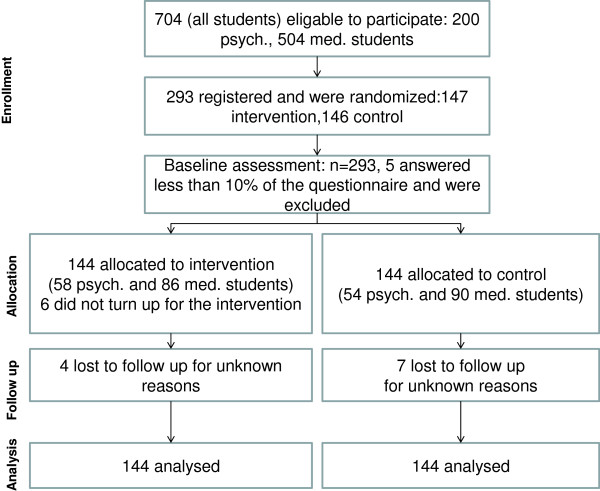
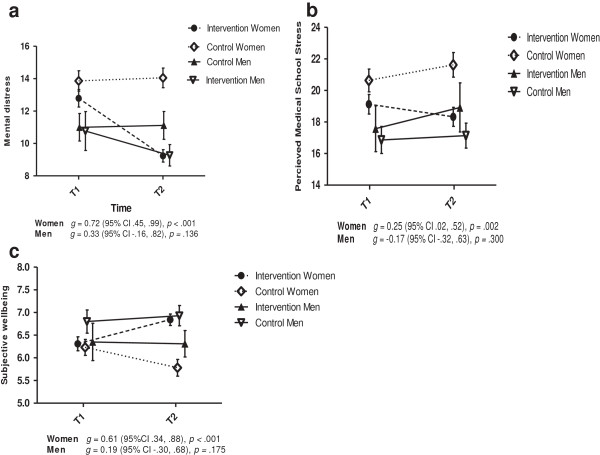
Background: Distress and burnout among medical and psychology professionals are commonly reported and have implications for the quality of patient care delivered. Already in the course of university studies, medicine and psychology students report mental distress and low life satisfaction. There is a need for interventions that promote better coping skills in students in order to prevent distress and future burnout. This study examines the effect of a seven-week Mindfulness-Based Stress Reduction (MBSR) programme on mental distress, study stress, burnout, subjective well-being, and mindfulness of medical and psychology students. Methods: A total of 288 students (mean age = 23 years, 76% female) from the University of Oslo and the University of Tromsø were randomly allocated to an intervention or control group. The control group continued with their standard university courses and received no intervention. Participants were evaluated using self-reported measures both before and after the intervention. These were: the ‘General Health Questionnaire, Maslach Burnout Inventory Student version, Perceived Medical School Stress, Subjective Well-being, and Five Facet Mindfulness Questionnaire’ and additional indices of compliance. Results: Following the intervention, a moderate effect on mental distress (Hedges’g 0.65, CI = .41, .88), and a small effect on both subjective well-being (Hedges’g 0.40, CI = .27, .63) and the mindfulness facet ‘non-reacting’ (Hedges’g 0.33, CI = .10, .56) were found in the intervention group compared with the control group. A higher level of programme attendance and reported mindfulness exercises predicted these changes. Significant effects were only found for female students who additionally reported reduced study stress and an increase in the mindfulness facet ‘non-judging’. Gender specific effects of participation in the MBSR programme have not previously been reported, and gender differences in the present study are discussed. Conclusion: Female medical and psychology students experienced significant positive improvements in mental distress, study stress, subjective well-being and mindfulness after participating in the MBSR programme. Trial registration: NCT00892138
Overview
The claims and statistics of this paper haven’t been checked yet.
Free: it reads the open-access text and checks the first 5 claims that cite a source we can check. Create a free account to check every claim.
Integrity signals
Registry
Cites
Statistics
Figures
Verification
Claims the paper makes
The claims and statistics of this paper haven’t been checked yet.
Free: it reads the open-access text and checks the first 5 claims that cite a source we can check. Create a free account to check every claim.
Claims other papers make about this one
Each is checked against this paper’s own text: does it say what the citing paper says it does?
The cited source says what the claim attributes to it.
In the citing paper
“It was suggested that unpleasant experiences are part of the intervention effect [124]”
In the citing paper
“One study reported that some participants “…experienced adverse emotional, mental or bodily states during mindfulness practice. However, this was not considered to be unintended effects of the intervention, but rather expected results of becoming more mindful of inner experiences” (page 5) [124].”
Self-check
Percentages, sums and reported differences re-computed from the paper’s own numbers.
The self-check needs the paper’s full text.
Citations
Cites
Cochrane Handbook for Systematic Reviews of Interventions: Cochrane Book Series
(2008) · doi:10.1002/9780470712184 · Cited by 25,048
Using Self-Report Assessment Methods to Explore Facets of Mindfulness
Baer, R. A., Smith, G. T., Hopkins, J., Krietemeyer, J., & Toney, L. (2006) · Assessment · doi:10.1177/1073191105283504 · Cited by 7,511 · cited 4×
“Suboptimal properties of the non-reactivity facet in a student sample have also been found in previous research [37].”
BackgroundMethodResultInfluential(1988) · NFER-Nelson eBooks · Cited by 5,560
Burnout and Engagement in University Students: A Cross-National Study
Schaufeli, W. B., Martínez, I. M., Pinto, A. M., Salanova, M., & Bakker, A. B. (2002) · Journal of Cross-Cultural Psychology · doi:10.1177/0022022102033005003 · Cited by 3,418
Baer, R. A., Smith, G. T., Lykins, E., Button, D., Krietemeyer, J., Sauer, S., Walsh, E., Duggan, D., & Williams, J. M. G. (2008) · Assessment · doi:10.1177/1073191107313003 · Cited by 2,930 · cited 2×
“However, we have found only small effect sizes for mindfulness, and the level of mindfulness measured at T2 is considerably lower than those reported in studies of experienced meditators [48].”
ResultDyrbye, L. N., Thomas, M. R., & Shanafelt, T. D. (2006) · Academic Medicine · doi:10.1097/00001888-200604000-00009 · Cited by 2,909
Assessment of Mindfulness by Self-Report: The Kentucky Inventory of Mindfulness Skills
Baer, R. A., Smith, G. T., & Allen, K. B. (2004) · Assessment · doi:10.1177/1073191104268029 · Cited by 2,298 · cited 1×
“By learning mindfulness, student mental health can be enhanced 2a), perceived medical school stress (Figure 2b) and subjective wellbeing (Figure 2c) including means and SD. through an improved ability to observe with an acceptance that is non-judging and non-reacting [47].”
BackgroundBurnout and Medical Errors Among American Surgeons
Shanafelt, T. D., Balch, C. M., Bechamps, G., Russell, T., Dyrbye, L., Satele, D., Collicott, P., Novotny, P. J., Sloan, J., & Freischlag, J. (2010) · Annals of Surgery · doi:10.1097/sla.0b013e3181bfdab3 · Cited by 2,099 · cited 1×
“Distress among medical and psychology professionals is associated with poorer patient care [1], a higher risk of future medical errors [2], as well as depression, anxiety and reduced life satisfaction [3-5].”
BackgroundEffects of mindfulness-based stress reduction on medical and premedical students
Shapiro, S. L., Schwartz, G. E., & Bonner, G. (1998) · Journal of Behavioral Medicine · doi:10.1023/a:1018700829825 · Cited by 1,493
How to Select, Calculate, and Interpret Effect Sizes
Durlak, J. A. (2009) · Journal of Pediatric Psychology · doi:10.1093/jpepsy/jsp004 · Cited by 1,446
Research works printed but not linked: 2
- De Vibe M Mindfulness training for stress management: a two-centre randomised controlled study of medical and psychology students with long-term follow up 2009 ClinicalTrials.gov [Internet] 2009-. Available from http://clinicaltrials.gov/ct2/show/NCT00892138. Identifier NCT00892138 PMC3751423 23941053
- Kabat-Zinn J Full Chatastrophe Living: Using the wisdom of your body and mind to face stress, pain and illness 2005 New York: Bantam Dell
Cited by
Items 201–300 of 394
Mapping the mindfulness: An literature Review of mindfulness in educational field
Kim, D. J. (2022) · Open Education Studies · doi:10.1515/edu-2022-0008 · Cited by 24
Linares, J. J. G., Jurado, M. D. M. M., Fuentes, M. D. C. P., Martínez, Á. M., & Márquez, M. D. M. S. (2022) · International Journal of Environmental Research and Public Health · doi:10.3390/ijerph20010572 · Cited by 34
Becker, B. D., & Whitaker, R. C. (2017) · Mindfulness · doi:10.1007/s12671-017-0806-y · Cited by 14
An empirical study exploring the determinants of stress among medical healthcare professionals
Anjum, A., Anjum, A., Anjum, U., & Ming, X. (1970) · African Health Sciences · doi:10.4314/ahs.v19i4.31 · Cited by 10
Effects of Mind-Body Interventions on Adolescents’ Cooperativeness and Emotional Symptoms
Feruglio, S., Pascut, S., Matiz, A., Paschetto, A., & Crescentini, C. (2022) · Behavioral Sciences · doi:10.3390/bs12020033 · Cited by 17
Xu, J.-Q., Tang, Y.-M. J., & Chen, H. Y. K. (2025) · BMC Psychology · doi:10.1186/s40359-024-02233-3 · Cited by 13
“Helping professional trainees experienced enhanced subjective wellbeing after MBSR program [23].”
Does mindfulness matter on employee outcomes? Exploring its effects via perceived stress
Sentin, I., Camgöz, S. M., Karapınar, P. B., Aydın, E. M., & Ekmekci, Ö. T. (2025) · BMC Psychology · doi:10.1186/s40359-025-02626-y · Cited by 23
“Similarly, in a recent meta-analysis by Lomas et al. [10], mindfulness was found to be associated with different measures of positive well-being, including job satisfaction [12, 43], professional quality of life [47], and subjective well-being [48].”
Brami, C., Sultan, S., Robieux, L., Piot, M., Gartili, H., & Zenasni, F. (2023) · BMC Complementary Medicine and Therapies · doi:10.1186/s12906-023-03949-2 · Cited by 16
“looked directly at self-reported subjective well-being and found a significant increase following MBSR with a long-term effect at six year [35,36].”
BackgroundExperiences with a universal mindfulness and well-being programme at a UK medical school
Stewart-Brown, S. L., Cader, M., Walker, T., Janjua, S., Hanson, E., & Chilton, A.-M. (2018) · Health Education · doi:10.1108/he-10-2017-0053 · Cited by 9
“…al.,2003; Shapiro et al. ,2007] but in the last few years, programmes offered as part of the core curriculum have been developed, evaluated, and shown to have a positive effect on many indicators of mental health and professionalism [Salmon et al., 2011; Hassed et al., 2009; de Vibe et al., 2013].”
BackgroundWalter, O., Shenaar‐Golan, V., & Routray, S. (2021) · Frontiers in Psychology · doi:10.3389/fpsyg.2021.588597 · Cited by 17
Bringing Needed Change to Medical Student Well-Being: A Call to Expand Accreditation Requirements
Knight, A. P., Rea, M. M., Allgood, J. A., Sciolla, A., Haywood, A. M., Stephens, M. B., & Rajasekaran, S. K. (2022) · Teaching and Learning in Medicine · doi:10.1080/10401334.2021.2020121 · Cited by 12
Peer Counseling as A Coping Strategy for Academic Stress and Burnout in Final-Year Students
Kushendar, K., & Maba, A. P. (2022) · COUNS-EDU| The International Journal of Counseling and Education · doi:10.23916/0020220740540 · Cited by 27
Ross, S. J., Owens, K., Roberts, A., Jennings, E. A., & Mylrea, M. F. (2020) · Health Professions Education · doi:10.1016/j.hpe.2020.04.001 · Cited by 10
Moreno-Gómez, A., Luna, P., García-Diego, C., Rodríguez-Donaire, A., & Cejudo, J. (2023) · Evaluation and Program Planning · doi:10.1016/j.evalprogplan.2023.102252 · Cited by 8
Mindfulness predicts impostorism in trainee psychologists in professional programs.
Clark, O. K. T., Pickard, J. A., Gonsalvez, C. J., Deane, F. P., & Martin, J. (2025) · Clinical Psychologist · doi:10.1080/13284207.2024.2447426 · Cited by 8
A student-driven mindfulness curriculum for first-year osteopathic medical students: a pilot study
Nielsen, C., Katz, S., Parker, M., Trefsgar, J., Bcharah, H., Kalin, J., Delavary, D., Brunk-Grady, M., & Jaqua, B. (2023) · Journal of Osteopathic Medicine · doi:10.1515/jom-2022-0246 · Cited by 8
“These results support the existing evidence that suggests that mindfulness curricula in medical education may decrease stress [7, 14].”
ResultGaffney, C., Vertosick, E., Carlsson, S., Lin, X., Wolchasty, N. C., Hardbattle, R., Vickers, A. J., & Ehdaie, B. (2023) · Urologic Oncology Seminars and Original Investigations · doi:10.1016/j.urolonc.2023.09.016 · Cited by 8
Incorporación del mindfulness en el aula: un estudio piloto con estudiantes universitarios
Cuevas-Toro, A. M., Díaz, C., Delgado‐Rico, E., & Toral, M. V. (2017) · Universitas Psychologica · doi:10.11144/javeriana.upsy16-4.imae · Cited by 12
“…tras la participación en el programa, lo que no coincide con los resultados de otros estudios que aplicando el MBSR (Bonilla & Padilla, 2015; De Vibe et al., 2013; Shapiro et al., 2011; Song & Lindquist, 2015) encuentran un aumento significativo del nivel de mindfulness tras la finalización…”
BackgroundElkana, O., Bustanai, N. Y. K., Louzia-Timen, R., Kodesh, E., Franco, M., & Doniger, G. M. (2018) · Personality and Individual Differences · doi:10.1016/j.paid.2018.05.018 · Cited by 10
Mental health at dental school
Mahmud, A. (2020) · BDJ · doi:10.1038/s41415-019-1117-6 · Cited by 8
Trait Mindfulness Moderates Reactivity to Social Stress in an All-Male Sample
Lin, J., Massar, S. A. A., & Lim, J. (2020) · Mindfulness · doi:10.1007/s12671-020-01422-6 · Cited by 11
Lamothe, M., Rondeau, É., Duval, M., McDuff, P., Pastore, Y. D., & Sultan, S. (2020) · Complementary Therapies in Clinical Practice · doi:10.1016/j.ctcp.2020.101249 · Cited by 10
Untarini, N., Sayyida, S., & Singh, S. K. (2020) · BISMA (Bisnis dan Manajemen) · doi:10.26740/bisma.v13n1.p47-68 · Cited by 8
“Nearly 88% of managers experienced increased stress (De Vibe et al., 2013).”
BackgroundGalante, J., Friedrich, C., Dalgleish, T., White, I. R., & Jones, P. B. (2022) · BMJ Open · doi:10.1136/bmjopen-2021-058976 · Cited by 9
Applying Mindfulness-Based Practices in Child Psychiatry
Mathis, E. T., Dente, E., & Biel, M. G. (2018) · Child and Adolescent Psychiatric Clinics of North America · doi:10.1016/j.chc.2018.11.004 · Cited by 10
Developing a typology of interventions to support doctors’ mental health and wellbeing
Pearson, A., Carrieri, D., Melvin, A., Bramwell, C., Scott, J. L., Hancock, J., Papoutsi, C., Pearson, M., Wong, G., & Mattick, K. L. (2024) · BMC Health Services Research · doi:10.1186/s12913-024-10884-6 · Cited by 10
Sustainable benefits of mindfulness training in health professions education
Sköld, C., Steen, A., Niemi, M., Vinnars, B., & Kiessling, A. (2025) · BMC Medical Education · doi:10.1186/s12909-025-06998-y · Cited by 9
“Several studies have deployed MBSR or other forms of MBIs for healthcare students, to increase their future resilience to the tolls of a healthcare profession, or to increase their empathy and promote their professional development [2, 3, 16–18].”
“Flourish in the Clerkship Year”: a Curriculum to Promote Wellbeing in Medical Students
Flickinger, T., Kon, R. H., Jacobsen, B. A., Schorling, J. B., May, N., Harrison, M. B., & Plews-Ogan, M. (2022) · Medical Science Educator · doi:10.1007/s40670-022-01522-z · Cited by 8
Shearin, S., & Brewer‐Mixon, K. (2019) · Journal of Physical Therapy Education · doi:10.1097/jte.0000000000000124 · Cited by 10
“Recently, studies have also found interventions such as mindfulness to be effective tools in managing stress and anxiety among students specifically.(15,23,24) To our knowledge, there are no published studies that have examined the effectiveness of combining mindfulness training and CBT for anxious/stressed students.”
BackgroundGherardi‐Donato, E. C. D. S., Quinhoneiro, D. C. G., Gimenez, L. B. H., Siqueira, L. H., Díaz‐Serrano, K. V., & Zanetti, A. C. G. (2020) · SMAD Revista Eletrônica Saúde Mental Álcool e Drogas (Edição em Português) · doi:10.11606/issn.1806-6976.smad.2020.152589 · Cited by 27
Kiégés a magyar fogorvosok körében
Szalai, E. Á., Hallgató, J., Kunovszki, P., & Tóth, Z. (2021) · Orvosi Hetilap · doi:10.1556/650.2021.32010 · Cited by 7
Meyer, A., Schreiber, J., Brinkmann, J., Klatt, A. R., Stosch, C., & Streichert, T. (2021) · BMC Medical Education · doi:10.1186/s12909-021-02868-5 · Cited by 7
Wang, Q., & Wu, H. (2022) · Current Psychology · doi:10.1007/s12144-022-02810-y · Cited by 13
Profiles of Military Medical Students’ Well-being, Burnout, and Retention
Ma, T., Dong, T., Soh, M. Y., Artino, A. R., Landoll, R. R., Schreiber-Gregory, D. N., & Durning, S. J. (2023) · Military Medicine · doi:10.1093/milmed/usac137 · Cited by 8
Mindfulness-Based Intervention on Psychological Factors Among Students: A Meta-Analytic Study
Lal, D. M., & Kumar, S. (2023) · Journal of Rational-Emotive & Cognitive-Behavior Therapy · doi:10.1007/s10942-023-00514-1 · Cited by 13
Li, H., Upreti, T., Do, V., Dance, E., Lewis, M., Jacobson, R., & Goldberg, A. M. (2023) · Medical Teacher · doi:10.1080/0142159x.2023.2231625 · Cited by 8
Dog-assisted intervention at a Spanish university: pilot study
Gil, D. P., García, M. G., & Trujillo, C. R. C. (2019) · Journal of Applied Research in Higher Education · doi:10.1108/jarhe-03-2019-0067 · Cited by 9
Mindfulness i sykepleieutdanningen
Lystrup, M., Tuven, K., Oksholm, T., & Alvsvåg, H. (2019) · Nordisk sygeplejeforskning · doi:10.18261/issn.1892-2686-04-03
Dietrich, K. M., & Bidart, M. G. (2022) · Journal of American College Health · doi:10.1080/07448481.2022.2060709 · Cited by 6
Till, B., Hofhansl, A., & Niederkrotenthaler, T. (2024) · BMC Medical Education · doi:10.1186/s12909-023-05019-0 · Cited by 14
“For the first time, a seminar on this topic was implemented as an obligatory part of the curriculum (as opposed to voluntary or optional seminars explored in previous studies [5, 18–22]).”
BackgroundResultInfluentialInternalized Shame Experiences and Burnout in General Surgery Residents
Smith, S. M., Kobzeva-Herzog, A. J., McGillen, P., Castagne, M., Davies, J., Sanchez, S. E., Dechert, T. A., Brahmbhatt, T. S., & Theodore, S. (2025) · Journal of surgical education · doi:10.1016/j.jsurg.2025.103447 · Cited by 8
Teaching Note—BSW Students’ Experiences With an MBSR Assignment and the Five Facets of Mindfulness
Greene, D. S., Mullins, M. H., Cherry, D. J., & Baggett, P. (2019) · Journal of Social Work Education · doi:10.1080/10437797.2018.1540321 · Cited by 6
“Stress reduction is a common outcome of MBSR (de Vibe et al., 2013; Kabat-Zinn, 2013; Shapiro, Schwartz, & Bonner, 1998; Sharma & Rush, 2014), and the health and behavioral health benefits from stress reduction are well documented.”
BackgroundHernández, P. C., González, E. L., & Senent, J. M. (2023) · Ansiedad y Estrés · doi:10.5093/anyes2023a6 · Cited by 16
Os efeitos do mindfulness na percepção dos estudantes de medicina de uma universidade brasileira
Silveira, L. L., Fabrizzi, H. E., Hamilko, H. C. C., Stefanello, S., & dos Santos, D. V. D. (2021) · Revista Brasileira de Educação Médica · doi:10.1590/1981-5271v45.2-20200149 · Cited by 15
Brief Mindfulness-Based Cognitive Therapy in Women With Myocardial Infarction
Spruill, T. M., Park, C., Kalinowski, J., Arabadjian, M. E., Xia, Y., Shallcross, A. J., Visvanathan, P. D., Smilowitz, N. R., Hausvater, A., Bangalore, S., et al. (2025) · JACC Advances · doi:10.1016/j.jacadv.2024.101530 · Cited by 9
Huang, P., Lin, Z., Wang, B., & Du, Z. (2025) · Frontiers in Psychology · doi:10.3389/fpsyg.2025.1510987 · Cited by 17
Yay-Pence, A., Aslan, S., Çöldür, M., Atalay, Z., Beba, B., Sayın, C. C., Aydin, E., Gumus, Z., Uckan, A. S., Sahinoglu, E. N., et al. (2025) · Psychiatry Research · doi:10.1016/j.psychres.2025.116632 · Cited by 8
Mental Health in Swiss Veterinary Medicine Students: Variables Associated with Depression Scores
Gurtner, C., Krieger, T., & McConnell, M. (2024) · Journal of Veterinary Medical Education · doi:10.3138/jvme-2023-0149 · Cited by 5
Sun, J., Dehghan, M., Soltanmoradi, Y., Altwalbeh, D., Ghaedi‐Heidari, F., Saurombe, M. D., Hermis, A. H., Kahnooji, M., Farahmandnia, H., Pourmasumi, S., et al. (2024) · BMC Public Health · doi:10.1186/s12889-024-20477-x · Cited by 6
Loh, K. J., Othman, A., & Phang, C. K. (2022) · Education in Medicine Journal · doi:10.21315/eimj2022.14.2.1 · Cited by 10
Luzano, J. G. C., & Mordeno, I. G. (2023) · Current Psychology · doi:10.1007/s12144-023-05326-1 · Cited by 8
“Sample characteristics such as gender (see Frank, 2008; de Vibe et al., 2013 ) may influence the out - comes of research such as the present study.”
Bartos, L. J., Posadas, M. P., Wrapson, W., & Krägeloh, C. (2024) · Journal of Humanistic Psychology · doi:10.1177/00221678241233991 · Cited by 11
Helminen, E. C., Scheer, J. R., Morton, M. L., Coldon, A., & Felver, J. C. (2025) · Mindfulness · doi:10.1007/s12671-024-02496-2 · Cited by 7
“Previous research has also suggested that gender differences in mindfulness interventions may be due to differences in how emotions are experienced or expressed between women and men (de Vibe et al., 2013).”
A Correlational Study of Self-Regulated Learning, Stress and Mindfulness In Undergraduate Students
Trevisani, C. (2015) · Scholarship@Western (Western University) · Cited by 9
Mindfulness en estudiantes de medicina
Oró, P., Esquerda, M., Salas, J. V., Soler-González, J., & Pifarré, J. (2015) · Educación Médica · doi:10.4321/s2014-98322015000600003 · Cited by 18
“La práctica del mindfulness se ha demostrado útil también para los propios profesionales de ciencias de la salud y, más en concreto, los médicos y estudiantes de medicina [29-57].”
BackgroundEffectiveness of mindfulness based mental fitness training: an impact evaluation study
Pawar, A., Panda, J. K., & Bobdey, S. (2016) · International Journal of Research in Medical Sciences · doi:10.18203/2320-6012.ijrms20162307 · Cited by 6
Vajda, D. (2016) · Community Medicine & Public Health Care · doi:10.24966/cmph-1978/100014 · Cited by 5
“There are very few studies that have investigated the impact of gender on the effect of mindfulness-based intervention [27,40].”
BackgroundMindfulness no contexto dos transtornos mentais: uma revisão integrativa
Pinho, P. H., Carnevalli, L. M., Santos, R. O., & Lacerda, L. C. S. D. (2020) · SMAD Revista Eletrônica Saúde Mental Álcool e Drogas (Edição em Português) · doi:10.11606/issn.1806-6976.smad.2020.166027 · Cited by 20
Kogias, N., Geurts, D. E. M., Krause, F., Speckens, A. E. M., & Hermans, E. J. (2023) · BMC Psychology · doi:10.1186/s40359-023-01220-4 · Cited by 10
Chiodelli, R., de Mello, L. T. N., de Jesús, S. N., & Andretta, I. (2020) · Trends in Psychology · doi:10.1007/s43076-020-00034-2 · Cited by 9
Gil, D. P., Trujillo, C. R. C., & García, M. G. (2023) · Society and Animals · doi:10.1163/15685306-bja10146 · Cited by 4
Effects of a mindfulness-based groupwork program on adolescents in a children’s home
Atak, I., & Artan, T. (2024) · Social Work in Health Care · doi:10.1080/00981389.2024.2302631 · Cited by 5
“Studies show that practicing the acquired techniques (body scan, yoga, sitting meditation, etc.) between sessions significantly affects the effectiveness of groupwork program (De Vibe et al., 2013; Lehto et al., 2015).”
BackgroundWang, X., & Zhang, Z. (2025) · Frontiers in Psychology · doi:10.3389/fpsyg.2025.1647698 · Cited by 8
Kim, D. J. (2022) · International Journal of Educational Reform · doi:10.1177/10567879221106715 · Cited by 6
“At student level, mindfulness practices helped to reduce their stress, and improve psychological health along with well-being (De Vibe et al., 2013; Haliwa et al., 2021; Luberto et al., 2020).”
How does Mind–Body Bridging support professional identity development?
Lutovac, S., Kaasila, R., Petäjäniemi, M., & Siira, V. (2022) · International Journal for Educational and Vocational Guidance · doi:10.1007/s10775-022-09552-0 · Cited by 9
“Research has been done on various interventions that can help students cope with stress (de Vibe et al., 2013; Tarrasch, 2019), including mindful-ness-based methods and interventions (Eskic et al., 2019; Hue & Lau, 2015).”
Students’ perceptions on newly designed foundation course at MBBS entry level: A mixed-method study
Bhatnagar, K., & Oberoi, A. (2021) · Industrial Psychiatry Journal · doi:10.4103/ipj.ipj_67_20 · Cited by 5
Alves, M. I., Felipe, A. O. B., & Moreira, D. D. S. (2021) · International Journal of Mental Health Nursing · doi:10.1111/inm.12900 · Cited by 7
Jalene, S., Pharr, J. R., Sharma, M., & Poston, B. (2021) · Journal of Education and Health Promotion · doi:10.4103/jehp.jehp_1421_20 · Cited by 3
“[16] Similarly, meditation practice reduced stress in medical and psychology students,[18] undergraduates,[19] and patients with chronic depression.”
BackgroundStress Dynamics in Future Dentists: Insights From a 5‐Year Cohort Study
Amran, A. G., Halboub, E. S., Al‐Sosowa, A. A., Almaweri, A. A., Al‐Maweri, S. A., & Alhajj, M. N. (2025) · European Journal Of Dental Education · doi:10.1111/eje.13132 · Cited by 3
Wang, Y., Qu, W., Liu, H., Peng, Z., & Hu, Y. (2026) · Frontiers in Psychology · doi:10.3389/fpsyg.2026.1755245 · Cited by 4
Song, Y., & He, Y. A. (2025) · Journal of Evidence-Based Psychotherapies · doi:10.24193/jebp.2025.2.9 · Cited by 5
Vogtmann, J. W., & Provident, I. (2021) · Journal of Occupational Therapy Education · doi:10.26681/jote.2021.050417 · Cited by 8
Studi Kepustakaan Penerapan Teori Mindfulness untuk Mereduksi Stres Akademik
Wicaksono, R. A., Hidayat, R. R., & Makhmudah, U. (2022) · Jurnal Psikoedukasi dan Konseling · doi:10.20961/jpk.v5i2.55745 · Cited by 11
Carroll, R. C., Murphy, J., & Myers, J. (2024) · Journal of Holistic Nursing · doi:10.1177/08980101241249792 · Cited by 6
“The questionnaire, which is widely used in mindfulness research (e.g., Baer et al., 2012; Bartos et al., 2022; de Vibe et al., 2013), measures the fi ve facets of mindfulness (1) observing, (2) describing, (3) acting with awareness, (4) nonjudging of inner experience, and (5) nonreac-tivity to inner…”
Elsawaay, S., Mhanni, A., & Qutieshat, A. S. (2024) · Majallah-i dānishkadah-i pizishkī.Dānishgāh-i ̒ulūm-i pizishkī va khadamāt-i bihdāshtī- darmānī-i Tihrān./Majallah-i dānishkadah-i pizishkī.Dānishgāh-i ̒ulūm-i pizishkī va khadamāt-i bihdāshtī- darmānī-i Tihrān. · doi:10.61186/edcj.17.53.63 · Cited by 4
Solanes, A., Albajes‐Eizagirre, A., Fullana, M. A., Fortea, L., Fusar‐Poli, P., Torrent, C., Solé, B., Bonnín, C. D. M., Shin, J. I., Vieta, E., et al. (2021) · Revista de Psiquiatría y Salud Mental (English Edition) · doi:10.1016/j.rpsmen.2021.02.001 · Cited by 4
Aprendiendo a parar. El mindfulness como herramienta de bienestar.
Martínez-Lentisco, M. D. M., SERRANO, R. L. E., & Sola-Sola, E. (2017) · International Journal of Developmental and Educational Psychology Revista INFAD de psicología · doi:10.17060/ijodaep.2017.n1.v4.1049 · Cited by 3
Navigating academic setbacks with intention and self-efficacy for decentering and self-compassion
Rigaud, K., Török, L., Takács, Z. K., Salamon, J., Tóth‐Király, I., Bőthe, B., & Orosz, G. (2025) · Personality and Individual Differences · doi:10.1016/j.paid.2025.113360 · Cited by 2
Cebolla, A., Navarro‐Siurana, J., Galante, J., Sarrión-Castelló, P., Vidal, J., Fernández‐Castilla, B., Lecuona, O. Z., Vázquez, C., & Baños, R. (2025) · Applied Psychology Health and Well-Being · doi:10.1111/aphw.70069 · Cited by 7
The neglected contributions of self-efficacy to older adults’ financial capacity
Waheed, H. (2021) · Quality in Ageing and Older Adults · doi:10.1108/qaoa-05-2021-0043 · Cited by 2
Dong, C. C. S., Isings, E., Jones, S. M., Samson, H., McCorquodale, L., Telfer, T. G. W., Ropp, T., & Bell, C. E. (2024) · Cogent Education · doi:10.1080/2331186x.2024.2316920 · Cited by 5
“That mindfulness was inversely correlated with stress is consistent with many studies that have demonstrated that a mindful practice is effective at managing stress (De Vibe et al., 2013; Kabat-Zinn, 2003; Messer et al., 2016).”
Kardel, K. R., Iversen, P. O., Kaaya, A. N., Muhoozi, G. K. M., Veierød, M. B., Wangen, K. R., Børøsund, E., & Atukunda, P. (2024) · BMC Psychiatry · doi:10.1186/s12888-024-06056-9 · Cited by 2
“Still, a 6-year follow-up of an RCT on mindfulness training among university students found an increase in favorable ways of coping that extended an initial reduction in mental distress [30, 31].”
BackgroundAldiqs, M. A., Hamdan‐Mansour, A. M., Nowwara, A., Alhusamiah, B. K., Abuhashish, Y. H., & Amer, N. R. Y. (2025) · Advances in Dual Diagnosis · doi:10.1108/add-09-2024-0028 · Cited by 3
La pratica della consapevolezza: a scuola di mindfulness
Simone, M. D. (2016) · Studi sulla formazione · doi:10.13128/studi_formaz-18020 · Cited by 4
Fotinatos, N. (2018) · Springer eBooks · doi:10.1007/978-981-13-2143-6_11 · Cited by 2
Nagaoka, M., Koreki, A., Kosugi, T., Ninomiya, A., Mimura, M., & Sado, M. (2023) · Psychology Research and Behavior Management · doi:10.2147/prbm.s406347 · Cited by 3
Fan, Q., Hu, W., Han, X., Henderson, S. L., & Geng, Y. (2024) · Journal of Health Psychology · doi:10.1177/13591053241242526 · Cited by 2
“One prior study on mindfulness training demonstrated that only female students reported significantly reduced study stress (de Vibe et al., 2013).”
Waqas, A., Khan, S., Sharif, M. W., khalid, U., & Ali, A. (2014) · doi:10.7287/peerj.preprints.706v1 · Cited by 2
Galante, J., Friedrich, C., Dalgleish, T., White, I. R., & Jones, P. B. (2021) · doi:10.31234/osf.io/3gsv9 · Cited by 2
Walter, O., Kasler, J., & Routray, S. (2023) · Research Square · doi:10.21203/rs.3.rs-3132521/v1 · Cited by 2
Mindfulness-Based Interventions for Psychiatry
Ivkovic, A., Evans, S., Mirsky, P., Ashar, Y. K., & Muskin, P. R. (2024) · Tasman’s Psychiatry · doi:10.1007/978-3-030-51366-5_159 · Cited by 1
Johansen, G. M., & Alteren, J. (2021) · Nordisk tidsskrift for helseforskning · doi:10.7557/14.5724 · Cited by 1
Atención Plena y su Efecto en Trastornos Afectivos de Universitarios: Meta-Análisis
Alcántara-Obando, M. O., & Peralta-Eugenio, G. V. (2023) · Revista de Psicoterapia · doi:10.5944/rdp.v34i126.36532 · Cited by 5
Implementation and Evaluation of a National Well-Being Curriculum for KL2 Scholars
Roman, G., Duthely, L. M., Attia, J., Spike, A. E., McIntosh, S. E., Pusek, S. N., Mehta, D. H., & Bredella, M. A. (2024) · Journal of Integrative and Complementary Medicine · doi:10.1089/jicm.2023.0701 · Cited by 1
Hassles during the First Year of Medical School: Can a Student Wellness Program Make a Difference?
Johnson, J. C., Smith, C. K., & Degenhardt, B. F. (2024) · OBM Integrative and Complementary Medicine · doi:10.21926/obm.icm.2403057 · Cited by 1
Yurayat, P., Katsatasri, P., & Savatsomboon, G. (2025) · International Education Studies · doi:10.5539/ies.v18n1p33 · Cited by 5
“Simultaneously, clinical psychology students must take care of their own health and well-being (de Vibe, 2014; de Vibe et al., 2013).”
Undergraduate student perceptions of course-based mental wellness trainings
Walker, J., Campbell, I., & Leary, M. P. (2025) · Academia Mental Health and Well-Being · doi:10.20935/mhealthwellb7631 · Cited by 2
Mind Power: A Holistic Mindful-Based Health Promotion Course for University Students
Ray, H. A., & Flessati, S. (2025) · Mindfulness · doi:10.1007/s12671-025-02648-y · Cited by 1
“This reduction supports previous findings that mindfulness practices enhance the management of stress by improving emotional regulation and resilience (Bai et al., 2020; Burgstahler & Stenson, 2020; De Vibe et al., 2013; Gallego et al., 2014; Ramler et al., 2016; Zimmaro et al., 2016).”
Moqbel, M., Frimpong, B., & Zhang, L. (2026) · Information Systems Frontiers · doi:10.1007/s10796-025-10673-4 · Cited by 2
“Organizations should provide mindfulness-based stress reduction (MBSR) programs to restore depleted cognitive and emotional resources (de Vibe et al., 2013; O’Hare & Gemelli, 2023; Polle & Gair, 2021; Voss et al., 2020).”
Cebolla, A., Fernández-Castilla, B., Lecuona, O. Z., Navarro‐Siurana, J., Galante, J., Sarrión-Castelló, P., Vidal, J., Baños, R. M., & Vázquez, C. (2026) · Clinical Psychology Review · doi:10.1016/j.cpr.2026.102692 · Cited by 1
Metadata
- Authors
- de Vibe, M., Solhaug, I., Tyssen, R., Friborg, O., Rosenvinge, J. H., Sørlie, T., & Bjørndal, A.
- Affiliations
- UiT The Arctic University of Norway (NO)
- University of Oslo (NO)
- University Hospital of North Norway (NO)
- Center for Child and Adolescent Mental Health, Eastern and Southern Norway (NO)
- Corresponding author
- Solhaug, Ida
- Venue
- BMC Medical Education
- Published
- 2013-08-13
- Volume
- 13
- Issue
- 1
- Pages
- 107-107
- ISSN
- 1472-6920 (ISSN-L)
- PMC
- PMC3751423
- OpenAlex
- W2164910355
- Cited by
- 398
- References
- 51
- Citations by year
- 2026: 21 · 2025: 32 · 2024: 25 · 2023: 33 · 2022: 40 · 2021: 56 · 2020: 38 · 2019: 37 · 2018: 32 · 2017: 23 · 2016: 23 · 2015: 26 · 2014: 8 · 2013: 2
- FWCI
- 21.86
- Type
- journal article
- Language
- en
- Open access
- gold
- doi.org
- Licence
- Locations
- BMC Medical Education (publishedVersion, cc-by)
- Europe PMC (PubMed Central) (publishedVersion, cc-by)
- PubMed Central (publishedVersion, cc-by)
- PubMed (publishedVersion)
- NORA - Norwegian Open Research Archives (submittedVersion, other-oa)
- NORA - Norwegian Open Research Archives (submittedVersion, cc-by)
- Funders
- Norske Legeforening
- Topics
- Social Sciences › Psychology › Clinical Psychology › Mindfulness and Compassion Interventions
- Health Sciences › Health Professions › General Health Professions › Healthcare professionals’ stress and burnout
- Social Sciences › Psychology › Social Psychology › Stress and Burnout Research
- Keywords
- mindfulness-based stress reduction, medical students, psychology students, academic burnout, psychological distress, academic stress, subjective well-being, mindfulness, gender differences, coping strategies, non-judgment
- MeSH terms
- Burnout, Professional, Female, Humans, Male, Psychiatric Status Rating Scales, Psychology, Surveys and Questionnaires, Stress, Psychological, Students, Students, Medical, Young Adult, Mindfulness
About these checks
Registry, retraction, Cites and statistics results are computed, not judged, with one exception: a printed reference that no index lists is read once by a model before it counts as a citation error. Claims are extracted by a model and kept only when their quote appears verbatim in the text; each cited source is then checked, with a model’s help, for whether it says what the claim relies on. Those verdicts can be wrong — read the claim’s quote and the cited source before relying on one.
Statistics and arithmetic are recomputed, not judged.
Confidence bands are shown only for fields calibrated on our annotated test set. None is calibrated yet, so no band is shown.
What counts as a claim ›How we measure confidence ›How we check this ›
Are you an author, or do you see a problem with this page? Request a review
Data sources
Bibliographic data: Semantic Scholar, OpenAlex, Crossref.
Contains information from the Semantic Scholar Academic Graph Datasets, made available under the ODC Attribution License (ODC-BY 1.0).
Semantic Scholar’s data is described in: Kinney, R., et al. (2023). The Semantic Scholar Open Data Platform. arXiv:2301.10140.
