

The DOI matches its Crossref record; 98 of the 99 references it cites were found in a registry or an index.
A knowledge-based taxonomy of critical factors for adopting electronic health record systems by physicians: a systematic literature review
Open accessAbstract
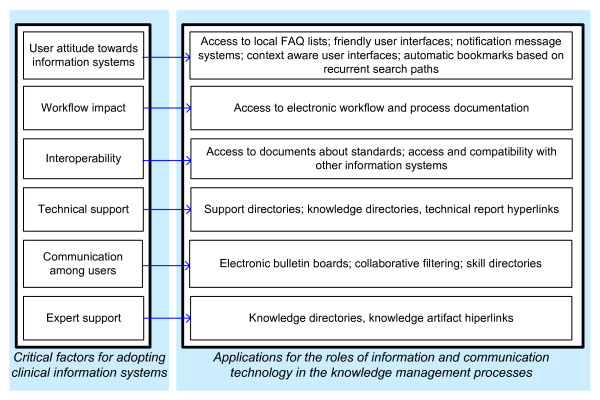
BACKGROUND: The health care sector is an area of social and economic interest in several countries; therefore, there have been lots of efforts in the use of electronic health records. Nevertheless, there is evidence suggesting that these systems have not been adopted as it was expected, and although there are some proposals to support their adoption, the proposed support is not by means of information and communication technology which can provide automatic tools of support. The aim of this study is to identify the critical adoption factors for electronic health records by physicians and to use them as a guide to support their adoption process automatically. METHODS: This paper presents, based on the PRISMA statement, a systematic literature review in electronic databases with adoption studies of electronic health records published in English. Software applications that manage and process the data in the electronic health record have been considered, i.e.: computerized physician prescription, electronic medical records, and electronic capture of clinical data. Our review was conducted with the purpose of obtaining a taxonomy of the physicians main barriers for adopting electronic health records, that can be addressed by means of information and communication technology; in particular with the information technology roles of the knowledge management processes. Which take us to the question that we want to address in this work: "What are the critical adoption factors of electronic health records that can be supported by information and communication technology?". Reports from eight databases covering electronic health records adoption studies in the medical domain, in particular those focused on physicians, were analyzed. RESULTS: The review identifies two main issues: 1) a knowledge-based classification of critical factors for adopting electronic health records by physicians; and 2) the definition of a base for the design of a conceptual framework for supporting the design of knowledge-based systems, to assist the adoption process of electronic health records in an automatic fashion. From our review, six critical adoption factors have been identified: user attitude towards information systems, workflow impact, interoperability, technical support, communication among users, and expert support. The main limitation of the taxonomy is the different impact of the adoption factors of electronic health records reported by some studies depending on the type of practice, setting, or attention level; however, these features are a determinant aspect with regard to the adoption rate for the latter rather than the presence of a specific critical adoption factor. CONCLUSIONS: The critical adoption factors established here provide a sound theoretical basis for research to understand, support, and facilitate the adoption of electronic health records to physicians in benefit of patients.
Overview
The claims and statistics of this paper haven’t been checked yet.
Run the check — free, no account needed. It reads the open-access text and checks the sources it cites.
Integrity signals
Registry
Cites
Statistics
Figures
Verification
Claims the paper makes
The claims and statistics of this paper haven’t been checked yet.
Run the check — free, no account needed. It reads the open-access text and checks the sources it cites.
Claims other papers make about this one
Each is checked against this paper’s own text: does it say what the citing paper says it does?
In the citing paper
“Access to ongoing support to use systems was important for system use [21, 25, 28, 31, 37, 39, 43, 54] and a barrier to implementation when it was lacking [21].”
From Factors that influence the implementation of e-health: a systematic review of systematic reviews (an update) (2016) · cites this paper as [21]
In the citing paper
“Positive attitudes of practitioners toward e-health systems and their implementation increased acceptance and implementation [20, 21, 41, 44, 46, 49]”
From Factors that influence the implementation of e-health: a systematic review of systematic reviews (an update) (2016) · cites this paper as [21]
In the citing paper
“Positive staff attitudes were described as: beliefs that the new systems would benefit patients [56], interest in the technologies, perceived usefulness and motivation in working with the systems [21].”
From Factors that influence the implementation of e-health: a systematic review of systematic reviews (an update) (2016) · cites this paper as [21]
Self-check
Percentages, sums and reported differences re-computed from the paper’s own numbers.
The self-check needs the paper’s full text.
Citations
Cites
Preferred Reporting Items for Systematic Reviews and Meta-Analyses: the PRISMA statement
Moher, D., Liberati, A., Tetzlaff, J., Altman, D. G., & for the PRISMA Group (2009) · BMJ · doi:10.1136/bmj.b2535 · Cited by 83,823
Perceived usefulness, perceived ease of use, and user acceptance of information technology
Davis, F. D. (1989) · MIS Quarterly · doi:10.2307/249008 · Cited by 68,483
Preferred Reporting Items for Systematic Reviews and Meta-Analyses: The PRISMA Statement
Moher, D., Liberati, A., Tetzlaff, J., Altman, D. G., & The PRISMA Group (2009) · PLoS Medicine · doi:10.1371/journal.pmed.1000097 · Cited by 64,042
Rogers, E. M., Singhal, A., & Quinlan, M. M. (2019) · Routledge eBooks · doi:10.4324/9780203710753-35 · Cited by 37,670
Preferred reporting items for systematic reviews and meta-analyses: The PRISMA statement
Moher, D., Liberati, A., Tetzlaff, J., Altman, D. G., & the PRISMA Group* (2009) · Annals of Internal Medicine · doi:10.7326/0003-4819-151-4-200908180-00135 · Cited by 37,554
Valente, T. W. (2003) · Genetics in Medicine · doi:10.1097/01.gim.0000061743.67794.c4 · Cited by 20,559
(1993) · Journal of the American Dietetic Association · doi:10.1016/0002-8223(93)91697-o · Cited by 18,452
The Knowledge-Creating Company
Nonaka, I. (1998) · Elsevier eBooks · doi:10.1016/b978-0-7506-7009-8.50016-1 · Cited by 14,668
Alavi, M., & Leidner, D. E. (2001) · MIS Quarterly · doi:10.2307/3250961 · Cited by 10,176
(1988) · Cited by 6,825
Research works printed but not linked: 2
- HIMSS: Healthcare Information and Management Systems Society. HIMSS hot topics survey. Annual HIMSS Conference and Exhibition. Atlanta. 2002
- HarrisInteractive: U.S. Trails Other English Speaking Countries in Use of Electronic Medical Records and Electronic Prescribing. HarrisInteractive Health Care News. 2001, 1:
Cited by
Sorted by citations
Ross, J., Stevenson, F., Lau, R., & Murray, E. (2016) · Implementation Science · doi:10.1186/s13012-016-0510-7 · Cited by 1,011
McGinn, C. A., Grenier, S., Duplantie, J., Shaw, N., Sicotte, C., Mathieu, L., Leduc, Y., Légaré, F., & Gagnon, M.-P. (2011) · BMC Medicine · doi:10.1186/1741-7015-9-46 · Cited by 393
Personal Health Records: A Systematic Literature Review
Roehrs, A., da Costa, C. A., Righi, R. D. R., & Farias, K. (2017) · Journal of Medical Internet Research · doi:10.2196/jmir.5876 · Cited by 356
Barriers for Adopting Electronic Health Records (EHRs) by Physicians
Ajami, ., & Bagheri-Tadi, T. (2013) · Acta Informatica Medica · doi:10.5455/aim.2013.21.129-134 · Cited by 319
Clinical Benefits of Electronic Health Record Use: National Findings
King, J., Patel, V., Jamoom, E. W., & Furukawa, M. F. (2013) · Health Services Research · doi:10.1111/1475-6773.12135 · Cited by 308
Metadata
- Authors
- Castillo, V. H., Martínez-García, A. I., & Pulido, J.
- Affiliations
- Centro de Investigación Científica y de Educación Superior de Ensenada (MX)
- Universidad de Colima (MX)
- Corresponding author
- Castillo, Víctor H
- Venue
- BMC Medical Informatics and Decision Making
- Published
- 2010-10-15
- Volume
- 10
- Issue
- 1
- Pages
- 60-60
- ISSN
- 1472-6947 (ISSN-L)
- PMC
- PMC2970582
- OpenAlex
- W2107188450
- Cited by
- 155
- References
- 99
- Citations by year
- 2026: 2 · 2025: 2 · 2024: 5 · 2023: 5 · 2022: 30 · 2021: 6 · 2020: 8 · 2019: 4 · 2018: 21 · 2017: 8 · 2016: 13 · 2015: 11 · 2014: 12 · 2013: 16 · 2012: 7
- FWCI
- 1.26
- Type
- journal article
- Language
- en
- Open access
- gold
- doi.org
- Licence
- Locations
- BMC Medical Informatics and Decision Making (publishedVersion, cc-by)
- PubMed Central (publishedVersion, cc-by)
- PubMed (publishedVersion)
- DOAJ (DOAJ: Directory of Open Access Journals) (submittedVersion, cc-by-sa)
- Funders
- Universidad de Colima
- Consejo Nacional de Ciencia y Tecnología
- Topics
- Health Sciences › Health Professions › Health Information Management › Electronic Health Records Systems
- Social Sciences › Decision Sciences › Information Systems and Management › Technology Adoption and User Behaviour
- Social Sciences › Business, Management and Accounting › Management Information Systems › Information Systems Theories and Implementation
- Keywords
- electronic health records, technology adoption, physicians, adoption factors, barriers to adoption, expert systems, knowledge management, interoperability, user attitudes, technical support, expert support, conceptual framework
- MeSH terms
- Attitude to Computers, Diffusion of Innovation, Practice Patterns, Physicians', Electronic Health Records
About these checks
Registry, retraction, Cites and statistics results are computed, not judged, with one exception: a printed reference that no index lists is read once by a model before it counts as a citation error. Claims are extracted by a model and kept only when their quote appears verbatim in the text; each cited source is then checked, with a model’s help, for whether it says what the claim relies on. Those verdicts can be wrong — read the claim’s quote and the cited source before relying on one.
Statistics and arithmetic are recomputed, not judged.
Confidence bands are shown only for fields calibrated on our annotated test set. None is calibrated yet, so no band is shown.
What counts as a claim ›How we measure confidence ›How we check this ›
Are you an author, or do you see a problem with this page? Request a review
