

The DOI matches its Crossref record; 33 of the 34 references it cites were found in a registry or an index.
Barriers to the acceptance of electronic medical records by physicians from systematic review to taxonomy and interventions
Open accessAbstract
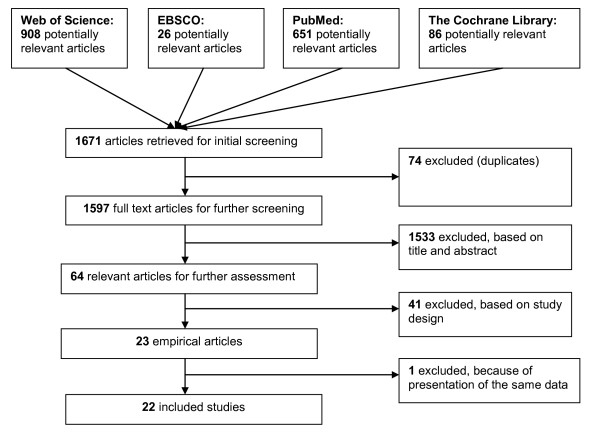
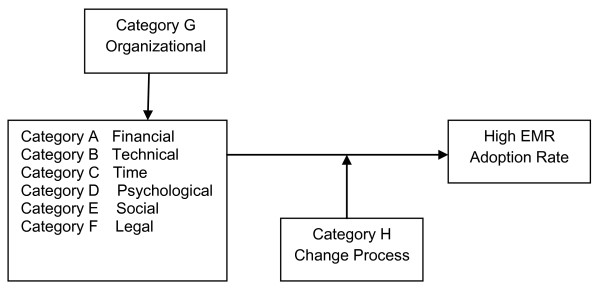
BACKGROUND: The main objective of this research is to identify, categorize, and analyze barriers perceived by physicians to the adoption of Electronic Medical Records (EMRs) in order to provide implementers with beneficial intervention options. METHODS: A systematic literature review, based on research papers from 1998 to 2009, concerning barriers to the acceptance of EMRs by physicians was conducted. Four databases, "Science", "EBSCO", "PubMed" and "The Cochrane Library", were used in the literature search. Studies were included in the analysis if they reported on physicians' perceived barriers to implementing and using electronic medical records. Electronic medical records are defined as computerized medical information systems that collect, store and display patient information. RESULTS: The study includes twenty-two articles that have considered barriers to EMR as perceived by physicians. Eight main categories of barriers, including a total of 31 sub-categories, were identified. These eight categories are: A) Financial, B) Technical, C) Time, D) Psychological, E) Social, F) Legal, G) Organizational, and H) Change Process. All these categories are interrelated with each other. In particular, Categories G (Organizational) and H (Change Process) seem to be mediating factors on other barriers. By adopting a change management perspective, we develop some barrier-related interventions that could overcome the identified barriers. CONCLUSIONS: Despite the positive effects of EMR usage in medical practices, the adoption rate of such systems is still low and meets resistance from physicians. This systematic review reveals that physicians may face a range of barriers when they approach EMR implementation. We conclude that the process of EMR implementation should be treated as a change project, and led by implementers or change managers, in medical practices. The quality of change management plays an important role in the success of EMR implementation. The barriers and suggested interventions highlighted in this study are intended to act as a reference for implementers of Electronic Medical Records. A careful diagnosis of the specific situation is required before relevant interventions can be determined.
Overview
The claims and statistics of this paper haven’t been checked yet.
Run the check — free, no account needed. It reads the open-access text and checks the sources it cites.
Integrity signals
Registry
Cites
Statistics
Figures
Verification
Claims the paper makes
The claims and statistics of this paper haven’t been checked yet.
Run the check — free, no account needed. It reads the open-access text and checks the sources it cites.
Claims other papers make about this one
Each is checked against this paper’s own text: does it say what the citing paper says it does?
In the citing paper
“The need for recognised standards for the provision of e-health systems was described by many studies [16, 18, 20, 28, 33, 36, 48, 49, 51].”
From Factors that influence the implementation of e-health: a systematic review of systematic reviews (an update) (2016) · cites this paper as [18]
In the citing paper
“An absence or inadequacy of legislation and policies and liability concerns may hamper the implementation of e-health systems at the organisational and health professional level [17, 18, 20, 51].”
From Factors that influence the implementation of e-health: a systematic review of systematic reviews (an update) (2016) · cites this paper as [18]
In the citing paper
“Incentives by government organisations and other external stakeholders may facilitate adoption by healthcare organisations [17, 18, 39, 48, 49].”
From Factors that influence the implementation of e-health: a systematic review of systematic reviews (an update) (2016) · cites this paper as [18]
In the citing paper
“The fit between e-health systems and workflows in particular was discussed by the majority of studies [15, 16, 18, 21, 23, 25, 27, 28, 36, 40, 41, 43, 47–50, 52, 55–58].”
From Factors that influence the implementation of e-health: a systematic review of systematic reviews (an update) (2016) · cites this paper as [18]
In the citing paper
“and a lack of involvement can be a barrier to implementation [18, 53].”
From Factors that influence the implementation of e-health: a systematic review of systematic reviews (an update) (2016) · cites this paper as [18]
In the citing paper
“The quality of project management during the implementation period [18], careful study of the downstream effects of implementation on workflow [55], additional training [31, 55], the adaptability of technologies to fit with roles, tasks and workflows [37] and dedicated technical support staff [31] are suggested as strategies to reduce barriers related to disruptions to workflow, roles and respons”
From Factors that influence the implementation of e-health: a systematic review of systematic reviews (an update) (2016) · cites this paper as [18]
In the citing paper
“Generally, access to appropriate, high-quality, well-funded, and easily available training was reported as a facilitator to implementation, whereas it was reported as a barrier when it was non-existent or existent but inadequate [15, 16, 18, 20, 23, 25, 28, 31, 37, 43, 45, 50, 51, 53–58].”
From Factors that influence the implementation of e-health: a systematic review of systematic reviews (an update) (2016) · cites this paper as [18]
In the citing paper
“Physician resistance to e-health implementation is reported by several studies to be related to fear of [18], dissatisfaction with [18] and uncertainty over [43, 47] new roles and responsibilities, created by the introduction of e-health systems [18].”
From Factors that influence the implementation of e-health: a systematic review of systematic reviews (an update) (2016) · cites this paper as [18]
In the citing paper
“The designation of champions [18, 20, 25, 29, 31, 32, 36, 37, 39, 51, 54, 58] may be important for implementation success.”
From Factors that influence the implementation of e-health: a systematic review of systematic reviews (an update) (2016) · cites this paper as [18]
In the citing paper
“Specifically, fears over a loss of autonomy [16, 18, 27, 34, 37, 39, 43], concerns about liability [16, 18, 22, 37, 43, 51], concerns over patient privacy and security being compromised [16, 18, 20, 23, 24, 27, 28, 30, 31, 33, 39, 41, 43, 45, 47, 49, 51–53, 56, 57], and perceived threats to patient and health professional relationships [18, 25, 27, 28, 31, 34, 37–39, 41, 43, 54, 57] through the”
From Factors that influence the implementation of e-health: a systematic review of systematic reviews (an update) (2016) · cites this paper as [18]
In the citing paper
“The work of planning includes the delineation of roles and responsibilities [43], securing time to invest system selection and procurement [18], evaluating other concomitant policy and process changes [40], needs assessment and analysis, development of a business plan [44], early identification and engagement of champions [31], involving end users [16, 27, 41, 51], establishing a guiding”
From Factors that influence the implementation of e-health: a systematic review of systematic reviews (an update) (2016) · cites this paper as [18]
In the citing paper
“Healthcare professionals’ computer skills, abilities and experience were cited by several studies as influencing implementation and acceptance of e-health systems [16, 18, 25, 28, 34, 36, 37, 41, 43, 52, 57].”
From Factors that influence the implementation of e-health: a systematic review of systematic reviews (an update) (2016) · cites this paper as [18]
In the citing paper
“However, the current evidence base is dominated by studies from the US and given the major differences in the social, political and economic foundations of their healthcare system, it is important to explore whether these issues are relevant in other contexts.”
From Exploring the implementation of an electronic record into a maternity unit: a qualitative study using Normalisation Process Theory (2017) · cites this paper as [8]
In the citing paper
“Empirical evidence that explores the benefits, barriers and disadvantages of implementing electronic records has recently been summarised in a systematic review [8] of 22 studies, which identified technical issues alongside financial and time constraints as the most frequently reported barriers associated with electronic record implementation.”
From Exploring the implementation of an electronic record into a maternity unit: a qualitative study using Normalisation Process Theory (2017) · cites this paper as [8]
In the citing paper
“The 93 papers addressed a wide range of eHealth applications. 57 targeted the EHR/EMR, which was defined as computerized medical information systems that collect, store, and display patient information [24].”
From Health Care Provider Adoption of eHealth: Systematic Literature Review (2013) · cites this paper as [24]
Self-check
Percentages, sums and reported differences re-computed from the paper’s own numbers.
The self-check needs the paper’s full text.
Citations
Cites
The Journal of Family Practice
Geyman, J. P. (1997) · American Journal of Family Therapy · doi:10.1080/01926189708251066 · Cited by 3,088
Häyrinen, K., Saranto, K., & Nykänen, P. (2008) · International Journal of Medical Informatics · doi:10.1016/j.ijmedinf.2007.09.001 · Cited by 1,374
Electronic health records in ambulatory care—a national survey of physicians
DesRoches, C. M., Campbell, E. G., Rao, S. R., Donelan, K., Ferris, T. G., Jha, A., Kaushal, R., Levy, D. E., Rosenbaum, S., Shields, A. E., et al. (2008) · New England Journal of Medicine · doi:10.1056/nejmsa0802005 · Cited by 1,111
Physicians’ Use Of Electronic Medical Records: Barriers And Solutions
Miller, R. H., & Sim, I. (2004) · Health Affairs · doi:10.1377/hlthaff.23.2.116 · Cited by 869
(2002) · Computers in health care · doi:10.1007/978-1-4613-0069-4 · Cited by 425
Cavicchi, C., & Vagnoni, E. (2006) · Journal of Cleaner Production · doi:10.1016/j.ijmedinf.2006.09.016 · Cited by 361
Physician acceptance of information technologies: Role of perceived threat to professional autonomy
Walter, Z. D., & Lopez, M. S. (2008) · Decision Support Systems · doi:10.1016/j.dss.2008.06.004 · Cited by 331
Pizziferri, L., Kittler, A. F., Volk, L. A., Honour, M. M., Gupta, S., Wang, S. J., Wang, T., Lippincott, M. F., Li, Q., & Bates, D. W. (2004) · Journal of Biomedical Informatics · doi:10.1016/j.jbi.2004.11.009 · Cited by 283
Doctors' use of electronic medical records systems in hospitals: cross sectional survey
Lærum, H., Ellingsen, G., & Faxvaag, A. (2001) · BMJ · doi:10.1136/bmj.323.7325.1344 · Cited by 226
Earnest, M. A., Ross, S. E., Wittevrongel, L., Moore, L. A., & Lin, C.-T. (2004) · Journal of the American Medical Informatics Association · doi:10.1197/jamia.m1479 · Cited by 207
If electronic medical records are so great, why aren't family physicians using them?
Loomis, G. A., Ries, J., Saywell, R. M., & Thakker, N. (2002) · PubMed · Cited by 192
Primary Care Physicians’ Use of an Electronic Medical Record System: A Cognitive Task Analysis
Shachak, A., Hadas-Dayagi, M., Ziv, A., & Reis, S. (2009) · Journal of General Internal Medicine · doi:10.1007/s11606-008-0892-6 · Cited by 188
Which Physicians And Practices Are Using Electronic Medical Records?
Burt, C. W., & Sisk, J. E. (2005) · Health Affairs · doi:10.1377/hlthaff.24.5.1334 · Cited by 159
Barriers to proliferation of electronic medical records
Valdes, I., Kibbe, D. C., Tolleson, G., Kunik, M., & Petersen, L. (2004) · Journal of Innovation in Health Informatics · doi:10.14236/jhi.v12i1.102 · Cited by 133
Davidson, E., & Heslinga, D. (2006) · Information Systems Management · doi:10.1080/10580530601036786 · Cited by 130
Adoption of Electronic Health Records in Primary Care Pediatric Practices
Kemper, A. R., Uren, R. L., & Clark, S. J. (2006) · Pediatrics · doi:10.1542/peds.2005-3000 · Cited by 130
Vishwanath, A., & Scamurra, S. D. (2007) · Health Informatics Journal · doi:10.1177/1460458207076468 · Cited by 127
Implementing electronic health records: Key factors in primary care.
Terry, A. L., Thorpe, C. F., Giles, G., Brown, J. B., Harris, S. B., Reid, G. J., Thind, A., & Stewart, M. (2008) · PubMed Central · Cited by 123
Reardon, J. L., & Davidson, E. (2007) · European Journal of Information Systems · doi:10.1057/palgrave.ejis.3000714 · Cited by 114
Ludwick, D. A., & Doucette, J. (2008) · International Journal of Telemedicine and Applications · doi:10.1155/2009/853524 · Cited by 93
Jha, A. K., Bates, D. W., Jenter, C. A., Orav, E. J., Zheng, J., Cleary, P. D., & Simon, S. R. (2008) · Journal of Evaluation in Clinical Practice · doi:10.1111/j.1365-2753.2008.00975.x · Cited by 87
McLane, S. (2005) · CIN Computers Informatics Nursing · doi:10.1097/00024665-200503000-00008 · Cited by 81
What factors affect the use of electronic patient records by Irish GPs?
Meade, B., Buckley, D., & Boland, M. (2009) · International Journal of Medical Informatics · doi:10.1016/j.ijmedinf.2009.03.004 · Cited by 71
Exploring Physician Adoption of EMRs: A Multi-Case Analysis
Randeree, E. (2007) · Journal of Medical Systems · doi:10.1007/s10916-007-9089-5 · Cited by 71
International Journal of Telemedicine and Applications
(2022) · International Journal of Telemedicine and Applications · doi:10.1155/4909 · Cited by 67
The Use of Information Technologies Among Rural and Urban Physicians in Florida
Menachemi, N., Langley, A., & Brooks, R. G. (2007) · Journal of Medical Systems · doi:10.1007/s10916-007-9088-6 · Cited by 51
Resistance to Electronic Medical Records (EMRs): A Barrier to Improved Quality of Care
Meinert, D. B. (2005) · Informing Science and IT Education Conference · doi:10.28945/2896 · Cited by 49
Review of Bispectral Index Monitoring in the Emergency Department and Pediatric Intensive Care Unit
Dominguez, T. E., & Helfaer, M. A. (2006) · Pediatric Emergency Care · doi:10.1097/01.pec.0000203821.02045.69 · Cited by 49
International Journal of Telemedicine and Applications
(2008) · International Journal of Telemedicine and Applications · doi:10.1155/ijta · Cited by 31
Resistance to Electronic Medical Records (EMRs): A Barrier to Improved Quality of Care
Meinert, D. B. (2005) · Issues in Informing Science and Information Technology · doi:10.28945/846 · Cited by 29
(2012) · Wilderness and Environmental Medicine · doi:10.1016/j.wem.2012.02.010 · Cited by 17
Benefits and barriers to EMR implementation.
Dave, D. (2004) · PubMed · Cited by 14
Physicians and Electronic Health Records
Simon, S. R. (2007) · Archives of Internal Medicine · doi:10.1001/archinte.167.5.507 · Cited by 6
Research works printed but not linked: 4
- Terry AL, Thorpe CF, Giles GG, Brown JB, Harris SB, Reid GJ, Thind A, Stewart M: Implementing Electronic Health Records. Canadian Family Physician. 2008, 54: 730-736.
- Simon SR, Kalshal R, Cleary PD, Jenter CA, Volk LA, Oray EJ, Burdick E, Poon EG, Batees WW: Physicians and Electronic Health Records "A Statewide Survey. Archives of Internal Medicine. 2007, 167 (5): 507-512. 10.1001/archinte.167.5.507. · DOI
- European Commission: Study on the Legal Framework for Interoperable eHealth in Europe. 2009, Brussels: European Commission, Directorate General Information Society
- McCarthy C, Eastman D: Change Management Strategies for an Effective EMR implementations. HIMSS Chicago. 2010
Cited by
Sorted by citations
Ross, J., Stevenson, F., Lau, R., & Murray, E. (2016) · Implementation Science · doi:10.1186/s13012-016-0510-7 · Cited by 1,011
May, C. R., Cummings, A., Girling, M., Bracher, M., Mair, F. S., May, C. M., Murray, E., Myall, M., Rapley, T., & Finch, T. (2018) · Implementation Science · doi:10.1186/s13012-018-0758-1 · Cited by 683
Cresswell, K., & Sheikh, A. (2013) · International Journal of Medical Informatics · doi:10.1016/j.ijmedinf.2012.10.007 · Cited by 690
Barriers and facilitators to utilizing digital health technologies by healthcare professionals
do Nascimento, I. J. B., Abdulazeem, H. M., Vasanthan, L., Martínez, E. Z., Zucoloto, M. L., Østengaard, L., Muscat, N. A., Zapata, T., & Novillo-Ortiz, D. (2023) · npj Digital Medicine · doi:10.1038/s41746-023-00899-4 · Cited by 829
Health Literacy and Health Information Technology Adoption: The Potential for a New Digital Divide
Mackert, M., Mabry-Flynn, A., Champlin, S., Donovan, E. E., & Pounders, K. (2016) · Journal of Medical Internet Research · doi:10.2196/jmir.6349 · Cited by 503
Metadata
- Authors
- Boonstra, A., & Broekhuis, M.
- Affiliations
- University of Groningen (NL)
- Corresponding author
- Boonstra, Albert
- Venue
- BMC Health Services Research
- Published
- 2010-08-06
- Volume
- 10
- Issue
- 1
- Pages
- 231-231
- ISSN
- 1472-6963 (ISSN-L)
- PMC
- PMC2924334
- OpenAlex
- W2155857546
- Cited by
- 851
- References
- 34
- Citations by year
- 2026: 30 · 2025: 36 · 2024: 47 · 2023: 46 · 2022: 75 · 2021: 41 · 2020: 48 · 2019: 54 · 2018: 69 · 2017: 63 · 2016: 56 · 2015: 73 · 2014: 67 · 2013: 68 · 2012: 40
- FWCI
- 6.41
- Type
- journal article
- Language
- en
- Open access
- gold
- doi.org
- Licence
- Locations
- BMC Health Services Research (publishedVersion, cc-by)
- PubMed Central (publishedVersion, cc-by)
- PubMed (publishedVersion)
- DOAJ (DOAJ: Directory of Open Access Journals) (submittedVersion)
- University of Groningen research database (University of Groningen / Centre for Information Technology) (submittedVersion, cc-by)
- Topics
- Health Sciences › Health Professions › Health Information Management › Electronic Health Records Systems
- Social Sciences › Business, Management and Accounting › Management Information Systems › ERP Systems Implementation and Impact
- Social Sciences › Business, Management and Accounting › Management Information Systems › Information Systems Theories and Implementation
- Keywords
- electronic health records, physician acceptance, technology adoption barriers, EMR implementation, change management, organizational barriers, financial barriers, legal barriers, social barriers, psychological barriers, time barriers, technical challenges, implementation strategies, medical practice
- MeSH terms
- Attitude to Computers, Diffusion of Innovation, Humans, Physicians, Electronic Health Records
About these checks
Registry, retraction, Cites and statistics results are computed, not judged, with one exception: a printed reference that no index lists is read once by a model before it counts as a citation error. Claims are extracted by a model and kept only when their quote appears verbatim in the text; each cited source is then checked, with a model’s help, for whether it says what the claim relies on. Those verdicts can be wrong — read the claim’s quote and the cited source before relying on one.
Statistics and arithmetic are recomputed, not judged.
Confidence bands are shown only for fields calibrated on our annotated test set. None is calibrated yet, so no band is shown.
What counts as a claim ›How we measure confidence ›How we check this ›
Are you an author, or do you see a problem with this page? Request a review
