

The DOI matches its Crossref record; 15 of the 16 references it cites were found in a registry or an index.
Validation of the PHQ-9 as a screening instrument for depression in diabetes patients in specialized outpatient clinics
Open accessAbstract
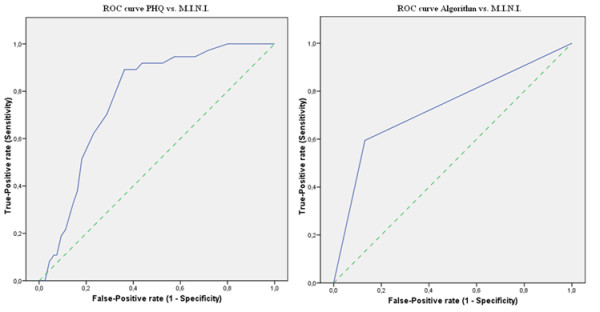
BACKGROUND: For the treatment of depression in diabetes patients, it is important that depression is recognized at an early stage. A screening method for depression is the patient health questionnaire (PHQ-9). The aim of this study is to validate the 9-item Patient Health Questionnaire (PHQ-9) as a screening instrument for depression in diabetes patients in outpatient clinics. METHODS: 197 diabetes patients from outpatient clinics in the Netherlands filled in the PHQ-9. Within 2 weeks they were approached for an interview with the Mini Neuropsychiatric Interview. DSM-IV diagnoses of Major Depressive Disorder (MDD) were the criterion for which the sensitivity, specificity, positive- and negative predictive values and Receiver Operator Curves (ROC) for the PHQ-9 were calculated. RESULTS: The cut-off point of a summed score of 12 on the PHQ-9 resulted in a sensitivity of 75.7% and a specificity of 80.0%. Predictive values for negative and positive test results were respectively 93.4% and 46.7%. The ROC showed an area under the curve of 0.77. CONCLUSIONS: The PHQ-9 proved to be an efficient and well-received screening instrument for MDD in this sample of diabetes patients in a specialized outpatient clinic. The higher cut-off point of 12 that was needed and somewhat lower sensitivity than had been reported elsewhere may be due to the fact that the patients from a specialized diabetes clinic have more severe pathology and more complications, which could be recognized by the PHQ-9 as depression symptoms, while instead being diabetes symptoms.
Overview
The claims and statistics of this paper haven’t been checked yet.
Run the check — free, no account needed. It reads the open-access text and checks the sources it cites.
Integrity signals
Registry
Cites
Statistics
Figures
Verification
Claims the paper makes
The claims and statistics of this paper haven’t been checked yet.
Run the check — free, no account needed. It reads the open-access text and checks the sources it cites.
Claims other papers make about this one
Each is checked against this paper’s own text: does it say what the citing paper says it does?
The cited source says what the claim attributes to it.
In the citing paper
“a number of tools have been utilised and validated to screen depression (PHQ-9 [50, 51], HADS [52, 53]) and anxiety (HADS [52], Generalised Anxiety Disorder 7-item scale (GAD-7) [54, 55]) in diabetes.”
Self-check
Percentages, sums and reported differences re-computed from the paper’s own numbers.
The self-check needs the paper’s full text.
Citations
Cites
The PHQ-9: Validity of a brief depression severity measure
Kroenke, K., Spitzer, R. L., & Williams, J. B. W. (2001) · Journal of General Internal Medicine · doi:10.1046/j.1525-1497.2001.016009606.x · Cited by 44,910
(1998) · The Journal of Clinical Psychiatry · Cited by 19,139
(1998) · PubMed · Cited by 10,216
Receiver-operating characteristic (ROC) plots: a fundamental evaluation tool in clinical medicine
ZWEIG, M. H., & Campbell, G. (1993) · Clinical Chemistry · doi:10.1093/clinchem/39.4.561 · Cited by 6,595
The mini international neuropsychiatric interview
Lecrubier, Y., Sheehan, D. V., Hergueta, T., & Weiller, E. (1998) · European Psychiatry · doi:10.1016/s0924-9338(99)80239-9 · Cited by 5,899
The Prevalence of Comorbid Depression in Adults With Diabetes
Anderson, R. J., Freedland, K. E., Clouse, R. E., & Lustman, P. J. (2001) · Diabetes Care · doi:10.2337/diacare.24.6.1069 · Cited by 3,926
Monitoring Depression Treatment Outcomes With the Patient Health Questionnaire-9
L??we, B., Un??tzer, J., Callahan, C. M., Perkins, A. J., & Kroenke, K. (2004) · Medical Care · doi:10.1097/00005650-200412000-00006 · Cited by 1,354
Gilbody, S., Richards, D., Brealey, S., & Hewitt, C. (2007) · Journal of General Internal Medicine · doi:10.1007/s11606-007-0333-y · Cited by 1,290
Depression in diabetic patients
Lustman, P. J., & Clouse, R. E. (2005) · Journal of Diabetes and its Complications · doi:10.1016/j.jdiacomp.2004.01.002 · Cited by 613
Behavioral and Clinical Factors Associated With Depression Among Individuals With Diabetes
Katon, W. J., Korff, M. V., Ciechanowski, P. S., Russo, J. E., Lin, E. H. B., Simon, G. E., Ludman, E. J., Walker, E. A., Bush, T. M., & Young, B. A. (2004) · Diabetes Care · doi:10.2337/diacare.27.4.914 · Cited by 458
Cited by
Sorted by citations
Manea, L., Gilbody, S., & McMillan, D. (2015) · General Hospital Psychiatry · doi:10.1016/j.genhosppsych.2014.09.009 · Cited by 795
Validity of the patient health questionnaire-9 for depression screening and diagnosis in East Africa
Gelaye, B., Williams, M. A., Lemma, S., Deyessa, N., Bahretibeb, Y., Shibre, T., Wondimagegn, D., Lemenhe, A., Fann, J. R., Stoep, A. V., et al. (2013) · Psychiatry Research · doi:10.1016/j.psychres.2013.07.015 · Cited by 548
The association between Diabetes mellitus and Depression.
Bădescu, S., Tataru, C. I., Kobylinska, L., Margarint, E. L. G., Zahiu, D., Am, Z., & Zăgrean, A. (2016) · PubMed Central · Cited by 514
Holt, R. I. G., de Groot, M., & Golden, S. H. (2014) · Current Diabetes Reports · doi:10.1007/s11892-014-0491-3 · Cited by 552
Constructs of depression and distress in diabetes: time for an appraisal
Snoek, F. J., Bremmer, M. A., & Hermanns, N. (2015) · The Lancet Diabetes & Endocrinology · doi:10.1016/s2213-8587(15)00135-7 · Cited by 449
Metadata
- Authors
- van Steenbergen-Weijenburg, K. M., de Vroege, L., Ploeger, R. R., Brals, J. W., Vloedbeld, M. G., Veneman, T. F., Hakkaart-van Roijen, L., Rutten, F. F., Beekman, A. T., & van der Feltz-Cornelis, C. M.
- Affiliations
- Ziekenhuis Groep Twente (NL)
- Erasmus MC (NL)
- Amsterdam UMC Location Vrije Universiteit Amsterdam (NL)
- ORCID
- Beekman, Aartjan TF
- Venue
- BMC Health Services Research
- Published
- 2010-08-12
- Volume
- 10
- Issue
- 1
- Pages
- 235-235
- ISSN
- 1472-6963 (ISSN-L)
- PMC
- PMC2927590
- OpenAlex
- W2121827707
- Cited by
- 200
- References
- 16
- Citations by year
- 2026: 5 · 2025: 10 · 2024: 20 · 2023: 13 · 2022: 15 · 2021: 12 · 2020: 17 · 2019: 12 · 2018: 17 · 2017: 15 · 2016: 11 · 2015: 14 · 2014: 10 · 2013: 10 · 2012: 12
- FWCI
- 12.14
- Type
- journal article
- Language
- en
- Open access
- gold
- doi.org
- Licence
- Locations
- BMC Health Services Research (publishedVersion, cc-by)
- PubMed Central (publishedVersion, cc-by)
- Research portal (Tilburg University) (publishedVersion, other-oa)
- PubMed (publishedVersion)
- Pure Amsterdam UMC (publishedVersion, other-oa)
- EUR Research Repository (Erasmus University Rotterdam) (publishedVersion, other-oa)
- VU Research Portal (publishedVersion, other-oa)
- Amsterdam UMC (VU Amsterdam) - Institutional Repository (acceptedVersion, other-oa)
- Data Archiving and Networked Services (DANS) (submittedVersion, other-oa)
- EUR Research Repository (Erasmus University Rotterdam) (submittedVersion, other-oa)
- RePub (Erasmus University Rotterdam) (submittedVersion, other-oa)
- Digital Academic REpository of VU University Amsterdam (Vrije Universiteit Amsterdam) (submittedVersion)
- DOAJ (DOAJ: Directory of Open Access Journals) (submittedVersion, cc-by-sa)
- RePub (Erasmus University Rotterdam) (submittedVersion)
- Topics
- Social Sciences › Psychology › Experimental and Cognitive Psychology › Anxiety, Depression, Psychometrics, Treatment, Cognitive Processes
- Health Sciences › Medicine › Endocrinology, Diabetes and Metabolism › Diabetes Management and Education
- Health Sciences › Medicine › Psychiatry and Mental health › Mental Health Treatment and Access
- Keywords
- PHQ-9, Patient Health Questionnaire, depression screening, diabetes mellitus, major depressive disorder, screening tool validation, sensitivity and specificity, cut-off values
- MeSH terms
- Aged, Ambulatory Care Facilities, Depressive Disorder, Major, Major Depressive Disorder, False Positive Reactions, Female, Humans, Interview, Psychological, Male, Mass Screening, Middle Aged, Netherlands, Diabetes Complications
About these checks
Registry, retraction, Cites and statistics results are computed, not judged, with one exception: a printed reference that no index lists is read once by a model before it counts as a citation error. Claims are extracted by a model and kept only when their quote appears verbatim in the text; each cited source is then checked, with a model’s help, for whether it says what the claim relies on. Those verdicts can be wrong — read the claim’s quote and the cited source before relying on one.
Statistics and arithmetic are recomputed, not judged.
Confidence bands are shown only for fields calibrated on our annotated test set. None is calibrated yet, so no band is shown.
What counts as a claim ›How we measure confidence ›How we check this ›
Are you an author, or do you see a problem with this page? Request a review
