

Four minutes for a patient, twenty seconds for a relative - an observational study at a university hospital
Open accessThe DOI matches its Crossref record; 31 of the 31 references it cites were found in a registry or an index.
Abstract
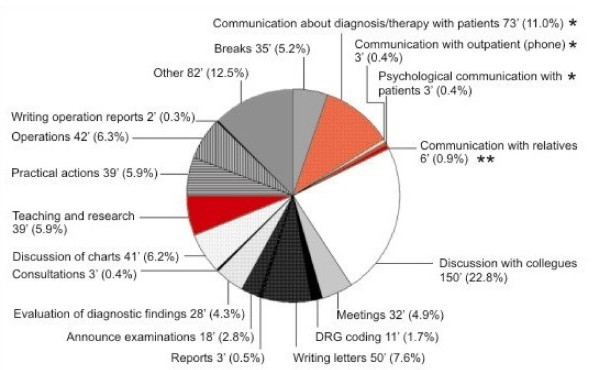
BACKGROUND: In the modern hospital environment, increasing possibilities in medical examination techniques and increasing documentation tasks claim the physicians' energy and encroach on their time spent with patients. This study aimed to investigate how much time physicians at hospital wards spend on communication with patients and their families and how much time they spend on other specific work tasks. METHODS: A non-participatory, observational study was conducted in thirty-six wards at the University Medical Center Freiburg, a 1700-bed academic hospital in Germany. All wards belonging to the clinics of internal medicine, surgery, radiology, neurology, and to the clinic for gynaecology took part in the study. Thirty-four ward doctors from fifteen different medical departments were observed during a randomly chosen complete work day. The Physicians' time for communication with patients and relatives and time spent on different working tasks during one day of work were assessed. RESULTS: 374 working hours were analysed. On average, a physician's workday on a university hospital ward added up to 658.91 minutes (10 hrs 58 min; range 490 - 848 min). Looking at single items of time consumption on the evaluation sheet, discussions with colleagues ranked first with 150 minutes on average. Documentation and administrative requirements took an average time of 148 minutes per day and ranked second. Total time for communication with patients and their relatives was 85 minutes per physician and day. Consequently, the available time for communication was 4 minutes and 17 seconds for each patient on the ward and 20 seconds for his or her relatives. Physicians assessed themselves to communicate twice as long with patients and sevenfold with relatives than they did according to this study. CONCLUSIONS: Workload and time pressure for physicians working on hospital wards are high. To offer excellent medical treatment combined with patient centred care and to meet the needs of patients and relatives on hospital wards, physicians should be given more time to focus on core clinical tasks. Time and health care management solutions to minimize time pressure are required. Further research is needed to assess quality of communication in hospital settings.
Overview
The claims and statistics of this paper haven’t been checked yet.
Free: it reads the open-access text and checks the first 5 claims that cite a source we can check. Create a free account to check every claim.
Integrity signals
Registry
Cites
Statistics
Figures
Verification
Claims the paper makes
The claims and statistics of this paper haven’t been checked yet.
Free: it reads the open-access text and checks the first 5 claims that cite a source we can check. Create a free account to check every claim.
Claims other papers make about this one
Each is checked against this paper’s own text: does it say what the citing paper says it does?
The source backs part of the claim, not all of it — or backs it for a different population, condition or comparison.
In the citing paper
“They can be accessed by patients at any time and do not have the same time constraints as healthcare experts, potentially making contact easier and more comfortable35.”
From The future landscape of large language models in medicine (2023) · cites this paper as [35]
Experimental — accuracy not yet measuredThe cited source says what the claim attributes to it.
In the citing paper
“Clinicians devote a substantial amount of time to documentation2”
From A framework to assess clinical safety and hallucination rates of LLMs for medical text summarisation (2025) · cites this paper as [2]
In the citing paper
“Documentation and administrative requirements consume around 25% of clinicians’ workdays35.”
From The future landscape of large language models in medicine (2023) · cites this paper as [35]
Self-check
Percentages, sums and reported differences re-computed from the paper’s own numbers.
The self-check needs the paper’s full text.
Citations
Cites
Doctor-patient communication: a review of the literature
Ong, L. M. L., de Haes, J. C. J. M., Hoos, A. M., & Lammes, F. B. (1995) · Social Science & Medicine · doi:10.1016/0277-9536(94)00155-m · Cited by 2,430
Levinson, W. (1997) · JAMA: The Journal of the American Medical Association · doi:10.1001/jama.1997.03540310051034 · Cited by 1,119
(2013) · Congress Online · doi:10.4324/9780203494035-16 · Cited by 664
Consultation length in general practice: cross sectional study in six European countries
Deveugele, M., Derese, A., van den Brink-Muinen, A., Bensing, J., & De Maeseneer, J. (2002) · BMJ · doi:10.1136/bmj.325.7362.472 · Cited by 627 · cited 1×
“These results are similar to the findings of other studies [25,26] and may be attributed to professional experience and greater range of communication skills.”
ResultTime and the Patient–Physician Relationship
Dugdale, D. C., Epstein, R., & Pantilat, S. Z. (1999) · Journal of General Internal Medicine · doi:10.1046/j.1525-1497.1999.00263.x · Cited by 609 · cited 2×
“time spent on communication with patients [ 1-3 ].”
BackgroundEffective communication skills are the key to good cancer care
Fallowfield, L., & Jenkins, V (1999) · European Journal of Cancer · doi:10.1016/s0959-8049(99)00212-9 · Cited by 556 · cited 1×
“000 consultations with patients, communication should be viewed as a core clinical skill and an integral medical task [11].”
BackgroundFamily satisfaction with care in the intensive care unit: Results of a multiple center study*
Heyland, D. K., Rocker, G. M., Dodek, P. M., Kutsogiannis, D. J., Konopad, E., Cook, D. J., Peters, S., Tranmer, J. E., & O’Callaghan, C. J. (2002) · Critical Care Medicine · doi:10.1097/00003246-200207000-00002 · Cited by 458 · cited 1×
“Taking into consideration that relatives rate physicians' communication skills as important as their medical capabilities, the results of the present study should start further reflections on communication lengths and quality of dialogues with the relatives on hospital wards [17].”
Physician–Patient Communication
Hall, J. A., & Roter, D. L. (2012) · The Oxford Handbook of Health Psychology · doi:10.1093/oxfordhb/9780195342819.013.0014 · Cited by 334
Patient satisfaction with time spent with their physician.
Gross, D. A., Zyzanski, S. J., Borawski, E. A., Cebul, R. D., & Stange, K. C. (1998) · PubMed · Cited by 248
Physician Discontent: Challenges and Opportunities
Mechanic, D. (2003) · JAMA · doi:10.1001/jama.290.7.941 · Cited by 220 · cited 1×
“The time for communication and personal contact between physicians and patients seems to be an increasingly valuable resource [5,6].”
Background
Research works printed but not linked: 2
- Häuser S Schwebius P Vier Minuten pro Patient, eine Minute pro Angehörigen Psychother Psychosom Med Psychol 1999 49 168 170 10396134
- Hartmann W Topp F Kronmüller K Zipfel S Herzog W Family Medicine - Empirischer Bedarf zwischen Kosten und Nutzen Psychother Psychosom Med Psychol 1999 49 468
Cited by
The future landscape of large language models in medicine
Clusmann, J., Kolbinger, F. R., Muti, H. S., Carrero, Z. I., Eckardt, J.-N., Laleh, N. G., Löffler, C. M. L., Schwarzkopf, S.-C., Unger, M., Veldhuizen, G. P., et al. (2023) · Communications Medicine · doi:10.1038/s43856-023-00370-1 · Cited by 1,045
“They can be accessed by patients at any time and do not have the same time constraints as healthcare experts, potentially making contact easier and more comfortable 35 .”
BackgroundA framework to assess clinical safety and hallucination rates of LLMs for medical text summarisation
Asgari, E., Montaña-Brown, N., Dubois, M., Khalil, S., Balloch, J., Yeung, J. A., & Pimenta, D. (2025) · npj Digital Medicine · doi:10.1038/s41746-025-01670-7 · Cited by 423
“Clinicians devote a substantial amount of time to documentation 2 , and prolonged interaction with electronic health records, where clinical documentation is logged, has been demonstrated to raise cognitive load and lead to burnout 3 .”
The impact of electronic health record systems on clinical documentation times: a systematic review
Baumann, L. A., Baker, J., & Elshaug, A. G. (2018) · Health Policy · doi:10.1016/j.healthpol.2018.05.014 · Cited by 320
Does supervision improve health worker productivity? Evidence from the Upper East Region of Ghana
Frimpong, J. A., Helleringer, S., Awoonor‐Williams, J. K., Yeji, F., & Phillips, J. F. (2011) · Tropical Medicine & International Health · doi:10.1111/j.1365-3156.2011.02824.x · Cited by 119
“Data for the TUS were collected using the work-sampling methodology (i.e. direct observation) (Linden & English 1994; Capuano et al. 2004; Poissant et al. 2005; Herdman et al. 2009; Becker et al. 2010).”
Methodvon Blanckenburg, P., Hofmann, M., Rief, W., Seifart, U., & Seifart, C. (2020) · Patient Education and Counseling · doi:10.1016/j.pec.2020.02.036 · Cited by 105
Bussmann, S., Muders, P., Zahrt-Omar, C. A., Escobar, P. L. C., Claus, M., Schildmann, J., & Weber, M. (2013) · American Journal of Hospice and Palliative Medicine® · doi:10.1177/1049909113512718 · Cited by 71
“Becker showed that the average time a physician spent communicating with a single patient in German hospital wards was about 4 min/d and communication with families took only 20 seconds.(28) However, patient communication competence can be enhanced by training modules.”
BackgroundOrri, M., Farges, O., Clavien, P., Barkun, J. S., & Révah‐Levy, A. (2014) · Annals of Surgery · doi:10.1097/sla.0000000000000962 · Cited by 66
The work pattern of personal care workers in two Australian nursing homes: a time-motion study
Qian, S., Yu, P., Zhang, Z., Hailey, D. M., Davy, P. J., & Nelson, M. (2012) · BMC Health Services Research · doi:10.1186/1472-6963-12-305 · Cited by 62
“Work sampling and time-motion techniques have been applied extensively to measure the work pattern in healthcare settings [5-12].”
BackgroundStroop, A., Stroop, T., Alsofy, S. Z., Nakamura, M., Möllmann, F., Greiner, C., & Stroop, R. (2023) · European Spine Journal · doi:10.1007/s00586-023-07975-z · Cited by 55
“This is essential for taking the patient’s medical history and achieving informed consent for the required diagnostics and therapy—a sustainable patient compliance represents the relevant basis in the treatment prognosis [7–9].”
Impact of hospitalist communication‐skills training on patient‐satisfaction scores
O’Leary, K. J., Darling, T. A., Rauworth, J., & Williams, M. V. (2013) · Journal of Hospital Medicine · doi:10.1002/jhm.2041 · Cited by 52
Understanding natural language: Potential application of large language models to ophthalmology
Yang, Z., Wang, D., Zhou, F., Song, D., Zhang, Y., Jiang, J., Kong, K., Liu, X., Qiao, Y., Chang, R. T., et al. (2024) · Asia-Pacific Journal of Ophthalmology · doi:10.1016/j.apjo.2024.100085 · Cited by 50
Holzer, E., Tschan, F., Kottwitz, M. U., Beldi, G., Businger, A. P., & Semmer, N. K. (2019) · BMC Surgery · doi:10.1186/s12893-019-0570-0 · Cited by 43
Taylor, F., Halter, M., & Drennan, V. M. (2019) · BMC Health Services Research · doi:10.1186/s12913-019-4410-9 · Cited by 38
Desjarlais-deKlerk, K., & Wallace, J. E. (2013) · BMC Health Services Research · doi:10.1186/1472-6963-13-261 · Cited by 35
“Communicating and exchanging information are key to diagnosis and treatment [3,14-17].”
BackgroundThe barriers to uptake of artificial intelligence in hepatology and how to overcome them
Clusmann, J., Balaguer‐Montero, M., Bassegoda, O., Schneider, C. V., Seraphin, T. P., Paintsil, E. K., Luedde, T., Pérez-López, R., Caldéraro, J., Gilbert, S., et al. (2025) · Journal of Hepatology · doi:10.1016/j.jhep.2025.07.003 · Cited by 34
RetractedLarge Language Models in Oncology: Revolution or Cause for Concern?
Caglayan, A., Slusarczyk, W., Rabbani, R. D., Ghose, A., Papadopoulos, V. P., & Boussios, S. (2024) · Current Oncology · doi:10.3390/curroncol31040137 · Cited by 30
“Although essential, these requirements have been noted to consume approximately 25% of physicians’ workload [37].”
BackgroundRothberg, M. B., Steele, J. R., Wheeler, J., Arora, A., Priya, A., & Lindenauer, P. K. (2011) · Journal of General Internal Medicine · doi:10.1007/s11606-011-1857-8 · Cited by 30
i P ad use at the bedside: a tool for engaging patients in care processes during ward rounds?
Baysari, M. T., Adams, K., Lehnbom, E. C., Westbrook, J. I., & Day, R. O. (2014) · Internal Medicine Journal · doi:10.1111/imj.12518 · Cited by 29
Jors, K., Tietgen, S., Xander, C. J., Momm, F., & Becker, G. (2016) · Palliative Medicine · doi:10.1177/0269216316648071 · Cited by 28
Self-citationBrooks, A. T., Silverman, L., & Wallen, G. R. (2013) · Integrative Medicine Insights · doi:10.4137/imi.s12783 · Cited by 22
Person-centred care: Possibilities, barriers and effects in hospitalised patients
Wolf, A. (2012) · Gothenburg University Publications Electronic Archive (Gothenburg University) · Cited by 20
Retrieval Augmented Thought Process for Private Data Handling in Healthcare
Pouplin, T., Sun, H., Holt, S., & van der Schaar, M. (2025) · IEEE Journal of Biomedical and Health Informatics · doi:10.1109/jbhi.2025.3645636 · Cited by 17
Carl, N., Nguyen, L., Haggenmüller, S., Joachim Hetz, M., Theres Winterstein, J., Otto Hartung, F., Gruene, B., Nikolas Kather, J., Holland-Letz, T., Stephan Michel, M., et al. (2024) · European Urology Open Science · doi:10.1016/j.euros.2024.10.009 · Cited by 15
“This study has limitations from a potential social desirability bias [31], due to a direct questioning procedure.”
BackgroundUsing large language models as decision support tools in emergency ophthalmology
Krešo, A., Boban, Z., Kabić, Š., Rada, F., Batistic, D., Barun, I., Znaor, L., Kumrić, M., Božić, J., & Vrdoljak, J. (2025) · International Journal of Medical Informatics · doi:10.1016/j.ijmedinf.2025.105886 · Cited by 16
Li, A., Shrestha, R., Jegatheeswaran, T., Chan, H. O., Hong, C., & Joshi, R. (2024) · medRxiv · doi:10.1101/2024.09.27.24314506 · Cited by 15
“The results from this study can provide evidence for the use of LLMs in helping physicians streamline their note-taking process during patient care, and optimizing time efficiency (Alissa et al., 2022; Becker et al., 2010).”
ResultSynoptic reporting by summarizing cancer pathology reports using large language models
Rajaganapathy, S., Chowdhury, S., Li, X., Buchner, V., He, Z., Zhang, R., Jiang, X., Yang, P., Cerhan, J. R., & Zong, N. (2025) · npj Health Systems · doi:10.1038/s44401-025-00013-8 · Cited by 14
“Documentation and administrative work has beenshowntotake22%ofaclinician ’ sworkdayonaverage 10 .”
Witherspoon, L., Nham, E., Abdi, H., Dergham, A., Skinner, T., Oake, J. S., WATTERSON, J. D., & Lavallée, L. T. (2019) · BMC Health Services Research · doi:10.1186/s12913-019-4844-0 · Cited by 14
Data augmented large language models for medical record generation
Zhang, X., Zhao, G., Ren, Y., Wang, W., Cai, W., Zhao, Y., Zhang, X., & Liu, J. (2024) · Applied Intelligence · doi:10.1007/s10489-024-05934-9 · Cited by 13
“Coincidentally, according to [3], physicians in Germany have been required to work on various documents writing every day, including clinical documents and administrative documents, and this task spends approx-123 imately 21.5 percent of their daily workloads.”
InfluentialWiljer, D., Tavares, W., Charow, R., Williams, S., Campbell, C. B., Davis, D., Jeyakumar, T., Mylopoulos, M., Okrainec, A., Silver, I., et al. (2022) · Journal of Continuing Education in the Health Professions · doi:10.1097/ceh.0000000000000423 · Cited by 13
“These time restraints and competing interests that physicians encounter are likely to dampen enthusiasm to pursue data for learning.(46) This issue is magnified in a pandemic where care demands can be overwhelming, and the system is strained.”
BackgroundEl acompañante en la entrevista clínica de atención primaria
Turabián, J. L., & Franco, B. P. (2014) · Medicina de Familia SEMERGEN · doi:10.1016/j.semerg.2014.05.012 · Cited by 12
Sack, C., Sack, H., Willich, N. A., & Popp, W. (2014) · Strahlentherapie und Onkologie · doi:10.1007/s00066-014-0758-2 · Cited by 12
Beobachtungsstudie ärztlicher und pflegerischer Aktivitäten in der Notaufnahme
Weigl, M., Händl, T., Wehler, M., & Schneider, A. (2020) · Medizinische Klinik - Intensivmedizin und Notfallmedizin · doi:10.1007/s00063-020-00657-4 · Cited by 9
Communication in The Clinical Routine of Neonatologists
Börner, N., Mache, S., Scutaru, C., Metze, B. C., & Bührer, C. (2018) · Zeitschrift für Geburtshilfe und Neonatologie · doi:10.1055/a-0651-5162 · Cited by 8
Schröder, G., Pawliczek, L., Glass, Ä., & Schober, H. (2024) · DMW - Deutsche Medizinische Wochenschrift · doi:10.1055/a-2335-6340 · Cited by 8
Automated Interactive Patient History-Taking System: A Review
Desai, A. A., Desai, A., & Mathew, S. E. (2021) · D Y Patil Journal of Health Sciences · doi:10.4103/dypj.dypj_4_20 · Cited by 7
Are we providing patient-centered care? Preferences about paracentesis and thoracentesis procedures
Barsuk, J. H., Kozmic, S. E., Scher, J., Feinglass, J. M., Hoyer, A., & Wayne, D. B. (2014) · Patient Experience Journal · doi:10.35680/2372-0247.1024 · Cited by 7
Dahiya, D. S., Ali, H., Moond, V., Shah, M. D. A., Santana, C., Ali, N., Sheikh, A. B., Nadeem, M., Munir, A., Quazi, M. A., et al. (2025) · Gastroenterology Research · doi:10.14740/gr2011 · Cited by 6
“Unlike human experts who are bound by time restrictions, LLMs are available at all hours, making them more accessible and allowing for the facilitation of more relaxed interactions [25].”
Erfassung möglicher Verbesserungen im Ablauf der Strahlentherapie — eine Patientenbefragung
Momm, F., Jooß, D., Xander, C. J., Adebahr, S., Duncker-Rohr, V., Heinemann, F. E., Kirste, S., Messmer, M. B., Grosu, A., & Becker, G. (2011) · Strahlentherapie und Onkologie · doi:10.1007/s00066-011-2264-0 · Cited by 6
“Dieses Ergebnis steht im Widerspruch zu anderen Arbeiten, die über erhebliche Defizite im Bereich des ärztlichen Zeitaufwandes für die Patienten berichten [1].”
BackgroundSelf-citationThanner, M., Drack, G., & Hornung, R. (2015) · Geburtshilfe und Frauenheilkunde · doi:10.1055/s-0035-1558273 · Cited by 6
“However, it could be possible that the time expended for those tasks that are felt to be unpleasant such as, for example, documentation are unconsciously or deliberately overestimated [21 – 22].”
BackgroundWas vom Tage übrig bleibt – Arbeitsalltag einer Universitätsmedizin für Kinder und Jugendliche
Heinen, F., Landgraf, M. N., Böhmer, J., Borggräfe, I., Bidlingmaier, C., Krohn, K., Hoffmann, F., Nicolaï, T., Weigl, M., von Kries, R., et al. (2016) · Zeitschrift für Evidenz Fortbildung und Qualität im Gesundheitswesen · doi:10.1016/j.zefq.2016.09.002 · Cited by 6
Segon, A., Segon, Y. S., Kumar, V., & Kato, H. (2020) · Journal of Patient Experience · doi:10.1177/2374373520942418 · Cited by 5
“According to one study, inpatient providers spend 4 minutes with a patient and 20 seconds with a relative per day (7).”
BackgroundTurini, G. A., Gjelsvik, A., & Renzulli, J. (2017) · Urology · doi:10.1016/j.urology.2016.12.069 · Cited by 5
Patient Health Literacy and Perception of Provider Communication: Is there a Link?
Vaughn, E. (2015) · Journal of Family Medicine and Disease Prevention · doi:10.23937/2469-5793/1510016 · Cited by 4
“Many physicians believe that the use of effective communication techniques is prohibitively time-consuming [23].”
BackgroundSchäfer‐Keller, P., Graf, D., Denhaerynck, K., Santos, G. C., Girard, J., Verga, M.-E., Tschann, K., Menoud, G., Kaufmann, A.-L., Leventhal, M., et al. (2023) · Pilot and Feasibility Studies · doi:10.1186/s40814-023-01338-7 · Cited by 4
“We are aware that this far exceeds the time available in usual care [77]; however, we could not identify any time-saving opportunities.”
BackgroundInefficient Processes and Associated Factors in Primary Care Nursing: System Configuration Analysis
Tarver, W. L., Savoy, A., Patel, H., Weiner, M., & Holden, R. J. (2024) · JMIR Human Factors · doi:10.2196/49691 · Cited by 3
The Fear of Losing Control - What Prevents the Automation of Business Processes in Sensitive Areas
Koch, J., Vollenberg, C., Plattfaut, R., & Coners, A. (2022) · Hawaii International Conference on System Sciences (HICSS) · doi:10.24251/hicss.2022.753 · Cited by 3
Maupomé, G., Holcomb, C., & Schrader, S. M. (2016) · Journal of Dental Education · doi:10.1002/j.0022-0337.2016.80.11.tb06220.x · Cited by 3
Ames, H. (2011) · NVA (Nasjonalt vitenarkiv) · Cited by 3
Orthopedic Resident and Patient Perception of Electronic Medical Record Use During the Clinic Visit
Rwigema, C., FANG, W. H., Chen, X. T., Lane, C., Jones, I. A., & Vangsness, C. T. (2023) · Cureus · doi:10.7759/cureus.43885 · Cited by 2
“There has been a rising focus on greater documentation leading to increased time pressure and resident dissatisfaction [12].”
BackgroundAssessing Patient Satisfaction With the Discharge Process Through a Patient-Centered Lens
Nguyen, A. T., Lam, J., Schwartz, Z. M., Mascio, A. A., Coughlin, E. C., & Gupta, S. (2025) · Cureus · doi:10.7759/cureus.87923 · Cited by 2
“For some general medicine clinics, patients surveyed expressed a lower satisfaction rating as time passed, which could be due to additional time to consider the visit and their health outcome or difficulty expressing dissatisfaction directly to the provider [13, 14].”
LLM-gestützte Extraktion klinischer Daten: Potenziale und Herausforderungen
Seidl, P., Szep, M., Breden, S., Charitou, F., Mogler, C., Schüffler, P. J., von Eisenhart‐Rothe, R., Lazic, I., & Hinterwimmer, F. (2025) · Die Orthopädie · doi:10.1007/s00132-025-04754-0 · Cited by 2
Glizner, A., Schade, F., Frerichs, H. V., Stiel, S., & van Baal, K. (2026) · Zeitschrift für Evidenz Fortbildung und Qualität im Gesundheitswesen · doi:10.1016/j.zefq.2025.10.009 · Cited by 2
Aguilar, C., Amith, M. “., Tang, L., Hamilton, J. E., Savas, L. S., Rhee, D., Khan, T., & Tao, C. (2023) · Lecture notes in computer science · doi:10.1007/978-3-031-35741-1_25 · Cited by 2
Die spezifische Rolle ärztlicher Psychotherapie aus Sicht somatisch tätiger Krankenhausärzte
Frühauf, J., Engbrink, S., Schepker, R., Freyberger, H. J., & Heuft, G. (2013) · Zeitschrift für psychosomatische Medizin und Psychotherapie · doi:10.13109/zptm.2013.59.4.336 · Cited by 2
Komagamine, J., & Komagamine, T. (2017) · BMJ Open · doi:10.1136/bmjopen-2017-019480 · Cited by 2
“Furthermore, in previous studies, time spent communicating with patients and direct patient care were not affected by time spent during medical record documentation.(38) 39 Fourth, participation in annual meetings during conferences and holidays could affect medical record documentation.”
BackgroundRahmer, B. (2014) · Library, Museums and Press - UDSpace (University of Delaware) · doi:10.58088/hgj9-ys60 · Cited by 2
Tyske sykehusleger i Norge i et institusjonelt perspektiv
Kirchhoff, R. (2013) · NORA - Norwegian Open Research Archives · doi:10.13140/rg.2.1.1333.7767 · Cited by 2
Pan, J., Tyrtova, E., Wiseman, D. B., Park, C., & Hofstetter, C. P. (2025) · World Neurosurgery · doi:10.1016/j.wneu.2025.124519 · Cited by 1
PANDORA BOX OF POSSIBILITIES AND LIMITATIONS: UNLEASHING THE POWER OF CHATGPT IN HEALTHCARE
Qaiser, N., & Arshad, R. (2025) · Pakistan Journal of Physiology · doi:10.69656/pjp.v21i3.1720 · Cited by 1
Künstliche Intelligenz: Chancen und Grenzen
Clusmann, J., Schneider, C. V., Foersch, S., Truhn, D., & Kather, J. N. (2025) · Forum · doi:10.1007/s12312-025-01520-3 · Cited by 1
The development and evaluation of two compassionate cities
Quintiens, B. (2024) · VUBIR (Vrije Universiteit Brussel) · Cited by 1
Rinderknecht, E., Alexa, R., Wülfing, C., Carl, N., May, M., & Frees, S. (2026) · Die Urologie · doi:10.1007/s00120-026-02818-3 · Cited by 1
Künstliche Intelligenz im urologischen Versorgungsalltag: Ergebnisse des KI-Barometers
Carl, N., Wessels, F., Jeutner, J., Frees, S., Wenzel, M., Chun, F. K. ‐., Struck, J. P., Borgmann, H., & Rodler, S. (2026) · Die Urologie · doi:10.1007/s00120-026-02852-1 · Cited by 1
Niemi, J. K., Vuori, J., Timonen, H., & Pullins, E. B. (2026) · Journal of Personal Selling and Sales Management · doi:10.1080/08853134.2026.2688068 · Cited by 1
Haagen, M. (2019) · PiD - Psychotherapie im Dialog · doi:10.1055/a-0644-6358 · Cited by 1
“FAZIT Familienorientierung ist für alle medizinischen Fächer wünschenswert, auch für den Patienten [12], weil viele Kranke überwiegend von Familienmitgliedern versorgt werden.”
BackgroundInfluentialProot, C., & Yorke, M. (2021) · Routledge eBooks · doi:10.4324/9781003089346-8 · Cited by 1
Herpes zoster in older adults: Impact on carbon footprint in the United States
Curran, D., Bitetti, J., Catterall, I., & Wincott, S. (2024) · Human Vaccines & Immunotherapeutics · doi:10.1080/21645515.2024.2335722 · Cited by 1
Orri, M. (2015) · theses.fr (ABES) · doi:10.70675/9241c314z3c47z4c08za081zbca8ccf263f2 · Cited by 1
Orellana-Rios, C. L. (2020) · Natallia Sender (Europa-Universität Viadrina Frankfurt) · doi:10.11584/opus4-517 · Cited by 1
Ebrahimian, A., & Rahbar, A. (2023) · Research Square · doi:10.21203/rs.3.rs-2526004/v1 · Cited by 1
Nursing work activities in Australian residential aged care homes
Qian, S. (2015) · Research Online (University of Wollongong)
Salutogene Ressourcen im Berliner Gesundheitssystem
Hintner, I. (2014) · Universitätsbibliothek der FU Berlin Hochschulschriftenstelle u. Dokumentenserver · doi:10.17169/refubium-12818
A novel bedside communication tool.
White, B. P., & Bradley, P. G. (2011) · PubMed
Ertel, L. A. (2020) · Glavvrač (Chief Medical Officer) · doi:10.33920/med-03-2003-05
Global Trends in Clinical Practice and Healthcare Delivery: Opportunities for Growth and Innovation
Seitzinger, P., Rafid-Hamed, Z., & Kalra, J. (2021) · Lecture notes in networks and systems · doi:10.1007/978-3-030-80744-3_2
Reifegerste, D. (2019) · Springer eBooks · doi:10.1007/978-3-658-25031-7_1
ПРОБЛЕМИ ОРГАНІЗАЦІЇ ТРУДОВОГО ПРОЦЕСУ ЛІКАРІВ-ХІРУРГІВ У ЗАКЛАДАХ ОХОРОНИ ЗДОРОВ’Я
Zenkina, V. I., & Паустовський, Ю. (2024) · Перспективи та інновації науки · doi:10.52058/2786-4952-2024-1(35)-921-933
Merk, J. (2025) · Publication Server of Goethe University Frankfurt am Main (Goethe University Frankfurt) · doi:10.21248/gups.88359
Thümmler, K., & Berth, H. (2025) · physioscience · doi:10.1055/s-0045-1808127
Perceptions of Ward Round Time: A Vignette-Based Study of Patients, Physicians, and Medical Students
Park, J. S., Lee, S. Y., Kim, U.-N., Yim, J., Hwang, H., Shin, Y., & Kyung, Y. (2025) · Quality Improvement in Health Care · doi:10.14371/qih.2025.31.1.65
Carl, N., & Wessels, F. (2025) · Uro-News · doi:10.1007/s00092-025-6677-y
Large Language Models, argumentation, and healthcare: A socio-cognitive perspective
Paglieri, F. (2025) · Journal of Argumentation in Context · doi:10.1075/jaic.25024.pag
Schäfer‐Keller, P., Graf, D., Denhaerynck, K., Santos, G. C., Girard, J., Verga, M.-E., Tschann, K., Menoud, G., Kaufmann, A.-L., Leventhal, M., et al. (2023) · Figshare · doi:10.6084/m9.figshare.23590587
Schäfer‐Keller, P., Graf, D., Denhaerynck, K., Santos, G. C., Girard, J., Verga, M.-E., Tschann, K., Menoud, G., Kaufmann, A.-L., Leventhal, M., et al. (2023) · Figshare · doi:10.6084/m9.figshare.23590584
Veliki jezikovni modeli na področju medicine in razvoj aplikacije Home Doctor
Zadobovšek, M. (2024) · Repository of the University of Ljubljana (University of Ljubljana)
Gaik, C., Münster, T., Kretz, F., & Gude, P. (2026) · BMC Anesthesiology · doi:10.1186/s12871-026-03665-7
“…this, flexible formats such as concise summaries or app-based quick-access tools could offer a more practical solution for anesthe-tists, particularly in hospital settings where rising work-load and time constraints may hinder both access to and implementation of best-practice recommendations [26].”
Pawliczek, L. (2023) · Ros Dok Rostocker Dokumentenserver (Universitätsbibliothek Rostock) · doi:10.18453/rosdok_id00005178
Genética predictiva y justicia social en la medicina personalizada: enfoque bioético
Ortiz‐Cruz, G., Gomes-Araujo, R., & NUPO, S. S. (2026) · Revista CONAMED · doi:10.35366/123027
Konowski, K., Schulz, S., & Vogt, V. (2026) · Zeitschrift für Evidenz Fortbildung und Qualität im Gesundheitswesen · doi:10.1016/j.zefq.2026.04.007
Haseyama, Y., Ito, T., Sakaji, H., & Noda, I. (2026) · Transactions of the Japanese Society for Artificial Intelligence · doi:10.1527/tjsai.41-4_an40-e
KOTHARI, D., Richards, E., Alghabra, Y., Hirsi, Y., Ali, M., Vining, I., & Metaxa, V. (2026) · Cureus · doi:10.7759/cureus.113406
“However, effective communication during inpatient ward rounds is often overlooked due to workload pressures, staffing shortages, time constraints, and the hierarchical structure of hospital medicine [2].”
Spille, D. C., Regenhardt, E., Bruns, A.-K., Geißler, S., Wenning, M., Friedrich, A., & Stummer, W. (2026) · Acta Neurochirurgica · doi:10.1007/s00701-026-07084-y
Metadata
- Authors
- Becker, G., Kempf, D. E., Xander, C. J., Momm, F., Olschewski, M., & Blum, H. E.
- Affiliations
- University Medical Center Freiburg (DE)
- Corresponding author
- Becker, Gerhild
- Venue
- BMC Health Services Research
- Published
- 2010-04-09
- Volume
- 10
- Issue
- 1
- Pages
- 94-94
- ISSN
- 1472-6963 (ISSN-L)
- PMC
- PMC2907756
- OpenAlex
- W2114014706
- Cited by
- 81
- References
- 31
- Citations by year
- 2026: 8 · 2025: 14 · 2024: 10 · 2023: 8 · 2022: 2 · 2021: 3 · 2020: 4 · 2019: 5 · 2018: 2 · 2017: 2 · 2016: 3 · 2015: 2 · 2014: 5 · 2013: 6 · 2012: 2
- FWCI
- 7.38
- Type
- journal article
- Language
- en
- Open access
- gold
- doi.org
- Licence
- cc-by
- creativecommons.org/licenses/by/2.0 (tdm)
- Locations
- BMC Health Services Research (publishedVersion, cc-by)
- PubMed Central (publishedVersion, cc-by)
- PubMed (publishedVersion)
- DOAJ (DOAJ: Directory of Open Access Journals) (submittedVersion)
- Topics
- Health Sciences › Health Professions › General Health Professions › Patient-Provider Communication in Healthcare
- Social Sciences › Decision Sciences › Management Science and Operations Research › Healthcare Operations and Scheduling Optimization
- Health Sciences › Nursing › Leadership and Management › Hospital Admissions and Outcomes
- Keywords
- physician time use, physician-patient communication, physician-family communication, time pressure, physician workload, documentation burden, administrative functions, hospital wards, patient-centered care
- MeSH terms
- Attitude of Health Personnel, Communication, Family, Forms and Records Control, Germany, Hospital Departments, Hospitals, University, Humans, Medical History Taking, Physician-Patient Relations, Practice Patterns, Physicians', Time Factors, Work Schedule Tolerance, Qualitative Research
About these checks
Registry, retraction, Cites and statistics results are computed, not judged, with one exception: a printed reference that no index lists is read once by a model before it counts as a citation error. Claims are extracted by a model and kept only when their quote appears verbatim in the text; each cited source is then checked, with a model’s help, for whether it says what the claim relies on. Those verdicts can be wrong — read the claim’s quote and the cited source before relying on one.
Statistics and arithmetic are recomputed, not judged.
Confidence bands are shown only for fields calibrated on our annotated test set. None is calibrated yet, so no band is shown.
What counts as a claim ›How we measure confidence ›How we check this ›
Are you an author, or do you see a problem with this page? Request a review
Data sources
Bibliographic data: Semantic Scholar, OpenAlex, Crossref.
Contains information from the Semantic Scholar Academic Graph Datasets, made available under the ODC Attribution License (ODC-BY 1.0).
Semantic Scholar’s data is described in: Kinney, R., et al. (2023). The Semantic Scholar Open Data Platform. arXiv:2301.10140.
