

Four minutes for a patient, twenty seconds for a relative - an observational study at a university hospital
Open accessThe DOI matches its Crossref record; 31 of the 31 references it cites were found in a registry or an index.
Abstract
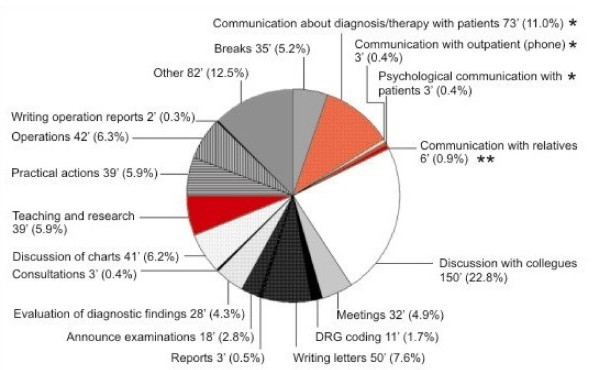
BACKGROUND: In the modern hospital environment, increasing possibilities in medical examination techniques and increasing documentation tasks claim the physicians' energy and encroach on their time spent with patients. This study aimed to investigate how much time physicians at hospital wards spend on communication with patients and their families and how much time they spend on other specific work tasks. METHODS: A non-participatory, observational study was conducted in thirty-six wards at the University Medical Center Freiburg, a 1700-bed academic hospital in Germany. All wards belonging to the clinics of internal medicine, surgery, radiology, neurology, and to the clinic for gynaecology took part in the study. Thirty-four ward doctors from fifteen different medical departments were observed during a randomly chosen complete work day. The Physicians' time for communication with patients and relatives and time spent on different working tasks during one day of work were assessed. RESULTS: 374 working hours were analysed. On average, a physician's workday on a university hospital ward added up to 658.91 minutes (10 hrs 58 min; range 490 - 848 min). Looking at single items of time consumption on the evaluation sheet, discussions with colleagues ranked first with 150 minutes on average. Documentation and administrative requirements took an average time of 148 minutes per day and ranked second. Total time for communication with patients and their relatives was 85 minutes per physician and day. Consequently, the available time for communication was 4 minutes and 17 seconds for each patient on the ward and 20 seconds for his or her relatives. Physicians assessed themselves to communicate twice as long with patients and sevenfold with relatives than they did according to this study. CONCLUSIONS: Workload and time pressure for physicians working on hospital wards are high. To offer excellent medical treatment combined with patient centred care and to meet the needs of patients and relatives on hospital wards, physicians should be given more time to focus on core clinical tasks. Time and health care management solutions to minimize time pressure are required. Further research is needed to assess quality of communication in hospital settings.
Overview
The claims and statistics of this paper haven’t been checked yet.
Free: it reads the open-access text and checks the first 5 claims that cite a source we can check. Create a free account to check every claim.
Integrity signals
Registry
Cites
Statistics
Figures
Verification
Claims the paper makes
The claims and statistics of this paper haven’t been checked yet.
Free: it reads the open-access text and checks the first 5 claims that cite a source we can check. Create a free account to check every claim.
Claims other papers make about this one
Each is checked against this paper’s own text: does it say what the citing paper says it does?
The source backs part of the claim, not all of it — or backs it for a different population, condition or comparison.
In the citing paper
“They can be accessed by patients at any time and do not have the same time constraints as healthcare experts, potentially making contact easier and more comfortable35.”
From The future landscape of large language models in medicine (2023) · cites this paper as [35]
Experimental — accuracy not yet measuredThe cited source says what the claim attributes to it.
In the citing paper
“Clinicians devote a substantial amount of time to documentation2”
From A framework to assess clinical safety and hallucination rates of LLMs for medical text summarisation (2025) · cites this paper as [2]
In the citing paper
“Documentation and administrative requirements consume around 25% of clinicians’ workdays35.”
From The future landscape of large language models in medicine (2023) · cites this paper as [35]
Self-check
Percentages, sums and reported differences re-computed from the paper’s own numbers.
The self-check needs the paper’s full text.
Citations
Cites
Doctor-patient communication: a review of the literature
Ong, L. M. L., de Haes, J. C. J. M., Hoos, A. M., & Lammes, F. B. (1995) · Social Science & Medicine · doi:10.1016/0277-9536(94)00155-m · Cited by 2,430
Levinson, W. (1997) · JAMA: The Journal of the American Medical Association · doi:10.1001/jama.1997.03540310051034 · Cited by 1,119
(2013) · Congress Online · doi:10.4324/9780203494035-16 · Cited by 664
Consultation length in general practice: cross sectional study in six European countries
Deveugele, M., Derese, A., van den Brink-Muinen, A., Bensing, J., & De Maeseneer, J. (2002) · BMJ · doi:10.1136/bmj.325.7362.472 · Cited by 627 · cited 1×
“These results are similar to the findings of other studies [25,26] and may be attributed to professional experience and greater range of communication skills.”
ResultTime and the Patient–Physician Relationship
Dugdale, D. C., Epstein, R., & Pantilat, S. Z. (1999) · Journal of General Internal Medicine · doi:10.1046/j.1525-1497.1999.00263.x · Cited by 609 · cited 2×
“time spent on communication with patients [ 1-3 ].”
BackgroundEffective communication skills are the key to good cancer care
Fallowfield, L., & Jenkins, V (1999) · European Journal of Cancer · doi:10.1016/s0959-8049(99)00212-9 · Cited by 556 · cited 1×
“000 consultations with patients, communication should be viewed as a core clinical skill and an integral medical task [11].”
BackgroundFamily satisfaction with care in the intensive care unit: Results of a multiple center study*
Heyland, D. K., Rocker, G. M., Dodek, P. M., Kutsogiannis, D. J., Konopad, E., Cook, D. J., Peters, S., Tranmer, J. E., & O’Callaghan, C. J. (2002) · Critical Care Medicine · doi:10.1097/00003246-200207000-00002 · Cited by 458 · cited 1×
“Taking into consideration that relatives rate physicians' communication skills as important as their medical capabilities, the results of the present study should start further reflections on communication lengths and quality of dialogues with the relatives on hospital wards [17].”
Physician–Patient Communication
Hall, J. A., & Roter, D. L. (2012) · The Oxford Handbook of Health Psychology · doi:10.1093/oxfordhb/9780195342819.013.0014 · Cited by 334
Patient satisfaction with time spent with their physician.
Gross, D. A., Zyzanski, S. J., Borawski, E. A., Cebul, R. D., & Stange, K. C. (1998) · PubMed · Cited by 248
Physician Discontent: Challenges and Opportunities
Mechanic, D. (2003) · JAMA · doi:10.1001/jama.290.7.941 · Cited by 220 · cited 1×
“The time for communication and personal contact between physicians and patients seems to be an increasingly valuable resource [5,6].”
BackgroundSatisfactions, Dissatisfactions, and Causes of Stress in Medical Practice
Mawardi, B. H. (1979) · JAMA: The Journal of the American Medical Association · doi:10.1001/jama.1979.03290400043020 · Cited by 207 · cited 1×
“Research revealed that the primary source of dissatisfaction of physicians is "time pressure" [13, 21 ,22].”
BackgroundWestbrook, J. I., Ampt, A., Kearney, L., & Rob, M. I. (2008) · Medical Journal of Australia · doi:10.5694/j.1326-5377.2008.tb01762.x · Cited by 180 · cited 1×
“Our results regarding different work tasks are comparable to two recent studies focusing on the physicians' activities on hospital wards [18,19].”
ResultWorkload and job satisfaction among general practitioners: A review of the literature
Groenewegen, P., & Hutten, J. B. F. (1991) · Social Science & Medicine · doi:10.1016/0277-9536(91)90087-s · Cited by 156 · cited 1×
“Research revealed that the primary source of dissatisfaction of physicians is "time pressure" [13,21,22].”
BackgroundSpötl, H.-P., & Ammenwerth, E. (2009) · Methods of Information in Medicine · doi:10.3414/me0569 · Cited by 142 · cited 1×
“Our results regarding different work tasks are comparable to two recent studies focusing on the physicians' activities on hospital wards [18,19].”
Result(2009) · PubMed · Cited by 138
Doctor–patient communication: a comparison of the USA and Japan
Ohtaki, S., Ohtaki, T., & Fetters, M. D. (2003) · Family Practice · doi:10.1093/fampra/cmg308 · Cited by 118 · cited 1×
“They are preferably done in the context of general practice consultations [7,8].”
BackgroundMorrison, I., & Smith, R. (2000) · BMJ · doi:10.1136/bmj.321.7276.1541 · Cited by 102 · cited 4×
“Administrative requirements take an increasing part of physicians' daily work and add to time pressure in clinical practice [3,10, 13 ].”
BackgroundResultInfluentialHow should hamsters run? Some observations about sufficient patient time in primary care
Mechanic, D. (2001) · BMJ · doi:10.1136/bmj.323.7307.266 · Cited by 93 · cited 1×
“A sense of dissatisfaction and lack of time are known by many doctors in many countries [23].”
BackgroundThe Patient-Physician Relationship: JAMA Focuses on the Center of Medicine
Glass, R. M. (1996) · JAMA · doi:10.1001/jama.1996.03530260061033 · Cited by 81 · cited 1×
“Multiple reports including our results reveal that physicians work load and multitasking demands are rather high [1,12-14].”
The workload of GPs: consultations of patients with psychological and somatic problems compared.
Zantinge, E. M., Verhaak, P. F. M., Kerssens, J. J., & Bensing, J. M. (2005) · Europe PMC (PubMed Central) · Cited by 74
Time for care. Length of general practice consultations in Australia.
Britt, H. C., Valenti, L., & Miller, G. C. (2002) · PubMed · Cited by 72
Davidoff, F. (1997) · Annals of Internal Medicine · doi:10.7326/0003-4819-127-6-199709150-00011 · Cited by 50
Satisfactions, dissatisfactions, and causes of stress in medical practice
Bh, M. (1979) · JAMA · doi:10.1001/jama.241.14.1483 · Cited by 36
The patient-physician relationship. JAMA focuses on the center of medicine
Glass, R. M. (1996) · JAMA · doi:10.1001/jama.275.2.147 · Cited by 30
Databases in the Next Millennium
Davidoff, F. (1997) · Annals of Internal Medicine · doi:10.7326/0003-4819-127-8_part_2-199710151-00067 · Cited by 29
Forty-seven minutes a year for the patient.
Gray, D. P. (1998) · Europe PMC (PubMed Central) · Cited by 25
Can a senior house officer's time be used more effectively?
Mitchell, J. (2004) · Emergency Medicine Journal · doi:10.1136/emj.2003.007088 · Cited by 17 · cited 1×
“Further research is needed to qualitatively research the physicians' working tasks and identify the activities which could possibly be delegated to non-medical staff which would be less expansive and make physicians' work more effective [20].”
BackgroundHäuser, W., & Schwebius, P. (1999) · PubMed · Cited by 11
Middeke, M. (2005) · DMW - Deutsche Medizinische Wochenschrift · doi:10.1055/s-2005-923330 · Cited by 7 · cited 1×
“The time for communication and personal contact between physicians and patients seems to be an increasingly valuable resource [5,6].”
BackgroundFehlenberg, D., & Köhle, K. (1983) · PubMed · Cited by 5
Wer verstehen will, braucht Zeit
Hemmer-Schanze, C., & Füessl, H. S. (2006) · MMW - Fortschritte der Medizin · doi:10.1007/bf03364518 · Cited by 3
Research works printed but not linked: 2
- Häuser S Schwebius P Vier Minuten pro Patient, eine Minute pro Angehörigen Psychother Psychosom Med Psychol 1999 49 168 170 10396134
- Hartmann W Topp F Kronmüller K Zipfel S Herzog W Family Medicine - Empirischer Bedarf zwischen Kosten und Nutzen Psychother Psychosom Med Psychol 1999 49 468
Cited by
The future landscape of large language models in medicine
Clusmann, J., Kolbinger, F. R., Muti, H. S., Carrero, Z. I., Eckardt, J.-N., Laleh, N. G., Löffler, C. M. L., Schwarzkopf, S.-C., Unger, M., Veldhuizen, G. P., et al. (2023) · Communications Medicine · doi:10.1038/s43856-023-00370-1 · Cited by 1,045
“They can be accessed by patients at any time and do not have the same time constraints as healthcare experts, potentially making contact easier and more comfortable 35 .”
BackgroundA framework to assess clinical safety and hallucination rates of LLMs for medical text summarisation
Asgari, E., Montaña-Brown, N., Dubois, M., Khalil, S., Balloch, J., Yeung, J. A., & Pimenta, D. (2025) · npj Digital Medicine · doi:10.1038/s41746-025-01670-7 · Cited by 423
“Clinicians devote a substantial amount of time to documentation 2 , and prolonged interaction with electronic health records, where clinical documentation is logged, has been demonstrated to raise cognitive load and lead to burnout 3 .”
The impact of electronic health record systems on clinical documentation times: a systematic review
Baumann, L. A., Baker, J., & Elshaug, A. G. (2018) · Health Policy · doi:10.1016/j.healthpol.2018.05.014 · Cited by 320
Does supervision improve health worker productivity? Evidence from the Upper East Region of Ghana
Frimpong, J. A., Helleringer, S., Awoonor‐Williams, J. K., Yeji, F., & Phillips, J. F. (2011) · Tropical Medicine & International Health · doi:10.1111/j.1365-3156.2011.02824.x · Cited by 119
“Data for the TUS were collected using the work-sampling methodology (i.e. direct observation) (Linden & English 1994; Capuano et al. 2004; Poissant et al. 2005; Herdman et al. 2009; Becker et al. 2010).”
Methodvon Blanckenburg, P., Hofmann, M., Rief, W., Seifart, U., & Seifart, C. (2020) · Patient Education and Counseling · doi:10.1016/j.pec.2020.02.036 · Cited by 105
Metadata
- Authors
- Becker, G., Kempf, D. E., Xander, C. J., Momm, F., Olschewski, M., & Blum, H. E.
- Affiliations
- University Medical Center Freiburg (DE)
- Corresponding author
- Becker, Gerhild
- Venue
- BMC Health Services Research
- Published
- 2010-04-09
- Volume
- 10
- Issue
- 1
- Pages
- 94-94
- ISSN
- 1472-6963 (ISSN-L)
- PMC
- PMC2907756
- OpenAlex
- W2114014706
- Cited by
- 81
- References
- 31
- Citations by year
- 2026: 8 · 2025: 14 · 2024: 10 · 2023: 8 · 2022: 2 · 2021: 3 · 2020: 4 · 2019: 5 · 2018: 2 · 2017: 2 · 2016: 3 · 2015: 2 · 2014: 5 · 2013: 6 · 2012: 2
- FWCI
- 7.38
- Type
- journal article
- Language
- en
- Open access
- gold
- doi.org
- Licence
- cc-by
- creativecommons.org/licenses/by/2.0 (tdm)
- Locations
- BMC Health Services Research (publishedVersion, cc-by)
- PubMed Central (publishedVersion, cc-by)
- PubMed (publishedVersion)
- DOAJ (DOAJ: Directory of Open Access Journals) (submittedVersion)
- Topics
- Health Sciences › Health Professions › General Health Professions › Patient-Provider Communication in Healthcare
- Social Sciences › Decision Sciences › Management Science and Operations Research › Healthcare Operations and Scheduling Optimization
- Health Sciences › Nursing › Leadership and Management › Hospital Admissions and Outcomes
- Keywords
- physician time use, physician-patient communication, physician-family communication, time pressure, physician workload, documentation burden, administrative functions, hospital wards, patient-centered care
- MeSH terms
- Attitude of Health Personnel, Communication, Family, Forms and Records Control, Germany, Hospital Departments, Hospitals, University, Humans, Medical History Taking, Physician-Patient Relations, Practice Patterns, Physicians', Time Factors, Work Schedule Tolerance, Qualitative Research
About these checks
Registry, retraction, Cites and statistics results are computed, not judged, with one exception: a printed reference that no index lists is read once by a model before it counts as a citation error. Claims are extracted by a model and kept only when their quote appears verbatim in the text; each cited source is then checked, with a model’s help, for whether it says what the claim relies on. Those verdicts can be wrong — read the claim’s quote and the cited source before relying on one.
Statistics and arithmetic are recomputed, not judged.
Confidence bands are shown only for fields calibrated on our annotated test set. None is calibrated yet, so no band is shown.
What counts as a claim ›How we measure confidence ›How we check this ›
Are you an author, or do you see a problem with this page? Request a review
Data sources
Bibliographic data: Semantic Scholar, OpenAlex, Crossref.
Contains information from the Semantic Scholar Academic Graph Datasets, made available under the ODC Attribution License (ODC-BY 1.0).
Semantic Scholar’s data is described in: Kinney, R., et al. (2023). The Semantic Scholar Open Data Platform. arXiv:2301.10140.
