

The DOI matches its Crossref record; 147 of the 149 references it cites were found in a registry or an index.
Integrating telecare for chronic disease management in the community: What needs to be done?
Open accessAbstract
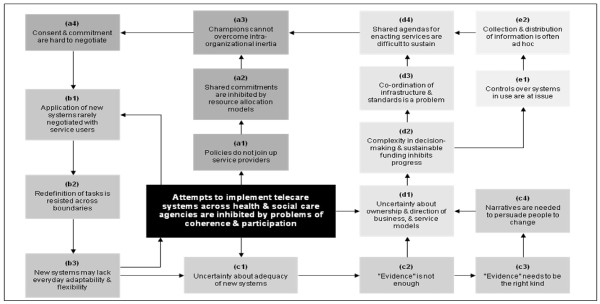
Background: Telecare could greatly facilitate chronic disease management in the community, but despite government promotion and positive demonstrations its implementation has been limited. This study aimed to identify factors inhibiting the implementation and integration of telecare systems for chronic disease management in the community. Methods: Large scale comparative study employing qualitative data collection techniques: semi-structured interviews with key informants, task-groups, and workshops; framework analysis of qualitative data informed by Normalization Process Theory. Drawn from telecare services in community and domestic settings in England and Scotland, 221 participants were included, consisting of health professionals and managers; patients and carers; social care professionals and managers; and service suppliers and manufacturers. Results: Key barriers to telecare integration were uncertainties about coherent and sustainable service and business models; lack of coordination across social and primary care boundaries, lack of financial or other incentives to include telecare within primary care services; a lack of a sense of continuity with previous service provision and self-care work undertaken by patients; and general uncertainty about the adequacy of telecare systems. These problems led to poor integration of policy and practice. Conclusion: Telecare services may offer a cost effective and safe form of care for some people living with chronic illness. Slow and uneven implementation and integration do not stem from problems of adoption. They result from incomplete understanding of the role of telecare systems and subsequent adaption and embeddedness to context, and uncertainties about the best way to develop, coordinate, and sustain services that assist with chronic disease management. Interventions are therefore needed that (i) reduce uncertainty about the ownership of implementation processes and that lock together health and social care agencies; and (ii) ensure user centred rather than biomedical/service-centred models of care.
Overview
The claims and statistics of this paper haven’t been checked yet.
Run the check — free, no account needed. It reads the open-access text and checks the sources it cites.
Integrity signals
Registry
Cites
Statistics
Figures
Verification
Claims the paper makes
The claims and statistics of this paper haven’t been checked yet.
Run the check — free, no account needed. It reads the open-access text and checks the sources it cites.
Claims other papers make about this one
Each is checked against this paper’s own text: does it say what the citing paper says it does?
In the citing paper
“However, a number of studies have demonstrated that these types of interventions often fail to be successfully implemented and adopted within routine healthcare [5].”
From Exploring barriers to participation and adoption of telehealth and telecare within the Whole System Demonstrator trial: a qualitative study (2012) · cites this paper as [5]
Self-check
Percentages, sums and reported differences re-computed from the paper’s own numbers.
The self-check needs the paper’s full text.
Citations
Cites
(1999) · Cited by 28,356
Qualitative Analysis for Social Scientists
Strauss, A. L. (1987) · doi:10.1017/cbo9780511557842 · Cited by 12,277
Pharmacological interventions for somatoform disorders in adults
Kleinstäuber, M., Witthöft, M., Steffanowski, A., van Marwijk, H., Hiller, W., & Lambert, M. J. (2014) · Cochrane Database of Systematic Reviews · doi:10.1002/14651858.cd010628.pub2 · Cited by 11,369
Qualitative research in health care: Analysing qualitative data
Pope, C. (2000) · BMJ · doi:10.1136/bmj.320.7227.114 · Cited by 8,131
Reassembling the social: An introduction to actor‐network‐theory
Turnbull, J. (2008) · New Zealand Geographer · doi:10.1111/j.1745-7939.2008.00151_4.x · Cited by 7,646
Diffusion of Innovations in Service Organizations: Systematic Review and Recommendations
GREENHALGH, T., ROBERT, G., MACFARLANE, F., BATE, P., & KYRIAKIDOU, O. (2004) · The Milbank Quarterly · doi:10.1111/j.0887-378x.2004.00325.x · Cited by 7,448
Snowball Sampling: Problems and Techniques of Chain Referral Sampling
Biernacki, P., & Waldorf, D. (1981) · Sociological Methods & Research · doi:10.1177/004912418101000205 · Cited by 6,001
Qualitative data analysis for applied policy research
(2002) · Analyzing Qualitative Data · doi:10.4324/9780203413081-14 · Cited by 4,964
Qualitative data analysis for applied policy research
Ritchie, J., & Spencer, L. (2010) · Analyzing qualitative data · doi:10.4324/9780203413081_chapter_9 · Cited by 4,800
Chronic illness as biographical disruption
Bury, M. (1982) · Sociology of Health & Illness · doi:10.1111/1467-9566.ep11339939 · Cited by 3,960
Research works printed but not linked: 5
- Department of Health: Building telecare in England. 2005, Scottish Executive
- Department of Health; The Welsh Office; DTI: Telemedicine and Telecare Impact on Healthcare. 1998, 1-33.
- Commission Audit: Implementing telecare: strategic analysis and guidelines for policy makers, commissioners and providers. 2004, London: Audit Commission
- May C, Finch T, Cornford J, Exley C, Gately C, Kirk S, Jenkings KN, Mair FS, Osbourne J, Robinson AL, et al: Integrating Telecare for Chronic Disease Management in the Community: What Needs to be Done?. 2009, London: NIHR
- Cassell C, Symon G, (Eds.): Qualitative methods in organizational research - a practice guide. 1994, London: Sage
Cited by
Sorted by citations
Evaluating barriers to adopting telemedicine worldwide: A systematic review
Scott Kruse, C., Karem, P., Shifflett, K., Vegi, L., Ravi, K., & Brooks, M. (2018) · Journal of Telemedicine and Telecare · doi:10.1177/1357633x16674087 · Cited by 1,735
Bridging Research and Practice
Tabak, R. G., Khoong, E. C., Chambers, D. A., & Brownson, R. C. (2012) · American Journal of Preventive Medicine · doi:10.1016/j.amepre.2012.05.024 · Cited by 1,386
Interactive telemedicine: effects on professional practice and health care outcomes
Flodgren, G., Rachas, A., Farmer, A. J., Inzitari, M., & Shepperd, S. (2015) · Cochrane Database of Systematic Reviews · doi:10.1002/14651858.cd002098.pub2 · Cited by 806
May, C. R., Cummings, A., Girling, M., Bracher, M., Mair, F. S., May, C. M., Murray, E., Myall, M., Rapley, T., & Finch, T. (2018) · Implementation Science · doi:10.1186/s13012-018-0758-1 · Cited by 683
Self-citationNational Standards for Diabetes Self-Management Education and Support
Haas, L. B., Maryniuk, M. D., Beck, J. K., Cox, C. E., Duker, P. N., Edwards, L. J., Fisher, E. B., Hanson, L., Kent, D., Kolb, L. E., et al. (2012) · Diabetes Care · doi:10.2337/dc12-1707 · Cited by 686
Metadata
- Authors
- May, C. R., Finch, T. L., Cornford, J., Exley, C., Gately, C., Kirk, S., Jenkings, K. N., Osbourne, J., Robinson, A. L., Rogers, A., Wilson, R., & Mair, F. S.
- Affiliations
- University of Southampton (GB)
- Newcastle University (GB)
- University of East Anglia (GB)
- University of Manchester (GB)
- Cranfield University (GB)
- University of Glasgow (GB)
- Corresponding author
- Finch, Tracy L
- Venue
- BMC Health Services Research
- Published
- 2011-05-27
- Volume
- 11
- Issue
- 1
- Pages
- 131-131
- ISSN
- 1472-6963 (ISSN-L)
- PMC
- PMC3116473
- OpenAlex
- W2146384540
- Cited by
- 220
- References
- 149
- Citations by year
- 2026: 1 · 2025: 8 · 2024: 13 · 2023: 11 · 2022: 11 · 2021: 9 · 2020: 22 · 2019: 17 · 2018: 18 · 2017: 11 · 2016: 22 · 2015: 20 · 2014: 14 · 2013: 20 · 2012: 16
- FWCI
- 17.93
- Type
- journal article
- Language
- en
- Open access
- gold
- doi.org
- Licence
- Locations
- BMC Health Services Research (publishedVersion, cc-by)
- PubMed Central (publishedVersion, cc-by)
- PubMed (publishedVersion)
- Research Explorer (The University of Manchester) (publishedVersion, other-oa)
- Northumbria Research Link (Northumbria University) (acceptedVersion)
- UEA Digital Repository (University of East Anglia) (acceptedVersion)
- e-space (Manchester Metropolitan University) (acceptedVersion)
- ENLIGHTEN (Jurnal Bimbingan dan Konseling Islam) (acceptedVersion)
- ePrints Soton (University of Southampton) (acceptedVersion)
- LSHTM Research Online (London School of Hygiene and Tropical Medicine) (acceptedVersion)
- DOAJ (DOAJ: Directory of Open Access Journals) (submittedVersion)
- Figshare (submittedVersion, cc-by)
- Newcastle University ePrints (Newcastle Univesity) (cc-by)
- Funders
- National Institute for Health and Care Research
- Topics
- Health Sciences › Medicine › Public Health, Environmental and Occupational Health › Telemedicine and Telehealth Implementation
- Health Sciences › Health Professions › General Health Professions › Health Policy Implementation Science
- Health Sciences › Medicine › Geriatrics and Gerontology › Technology Use by Older Adults
- Keywords
- telecare, chronic disease management, implementation barriers, Normalization Process Theory, primary care, social care, health and social care coordination, service model, continuity of care, user-centred care, community-based care
- MeSH terms
- Chronic Disease, Community Health Services, Cooperative Behavior, Education, England, Humans, Scotland, Social Work, Negotiating, Telemedicine, Disease Management, Uncertainty, Qualitative Research
About these checks
Registry, retraction, Cites and statistics results are computed, not judged, with one exception: a printed reference that no index lists is read once by a model before it counts as a citation error. Claims are extracted by a model and kept only when their quote appears verbatim in the text; each cited source is then checked, with a model’s help, for whether it says what the claim relies on. Those verdicts can be wrong — read the claim’s quote and the cited source before relying on one.
Statistics and arithmetic are recomputed, not judged.
Confidence bands are shown only for fields calibrated on our annotated test set. None is calibrated yet, so no band is shown.
What counts as a claim ›How we measure confidence ›How we check this ›
Are you an author, or do you see a problem with this page? Request a review
