

The DOI matches its Crossref record; 39 of the 39 references it cites were found in a registry or an index.
How much time do nurses have for patients? a longitudinal study quantifying hospital nurses' patterns of task time distribution and interactions with health professionals
Open accessAbstract
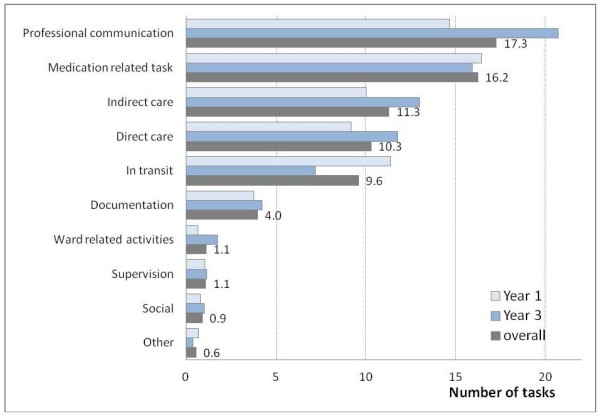
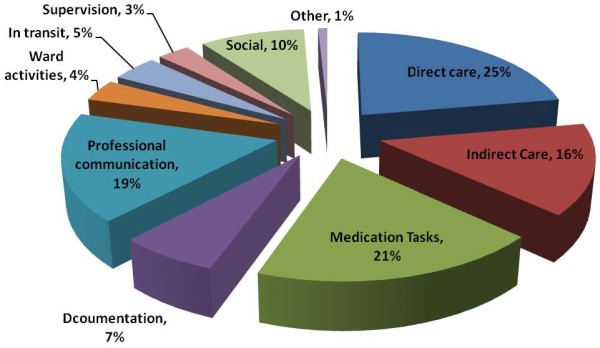
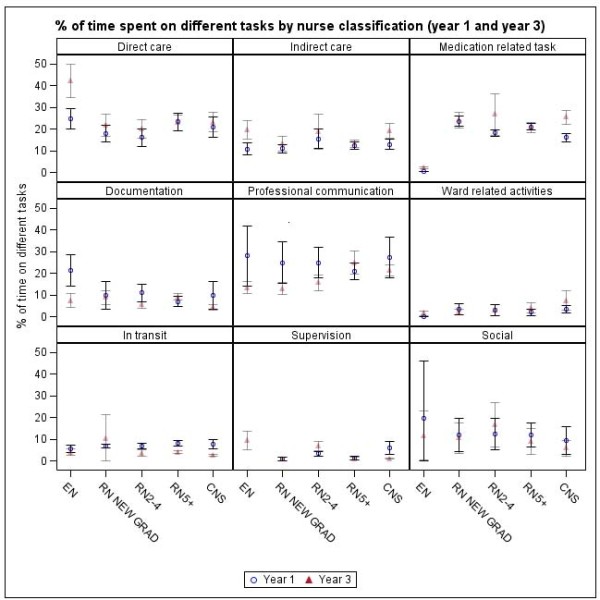
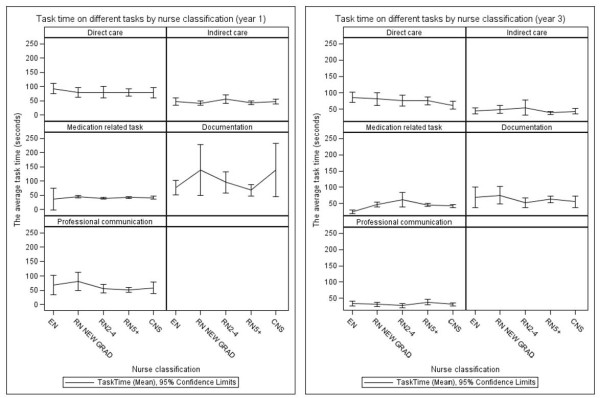
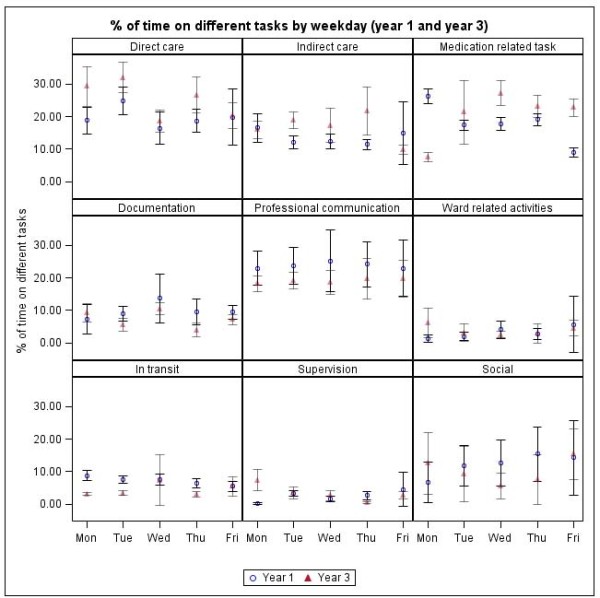
BACKGROUND: Time nurses spend with patients is associated with improved patient outcomes, reduced errors, and patient and nurse satisfaction. Few studies have measured how nurses distribute their time across tasks. We aimed to quantify how nurses distribute their time across tasks, with patients, in individual tasks, and engagement with other health care providers; and how work patterns changed over a two year period. METHODS: Prospective observational study of 57 nurses for 191.3 hours (109.8 hours in 2005/2006 and 81.5 in 2008), on two wards in a teaching hospital in Australia. The validated Work Observation Method by Activity Timing (WOMBAT) method was applied. Proportions of time in 10 categories of work, average time per task, time with patients and others, information tools used, and rates of interruptions and multi-tasking were calculated. RESULTS: Nurses spent 37.0%[95%CI: 34.5, 39.3] of their time with patients, which did not change in year 3 [35.7%; 95%CI: 33.3, 38.0]. Direct care, indirect care, medication tasks and professional communication together consumed 76.4% of nurses' time in year 1 and 81.0% in year 3. Time on direct and indirect care increased significantly (respectively 20.4% to 24.8%, P < 0.01;13.0% to 16.1%, P < 0.01). Proportion of time on medication tasks (19.0%) did not change. Time in professional communication declined (24.0% to 19.2%, P < 0.05). Nurses completed an average of 72.3 tasks per hour, with a mean task length of 55 seconds. Interruptions arose at an average rate of two per hour, but medication tasks incurred 27% of all interruptions. In 25% of medication tasks nurses multi-tasked. Between years 1 and 3 nurses spent more time alone, from 27.5%[95%CI 24.5, 30.6] to 39.4%[34.9, 43.9]. Time with health professionals other than nurses was low and did not change. CONCLUSIONS: Nurses spent around 37% of their time with patients which did not change. Work patterns were increasingly fragmented with rapid changes between tasks of short length. Interruptions were modest but their substantial over-representation among medication tasks raises potential safety concerns. There was no evidence of an increase in team-based, multi-disciplinary care. Over time nurses spent significantly less time talking with colleagues and more time alone.
Overview
The claims and statistics of this paper haven’t been checked yet.
Run the check — free, no account needed. It reads the open-access text and checks the sources it cites.
Integrity signals
Registry
Cites
Statistics
Figures
Verification
Claims the paper makes
The claims and statistics of this paper haven’t been checked yet.
Run the check — free, no account needed. It reads the open-access text and checks the sources it cites.
Claims other papers make about this one
Each is checked against this paper’s own text: does it say what the citing paper says it does?
In the citing paper
“Time studies in nursing highlight the considerable time spent on routine and administrative tasks, thereby supporting the use of AI in areas like monitoring and documentation [39, 40].”
From Nurses’ perceptions, experience and knowledge regarding artificial intelligence: results from a cross-sectional online survey in Germany (2024) · cites this paper as [39]
Self-check
Percentages, sums and reported differences re-computed from the paper’s own numbers.
The self-check needs the paper’s full text.
Citations
Cites
Hospital Nurse Staffing and Patient Mortality, Nurse Burnout, and Job Dissatisfaction
Aiken, L. H. (2002) · JAMA · doi:10.1001/jama.288.16.1987 · Cited by 5,226
Costs of a predictible switch between simple cognitive tasks.
Rogers, R. D., & Monsell, S. (1995) · Journal of Experimental Psychology: General · doi:10.1037/0096-3445.124.2.207 · Cited by 3,170
Monsell, S. (2003) · Trends in Cognitive Sciences · doi:10.1016/s1364-6613(03)00028-7 · Cited by 2,984
Nurse-Staffing Levels and the Quality of Care in Hospitals
Needleman, J., Buerhaus, P. I., Mattke, S., Stewart, M. T., & Zelevinsky, K. (2002) · New England Journal of Medicine · doi:10.1056/nejmsa012247 · Cited by 2,246
Shifting Intentional Set: Exploring the Dynamic Control of Tasks
(1994) · The MIT Press eBooks · doi:10.7551/mitpress/1478.003.0025 · Cited by 1,328
Association of Interruptions With an Increased Risk and Severity of Medication Administration Errors
Westbrook, J. I. (2010) · Archives of Internal Medicine · doi:10.1001/archinternmed.2010.65 · Cited by 772
Self-citation(1994) · The MIT Press eBooks · doi:10.7551/mitpress/1478.001.0001 · Cited by 749
Changes in executive control across the life span: Examination of task-switching performance.
Cepeda, N. J., Kramer, A. F., & Gonzalez de Sather, J. C. M. (2001) · Developmental Psychology · doi:10.1037/0012-1649.37.5.715 · Cited by 657
A 36-hospital time and motion study: how do medical-surgical nurses spend their time?
Hendrich, A., Chow, M. P., Skierczynski, B. A., & Lu, Z. (2008) · The Permanente Journal · doi:10.7812/tpp/08-021 · Cited by 530
Tips for learners of evidence-based medicine: 3. Measures of observer variability (kappa statistic)
McGinn, T. G. (2004) · Canadian Medical Association Journal · doi:10.1503/cmaj.1031981 · Cited by 482
Research works printed but not linked: 3
- Duffield C, Diers D, O'Brien-Pallas L, Aisbett C, Roche M, King M, Aisbett K: Nursing, the work environment and patient outcomes. App Nurs Res. 2011.
- Australian Institute for Health and Welfare: Health Expenditure Australia 2007-08. Health and Welfare Expenditure Series. 2009, Canberra: AIHW
- National Health and Hospitals Reform Commission: A healthier future for all Australians. 2009, Canberra: Commonwealth of Australia
Cited by
Sorted by citations
Items 301–375 of 375
The Socio-technical Foundations of Health Information Work
Mather, C. A., & Whetton, S. (2021) · Health informatics · doi:10.1007/978-3-030-81850-0_3 · Cited by 1
Non-COVID-19 hospitalizations: patients’ experiences during the COVID-19 pandemic
Patrick, J. (2022) · Patient Experience Journal · doi:10.35680/2372-0247.1721 · Cited by 1
Nurses' Medication Work: The Social Organization of Rule Breaking to Keep Patients Safe
Dyjur, L. (2015) · Libraries and Cultural Resources (University of Calgary) · doi:10.11575/prism/27149 · Cited by 1
The impact of patient transfers and bedspace moves on nurse workload
Blay, N. (2015) · UTS ePRESS (University of Technology Sydney) · Cited by 1
Santana, P. R. C. (2019) · doi:10.6035/14103.2019.430142 · Cited by 1
Gohil, S. K., Quan, K. A., Madey, K. M., Adelsohn, S., Tjoa, T., Tifrea, D. F., Crews, B. O., Monuki, E. S., Khan, S., Schubl, S. D., et al. (2021) · Research Square · doi:10.21203/rs.3.rs-566927/v1 · Cited by 1
Wilson‐Aggarwal, J. K., Gotts, N., Wong, W. K., Liddington, C., Knight, S., Spyer, M. J., Houlihan, C. F., Nastouli, E., & Manley, E. (2022) · medRxiv · doi:10.1101/2022.06.10.22276247 · Cited by 1
Cremer, S. (2024) · doi:10.26481/dis.20240411sc · Cited by 1
Gholampour, A., Bezaatpour, F., Hashemi, B., & Khameslou, M. A. (2025) · Research Square · doi:10.21203/rs.3.rs-7329125/v1 · Cited by 1
Park, C. S. (2026) · SSRN Electronic Journal · doi:10.2139/ssrn.7250158 · Cited by 1
The provision of care for older adults in the acute care setting
Kashfi, G. (2015) · Tuwhera (Auckland University of Technology)
The Therapeutic Alliance inMental Health Services:A Politico-Critical Analysis ofKnowledge and Power
Grech, P. (2014) · White Rose eTheses Online (University of Leeds, The University of Sheffield, University of York)
Leadership and excellence in the early recognition of critical illness: A call for papers
Smith, M. C., & Lyte, G. (2013) · Intensive and Critical Care Nursing · doi:10.1016/j.iccn.2013.10.001
Support for nurses dealing with rituals held in health care facilities
Jiyane, P. M. (2014) · UpSpace Institutional Repository (University of Pretoria)
Czas pracy na pielęgniarskich stanowiskach w szpitalnych oddziałach ratunkowych
Klukow, J. W., & Ksykiewicz-Dorota, A. (2013) · Przedsiebiorczosc i Zarzadzanie
The Introduction of Patient’s Own Drug Scheme in a Specialist Palliative Care Inpatient Unit
Wright, M., Moran, S., & Doody, O. (2016) · Journal of Hospice and Palliative Nursing · doi:10.1097/njh.0000000000000291
Nghiên cứu nhu cầu đào tạo Cử nhân tâm lý chuyên ngành Tâm lý lâm sàng cho các cơ sở y tế
Kiên, P. T., & Tran, H. T. (2017) · VNU Journal of Science Medical and Pharmaceutical Sciences · doi:10.25073/2588-1132/vnumps.4063
Idealet og virkeligheden – kirurgiske sygeplejerskers oplevelser af sygeplejen
Bergenholtz, H. (2017) · Klinisk Sygepleje · doi:10.18261/issn.1903-2285-2017-03-04
Mather, C. A. (2018) · UTAS Research Repository · doi:10.25959/100.00028466
Nurses? use of smartphones for work purposes in the Philippines : predictors, outcomes, and issues
Bautista, J. R. (2019) · doi:10.32657/10220/48111 · Cited by 1
Increasing Hand Hygiene Performance in Health Care Workers with Electronic Real-time Prompting
Pong, S. M. (2019) · TSpace (University of Toronto)
Role of literary works in medical education
Hozyasz, K. K. (2020) · Nursing and Public Health · doi:10.17219/pzp/119058
van den Oetelaar, W. F. J. M. (2020) · Utrecht University Repository (Utrecht University) · doi:10.33540/147
Diseño y simulación de un robot seguidor de personas para el transporte de suministros en hospitales
Vásquez, D. M. R., Herrera, L. R., López, A. D., & Roque, Y. D. (2020) · Ciencia Ingenierías y Aplicaciones · doi:10.22206/cyap.2020.v3i2.pp91-126
Young, A. (2012) · Faculty of Health
Evaluation of Clinical Activities by Nurses Through Time Study
Chousein, C., & Aslan, M. (2022) · Sağlık ve Hemşirelik Yönetimi Dergisi · doi:10.54304/shyd.2022.99422
Time allocated on different tasks among nurses in Bangladesh: An observational time–motion study
Hiura, M., Lily, S. A., Sengupta, S., Yamamoto, Y., & Khatun, K. S. (2022) · International Journal of Advances in Nursing Management · doi:10.52711/2454-2652.2022.00076
Peningkatan Kompetensi Keperawatan Geriatri Dasar bagi Perawat di Kota Bekasi
Pradana, A. A., Silaswati, S., Maryam, R. S., & Kurniati, D. (2022) · International Journal of Community Service Learning · doi:10.23887/ijcsl.v6i4.51032
Sammons, E. K. (2023) · Nursing · doi:10.1097/01.nurse.0000936740.01306.c6
Zusammenhang der Patientenzufriedenheit mit der Anwesenheitszeit Pflegender am Patientenbett
Zozman, M., & Stocker, R. A. (2023) · Pflege · doi:10.1024/1012-5302/a000951
The silent scream of nurses: a qualitative study
KAYSERİLİOĞLU, G., & Bulut, Ö. Ü. (2023) · Innowacje w Pielęgniarstwie · doi:10.21784/iwp.2023.001
Llagostera‐Reverter, I., & Llagostera-Reverter, I. (2023) · Tesis Doctorals en Xarxa (Consorci de Serveis Universitaris de Catalunya) · doi:10.6035/14103.2023.429241
Mobeen, A., Shafiq, M., Aziz, M. H., & Mohsin, M. J. (2023) · AIP conference proceedings · doi:10.1063/5.0118760
Charting is Never Exciting: Measuring Physician Time Use in Medical DramasPreprint
Jackson, K. C., Miller, K. A., Hill, S. M., Johnson, S. S., Reimanis, L. A., & Lofgren, E. (2024) · medRxiv · doi:10.1101/2024.03.01.24303412
INDIVIDUAL WORK PERFORMANCE OF MILLENNIAL EMPLOYEES IN TERMS OF SERVANT LEADERSHIP PERCEPTION
Jayanagara, O. (2024) · Milestone Journal of Strategic Management · doi:10.19166/ms.v4i1.8214
Das, A., Garg, R., Singh, R. P., & Banerjee, T. (2024) · Journal of Family Medicine and Primary Care · doi:10.4103/jfmpc.jfmpc_1783_23
Kurniawan, S., Nilmanat, K., Boonyasopun, U., & Ganefianty, A. (2024) · Jurnal Keperawatan Padjadjaran · doi:10.24198/jkp.v12i2.2549
Lande, V., Yeravdekar, R., & Singh, A. (2024) · Hospital Topics · doi:10.1080/00185868.2024.2391939
Thate, J., Rossetti, S. C., Yen, P., Dykes, P. C., Schnock, K. O., & Cato, K. (2025) · Cognitive informatics in biomedicine and healthcare · doi:10.1007/978-3-031-82971-0_10
The Impact of Hospital Design on Time Spent on Nursing Tasks: A Time Motion Study
Korteland, T. W., Li, C.-Y., Dohmen, N., Urbanus, B. H. A., van Zelst, S., Pu, L., van Dijk, M., & Ista, E. (2025) · HERD Health Environments Research & Design Journal · doi:10.1177/19375867251330838
Kagonya, V., Onyango, O., Maina, M., Karumba, K., Imam, A., Fuller, S., Gathara, D., & English, M. (2025) · SSRN Electronic Journal · doi:10.2139/ssrn.5247463
Stoilova, S., Geneva-Popova, M. G., & Popova-Belova, S. D. (2025) · Journal of Clinical Medicine · doi:10.3390/jcm14144854
Savage, B. K., Barringer, M. N., & Lindsay, A. (2025) · Sociological Focus · doi:10.1080/00380237.2025.2544543
Ryan, L. M., Gluck, S., Thomas, J. S., Cohen, M., Wislang, K., Maddison, J., Chur‐Hansen, A., & Laurence, C. (2025) · Internal Medicine Journal · doi:10.1111/imj.70259
大滝, 千., Izumi, S., Fujimoto, K., Inoue, K., Nishikawa, M., Teraoka, A., & Saito, I. (2025) · Cureus · doi:10.7759/cureus.97195
Maxie, E. A. (2025) · SSRN Electronic Journal · doi:10.2139/ssrn.5790003
Hiemer, J., & Andresen, M. (2025) · German Journal of Human Resource Management Zeitschrift für Personalforschung · doi:10.1177/23970022251391028
Knox, M. K., Eck, C. S., Dorsey, L. E., Mehta, P. D., Yang, C. P., & Petersen, L. A. (2025) · Medical Care · doi:10.1097/mlr.0000000000002191
Gohil, S. K., Quan, K. A., Madey, K. M., Adelsohn, S., Tjoa, T., Tifrea, D., Crews, B. O., Monuki, E. S., Khan, S., Schubl, S. D., et al. (2021) · Figshare · doi:10.6084/m9.figshare.17065942
Leslie, H. H., Laos, D., Cárcamo, C., Pérez-Cuevas, R., & Garcia, P. J. (2021) · Figshare · doi:10.6084/m9.figshare.13727512
Rashidi, A., Whitehead, L., & Kaistha, P. (2021) · Figshare · doi:10.6084/m9.figshare.17304828
Alomar, T. O., Glivar, G. C., Chung, E. B., Craig, K. J., Ward, A., Dingel, A. J., Kearsley, B. K., Goodwin, J. R., McCurry, A. D., Casanova, M. P., et al. (2026) · Healthcare · doi:10.3390/healthcare14010102
Sastry, S. A. V. K. (2026) · International Journal of Computational and Experimental Science and Engineering · doi:10.22399/ijcesen.4868
Simulated asset tracking study in a diabetes clinic
Delgado, M. A., Worlikar, H., McCabe, I., & O'Keeffe, D. T. (2026) · Journal of Healthcare Simulation · doi:10.54531/rzvs5836
Factors Associated With the Perceived Need for Medical Interpreters Among Health Care Professionals
Kosugi, M., Miyamoto, A., Wang, Y., Niyonsaba, F., Noda, A., Hara, K., & Ono, N. (2026) · Cureus · doi:10.7759/cureus.105226
Bleijlevens, M. H. C., Ginkel, J. M. D. M., van Breukelen, G., Zwakhalen, S. M. G., Hermens, L., Metzelthin, S., Waal, G. H., & Vluggen, S. (2026) · International Journal of Nursing Studies Advances · doi:10.1016/j.ijnsa.2026.100525
Mumford, V., Gu, Y., Raban, M. Z., Fitzpatrick, E., Merchant, A., Li, L., & Westbrook, J. I. (2026) · Drugs & Therapy Perspectives · doi:10.1007/s40267-026-01235-y
Self-citationDong, X., Ding, S., Wang, S., Liu, M., Gan, G., Cao, H., Wang, X., Chen, N., Tan, B., Xie, J., et al. (2026) · Journal of Nursing Management · doi:10.1155/jonm/4433675
Manirafasha, E. N., Ewing, H., Ndaimani, A., Ngwibete, A., Maweu, D., & Uwimana, C. (2026) · Nursing Research and Reviews · doi:10.2147/nrr.s616234
Iwamoto, K., Toyama, M., Yamamoto, G., (35901), C. L., Kishimoto, K., Mori, Y., & Kuroda, T. (2026) · JMIR Human Factors · doi:10.2196/89940
Roles and impact of pharmacy technicians on hospital wards: a systematic review
Graef, M. D., Heirman, J., Snoeck, T., Heerdink, E. R., Dijkstra, N. E., Dilles, T., & Serraes, B. (2026) · International Journal of Nursing Studies Advances · doi:10.1016/j.ijnsa.2026.100593
Polo-Rodríguez, A., Escalera-Esteban, A., Anguita-Molina, M. Á., Valenzuela-López, I., Correa‐Rodríguez, M., Rueda‐Medina, B., & Medina-Quero, J. (2026) · Electronics · doi:10.3390/electronics15143042
HIV-related knowledge, attitude and practice of nurses towards people living with HIV in Singapore
Shen, C. T., Wong, Y. Q., Fan, E. A., Renganathan, K., Kumar, P. A., & Acharyya, S. (2026) · Discover Public Health · doi:10.1186/s12982-026-02630-6
Strategic Optimization of Nurse-Patient Ratios Across Units and Shifts in a Teaching Hospital
Mathews, L., Kumar, K. M. S., & Balamurugan, G. (2026) · Cureus · doi:10.7759/cureus.118278
Magro, G., Bassi, E., Chiappinotto, S., Dussi, G., Conti, A., Ambrosi, E., Canzan, F., Marini, G., Clari, M., Molin, A. D., et al. (2026) · Journal of Nursing Management · doi:10.1155/jonm/9885933
Cheung, J. (2013) · The Sydney eScholarship Repository (The University of Sydney)
Metadata
- Authors
- Westbrook, J. I., Duffield, C., Li, L., & Creswick, N. J.
- Affiliations
- UNSW Sydney (AU)
- University of Technology Sydney (AU)
- Corresponding author
- Westbrook, Johanna I
- Venue
- BMC Health Services Research
- Published
- 2011-11-24
- Volume
- 11
- Issue
- 1
- Pages
- 319-319
- ISSN
- 1472-6963 (ISSN-L)
- PMC
- PMC3238335
- OpenAlex
- W2091893465
- Cited by
- 376
- References
- 39
- Citations by year
- 2026: 17 · 2025: 34 · 2024: 31 · 2023: 24 · 2022: 24 · 2021: 36 · 2020: 37 · 2019: 33 · 2018: 27 · 2017: 23 · 2016: 26 · 2015: 25 · 2014: 22 · 2013: 9 · 2012: 8
- FWCI
- 32.10
- Type
- journal article
- Language
- en
- Open access
- gold
- doi.org
- Licence
- Locations
- BMC Health Services Research (publishedVersion, cc-by)
- Europe PMC (PubMed Central) (publishedVersion, cc-by)
- PubMed Central (publishedVersion, cc-by)
- PubMed (publishedVersion)
- DOAJ (DOAJ: Directory of Open Access Journals) (submittedVersion)
- UTS ePRESS (University of Technology Sydney) (submittedVersion)
- Funders
- University of New South Wales
- Medical Research Council
- Australian Research Council
- National Health and Medical Research Council
- National Medical Research Council
- Topics
- Health Sciences › Nursing › Research and Theory › Nursing education and management
- Social Sciences › Decision Sciences › Management Science and Operations Research › Healthcare Operations and Scheduling Optimization
- Health Sciences › Health Professions › General Health Professions › Nursing Roles and Practices
- Keywords
- nurse-patient interaction, interruptions, multitasking, medication administration, professional communication, wombats, patient safety, quality of care, nursing satisfaction, patient satisfaction, patient outcomes
- MeSH terms
- Australia, Hospitals, Teaching, Humans, Interprofessional Relations, Nurse-Patient Relations, Nursing Care, Nursing Staff, Hospital, Prospective Studies, Time and Motion Studies, Nursing Methodology Research, Workload, Practice Patterns, Nurses'
About these checks
Registry, retraction, Cites and statistics results are computed, not judged, with one exception: a printed reference that no index lists is read once by a model before it counts as a citation error. Claims are extracted by a model and kept only when their quote appears verbatim in the text; each cited source is then checked, with a model’s help, for whether it says what the claim relies on. Those verdicts can be wrong — read the claim’s quote and the cited source before relying on one.
Statistics and arithmetic are recomputed, not judged.
Confidence bands are shown only for fields calibrated on our annotated test set. None is calibrated yet, so no band is shown.
What counts as a claim ›How we measure confidence ›How we check this ›
Are you an author, or do you see a problem with this page? Request a review
