

Text-messaging versus telephone reminders to reduce missed appointments in an academic primary care clinic: a randomized controlled trial
Open accessThe DOI matches its Crossref record; 27 of the 27 references it cites were found in a registry or an index.
Abstract
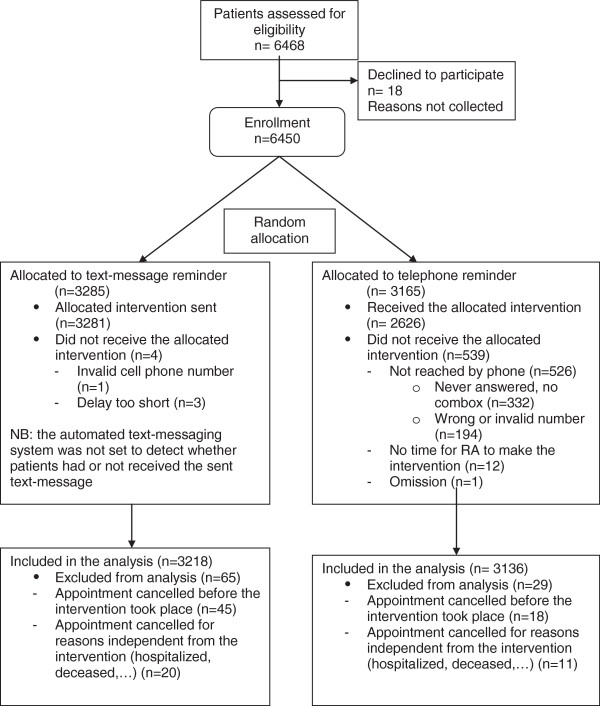
BACKGROUND: Telephone or text-message reminders have been shown to significantly reduce the rate of missed appointments in different medical settings. Since text-messaging is less resource-demanding, we tested the hypothesis that text-message reminders would be as effective as telephone reminders in an academic primary care clinic. METHODS: A randomized controlled non-inferiority trial was conducted in the academic primary care division of the Geneva University Hospitals between November 2010 and April 2011. Patients registered for an appointment at the clinic, and for whom a cell phone number was available, were randomly selected to receive a text-message or a telephone call reminder 24 hours before the planned appointment. Patients were included each time they had an appointment. The main outcome was the rate of unexplained missed appointments. Appointments were not missed if they were cancelled or re-scheduled before or independently from the intervention. We defined non-inferiority as a difference below 2% in the rate of missed appointments and powered the study accordingly. A satisfaction survey was conducted among a random sample of 900 patients (response rate 41%). RESULTS: 6450 patients were included, 3285 in the text-message group and 3165 in the telephone group. The rate of missed appointments was similar in the text-message group (11.7%, 95% CI: 10.6-12.8) and in the telephone group (10.2%, 95% CI: 9.2-11.3 p = 0.07). However, only text message reminders were cost-effective. No patient reported any disturbance by any type of reminder in the satisfaction survey. Three quarters of surveyed patients recommended its regular implementation in the clinic. CONCLUSIONS: Text-message reminders are equivalent to telephone reminders in reducing the proportion of missed appointments in an academic primary care clinic and are more cost-effective. Both types of reminders are well accepted by patients.
Overview
The claims and statistics of this paper haven’t been checked yet.
Free: it reads the open-access text and checks the first 5 claims that cite a source we can check. Create a free account to check every claim.
Integrity signals
Registry
Cites
Statistics
Figures
Verification
Claims the paper makes
The claims and statistics of this paper haven’t been checked yet.
Free: it reads the open-access text and checks the first 5 claims that cite a source we can check. Create a free account to check every claim.
Claims other papers make about this one
Each is checked against this paper’s own text: does it say what the citing paper says it does?
The source backs part of the claim, not all of it — or backs it for a different population, condition or comparison.
In the citing paper
“Attendance was slightly higher following telephone reminders compared with text messaging reminders among primary care patients, but not so among patients with mental health disorders.”
From The Empirical Foundations of Telemedicine Interventions in Primary Care (2016) · cites this paper as [103]
Experimental — accuracy not yet measuredThe cited source says what the claim attributes to it.
In the citing paper
“The rate of missed appointments was similar in both groups (11.7% for text messaging and 10.2% for telephone).”
From The Empirical Foundations of Telemedicine Interventions in Primary Care (2016) · cites this paper as [103]
The cited source says what the claim attributes to it.
In the citing paper
“The data on satisfaction were positive, but they were based on a sample with a very low response rate.”
From The Empirical Foundations of Telemedicine Interventions in Primary Care (2016) · cites this paper as [103]
Self-check
Percentages, sums and reported differences re-computed from the paper’s own numbers.
The self-check needs the paper’s full text.
Citations
Cites
Mobile phone messaging reminders for attendance at healthcare appointments
Gurol-Urganci, I., de Jongh, T., Vodopivec-Jamsek, V., Atun, R., & Car, J. (2013) · Cochrane Database of Systematic Reviews · doi:10.1002/14651858.cd007458.pub3 · Cited by 594 · cited 2×
“Systematic reviews indicate that text-message reminders are more effective than no reminder among a wide age range of patients [9,10].”
BackgroundGuy, R., Hocking, J., Wand, H., Stott, S., Ali, H., & Kaldor, J. (2012) · Health Services Research · doi:10.1111/j.1475-6773.2011.01342.x · Cited by 329 · cited 1×
“Systematic reviews indicate that text-message reminders are more effective than no reminder among a wide age range of patients [9,10].”
BackgroundProspective controlled study of psychiatric out-patient non-attendance: Characteristics and outcome
Killaspy, H., Banerjee, S., King, M., & Lloyd, M. (2000) · British Journal of Psychiatry · doi:10.1192/bjp.176.2.160 · Cited by 325 · cited 2×
“It is well known that non-attendance rate among patients with mental disorders is high (up to 40%) [18,19], predominantly among patients with alcohol and drug abuse (18-36%) [20].”
BackgroundThe use of text messaging to improve attendance in primary care: a randomized controlled trial
Leong, K. C., Chen, W. S., Leong, K. W., Mastura, I., Mimi, O., Sheikh, M. A., Zailinawati, A. H., Ng, C. J., Phua, K. L., & Teng, C. L. (2006) · Family Practice · doi:10.1093/fampra/cml044 · Cited by 291 · cited 2×
“The advantages of text-message reminders are their cheaper cost and lower use of resources [12].”
BackgroundChen, Z.-W., Fang, L.-Z., Chen, L.-Y., & Dai, H.-L. (2008) · Journal of Zhejiang University SCIENCE B · doi:10.1631/jzus.b071464 · Cited by 231 · cited 1×
“Two Asian studies showed that they were equally effective in primary care settings but sample sizes were small [11,12].”
BackgroundEffects of Discharge Planning and Compliance With Outpatient Appointments on Readmission Rates
Nelson, E. A., Maruish, M. E., & Axler, J. L. (2000) · Psychiatric Services · doi:10.1176/appi.ps.51.7.885 · Cited by 230 · cited 1×
“They interfere with adequate medical care, misspend administrative and medical resources, and are associated with adverse patient health outcomes [1,2].”
BackgroundThe Effectiveness of Outpatient Appointment Reminder Systems in Reducing No-Show Rates
Parikh, A., Gupta, K., Wilson, A. C., Fields, K., Cosgrove, N. M., & Kostis, J. B. (2010) · The American Journal of Medicine · doi:10.1016/j.amjmed.2009.11.022 · Cited by 226 · cited 3×
“This is consistent with another study which showed that telephone reminders by a staff member were also slightly more effective than automated phone calls to reduce nonattendance in an academic outpatient practice [13].”
BackgroundResultMurdock, A., Rodgers, C., Lindsay, H., & Tham, T. C. K. (2002) · Journal of the Royal Society of Medicine · doi:10.1177/014107680209500605 · Cited by 175 · cited 1×
“Postal reminders are effective, but costly, and their effect decreases with time [4,5].”
BackgroundZhou-wen, Chen, Li-zheng, Fang, LiYing, L., Honglei, & Dai (2008) · Journal of Zhejiang University SCIENCE B · Cited by 164
Reduction of missed appointments at an urban primary care clinic: a randomised controlled study
Junod Perron, N., Dominicé Dao, M., Kossovsky, M. P., Miserez, V., Chuard, C., Calmy, A., & Gaspoz, J.-M. (2010) · BMC Family Practice · doi:10.1186/1471-2296-11-79 · Cited by 150 · cited 1×
“In a previous study, 48 hours delay allowed reallocation of 28% of the spaces made vacant after cancellation [14].”
MethodSelf-citation
Cited by
Items 101–136 of 136
Chen, K. M., Bailey, K., Nemytov, S., Katranji, K., Bouton, M., Wallach, A. B., & Jackson, H. B. (2025) · Journal of Evaluation in Clinical Practice · doi:10.1111/jep.70278 · Cited by 1
Sawafi, F. A., Musalhi, M. A., Sheheimi, K. M. A., Falahi, A. S. A., & Sudairi, S. A. A. (2025) · Cureus · doi:10.7759/cureus.96541 · Cited by 1
“Automated reminders through phone calls, text messages, WhatsApp, or email can significantly reduce no-show rates by reminding patients of their upcoming visits [9,10].”
Role of text messages in improving eye clinic attendance among diabetic patients
Maigida, N. B., Adenuga, O., & Mpyet, C. (2026) · Global Journal of Cataract Surgery and Research in Ophthalmology · doi:10.25259/gjcsro_51_2025 · Cited by 1
Basic Services Reach Out Towards Under-Served Populations
Wetter, T. C. (2015) · Health informatics · doi:10.1007/978-3-319-19590-2_10 · Cited by 1
No-Show with Particular Emphasis on Nuclear Medicine
Lauwerens-Daniëls, K., & Freese, J. (2016) · Springer eBooks · doi:10.1007/978-3-319-33531-5_24 · Cited by 1
Saxe-Custack, A., Kerver, J. M., Mphwanthe, G., & Weatherspoon, L. (2019) · SAGE Open Medicine · doi:10.1177/2050312119863920 · Cited by 2
“Normal weight, frequency (%) 10 (29) 3 (25) 7 (32) p = 0.”
Clinical Effectiveness Bulletin
(2017) · International Journal of Paediatric Dentistry · doi:10.1111/ipd.12321 · Cited by 1
Al‐Rumaihi, K., Ansari, W. E., & Arafa, M. M. (2023) · Elsevier eBooks · doi:10.1016/b978-0-443-15299-3.00006-3 · Cited by 1
Haji, H. A., Suleman, H., & Rivett, U. (2014) · Lecture notes in computer science · doi:10.1007/978-3-319-06269-3_22 · Cited by 1
“It is more preferable in the areas where network connections are unstable [19].”
BackgroundHobabagabo, A. F., Wong, R., El-Halabi, S., Rwagasore, E., Niyonsenga, S. P., Gishoma, C., Uwingabire, E., Mukamazimpaka, A., & El‐Khatib, Z. (2019) · Journal of Management and Strategy · doi:10.5430/jms.v10n2p60 · Cited by 1
“Other similar studies have found SMS to be more cost-effective than phone call reminders (Leong et al., 2006; Perron et al., 2013).”
BackgroundExtracting Appointment Spans from Medical Conversations
Meripo, N. V., & Konam, S. (2021) · doi:10.18653/v1/2021.nlpmc-1.6 · Cited by 1
“Mookadam et al. (2016) and Perron et al. (2013) show that proactive reminders through text messages, calls, and mobile applications are promising and significantly decrease the missed appointment rates.”
BackgroundCareMessage Text Usage Increases Appointment Adherence in a Student-Run Free Clinic
Chen, E., Hoang, P., Garcia, K., Richwagen, N., & Pasarica, M. (2022) · Journal of Student-Run Clinics · doi:10.59586/jsrc.v8i1.295 · Cited by 1
Rizvi, R. F., Suárez, F., Wang, S., Preininger, A. M., Draulis, K., Felix, W., Scivittaro, V., Chowdhury, B., Sepulveda, M., & Jackson, G. P. (2021) · doi:10.2196/preprints.29445 · Cited by 1
Edwards, N., Cini, D., & Dingli, G. C. (2014) · OAR@UM (University of Malta)
m ‐Health Care Models and Applications
Istepanian, R. S. H., & Woodward, B. (2016) · Wiley eBooks · doi:10.1002/9781119302889.ch5 · Cited by 1
Sofka, R. M. (2016) · ScholarWorks -A service of University of Vermont Libraries (University of Vermont)
Reinemann, L. J. (2013) · OhioLink ETD Center (Ohio Library and Information Network)
Organizing integrated processes in cancer care
Leeftink, A. G. (2017) · doi:10.3990/1.9789036544115 · Cited by 1
Li, J., Wei, L., Zhang, T., & Xia, D. (2017) · Blood and Genomics · doi:10.46701/apjbg.2017032017035
Ramlucken, L. (2018) · DUT Open Scholar (Durban University of Technology) · doi:10.51415/10321/3190
Kodama, T., Tamura, Y., Komori, T., Kataoka, M., Igura, K., & Hashimoto, T. (2020) · CIN Computers Informatics Nursing · doi:10.1097/cin.0000000000000636
“The intervention alsomakes it possible to send a substantial number of messages simultaneously and independently, which reduces labor expenditures, and is more cost-effective than other media, such as telephone calls.(25) Furthermore, unlike pamphlets with useful information, text messages can be kept on patients' mob…”
BackgroundThe effects of an educational intervention on exercise advice behaviours of Thai oncology nurses
Witwaranukool, P. (2022) · Queensland University of Technology · doi:10.5204/thesis.eprints.228685
Aly, A. A., Elaal, E. M. A., & gammal, W. E. S. A. E. (2023) · Egyptian Journal of Health Care · doi:10.21608/ejhc.2023.311409 · Cited by 1
The Use of Technology to Enhance Treatment Adherence
Adragna, M. S., & Sengupta, S. (2024) · Springer eBooks · doi:10.1007/978-3-031-58141-0_16
Digital Health Solutions for Improving Ambulatory Care Utilisation
Selim, S. (2025) · Queensland University of Technology · doi:10.5204/thesis.eprints.255530
Lange, T. C., Holtgrave, G.-H., Knöchelmann, A. C., Babadağ, B., Steinmann, D., & Bruns, F. (2025) · European Journal of Cancer Care · doi:10.1155/ecc/9992797
“Studies have shown that direct contact over the phone is difcult to ignore and often results in higher adherence than more impersonal forms of reminders [27, 28].”
Pervin, J., Sarker, B. K., Nu, U. T., Khatun, F., Rahman, A. M. Q., Venkateswaran, M., Rahman, A., Frøen, J. F., & Friberg, I. K. (2021) · Figshare · doi:10.6084/m9.figshare.14456673
Pervin, J., Sarker, B. K., Nu, U. T., Khatun, F., Rahman, A. M. Q., Venkateswaran, M., Rahman, A., Frøen, J. F., & Friberg, I. K. (2021) · Figshare · doi:10.6084/m9.figshare.14456676
Hassani, A., Pecar, K. D., Soliman, M., Bunyon, P., Ellinger, C., Tulysewskid, G., Croft, J., Carillo, C., Wewegama, G., du Plessis-Schneider, S., et al. (2026) · medRxiv · doi:10.64898/2026.04.22.26351525
Patient-oriented medical care: features and prospects of the patient’s pathway map implementation
Navasardyan, A. R., Makarova, D. D., Mikaelyan, M. V., Kabanets, A. I., Lobastov, K. V., Сытьков, В. В., & Martsevich, S. Y. (2026) · Rational Pharmacotherapy in Cardiology · doi:10.20996/1819-6446-2026-3291
Rousaki, A., Jones, D. J., Dowding, D., & Gasteiger, N. (2026) · Journal of the American Medical Informatics Association · doi:10.1093/jamia/ocag112 · Cited by 1
Liang, K. L., Jammali, E., Tarabichi, Y., Kaelber, D. C., Rybińska, A., & Hughes, A. M. (2026) · Applied Clinical Informatics · doi:10.1055/a-2900-1614
Quantum–AI Enabled Opportunity for Maternal and Child Health Trial
Rahman, M., & Roosan, D. (2026) · Springer eBooks · doi:10.1007/978-3-032-19536-4_11
Grob, J., Navar, J., Lopez, H., Bishop, M., Reynolds, R., Moore, J., & Porter, I. E. (2026) · Journal of Ambulatory Care Management · doi:10.1097/jac.0000000000000573
Gallagher, M., Huynh, J., Wang, D. C., Kulshrestha, A., Arroyave, J. S., Gong, E., Mirro, I., Taylor, B., Zuccaro, P., Kim, E., et al. (2026) · Urology · doi:10.1016/j.urology.2026.10.023
Metadata
- Authors
- Junod Perron, N., Dao, M. D., Righini, N. C., Humair, J.-P., Broers, B., Narring, F., Haller, D. M., & Gaspoz, J.-M.
- Affiliations
- University Hospital of Geneva (CH)
- European Organization for Nuclear Research (CH)
- Venue
- BMC Health Services Research
- Published
- 2013-04-04
- Volume
- 13
- Issue
- 1
- Pages
- 125-125
- ISSN
- 1472-6963 (ISSN-L)
- PMC
- PMC3623700
- OpenAlex
- W2145151781
- Semantic Scholar
- ea52affeacbb605cf94cbcae270960d0fb921262
- Cited by
- 133
- References
- 27
- Citations by year
- 2026: 8 · 2025: 6 · 2024: 2 · 2023: 7 · 2022: 11 · 2021: 21 · 2020: 7 · 2019: 13 · 2018: 11 · 2017: 10 · 2016: 11 · 2015: 11 · 2014: 12 · 2013: 3
- FWCI
- 19.19
- Type
- journal article
- Language
- en
- Open access
- gold
- doi.org
- Licence
- cc-by
- creativecommons.org/licenses/by/2.0 (tdm)
- Locations
- BMC Health Services Research (publishedVersion, cc-by)
- Europe PMC (PubMed Central) (publishedVersion, cc-by)
- PubMed Central (publishedVersion, cc-by)
- PubMed (publishedVersion)
- Archive ouverte UNIGE (University of Geneva) (publishedVersion, other-oa)
- Minerva Access (University of Melbourne) (submittedVersion, cc-by)
- Archive ouverte UNIGE (University of Geneva) (submittedVersion, cc-by)
- Funders
- Hôpitaux Universitaires de Genève
- Topics
- Social Sciences › Decision Sciences › Management Science and Operations Research › Healthcare Operations and Scheduling Optimization
- Health Sciences › Health Professions › General Health Professions › Mobile Health and mHealth Applications
- Health Sciences › Health Professions › Health Information Management › Health, Technology, Consumer Behavior
- Keywords
- missed appointments, appointment reminders, SMS reminders, telephone reminders, primary care, non-inferiority, cost-effectiveness, patient satisfaction
- MeSH terms
- Academic Medical Centers, Adult, Appointments and Schedules, Female, Humans, Male, Middle Aged, Outpatient Clinics, Hospital, Patient Compliance, Primary Health Care, Surveys and Questionnaires, Switzerland, Telephone, Reminder Systems, Patient Satisfaction, Text Messaging
About these checks
Registry, retraction, Cites and statistics results are computed, not judged, with one exception: a printed reference that no index lists is read once by a model before it counts as a citation error. Claims are extracted by a model and kept only when their quote appears verbatim in the text; each cited source is then checked, with a model’s help, for whether it says what the claim relies on. Those verdicts can be wrong — read the claim’s quote and the cited source before relying on one.
Statistics and arithmetic are recomputed, not judged.
Confidence bands are shown only for fields calibrated on our annotated test set. None is calibrated yet, so no band is shown.
What counts as a claim ›How we measure confidence ›How we check this ›
Are you an author, or do you see a problem with this page? Request a review
Data sources
Bibliographic data: Semantic Scholar, OpenAlex, Crossref.
Contains information from the Semantic Scholar Academic Graph Datasets, made available under the ODC Attribution License (ODC-BY 1.0).
Semantic Scholar’s data is described in: Kinney, R., et al. (2023). The Semantic Scholar Open Data Platform. arXiv:2301.10140.
