

Text-messaging versus telephone reminders to reduce missed appointments in an academic primary care clinic: a randomized controlled trial
Open accessThe DOI matches its Crossref record; 27 of the 27 references it cites were found in a registry or an index.
Abstract
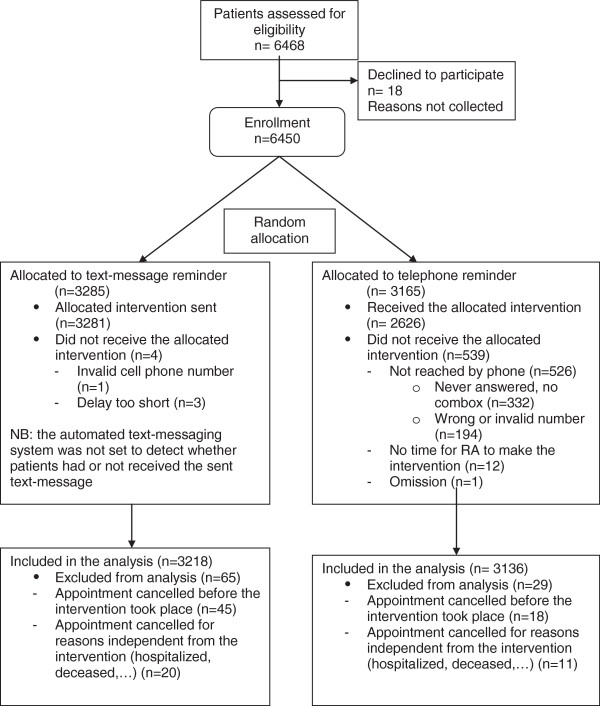
BACKGROUND: Telephone or text-message reminders have been shown to significantly reduce the rate of missed appointments in different medical settings. Since text-messaging is less resource-demanding, we tested the hypothesis that text-message reminders would be as effective as telephone reminders in an academic primary care clinic. METHODS: A randomized controlled non-inferiority trial was conducted in the academic primary care division of the Geneva University Hospitals between November 2010 and April 2011. Patients registered for an appointment at the clinic, and for whom a cell phone number was available, were randomly selected to receive a text-message or a telephone call reminder 24 hours before the planned appointment. Patients were included each time they had an appointment. The main outcome was the rate of unexplained missed appointments. Appointments were not missed if they were cancelled or re-scheduled before or independently from the intervention. We defined non-inferiority as a difference below 2% in the rate of missed appointments and powered the study accordingly. A satisfaction survey was conducted among a random sample of 900 patients (response rate 41%). RESULTS: 6450 patients were included, 3285 in the text-message group and 3165 in the telephone group. The rate of missed appointments was similar in the text-message group (11.7%, 95% CI: 10.6-12.8) and in the telephone group (10.2%, 95% CI: 9.2-11.3 p = 0.07). However, only text message reminders were cost-effective. No patient reported any disturbance by any type of reminder in the satisfaction survey. Three quarters of surveyed patients recommended its regular implementation in the clinic. CONCLUSIONS: Text-message reminders are equivalent to telephone reminders in reducing the proportion of missed appointments in an academic primary care clinic and are more cost-effective. Both types of reminders are well accepted by patients.
Overview
The claims and statistics of this paper haven’t been checked yet.
Free: it reads the open-access text and checks the first 5 claims that cite a source we can check. Create a free account to check every claim.
Integrity signals
Registry
Cites
Statistics
Figures
Verification
Claims the paper makes
The claims and statistics of this paper haven’t been checked yet.
Free: it reads the open-access text and checks the first 5 claims that cite a source we can check. Create a free account to check every claim.
Claims other papers make about this one
Each is checked against this paper’s own text: does it say what the citing paper says it does?
The source backs part of the claim, not all of it — or backs it for a different population, condition or comparison.
In the citing paper
“Attendance was slightly higher following telephone reminders compared with text messaging reminders among primary care patients, but not so among patients with mental health disorders.”
From The Empirical Foundations of Telemedicine Interventions in Primary Care (2016) · cites this paper as [103]
Experimental — accuracy not yet measuredThe cited source says what the claim attributes to it.
In the citing paper
“The rate of missed appointments was similar in both groups (11.7% for text messaging and 10.2% for telephone).”
From The Empirical Foundations of Telemedicine Interventions in Primary Care (2016) · cites this paper as [103]
The cited source says what the claim attributes to it.
In the citing paper
“The data on satisfaction were positive, but they were based on a sample with a very low response rate.”
From The Empirical Foundations of Telemedicine Interventions in Primary Care (2016) · cites this paper as [103]
Self-check
Percentages, sums and reported differences re-computed from the paper’s own numbers.
The self-check needs the paper’s full text.
Citations
Cites
Mobile phone messaging reminders for attendance at healthcare appointments
Gurol-Urganci, I., de Jongh, T., Vodopivec-Jamsek, V., Atun, R., & Car, J. (2013) · Cochrane Database of Systematic Reviews · doi:10.1002/14651858.cd007458.pub3 · Cited by 594 · cited 2×
“Systematic reviews indicate that text-message reminders are more effective than no reminder among a wide age range of patients [9,10].”
BackgroundGuy, R., Hocking, J., Wand, H., Stott, S., Ali, H., & Kaldor, J. (2012) · Health Services Research · doi:10.1111/j.1475-6773.2011.01342.x · Cited by 329 · cited 1×
“Systematic reviews indicate that text-message reminders are more effective than no reminder among a wide age range of patients [9,10].”
BackgroundProspective controlled study of psychiatric out-patient non-attendance: Characteristics and outcome
Killaspy, H., Banerjee, S., King, M., & Lloyd, M. (2000) · British Journal of Psychiatry · doi:10.1192/bjp.176.2.160 · Cited by 325 · cited 2×
“It is well known that non-attendance rate among patients with mental disorders is high (up to 40%) [18,19], predominantly among patients with alcohol and drug abuse (18-36%) [20].”
BackgroundThe use of text messaging to improve attendance in primary care: a randomized controlled trial
Leong, K. C., Chen, W. S., Leong, K. W., Mastura, I., Mimi, O., Sheikh, M. A., Zailinawati, A. H., Ng, C. J., Phua, K. L., & Teng, C. L. (2006) · Family Practice · doi:10.1093/fampra/cml044 · Cited by 291 · cited 2×
“The advantages of text-message reminders are their cheaper cost and lower use of resources [12].”
BackgroundChen, Z.-W., Fang, L.-Z., Chen, L.-Y., & Dai, H.-L. (2008) · Journal of Zhejiang University SCIENCE B · doi:10.1631/jzus.b071464 · Cited by 231 · cited 1×
“Two Asian studies showed that they were equally effective in primary care settings but sample sizes were small [11,12].”
BackgroundEffects of Discharge Planning and Compliance With Outpatient Appointments on Readmission Rates
Nelson, E. A., Maruish, M. E., & Axler, J. L. (2000) · Psychiatric Services · doi:10.1176/appi.ps.51.7.885 · Cited by 230 · cited 1×
“They interfere with adequate medical care, misspend administrative and medical resources, and are associated with adverse patient health outcomes [1,2].”
BackgroundThe Effectiveness of Outpatient Appointment Reminder Systems in Reducing No-Show Rates
Parikh, A., Gupta, K., Wilson, A. C., Fields, K., Cosgrove, N. M., & Kostis, J. B. (2010) · The American Journal of Medicine · doi:10.1016/j.amjmed.2009.11.022 · Cited by 226 · cited 3×
“This is consistent with another study which showed that telephone reminders by a staff member were also slightly more effective than automated phone calls to reduce nonattendance in an academic outpatient practice [13].”
BackgroundResultMurdock, A., Rodgers, C., Lindsay, H., & Tham, T. C. K. (2002) · Journal of the Royal Society of Medicine · doi:10.1177/014107680209500605 · Cited by 175 · cited 1×
“Postal reminders are effective, but costly, and their effect decreases with time [4,5].”
BackgroundZhou-wen, Chen, Li-zheng, Fang, LiYing, L., Honglei, & Dai (2008) · Journal of Zhejiang University SCIENCE B · Cited by 164
Reduction of missed appointments at an urban primary care clinic: a randomised controlled study
Junod Perron, N., Dominicé Dao, M., Kossovsky, M. P., Miserez, V., Chuard, C., Calmy, A., & Gaspoz, J.-M. (2010) · BMC Family Practice · doi:10.1186/1471-2296-11-79 · Cited by 150 · cited 1×
“In a previous study, 48 hours delay allowed reallocation of 28% of the spaces made vacant after cancellation [14].”
MethodSelf-citationMissed appointments in primary care: questionnaire and focus group study of health professionals.
Hussain‐Gambles, M., Neal, R. D., Dempsey, O., Lawlor, D. A., & Hodgson, J. (2004) · Europe PMC (PubMed Central) · Cited by 137
Missed appointments in general practice: retrospective data analysis from four practices.
Neal, R. D., Lawlor, D. A., Allgar, V. L., Colledge, M., Ali, S., Hassey, A., Portz, C., & Wilson, A. (2001) · Europe PMC (PubMed Central) · Cited by 132
Appointment Adherence and Disparities in Outcomes Among Patients with Diabetes
Schectman, J. M., Schorling, J. B., & Voss, J. D. (2008) · Journal of General Internal Medicine · doi:10.1007/s11606-008-0747-1 · Cited by 124 · cited 1×
“They interfere with adequate medical care, misspend administrative and medical resources, and are associated with adverse patient health outcomes [1,2].”
BackgroundSims, H., Sanghara, H., Hayes, D., Wandiembe, S., Finch, M., Jakobsen, H., Tsakanikos, E., Okocha, C. I., & Kravariti, E. (2012) · Psychiatric Services · doi:10.1176/appi.ps.201100211 · Cited by 119 · cited 1×
“It is well known that non-attendance rate among patients with mental disorders is high (up to 40%) [18,19], predominantly among patients with alcohol and drug abuse (18-36%) [20].”
BackgroundTelephone reminders improve adolescent clinic attendance: A randomized controlled trial
Sawyer, S., Zalan, A., & Bond, L. (2002) · Journal of Paediatrics and Child Health · doi:10.1046/j.1440-1754.2002.00766.x · Cited by 113 · cited 1×
“Clinical trials showed evidence that telephone reminders can reduce missed appointments [6-8].”
BackgroundHashim, M. J., Franks, P. J., & Fiscella, K. A. (2001) · PubMed · Cited by 101
Mobile phone messaging reminders for attendance at scheduled healthcare appointments
Car, J., Gurol-Urganci, I., de Jongh, T., Vodopivec-Jamsek, V., & Atun, R. (2008) · Cochrane Database of Systematic Reviews · doi:10.1002/14651858.cd007458 · Cited by 95
Texting appointment reminders to repeated non-attenders in primary care: randomised controlled study
Fairhurst, K., & Sheikh, A. (2008) · Quality and Safety in Health Care · doi:10.1136/qshc.2006.020768 · Cited by 94
Mitchell, A. J., & Selmes, T. (2007) · Psychiatric Services · doi:10.1176/appi.ps.58.6.868 · Cited by 83
Failed appointments in an orthodontic clinic
Bos, A., Hoogstraten, J., & Prahl-Andersen, B. (2005) · American Journal of Orthodontics and Dentofacial Orthopedics · doi:10.1016/j.ajodo.2004.11.014 · Cited by 82
Labhardt, N. D., Balo, J., Ndam, M., Manga, E., & Stoll, B. (2011) · Tropical Medicine & International Health · doi:10.1111/j.1365-3156.2011.02827.x · Cited by 81 · cited 1×
“Alternative effective interventions include incentives, such as free treatment for patients with regular attendance [24], or compulsory involvement in an educational program in order to continue receiving care after several missed appointments [25].”
BackgroundJohnson, E. H. (1969) · Cited by 52
Ritchie, P. D., Jenkins, M., & Cameron, P. A. (2000) · Australian and New Zealand Journal of Medicine · doi:10.1111/j.1445-5994.2000.tb00860.x · Cited by 43 · cited 1×
“Clinical trials showed evidence that telephone reminders can reduce missed appointments [6-8].”
BackgroundEncouraging Attendance at Outpatient Appointments: Can We Do More?
Henderson, R. P. (2008) · Scottish Medical Journal · doi:10.1258/rsmsmj.53.1.9 · Cited by 39 · cited 1×
“Postal reminders are effective, but costly, and their effect decreases with time [4,5].”
BackgroundA Model Program to Reduce Patient Failure to Keep Scheduled Medical Appointments
Schmalzried, H. D., & Liszak, J. (2011) · Journal of Community Health · doi:10.1007/s10900-011-9505-0 · Cited by 33 · cited 1×
“Alternative effective interventions include incentives, such as free treatment for patients with regular attendance [24], or compulsory involvement in an educational program in order to continue receiving care after several missed appointments [25].”
BackgroundLanguage difficulties in an Outpatient Clinic in Switzerland
Bischoff, A., Tonnerre, C., Loutan, L., & Stalder, H. (1999) · Sozial- und Präventivmedizin · doi:10.1007/bf01358978 · Cited by 29 · cited 5×
“The fact that text messages were sent in French only whereas phone reminders occurred in four languages may have enhanced the effectiveness of telephone reminders over text messages.”
MethodInfluentialImproving endoscopy completion: effectiveness of an interactive voice response system.
Griffin, J. M., Hulbert, E., Vernon, S. W., Nelson, D. B., Hagel, E. M., Nugent, S. M., Simon, A. B., Bangerter, A. K., & van Ryn, M. (2011) · PubMed · Cited by 20
Cited by
Iribarren, S. J., Cato, K., Falzon, L., & Stone, P. W. (2017) · PLOS ONE · doi:10.1371/journal.pone.0170581 · Cited by 519
The Empirical Foundations of Telemedicine Interventions in Primary Care
Bashshur, R. L., Howell, J. D., Krupinski, E. A., Harms, K. M., Bashshur, N., & Doarn, C. R. (2016) · Telemedicine and e-Health · doi:10.1089/tmj.2016.0045 · Cited by 370
“Perron et al.(103) 2013 Switzerland RCT 6,450 Mobile phone/ text messaging Appointment reminders 6 months Text message equivalent to phone reminders: both improved attendance Missed appointments = 11.”
Using text message reminders in health care services: A narrative literature review
Schwebel, F. J., & Larimer, M. E. (2018) · Internet Interventions · doi:10.1016/j.invent.2018.06.002 · Cited by 238
Mobile Phones: The Next Step towards Healthcare Delivery in Rural India?
DeSouza, S. I., Rashmi, M. R., Vasanthi, A. P., Joseph, S. M., & Rodrigues, R. (2014) · PLoS ONE · doi:10.1371/journal.pone.0104895 · Cited by 158
Samuels, R. C., Ward, V. L., Melvin, P. R., Macht-Greenberg, M., Wenren, L. M., Yi, J., Massey, G., & Cox, J. E. (2015) · Clinical Pediatrics · doi:10.1177/0009922815570613 · Cited by 171
“Our improvement initiatives will continue to emphasize reminder phone calls, and text reminders are currently under consideration, though they have had limited success in other settings.(18,19) To improve access for our patients, we have already expanded our evening availability for well child care, and are proposing…”
Background
Metadata
- Authors
- Junod Perron, N., Dao, M. D., Righini, N. C., Humair, J.-P., Broers, B., Narring, F., Haller, D. M., & Gaspoz, J.-M.
- Affiliations
- University Hospital of Geneva (CH)
- European Organization for Nuclear Research (CH)
- Venue
- BMC Health Services Research
- Published
- 2013-04-04
- Volume
- 13
- Issue
- 1
- Pages
- 125-125
- ISSN
- 1472-6963 (ISSN-L)
- PMC
- PMC3623700
- OpenAlex
- W2145151781
- Semantic Scholar
- ea52affeacbb605cf94cbcae270960d0fb921262
- Cited by
- 133
- References
- 27
- Citations by year
- 2026: 8 · 2025: 6 · 2024: 2 · 2023: 7 · 2022: 11 · 2021: 21 · 2020: 7 · 2019: 13 · 2018: 11 · 2017: 10 · 2016: 11 · 2015: 11 · 2014: 12 · 2013: 3
- FWCI
- 19.19
- Type
- journal article
- Language
- en
- Open access
- gold
- doi.org
- Licence
- cc-by
- creativecommons.org/licenses/by/2.0 (tdm)
- Locations
- BMC Health Services Research (publishedVersion, cc-by)
- Europe PMC (PubMed Central) (publishedVersion, cc-by)
- PubMed Central (publishedVersion, cc-by)
- PubMed (publishedVersion)
- Archive ouverte UNIGE (University of Geneva) (publishedVersion, other-oa)
- Minerva Access (University of Melbourne) (submittedVersion, cc-by)
- Archive ouverte UNIGE (University of Geneva) (submittedVersion, cc-by)
- Funders
- Hôpitaux Universitaires de Genève
- Topics
- Social Sciences › Decision Sciences › Management Science and Operations Research › Healthcare Operations and Scheduling Optimization
- Health Sciences › Health Professions › General Health Professions › Mobile Health and mHealth Applications
- Health Sciences › Health Professions › Health Information Management › Health, Technology, Consumer Behavior
- Keywords
- missed appointments, appointment reminders, SMS reminders, telephone reminders, primary care, non-inferiority, cost-effectiveness, patient satisfaction
- MeSH terms
- Academic Medical Centers, Adult, Appointments and Schedules, Female, Humans, Male, Middle Aged, Outpatient Clinics, Hospital, Patient Compliance, Primary Health Care, Surveys and Questionnaires, Switzerland, Telephone, Reminder Systems, Patient Satisfaction, Text Messaging
About these checks
Registry, retraction, Cites and statistics results are computed, not judged, with one exception: a printed reference that no index lists is read once by a model before it counts as a citation error. Claims are extracted by a model and kept only when their quote appears verbatim in the text; each cited source is then checked, with a model’s help, for whether it says what the claim relies on. Those verdicts can be wrong — read the claim’s quote and the cited source before relying on one.
Statistics and arithmetic are recomputed, not judged.
Confidence bands are shown only for fields calibrated on our annotated test set. None is calibrated yet, so no band is shown.
What counts as a claim ›How we measure confidence ›How we check this ›
Are you an author, or do you see a problem with this page? Request a review
Data sources
Bibliographic data: Semantic Scholar, OpenAlex, Crossref.
Contains information from the Semantic Scholar Academic Graph Datasets, made available under the ODC Attribution License (ODC-BY 1.0).
Semantic Scholar’s data is described in: Kinney, R., et al. (2023). The Semantic Scholar Open Data Platform. arXiv:2301.10140.
