

Text-messaging versus telephone reminders to reduce missed appointments in an academic primary care clinic: a randomized controlled trial
Open accessThe DOI matches its Crossref record; 27 of the 27 references it cites were found in a registry or an index.
Abstract
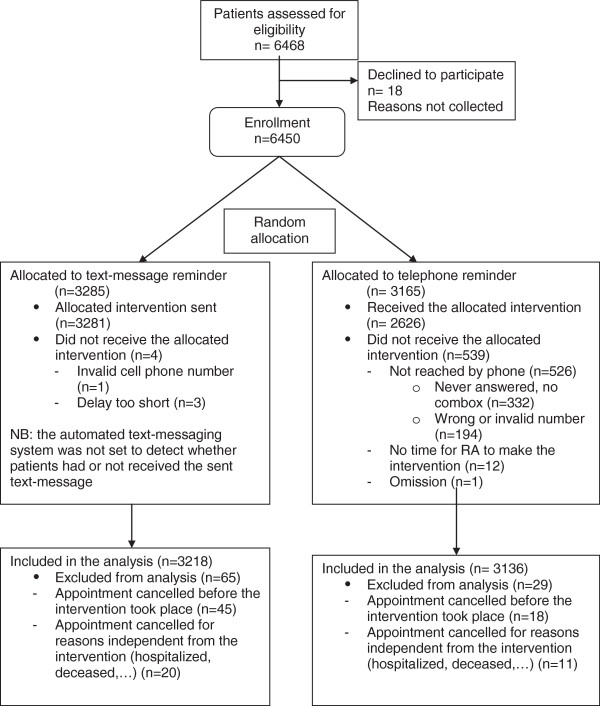
BACKGROUND: Telephone or text-message reminders have been shown to significantly reduce the rate of missed appointments in different medical settings. Since text-messaging is less resource-demanding, we tested the hypothesis that text-message reminders would be as effective as telephone reminders in an academic primary care clinic. METHODS: A randomized controlled non-inferiority trial was conducted in the academic primary care division of the Geneva University Hospitals between November 2010 and April 2011. Patients registered for an appointment at the clinic, and for whom a cell phone number was available, were randomly selected to receive a text-message or a telephone call reminder 24 hours before the planned appointment. Patients were included each time they had an appointment. The main outcome was the rate of unexplained missed appointments. Appointments were not missed if they were cancelled or re-scheduled before or independently from the intervention. We defined non-inferiority as a difference below 2% in the rate of missed appointments and powered the study accordingly. A satisfaction survey was conducted among a random sample of 900 patients (response rate 41%). RESULTS: 6450 patients were included, 3285 in the text-message group and 3165 in the telephone group. The rate of missed appointments was similar in the text-message group (11.7%, 95% CI: 10.6-12.8) and in the telephone group (10.2%, 95% CI: 9.2-11.3 p = 0.07). However, only text message reminders were cost-effective. No patient reported any disturbance by any type of reminder in the satisfaction survey. Three quarters of surveyed patients recommended its regular implementation in the clinic. CONCLUSIONS: Text-message reminders are equivalent to telephone reminders in reducing the proportion of missed appointments in an academic primary care clinic and are more cost-effective. Both types of reminders are well accepted by patients.
Overview
The claims and statistics of this paper haven’t been checked yet.
Free: it reads the open-access text and checks the first 5 claims that cite a source we can check. Create a free account to check every claim.
Integrity signals
Registry
Cites
Statistics
Figures
Verification
Claims the paper makes
The claims and statistics of this paper haven’t been checked yet.
Free: it reads the open-access text and checks the first 5 claims that cite a source we can check. Create a free account to check every claim.
Claims other papers make about this one
Each is checked against this paper’s own text: does it say what the citing paper says it does?
The source backs part of the claim, not all of it — or backs it for a different population, condition or comparison.
In the citing paper
“Attendance was slightly higher following telephone reminders compared with text messaging reminders among primary care patients, but not so among patients with mental health disorders.”
From The Empirical Foundations of Telemedicine Interventions in Primary Care (2016) · cites this paper as [103]
Experimental — accuracy not yet measuredThe cited source says what the claim attributes to it.
In the citing paper
“The rate of missed appointments was similar in both groups (11.7% for text messaging and 10.2% for telephone).”
From The Empirical Foundations of Telemedicine Interventions in Primary Care (2016) · cites this paper as [103]
The cited source says what the claim attributes to it.
In the citing paper
“The data on satisfaction were positive, but they were based on a sample with a very low response rate.”
From The Empirical Foundations of Telemedicine Interventions in Primary Care (2016) · cites this paper as [103]
Self-check
Percentages, sums and reported differences re-computed from the paper’s own numbers.
The self-check needs the paper’s full text.
Citations
Cites
Mobile phone messaging reminders for attendance at healthcare appointments
Gurol-Urganci, I., de Jongh, T., Vodopivec-Jamsek, V., Atun, R., & Car, J. (2013) · Cochrane Database of Systematic Reviews · doi:10.1002/14651858.cd007458.pub3 · Cited by 594 · cited 2×
“Systematic reviews indicate that text-message reminders are more effective than no reminder among a wide age range of patients [9,10].”
BackgroundGuy, R., Hocking, J., Wand, H., Stott, S., Ali, H., & Kaldor, J. (2012) · Health Services Research · doi:10.1111/j.1475-6773.2011.01342.x · Cited by 329 · cited 1×
“Systematic reviews indicate that text-message reminders are more effective than no reminder among a wide age range of patients [9,10].”
BackgroundProspective controlled study of psychiatric out-patient non-attendance: Characteristics and outcome
Killaspy, H., Banerjee, S., King, M., & Lloyd, M. (2000) · British Journal of Psychiatry · doi:10.1192/bjp.176.2.160 · Cited by 325 · cited 2×
“It is well known that non-attendance rate among patients with mental disorders is high (up to 40%) [18,19], predominantly among patients with alcohol and drug abuse (18-36%) [20].”
BackgroundThe use of text messaging to improve attendance in primary care: a randomized controlled trial
Leong, K. C., Chen, W. S., Leong, K. W., Mastura, I., Mimi, O., Sheikh, M. A., Zailinawati, A. H., Ng, C. J., Phua, K. L., & Teng, C. L. (2006) · Family Practice · doi:10.1093/fampra/cml044 · Cited by 291 · cited 2×
“The advantages of text-message reminders are their cheaper cost and lower use of resources [12].”
BackgroundChen, Z.-W., Fang, L.-Z., Chen, L.-Y., & Dai, H.-L. (2008) · Journal of Zhejiang University SCIENCE B · doi:10.1631/jzus.b071464 · Cited by 231 · cited 1×
“Two Asian studies showed that they were equally effective in primary care settings but sample sizes were small [11,12].”
BackgroundEffects of Discharge Planning and Compliance With Outpatient Appointments on Readmission Rates
Nelson, E. A., Maruish, M. E., & Axler, J. L. (2000) · Psychiatric Services · doi:10.1176/appi.ps.51.7.885 · Cited by 230 · cited 1×
“They interfere with adequate medical care, misspend administrative and medical resources, and are associated with adverse patient health outcomes [1,2].”
BackgroundThe Effectiveness of Outpatient Appointment Reminder Systems in Reducing No-Show Rates
Parikh, A., Gupta, K., Wilson, A. C., Fields, K., Cosgrove, N. M., & Kostis, J. B. (2010) · The American Journal of Medicine · doi:10.1016/j.amjmed.2009.11.022 · Cited by 226 · cited 3×
“This is consistent with another study which showed that telephone reminders by a staff member were also slightly more effective than automated phone calls to reduce nonattendance in an academic outpatient practice [13].”
BackgroundResultMurdock, A., Rodgers, C., Lindsay, H., & Tham, T. C. K. (2002) · Journal of the Royal Society of Medicine · doi:10.1177/014107680209500605 · Cited by 175 · cited 1×
“Postal reminders are effective, but costly, and their effect decreases with time [4,5].”
BackgroundZhou-wen, Chen, Li-zheng, Fang, LiYing, L., Honglei, & Dai (2008) · Journal of Zhejiang University SCIENCE B · Cited by 164
Reduction of missed appointments at an urban primary care clinic: a randomised controlled study
Junod Perron, N., Dominicé Dao, M., Kossovsky, M. P., Miserez, V., Chuard, C., Calmy, A., & Gaspoz, J.-M. (2010) · BMC Family Practice · doi:10.1186/1471-2296-11-79 · Cited by 150 · cited 1×
“In a previous study, 48 hours delay allowed reallocation of 28% of the spaces made vacant after cancellation [14].”
MethodSelf-citation
Cited by
Iribarren, S. J., Cato, K., Falzon, L., & Stone, P. W. (2017) · PLOS ONE · doi:10.1371/journal.pone.0170581 · Cited by 519
The Empirical Foundations of Telemedicine Interventions in Primary Care
Bashshur, R. L., Howell, J. D., Krupinski, E. A., Harms, K. M., Bashshur, N., & Doarn, C. R. (2016) · Telemedicine and e-Health · doi:10.1089/tmj.2016.0045 · Cited by 370
“Perron et al.(103) 2013 Switzerland RCT 6,450 Mobile phone/ text messaging Appointment reminders 6 months Text message equivalent to phone reminders: both improved attendance Missed appointments = 11.”
Using text message reminders in health care services: A narrative literature review
Schwebel, F. J., & Larimer, M. E. (2018) · Internet Interventions · doi:10.1016/j.invent.2018.06.002 · Cited by 238
Mobile Phones: The Next Step towards Healthcare Delivery in Rural India?
DeSouza, S. I., Rashmi, M. R., Vasanthi, A. P., Joseph, S. M., & Rodrigues, R. (2014) · PLoS ONE · doi:10.1371/journal.pone.0104895 · Cited by 158
Samuels, R. C., Ward, V. L., Melvin, P. R., Macht-Greenberg, M., Wenren, L. M., Yi, J., Massey, G., & Cox, J. E. (2015) · Clinical Pediatrics · doi:10.1177/0009922815570613 · Cited by 171
“Our improvement initiatives will continue to emphasize reminder phone calls, and text reminders are currently under consideration, though they have had limited success in other settings.(18,19) To improve access for our patients, we have already expanded our evening availability for well child care, and are proposing…”
BackgroundKhonsari, S., Subramanian, P., Chinna, K., Latif, L. A., Ling, L. W., & Gholami, O. (2015) · European Journal of Cardiovascular Nursing · doi:10.1177/1474515114521910 · Cited by 127
Using digital notifications to improve attendance in clinic: systematic review and meta-analysis
Robotham, D., Satkunanathan, S., Reynolds, J., Stahl, D. R., & Wykes, T. (2016) · BMJ Open · doi:10.1136/bmjopen-2016-012116 · Cited by 129
Patient reminder systems and asthma medication adherence: a systematic review
Tran, N., Coffman, J. M., Sumino, K., & Cabana, M. D. (2014) · Journal of Asthma · doi:10.3109/02770903.2014.888572 · Cited by 105
“telephone or web-based programs), text messaging is easy and inexpensive to implement [17,18], which makes it an appealing method to increase adherence.”
MethodKempny, A., Diller, G.-P., Dimopoulos, K., Alonso-Gonzalez, R., Uebing, A., Li, W., Babu-Narayan, S., Swan, L., Wort, S. J., & Gatzoulis, M. A. (2016) · International Journal of Cardiology · doi:10.1016/j.ijcard.2015.10.081 · Cited by 102
Hallsworth, M., Berry, D., Sanders, M., Sallis, A., King, D., Vlaev, I., & Darzi, A. W. (2015) · PLoS ONE · doi:10.1371/journal.pone.0137306 · Cited by 123
“There is also evidence that SMS reminders are more cost-effective than telephone reminders [12].”
BackgroundArora, S., Burner, E., Terp, S., Nok Lam, C., Nercisian, A., Bhatt, V., & Menchine, M. (2015) · Academic Emergency Medicine · doi:10.1111/acem.12503 · Cited by 79
The uses of smartphones and tablet devices in surgery: A systematic review of the literature
Mobasheri, M. H., Johnston, M. J., Syed, U. M., King, D., & Darzi, A. W. (2015) · Surgery · doi:10.1016/j.surg.2015.03.029 · Cited by 80
Comparison of Reminder Methods in Selected Adolescents With Records in an Immunization Registry
Morris, J., Wang, W., Wang, L., Peddecord, K. M., & Sawyer, M. H. (2015) · Journal of Adolescent Health · doi:10.1016/j.jadohealth.2015.01.010 · Cited by 75
Eze, P., Lawani, L. O., & Acharya, Y. (2021) · BMJ Global Health · doi:10.1136/bmjgh-2021-005035 · Cited by 83
Large-Scale No-Show Patterns and Distributions for Clinic Operational Research
Davies, M., Goffman, R. M., May, J. H., Monte, R., Rodriguez, K. L., Tjader, Y. C., & Vargas, D. L. (2016) · Healthcare · doi:10.3390/healthcare4010015 · Cited by 77
“To reduce missed clinic appointments, organizations must mine data [19], develop effective appointment-keeping strategies [20,21], and systemically implement strategies in their operations [22].”
BackgroundShah, S. J., Cronin, P. R., Hong, C. S., Hwang, A. S., Ashburner, J. M., Bearnot, B. I., Richardson, C. A., Fosburgh, B. W., & Kimball, A. B. (2016) · Journal of General Internal Medicine · doi:10.1007/s11606-016-3813-0 · Cited by 73
Mohammed, H., Rizk, M. Z., Wafaie, K., Ulhaq, A., & Almuzian, M. (2018) · European Journal of Orthodontics · doi:10.1093/ejo/cjy045 · Cited by 65
Valsangkar, N. P., Eppstein, A. C., Lawson, R. A., & Taylor, A. (2016) · JAMA Surgery · doi:10.1001/jamasurg.2016.2808 · Cited by 63
Picou, E. M. (2022) · Seminars in Hearing · doi:10.1055/s-0042-1758375 · Cited by 53
Solving the problem of non‐attendance in substance abuse services
Milward, J., Lynskey, M. T., & Strang, J. (2014) · Drug and Alcohol Review · doi:10.1111/dar.12194 · Cited by 58
“Appointment reminders are a relatively simple and adaptable intervention to improve forgetfulness-related non-attendance and are cost-effective; appointments which would have resulted in a non-attendance can be cancelled and rescheduled resulting in significant financial savings [56].”
The Promises and Pitfalls of Digital Technology in Its Application to Alcohol Treatment
Muench, F. (2014) · Alcohol Research: Current Reviews · doi:10.35946/arcr.v36.1.14 · Cited by 50
“It reduces staffing costs and increases efficiency, because multiple messages can be programmed simultaneously and responses can be collected automatically and reviewed in a single sitting (Gurol-Urganci et al. 2013; Perron et al. 2013).”
BackgroundMekonnen, Z. A., Gelaye, K. A., Were, M. C., & Tilahun, B. C. (2021) · JMIR mhealth and uhealth · doi:10.2196/27603 · Cited by 57
Garrison‐Desany, H. M., Wilson, E., Munos, M. K., Sawadogo‐Lewis, T., Maïga, A., Ako, O., Mkuwa, S., Hobbs, A. J., & Morgan, R. (2021) · BMC Public Health · doi:10.1186/s12889-021-10972-w · Cited by 58
It’s how you say it: Systematic A/B testing of digital messaging cut hospital no-show rates
Senderey, A. B., Kornitzer, T., Lawrence, G. M., Zysman, H., Hallak, Y., Ariely, D., & Balicer, R. D. (2020) · PLoS ONE · doi:10.1371/journal.pone.0234817 · Cited by 54
Werner, K., Alsuhaibani, S., Alsukait, R. F., Alshehri, R., Herbst, C. H., Alhajji, M., & Lin, T. K. (2023) · BMC Health Services Research · doi:10.1186/s12913-023-10059-9 · Cited by 63
“Lastly, we are cognizant that publication bias may favour studies with positive results, leaving out many interventions to reduce patient non-attendance; never-theless, our review captures ten studies with null results [23, 32–36, 39, 49, 51, 68].”
BackgroundResultEslami, S., Habibi, M. R. M., Abadi, F. M., Tabesh, H., Vakili-Arki, H., & Abu–Hanna, A. (2018) · Journal of Advanced Pharmaceutical Technology amp Research · doi:10.4103/japtr.japtr_134_18 · Cited by 45
“have reported that among the communication technologies, phone call, and text reminders have been more useful than other reminder strategies.[23]”
BackgroundAdvances in Motivational Interviewing for Pediatric Obesity
Resnicow, K., Harris, D. L., Wasserman, R. C., Schwartz, R. P., Pérez‐Rosas, V., Mihalcea, R. F., & Snetselaar, L. (2016) · Pediatric Clinics of North America · doi:10.1016/j.pcl.2016.02.008 · Cited by 42
Postal, L., Celuppi, I. C., Lima, G. D. S., Felisberto, M., Lacerda, T. C., Wazlawick, R. S., & Dalmarco, E. M. (2021) · Ciência & Saúde Coletiva · doi:10.1590/1413-81232021266.38072020 · Cited by 70
Andreae, M. H., Nair, S., Gabry, J., Goodrich, B., Hall, C. B., & Shaparin, N. (2017) · Journal of Clinical Anesthesia · doi:10.1016/j.jclinane.2017.08.014 · Cited by 40
“We concede that our pragmatic trial tested the effectiveness of a human call in the setting of a clinic attuned to the needs of a diverse underserved population [2] and hence may be less effective in other settings, especially where language is less important? We further concede that we did not compare the human phone…”
Weaver, K. E., Ellis, S. D., Denizard-Thompson, N. M., Kronner, D., & MILLER, D. P. (2015) · JMIR mhealth and uhealth · doi:10.2196/mhealth.4651 · Cited by 36
“This finding is consistent with studies finding varied preferences for receiving automatic reminders [14,15,34-37].”
ResultA predictive model for decreasing clinical no-show rates in a primary care setting
Ahmad, M. U., Zhang, A., & Mhaskar, R. S. (2019) · International Journal of Healthcare Management · doi:10.1080/20479700.2019.1698864 · Cited by 34
“Other research has studied methods of reducing noshows, including: staff telephone reminders [12], automated telephone reminders [13], text messages [13,14], exit interviews [15], missed appointment fees [16], overbooking [17–19], predictive modeling [20–25], and predictive modeling with overbooking [26–35].”
MethodShaparin, N., White, R. S., Andreae, M. H., Hall, C. B., & Kaufman, A. G. (2014) · Journal of Pain · doi:10.1016/j.jpain.2014.03.004 · Cited by 29
Shuen, J. A., Wilson, M. P., Kreshak, A. A., Mullinax, S., Brennan, J. J., Castillo, E. M., Hinkle, C., & Vilke, G. M. (2018) · Journal of Emergency Medicine · doi:10.1016/j.jemermed.2018.07.023 · Cited by 36
Ruggeri, K., Folke, T., Benzerga, A., Verra, S. E., Büttner, C., Steinbeck, V., Yee, S., & Chaiyachati, K. H. (2020) · BMC Health Services Research · doi:10.1186/s12913-020-05097-6 · Cited by 32
MacPherson, M., Cranston, K. D., Locke, S., Bourne, J. E., & Jung, M. E. (2021) · Translational Behavioral Medicine · doi:10.1093/tbm/ibab058 · Cited by 33
Text-messaging to reduce missed appointment in a youth clinic: a randomised controlled trial
Narring, F., Perron, N. J., Dao, M. D., Righini, N. C., Humair, J., Broers, B., Gaspoz, J., & Haller, D. M. (2013) · Journal of Epidemiology & Community Health · doi:10.1136/jech-2013-202510 · Cited by 30
Self-citationTofighi, B., Grazioli, F., Bereket, S., Grossman, E., Aphinyanaphongs, Y., & Lee, J. D. (2017) · American Journal on Addictions · doi:10.1111/ajad.12557 · Cited by 28
“Non-attendance at outpatient follow-up appointments is common in adults with substance use disorders and contributes to increased waiting lists, adverse treatment outcomes, treatment dropout, and relapse.(1) The rising opioid misuse epidemic has intensified efforts to implement cost-effective strategies to retain pati…”
BackgroundLam, T. Y. T., Hui, A. J., Sia, F., Wong, M. Y., Lee, C. C. P., Chung, K. W., Lau, J. Y. W., Wu, P., & Sung, J. J. �. (2020) · Journal of Gastroenterology and Hepatology · doi:10.1111/jgh.15218 · Cited by 23
What do we know about no‐show behavior? A systematic, interdisciplinary literature review
Amberger, C., & Schreyer, D. (2022) · Journal of Economic Surveys · doi:10.1111/joes.12534 · Cited by 25
Role of Text Message Reminder on Oral Hygiene Maintenance of Orthodontic Patients
Guram, G., Kumar, G. S., Kashyap, A., Raghav, S., Bhardwaj, R., & Singh, A. (2018) · The Journal of Contemporary Dental Practice · doi:10.5005/jp-journals-10024-2219 · Cited by 22
Singh, G., Manjunatha, N., Rao, S., Shashidhara, H. N., Moirangthem, S., Madegowda, R. K., Binukumar, B., & Varghese, M. (2017) · Indian Journal of Psychological Medicine · doi:10.4103/0253-7176.207325 · Cited by 21
Wallace, D. J., Ray, K. N., Degan, A., Kurland, K. S., Angus, D. C., & Malinow, A. (2017) · BMJ Quality & Safety · doi:10.1136/bmjqs-2017-007168 · Cited by 22
Lee, S., Han, J., Park, R. W., Kim, G. J., Rim, J. H., Cho, J., Lee, K. H., Lee, J., Kim, S., & Kim, J. H. (2019) · Drug Safety · doi:10.1007/s40264-018-0767-7 · Cited by 25
Margham, T., Williams, C., Steadman, J., & Hull, S. (2020) · British Journal of General Practice · doi:10.3399/bjgp20x713909 · Cited by 23
The relative efficacy of telephone and email reminders to elicit blood donation
Germain, M., & Godin, G. (2015) · Vox Sanguinis · doi:10.1111/vox.12316 · Cited by 20
Triemstra, J. D., & Lowery, L. (2018) · Cureus · doi:10.7759/cureus.3613 · Cited by 19
“Other studies have focused on the methods to decrease the nonattendance rate, which include patient reminder systems, targeted overbooking and penalization [6-7].”
Singleton, A. C., Raeside, R., Partridge, S. R., Tat-Ko, J., Sum, S. C. M., Hyun, K. K., Hayes, M., Chow, C. K., Thiagalingam, A., Maka, K., et al. (2021) · Journal of Cancer Survivorship · doi:10.1007/s11764-021-01106-7 · Cited by 19
Implementation of a Text Message to Improve Adherence to Clinic and Social Service Appointments
Anthony, N., Molokwu, J., Alozie, O. K., & Magallanes, D. (2019) · Journal of the International Association of Providers of AIDS Care (JIAPAC) · doi:10.1177/2325958219870166 · Cited by 22
Thorpe, R. D., Masser, B., Nguyen, L., Gemelli, C. N., & Davison, T. E. (2020) · Transfusion · doi:10.1111/trf.15787 · Cited by 17
“While the challenge of getting recipients to answer their phones is not unique to BCAs, the benefits of an increased answer rate may be substantial in promoting plasma donor return and may justify the increased cost associated with this approach.(17,18) Future research should explore this, as well as systematically ex…”
BackgroundBagheri, F., Behnam, F., Galavi, Z., & Ahmadian, L. (2022) · BMC Health Services Research · doi:10.1186/s12913-022-08635-6 · Cited by 19
Alawadhi, A., Palin, V., & van Staa, T. P. (2021) · BMJ Open · doi:10.1136/bmjopen-2020-046596 · Cited by 15
Anthony, C. A., Rojas, E. O., Glass, N. A., Keffala, V. J., Noiseux, N., Elkins, J. S., Brown, T. S., & Bedard, N. A. (2021) · The Journal of Arthroplasty · doi:10.1016/j.arth.2021.12.006 · Cited by 15
“Interventions have also been performed utilizing this modern communication technique including medication adherence [13,14], office appointment reminders [15,16], blood pressure management [17], and as an adjunct to traditional communication”
Measuring the effectiveness of patient-chosen reminder methods in a private orthodontic practice
Wegrzyniak, L. M., Hedderly, D., Chaudry, K., & Bollu, P. (2018) · The Angle Orthodontist · doi:10.2319/090517-597.1 · Cited by 15
“In the Angle Orthodontist, Vol 88, No 3, 2018 Perron et al.6 study, two phone call attempts were made before a message was left.”
BackgroundResultInfluentialMacPherson, M., & Kapadia, S. (2023) · BMC Digital Health · doi:10.1186/s44247-023-00033-0 · Cited by 14
Saeed, S., Somani, N., Sharif, F., & Kazi, A. M. (2018) · JMIR Research Protocols · doi:10.2196/resprot.9294 · Cited by 19
Kratzke, C., & Wilson, S. (2013) · Journal of Cancer Education · doi:10.1007/s13187-013-0576-8 · Cited by 12
“In a randomized controlled trial, text message appointment reminders were more costeffective yet some practices may also continue to use telephone reminders [32].”
BackgroundZebina, M., Melot, B., Binachon, B., Ouissa, R., Lamaury, I., & Hoen, B. (2019) · Patient Preference and Adherence · doi:10.2147/ppa.s182186 · Cited by 15
Gellasch, P. (2019) · Journal of Pediatric Health Care · doi:10.1016/j.pedhc.2019.01.004 · Cited by 19
Peterson, K., McCleery, E., Anderson, J., Waldrip, K., & Helfand, M. (2015) · Europe PMC (PubMed Central) · Cited by 16
A scoping review of hospital to home transitional care programmes for stroke survivors
Xu, X., Chen, H., Xu, D., Tan, F., & Li, X. (2024) · Journal of Clinical Nursing · doi:10.1111/jocn.17070 · Cited by 13
Bracken, K., KEECH, A. C., Hague, W. E., Kirby, A. C., Robledo, K. P., Allan, C. A., Conway, A. J., Daniel, M., Gebski, V., Grossmann, M., et al. (2019) · Journal of Clinical Epidemiology · doi:10.1016/j.jclinepi.2019.04.009 · Cited by 14
“By contrast, SMS reminders have the advantage of being cheaper [13], less intrusive, and providing written information that participants can refer to later.”
BackgroundResultInfluentialYakovchenko, V., McInnes, D. K., Petrakis, B. A., Gillespie, C., Lipschitz, J. M., McCullough, M. B., Richardson, L. M., Vetter, B., & Hogan, T. P. (2021) · JMIR mhealth and uhealth · doi:10.2196/31037 · Cited by 15
“Studies show positive results for texting interventions, with demonstrated effects on chronic illness self-management, medication adherence, missed appointments, and behavior change, including weight loss and smoking cessation [2,7-10].”
BackgroundRomocki, L. S., Marais, A. C. D., Cofie, L. E., Anderson, C., Curington, T., & Smith, J. S. (2019) · JMIR Formative Research · doi:10.2196/12675 · Cited by 12
“SMS interventions have been shown to improve the rate of attendance at health care appointments for surveyed populations [17] and may have a similar impact as phone call and postal reminders [18-20].”
BackgroundAdedokun, A., Oladipo, I., & Odujoko, T. (2015) · Primary Health Care Research & Development · doi:10.1017/s1463423615000213 · Cited by 11
“This is further supported by evidence from a recent randomized controlled trial which showed that text messaging was as effective as, but more cost-effective than, phone call reminder in reducing missed appointments at an academic primary care clinic (Perron et al., 2013).”
BackgroundWhat the elderly think of the care provided by health services
Lubenow, J. A. M., & Silva, A. O. (2019) · Revista Brasileira de Geriatria e Gerontologia · doi:10.1590/1981-22562019022.180195 · Cited by 10
Weber, K. G., DaSilva, A. F., Dault, J. T., Eber, R., Huner, K., Jones, D., Kornman, K., Ramaswamy, V., Snyder, M. D., Ward, B., et al. (2021) · Journal of Dental Education · doi:10.1002/jdd.12538 · Cited by 10
Roseland, M. E., Shankar, P. R., Houck, G. E., & Davenport, M. S. (2021) · Academic Radiology · doi:10.1016/j.acra.2021.03.008 · Cited by 10
Koutkias, V. G. (2019) · Drug Safety · doi:10.1007/s40264-018-00793-z · Cited by 18
Digital health solutions for reducing the impact of non-attendance: A scoping review
Selim, S. M., Kularatna, S., Carter, H. E., Bohorquez, N. G., & McPhail, S. (2023) · Health Policy and Technology · doi:10.1016/j.hlpt.2023.100759 · Cited by 11
Zhong, L., Noud, B. P., Pruitt, H., Marcrum, S. C., & Picou, E. M. (2021) · International Journal of Audiology · doi:10.1080/14992027.2021.1937346 · Cited by 10
Scheuermeyer, F. X., Grunau, B. E., Findlay, T., Grafstein, E., Christenson, J. M., Lang, E., Rowe, B. H., & Ho, K. (2015) · Journal of Telemedicine and Telecare · doi:10.1177/1357633x15587626 · Cited by 8
Morse, E., & Mitchell, S. (2016) · Journal of Midwifery & Women s Health · doi:10.1111/jmwh.12494 · Cited by 9
Texting Test Results Reduces the Time to Treatment for Sexually Transmitted Infections
Bilello, L. A., Livingood, W. C., Lukens-Bull, K., Smotherman, C. R., & Choe, U. (2018) · Journal of Public Health Management and Practice · doi:10.1097/phh.0000000000000795 · Cited by 7
Peer Group and Text Message–Based Weight-Loss and Management Intervention for African American Women
Lee, S., Schorr, E. N., Chi, C., Treat‐Jacobson, D., Mathiason, M. A., & Lindquist, R. A. (2017) · Western Journal of Nursing Research · doi:10.1177/0193945917697225 · Cited by 11
“…health management (Luxton, McCann, Bush, Mishkind, & Reger, 2011), prenatal support (Gazmararian, Elon, Yang, Graham, & Parker, 2014), medication adherence (Foreman et al., 2012), appointment reminders (Perron et al., 2013), and HIV/STD prevention (Juzang, Fortune, Black, Wright, & Bull, 2011).”
Engineering for reliability in at-home chronic disease management.
Kendall, L., Eschler, J., Lozano, P., McClure, J. B., Vizer, L. M., Ralston, J. D., & Pratt, W. (2014) · PubMed · Cited by 7
Mclaughlin, M., Modrcin, A. C., Hickman, T. P., & Hoffman, M. A. (2021) · Journal of Pediatric Rehabilitation Medicine · doi:10.3233/prm-200790 · Cited by 6
Hamilton, K., Short, S., Cudby, K., Werner, M., O'Connor‐Robertson, O., Larkins, W., Prangley, D., Ibrahim, A., Leung, B., Norris, P., et al. (2022) · Internal Medicine Journal · doi:10.1111/imj.15892 · Cited by 5
Molokwu, J., Dwivedi, A. K., Alomari, A., Guzmán, J., & Shokar, N. K. (2022) · Hispanic Health Care International · doi:10.1177/15404153221098950 · Cited by 5
“…improved asthma control, improved HbA1c levels, smoking quit rates, effective promotion of on-time completion of the HPV vaccination series (Haapala et al., 2009; Rodgers et al., 2005; Yoon & Kim, 2008), and increased likelihood of attending clinical appointments (Junod Perron et al., 2013).”
BackgroundReduction of No-Show Rate for New Patients in a Pediatric Neurology Clinic
Set, K. K., Bailey, J., & Kumar, G. (2022) · The Joint Commission Journal on Quality and Patient Safety · doi:10.1016/j.jcjq.2022.09.001 · Cited by 5
Santucci, R., Levêque, D., Herbrecht, R., Fischbach, M., Gérout, A. C., Untereiner, C., Bouayad-Agha, K., & Couturier, F. (2014) · Annales Pharmaceutiques Françaises · doi:10.1016/j.pharma.2014.05.003 · Cited by 5
(2018) · NSUWorks (Nova Southeastern University) · Cited by 5
Calixte, D., Morris, S. M., Toussaint, E., Fénelon, D. L., Banigbe, B., & Kwan, G. F. (2025) · PLOS Global Public Health · doi:10.1371/journal.pgph.0004376 · Cited by 4
“Live phone calls could address this barrier as well and have been shown to be effective in improving appointment attendance, though are not cost effective as clinic staff have to place each call [52].”
Lizarraga, I., Alvirio, L. A. M., Pérez‐Lu, J. E., & Cárcamo, C. (2019) · Revista Peruana de Medicina Experimental y Salud Pública · doi:10.17843/rpmesp.2019.363.4139 · Cited by 6
An Integrative Review of Text Message Reminders for Medical Surveillance Examinations
Lockhart, T., Gillespie, G. L., & Grant, V. (2016) · Workplace Health & Safety · doi:10.1177/2165079916672479 · Cited by 5
“For a few studies (Hogan, McCormack, Traynor, & Winter, 2008; McInnes et al., 2014; Perron et al., 2013), outcome data were collected using surveys; the other studies used computer-based clinic software to track attendance.”
BackgroundMethodPerspectives of internal medicine residency clinics: A national survey of US medical directors
Fortuna, R. J., Tobin, D. G., Sobel, H. G., Barrette, E., Noronha, C. F., Laufman, L. E., Huang, X., Staggers, K. A., Nadkarni, M. M., & Lu, L. (2022) · Education for Health · doi:10.4103/efh.efh_75_22 · Cited by 3
Zamina, B. Y. G., Tiembré, I., Konan, N., Attoh-Touré, H., Tétchi, S. M., & Benié, B. V. J. (2018) · Santé Publique · doi:10.3917/spub.185.0545 · Cited by 6
Pervin, J., Sarker, B. K., Nu, U. T., Khatun, F., Rahman, A. M., Venkateswaran, M., Rahman, A. M., Frøen, J. F., & Friberg, I. K. (2021) · BMC Public Health · doi:10.1186/s12889-021-10811-y · Cited by 3
“While in some low resource settings, mobile phone text messaging has been shown to increase ANC attendance [30], others have found that telephone call reminders, compared to text messaging reminders, were more effective in increasing ANC attendance [31].”
BackgroundA study to evaluate resource draining “no shows”
Chand, A. A., Kamble, K. M., Diwan, A. K., Mahobia, V. K., & Chand, D. A. (2017) · Journal of Cancer Research and Therapeutics · doi:10.4103/0973-1482.162112 · Cited by 3
Fennell, B. S., Cottrell‐Daniels, C., Hoover, D. S., Spears, C. A., Nguyen, N., Piñeiro, B., McNeill, L. H., Wetter, D. W., Vidrine, D. J., & Vidrine, J. I. (2023) · Translational Behavioral Medicine · doi:10.1093/tbm/ibad007 · Cited by 4
Chen, B., DUNSIGER, S. I., & Pinto, B. M. (2023) · Translational Behavioral Medicine · doi:10.1093/tbm/ibad026 · Cited by 4
No Shows: Effec tiveness of Termination Policy and Review of Best Practices
Vijayan, M. (2014) · CORE Scholar (Wright State University) · Cited by 6
Omokanye, S. A., Adeleke, I. T., Adekanye, A. O., Adewale, F. B., Nwachukwu, C., & Adebisi, A. A. (2021) · International Journal of Biological and Pharmaceutical Sciences Archive · doi:10.30574/ijbpsa.2021.1.2.0035 · Cited by 4
“The after effect of missed appointment include; disruption of daily work planning of both physicians and administrative staff [8,20], interference with adequate medical care [21], time lost and decreased efficiency on the part of physicians [18] and prolonged waiting time [7].”
BackgroundLevine, D. M., Kakani, P., & Mehrotra, A. (2021) · npj Digital Medicine · doi:10.1038/s41746-021-00389-5 · Cited by 2
Hsiao, S., Chuang, Y.-C., Ma, S.-L., Lin, H.-T., Lee, I.-C., & Chen, P.-S. (2025) · Journal of Medical Internet Research · doi:10.2196/81324 · Cited by 3
Ismail, M. S. M., Almakarem, A. S. A., Abdalla, S. S., Salem, N. M., Abdelwahed, A. Y., & Elbilgahy, A. A. (2022) · International Journal of Health Sciences · doi:10.53730/ijhs.v6ns9.14569 · Cited by 2
Yusoff, R. M., Mulud, Z. A., & Mohammadnezhad, M. (2022) · Malaysian Journal of Medicine and Health Sciences · doi:10.47836/mjmhs.18.s15.45 · Cited by 2
Standardized text messages improve 30-day patient follow-up for ACS pediatric NSQIP cases
Taylor, S. L., Meyer, J. M., Munoz‐Abraham, A. S., & Chatoorgoon, K. K. (2019) · Pediatric Surgery International · doi:10.1007/s00383-019-04436-x · Cited by 2
Increasing Follow-Up Rates at a Free Clinic
Smith, D. W., Vess, J., & Johnson, E. E. (2019) · Journal of Community Health Nursing · doi:10.1080/07370016.2019.1583842 · Cited by 2
Chepkirui, M., Kimego, D., Nzioki, C., Jowi, E. A., Opondo, C., & Agweyu, A. (2025) · Pilot and Feasibility Studies · doi:10.1186/s40814-025-01610-y · Cited by 1
Metadata
- Authors
- Junod Perron, N., Dao, M. D., Righini, N. C., Humair, J.-P., Broers, B., Narring, F., Haller, D. M., & Gaspoz, J.-M.
- Affiliations
- University Hospital of Geneva (CH)
- European Organization for Nuclear Research (CH)
- Venue
- BMC Health Services Research
- Published
- 2013-04-04
- Volume
- 13
- Issue
- 1
- Pages
- 125-125
- ISSN
- 1472-6963 (ISSN-L)
- PMC
- PMC3623700
- OpenAlex
- W2145151781
- Semantic Scholar
- ea52affeacbb605cf94cbcae270960d0fb921262
- Cited by
- 133
- References
- 27
- Citations by year
- 2026: 8 · 2025: 6 · 2024: 2 · 2023: 7 · 2022: 11 · 2021: 21 · 2020: 7 · 2019: 13 · 2018: 11 · 2017: 10 · 2016: 11 · 2015: 11 · 2014: 12 · 2013: 3
- FWCI
- 19.19
- Type
- journal article
- Language
- en
- Open access
- gold
- doi.org
- Licence
- cc-by
- creativecommons.org/licenses/by/2.0 (tdm)
- Locations
- BMC Health Services Research (publishedVersion, cc-by)
- Europe PMC (PubMed Central) (publishedVersion, cc-by)
- PubMed Central (publishedVersion, cc-by)
- PubMed (publishedVersion)
- Archive ouverte UNIGE (University of Geneva) (publishedVersion, other-oa)
- Minerva Access (University of Melbourne) (submittedVersion, cc-by)
- Archive ouverte UNIGE (University of Geneva) (submittedVersion, cc-by)
- Funders
- Hôpitaux Universitaires de Genève
- Topics
- Social Sciences › Decision Sciences › Management Science and Operations Research › Healthcare Operations and Scheduling Optimization
- Health Sciences › Health Professions › General Health Professions › Mobile Health and mHealth Applications
- Health Sciences › Health Professions › Health Information Management › Health, Technology, Consumer Behavior
- Keywords
- missed appointments, appointment reminders, SMS reminders, telephone reminders, primary care, non-inferiority, cost-effectiveness, patient satisfaction
- MeSH terms
- Academic Medical Centers, Adult, Appointments and Schedules, Female, Humans, Male, Middle Aged, Outpatient Clinics, Hospital, Patient Compliance, Primary Health Care, Surveys and Questionnaires, Switzerland, Telephone, Reminder Systems, Patient Satisfaction, Text Messaging
About these checks
Registry, retraction, Cites and statistics results are computed, not judged, with one exception: a printed reference that no index lists is read once by a model before it counts as a citation error. Claims are extracted by a model and kept only when their quote appears verbatim in the text; each cited source is then checked, with a model’s help, for whether it says what the claim relies on. Those verdicts can be wrong — read the claim’s quote and the cited source before relying on one.
Statistics and arithmetic are recomputed, not judged.
Confidence bands are shown only for fields calibrated on our annotated test set. None is calibrated yet, so no band is shown.
What counts as a claim ›How we measure confidence ›How we check this ›
Are you an author, or do you see a problem with this page? Request a review
Data sources
Bibliographic data: Semantic Scholar, OpenAlex, Crossref.
Contains information from the Semantic Scholar Academic Graph Datasets, made available under the ODC Attribution License (ODC-BY 1.0).
Semantic Scholar’s data is described in: Kinney, R., et al. (2023). The Semantic Scholar Open Data Platform. arXiv:2301.10140.
