

'The girl with her period is the one to hang her head' Reflections on menstrual management among schoolgirls in rural Kenya
Open accessThe DOI matches its Crossref record; 17 of the 18 references it cites were found in a registry or an index.
Abstract
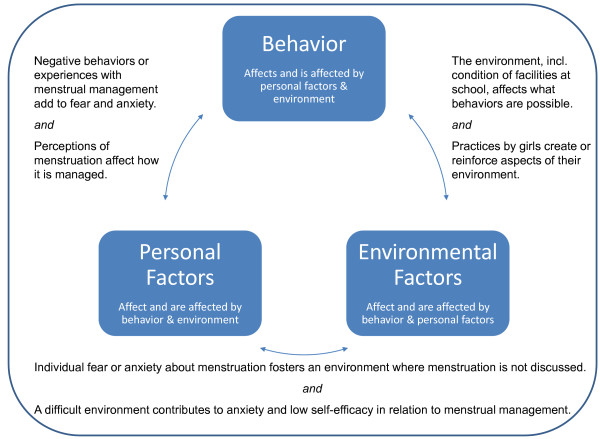
Background: The onset of menstruation is a landmark event in the life of a young woman. Yet the complications and challenges that can accompany such an event have been understudied, specifically in resource-poor settings. As interventions aim to improve female attendance in schools, it is important to explore how menstruation is perceived and navigated by girls in the school setting. This research conveys rural Kenyan schoolgirls' perceptions and practices related to menstruation Methods: Data were collected at six rural schools in the Nyanza Province of Western Kenya. Using focus group discussions, in-depth interviews, and field notes from observations, researchers collected information from 48 primary schoolgirls and nine teachers. Systematic analysis began with a reading of transcripts and debriefing notes, followed by manual coding of the narratives. Results: Focus group discussions became opportunities for girls to share thoughts on menstruation, instruct one another on management practices and advise one another on coping mechanisms. Girls expressed fear, shame, distraction and confusion as feelings associated with menstruation. These feelings are largely linked to a sense of embarrassment, concerns about being stigmatized by fellow students and, as teachers explained, a perception that the onset of menstruation signals the advent of a girl's sexual status. Among the many methods for managing their periods, girls most frequently said they folded, bunched up or sewed cloth, including cloth from shirts or dresses, scraps of old cloth, or strips of an old blanket. Cloth was reported to frequently leak and cause chafing, which made school attendance difficult particularly as the day progressed. Attitudes and practices of girls toward menstruation have been arranged into personal, environmental and behavioural factors. Conclusion: Further research on menstrual management options that are practical, sustainable and culturally acceptable must be conducted to inform future programs and policies that aim to empower young girls as they transition into womanhood. Stakeholders working within this and similar contexts must consider systematic mechanisms to explain to young girls what menstruation is and how to manage it. Providing sanitary supplies or guiding girls on how to create supplies serve as critical components for future interventions.
Overview
The claims and statistics of this paper haven’t been checked yet.
Free: it reads the open-access text and checks the first 5 claims that cite a source we can check. Create a free account to check every claim.
Integrity signals
Registry
Cites
Statistics
Figures
Verification
Claims the paper makes
The claims and statistics of this paper haven’t been checked yet.
Free: it reads the open-access text and checks the first 5 claims that cite a source we can check. Create a free account to check every claim.
Claims other papers make about this one
Each is checked against this paper’s own text: does it say what the citing paper says it does?
The source backs part of the claim, not all of it — or backs it for a different population, condition or comparison.
In the citing paper
“A lack of adequate guidance on menstrual management; water, disposal, and private changing facilities; and sanitary hygiene materials in low- and middle-income countries leaves schoolgirls with limited options for healthy personal hygiene during monthly menses.”
From Menstrual hygiene management among adolescent schoolgirls in low- and middle-income countries: research priorities (2016) · cites this paper as [11]
Experimental — accuracy not yet measuredThe source backs part of the claim, not all of it — or backs it for a different population, condition or comparison.
In the citing paper
“inadequate social support, ongoing gender inequality, and social and hygiene taboos around menstruation in numerous countries leave girls experiencing shame, fear, and confusion when trying to cope with their menstrual flow (9–15, 20, 21).”
From Menstrual hygiene management among adolescent schoolgirls in low- and middle-income countries: research priorities (2016) · cites this paper as [11]
Experimental — accuracy not yet measuredThe source backs part of the claim, not all of it — or backs it for a different population, condition or comparison.
In the citing paper
“Many girls in LMIC cannot afford sanitary pads and resort to impromptu items like old cloth or cotton wool, or use a minimal number of pads, which leak, smell and chafe, causing them stigma, shame and discomfort.3–6”
From Menstrual cups and sanitary pads to reduce school attrition, and sexually transmitted and reproductive tract infections: a cluster randomised controlled feasibility study in rural Western Kenya (2016) · cites this paper as [5]
Experimental — accuracy not yet measuredThe source backs part of the claim, not all of it — or backs it for a different population, condition or comparison.
In the citing paper
“In addition to these structural and resource barriers, women and girls face information and social support challenges: girls are often unprepared, uninformed, misinformed, and lack adequate support for understanding and managing menarche, menstruation, and puberty, resulting in fear, uncertainty, and potentially harmful behaviors, like risky sex, reduced bathing, and limited food and water intake”
From ’It’s like a burden on the head’: Redefining adequate menstrual hygiene management throughout women’s varied life stages in Odisha, India. (2019) · cites this paper as [26]
Experimental — accuracy not yet measured
32 more claims about this paper
Create a free account to see every claim other papers make about this one.
Self-check
Percentages, sums and reported differences re-computed from the paper’s own numbers.
The self-check needs the paper’s full text.
Citations
Cites
Kenya Demographic and Health Survey 1989
Kenya, & Std Control Programme (1989) · Cited by 1,756
Obonyo, J. (2010) · Cited by 732
Menstrual hygiene: How hygienic is the adolescent girl?
Dasgupta, A., & Sarkar, M. (2008) · Indian Journal of Community Medicine · doi:10.4103/0970-0218.40872 · Cited by 592 · cited 1×
“The fact that girls in this study expressed negative feelings such as fear and anxiety is supported by studies conducted in India, Nigeria, Tanzania and Pakistan [4][9][5][19][3][1][11].”
Unsafe sexual behaviour in South African youth
Eaton, L., Flisher, A. J., & Aarø, L. E. (2003) · Social Science & Medicine · doi:10.1016/s0277-9536(02)00017-5 · Cited by 536 · cited 1×
“The inadequate level of information girls conveyed in interviews speaks to the urgent need for girls to receive more guidance on menstruation, which has been previously recommended [ 18 ][1][11].”
The state of the world's children 2011 - adolescence: an age of opportunity.
Anthony, D. (2011) · Cited by 346
Sommer, M. (2010) · Journal of Adolescence · doi:10.1016/j.adolescence.2009.03.008 · Cited by 305 · cited 6×
“The fact that girls in this study expressed negative feelings such as fear and anxiety is supported by studies conducted in India, Nigeria, Tanzania and Pakistan [4][9][5][19][3][1][11].”
InfluentialMenstrual Practices and Reproductive Problems: A Study of Adolescent Girls in Rajasthan
Khanna, A., Goyal, R. S., & Bhawsar, R. (2005) · Journal of Health Management · doi:10.1177/097206340400700103 · Cited by 248
The State of the World's Children, 2004: Girls, Education And Development
Bellamy, C. (2004) · Medical Entomology and Zoology · Cited by 204
Angier, N. (1999) · Virago Press eBooks · Cited by 202
Menstrual knowledge and practices of female adolescents in urban Karachi, Pakistan
Ali, T. S., & Rizvi, S. N. (2010) · Journal of Adolescence · doi:10.1016/j.adolescence.2009.05.013 · Cited by 187
Research works printed but not linked: 8
- Scott L Dopson S Montgomery P Dolan C Ryus C Impact of Providing Sanitary Pads to Poor Girls in Africa 2009 University of Oxford
- Greene L SWASH+ Application of Lessons Learned to Current and Future Practice SWASH+ Programatic Management Group Meeting: 2009 2009; Tom Mboya Labour College, Kisumu Kenya 2009
- Thomas E Publications C Healthy Futures, Reducing Barriers to Primary School Completion for Kenyan Girls Special Publication No 23 2002 Baltimore: Johns Hopkins University, Center for Communication Programs, Population Communication Services; Washington DC: The Academy for Educational Development
- Sommer M Kirk J 'Menstruation is on her mind': Girl-centered, holistic thinking for school sanitation WASH in Schools Notes and News Volume April 2008 IRC and UNICEF 4 6
- Nahar Q Ahmed R Addressing Special Needs of Girls: Challenges in school SACOSAN II 2006 Islamabad, Pakistan
- UNFPA The state of the world's adolescents 2003 New York: UNFPA
- UNICEF UNICEF, Ministry of Rural Development GoI Sharing Simple Facts 2008 http://www.indiasanitationportal.org/sites/default/files/MHM_Book.pdf accessed March 15, 2011
- Sommer M The Puberty (Kubalehe) Book 2010 http://www.growandknow.org/Grow_and_Know/Puberty_(kubalehe)_book.pdf accessed December 2, 2010
Cited by
Items 301–316 of 316
Shah, V., Phillips‐Howard, P. A., Hennegan, J. M., Cavill, S., Sonko, B. J., Sinjanka, E., Trawally, N. C., Kanteh, A., Mendy, F., Bah, A. B., et al. (2022) · Figshare · doi:10.6084/m9.figshare.20329861
Sarı, S. G., & Uğur, H. G. (2025) · Women & Health · doi:10.1080/03630242.2026.2628760
Conteh, D. N., Musa, A. O., Issa, B. O., Aruwa, H. U., Fatuade, O. O., & Uthman, M. M. B. (2026) · Discover Public Health · doi:10.1186/s12982-026-01623-9 · Cited by 1
Okello, E. S., Sedekia, Y., Matungwa, D. J., Torondel, B., Greco, G., Rubli, J., Ayieko, P., Mcharo, O., Luwayi, J. R., Hunsaker, B., et al. (2026) · Evaluation Review · doi:10.1177/0193841x261422289
“This demonstrates that an appropriate educational approach allowing adolescents to feel empowered has the potential to improve practices (McMahon et al., 2011).”
Göl, İ., Şenol, D. K., Açıkgöz, S., & Deniz, A. Ö. (2026) · Women & Health · doi:10.1080/03630242.2026.2659039
“…that poor educational attainment among girls is associated with reduced lifelong economic opportunities and has broader negative implications for public health, sexual and reproductive health outcomes, self-esteem, and perceived autonomy (Mason et al. 2013; McMahon et al. 2011; Tull 2019).”
Chatterjee, J. (2026) · Social enterprise journal · doi:10.1108/sej-05-2025-0103 · Cited by 1
Frimpong, J. A., Codjoe, S. N. A., Abu, M., Ayisi-Addo, A. K., & Bayari, E. E. (2026) · Discover Education · doi:10.1007/s44217-026-01733-1
“…and girls’ attendance, particularly in relation to MHM. Research from sub-Saharan Africa and South Asia consistently report that the absence of clean, private, and functional toilets, water, and hygiene facilities constrains girls’ ability to attend school during menstruation [19, 21, 24].”
Rafee, M., Kushwaha, S., Dolma, T., Tsomo, J., Banoo, J., Khenrab, S., & Lanzes, T. (2026) · Research Square · doi:10.21203/rs.3.rs-10175427/v1
An invisible crisis in women’s health: A qualitative study of midwives’ views on period poverty
Bıdık, N. Ü., & Akarçay, S. (2026) · Health Care For Women International · doi:10.1080/07399332.2026.2704546
“…it was revealed that alternatives to hygienic menstrual products leaked menstrual blood and caused irritation, leading girls to experience fear, shame, distraction, confusion, and feelings of powerlessness; this situation also made it difficult for them to attend school (McMahon et al., 2011).”
Hallad, J. S., Chokhandre, P. K., Pundappanavar, B. I., & Vatavati, S. R. (2026) · Global Social Welfare · doi:10.1007/s40609-026-00473-2
Rezvi, M. R., Rumman, M. H., Mehejabin, F., Maesha, Z. F., & Mizan, C. M. (2026) · Women s Reproductive Health · doi:10.1080/23293691.2026.2709023
Akinreni, T., Buitrago-García, T., Sawadogo, N., Souares, A., Reñosa, M. D. C., Scott, K., Sié, A., Langlotz, S., Bärnighausen, T., & McMahon, S. A. (2026) · PLOS Global Public Health · doi:10.1371/journal.pgph.0006804
Self-citationUnderstanding menstrual hygiene knowledge among women: a case study from Koch Bihar district, India
Das, T. K., & Karjee, S. (2026) · SN Social Sciences · doi:10.1007/s43545-026-01746-5
“A qualitative study in rural Kenya found that girls commonly experienced fear, confusion, distraction, and shame during menstruation (McMahon et al. 2011).”
Odingo, C. C. A., & Nyaga, D. M. (2026) · Springer eBooks · doi:10.1007/978-3-032-20102-7_8
Ansell, E., Saleh, I., Zulaika, G., Obor, D., van Eijk, A. M., Oruko, K., Oketch, S. Y., Phillips‐Howard, P. A., & Mason, L. (2026) · Frontiers in Reproductive Health · doi:10.3389/frph.2026.1931799
“Similarly, they report that girls feel embarrassed, ashamed, and stressed as a consequence (11, 16, 26, 29, 30).”
Metadata
- Authors
- McMahon, S. A., Winch, P. J., Caruso, B. A., Obure, A. F., Ogutu, E. A., Ochari, I. A., & Rheingans, R. D.
- Affiliations
- Johns Hopkins University (US)
- Emory University (US)
- Great Lakes University of Kisumu (KE)
- University of Florida (US)
- Corresponding author
- Caruso, Bethany A
- Venue
- BMC International Health and Human Rights
- Published
- 2011-06-16
- Volume
- 11
- Issue
- 1
- Pages
- 7-7
- ISSN
- 1472-698X (ISSN-L)
- PMC
- PMC3129305
- OpenAlex
- W2112927998
- Semantic Scholar
- 2d287821305a52108afd1aef6903690c2b4209d6
- Cited by
- 316
- References
- 18
- Citations by year
- 2026: 16 · 2025: 25 · 2024: 20 · 2023: 23 · 2022: 37 · 2021: 31 · 2020: 31 · 2019: 25 · 2018: 24 · 2017: 23 · 2016: 16 · 2015: 17 · 2014: 14 · 2013: 9 · 2012: 5
- FWCI
- 8.81
- Type
- journal article
- Language
- en
- Open access
- gold
- doi.org
- Licence
- Locations
- BMC International Health and Human Rights (publishedVersion, cc-by)
- PubMed Central (publishedVersion, cc-by)
- PubMed (publishedVersion)
- NC Digital Online Collection of Knowledge and Scholarship (The University of North Carolina at Greensboro) (submittedVersion)
- DOAJ (DOAJ: Directory of Open Access Journals) (submittedVersion, cc-by-sa)
- Figshare (submittedVersion)
- Appalachian State University
- Funders
- Bill and Melinda Gates Foundation
- Emory University
- Topics
- Health Sciences › Medicine › Public Health, Environmental and Occupational Health › Menstrual Health and Disorders
- Health Sciences › Medicine › Public Health, Environmental and Occupational Health › Adolescent Sexual and Reproductive Health
- Health Sciences › Medicine › Reproductive Medicine › Hypothalamic control of reproductive hormones
- Keywords
- menstrual management, female students, rural Kenya, school attendance, stigma, shame, girls' perceptions, coping strategies, women's empowerment, transition to womanhood
About these checks
Registry, retraction, Cites and statistics results are computed, not judged, with one exception: a printed reference that no index lists is read once by a model before it counts as a citation error. Claims are extracted by a model and kept only when their quote appears verbatim in the text; each cited source is then checked, with a model’s help, for whether it says what the claim relies on. Those verdicts can be wrong — read the claim’s quote and the cited source before relying on one.
Statistics and arithmetic are recomputed, not judged.
Confidence bands are shown only for fields calibrated on our annotated test set. None is calibrated yet, so no band is shown.
What counts as a claim ›How we measure confidence ›How we check this ›
Are you an author, or do you see a problem with this page? Request a review
Data sources
Bibliographic data: Semantic Scholar, OpenAlex, Crossref.
Contains information from the Semantic Scholar Academic Graph Datasets, made available under the ODC Attribution License (ODC-BY 1.0).
Semantic Scholar’s data is described in: Kinney, R., et al. (2023). The Semantic Scholar Open Data Platform. arXiv:2301.10140.
