

Effects of icosapent ethyl on lipid and inflammatory parameters in patients with diabetes mellitus-2, residual elevated triglycerides (200–500 mg/dL), and on statin therapy at LDL-C goal: the ANCHOR study
Open accessThe DOI matches its Crossref record; 44 of the 45 references it cites were found in a registry or an index.
Abstract
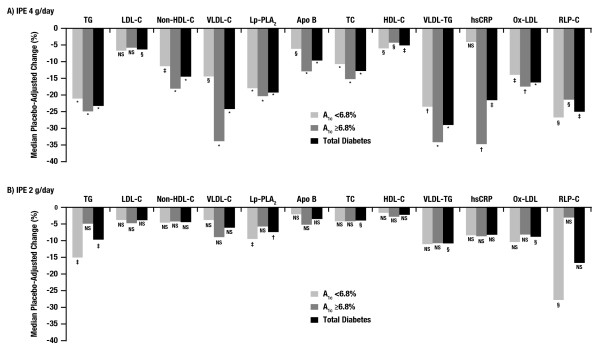
BACKGROUND: Icosapent ethyl (IPE) is a high-purity prescription form of eicosapentaenoic acid (EPA) ethyl ester indicated as an adjunct to diet to reduce triglyceride (TG) levels in adult patients with severe (≥500 mg/dL) hypertriglyceridemia. ANCHOR was a 12-week, phase 3 study that evaluated the efficacy and safety of IPE in patients (N = 702) with residual high fasting TG levels (≥200 and <500 mg/dL) despite having optimized low-density lipoprotein cholesterol (LDL-C) levels (≥40 and <100 mg/dL) on statin therapy. Among patients randomized to IPE (4 g/day or 2 g/day) or placebo, 514 (73%) had diabetes mellitus. METHODS: A post hoc subgroup analysis of the ANCHOR study was conducted to assess the effects of IPE on median placebo-adjusted percent change from baseline in efficacy end point parameters in 3 subgroups: total (all subjects with diabetes-overall median baseline glycosylated hemoglobin A₁c [A₁c] = 6.8%), better-controlled diabetes (below median baseline A1c), and less-controlled diabetes (above median baseline A1c). RESULTS: Baseline efficacy parameters were similar among all groups except high-sensitivity C-reactive protein (hsCRP), which was higher in the total and less-controlled diabetes groups. Compared with placebo, IPE 4 g/day significantly reduced TG, non-high-density lipoprotein cholesterol, very-low-density lipoprotein cholesterol (VLDL-C), lipoprotein-associated phospholipase A2, apolipoprotein B (Apo B), total cholesterol, high-density lipoprotein cholesterol, VLDL-TG, oxidized LDL, and remnant-like particle cholesterol in all 3 diabetes groups, LDL-C in the total diabetes group, and hsCRP in the total and less-controlled diabetes groups. Decreases in hsCRP and Apo B were much greater in patients with less-controlled diabetes. There were no significant increases in fasting plasma glucose, A1c, insulin, or homeostasis model assessment-estimated insulin resistance in any group. CONCLUSION: IPE 4 g/day significantly improved lipid and lipid-related parameters without worsening glycemic control in patients with diabetes and mixed dyslipidemia, with possibly greater effects among those with less-controlled diabetes. TRIAL REGISTRATION: Clinicaltrials.gov Identifier NCT01047501.
Overview
The claims and statistics of this paper haven’t been checked yet.
Free: it reads the open-access text and checks the first 5 claims that cite a source we can check. Create a free account to check every claim.
Integrity signals
Registry
Cites
Statistics
Figures
Verification
Claims the paper makes
The claims and statistics of this paper haven’t been checked yet.
Free: it reads the open-access text and checks the first 5 claims that cite a source we can check. Create a free account to check every claim.
Self-check
Percentages, sums and reported differences re-computed from the paper’s own numbers.
The self-check needs the paper’s full text.
Citations
Cites
Matthews, D. R., Hosker, J. P., Rudenski, A. S., Naylor, B. A., Treacher, D. F., & Turner, R. C. (1985) · Diabetologia · doi:10.1007/bf00280883 · Cited by 31,502
Detection, evaluation, and treatment of high blood cholesterol in adults (Adult Treatment Panel III)
Grundy, S. M., Becker, D. M., Clark, L. T., Cooper, R., Denke, M. A., Howard, J. L., Hunninghake, D. B., Illingworth, D. R., Luepker, R. V., McBride, P. E., et al. (2002) · Civil War Book Review · Cited by 12,198
Niacin in Patients with Low HDL Cholesterol Levels Receiving Intensive Statin Therapy
The AIM-HIGH Investigators (2011) · New England Journal of Medicine · doi:10.1056/nejmoa1107579 · Cited by 2,911
Collaborators, C. T. T. (. (2008) · The Lancet · doi:10.1016/s0140-6736(08)60104-x · Cited by 2,081
(1999) · PubMed · Cited by 2,062
Triglycerides and Cardiovascular Disease: A Scientific Statement From the American Heart Association
Miller, M., Stone, N. J., Ballantyne, C., Bittner, V., Criqui, M. H., Ginsberg, H. N., Goldberg, A. C., Howard, W. J., Jacobson, M. S., Kris-Etherton, P. M., et al. (2011) · Circulation · doi:10.1161/cir.0b013e3182160726 · Cited by 1,871
Self-citationBantle (2008) · doi:10.2337/dc08-s061 · Cited by 1,795
Marchioli, R., Barzi, F., Bomba, E., Chieffo, C., Di Gregorio, D., Di Mascio, R., Franzosi, M. G., Geraci, E., Levantesi, G., Maggioni, A. P., et al. (2002) · Circulation · doi:10.1161/01.cir.0000014682.14181.f2 · Cited by 1,311
Warnick, G. R., & Albers, J. J. (1978) · Journal of Lipid Research · doi:10.1016/s0022-2275(20)41577-9 · Cited by 1,250
Research works printed but not linked: 2
- Manual of Laboratory Operations: LRC Program, Vol. 1: Lipid and Lipoprotein Analysis. DHEW Publication No. (NIH) 75-628. May 1974. Department of Health, Education, and Welfare: Washington, DC; 1982.
- McPherson R: Remnant cholesterol: "Non-(HDL-C + LDL-C)" as a coronary artery disease risk factor. J Am Coll Cardiol 2013, 61:437-439.
Cited by
Skulas-Ray, A. C., Wilson, P. W. F., Harris, W. S., Brinton, E. A., Kris-Etherton, P. M., Richter, C. K., Jacobson, T. A., Engler, M. B., Miller, M., Robinson, J. G., et al. (2019) · Circulation · doi:10.1161/cir.0000000000000709 · Cited by 512
Self-citationHypertriglyceridemia: a too long unfairly neglected major cardiovascular risk factor
Tenenbaum, A., Klempfner, R., & Fisman, E. Z. (2014) · Cardiovascular Diabetology · doi:10.1186/preaccept-2085133501150912 · Cited by 186
Sakai, C., Ishida, M., Ohba, H., Yamashita, H., Uchida, H., Yoshizumi, M., & Ishida, T. (2017) · PLOS ONE · doi:10.1371/journal.pone.0187934 · Cited by 179
Borow, K. M., Nelson, J. R., & Mason, R. P. (2015) · Atherosclerosis · doi:10.1016/j.atherosclerosis.2015.07.035 · Cited by 175
Preston Mason, R. (2019) · Current Atherosclerosis Reports · doi:10.1007/s11883-019-0762-1 · Cited by 129
Role of EPA in Inflammation: Mechanisms, Effects, and Clinical Relevance
Crupi, R., & Cuzzocrea, S. (2022) · Biomolecules · doi:10.3390/biom12020242 · Cited by 108
Cholesterol Remnants, Triglyceride-Rich Lipoproteins and Cardiovascular Risk
Baratta, F., Cocomello, N., Coronati, M., Ferro, D., Pastori, D., Angelico, F., & Ben, M. D. (2023) · International Journal of Molecular Sciences · doi:10.3390/ijms24054268 · Cited by 95
Detopoulou, P., Demopoulos, C. A., & Antonopoulou, S. (2021) · Nutrients · doi:10.3390/nu13020462 · Cited by 85
Prescription omega-3 fatty acid products containing highly purified eicosapentaenoic acid (EPA)
Brinton, E. A., & Mason, R. P. (2017) · Lipids in Health and Disease · doi:10.1186/s12944-017-0415-8 · Cited by 83
Self-citationLin, N., Shi, J., Li, Y., Zhang, X., Chen, Y., Calder, P. C., & Tang, L. (2016) · Lipids in Health and Disease · doi:10.1186/s12944-016-0303-7 · Cited by 79
Asztalos, I. B., Gleason, J. A., Sever, S., Gedik, R., Asztalos, B. F., Horvath, K. V., Dansinger, M. L., Lamon‐Fava, S., & Schaefer, E. J. (2016) · Metabolism · doi:10.1016/j.metabol.2016.07.010 · Cited by 79
Mason, R. P., Sherratt, S. C. R., & Jacob, R. F. (2016) · Journal of Cardiovascular Pharmacology · doi:10.1097/fjc.0000000000000379 · Cited by 72
Current and future trends in the lipid lowering therapy
Okopień, B., Bułdak, Ł., & Bołdys, A. (2016) · Pharmacological Reports · doi:10.1016/j.pharep.2016.03.016 · Cited by 72
Iqbal, Z., Ho, J. H., Adam, S., France, M. W., Syed, A. A., Neely, D., Rees, A., Khatib, R., Cegla, J., Byrne, C. D., et al. (2020) · Atherosclerosis · doi:10.1016/j.atherosclerosis.2020.09.008 · Cited by 66
Abbott, K. A., Burrows, T. L., Thota, R. N., Acharya, S., & Garg, M. L. (2016) · American Journal of Clinical Nutrition · doi:10.3945/ajcn.116.138172 · Cited by 61
Dietary and Pharmacological Fatty Acids and Cardiovascular Health
Wu, H., Xu, L., & Ballantyne, C. M. (2020) · The Journal of Clinical Endocrinology & Metabolism · doi:10.1210/clinem/dgz174 · Cited by 59
Self-citationSheikh, O., Hei, A. V., Battisha, A., Hammad, T., Pham, S. V., & CHILTON, R. J. (2019) · Cardiovascular Diabetology · doi:10.1186/s12933-019-0887-0 · Cited by 60
Remnant cholesterol and ischemic heart disease
Varbo, A., & Nordestgaard, B. G. (2014) · Current Opinion in Lipidology · doi:10.1097/mol.0000000000000093 · Cited by 55
Ballantyne, C. M., Bays, H. E., Philip, S., Doyle, R. T., Braeckman, R. A., Stirtan, W. G., Soni, P. N., & Juliano, R. A. (2016) · Atherosclerosis · doi:10.1016/j.atherosclerosis.2016.08.005 · Cited by 52
Self-citationMiller, M. J., Ballantyne, C. M., Bays, H. E., Granowitz, C. B., Doyle, R. T., Juliano, R. A., & Philip, S. (2019) · The American Journal of Cardiology · doi:10.1016/j.amjcard.2019.05.057 · Cited by 52
Self-citationLi, J., Li, X., Gathirua‐Mwangi, W. G., & Song, Y. (2020) · BMJ Open Diabetes Research & Care · doi:10.1136/bmjdrc-2019-000925 · Cited by 42
History and future of omega-3 fatty acids in cardiovascular disease
Sperling, L. S., & Nelson, J. R. (2016) · Current Medical Research and Opinion · doi:10.1185/03007995.2015.1120190 · Cited by 34
Remnant cholesterol in atherosclerotic cardiovascular disease: A systematic review and meta-analysis
Delialis, D., Georgiopoulos, G. A., Aivalioti, E., Konstantaki, C., Oikonomou, E., Bampatsias, D., Mavraganis, G., Vardavas, C. I., Liberopoulos, E. N., Stellos, K., et al. (2023) · Hellenic Journal of Cardiology · doi:10.1016/j.hjc.2023.04.007 · Cited by 33
Lomitapide for the treatment of hypertriglyceridemia
Berberich, A. J., & Hegele, R. A. (2016) · Expert Opinion on Investigational Drugs · doi:10.1080/13543784.2016.1254187 · Cited by 31
Pal, A., Sun, S., Armstrong, M., Manke, J., Reisdorph, N., Adams, V. R., Kennedy, A. J., Zu, Y., Moustaïd‐Moussa, N., Carroll, I. M., et al. (2021) · Biochimica et Biophysica Acta (BBA) - Molecular and Cell Biology of Lipids · doi:10.1016/j.bbalip.2021.159059 · Cited by 28
Miller, M. J., Tokgözoğlu, L. S., Parhofer, K. G., Handelsman, Y., Leiter, L. A., Landmesser, U., Brinton, E. A., & Catapano, A. L. (2022) · Expert Review of Cardiovascular Therapy · doi:10.1080/14779072.2022.2103541 · Cited by 26
Self-citationAggarwal, R., Bhatt, D. L., Steg, P. G., Miller, M. J., Brinton, E. A., Dunbar, R. L., Ketchum, S. B., Tardif, J., Martens, F. M. A. C., Ballantyne, C. M., et al. (2025) · Journal of the American Heart Association · doi:10.1161/jaha.124.038656 · Cited by 23
Self-citationPrescription omega-3 fatty acid products: Considerations for patients with diabetes mellitus
Avallone, L., Shaikh, A., Hassan, A., & Tajuddin, N. (2016) · Diabetes, Metabolic Syndrome and Obesity: Targets and Therapy · doi:10.2147/dmso.s97036 · Cited by 22
Marine‐derived n‐3 fatty acids therapy for stroke
Campano, C. G. A., Macleod, M., Thies, F., Aucott, L., & Macleod, M. (2017) · Cochrane Database of Systematic Reviews · doi:10.1002/14651858.cd012815
Hassan, A., Tajuddin, N. N., & Shaikh, A. (2014) · Cardiology and Therapy · doi:10.1007/s40119-014-0032-9 · Cited by 21
Trivedi, K., Le, V. T., & Nelson, J. R. (2020) · Postgraduate Medicine · doi:10.1080/00325481.2020.1783937 · Cited by 21
Mosca, L. J., Ballantyne, C. M., Bays, H. E., Guyton, J. R., Philip, S., Doyle, R. T., & Juliano, R. A. (2016) · The American Journal of Cardiology · doi:10.1016/j.amjcard.2016.10.027 · Cited by 17
Self-citationNozue, T., Yamamoto, S., Tohyama, S., Fukui, K., Umezawa, S., Onishi, Y., Kunishima, T., Sato, A., Nozato, T., Miyake, S., et al. (2014) · Cardiovascular Diabetology · doi:10.1186/1475-2840-13-13 · Cited by 17
Baum, S. J., & Scholz, K. P. (2019) · Clinical Cardiology · doi:10.1002/clc.23220 · Cited by 16
Icosapent Ethyl – A Successful Treatment for Symptomatic COVID-19 Infection
Berger, A. A., Sherburne, R., Urits, I., Patel, H., & Eskander, J. P. (2020) · Cureus · doi:10.7759/cureus.10211 · Cited by 16
Khandouzi, N., Zahedmehr, A., & Nasrollahzadeh, J. (2020) · Lipids in Health and Disease · doi:10.1186/s12944-020-01362-z · Cited by 16
Triglyceride Treatment in the Age of Cholesterol Reduction
Agrawal, N., Corradi, P. F., Gumaste, N., & Goldberg, I. J. (2016) · Progress in Cardiovascular Diseases · doi:10.1016/j.pcad.2016.08.003 · Cited by 15
Potential Mechanisms by Which Hydroxyeicosapentaenoic Acids Regulate Glucose Homeostasis in Obesity
Shaikh, S. R., Virk, R., & Dyke, T. E. V. (2022) · Advances in Nutrition · doi:10.1093/advances/nmac073 · Cited by 15
Spotlight on Icosapent Ethyl for Cardiovascular Risk Reduction: Evidence to Date
Jia, X., Koh, S., Al Rifai, M., Blumenthal, R. S., & Virani, S. S. (2020) · Vascular Health and Risk Management · doi:10.2147/vhrm.s210149 · Cited by 14
KEECH, A. C., & Jenkins, A. J. (2017) · Current Opinion in Lipidology · doi:10.1097/mol.0000000000000465 · Cited by 14
Brinton, E. A., Ballantyne, C. M., Guyton, J. R., Philip, S., Doyle, R. T., Juliano, R. A., & Mosca, L. (2018) · Journal of Women's Health · doi:10.1089/jwh.2017.6757 · Cited by 13
Self-citationAmbrosy, A. P., Malik, U. I., Thomas, R. C., Parikh, R., Tan, T. C., Goh, C. H., Selby, V. N., Solomon, M. D., Avula, H. R., Fitzpatrick, J. K., et al. (2021) · American Heart Journal · doi:10.1016/j.ahj.2021.01.018 · Cited by 13
Marine-derived n-3 fatty acids therapy for stroke.
Campano, C. G. A., Macleod, M., Aucott, L., & Thies, F. (2019) · Cochrane Database of Systematic Reviews · doi:10.1002/14651858.cd012815.pub2 · Cited by 16
Vijayaraghavan, K., Szerlip, H. M., Ballantyne, C. M., Bays, H. E., Philip, S., Doyle, R. T., Juliano, R. A., & Granowitz, C. B. (2019) · Postgraduate Medicine · doi:10.1080/00325481.2019.1643633 · Cited by 12
Self-citationBraeckman, R. A., Stirtan, W. G., & Soni, P. N. (2014) · Clinical Pharmacology in Drug Development · doi:10.1002/cpdd.150 · Cited by 11
Self-citationBramlage, P., Lanzinger, S., Rathmann, W., Gillessen, A., Scheper, N., Schmid, S. M., Kaltheuner, M., Seufert, J., Danne, T., & Holl, R. W. (2016) · Diabetes Obesity and Metabolism · doi:10.1111/dom.12783 · Cited by 11
RSSDI consensus recommendations for dyslipidemia management in diabetes mellitus
Saboo, B., Agarwal, S., Makkar, B. M., Chawla, R., Ghosh, S. K., Viswanathan, V., Gupta, S., Kumar, C. V., Maheshwari, A., Sreenivasamurthy, L., et al. (2022) · International Journal of Diabetes in Developing Countries · doi:10.1007/s13410-022-01063-6 · Cited by 11
Crandell, J. R., Tartaglia, C., & Tartaglia, J. (2016) · Postgraduate Medicine · doi:10.1080/00325481.2016.1241129 · Cited by 10
Marine-derived n-3 fatty acids therapy for stroke.
Campano, C. G. A., Macleod, M., Aucott, L., & Thies, F. (2022) · Cochrane Database of Systematic Reviews · doi:10.1002/14651858.cd012815.pub3 · Cited by 2
Three Cases of COVID-19 Pneumonia That Responded to Icosapent Ethyl Supportive Treatment
Suh, W., Urits, I., Viswanath, O., Kaye, A. D., Patel, H., Hall, W., & Eskander, J. P. (2020) · American Journal of Case Reports · doi:10.12659/ajcr.928422 · Cited by 8
Abbas, N. A. T., El-Sayed, S. S., El-Fatah, S. S. A., Sarhan, W. M., Abdelghany, E. M. A., Sarhan, O. M., & Mahmoud, S. S. (2023) · Naunyn-Schmiedeberg s Archives of Pharmacology · doi:10.1007/s00210-023-02577-4 · Cited by 8
Perspectives on a new prescription omega-3 fatty acid, icosapent ethyl, for hypertriglyceridemia
Jacobson, T. A. (2014) · Clinical Lipidology · doi:10.2217/clp.14.10 · Cited by 6
Khan, M. S., Ishaq, M., Ayub, M. T., Rehman, A. U., Hayes, J. J., Mortada, M. E., & Biederman, R. W. (2021) · Journal of Lipids · doi:10.1155/2021/6696915 · Cited by 5
Icosapent Ethyl (Vascepa®) for the Treatment of Acute, Severe Pancreatitis
Berger, A. A., Sherburne, R., Urits, I., Patel, H., & Eskander, J. P. (2020) · Cureus · doi:10.7759/cureus.11551 · Cited by 5
Kłosiewicz−Latoszek, L., Cybulska, B., & Tyszko, P. Z. (2020) · Annals of Agricultural and Environmental Medicine · doi:10.26444/aaem/126674 · Cited by 4
Fan, W., Philip, S., Toth, P. P., Granowitz, C. B., & Wong, N. D. (2020) · American Journal of Preventive Cardiology · doi:10.1016/j.ajpc.2020.100087 · Cited by 4
Simental-Mendía, L. E., Simental-Mendía, M. A., Barragán‐Zuñiga, L. J., & Aguillón-Marín, P. (2025) · Journal of clinical lipidology · doi:10.1016/j.jacl.2025.12.013 · Cited by 4
Agrawal, P. (2022) · Journal of Gastroenterology Research · doi:10.36959/621/629 · Cited by 2
Cardiovascular Pharmacotherapy and Glucose Metabolism: The Good, the Bad and the Unsightly
Bianchettin, R. G., Poirier, P., López-Jiménez, F. A., Lavie, C. J., & Piché, M. (2025) · American Journal of Cardiovascular Drugs · doi:10.1007/s40256-025-00777-2 · Cited by 1
Liakos, C. I., Lanaras, L., Bristianou, M., & Papadopoulos, D. P. (2024) · Lipids · doi:10.1002/lipd.12391 · Cited by 1
Ganda, O. P., Busch, R. S., Nelson, J. R., & Philip, S. (2023) · Contemporary diabetes · doi:10.1007/978-3-031-26681-2_25 · Cited by 1
DePace, N. L., & Colombo, J. (2019) · Springer eBooks · doi:10.1007/978-3-030-17016-5_6 · Cited by 1
DePace, N. L., & Colombo, J. (2019) · Springer eBooks · doi:10.1007/978-3-030-17016-5_3 · Cited by 1
Icosapent ethyl in hypertriglyceridaemia: a guide to its use
Lyseng-Williamson, K. A., McCormack, P. L., & Kim, E. (2016) · Drugs & Therapy Perspectives · doi:10.1007/s40267-016-0278-5
Yang, Y., Wang, J., Zhang, J., Zhang, D., Ma, M., Wang, C., & Lin, X. (2026) · European journal of medical research · doi:10.1186/s40001-026-04211-4
Domenecha, M., Estruch, R., Moreno, R., & Sánchez, M. A. (2017) · Revista Española de Cardiología Suplementos · doi:10.1016/s1131-3587(19)30012-3
Simental‐Mendía, L. E., Simental-Mendía, M. A., Barragán‐Zuñiga, L. J., & Aguillón-Marín, P. (2026) · Journal of clinical lipidology · doi:10.1016/j.jacl.2026.01.019
Rijjal, D. A. (2022) · TSpace (University of Toronto)
Eskander, J. P., Peregrim, S., Ryan, L. Y., Syed, Z., Urits, I., Viswanath, O., & Kaye, A. D. (2022) · Journal of Clinical Images & Reports · doi:10.47363/jcir/2022(1)106
Cruess, S. M., Callahan, J. X., Raso, I., Valencia, B., & Eskander, J. P. (2023) · Journal of Complementary and Integrative Medicine · doi:10.1515/jcim-2023-0129
Metadata
- Authors
- Brinton, E. A., Ballantyne, C. M., Bays, H. E., Kastelein, J. J., Braeckman, R. A., & Soni, P. N.
- Affiliations
- Foundation for Biomedical Research (US)
- Baylor College of Medicine (US)
- Louisville Metabolic and Atherosclerosis Research Center (US)
- Amsterdam UMC Location University of Amsterdam (NL)
- Amarin (United States) (US)
- Corresponding author
- Brinton, Eliot A
- Venue
- Cardiovascular Diabetology
- Published
- 2013
- Volume
- 12
- Issue
- 1
- Pages
- 100
- ISSN
- 1475-2840 (ISSN-L)
- PMC
- PMC3718763
- OpenAlex
- W2134172530
- Cited by
- 70
- References
- 45
- Citations by year
- 2026: 2 · 2025: 4 · 2024: 1 · 2023: 5 · 2022: 7 · 2021: 4 · 2020: 10 · 2019: 10 · 2018: 1 · 2017: 5 · 2016: 13 · 2015: 2 · 2014: 6
- FWCI
- 6.48
- Type
- journal article
- Language
- en
- Open access
- gold
- doi.org
- Licence
- cc-by
- Locations
- Cardiovascular Diabetology (publishedVersion, cc-by)
- Europe PMC (PubMed Central) (publishedVersion, cc-by)
- PubMed Central (publishedVersion, cc-by)
- PubMed (publishedVersion)
- Data Archiving and Networked Services (DANS) (submittedVersion)
- Pure Amsterdam UMC (submittedVersion)
- Funders
- American Heart Association
- Amgen
- Bristol-Myers Squibb
- Pfizer
- AstraZeneca
- GlaxoSmithKline
- Sanofi
- Cargill
- Gilead Sciences
- Amarin Corporation
- Kowa Company
- Daiichi-Sankyo
- Eisai
- Novo Nordisk
- Shionogi
- Esperion Therapeutics
- National Institutes of Health
- Genentech
- Amarin Pharma
- Daiichi Sankyo Europe
- Topics
- Health Sciences › Nursing › Nutrition and Dietetics › Fatty Acid Research and Health
- Health Sciences › Medicine › Cardiology and Cardiovascular Medicine › Lipoproteins and Cardiovascular Health
- Health Sciences › Medicine › Cardiology and Cardiovascular Medicine › Lipid metabolism and disorders
- Keywords
- icosapent ethyl, eicosapentaenoic acid, hypertriglyceridemia, type 2 diabetes, statin therapy, LDL cholesterol, triglycerides, high-sensitivity C-reactive protein, apolipoprotein B, lipoprotein-associated phospholipase A2, remnant-like particle cholesterol, oxidized LDL, glycemic control
- MeSH terms
- Hypolipidemic Agents, Diabetes Mellitus, Type 2, Double-Blind Method, Glycated Hemoglobin, Humans, Hypoglycemic Agents, Cholesterol, LDL, Time Factors, Triglycerides, Eicosapentaenoic Acid, Biomarkers, Treatment Outcome, Inflammation Mediators, Hydroxymethylglutaryl-CoA Reductase Inhibitors, Dyslipidemias
About these checks
Registry, retraction, Cites and statistics results are computed, not judged, with one exception: a printed reference that no index lists is read once by a model before it counts as a citation error. Claims are extracted by a model and kept only when their quote appears verbatim in the text; each cited source is then checked, with a model’s help, for whether it says what the claim relies on. Those verdicts can be wrong — read the claim’s quote and the cited source before relying on one.
Statistics and arithmetic are recomputed, not judged.
Confidence bands are shown only for fields calibrated on our annotated test set. None is calibrated yet, so no band is shown.
What counts as a claim ›How we measure confidence ›How we check this ›
Are you an author, or do you see a problem with this page? Request a review
Data sources
Bibliographic data: Semantic Scholar, OpenAlex, Crossref.
Contains information from the Semantic Scholar Academic Graph Datasets, made available under the ODC Attribution License (ODC-BY 1.0).
Semantic Scholar’s data is described in: Kinney, R., et al. (2023). The Semantic Scholar Open Data Platform. arXiv:2301.10140.
